THE VISUAL PATTERN OF INTEGRATED SPACES FOR CHOW KIT AIDS/HIV COMMUNITY
CHIONG HOE SIENG
THE VISUAL PATTERN OF INTEGRATED SPACES FOR CHOW KIT AIDS/HIV COMMUNITY
CHIONG HOE SIENG
A dissertation submitted in partial fulfilment of the requirements for the award of the degree of
Master of Architecture
Faculty of Built Environment Universiti Teknologi Malaysia
ACKNOWLEDGEMENTS
Completing this dissertation has brought me so far in which many whom have shown me their love and supports. I would like to express my gratitude and extend my appreciation to all those who gave me the possibility and supports to complete this dissertation.
First and foremost, I would like to whole-heartedly thank my first dissertation supervisor, Dr Sharifah Salwa Syed Mahdzar for showing such great generosity and endless guidance throughout the semesters, in both design thesis and dissertation writings. I am really thankful for her modesty and patience in guiding and sharing her knowledge as well as her class on Space Syntax technique which further exposing me in the world of urban designing and not mere sole architecture.
I would also like to express my sincere appreciation to my second dissertation supervisor, Assoc. Prof. Dr. Syed Ahmad Iskandar Syed Arrifin for contributing the time and patience in reading the drafts and offering valuable feedbacks despite his tight schedule. I am deeply indebted to both of them for their supervisions, guidance, supports and advises that were truly helped the progression and smoothness of this dissertation.
My sincere appreciation also extends to all the respondents who participated in the questionnaire as well as the interviews session made. Thank you so much for your time and feedbacks. Similarly grateful to all my peers who assist at various occasions when I needed them.
ABSTRACT
ABSTRAK
TABLE OF CONTENTS
CHAPTER TITLE PAGE
DECLARATION v
DEDICATION vi
1
ABSTRACT viii
ABSTRAK ix
TABLE OF CONTENTS x
LIST OF TABLES xiv
LIST OF FIGURES xvi
LIST OF APPENDICES xx
INTRODUCTION 1
1.1 Introduction 1
1.2 Problem Statement 2
1.3 Research Aim 3
1.4 Research Objectives 3
1.5 Research Questions 4
1.6 Research Methodology 4
1.7 Research Scope 6
1.8 Significance of Research 7
1.9 Expected Findings 7
1.10 Structure of Dissertation 8
1.11 Summary 9
LITERATURE REVIEW 10
2.1 Introduction 10
2.2 Community of AIDS/HIV carriers in Chow Kit 11 2.2.1 Background of Chow Kit, Kuala Lumpur 11
2.2.2 Key populations of the risk communities 12
2.2.3 Social behaviours of the risk communities 14
2.3 Community Engagement on Social Aspects 18
2.3.1 Symbolic interaction theory 20
2.3.2 Shared environment on visibility 21
2.4 Community Engagement on Urban Aspects 23
2.4.1 Community attachment 24
2.4.2 Place attachment and placemaking 25
2.4.3 Civil buildings and their public spaces 26
2.5 Space Syntax in Relation to Spatial Configuration and Visual Pattern 27
2.5.1 Space Syntax analysis technique 27
2.5.2 Efficiency of spaces 27
2.5.3 Visibility graph analysis on layouts 28
2.6 Summary 29
METHODOLOGY 30
3.1 Introduction 30
3.2 Scope of Research 30
3.3 Research Design 31
3.4 Research Procedure 33
3.5 Primary Data : Data Collection for Analysis Research
Procedure 33
3.5.1 Data collection procedure 33
3.5.2 On-site visits 34
3.5.3 Unstructured interviews 34
3.5.4 Online questionnaire 36
4
3.5.5 Space Syntax analysis 37
3.6 Secondary Data : Literature Based Research 38 3.6.1 Data collection procedure 38
3.6.2 Case studies 39
3.7 Data Analysis Procedure 40
3.8 Summary 41
ANALYSIS, FINDINGS AND DISCUSSION 42
4.1 Introduction 42
4.2 Objective 1 : Identification ofrelevant social activities 43
4.2.1 Profile of respondents 43
4.2.2 Health concern matters 46
4.2.3 Level of awareness and knowledge 49
4.2.4 Social interaction and engagement 51
4.2.5 Community engagement in urban respond 52
4.2.6 Environmental and architectural preference 57
4.2.7 Discussion on Objective 1 61
4.3 Objective 2 : Evaluation of the degree of visibility of selected
case studies 63
4.3.1 Case Studies on AIDS Healthcare Centres 64
4.3.2 Precedent Studies from Oversea 71
4.3.3 Comparison and Findings 76
4.3.4 Visual pattern of existing conditions of the case
studies and precedent studies 78
4.3.5 Discussion on Objective 2 81
4.4 Objective 3: Correlation on the visual integration and
connectivity of the preliminary experiments 82 4.4.1 Preliminary Experiments on Geometrical Forms
5
4.4.2 Preliminary Experiments on Spatial Levelling on
Section Wise 88
4.4.3 Discussion on Objective 3 94
4.5 Summary 95
CONCLUSION AND RECOMMENDATION 97
5.1 Introduction 97
5.2 Research Synthesis 98
5.2.1 Synthesis 1 – Categorizing social activities based on perceptions and social behaviours 98
5.2.2 Synthesis 2 – Examination of visual pattern on
spatial configuration 100
5.2.3 Synthesis 3- The importance of visual pattern on
spatial leveling and arrangements 101
5.3 Limitations 102
5.4 Recommendations 102
5.5 Conclusion 103
REFERENCES 104
LIST OF TABLES
TABLE NO. TITLE PAGE
Table 1.1
Table 2.1
Table 2.2
Table 3.1
Table 4.1
Table 4.2
Table 4.3
Table 4.4
Table 4.5
Table 4.6
Summary of Reseach Aim, Research Objectives, Research Questions, Theories, Instruments and Data
Analysis for Research 5
Method of transmission among the categories of people
with the number of recorded cases on 2014 13 Social behaviours and psychological emotions of the
AIDS/HIV carriers before and after the screening 18 List of interviewed parties with their profession and
background 35
Tabulation of the background of the respondents during
the online survey from 29th April 2016 to 5th May 2016 44 Establishment of relationship between the attributes of
social behaviors in relation to the design intention and
atmosphere of the associated activities 61 Establishment of the relationship between the attributes
on building programmes in relation to the design
intention and atmosphere of the associated activities 65 Establishment of the relationship between the attributes
on building programmes in relation to the design
intention and atmosphere of the associated activities 67 Establishment of the relationship between the attributes
on building programmes in relation to the design
intention and atmosphere of the associated activities 70 Establishment of the relationship between the attributes
intention and atmosphere of the associated activities 73 Establishment of the relationship between the attributes
on building programmes in relation to the design
intention and atmosphere of the associated activities 75 Comparison of both pros and cons of the discussed case
studies 77
Comparison of the analyzed case studies on the degree of visibility of the spatial levelling and arrangement
between spaces 78
Physical characteristics of the varied shapes of the test
models and its variables 83
Comparison of analysed visual connectivity, visual integration and correlation result data according to the
varied shapes of floor plate 85
Establishment of the relationship between the attributes on the varied shapes in relation to the community
engagement in the social and urban aspects 87 Physical characteristics of the levelling of the test models
and its variables 89
Comparison of analysed visual connectivity, visual integration and correlation result data according to the
varied shapes of levelling 91
Establishment of the relationship between the attributes on the varied levelling in relation to the community
engagement in the social and urban aspects 94 Table 4.7
Table 4.8
Table 4.9
Table 4.10
Table 4.11
Table 4.12
Table 4.13
Table 4.14
LIST OF FIGURES
FIGURE NO. TITLE PAGE
Figure 2.1 Figure 2.2 Figure 2.3 Figure 2.4 Figure 2.5 Figure 2.6 Figure 2.7 Figure 2.8 Figure 3.1 Figure 3.2
Markets available at Chow Kit, Kuala Lumpur 11 Illicit activities at Chow Kit, Kuala Lumpur 12 Statistic of total people living with HIV in 12 countries 14 Graphic representation of the relationship between the
quality of outdoor spaces and the rate of occurrence of
outdoor activities 19
The outline of concept varying degrees of contact
intensity of various contact form 22
Labyrinths, Mazes and the Spaces Inbetween - Sam
McElhinney 23
Graphic representation of the measurement for
community attachment 24
Graphic representation of elements included for
placemaking 25
Research Design Framework 32
Framework of questionnaire in understanding the perceptions of the public as well as the AIDS/HIV
carriers on Chow Kit and AIDS relating matter 36 Example of drawing prepared on AutoCad and later
exported to DepthMap for analysis 38
Framework of analysis on selected case studies and precedent studies in relationship to attributes on building programmes in relation to the design intention and
atmosphere of the associated activities 40 Bar chart of respondents to survey questionnaire by age
Figure 3.3
Figure 3.4
Figure 4.2
Figure 4.3
Figure 4.4
Figure 4.5
group and gender 45
Bar chart of percentage of respondents races by
occupational status 46
Pie chart shows the percentage of respondents on the
frequency in having health check-up 47
Pie chart shows the percentage of respondents on
awareness on AIDS/HIV 47
Pie chart shows the percentage of respondents’
perceptions on Malaysia healthcare centres 48 Pie chart shows the percentage of respondents knowledge
on how the virus was initiated and how will it be
transmitted 49
Pie chart shows the percentage of respondents’ knowledge on the location of AIDS/HIV healthcare
centre at Malaysia 50
Pie chart shows the percentage of respondents on
AIDS/HIV carriers or knowing any AIDS/HIV carriers 51 Pie chart shows the percentage of respondents’
willingness in engaging themselves with AIDS/HIV
carriers within a common space 52
Bar chart of percentage of respondents reasons to visit
Chow Kit 53
Pie chart shows the percentage of respondents to the
image they have on Chow Kit 53
Pie chart shows the percentage of respondents to the
image they have on Chow Kit 54
Pie chart shows the percentage of respondents whether
they will loiter around Chow Kit during the night time 54
Mapping of the zonings on Chow Kit 55
Pie chart shows the percentage of respondents to zonings
on Chow Kit they will not likely to approach 55 Static activities recorded during the site observations 56 Total number of static pedestrian recorded during the site
Figure 4.18 Figure 4.19 Figure 4.20 Figure 4.21 Figure 4.22 Figure 4.23 Figure 4.24 Figure 4.25 Figure 4.26 Figure 4.27 Figure 4.28 Figure 4.29 Figure 4.30 Figure 4.31 Figure 4.32 Figure 4.33 Figure 4.34 Figure 4.35 Figure 4.36 Figure 4.37 Figure 4.38 Figure 4.39
observations 56
Bar chart of percentage of respondents when approaching
a AIDS healthcare centre 58
Exterior perspectives of healthcare centres at Malaysia
which used in the survey as reference 58
Pie chart shows the percentage of respondents’ selection
of image that they have for AIDS/HIV healthcare centre 59 Interior perspectives of building environments which
used in the survey as reference 59
Pie chart shows the percentage of respondents’ selection of preference/ idealized environment of AIDS/HIV
healthcare centre 60
Front view perspectives of the centre 64
Open layout of the space 65
Front view perspectives of the centre 66
Dull and packed waiting area with levelling that will
cause negative spaces 67
Open access to the nature which at the same times allow
natural ventilation and daylighting to enter the space 67
Front view perspectives of the centre 69
Naturally daylighting entering the space 69
Dull and packed waiting area 69
Front view perspectives of the centre 71
Naturally daylighting entering the community hall 72 Green harvesting for the empowerment of the patients 72
Front view perspectives of the centre 74
Naturally daylighting entering the spaces 75 Outdoor empowerment programmes for the patients 75 Varied shapes of floor plate used for simulation 83 Comparison of visual connectivity, visual integration and
correlation results according to the varied shapes of floor
plate 84
Figure 4.40
Figure 5.1
Figure 5.2
Figure 5.3
Comparison of visual connectivity, visual integration and correlation results according to the varied shapes of
levelling 90
Concept of social integration between community
engagement on urban and social aspects 98 Suggested arrangement of programmes according to
category the social behaviors of AIDS/HIV carriers in
reference with the precedent studies from Africa 99 Reforming the conventional AIDS environment of case
LIST OF APPENDICES
APPENDIX TITLE PAGE
A B
Thesis Online Questionnaire Survey 110
Responds of Thesis Online Questionnaire Survey 113 List of Compilation of Final Design Thesis Presentation
Boards and Drawings 114
CHAPTER 1
1 INTRODUCTION
1.1 Introduction
Static activities are fundamental to the social needs of people in streets, within an urban context. An analysis of such activities can offer insights into the processes of interaction between people and between people and their environment. (Mahdzar, 2008). Chow Kit, which is located at a sub-district in central Kuala Lumpur, Malaysia is known for illicit activities such as drug use and sex work. There many have negative perceptions of Chow Kit, with the area often linked to crime, prostitution, drugs and the large number of immigrants, and it is being labelled as a red-light district (Priya, 2013). Public tend to distant themselves from Chow Kit as well as neither mingle around the community nor with the community.
In dealing with AIDS/HIV relating matter, health care facilities, where patients and people to be able to receive treatment and counseling, will vary as different individuals will portray different behaviours. Behaviours spread through social networks rapidly and unpredictably which cause people to be unaware of its impacts (Hallsworth, M. and Halpern, D., 2017). Thus it is essential to investigate and study the social issues and the user’s behaviours as well as in the term of community engagement. Spatial layout can reflect and embody a social pattern (Hillier, 2014). With that, a comprehensive level of understanding can be achieved in order to propose effective architectural solutions to bind the social, architecture and environmental aspects together. Therefore research on the socio-culture of the people and attributes on community engagement are conducted, along with the analysis of visual pattern of integrated spaces. These are tested with Space Syntax analysis tool which is method of analysing the inter-visibility connections within buildings, in both spatial configuration and levelling wise.
1.2 Problem Statement
AIDS in general is not a new term and yet, still pretty much distant themselves when they encounter it. In term of architecture, it has not been meaningfully expressed in Malaysia. A conversional method of locating AIDS facilities in a hospital is unable to reach out to more people regarding this disease, thus isolation and stigmatization occur. The present health care centre with no community engagement has resulted in the disconnectivity of urban development at Chow Kit as well as social exclusion within the community onto this marginalized population.
well as the visual patterns of selected case studies and precedent studies are conducted. By analysis the visual pattern will allow the designers to understand a particular spatial area better before designing a holistic building. ‘ConservativeUse of Space’ is labelled for spaces that are being used to reflect and reproduce a given social pattern by the control of co-presence (Hillier, 2014). AIDS/HIV carriers should be able to share the same environment with others without any fears of judgements or prejudices.
The dissertation looks into the three criteria; urban, social and architecture issues, in order to achieve a sustainable community through learning means (programmes) as well as the urban intervention on public spaces. The bridging of social chasm within urban community is idealized and these will lead to the improvement of social living environment among the communities. Thus, through exploration on architectural approach, it will encourage thrive of Chow Kit as well as Jalan Sultan Ismail.
1.3 Research Aim
The dissertation aims to bridge the gaps between AIDS/HIV carriers with the Chow Kit community through visibility of connected spaces.
1.4 Research Objectives
i. To identify the relevant social activities for the community based on perceptions and social behavioral needs
ii. To apply and measure the degree of visibility of selected precedent studies by using Space Syntax Visual Graph Analysis (VGA)
iii. To correlate the visual integration and connectivity of spatial configurations by using Space Syntax Visual Graph Analysis (VGA)
1.5 Research Questions
Consequently, the research questions can be derived as follow:
i. What are the relevant social activities based on the perceptions and the social behavioral needs of the AIDS/HIV carriers as well as public?
ii. How would Visual Graph Analysis (VGA) help to determine the spatial arrangement and levelling to curb the privacy needed by the carriers? iii. What is the correlation between the visual integration and connectivity of
the proposed spatial levelling and arrangement between spaces?
1.6 Research Methodology
Chapter 3 – Methodology will further discuss on the adopted methodology as well as data collection, analysis and synthesis. Three steps of research methodology used are as follow:
i. Conduct questionnaire and interviews to understand and identify the relevant social activities for the community based on perceptions and social behavioral needs along with literature reviews
ii. Apply Space Syntax software to measure the degree of visibility of the spatial levelling and arrangement between spaces of selected case studies and precedent studies
iii. Adapt Space Syntax software to correlate the visual integration and connectivity of spatial levelling and arrangement between spaces.
To achieve research objectives in relevant to research questions, research methods comprise of three tasks are developed and summarised in Table 1.1. Three research questions that are highlighted are addressed as followed.
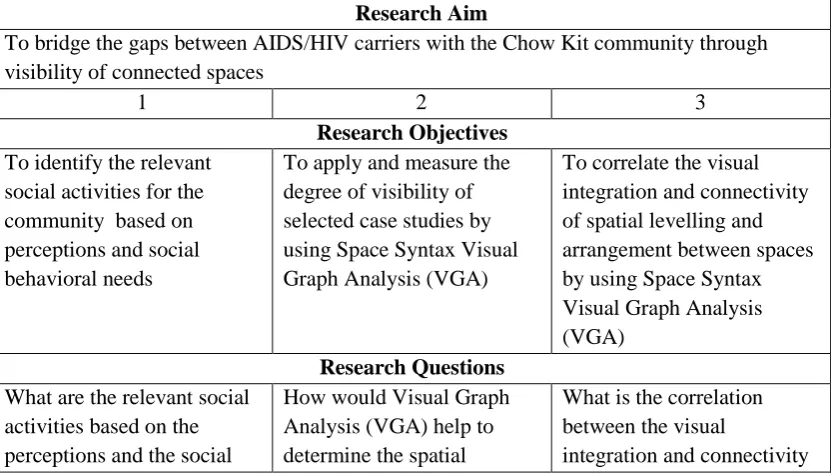
Table 1.1: Summary of Reseach Aim, Research Objectives, Research Questions, Theories, Instruments and Data Analysis for Research
Research Aim
To bridge the gaps between AIDS/HIV carriers with the Chow Kit community through visibility of connected spaces
1 2 3
Research Objectives To identify the relevant
social activities for the community based on perceptions and social behavioral needs
To apply and measure the degree of visibility of selected case studies by using Space Syntax Visual Graph Analysis (VGA)
To correlate the visual integration and connectivity of spatial levelling and arrangement between spaces by using Space Syntax Visual Graph Analysis (VGA)
Research Questions What are the relevant social
activities based on the perceptions and the social
How would Visual Graph Analysis (VGA) help to determine the spatial
What is the correlation between the visual
behavioral needs of the AIDS/ HIV carriers as well as public
arrangement and levelling to curb the privacy needed by the carriers?
of the proposed spatial levelling and arrangement between spaces?
Theories/ Principles Theory of social behaviour Theory of spatial
arrangement and Space Syntax
Theory of spatial arrangement and Space Syntax
Tools/ Instruments Online survey, unstructured
interview, field visit, site observation, video and documentary
Precedent studies and visibility graph analysis
Visibility graph analysis
Data Analysis Perception and
understandings of public and AIDS/HIV
Degree of visibility of selected case studies and precedent studies in Space Syntax
Correlation the visual integration and connectivity of spatial levelling and arrangement between spaces
1.7 Research Scope
The scope of the dissertation is focusing on the visual pattern of the integrated space which the aim is to bridge the gaps between AIDS/HIV carriers with the Chow Kit community through learning means and integrated spaces.
arrangement between spaces are conducted in order to recommend ideal spatial configuration according to the social behavioural needs and privacy settings.
However, in this dissertation, not all data on social behaviors of AIDS/HIV carriers are able to be collected due to the limited respondents that will to be questioned and thus, literature review based on secondary sources such as journal and video documentaries are used to assist.
1.8 Significance of Research
The significance of this dissertation allows the exploration in architectural designing approaches in advocating direct and indirection interaction, in both within a building as well as the urban fabric. As AIDS is still a taboo topic in the context of Malaysia, the design is meant to be an alternative platforms which encourage public participation in order to increase the awareness as well as integration of public space within the context. Adopting the concept of continuous learning pattern, a designated spatial of facilities’ guideline in the exploration in architectural building layout will be outlined, which can be applied to the Design Thesis.
1.9 Expected Findings
the findings will be an alternative architectural design approach in arranging building layouts, which take into account of spatial visual pattern, spatial behaviour and environmental qualities.
1.10 Structure of Dissertation
There are a total of five chapters in this dissertation.
Chapter 1 : Introduction
Chapter 1 elaborates on the overview of the research dissertation. It outlines research background study, problem statements, research aim, research objectives, research questions, research methodology, research scope, significance of research, and expected findings of this research.
Chapter 2 : Literature review
Chapter 2 provides overview topic which covers issues on AIDS/HIV carriers and Chow Kit as well as the community engagement on the social and urban aspects. It also argues on integrated spaces on the aspect of experimenting the visibility on spatial layouts and configurations.
Chapter 3 : Research Methodology
includes the procedures in data and samples collection, summary of literature review, VGA analysis, and etcetera.
Chapter 4 : Analysis, Findings and Discussions
Chapter 4 presents the data that are collected from both primary and secondary data and then further discussions and analysis will be made. The analyzed data will be used to determine the relevant social activities as well as spatial configuration for the users within, which can be applied to the Design Thesis.
Chapter 5 : Conclusion and Recommendations
Chapter 5 concludes the findings and recommendations to the summary of the research findings and synthesises in relation to the research objectives. Various limitations and suggestions regarding this research will be outlined as well.
1.11 Summary
REFERENCES
ACAPS. (2012). Qualitative and Quantitative Research Techniques for Humanitarian Needs Assessment.
Aloysius, S. (2012). Social Architecture – Social System, Architecture, Architectural Design Values, Social media. Commun, United Kingdom.
ArchDaily. (2011, May 19). Ubuntu Centre / Field Architecture. Retrieved March 5, 2017, from ArchDaily: http://www.archdaily.com/135432/ubuntu-centre-field-architecture
Baldwin, E. (2015). Icons of Design: 10 Landmark Projects Representing Culture and Place. Retrieved February 16, 2017, from Architizer:
http://architizer.com/blog/cultural-projects/
Bartels, E. M. (2013). Transparency: The Unspoken Design Element - How Levels of Visibility Affect Adult Learning and Sharing. University of Nebraska - Lincoln.
Bentley, I. (1985). Responsive Environemnts- Manual for designers . Bodmin, Cornwall, Great Britain: MPG Books Ltd.
Bezuidenhoudt, C., Elago, H., Kalenga, E., Klazen, S., Nghipondoka, K., Ashton, D.,. (2010). The Psychological Impact of HIV/AIDS: People are more than statistics. Retrieved March 30, 2017, from Future Leaders Summit:
https://org.elon.edu/summit/essays/essay4.pdf
Boundless. (2015). Understanding Social Interaction. Retrieved April 10, 2017, from Boundless: https://www.boundless.com/sociology/textbooks/boundless- sociology-textbook/social-interaction-5/understanding-social-interaction-50/understanding-social-interaction-314-5912/
Cabe Space. (2006). Better Public Building. Retrieved January 30, 2017, from Cabe Space: http://www.dqionline.com/downloads/better_public_building.pdf Chan, Iris WS., and Chung, Rita WY. (2007). Meeting Psychosocial Needs of HIV
Patients. Retrieved April 5, 2017, from Info Gov HK: http://www.info.gov.hk/aids/pdf/g190htm/05.htm
Crawford, N. (2002, November). HIV needs psychology. Retrieved March 15, 2017, from American Psychological Association:
http://www.apa.org/monitor/nov02/hiv.aspx
Cross, J. E. (2001). What is Sense of Place? Department of Sociology, Colorado State University.
Cross, J. E. (2003). Conceptualizing Community Attachment. Department of Sociology, Colorado State University.
Dozier,A., Hacker, K., Silberberg, M., and Ziegahn, L. (2010). Chapther 6 : The Value of Social Networking in Community. Retrieved February 20, 2017, from ATSDR.CDC.Gov:
https://www.atsdr.cdc.gov/communityengagement/pdf/pce_report_chapter_6 _shef.pdf
Franz, G. and Wiener, JM. (2008). From space syntax to space semantics. Max Planck Institute for Biological Cybernetics, Spemannstr. 38, 72076 Tübingen, Germany.
Gehl, J. (1996). Life Between Builidings Using Public Space. Washington, Covelo, London: Island Press.
Gehl, J. (2010). Cities for People. Washington, Covelo, London: Island Press. Georgiou, M. (2006). Architectural Privacy - A Topological Approach To Relational
Design Problems. Bartlett School of Graduate Studies.
Gill, P., Stewart, K., Treasure, E. and Chadwick, B. (2008). Methods of Data
Collection in Qualitative Research: Interviews and Focus Groups. Retrieved February 15, 2017, from British Dental Journal :
https://www.nature.com/bdj/journal/v204/n6/full/bdj.2008.192.html
Goffman, E. (1963). Behaviuor in Public Places, Notes on the Social Organisation of Gatherings. New York, The Free Press.
Catalyst: http://catalyst.nejm.org/applying-behavioral-insights-improve-health-care/
Hashem, H., Abbas, Y.S., Akbar, H.A., Nazgol, B. (2013). Comparison the concepts of sense of place and attachment to place in Architectural Studies. Malaysia: GEOGRAFIA OnlineTM Malaysia Journal of Society and Space.
Hiller, B. and Hanson, J. (1984). The Social Logic of Space. Bartlett School of Architecture and Planning, University College London: Cambridge University Press.
Hillier, B. (2014). Space Syntax as a Theory as well as a Method. Retrieved January 15, 2017, from ISUF, Space Syntax Laboratory, University College London: http://isuf2014.fe.up.pt/Hillier.pdf
Hilller, B. and Stonor, T. (2010). Space Syntax - Strategic Urban Design. City Planning Institute of Japan: Future of Urban Space and Humanity. Jacobs, J. (1961). The Death and Life of Great American Cities. 457 Madison
Avenue, New York 22: Random House, Inc.
Lau, JT., Tsui, HY., Li, CK., Chung, RW., Chan, MW., and Molassiotis, A. (2003). Needs Assessment and Social Environment of People Living with HIV/ AIDS
in Hong Kong. Hong Kong: AIDS Care.
Lynch, K. (1960). The Image of the City. Massachusetts Institute of Technology, Cambridge, Massachusetts, and London, England.: The MIT Press. Mack, N., Woodsong, C., Macqueen, KM., Guest, G. and Namey, E. (2005).
Qualitative Research Methods: A Data Collector’s Field Guide. Research Triangle Park, North Carolina: Family Health International.
Mahdzar, S. (2008). Sociability vs Accessibility,Urban Street Life. Bartlett School of Planning, University College London.
Malaysian AIDS Council. (2014). Annual Report 2013. Retrieved February 15, 2017, from Malaysian AIDS Council & Malaysian AIDS Foundation:
http://www.mac.org.my/v3/wp-content/uploads/2014/05/Annual-Report-2013_A4_FA_22052013-web.pdf
Manaugh, G. (2010). The Switching Labyrinth. Retrieved March 15, 2017, from BLDGBLOG: http://www.bldgblog.com/2010/04/the-switching-labyrinth/ McLane, Y. (2013). Spatial Contexts, Permeability, and Visibility in Relation to
Ministry of Health Malaysia. ( 2015). National strategic plan, EndingAIDS 2016-2030. Retrieved February 10, 2017, from
http://www.aidsdatahub.org/sites/default/files/publication/Malaysia_National _strategic_plan_2016-2030.pdf
Molthrop, E. (2012). Biophilic Design, A Review of Principle and Practice. Environmental Sciences.
Morni, Z. (2015). Utilising Abandoned Leprosarium for HIV & AIDS Hospice Centre. Department Of Architecture, Faculty of Built Environment, Universiti Teknologi Malaysia: HOME Thesis Panel.
Mueller, M. and Cottell, F. (2013). Concrete Geometries – Spatial Form And Social Behavior, Rethinking the Social in Architecture, . Umea School of
Architecture, Umea, Sweden.
Murphy, DA., Durako, SJ., Moscicki, AB., Vermund, SH., Ma, Y., Schwarz, DF., Muenz, LR., and Adolescend Medicine HIV/AIDS Research Network. (2001). No Change in Health Risk Behaviors Over Time Among HIV Infected Adolescents in Care: Role of Psychological Distress. Elsevier Science Inc., Avenue of the Americas, New York: Journal of Adolescent Health .
Neeson, R. (2002). Designing Limits : Tourism + Public Space. Retrieved April 5, 2017, from http://architectureinsights.com.au/resources/designing-limits-tourism-public-space/
Nikitin, C. (2009). Civic Buildings and their Public Spaces Can Improve The
Quality of Life in Cities. Retrieved March 21, 2017, from Recreation & Parks BC Magazine:
http://www.pps.org/pdf/BC_RecreationandParks_Nikitin_Spring09.pdf Nord, C. (2007). Spaces of Hope : Architectural design for HIV services in Uganda.
Retrieved from Linköping University, Department of Social and Welfare Studies, NISAL - National Institute for the Study of Ageing and Later Life. Poh, S. (2011, September 30). 'Pecah Lobang' (Busted): Muslim transsexual sex
workers in Malaysia. Malaysia. Retrieved from https://www.youtube.com/watch?v=DvyheyCponY
Priya, S. S. (2013, December 20). Empowering the children of Chow Kit. Retrieved January 10, 2017, from The Star:
http://www.thestar.com.my/news/community/2013/12/20/empowering-the- children-of-chow-kit-duo-aim-to-change-publics-negative-perception-of-area-via-commun/
Project for Public Spaces. (2009). What is Placemaking? Retrieved April 10, 2017, from PPS, New York City:
http://www.pps.org/reference/what_is_placemaking
PT Foundation. (2013). PT Foundation Annual Report 2013. Retrieved February 20, 2017, from http://ptfmalaysia.org/v2/wp-content/uploads/2014/02/Annual-Report-2013.pdf
Ramovha, R., Khoza, L.B., Lebese, R.T. and Shilubane, H.N. . (2012, March 18). The Psychological Experience of HIV and Aids by Newly Diagnosed Infected
Patients at Hospital A of Vhembe District, Limpopo Province. Retrieved April 15, 2017, from Journal of AIDS & Clinical Research:
https://www.omicsonline.org/the-psychological-experience-of-hiv-and-aids- by-newly-diagnosed-infected-patients-at-hospital-a-of-vhembe-district-limpopo-province-2155-6113.S1-006.php?aid=6647
Rozaidah, T. (2006). “Malaysia”, Fighting a Rising Tide: The Response to AIDS in East Asia. Tokyo: Japan.
SAGE. (2012). Spatial Interaction. Retrieved April 20, 2017, from Encyclopedia of Geographic Information Science:
http://www.spatialcomplexity.info/files/2012/01/BATTY-Spatial-Interaction-Encyclopedia.pdf
State Goverment Victoria. (2013). What is Community Engagement? Retrieved February 20, 2017, from Department of Environment and Primary Industries:
http://www.dse.vic.gov.au/effective-engagement/introduction-to-engagement/what-is-community-engagement
Steenson, MW. and Scharmen, F. (2011). Interaction Design. Retrieved May 1, 2017, from Domusweb:
http://www.domusweb.it/en/op-ed/2011/06/22/architecture-needs-to-interact.html
Terrapin Bright Green. (2012). The Economics of Biophilia - Why Designing with Nature in Mind Makes Financial Sense. New York, Washington DC. Turner, A., Doxa, M., O’Sullivan, D., and Penn, A. . (2001). From Isovists to
Visibility Graphs: A Methodology for the Analysis of Arcthiectural Space.
UNAIDS. (2013). UNAIDS report 2013, HIV in Asia and the Pacific. Joint United Nations Programme on HIV/AIDS (UNAIDS).
Varoudis, T. and Penn, A. (2015). Visibility, accessibility and beyond: Next generation visibility graph analysis. Proceedings of the 10th International Space Syntax Symposium. Bartlett School of Architecture, UCL.
Vellenga, A. (2001, March 28). Taking the First Step : The Labyrinth and The World of Landscape Architecture. Retrieved April 10, 2017, from
https://theses.lib.vt.edu/theses/available/etd-05302001-160852/unrestricted/thesisav.pdf
Whyte, W. H. (1980). The Social Life of Small Urban Spaces. New York: Project for Public Spaces.