ISSN(Online): 2320-9801
ISSN (Print): 2320-9798
I
nternational
J
ournal of
I
nnovative
R
esearch in
C
omputer
and
C
ommunication
E
ngineering
(A High Impact Factor, Monthly, Peer Reviewed Journal) Website: www.ijircce.com
Vol. 5, Issue 10, October 2017
A Power Proficient Using Leach Protocol in
Wireless Sensor Network
P.Sujatha 1, N.Hyrunnisha MCA., M.Phil.2
Research Scholar, Dept. of Computer Science, Muthayammal College of Arts and Science, Rasipuram, India 1
Asst Professor, Dept. of Computer Science, Muthayammal College of Arts and Science, Rasipuram, India 2
ABSTRACT: One of the specified issues for wireless device networks is increasing the network amount. Bunch is associate economical technique for prolonging the amount of wireless device networks. This thesis proposes a multihop bunch formula (MHC- multihop bunch algorithm) for energy saving in wireless device networks. MHC selects the clusterheads in step with the two parameters the remaining energy and node degree. What’s a lot of cluster heads like their members in step with the two parameters of device the remaining energy then the gap to its cluster head. MHC is finished in three phases quickly. Simulation results show that the planned kindle will increase the network amount over Sixteen temperament issue type compared of the LEACH(Low-energy accommodative bunch hierarchy) protocol
KEYWORDS: LEACH Protocol, Multihop, Clustering, energy
I. INTRODUCTION
WSN individuals set of Ad-hoc networks. WSN consists of specially distributed autonomous sensors handy and glove monitor physical or environmental conditions like temperature, sound, vibration, pressure, motion etc. LEACH protocol is that the initial protocol of stratified routing that projected data fusion; it's of milestone significance in agglomeration routing protocol. Routing ways in during which inside which and security problems unit of discharge nice analysis challenge. of late in WSN, numbers of routing protocols unit of measurement projected for WSN but most well-known protocols unit of measurement stratified protocols like LEACH. Stratified protocols unit of measurement written to chop back energy consumption by aggregating information and to chop back the transmissions to the bottom station.
Routing ways in which during which and security issues unit of measurement an impressive analysis challenge presently days in WSN but throughout this paper we've a bent to unit of measurement aiming to emphasize on the routing protocol. Fairly routing protocols unit of measurement planned for WSN but the foremost accepted unit of measurement hierarchical protocols like LEACH and PEGASIS. Hierarchical protocols unit of measurement written to cut back energy consumption by aggregating information and to cut back the transmissions to the bottom Station. LEACH is taken into thought as a results of the foremost well likeable routing protocol that use cluster based totally routing so on prune energy consumption. Throughout this paper foremost we've a bent to tend to analysis LEACH protocol so at intervals the third section we've a bent to unit of measurement aiming to discuss the phases of LEACH protocol. At intervals the fourth section we've a bent to tend to stipulate varied potential attacks on it and at intervals the fifth section there unit of measurement the advantages and downsides of LEACH. At intervals the last section we've a bent to tend to match LEACH with totally utterly totally different protocols.
Low Energy accommodative clump Hierarchy (LEACH) protocol is additionally a TDMA primarily based coat protocol. The principal aim of this protocol is to boost the number of wireless device networks by lowering the energy consumption needed to create and maintain Cluster Heads. The operation of LEACH protocol consists of the various rounds with a mix of phases in every: Set-up section and Steady section.
ISSN(Online): 2320-9801
ISSN (Print): 2320-9798
I
nternational
J
ournal of
I
nnovative
R
esearch in
C
omputer
and
C
ommunication
E
ngineering
(A High Impact Factor, Monthly, Peer Reviewed Journal) Website: www.ijircce.com
Vol. 5, Issue 10, October 2017
agglomeration hierarchy (LEACH) is that the primary cluster-based routing protocols in wireless device networks. LEACH selects cluster heads with some chance, and thus the cluster heads fuse and combination data coming back from nodes that belong to the individual cluster. Cluster heads unit sporadically rotated among the nodes to balance energy consumption, and enhances the network fundamental measure. However, some cluster heads might even be really close to each other and cannot be uniformly deployed inside the networks by chance mechanism, and cluster heads vary is not invariably adequate the pre established variety. To uniformly deploy cluster heads, a centralized version of LEACH, LEACH-C, and a centralized energy-efficient routing protocol–BCDCP unit projected. However, these centralized algorithms bring worse measurability and strength to large networks than distributed algorithms. To beat the constraints of LEACH, a correct logic approach to cluster head election is projected that uses three fuzzy variables (concentration, energy and centrality). However, this rule is also a centralized election mechanism, and therefore rock bottom station should collect the energy and distance data from all device nodes.
In, cluster head election mechanism exploitation system of logic (CHEF) is projected, that will be a localized cluster head election mechanism. Cook uses energy and native distance as fuzzy variables within the fuzzy if-then rules. Simulation results show that the cluster heads in cook unit many equally distributed over the network than those in LEACH, then cook extra prolongs the network period of time. However cook doesn't construct multi-hop routes in cluster heads. A generalized system of logic primarily based energy-aware routing is providing would be a soft, tunable parameter primarily based rule. However this rule assumes that a cluster he distribute clusters over the networks, FSCA employs migration fuzzy module to re cluster and merge existed clusters. However, re cluster the total network adds lots of management overhead and needs lots of time. In, associate energy and mobility-aware geographical multipath routing (EM-GMR) rule is bestowed, that's predicated on mathematical logic system considering the remaining battery capability, mobility, and distance to the destination node.ad is much powerful as compared to the alternative device nodes and has no energy limitation. A fuzzy self-clustering rule (FSCA) considers the node residual energy and native density to spice up the fundamental measure of WSNs.
III. EXISTING SYSTEM
Lifetime improvement has continually been a vital issue as most of the wireless sensing element networks (WSNs) operate in unattended atmosphere wherever human access and observance square measure much impracticable. Cluster is one amongst the foremost powerful techniques which will prepare the system operation in associated manner to attend the network quantifiability, minimize energy consumption, and win prolonged network period of time. to beat this issue, current researchers have triggered the proposition of the many varied cluster algorithms. However, most of the projected algorithms overburden the cluster head (CH) throughout cluster formation. to beat this drawback, several researchers have return up with the thought of symbolic logic (FL), that is applied in WSN for deciding.
Disadvantages
There isn't any guarantee to the information life time.
It consume the additional energy.
ISSN(Online): 2320-9801
ISSN (Print): 2320-9798
I
nternational
J
ournal of
I
nnovative
R
esearch in
C
omputer
and
C
ommunication
E
ngineering
(A High Impact Factor, Monthly, Peer Reviewed Journal) Website: www.ijircce.com
Vol. 5, Issue 10, October 2017
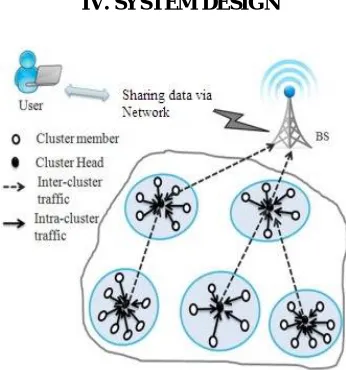
IV. SYSTEM DESIGN
Fig No.4.1 System design
V. PROPOSED SYSTEM
• One of the very important problems for wireless detector networks is increasing the network fundamental quantity.
• Bunch is associate economical technique for prolonging the fundamental quantity of wireless detector
networks.
• This thesis proposes a multihop bunch formula (MHC) for energy saving in wireless detector networks.
Advantages
The MHC protocol increase the life time of the information
It isn't consuming the lot of energy.
More economical and quick performance.
VI. METHODOLOGIES
Networking Module.
Transmission State
Packet Division Module.
Clustering Phase
Energy Efficient Balancing Module.
NETWORKING MODULE
ISSN(Online): 2320-9801
ISSN (Print): 2320-9798
I
nternational
J
ournal of
I
nnovative
R
esearch in
C
omputer
and
C
ommunication
E
ngineering
(A High Impact Factor, Monthly, Peer Reviewed Journal) Website: www.ijircce.com
Vol. 5, Issue 10, October 2017
TRANSMISSION STATE
Throughout this section, the non-head nodes monitor the setting that they are offered to life at a special time to send information aboard Energy Index to the cluster head victimization transmitter based totally code assignment. All completely totally cluster nodes will combination the message received from different nodes and saves it.
PACKET DIVISION MODULE.
Packet modification might even be a method of grouping info transmitted over a digital network into packets that unit composed of a header and a payload. Info among the header is used} by networking hardware to direct the packet to its destination where the payload is extracted and used by application code.
CLUSTERING HALF
The third module is cluster forming that decides that cluster head a tool ought to be associated with. The standards are delineate as follows: for a tool with tentative standing or being a cluster member, it'd haphazardly affiliate itself with a cluster head among its candidate peers for load balance purpose. Among the rare case that there is no cluster head among the candidate peers of a tool with tentative standing, the device would claim itself and its current candidate peers as a results of the cluster heads.
ENERGY ECONOMICAL FEAT MODULE.
Load effort refers to efficiently distributing incoming network traffic across a gaggle of backend servers, additionally named as a server farm or server pool. Throughout this way, a load balancer performs succeeding functions: Distributes shopper requests or network load efficiently across multiple servers. At the high level, our framework has a pair of goals. The first is to produce recommendation concerning what form of algorithms to use given certain beliefs concerning the relation of the similarity perform to the cluster task.
VII. PERFORMANCE EVALUATION AND RESULTS
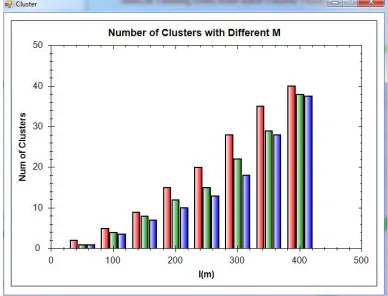
LEACH protocol incorporates a downside that the cluster head node consumes further energy than ancient nodes. Advanced-LEACH protocol, a heterogeneous protocol accustomed decrease probability of failure nodes and for extending the live before the death of the first node (called stability period). each detector is awake to the start of each spherical exploitation synchronic clock. Let n be the complete form of nodes and m be the fraction of n that have energy quite different nodes called CGA nodes (nodes elite as gateways or cluster heads). The rest of (1-m)*n nodes act as ancient nodes.
ISSN(Online): 2320-9801
ISSN (Print): 2320-9798
I
nternational
J
ournal of
I
nnovative
R
esearch in
C
omputer
and
C
ommunication
E
ngineering
(A High Impact Factor, Monthly, Peer Reviewed Journal) Website: www.ijircce.com
Vol. 5, Issue 10, October 2017
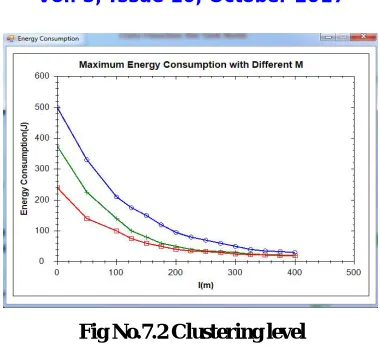
Fig No.7.2 Clustering level
VIII. CONCLUSION AND FUTURE WORK
The analysis work presents energy economical cluster head selection algorithms for wireless device network. The performance of the conferred DLEACH, DBR-LEACH Associate in Nursing BP-DCA algorithms square measure evaluated by victimization Associate in Nursing analytical model and simulation experiment victimization NS2. to analyze the performance of the conferred cluster head selection algorithms; the metrics like vary of cluster heads selected, residual energy of the network, first node die (FND) time and vary of Alive nodes at the tip of simulation were compared with LEACH and Static LEACH protocols.
REFERENCES
[1] Weiser, M., “The PC for the twenty initial century”, Scientific yank, 265(3), Sept 1991, pp. 94-104.
[2] B. Warneke, M. Last, B. Liebowitz, K. Pister, “Smart Dust: Communicating with a cubic-mille meter computer”, IEEE PC, January 2001, pp. 2-9.
[3] R. Min, M. Bhardwaj, S. Cho, E. Shih, A. Sinha, A. Wang, A.Chandrakasan, “Low-power wireless device networks”, VLSI Design2001, Invited Paper, Bangalore, New vogue amount of your time 2001.
[4] K. Pister, “On the boundaries and applications of MEMS device networks”, Defence Science Study cluster report, Institute for Defence Analysis, Alexandria, VA.
[5] J. M. Rabaey, M. J. Ammer, J. L. da Silva, D. Patel, S. Roundy, “Pico Radio supports specific ultra-low power wireless networking, IEEE Computer, July 2000, pp. 42-48.
[6] D. Timmermann, „Smart environments“, Invited Paper, Laden burger Diskurs, Ladenburg, New vogue amount of your time 2001.
[7] A. Sinha, A. Chandrakasan, „Dynamic power management in wireless sensor networks“, IEEE vogue & take a glance at of Computers, March-April2001, S. 62-74.
[8] L. Zhong, R. Shah, C. Guo, J. Rabaey, “An radical low power and distributed access protocol for broadband wireless device networks”, IEEE Broadband Wireless Summit, Las Vegas, May 2001.
[9] V. Rodoplu, T. H. Meng, “Minimum energy mobile wireless networks”, IEEE Jour. elect Areas Comm., August 1999, pp. 1333-1344.
[10] W. Heinzelman, A. Chandrakasan, H. Balakrishnan, „Energy-efficient communication protocol for wireless micro sensor networks“, Proceedings of the thirty third International Conference on System Sciences(HICSS '00), New vogue amount of your time 2000.
[11]. W. Heinzelman, A. Sinha, A. Wang, A. Chandrakasan, “Energy scalable algorithms and protocols for wireless micro sensor networks”, Proc. International Conference on Acoustics, Speech, and Signal technique (ICASSP '00), June 2000
[12] W. Heinzelman, A. Chandrakasan, H. Balakrishnan, „An application specific protocol vogue for wireless micro sensor networks“, impress: IEEE act on Wireless Networking.
[13] S. Lindsey, C. Raghavendra, K. Sivalingam, “Data gathering in sensor networks exploitation the energy*delay metric”, Proc. of the IPDPS Workshop on issues in Wireless Networks and Mobile Computing, April2001.