ISSN(Online): 2320-9801
ISSN (Print): 2320-9798
I
nternational
J
ournal of
I
nnovative
R
esearch in
C
omputer
and
C
ommunication
E
ngineering
(An ISO 3297: 2007 Certified Organization)
Vol. 4, Issue 9, September 2016
An Efficient Technique over Ranking Fraud
Detection for Mobile Apps
Meesala Santoshi Kumari, Chaladi Sreenu Babu
M.Tech Scholar, Department of Computer Science Engineering, GMRIT, Rajam, India
Associate Professor, Department of Computer Science & Engineering, GMRIT, Rajam, India
ABSTRACT: Mobile application assumes a critical part for all the advanced smart phones to play or perform diverse tasks. Mobile application developers are accessible in vast number; they can build up the distinctive mobile applications. For making ale clients for their applications a few designers include in unlawful exercises. Because of these illicit exercises the mobile applications procures high rank in the application notoriety list. Such fake exercises are utilized by more application developers. A positioning extortion location framework for mobile Apps is proposed in this paper ranking misrepresentation in the mobile App market alludes to false or misleading exercises which have a reason for knocking up the Apps in the notoriety list. In fact, it turns out to be increasingly visit for App designers to utilize shady means, for example, blowing up their Apps deals or posting imposter App evaluations, to submit positioning extortion. This paper gives an all-encompassing point of view of situating distortion and propose a Ranking extortion distinguishing proof structure for mobile Apps. Specifically, it is proposed to exactly discover the mining to posture blackmail the dynamic time frames, to be particular driving sessions, of compact Apps. The KNN algorithm is applied to enhance effectiveness and precision of the application. These all proofs are consolidated for recognizing the extortion applications. The App stores also allow users to write some textual comments as App reviews. Such reviews can reflect the personal perceptions and usage experiences of existing users for particular mobile Apps. Indeed, review manipulation is one of the most important perspective of App ranking fraud.
KEYWORDS
:
Mobile Apps, Ranking Fraud Detection, historical ranking records, rating and review, KNN Algorithm.I.INTRODUCTION
ISSN(Online): 2320-9801
ISSN (Print): 2320-9798
I
nternational
J
ournal of
I
nnovative
R
esearch in
C
omputer
and
C
ommunication
E
ngineering
(An ISO 3297: 2007 Certified Organization)
Vol. 4, Issue 9, September 2016
positioning extortion for each App, so it is critical to naturally identify misrepresentation without utilizing any essential data
.
Mobile Apps are not generally positioned high in the leader board, but rather just in some driving occasions positioning that is misrepresentation as a rule happens in driving sessions. In this manner, primary target is to recognize positioning misrepresentation of mobile Apps inside driving sessions. To start with propose a powerful calculation to recognize the main sessions of each App in light of its chronicled positioning records. At that point, with the investigation of Apps' positioning practices, discover the deceitful Apps frequently have diverse positioning examples in every driving session contrasted and typical Apps. In this way, some misrepresentation proofs are describe from Apps' authentic positioning records. At that point three capacities are produced to concentrate such positioning based extortion confirmations. Hence, advance two sorts of extortion confirmations are proposed taking into account Apps' appraising and audit history, which mirror some oddity designs from Apps' authentic rating and survey records. Also, to incorporate these three sorts of proofs, an unsupervised confirmation conglomeration strategy is produced which is utilized for assessing the validity of driving sessions from mobile Apps. In any case, now instead of relying upon client's surveys and remarks courses of action, App architect developers resort to some fake positions and remarks to deliberately help their Apps and at last results the chart rankings on an App store. This is normally comes about by using indicated human water military to expand the App downloads, assessments and overviews in a brief while. Case in point, an article from Venture Beat reported that, when an App was propelled position, it could be expansions from number 1,800 to the fundamental 25 Apples sans top leader board and roughly more than 50,000-100,000 new clients or customers could be included within a couple days. Honestly, such situating fake representation brings stresses up in the business sector of App industry.
II. RELATED WORK
ISSN(Online): 2320-9801
ISSN (Print): 2320-9798
I
nternational
J
ournal of
I
nnovative
R
esearch in
C
omputer
and
C
ommunication
E
ngineering
(An ISO 3297: 2007 Certified Organization)
Vol. 4, Issue 9, September 2016
From this paper we have alluded:- • Concept of misrepresentation discovery [2] Evaluative writings on the Web have turned into a significant wellspring of feelings on items, administrations, occasions, people, and so on. As of late, numerous scientists have concentrated such feeling sources as item audits, discussion posts, and web journals. Be that as it may, existing examination has been centered on characterization and synopsis of feelings utilizing characteristic dialect handling and information mining methods. An essential issue that has been dismissed so far is supposition spam or dependability of online feelings. In this paper, we think about this issue with regards to item audits, which are feeling rich and are broadly utilized by customers and item producers. In the previous two years, a few new businesses additionally showed up which total assessments from item surveys. It is accordingly high time to study spam in surveys. To the best of our insight, there is still no distributed study on this subject, in spite of the fact that Web spam and email spam have been researched widely. We will see that sentiment spam is very unique in relation to Web spam and email spam
Accordingly requires distinctive location procedures. In view of the investigation of 5.8 million surveys and 2.14 million commentators from amazon.com, we demonstrate that sentiment spam in audits is across the board. This paper examines such spam exercises and introduces some novel methods to recognize them. [3] Many procedures.
In view of the investigation of 5.8 million surveys and 2.14 million commentators from amazon.com, we demonstrate that sentiment spam in audits is across the board. This paper examines such spam exercises and introduces some novel methods to recognize them. [3] Many applications in data recovery, regular dialect handling, information mining, and related fields require a positioning of examples as for determined criteria instead of an arrangement. Besides, for some such issues, numerous set up positioning models have been all around considered and it is attractive to consolidate their outcomes into a joint positioning, formalism indicated as rank accumulation.
III. PROBLEM STATEMENT
Many mobile app stores launched daily app leader boards which show the chart ranking of popular apps. The leader board is the important for promoting apps. Original application grade level decreases due to the duplication arrival in the mobile apps. In recent activities duplicate version of an application not burned or blocked. This is the major defect. Higher rank leads huge number of downloads and the app developer will get more profit. In this they allow Fake Application also. User not understanding the Fake Apps then the user also gives the reviews in the fake application. Exact Review or Ratings or Ranking Percentage are not correctly Calculated.
IV. THE UNPRECEDENTED DATA
The test information sets were gathered from the "Best Free 300" and "Top Paid 300" leader boards of Apple's Application Store (U.S.) from February 2, 2010 to September 17, 2012. The information sets contain the every day diagram rankings1 of top 300 free Apps and main 300 paid Apps, individually. Besides, every information set additionally contains the client appraisals and audit data. Demonstrate the appropriations of the quantity of Apps concerning diverse rankings in these information sets. In the figures, we can see that the quantity of Apps with low rankings is more than that of Apps with high rankings. Besides, the rivalry between free Apps is more than that between paid Applications, particularly in high rankings (e.g., main 25 demonstrate the circulation of the quantity of Apps with deference to various number of evaluations in these information sets. In the figures, we can see that the circulation of App evaluations is not, which demonstrates that just a little rate of Apps are exceptionally well known.
Human Judgment Based Evaluation
To the best of our insight, there is no current benchmark to choose which driving sessions or Apps truly contain positioning misrepresentation. Therefore, we create four instinctive baselines and welcome five human evaluators to accept the adequacy of our methodology Evidence Aggregation based Ranking Fraud Detection (EA-RFD). Especially, we mean our methodology with score based total (i.e., Principle 1) as EA-RFD-1, and our methodology with rank based accumulation (i.e., Principle 2) as EA-RFD-2, individually.
Baselines
ISSN(Online): 2320-9801
ISSN (Print): 2320-9798
I
nternational
J
ournal of
I
nnovative
R
esearch in
C
omputer
and
C
ommunication
E
ngineering
(An ISO 3297: 2007 Certified Organization)
Vol. 4, Issue 9, September 2016
integrated by our aggregation approach. The second baseline Rating-RFD stands for Rating evidence based ranking fraud detection, which estimates the ranking fraud for each leading session by only using rating based evidences (i.e., C4 and C5). These two evidences are integrated by our aggregation approach. effectiveness of different kinds of evidences, and our preliminary experiments validated that baselines with Principle 2 always outperform baselines with Principle 1. The last baseline E-RFD stands for evidence based ranking fraud detection, which estimates the ranking fraud for each leading session by ranking, rating and review based evidences without evidence aggregation. Specifically, it ranks leading sessions by Equation (18), where each wi is set to be 1=7 equally. This baseline is used for evaluating the effectiveness of our ranking aggregation method. Note that, according to Definition 3, we need to define some ranking ranges before extracting ranking based evidences for EA-RFD-1, EA-RFD-2, Rank-RFD and E-RFD. In our experiments, we segment the rankings into five different ranges, i.e., ½1; 10_, ½11; 25_, ½26; 50_, ½51; 100_, ½101; 300_, which are commonly used in App leader boards. Furthermore, we use the LDA model to extract review topics as introduced in Section 3.3. Particularly, we first normalize each review by the Stop-Words Remover [6] and the Porter Stemmer [7]. Then, the number of latent topic Kz is set to 20 according to the perplexity based estimation approach.
Performance
In this area, we show the general exhibitions of every positioning extortion location approach concerning different assessment measurements, i.e., Precision@K, Recall@K, F@k, and NDCG@K. Especially, here we set the most extreme K to be 200, and all examinations are led on a 2.8 GHZ2 quad-center CPU, 4G primary memory PC. we demonstrate the assessment execution of every identification approach in two information sets. we can watch that the assessment results in two information sets are steady. In reality, by breaking down the assessment results, we can acquire a few shrewd perceptions. In particular, to start with, we find that our methodology, i.e., EA-RFD-2/EA-RFD-1, reliably outflanks different baselines and the upgrades are more critical for littler K (e.g., K < 100). This outcome plainly accepts the adequacy of our confirmation conglomeration based system for identifying positioning extortion. Second, EA-RFD-2 beats EA-RFD-1 sightly as far as all assessment measurements, which demonstrates that rank based total (i.e., Principle 2) is more successful than score based accumulation (i.e., Principle 1) for coordinating extortion confirmations. Third, our methodology reliably outflanks E-RFD, which accepts the viability of confirmation aggregation for distinguishing positioning extortion. Fourth, E-RFD have preferred discovery exe
V. MOBILE APP RECOMMENDATIONS
To help users understand the different risks of Apps is to categorize the risks into discrete levels (e.g., Low, Medium, and High). In fact, people often describe their perception about risk or security with such discrete level Therefore, in the popularity of the app is determined by total number of download and average rating. Intuitively, there are two types of ranking principles for recommending apps.
.
RELIABLE DANGEROUS SYSTEM
Modify/delete SD card
contents Read Contacts
Make phone calls Read calendar data
Write contact data Send SMS or MMS
Write calendar data Read browser history &
bookmarks Read sensitive logs
Modify global system
settings
Write browser history &
bookmarks Authenticate Accounts
Read sync settings Automatically start at boot Install DRM
Access mock location Retrieve running applications Add system service
Battery stats Take pictures and videos In-app billing
Bluetooth Admin Access location extra commands Format file systems
Clear app cache Change Configuration Process outgoing calls
ISSN(Online): 2320-9801
ISSN (Print): 2320-9798
I
nternational
J
ournal of
I
nnovative
R
esearch in
C
omputer
and
C
ommunication
E
ngineering
(An ISO 3297: 2007 Certified Organization)
Vol. 4, Issue 9, September 2016
Security Principle: Ranking of App is evaluated by their risk score in ascending order and the same risk score Apps will be ranked further by popularity scores.
Popularity Principle: Ranking of App is evaluated by their popularity score in descending order and the same popularity score Apps will be ranked further by risk scores.
VI. PROPOSED SYSTEM
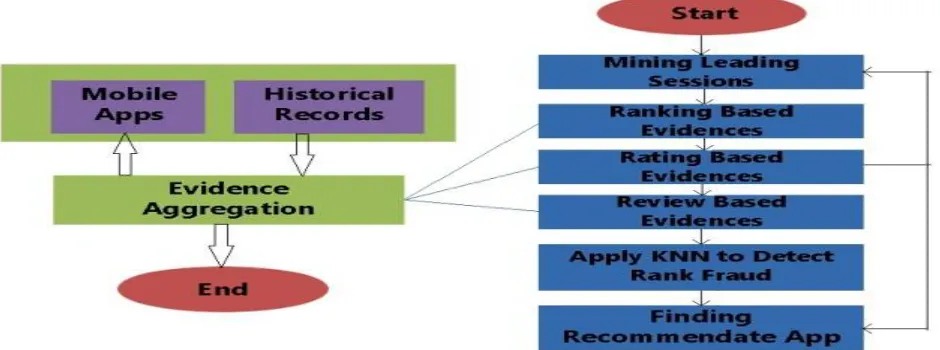
With the expansion in the quantity of web Apps, to identify the fake Apps, we have proposed a basic and powerful calculation which recognizes the leading sessions of each Application in light of its chronicled positioning of records. By examining the ranking behavior of apps, we come across that the fraud apps frequently has dissimilar patterns for ranking compared with the normal apps in every leading sessions. Subsequently, will perceive few extortion confirmations from applications chronicled records and expounded to three capacities to get such positioning from misrepresentation confirmations. Further we propose two sorts of fraud evidence taking into account App’s review and ratings. It mirrors some peculiarity designs from Apps' authentic rating and survey records. Fig. 1 shows the structure of our positioning extortion framework for versatile applications. The leading sessions of mobile applications are evidence of interval of popularity, so these driving sessions will include just positioning control. Subsequently, the issue of recognizing positioning extortion is to recognize dangerous driving sessions. Together with the essential errand is to take out the main sessions of a versatile application from its chronicled positioning records.
Fig 1. Proposed System Architecture
Proposed Algorithm
K-nearest neighbors algorithm (k-NN) is a method for classifying objects based on closest training examples in the feature space. k-NN is a type of instance-based learning, or lazy learning where the function is only approximated locally and all computation is deferred until classification. The k-nearest neighbor algorithm is amongst the simplest of all machine learning algorithms: an object is classified by a majority vote of its neighbors, with the object being assigned to the class most common amongst its k nearest neighbors (k is a positive integer, typically small). If k = 1, then the object is simply assigned to the class of its nearest neighbor
1.Store the output values of the M nearest neighbors to query scenario q in vector
r=(r1,…,rn) by repeating the following loop M times;
a. Go to the next scenario si in the data set, where is the current iteration within the domain{1,…,P}
b. If q is not set or q<d(q,si):qd(q,si),t0i
c. Loop until we reach the end of the data set(i.e. i=p)
ISSN(Online): 2320-9801
ISSN (Print): 2320-9798
I
nternational
J
ournal of
I
nnovative
R
esearch in
C
omputer
and
C
ommunication
E
ngineering
(An ISO 3297: 2007 Certified Organization)
Vol. 4, Issue 9, September 2016
2 Calculate the arithmetic mean output across r as follows:
1∶ ṝ= 1
3Return ṝ as the output value for the query scenario q
VII. CONCLUSION
In this paper, we analyzed ranking fraud detection model for mobile applications. Currently a large number of mobile application engineers use distinctive fraud frameworks to create their rank. To prevent this, there are distinctive fraud identifying techniques which are introduced in this paper. Such systems are collected into three classes, for instance, web ranking fraud recognition, online review fraud discovery, mobile application recommendation. The proposed system implements the knn algorithm that work rule generation for the recommendation system that restricts the fake reviews. The system recommendation has been generated through the system knn algorithm operations for the better results to the user on the basis of previous records. Complaints of an original version of application provider can be undertaken by using Mining Leading Session algorithm. The duplicate version is identified by the admin by means of Historical Records. The admin will also see the date of publication of the apps. When the apps is detected as fraudulently published by the admin then the respective app will be blocked. The user can give the feedback at only once. Hence, a new user who wants to download an app for some purpose can get clear view about the available applications
REFERENCES
[1]. K. Shi and K. Ali, ―Getjar Mobile Application Recommendations with Very Sparse Datasetsǁ, International Conference on Knowledge Discovery and Data Mining, 2012.
[2]. N. Spirin and J. Han, ―Survey On Web Spam Detection: Principles and Algorithmsǁ, SIGKDD Explor, 2012.
[3]. M. N. Volkovs and R. S. Zemel, ―A Flexible Generative Model for Preference Aggregationǁ, International Conference on World Wide Web, 2012.
[4]. Clifton Phua, Vincent Lee, Kate Smith and Ross Gayler, ―A Comprehensive Survey of Data Mining-based Fraud Detection Researchǁ. [5]. Z.Wu, J.Wu, J. Cao, and D. Tao Hysad, ―A SemiSupervised Hybrid Shilling Attack Detector for Trustworthy Product Recommendationǁ,
International Conference on Knowledge Discovery and Data Mining, 2012.
[6]. S. Xie, G. Wang, S. Lin, and P. S. Yu, ―Review Spam Detection via Temporal Pattern Discoveryǁ, international conference on Knowledge discovery and data mining, 2012.
[7]. B. Yan and G. Chen, ―Appjoy: Personalized Mobile Application Discoveryǁ, International Conference on Mobile Systems, Applications, and Services, MobiSys, 2011.