Recognizing Open-Vocabulary Relations between Objects in I
m
ages
Masayasu Muraoka∗ Sumit Maharjan† Masaki Saito‡
Kota Yamaguchi‡ Naoaki Okazaki† Takayuki Okatani‡ Kentaro Inui† IBM Research – Tokyo∗ Tohoku University†‡
{sumit,okazaki,inui}@ecei.tohoku.ac.jp† {msaito,kyamagu,okatani}@vision.is.tohoku.ac.jp‡
Abstract
How can we describe the relations between objects in a picture? As recent deep neu-ral networks have exhibited impressive
perfor-mance in identifying individual entities in a picture, in this study we turn our attention to recognize inter-object relations. To recognize open-domain relations, (a) we propose collect-ing relational concepts automatically froman image-text corpus. In addition, using collected relational instances, (b) we train a classifier to recognize inter-object relations. A relation recognition experiment conducted in our study suggests that relative information calculated fromobjects improves relation recognition ef-fectively.
1 Introduction
Generating image descriptions draws considerable attention in the natural language processing and computer vision communities. Recent studies have addressed this task by using a Deep Neural Network (DNN) (Kiros et al., 2014; Karpathy and Fei-Fei, 2015; Vinyals et al., 2015; Donahue et al., 2015; Johnson et al., 2015). Even though these studies pro-vide elegant end-to-end solutions, they essentially extract visual features trained for an object recog-nition task, and plug theminto a (variant of) neural languagemodel. In other words, these studies essen-tially utilize the languagemodel to put the ‘pieces’ of recognized objects into a sentence.
∗This work was conducted while the author was in Tohoku University.
PERSON
SKATEBOARD
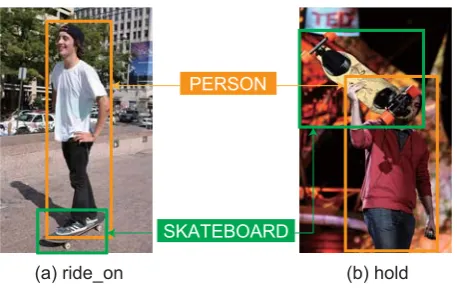
(a) ride_on (b) hold
Figure 1: Different relations between aman and skate-board.
One possible drawback of this approach is that these studies do not necessarily recognize the struc-ture of objects in an image, whereas a sentence typ-ically exhibits a syntactic/semantic structure. More specifically, they do not consider the spatial (posi-tional,magnitude, tangent, etc.) or action relations between objects in an image. Therefore, itmay be relatively easy to generate the description a man rides on a skateboard for Figure 1 (a) because the
major relation between the person and skateboard is
ride on. In contrast, we need to focus on the posi-tional relationship between theman and skateboard in Figure 1 (b), and verbalize the relationship ashold
for generating the descriptiona man holds a skate-board.
Now that DNNmodels have reached the level of a human’s ability for recognizing objects, as shown in the ImageNet Large Scale Visual Recognition Chal-lenge 2015 (ILSVRC2015) (He et al., 2015), we be-lieve that the primary and important next step to-ward image understanding is to recognize relations
tions between objects also opens up new applica-tions such as image retrieval using a subject-verb-object (SVO) triplet (Farhadi et al., 2010), reason-ing with relational knowledge grounded with both the image and text (Sadeghi et al., 2015), and en-richment of common-sense knowledge with visual information.
However, only a few studies have addressed re-lation recognition between objects. Elliott and de Vries (2015), Kong et al. (2014), and Lin et al. (2015) classified a pair of objects into a relation froma small number ofmanually-defined relations, but their types are restricted to positional ones (e.g.,
close to, on top of, and in front of), not including other types of relations such as actions (e.g., ride,
throw, andeat).
In this paper, we present the first approach for open-vocabulary relation recognition between ob-jects in images. The contributions of this paper are two fold.
(a) We propose to automatically extract relation instances between objects in images, e.g.,
ride on(PERSON, SKATEBOARD), using the IBM Model and the dependency information of descriptions.
(b) We train a classifier that recognizes relations between objects with novel features (e.g., po-sitional or regional feature and more), and demonstrate the effectiveness through the ex-periments.
2 Related work
2.1 Relation recognition between objects
Elliott and de Vries (2015) proposed Visual De-pendency Representation (VDR) to represent depen-dency relations between objects in images. VDR categorizes a relation of a pair of objects in five po-sitional relations:beside,above,below,on, and sur-rounds. They reported that the VDR-basedmethod could achieve a comparable performance to that us-ing DNN. Although they did not evaluate the effec-tiveness of VDR in relation recognition, the results indicated the importance of identifying inter-object relations for description generation.
RandomField (MRF) for building a relational graph representing inter-object relations. A node in the graph denotes either an object in an image or a noun in a caption describing the image. MRF trains the
mapping of objects to nouns. Their approach con-siders two types of relations (close–to, on–top–of) as the edge potential functions of MRF to capture a spatial relation between the objects. Extending the work of Kong et al. (2014), Lin et al. (2015) addressed a task for generatingmultiple sentences for indoor scenes, and built a scene graph froman image. In addition, they incorporated attribute ex-pressions (e.g., the color and size of an object) to vertices of the graph in order to generate detailed descriptions of the scene. In their work, a relation is defined by eight labels (next–to,near,top–of,above,
in–front–of,behind,to–left–of,to–right–of).
Unlike the previous work (Elliott and de Vries, 2015; Kong et al., 2014; Lin et al., 2015), we do not define relations in advance. Instead, we extract the vocabulary of relations between objects that are used frequently to describe the scenes of images in a dataset. This approach can naturally include action relations such aslook at,throw, andeat, which have never previously been explored.
The closest work to this paper is that by Aditya et al. (2015), in that they do not pre-define a relation vocabulary but instead extract relations from im -age descriptions. Their approach associates object categories (e.g., PERSON) with words (e.g., man) by using the WordNet hierarchy1. They extracted inter-object relation instances by applying a sem an-tic parser named the XYZ Parser (formally named the K-parser)2to image descriptions.
Our approach is different fromthat of Aditya et al. (2015) in two aspects. Firstly, we bridge object cate-gories and textual expressions by using an alignment
model for statisticalmachine translation. As we will show in Section 5.3, our alignment model outper-forms themethod using the WordNet hierarchy. Sec-ondly, they did not develop a relation recognizer be-tween two image objects, but only extracted relation instances for constructing a knowledge base. In
con-1It is trivial tomap an object category to textual expressions
because category labels were originally defined in ImageNet dataset and taken fromthe WordNet hierarchy.
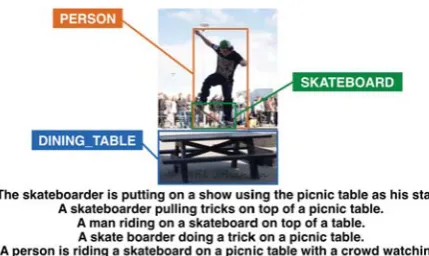
Figure 2: An instance in the MS COCO dataset.
trast, we build a classifier that predicts a relation be-tween a pair of objects.
2.2 Caption generation fromimages
Description generation is a fascinating application of image understanding. A number of studies applied DNNs for generating image descriptions with the availability of a large amount of training data (Karpathy and Fei-Fei, 2015; Vinyals et al., 2015; Donahue et al., 2015; Johnson et al., 2015; Kiros et al., 2014). A typical approach combines a Convolutional Neural Network (CNN) with a variant of a Recurrent Neural Network (RNN). We can view this approach as an instance of anencoder-decoder model, where an encoder (CNN) represents an input image with abstract features, and a decoder (RNN) realizes a sentence fromthe feature representation.
This architecture seemingly has the ability to rec-ognize object categories as well as relations between objects in an image. However, the end-to-endm od-els adopted in these studiesmake an analysis of the internal mechanism for generating image descrip-tions intractable. Furthermore, thesemodels do not encode spatial relationships between image objects. Thus, no one has demonstrated that these studies re-ally recognize relations between objects.
3 Dataset for image and description
We explore relations between objects using the MS COCO dataset (Lin et al., 2014)3. MS COCO is a large-scale collection of images depicting various objects in the scene, with an emphasis on the con-textual relationship betweenmultiple objects. The
3http://mscoco.org/
dataset was originally designed for various tasks in-cluding language generation, object segmentation, and context understanding betweenmultiple objects. The dataset contains 328k images, distributed under the Creative Commons Attribution 4.0 License4and Flickr Terms of Use5.
The dataset annotates objects with a single cat-egory (out of 80 categories) and a bounding box (e.g., the blue, green and yellow rectangles in Fig-ure 2). A bounding box is represented by four val-ues (x, y, w, h), where x and y represent the top-left coordinates of the bounding box, andw andh are the width and height, respectively, of the box. Throughout this work, we use the object categories and bounding boxes annotated in the dataset as the ground truth.
In addition, MS COCO includes five manually written descriptions (sentences) per image (see Fig-ure 2). We utilize these image descriptions to dis-cover relations between objects. For example, the third sentence in Figure 2 expresses theride on re-lation betweena mananda skateboard. If we could ground theman with a yellow bounding box (PER-SON) anda skateboardwith a green box (SKATE-BOARD), we could understand the meaning of
ride on(o1, o2)relation via the image: the objecto1 has a contact witho2, ando1is usually located above o2. Unfortunately, because the MS COCO dataset does not have alignments between images and words in its descriptions, we estimate the alignments, as will be explained in Section 5.1.
There are other publicly available datasets, such as the VLT2K (Elliott and Keller, 2013), PASCAL VOC (Everingham et al., 2014), Stanford 40 Ac-tions (Yao et al., 2011), and HICO (Chao et al., 2015). Those datasets contain relation inform a-tion, although the information restricts only posi-tional or action ones: VLT2K has only posiposi-tional relations, PASCAL VOC and Stanford 40 Actions contain action relations (e.g.,walkingandrunning), and HICO has human-object relations (e.g., riding a bike). We aim at a generic natural image under-standing that might involve object-object relation-ships other than people, and we consider the MS
4https://creativecommons.org/licenses/
by/4.0/legalcode
5https://info.yahoo.com/legal/us/yahoo/
utos/utos-173.html
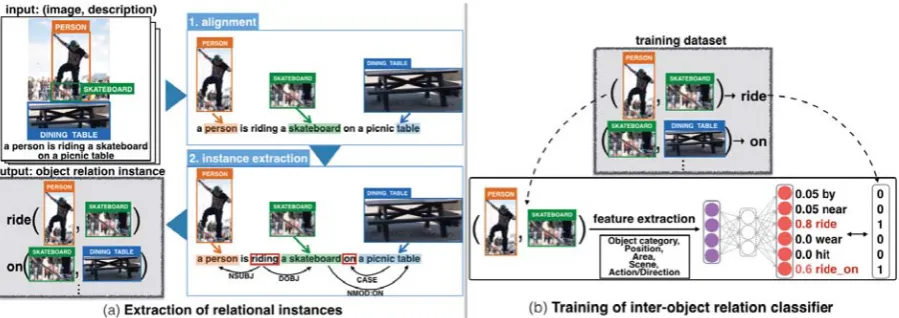
relation instances and (b) training of a classifier to recognize inter-object relations.
COCO dataset to be more appropriate for our pur-pose of open-vocabulary recognition.
4 Our approach
Figure 3 illustrates our approach. We first asso-ciate objects in an image with their corresponding expressions in the description, adapting an
align-mentmodel for statisticalmachine translation (Sec-tion 5.1). Using the alignments and dependency parses of image descriptions, we extract relation in-stances whose arguments are grounded to image ob-jects, and whose relations include various expres-sions that are commonly perceived and described for two objects (Section 5.2). Unlike the previous rule-based approaches (Elliott and Keller, 2013; Elliott and de Vries, 2015; Kong et al., 2014; Lin et al., 2015), our approach does not require hand-crafted relation labels or manual annotations between ob-jects.
Using the relation instances, we train a relation recognizer that predicts a relation for a given pair of unseen image objects (Section 6). The relation recognizer is modeled by a three-layer neural net-work, whose input provides various features for two given objects: object categories, relative coordinates and intersection areas, etc. The relation instances includemultiple relations between the same pair of objects in the image because MS COCO involves five independent descriptions. For example, the re-lation between the PERSON and SKATEBOARD is described byride onandridein Figure 2. Thus, we design the recognizer such that it can also handle
multiple relations between a pair of objects rather than force a single relation as the ground truth.
5 Extracting relation instances
5.1 Aligning image objects and text
Although the MS COCO dataset contains only 80 object categories (e.g., PERSON or CAR), each ob-ject category is referred to by a number of expres-sions. For example, the object category PERSON can be described by man, person, skateboarder,
skate boarder, etc., as shown in Figure 2. Thus, we need to identify the correspondences between ob-jects in an image and their referring expressions in the dataset.
In this study, we cast the problemof object-word alignment as a translation task, where the input lan-guage is a set of object categories and the output language is a description. Here, we use the IBM Model (Brown et al., 1993) to obtain the transla-tion probabilityP(w|c), wherec denotes an object category in an image and w denotes a word in its description. For instance, the IBM Model gives a higher probability forP(w = man|c = PERSON) after seeing the training instances:
PERSON, SKATEBOARD
a man is riding a skateboard
PERSON, DONUT
a man who is eating a donut
We use the GIZA++ (Och and Ney, 2003) im
ple-mentation6to estimate the alignments.
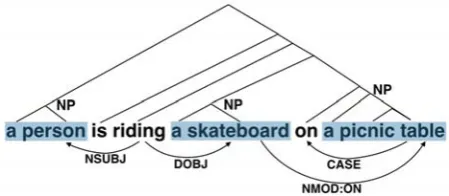
Figure 4: An output fromthe Stanford CoreNLP. The up-per part depicts a phrase-structure tree, and the lower part shows a dependency tree. Phrases in blue represent noun phrases.
5.2 Extracting relation instances
We extract object-relation instances froma descrip-tion with the image objects aligned. Suppose that we have a description that is aligned with the image objects.
a man/PERSONriding a skateboard/SKATEBOARD
on a picnic table/DINING TABLE
Here, we denote an object category in uppercase let-ters followed by a word and a slash. We extract two relation instances fromthe example:
ride(a man/PERSON,
a skateboard/SKATEBOARD),
on(a skateboard/SKATEBOARD,
a picnic table/DINING TABLE)
Because PERSON, SKATEBOARD, and DIN-ING TABLE are associated with the objects in the image, the two relation instances describe the re-lations between PERSON and SKATEBOARD ob-jects asrideand between SKATEBOARD and DIN-ING TABLE objects ason.
We design a method for extracting relation in-stances from dependency trees of image descrip-tions, inspired by the methods for Open Inform a-tion Extraca-tion (Schmitz et al., 2012; Nakashole et al., 2012; Xu et al., 2013; Moro and Navigli, 2013). We first parse a description using the Stan-ford CoreNLP (Manning et al., 2014)7. We find a set of the longest noun phrases (NPs) whose phrase structures are located at nodes of height no greater than three fromtheir leaves (in blue in Figure 4)8.
7We used Stanford CoreNLP 3.5.2.
http://stanfordnlp.github.io/CoreNLP/ 8This finds noun phrases with four words atmost.
Table 1: Result of object-word alignment.
Precision Recall F1 IBM Model .880 .743 .806
WordNet .738 .565 .638
We extract inter-object relation instances using the following templates.
1. v(o1, o2):o1 ←−−−nsubj v−−−→dobj o2 e.g.,ride(a man,a skateboard)
2. v p(o1, o2):o1←−−−nsubj v−−−→nmod o2 −−→case p e.g.,ride on(a man,a skateboard)
3. p(o1, o2):o1 −−−→nmod o2 −−→case p e.g.,on(a skateboard,a picnic table)
Templates 1 and 3 extract their example instances from Figure 4. Template 2 is used to extract the example from the sentence, “A man is riding on a skateboard.” In Template 1, we attach a parti-cle (compound:prt) if any to the verb for extract-ing take off(a man,the hat) from the sentence, “A
man is taking off the hat.” In this way, we extracted 156,293 instances with 5,153 distinct relations from
the MS COCO dataset.
5.3 Experiments
Table 1 reports the quality of the object-word
align-ments in terms of precision, recall, and F1. The performances were measured on a test set with 50 images that were sampled randomly from the MS COCO dataset; we annotated the gold-standard alignments for the 250 descriptions corresponding to the 50 images.
The alignment method presented in this paper achieved a reasonably high precision (0.880) despite its simplicity. Because we use only aligned descrip-tions as the source for relation extraction in Section 5.2, the precision ismore important than the recall.
In contrast, the method using the WordNet hi-erarchy, which has been commonly used in previ-ous work (Elliott and de Vries, 2015; Aditya et al., 2015), underperformed the presented alignment
method. The recall of the WordNetmethod was rel-atively low because WordNet is prone to suffer from
textual variations. For example, WordNet includes
skateboarderas a descendant of the synsetperson, but does not includeskate border norborder. The precision of the WordNet method was also lower than the IBM Model because some object categories
the MS COCO dataset.
Relation # of instances Relation # of instances on 19,666 (12.58%) of 4,096 (2.62%) in 14,300 (9.15%) next to 3,974 (2.54%) with 13,047 (8.35%) ride 3,711 (2.37%) hold 5,136 (3.29%) sit on 3,265 (2.09%) at 4,345 (2.78%) on top of 2,393 (1.53%)
(e.g., PERSON, FOOD, VEHICLE) are general con-cepts in WordNet and aremapped to general words (e.g.,buildingandgroup) inappropriately.
5.4 Collected relation instances
Table 2 lists the 10most frequent relations extracted fromthe MS COCO dataset. We can see fromthe ta-ble that our approach extracts not only spacial rela-tions consisting of preposirela-tions (e.g.,onandnext to) but also predicative relations representing actions (e.g.,hold,rideandsit on).
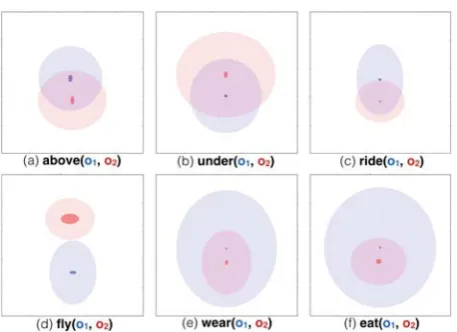
Figure 5 visualizes some interesting examples of relations. A relation instance r(o1, o2) consists of a relation expression r and objects o1 and o2 in the image. Each object o has the bounding box
(o.x, o.y, o.w, o.h). Therefore, we can compute the
means and standard deviations of objectso1 ando2 that appear as the arguments of the relationr. In this way, we can visualize a rough interpretation of spa-tial relationships between objects referred to by the relationr.
In Figure 5, we normalize the image coordinates of all bounding boxes to the range of [0,1], and transform the position of o2 to a relative coordi-nate with respect too1. The center of the ellipse in each visualization indicates themean of the center of the objects. A bright ellipse represents themean size of bounding boxes for the object, and a dark ellipse indicates the standard deviation of the cen-ter coordinates. For example, the visualization of
above(o1, o2)reflects themeaning ofabovethat the y-coordinate ofo1is greater than that ofo2.
The previous work (Elliott and de Vries, 2015; Kong et al., 2014; Lin et al., 2015) pre-defined rules to represent relations. For example, theabove rela-tion holds if an objecto1 has a greatery-coordinate than that ofo2 and if no overlap exists between the two objects. We would like to stress here that we could acquire similar rules automatically from the statistics of a large-scale dataset with image
anno-Figure 5: Visualization of positional relations between objects.
tations. In addition, it is non-trivial to define rules
manually for action verbs such aswearoreat. These spatial relationships will be encoded as features for the relation recognizer described in the next section.
6 Recognizing inter-object relations
6.1 Relation recognizer
Using the relation instances acquired in the previ-ous section, we train a classifier to recognize rela-tions between two objects in an unseen image. Let Rdenote a set of relations extracted in Section 5.2. WemodelP(r|o1, o2), the probability that two ob-jectso1 ando2 have the relation r ∈ R in the im -age. Note that multiple relations may hold true at the same time (e.g.,rideandride on). Thus, we
for-malize the recognition task as amulti-label classifi-cation problem. We design a three-layer neural net-work9 whose top layer uses the sigmoid activation functionσ,
P(r|o1, o2) =σ(wr·ho1,o2 +br), (1)
ho1,o2 = ReLU(Hxo1,o2 +bh). (2)
Here, xo1,o2 ∈ Rd is a feature vector for the two
object o1 and o2. The matrix H ∈ Rd×h, vec-tor wr ∈ Rd, and bias terms bh ∈ Rh, br ∈ R
are themodel parameters. ReLU(.) represents the leaky rectified linear unit function (Xu et al., 2015),
ReLU(x) = max(x, ax). We use the default slope
9We used Chainer (Tokui et al., 2015) to implement this
rela-Precision Recall F1 Majority baseline .282 .281 .281 Category only .467 .495 .480 All features .452 .474 .463 w/o Category .342 .352 .347
w/o Scene .479 .520 .499
w/o Action/Direction .449 .469 .459
w/o Area .441 .465 .453
w/o Position .420 .436 .428
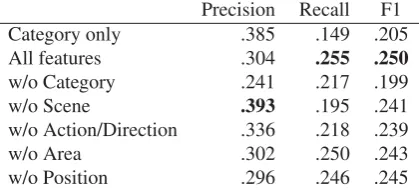
scores (0.045) between All features and Category only indicates the importance of spatial and visual features for recognizing relations between objects. We speculate the reason of the largest contribution of theCategoryfeature is that, compared to the spa-tial or visual features, it can reduce relation candi-dates given two objects. Wemight be able to specify the relations ifCategoryinformation (e.g., PERSON and SKATEBOARD) rather than the spacial or vi-sual information (e.g., ”o1 is upper ofo2”) is given when looking at a picture. The ablation test for Ac-tion/Directionshows that understanding the state of a person is also useful for recognizing relations.
We also evaluate the performance of relation recognition in terms of top-1 predictions, as it is im -portant practically for the application of description generation to predict at least one true-positive rela-tion. Defining a top-1 prediction as the relationrto which the classifier yielded the highest probability P(r|o1, o2) of all relations, we regard a prediction as correct if the predicted relation r is included in the set of gold relations.
Table 4 reports the performance of the top-1 eval-uation. We added a Majority baselinethat always predicts the most frequent relation on in the train-ing set. The full-featuremodel achieved a 0.463 F1 score. In contrast to our expectation, the best re-sult of a 0.499 F1 score was obtained without the scene features. This is probably because the rela-tion recognizer overfitted to the training data with the abstract features of thefc8layer of Place CNN, whichmay have the potential to discriminate against individual images. Removing the scene features, the relation recognizer could outperform the Category onlybaseline.
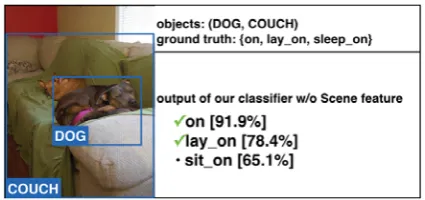
However, we also encounter pairs of image ob-jects for which the proposedmethod cannot predict relations in principle. Figure 6 shows a typical
ex-Figure 6: An example of our inter-object relation classi-fier. A green tick indicates that the relation is true (in-cluded in the gold labels).
ample of these instances. In this image, the dog is located around the center of the couch, but the spa-tial relationship is insufficient to describe the scene. Furthermore, we need to recognize the state of the dog in order to differentiate sleep on, lie on, and
sit on. It may be necessary to recognize the fine-grained properties about objects, e.g., whether or not the animal has its eyes closed.
7 Conclusion
In this paper, we presented the first approach for open-vocabulary relation recognition between ob-jects in images. In order to extract expressions that refer specifically to relations between objects, we successfully adopted a word alignmentmodel devel-oped for statistical machine translation. Using the relation instances whose arguments are grounded to image objects, we could train a relation recognizer that predicts a relation for a given pair of objects in an image. The experimental results demonstrated that the spatial features contributed to the task of re-lation recognition.
An immediate future work would be further anal-ysis to explore important features/attributes for rela-tion recognirela-tion, e.g., features/attributes expressing an object, two objects, or the whole scene of an im -age. We plan to demonstrate the usefulness of re-lation recognition between image objects in appli-cations including image description generation, im -age retrieval, and even image recognition with the commonsense knowledge extracted fromthe image descriptions.
Acknowledgments
re-Computer Vision and Pattern Recognition (CVPR), pages 1456–1464.
Michael Schmitz, Robert Bart, Stephen Soderland, Oren Etzioni, et al. 2012. Open language learning for
infor-mation extraction. InProceedings of the 2012 Joint Conference on Empirical Methods in Natural guage Processing and Computational Natural Lan-guage Learning, pages 523–534.
Seiya Tokui, Kenta Oono, Shohei Hido, and Justin Clay-ton. 2015. Chainer: a next-generation open source framework for deep learning. InProceedings of Work-shop on Machine Learning Systems (LearningSys) in The Twenty-ninth Annual Conference on Neural Infor-mation Processing Systems (NIPS).
Oriol Vinyals, Alexander Toshev, Samy Bengio, and
Du-mitru Erhan. 2015. Show and tell: A neural image caption generator. In Proceedings of the IEEE Con-ference on Computer Vision and Pattern Recognition (CVPR), pages 3156–3164.
Ying Xu, Mi-Young Kim, Kevin Quinn, Randy Goebel, and Denilson Barbosa. 2013. Open information ex-traction with tree kernels. InProceedings of the 2013 Conference of the North American Chapter of the As-sociation for Computational Linguistics: Human Lan-guage Technologies, pages 868–877.
Bing Xu, Naiyan Wang, Tianqi Chen, and Mu Li. 2015. Empirical evaluation of rectified activations in convo-lutional network. CoRR, abs/1505.00853.
Bangpeng Yao, Xiaoye Jiang, Aditya Khosla, Andy Lai Lin, Leonidas Guibas, and Li Fei-Fei. 2011.
Hu-man action recognition by learning bases of action at-tributes and parts. InProceedings of the IEEE Inter-national Conference on Computer Vision, pages 1331– 1338.
Bolei Zhou, Agata Lapedriza, Jianxiong Xiao, Antonio Torralba, and Aude Oliva. 2014. Learning deep fea-tures for scene recognition using places database. In