Subdomain Sensitive Statistical Parsing using Raw Corpora
Barbara Plank
∗, Khalil Sima’an
†∗Alfa Informatica, Faculty of Arts
University of Groningen, The Netherlands
†Language and Computation, Faculty of Science
University of Amsterdam, The Netherlands
Abstract
Modern statistical parsers are trained on large annotated corpora (treebanks). These treebanks usually consist of sentences addressing different subdomains (e.g. sports, politics, music), which implies that the statistics gathered by current statistical parsers are mixtures of subdomains of language use. In this paper we present a method that exploits raw subdomain corpora gathered from the web to introduce subdomain sensitivity into a given parser. We employ statistical techniques for creating an ensemble of domain sensitive parsers, and explore methods for amalgamating their predictions. Our experiments show that introducing domain sensitivity by exploiting raw corpora can improve over a tough, state-of-the-art baseline.
1.
Motivation
Current state-of-the-art statistical parsers are trained on large syntactically annotated corpora (treebanks) and their parameters are estimated to reflect properties of the train-ing data. Usually, a treebank/corpus consists of language use concerning a range of topics. For example, as observed by (Kneser and Peters, 1997), subdomains like ”politics, stock market, financial news etc. can be found“ in the Wall Street Journal (WSJ) Penn Treebank (PT) (Marcus et al., 1993). Hence, for a statistical parser trained on such a tree-bank the statistics gathered are averages over different sub-domains. By definition, averages smooth-out the statistical differences between the individual subdomains and weaken the biases in the model.
The present paper describes a method for incorporat-ing subdomain sensitivity into an existincorporat-ing state-of-the-art parser (Collins, 1997; Bikel, 2002) in order to improve its predictions. The main idea is to create and combine an en-semble of subdomain sensitive parsers (each for a different subdomain) without the need for further manual annotation of subdomain data. We exploit unannotated, subdomain specific corpora gathered from the web, for re-weighting the original treebank trees to reflect subdomain statistics, and employ that for training individual subdomain sensitive parsers. In what follows we describe first our re-weighting function, followed by methods for combining the subdo-main sensitive parsers. Finally, we exhibit the encouraging results of experiments against the baseline state-of-the-art parser.
2.
Subdomain Sensitive Parsing
To exploit domain-information and create an ensemble of subdomain sensitive parsers, one approach, used in (Bod, 1999), is to partition the given training treebank into dis-joint subtreebanks, each addressing one subdomain. We think that it is often not that straightforward (sometimes even impossible) to partition the training data along clear-cut subdomain borderlines. Furthermore, this approachleads to sparse data problems.
In this paper we suggest a more subtle method than par-titioning the treebank. For every subdomain, we create a “subdomain specific version” of the original treebank as follows. For every tree in the original treebank we give it a new count/weight that expresses the likelihood it will appear in the given subdomain. This method can be seen as sampling tree-types according to the specific subdomain distribution. We obtain subdomain specific parsers by train-ing a statistical parser on each of the resulttrain-ing subdomain specific versions separately. In the sequel, we present the method for tree-weighting followed by methods for parser combination.
2.1. Tree Weighting using LMs
Our Tree Weighting approach exploits Statistical Language
Models induced from raw subdomain-dependent corpora.
In more detail, given a set of subdomains and their corre-sponding raw corpora, we define a weighting function over the set of training instances in the original treebankT B:
1. For each subdomain-specific corpus, induce a Lan-guage Model (LM)θfrom the raw subdomain corpus.
2. For every treeπiin the treebankT B, define its count
under LMθto be equal to the average per-word count of its yieldy[πi]under LMθ:
fθ(πi) =fθ(y[πi]) =−logPθ(y[πi])/n
wherenis the length of yieldy[πi]andPθis the prob-ability under LMθ. Thus, the count is given by the length-normalized probability of the yield.
3. Letfmax
θ be the maximum count of a tree inT B
ac-cording toθ. The weightwiassigned toπi is defined
as:
wi=round
fmax θ
fθ(πi) a
(1)
sub-Figure 1: Summary of the Experimental Design for Sub-domain Aware Parsing
FINANCIAL and SPORTS subdomains, to the best of our
knowledge there were no ready-to-use corpora available. Hence, we used Wikipedia (Wikimedia Foundation Inc., 2007) to create domain-specific corpora ourselves. We used Wikipedia’s category system to extract relevant arti-cles from the English Wikipedia’s dump file, cleaned the articles from Wiki-syntax and segmented them into a one sentence-per-line corpus. The size of the resulting raw domain-specific corpora ranges from 6 to 11 million tokens. For each of the possible subdomains Statistical Language Models (LMs) were estimated and smoothed (using Chen and Goodman’s modified Kneser-Ney smoothing) by using the SRI Language Modeling Toolkit1 (SRILM). Then, we
applied our Tree Weighting function (section 2.1.) to create the subdomain specific training data2 for the
subdomain-sensitive parsers. The size of the resulting treebanks is be-tween 127k and 160k training instances.
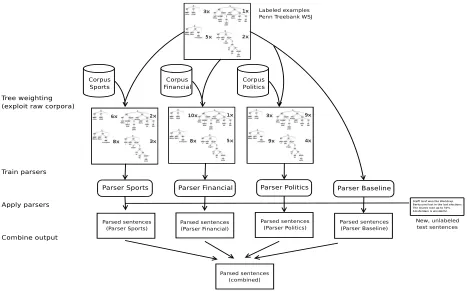
Figure 1 summarizes our experimental setting. The subdomain-weighted versions of the training treebankT Bθ
are created to train the respective parsing model. Our en-semble of parsers consists of a total of four parsers: three domain-dependent parsers, and the baseline parser. The domain-dependent parsers represent theFINANCIAL,POL
-ITICS and SPORTS domains, respectively. The baseline
parser is trained on the original treebank, the usual Penn Treebank WSJ sections 02 to 21, and is included in the en-semble to represent the ”general“ domainREST.
To evaluate parsing performance we use EVALB and the standard PARSEVAL evaluation metrics. Results of
1http://www.speech.sri.com/projects/srilm/
2
Note that we allowed duplicates in the original treebank be-fore weighting.
parsing sentences of length up to 40 words are reported for both the development (section 00) and test set (section 23).
Before assessing the ability of the parser combination tech-niques to select better parses, we first gauge in how far the Tree Weighting method (section 2.1.) results in a set of sub-domains parsers with complementary capabilities.
3.1. Effectiveness of Subdomain Tree Weighting To gauge whether subdomain Tree Weighting is giving more varied and useful subdomain specific parsers, we combine the output of the parsers using an optimal decision procedure, i.e. an oracle. Givenicandidate parse trees, the oracle is a decision procedure that selects the best tree by measuring the accuracy in F-score3against the gold stan-dard tree.
Parser / Combination Technique LR LP F-score
Section 00 (devset)
Baseline 89.44 89.63 89.53
Oracle combination 90.59 90.66 90.62
Improvement over baseline +1.15 +1.03 +1.09
Section 23 (testset)
Baseline 88.77 88.87 88.82
Oracle combination 90.11 90.11 90.11
Improvement over baseline +1.34 +1.24 +1.29
Table 1: Results of the pilot experiment
Table 1 demonstrates that the right combination of the parsers can yield a potential absolute performance increase
3
The harmonic mean of labeled precision (LP) and labeled re-call (LR): F-score=2∗LP∗LR
Individual Subdomain Parser LR LP F-score Section 00 (devset)
Sports 88.95 88.83 88.89
Financial 89.01 88.84 88.92
Politics 88.86 88.70 88.78
Table 2: Individual subdomain parser results
of 1.09% and 1.29% F-score compared to the baseline, ac-counting for an approximately 10% relative error reduction. The individual subdomain specific parsers, in contrast, are less accurate than the baseline when used each on their own (see table 2), which is expected since they are meant to be more specialized parsers.
Figure 2 exemplifies how subdomain sensitive parsing may improve over the original parser; it shows the relevant parts of the parse trees and the overall parsing performance for sentence #90 from the devset:
South Korea registered a trade deficit of $
101 million in October, reflecting the country’s economic sluggishness, according to government figures released Wednesday.
The example illustrates that a domain-specifically trained parser may indeed find a correct or better sentence anal-ysis than the baseline parser. The pilot study reveals that our domain-dependent parsing instantiation has potential. We next will see the results of our parser combination tech-niques that aim at achieving this potential.
Results of Parser Combination Techniques Table 3 re-ports the accuracy results for the selected parser combina-tion techniques on the test as well as the development set for sentences up to 40 words.
Parser / Combination Technique LR LP F-score
Section 00 (devset)
Baseline 89.44 89.63 89.53
Divergence Model (DVM) 89.50 89.68 89.59
Node Weight. incl. DVM,λ= 0.6 89.53 89.71 89.62
Section 23 (test set)
Baseline 88.77 88.87 88.82
Divergence Model (DVM) 88.80 88.91 88.85
Node Weight. incl. DVM,λ= 0.6 88.84 88.96 88.90
Table 3: Results of Parser Combination Techniques
Both the parser pre-selection and the parser post-selection technique can improve the baseline system slightly. The best technique is Node Weighting including the Divergence Model (NW-DVM), yielding an improvement of +0.09% and +0.08%. These figures are only about one tenth of the +1.29% that an oracle obtains (see table 1).
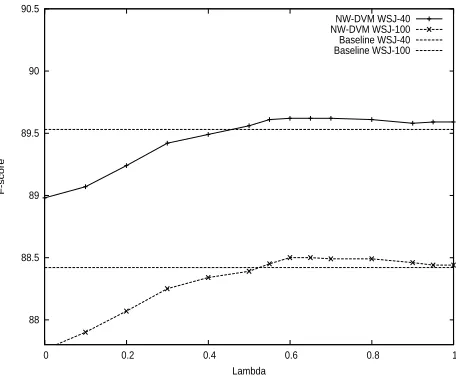
In figure 3 we depict the performance of NW-DVM when instantiated with various values forλ. We can see that for λ ≥0.5the technique slightly but constantly outperforms the baseline system, reaching a peak atλ= 0.6.
4.
Related Work
In (Bod, 1999), dialogue context/state is taken into ac-count by splitting up the training treebank into four disjoint
88 88.5 89 89.5 90 90.5
0 0.2 0.4 0.6 0.8 1
F-score
Lambda
NW-DVM WSJ-40 NW-DVM WSJ-100 Baseline WSJ-40 Baseline WSJ-100
Figure 3: Result of NW-DVM for sentences up to 40 (WSJ-40) and 100 (WSJ-100) words, respectively.
context-dependent subcorpora (place, time, date, yes/no). The “subdomain-dependent” parsers yield promising re-sults. For a tiny domain as the one explored by Bod (train information system) this simplistic approach could work given that the treebank is large enough. However, in the general case, splitting the training data into disjoint mains implies sparse data problems for each of the subdo-main parsers.
A further related study is the work by (Sekine, 1997). He analyzes the “domain dependence of parsing”. In his exper-iments a domain is characterized by the natural domains de-fined in the Brown corpus, for example ’Press Reportage’, ’General Fiction’ or ’Romance and Love Story’. Sekine ob-serves that in parsing, the data from the same domain is the most advantageous, followed by data from the same class, while training on data from another domain generally per-forms worst. Sekine claims that when trying “to parse a text in a particular domain, we should prepare a grammar which suits this domain” (Sekine, 1997), thus suggesting a “domain-dependent parser”.
Although different, work on domain adaptation is distantly related to our work. Recent research on adaptation is too numerous to discuss in a short paper. In particular, (Jiang and Zhai, 2007) suggest “instance weighting” as a method for adaptation. Our approach, subdomain instance weighting using raw data, can be seen as a novel ver-sion thereof. Theoretically speaking, successfull domain adaptation hinges on some sense of “overlap” between the source and target domains, e.g., (Ando and Zhang, 2005). The overlap between source and target domains can be seen as a (mix of) subdomain(s) of both. Naturally, in-stance weighting and its subdomain instantiation can be seen as a weighted version of self-training, e.g., (McClosky et al., 2006), which is again related to co-training (Blum and Mitchell, 1998).
5.
Conclusions and Outlook
a) VP
VBD
registered
NP
NP
a trade deficit
PP
IN
of
NP
NP
QP
$ 101 million
PP
in October
b) VP
VBD
registered
NP
NP
a trade deficit
PP
IN
of
NP
QP
$ 101 million PP
in October
Figure 2: Part of the parse tree for sentence #90 (a) predicted by the baseline parser (F-score of tree: 87.80%; incorrect PP-attachment), and (b) corresponding oracle prediction: in this case, either ofP arserFINANCIAL orP arserPOLITICS
(F-score of tree: 100%; correct PP-attachment).
sensitive parsers, where each parser is assumed to special-ize in its domain.
The empirical results demonstrate that our subdomain Tree Weighting method is promising as it yields an improve-ment of up to 1.29% F-score on the Penn Treebank Wall Street Journal. However, the experiments also show that parser combination is not a straightforward task: amalga-mating parser predictions gives only a modest improvement (+0.09%) over the (very tough) baseline system.
Given the simplicity of the Treebank Weighting scheme and the examined parse(r) selection methods, the experimen-tal results are promising and warrant further exploration. Therefore, future work will be manifold and consists in, amongst others: defining other ways of instantiating subdo-main sensitive parsers by using a more sophisticated notion of subdomain (e.g. integrating relations between entities), extending the current approach to a Bayesian approach, ex-ploring more sophisticated parser combination techniques, and examining the approach on corpora other than the WSJ, e.g., Brown corpus (see (Gildea, 2001)), thus looking at domain adaptation. Furthermore, we would like examine our approach with the current best-performing parsing sys-tems (Charniak and Johnson, 2005). It consists of a gen-erativen-best parsing system that employs a discriminative reranking scheme. We would like to gauge to what extent n-best parsing might benefit from subdomain information.
6.
References
Rie Kubota Ando and Tong Zhang. 2005. A framework for learn-ing predictive structures from multiple tasks and unlabeled data. Journal of Machine Learning Research, 6:1817–1853. Bikel, D. (2002). Design of a Multi-lingual, Parallel-processing
Statistical Parsing Engine. Proceedings of HLT 2002. Avrim Blum and Tom M. Mitchell. 1998. Combining labeled and
unlabeled sata with co-training. In COLT, pages 92–100. Bod, R. (1999). Context-sensitive spoken dialogue processing
with the DOP model. In Natural Language Engineering. Cam-bridge University Press.
Charniak, E. and Johnson, M. (2005). Coarse-to-Fine n-Best Pars-ing and MaxEnt Discriminative RerankPars-ing. ProceedPars-ings of the
43rd Annual Meeting of the Association for Computational Linguistics (ACL 2005).
Collins, M. (1997). Three Generative, Lexicalised Models for Statistical Parsing. Madrid. Proceedings of the 35th Annual Meeting of the ACL-EACL.
Collins, M. (2003). Head-Driven Statistical Models for Natural Language Parsing. Association of Computational Linguistics. Gildea, D. (2001). Corpus variation and parser performance. In
Proceedings of the 2001 Conference on Empirical Methods in Natural Language Processing (EMNLP).
Jing Jiang and ChengXiang Zhai. 2007. Instance weighting for domain adaptation in nlp. In Proceedings of ACL 2007, pages 264–271, Prague, Czech Republic, June. Association for Com-putational Linguistics.
Kneser, R. and Peters, J. (1997). Semantic clustering for adaptive language modeling. volume 02, page 779, Los Alamitos, CA, USA. IEEE Computer Society.
Koehn, P. (2005). Europarl: A Multilingual Corpus for Evaluation of Machine Translation. MT Summit.
Marcus, M., Santorini, B., and Marcinkiewicz, M. (1993). Build-ing a Large Annotated Corpus of English: the Penn Treebank.
Computational Linguistics, 13.
D. McClosky, E. Charniak, and M. Johnson. 2006. Reranking and self-training for parser adaptation. In Proceedings of the
COLING-ACL 2006. The Association for Computer
Linguis-tics.
Wikimedia Foundation Inc. (2007). Wikipedia, The Free Ency-clopedia. http://en.wikipedia.org/.