From pattern to gene, from gene to pattern
SEAN B. CARROLL*
Howard Hughes Medical Institute and Laboratory of Molecular Biology, University of Wisconsin, Madison, USA
ABSTRACT Our understanding of animal development has been revolutionized by genetic ap-proaches to the identification and isolation of pattern-regulating genes. In the past several years, fundamental embryological concepts such as morphogenetic fields, compartments, and organizers have been defined at a molecular level and visualized in developing animals. Here, I will discuss how the focus on the regulation and function of genes with dramatic effects on pattern formation, primarily by through the analysis of gene expression patterns as surrogates of physical pattern elements, has elucidated gene hierarchies that control developmental pathways.
KEY WORDS:
hierarchy, selector gene
0214-6282/97/$10.00
© UBC Press Printed in Spain
*Address for reprints: Howard Hughes Medical Institute and Laboratory of Molecular Biology, University of Wisconsin, 1525 Linden Drive, Madison, WI 53706,
USA. FAX: 608/262-9343. e-mail: [email protected]
“It is the mystery and beauty of organic form that sets the problem for us.” Ross Harrison (1913)
Introduction
What is the fascination of animal patterns? Surely there are many scientific motivations. Paleontologists study the forms and distributions of characters for clues to the relationships among animals and to gain insight into the tempo of evolution. Ecologists interpret patterns as the adaptive responses to the diversity of biological environments. For biomechanicians, patterns are the architectural solutions to problems posed by the physical world such as viscosity, gravity, pressure or heat. And, for embryologists, pattern formation is the central issue.
While the inspiration for studying patterns differ among sub-disciplines of Biology, there is one dimension that is shared by these fields and can be equally appreciated by the lay person -the aesthetic. Paul Weiss, the zoologist who contributed to the concept of morphogenetic field in the 1920’s, pointed out that what fossils, plants, and animals have in common, and that we sense as beauty, are the widely recognized elements of the aesthetics of art includ-ing features of symmetry, repetition, the alternation of pattern elements, the use of curves, proportions, and size gradients (Weiss, 1955). While often neglected or negated within scientific circles, the aesthetic motivation, as science historian Robert Root-Bernstein has amply documented, has inspired many of the most creative periods and minds of physics, chemistry, astronomy, and biology (Root-Bernstein, 1996).
Indeed, Agassiz, Haeckel, Boveri, and the prominent experi-mental embryologists of the first part of this century -Harrison, Spemann, Needham, Thompson, Weïss, and Waddington were inspired by what Gilbert and Faber have termed the visual and
conceptual aesthetics of emerging form (Gilbert and Faber, 1996). The early geneticists were not immune to the appeal of aesthetics. The once embryologist T.H. Morgan wrote:
“A transparent egg as it develops is one of the most fascinating objects in the world of living beings. The continuous change in form that takes place from hour to hour puzzles us by its very simplicity. The geometric patterns that present themselves at every turn invite mathematical analysis....This pageant makes an irresistible ap-peal to the emotional and artistic sides of our nature.”
But Morgan also cautioned:
“.... if the mystery that surrounds embryology is ever to come within our comprehension, we must ...have recourse to other means than description of the passing show (Morgan, 1927).”
re-examine the concepts of activator, selector, and realizator genes in light of the current depth of information about these hierarchies. I will briefly explore some of the major unsolved puzzles concern-ing selector genes and morphogenesis, the understandconcern-ing of which will be crucial to our appreciation of the beauty and diversity of animal design.
From pattern to gene: patterns of gene expression as
surrogates of final form
“Goethe called architecture ‘frozen music’. In the same sense, organic form is frozen development; and formal beauty reflects developmental order.” Paul Weiss (1955)
Genetic approaches to pattern forma-tion have focused primarily on the isola-tion of mutants with major effects on some regular feature of larval or adult body pattern. These mutants have gen-erally been classified according to their disruption of the formation, symmetry, identity, or size of specific structures -that is, according to their effects on the aesthetics of body pattern. Tempera-ture-sensitive mutations and clonal analy-sis techniques have further addressed the temporal and spatial requirements for, and cell autonomy of, gene function. By breaking down patterns into their es-sential major genetic inputs, otherwise imperceptible steps involved in the elabo-ration of final forms have been revealed. For example, the discovery of pair-rule gene mutants in Drosophila was wholly unexpected because it revealed that the establishment of the overt segmental periodicity of the larva proceeded through an intermediate, morphologically invis-ible, double-segment periodicity. With genetic approaches alone, many impor-tant concepts about the logic and hierar-chy of genetic operations during devel-opment have emerged. These include the role of homeotic genes as “selectors” of metamere pattern (García-Bellido, 1975; Lewis, 1978), the sequential compartmentalization of growing struc-tures (García-Bellido, 1975), and the pro-gressive subdivision of the embryonic field into smaller domains (Nüsslein-Volhard and Wieschaus, 1980).
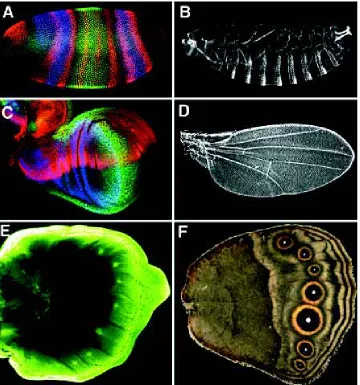
Further insights, however, as to how mutant phenotypes relate to gene func-tion during normal development required the molecular characterization of gene structure, function, and regulation. When molecular techniques revealed that the patterns of expression of particular ma-jor genes correlates with the formation Fig. 1. Patterns of gene expression as surrogates of final form. The patterns of gene expression in
developing Drosophila embryos (A), Drosophila wing imaginal discs (C), and butterfly wings (E) have served as surrogates for the analysis of final forms (B, D, and F, respectively). (A) Blastoderm Drosophila embryo stained with antibodies to the hairy (red), Kruppel (green), and giant (blue) segmentation proteins. (B) Segmental larval cuticular pattern nearly 24 h later. (C) Expression of the apterous (blue), cubitus interruptus (red) and vestigial (green) proteins reveals the dorsal compartment, anterior compartment, and future wing field of the growing imaginal disc which days later will metamorphose into (D), the adult wing. (E) Expression of the Distal-less protein (green) in spots in the center of each subdivision of the developing Bicyclus anynana wing in a fifth instar larva marks the future position of eyespots on the adult wing (F).
develop-ment. These gene expression patterns are the “frozen” moments in development that allow us to analyze the architecture of the regulatory hierarchies that underlie the formation of final patterns.
From gene to pattern: piecing together genetic
hierar-chies
“I should like to work like the archaeologist who pieces together the fragments of a lovely thing which are alone left to him. As he proceeds, fragment by fragment, he is guided by the conviction that these fragments are part of a larger whole which, however, he does not yet know.” Hans Spemann (1938) (Spemann, 1938)
In 1975, García-Bellido suggested that developmental path-ways consist of a sequence of steps controlled by the function of discrete genes. He offered the terms “selector genes” for homeotic genes (and other pattern-determining genes such as scute and hairy), “realizator gene” for the genes that encode products char-acteristic of differentiated cell types, and “activator” gene for those that encode products that regulate selector gene activation (García-Bellido, 1975). The fairly scanty evidence then available led him to add that “several genetic steps seem to be interposed between the reception of a signal, extrinsic to the genome, and its translation first into genetic and later into developmental terms. A hierarchy of genes may be involved in this process...”
The program for the past two decades has been to identify groups of genes necessary for the formation of a structure or pattern and to reassemble (conceptually) the connections between these genes that control the developmental operations that lead to
the final pattern. In practice, the architecture of these regulatory hierarchies emerges from the detailed analysis of the dependence or independence of individual gene expression patterns upon the function of other candidate members of the hierarchy. In this fashion it can be distinguished whether genes of a given phenotypic class control different steps of a single pathway and/or whether genes of different classes act sequentially or in parallel during development.
in the same hierarchy. The total loss-of-function mutant phenotype of such genes does not reveal these multiple roles which must be discerned by more dynamic methods. These three features of genetic hierarchies and the concrete existence of fields, compart-ments and organizers are well illustrated by the genetic hierarchy controlling the development of one of the most scrutinized pattern elements on the adult Drosophila, the wing edge or margin.
A model hierarchy: Pattern formation at the wing margin
Scores of studies have contributed directly or indirectly to our knowledge of the most proximate genetic regulatory mechanisms involved in the positioning and differentiation of the wing margin. Furthermore, progress in understanding many other patterning processes makes it possible to trace the many developmental operations upon which wing margin formation ultimately depends all the way back to the early embryo. The picture of this continuum is the result of piecing together subhierarchies that control the genesis of the peripheral nervous system, specification of the global wing field, compartmentalization of the wing imaginal disc, formation of the embryonic wing primordium, and the establish-ment of the anteroposterior and dorsoventral polarity of embryonic segments (Fig. 2).
The earliest manifestations of the developing wing margin are the expression of several genes in the third instar imaginal wing disc. The activation of the wingless gene in a stripe along the dorsoventral (DV) boundary of the disc (the future edge or margin of the wing, Fig. 2, red line in part IV) and of the AS-C genes in rows of sensory organ precursors on either side of the anterior portion of the Wg domain (Fig. 2, part IV, black dots) have become surrogates for the adult wing margin pattern. By studying the expression and regulation of these patterns it is now understood that Wg protein produced by cells along the DV boundary of the disc induces the expression of the AS-C genes (Couso et al., 1994; Diaz-Benjumea and Cohen, 1995; de Celis et al., 1996; Zecca et al., 1996). Products of the AS-C genes initiate the refinement of the stripe of AS-C gene expression into single sensory organ precur-sors via the Notch-mediated lateral inhibition pathway (Artavanis-Tsakonas et al., 1995). The vestigial gene acts in parallel as a nodal point for wing identity and is activated in two domains that together comprise the wing field: one domain is the D/V boundary and the second is the growing imaginal wing disc pouch which is in part organized by the Wg signal (Kim et al., 1996; Zecca et al., 1996; Neumann and Cohen, 1997). There is relatively little known about
the specific genetic operations that follow the establishment of these gene expression patterns in the third larval instar and that control the actual morphogenesis of the adult wing margin days later. Most efforts have focused on the operations leading to the establishment of the margin patterning field at the DV boundary.
The formation of the DV organizer and activation of genes at the DV boundary depends directly on the process of compartmentalization. Reciprocal signaling takes place between dorsal cells, whose identity is specified by the apterous selector gene (Diaz-Benjumea and Cohen, 1993) and the ventral cells. The signaling is mediated through ligands of the Notch receptor/signal transduction pathway, and induces the activation of wg and the vg boundary enhancer (Couso et al., 1995; Diaz-Benjumea and Cohen, 1995; Kim et al., 1995). In turn, DV compartmentalization must depend upon as yet unknown determinants that control the polarity of the early wing disc. In the early embryo, formation of the wing disc is regulated by the Wg signal along the anteroposterior axis of the embryonic body wall and the decapentaplegic and spitz signals along the dorsoventral axis of the embryo (Cohen et al., 1993; Goto and Hayashi, 1997). Wg function during formation and patterning of the wing field is a good example of the same signaling protein playing multiple roles in patterning hierarchies. Wg is required for at least three temporally and spatially independent operations: in the embryo for the segregation of the entire imaginal disc, in the second instar for specification of the wing field, and in the third instar to organize patterning from the D/V organizer.
Activator, selector, and realizator genes revisited
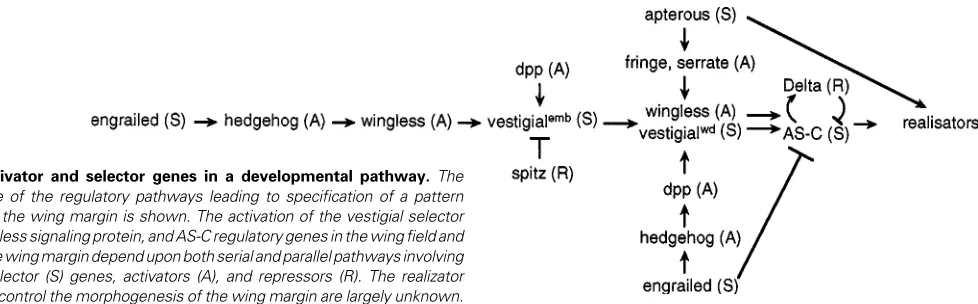
The genetic hierarchy controlling the formation and patterning of the wing margin contains several tiers of activating signals that regulate the expression of several types of genes that control cell identities. In terms of García-Bellido’s original concepts of an activator-selector-realizator hierarchy, we now understand that pathways are not strictly linear but branch and converge over time and in space. In this example, cells must “know” that they are within the wing field, whether they are a sensory organ precursor, either dorsal or ventral, or anterior or posterior. This information is imparted by at least four “selector” genes -vestigial, AS-C, engrailed, and apterous. The spatial patterns of activation of these are not regulated in a strict, linear hierarchical fashion but are activated through a combination of both independent and interaction-de-pendent regulatory mechanisms. For example, the expression of the vestigial selector gene in the wing field and the AS-C genes in Fig. 3. Activator and selector genes in a developmental pathway. The
the anterior wing margin are the product of both serial and parallel regulatory pathways (Fig. 3) involving an impressive number of activators.
Unsolved puzzles: The special role of selector genes
and morphogenesis
Ironically, despite the immense interest in the function of homeotic genes over the past two decades, relatively little is known about the roles played by selector genes in patterning hierarchies. A few targets of individual homeotic genes have been identified, but it is not understood whether homeotic selectors act upon a few genes at a higher level in a hierarchy or upon many genes throughout a hierarchy. Clearly, if we are to understand the development and evolution of segment and appendage diversity in insects and of body regions in other animals, an elucidation of the hierarchies regulated by the homeotic genes will be required.
A second major gap concerns the realizator genes. The search for mutations with large effects on body patterns and the use of patterns of gene expression as surrogates for final patterns, while immensely successful for understanding organization of the body plan and body parts, has generally neglected the problem of morphogenesis. We have terrific knowledge of genes required for segmentation, organogenesis and the differentiation of various cell types but virtually no grasp of what genes and processes are responsible for the morphogenesis of segments or to determine organ or cell size, shape, and microarchitecture. We are still largely “upstream” of the genes that determine cytoarchitecture and need to identify these and to understand the role of selector genes in their regulation.
García-Bellido has called for such an effort to focus on evolu-tionary invariant operations that control specific cellular behaviors (e.g., adherence) (García-Bellido, 1993), and suggests that: “The emerging picture is going to be more akin to a cubist painting than to a realistic portrait.” We have come very far, very quickly by devising simple, abstract representations of animal form. But while our methods have evolved and technical innovations have been essential catalysts, the inspiration remains the same now as it was for Harrison, Spemann, and the early developmental geneticists -to understand the developmental order underlying the beauty of animal form.
Acknowledgments
I thank Scott Gilbert for comments and his writing which provoked some of the ideas in this essay; Allen Laughon, Jeremy Ahouse and Stephen (Steve-O Devo) Paddock for additional comments; Steve Paddock, Jaeseob Kim and Leanne Olds for the artwork; and Jamie Wilson for help in manuscript preparation. SBC is an investigator of the Howard Hughes Medical Institute.
References
ARTAVANIS-TSAKONAS, S., MATSUNO, K. and FORTINI, M. (1995). Notch signaling. Science 268: 225-232.
COHEN, B., SIMCOX, A.A. and COHEN, S.M. (1993). Allocation of the thoracic imaginal primordia in the Drosophila embryo. Development 117: 597-608.
COUSO, J., BISHOP, S. and MARTINEZ ARIAS, A. (1994). The wingless signaling pathway and the patterning of the wing margin in Drosophila. Development 120: 621-636.
COUSO, J., KNUST, E. and MARTINEZ ARIAS, A. (1995). Serrate and wingless cooperate to induce vestigial gene expression and wing formation in Drosophila. Curr. Biol. 5: 1437-1447.
DE CELIS, J., GARCIA-BELLIDO, A. and BRAY, S. (1996). Activation and function of Notch at the dorsal-ventral boundary of the wing imaginal disc. Development 122: 359-369.
DIAZ-BENJUMEA, F. and COHEN, S. (1993). Interaction between dorsal and ventral cells in the imaginal disc directs wing development in Drosophila. Cell 75: 741-752.
DIAZ-BENJUMEA, F. and COHEN, S. (1995). Serrate signals through Notch to establish a Wingless-dependent organizer at the dorsal/ventral compartment boundary of the Drosophila wing. Development 121: 4215-4225.
FUJIOKA, M., JAYNES, J. and GOTO, T. (1995). Early even-skipped stripes act as morphogenetic gradients at the single cell level to establish engrailed expression. Development 121: 4371-4382.
GARCIA-BELLIDO, A. (1975). Genetic control of wing disc development in Dro-sophila. Ciba Found. Symp. 29: 161-182.
GARCÍA-BELLIDO, A. (1993). Coming of age. Trends Genet 9: 102-103.
GILBERT, S. and FABER, M. (1996). Looking at embryos: the visual and conceptual aesthetics of emerging form. In The Elusive Systhesis: Aesthetics and Science (ed. Tauber, A.) Kluwer Academic Publishers, Netherlands. pp. 125-151.
GOTO, S. and HAYASHI, S. (1997). Specification of the embryonic limb primordium by graded activity of Decapentaplegic. Development 124: 125-132.
KIM, J., IRVINE, K. and CARROLL, S. (1995). Cell recognition, signal induction, and symmetrical gene activation at the dorsal-ventral boundary of the developing Drosophila wing. Cell 82: 795-802.
KIM, J., SEBRING, A., ESCH, J., KRAUS, M., VORWERK, K., MAGEE, J. and CARROLL, S. (1996). Integration of positional signals and regulation of wing formation and identity by Drosophila vestigial gene. Nature 382: 133-138.
LEWIS, E.B. (1978). A gene complex controlling segmentation in Drosophila. Nature 276: 565-570.
MICHELSON, A., ABMAYR, S., BATE, M., ARIAS, A. and MANIATIS, T. (1990). Expression of a MyoD family member prefigures muscle pattern in Drosophila embryos. Genes Dev. 4: 2086-2097.
MORGAN, T. (1927). Experimental Embryology. Columbia University, New York.
NEUMANN, C. and COHEN, S. (1997). Long-range action of Wingless organizes the dorsal-ventral axis of the Drosophila wing. Development 124: 871-880.
NÜSSLEIN-VOLHARD, C. and WIESCHAUS, E. (1980). Mutations affecting segment number and polarity in Drosophila. Nature 287: 795-801.
ROOT-BERNSTEIN, R. (1996). The sciences and arts share a common creative aesthetic. In The Elusive Synthesis: Aesthetics and Science (ed. Tauber, A.) Kluwer Academic Publishers, Netherlands. pp. 49-82.
SKEATH, J.B. and CARROLL, S.B. (1992). Regulation of proneural gene expression and cell fate during neuroblast segregation in the Drosophila embryo. Develop-ment 114: 939-946.
SMALL, S., KRAUT, R., HOEY, T., WARRIOR, R. and LEVINE, M. (1991). Transcrip-tional regulation of a pair-rule stripe in Drosophila. Genes Dev. 5: 827-839.
SPEMANN, H. (1938). Embryonic Development and Induction. Yale University Press, New Haven.
WEISS, P. (1955). Beauty and the beast: Life and the rule of order. Sci. Monthly 81: 286-299.