The word complexity measure (WCM) in early
phonological development: A longitudinal study from birth to
three years old
Li-mei Chen
1and Yi-Hsiang Liu
2Abstract
Word Complexity Measure (WCM, Stoel-Gammon, 2010) is a system of phonological assessment for children’s speech productions, a method that focuses on the complexity rather than accuracy. With its flexible parameter program, the assessment can be adjusted to the phonological properties of different languages. In the current study, the WCM was used to assess speech production of three Mandarin-learning children from birth to three years old. In addition to the original parameters in Stoel-Gammon (2010), the Chinese version of WCM made some adjustments, including incorporating productions of fricatives, affricates, /ʐ/, /y/, and the late acquired vowels and consonants, to examine the complexity of speech productions. Major findings in the developmental changes of the first 3 years are: 1) the complexity of the intelligible words increased, with individual differences in the stability of changes; 2) the complexity of the unintelligible syllables also elaborated; 3) the percentage of simple words/syllables decreased in both intelligible and unintelligible productions.
Keywords: Production complexity, Mandarin-learning children, Phonological development, Word
complexity measure
1. Introduction
Word Complexity Measure (WCM, Stoel-Gammon, 2010) is a measurement for developmental phonology and disorder. WCM focuses on the complexity and is based on point-giving process. Comparing with Percentage of Consonant Correct (PCC, Shriberg & Kwiatkowski, 1982) and the measurement of whole-word productions (Ingram, 2002), WCM demonstrates advantages in describing the development of speech production because the parameter in WCM was designed to mirror the properties of child phonology. The PCC also calculates points in children’s speech for measuring intelligibility. However, in PCC only the accurate speech sounds are given points in the process, and those unintelligible utterances are not scored because they are not real words. Namely, the PCC examines and quantifies the accuracy of the sounds that is articulated correctly. However, children produce not only the intelligible words but many non-word sounds, especially in the early ages. By means of the WCM, those unintelligible utterances can also be scored and quantified. Children with
1,2 Department of Foreign Languages and Literature, National Cheng Kung University
The 2015 Conference on Computational Linguistics and Speech Processing ROCLING 2015, pp. 233-247
small vocabulary can also be inspected. For example, children with language disorders can also be examined with this measurement. This may provide a useful tool for clinical assessment. Moreover, WCM provides phonological development scales with which phonological changes can be tracked. In addition, children’s forms can be compared with target forms with WCM measures. Namely, both independent and relational analysis can be done with WCM. The whole-word production (Ingram, 2002) proposed four measures to estimate speech production of children: 1) the phonological mean length of utterance (PMLU); 2) the proportion of whole-word proximity; 3) the proportion of whole-word correctness; 4) the proportion of whole-word variability. The core lies in the PMLU, which gives points to each word based on two factors: 1) the number of segments in a word; 2) the number of correct consonants. The former factor demonstrates the independent analysis, and the later the relational analysis. In this aspect, the measurement of whole-word production is close to the WCM. However, the WCM can further provide a more comprehensive picture by accounting for both qualitative and quantitative nature in phonological development(Stoel-Gammon, 2010).
Furthermore, the prevailing advantage of the WCM is the flexible parameters that can be adjusted to target languages. This measurement was initially designed for English-speaking children, while in the present some of the parameters of WCM were adjusted to observe Chinese phonological system. The recorded speech productions were divided into two groups: intelligible words and unintelligible utterances. Each group was scored separately to prevent improper comparison of speech sounds in non-words and real words. Based on the phonological parameters, each sample was awarded a ‘complexity score’ and was calculated to get a ratio which mirrored the nature of error and accuracy. In general cases, first words emerge at the age of 12-15 months (Stoel-Gammon, 1989). The longitudinal speech productions analyzed in the present study started from about 2 months of age to better observe the transition from pre-speech vocalization to real-word productions.
2.
Methodology
2.1
Participants
Data of 3 typically developing boys (Child A, B, and C) were analyzed from 2 to 36 months of age. This longitudinal data is part of a larger scale of longitudinal observation of phonetic development in
Mandarin-learning children.
2.2 Procedure
were included in each recording.
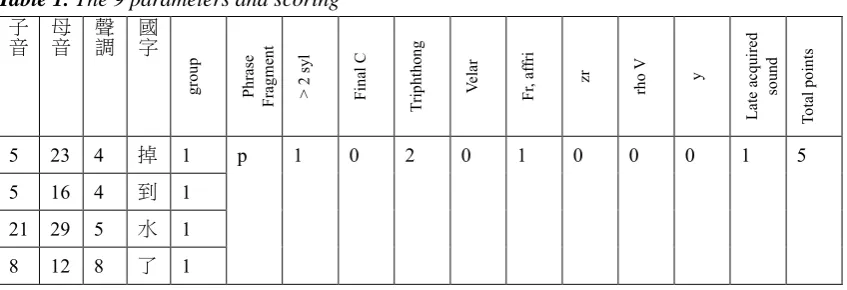
Each speech sample was awarded a score. Higher scores denote the presence of complex or later acquired phonological parameter. The adjusted parameters in the present study are listed below:
Word patterns
(1) Productions with more than two syllables receive 1 point.
Syllable structures
(1) Productions with a word–final consonant receive 1 point.
(2) Productions with a triphthong receive 1 point for each triphthong.
Sound classes
(1) Productions with a velar consonant receive 1 point for each velar. (2) Productions with a rhotic vowel /ɚ/ sound receive 1 point for each /ɚ/.
(3) Productions with a fricative or affricate receive 1 point for each fricative and affricate. (4) Productions with a /ʐ/ sound receive 1 point for each /ʐ/.
(5) Productions with a /y/ receive 1 point for each /y/.
(6) Productions with any of the late acquired sounds /ɨ/, /ɪaʊ/, /ɪo/, /ɪaŋ/, /tɕʰ /, /tɕ/, /ts/, or /ɕ/ receive 1 point for each of the late acquired sounds.
In this version of the WCM, the complexity indexes are modified. In word patterns, instead of words used in English, utterances (non-words) or phrases (intelligible meaningful units) were the units for analysis in Chinese version. In rule 1 in the current study, the distinction between a phrase and a fragment were made first. A phrase may include more than two words with a complete meaning (for example ‘ping guo’ apple in Chinese), while a fragment is a unfinished phrase that expresses incomplete meaning due to the sound quality or noise interruption. A fragment may contain only one word or more. Either a phrase or a fragment is counted as one unit. In syllable structures, the consonant cluster in the original WCM in rule 2 is replaced by triphthongs.
In sound classes, the syllabic liquid sound in the original WCM is deleted, and the only rhotic vowel in Chinese /ɚ/ is counted in rule 2. The voiced fricative /ʐ/ and the rounded high front vowel /y/ were added in rules 4 and 5 respectively. In rule 6, the late acquired sounds /ɨ/, /ɪaʊ/, /ɪo/, /ɪaŋ/, /tɕʰ /, /tɕ/, /ts/, and /ɕ/ were extracted from those acquired in the later stages of the longitudinal observation, according to the order of emergence and stabilization of vowels and consonants from birth to 36 months of age.
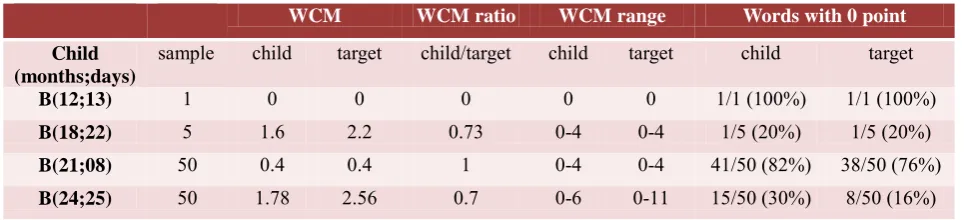
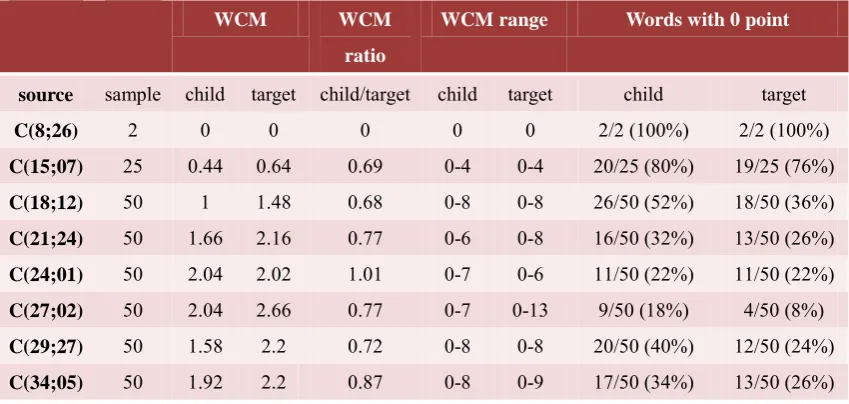
C(35;24) 50 1.72 2.16 0.8 0-9 0-10 21/50 (42%) 16/50 (32%) Sample words: the number of words the child produced in this recording session.
WCM (child): the average WCM scores of the child’s production in this recording session. WCM (target): the average WCM scores of the corresponding target forms.
WCM range: the range from the lowest WCM scores to the highest WCM scores. Words with 0 point: the percent of no-point words in all the sample words.
3.1.1 Summary and the analysis: the intelligible words
Figure 1. The WCM ratios of intelligible words among three subjects
Figure 1 compares the WCM ratio throughout 10 age stages of the three children. As seen in the figure, child A started his speech later than the other two but the phonological development seemed more stable and kept growing. Child C started his first words the earliest but the phonological development seemed unstable with irregular up-down pattern. Child B’s WCM ratios arouse and dropped, and then came in plain, and rose in the later stage. Figures 2, 3, 4 present the percentages of simple words in the productions of the three children respectively.
Figure 2. The simple words in the production of Child A
00.2 0.4 0.6 0.8 1 1.2
8 mths 12 mths 15 mths 18 mths 21 mths 24 mths 27 mths 30 mths 33 mths
The WCM ratio
Child A Child B Child C
0% 20% 40% 60% 80% 100%
15;09 18;22 21;01 24;02 27;18 30;23 33;03 36;09
The percentage of simple words in Child A was close to that in the target words, as seen in Figure 2. There was not obvious deviation from the target words. Therefore, not only the WCM ratio comparison accounted for Child A’s stability in phonological development but also the percentages of simple words can account for the stable development.
Figure 3. The simple words in the production of Child B
Although there was a fierce rise and fall in the percentage of simple words in Child B before 27 months of age, the two lines still accorded with each other. No obvious difference existed in the sample words and the target words. However, the deviation emerged from 27 months to 33 months of age, which mirrored the instability when Child B received low points due to the difficulty in producing final nasal consonants and fricative/affricate sounds. In the last stage, the deviation turned narrow and smooth, which could indicate the phonological development became more stable and closed to the target forms.
Figure 4. The simple words in the production of Child C
Similar to Child A, the percentage of simple words in Child C was close to that in the target words. However, in the later phases, after 27 months, the simple words increased in both the sample words and
0% 20% 40% 60% 80% 100%
12;13 18;22 21;08 24;25 27;07 30;01 33;10 36;15
Child B target
0% 20% 40% 60% 80% 100%
8;26 15;07 18;12 21;24 24;01 27;02 29;27 34;05 35;24
the target words. The reason was that Child C poorly performed in final consonant sounds, triphthongs, and velar sounds. This phenomenon caused no points for some of the sample words and thus rose the percentage of simple words.
3.2 The WCM applied in the unintelligible syllables
Although unintelligible syllables cannot be examined in terms of correctness, they still can show the complexity of phonological development, especially in early stages of production. Compared with intelligible words, unintelligible syllables mainly mirror children’s phonological properties rather than the natures of errors.
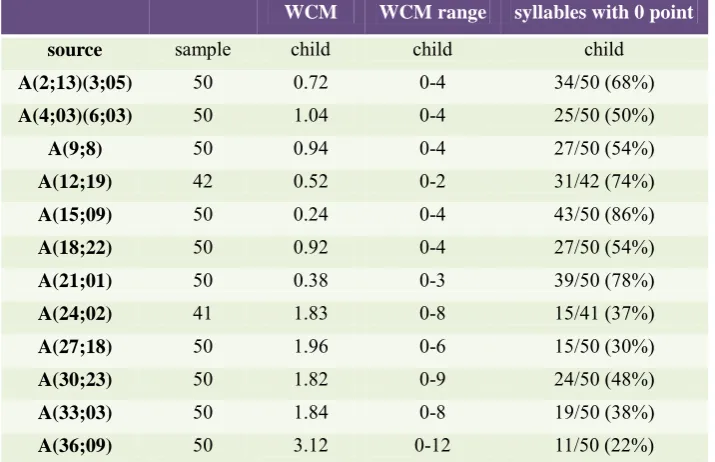
In Child A, the low scores at 12 months and 15 months were due to single syllable and simple sounds, e.g., /ə/ or /ɑ/ sounds. The 21-month-old data received points in almost every parameter, but the emergence of those indexes was infrequent. The 36-month-old data received very high scores. At this stage Child A was good at articulating velar and fricative/affricate sounds because he got high scores in these two parameters. Moreover, the late acquired sounds also appeared more frequently at the age of 36 months. In general, Child A demonstrated a growing trend of phonological complexity with gradually higher WCM scores, an expanding of WCM range, and a decreasing percentage of simple syllables as shown in Table 7.
Table 7. The analysis of Child A’s unintelligible syllables
WCM WCM range syllables with 0 point
source sample child child child
A(2;13)(3;05) 50 0.72 0-4 34/50 (68%)
A(4;03)(6;03) 50 1.04 0-4 25/50 (50%)
A(9;8) 50 0.94 0-4 27/50 (54%)
A(12;19) 42 0.52 0-2 31/42 (74%)
A(15;09) 50 0.24 0-4 43/50 (86%)
A(18;22) 50 0.92 0-4 27/50 (54%)
A(21;01) 50 0.38 0-3 39/50 (78%)
A(24;02) 41 1.83 0-8 15/41 (37%)
A(27;18) 50 1.96 0-6 15/50 (30%)
A(30;23) 50 1.82 0-9 24/50 (48%)
A(33;03) 50 1.84 0-8 19/50 (38%)
A(36;09) 50 3.12 0-12 11/50 (22%)
Sample words: the number of words the child produced in this recording session. WCM: the average WCM scores of the child’s production in this recording session. WCM range: the range from the lowest WCM scores to the highest WCM scores. Syllables with 0 point: the percent of no-point syllables in all the samples.
obviously high and a relative low WCM scores in his 4-to-5-month-old data and 12-month-old data. In the former, Child B articulated phoneme /h/ in almost every syllable, which contributed to a very high score in the velar sounds. The latter, the points almost gathered in the parameters ‘velar’ and ‘fricative/affricate’ which suggested that Child B was mature in articulating velar sounds and fricative/affricate sounds. Only one point was respectively given to the final consonant sounds and the utterances containing more than two syllables. Generally speaking, the WCM scores in Child B were quite high, yet the percentages of simple syllables were high.
Table 8. The analysis of Child B’s unintelligible syllables
WCM WCM range syllables with 0 point
source sample child child child
B(2;13)(3;04) 50 1.3 0-11 28/50 (56%)
B(4;04)(6;05) 50 2.22 0-8 17/50 (34%)
B(9;05) 50 1.26 0-7 28/50 (56%)
B(12;13) 50 0.68 0-4 33/50 (66%)
B(14;28) 46 1.3 0-4 19/46 (41%)
B(18;22) 50 0.92 0-3 23/50 (46%)
B(21;08) 50 1.22 0-5 20/50 (40%)
B(24;25) 50 1.14 0-5 22/50 (44%)
B(27;07) 50 0.96 0-6 28/50 (56%)
B(30;01) 50 0.92 0-5 32/50 (64%)
B(33;10) 50 0.82 0-7 32/50 (64%)
B(36;15) 50 0.82 0-5 29/50 (58%)
Sample words: the number of words the child produced in this recording session. WCM: the average WCM scores of the child’s production in this recording session. WCM range: the range from the lowest WCM scores to the highest WCM scores. Syllables with 0 point: the percent of no-point syllables in all the samples.
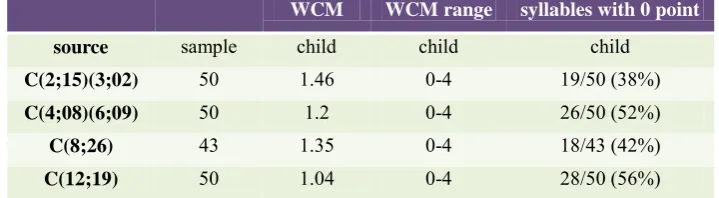
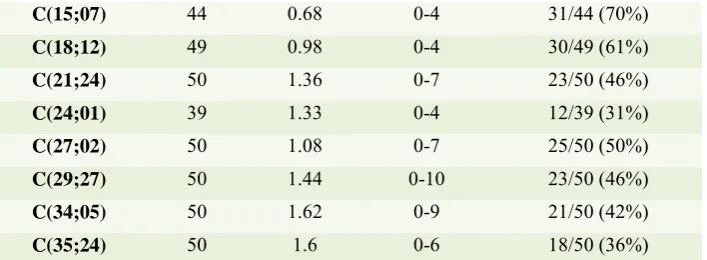
Child C’s data analysis is shown in Table 9. The data that consisted of less than 50 samples were at 8, 15, and 24 months of age. Child C generally displayed a stable phonological development, except for the two data that received relatively low WCM scores. The data at 15 months and 18 months included much more simple syllables. Conversely, the 24-month-old data included low percentage of simple syllables. The late acquired sounds emerged frequently at this stage.
Table 9. The analysis of Child C’s unintelligible syllables
WCM WCM range syllables with 0 point
source sample child child child
C(2;15)(3;02) 50 1.46 0-4 19/50 (38%)
C(4;08)(6;09) 50 1.2 0-4 26/50 (52%)
C(8;26) 43 1.35 0-4 18/43 (42%)
C(15;07) 44 0.68 0-4 31/44 (70%)
C(18;12) 49 0.98 0-4 30/49 (61%)
C(21;24) 50 1.36 0-7 23/50 (46%)
C(24;01) 39 1.33 0-4 12/39 (31%)
C(27;02) 50 1.08 0-7 25/50 (50%)
C(29;27) 50 1.44 0-10 23/50 (46%)
C(34;05) 50 1.62 0-9 21/50 (42%)
C(35;24) 50 1.6 0-6 18/50 (36%)
Sample words: the number of words the child produced in this recording session. WCM: the average WCM scores of the child’s production in this recording session. WCM range: the range from the lowest WCM scores to the highest WCM scores. Syllables with 0 point: the percent of no-point syllables in all the samples.
3.2.1 Summary and the analysis: the unintelligible syllables
Figure 5. The WCM scores of the three subjects in the unintelligible syllables
The phonological complexity of the three children can be displayed and compared and shown in Figure 5. Child A presented an evidently progressing phonological complexity since his WCM scores developed and rose. Child C did not show a remarkable progressing, and his developmental complexity proceeded slowly. Child B, however, performed a slightly regressing development. His phonological complexity seemed to grow unstably.
0 0.5 1 1.5 2 2.5 3 3.5
(2-3)
mths mths (4-6) mths 9 mths 12 mths 15 mths 18 mths 21 mths 24 mths 27 mths 30 mths 33 mths 36
Figure 6. The relation between Child A’s WCM scores and the simple syllables
Figure 7. The relation between Child B’s WCM scores and the simple syllables
Figure 8. The relation between Child C’s WCM scores and the simple syllables
00.5 1 1.5 2 2.5 3 3.5
Child A WCM
simple syllables
0 0.5 1 1.5 2 2.5 3 3.5
Child B WCM
simple syllables
0 0.5 1 1.5 2 2.5 3 3.5
Child C WCM
The relation between WCM scores and the percentage of simple syllables can also explain the level of phonological complexity. Figures 6, 7, 8 illustrate the relation of WCM scores and the simple syllables in three children respectively. Once the WCM scores rose, the percentage of simple syllables went downside, and vice versa.
Figure 9. The simple syllables in the productions of the three subjects
Child A and Child C displayed a decreasing percentage of simple syllables over time, whereas Child B presented a rise trend in the later stages. The percentage of simple words/syllables, together with the scoring process, seemed to be efficient to observe the data set thoroughly. Simply a quantified information (the WCM scores) cannot represent the whole event. This is one of remarkable advantages that the WCM offers to assess children’s phonological development.
4. Suggestion of further studies
The Word Complexity Measure (WCM) version used in this study further adjusted the original parameters to better fit Chinese phonology. The following features were added: production of fricatives, affricates, /ʐ/, /y/, and the late acquired sounds. However, the newly added parameter, the late acquired sounds, does not seem to reflect in the outcome effectively. It worked just as one of the point-giving indicators in the scoring process, and thus the core value of the parameter was mot prominent. In future studies, the parameter can be set up as an additional index, like the percentage of simple words, to efficiently observe and analyze the data. That is, the late acquired sounds can be counted as an index indicating advanced phonological complexity and can reflect the developmental milestone.
0% 10% 20% 30% 40% 50% 60% 70% 80% 90% 100%
References
Carson, P. C., Klee, T., Carson, K. D., & Hime, K. L. (2003). Phonological profiles of 2-year-olds with delayed language development predicting clinical outcomes at age 3.American Journal of
Speech-Language Pathology, 12, 28-39.
Ingram, D. (2002). The measurement of whole-word productions. Journal of Child Language, 29(4),
713-733.
Moeller, M. P., Hoover, B., Putman, C., Arbataitis, K., Bohnenkamp, G., Peterson, B., Wood, S., Lewis, D., Pittman, A., & Stelmachowicz, P. (2007). Vocalizations of Infants with Hearing Loss Compared with Infants with Normal Hearing: Part I - Phonetic development. Ear & Hearing, 28(5), 605-627.
Moeller, M. P., Hoover, B., Putman, C., Arbataitis, K., Bohnenkamp, G., Peterson, B., Wood, S., Lewis, D., Pittman, A., & Stelmachowicz, P. (2007). Vocalizations of Infants with Hearing Loss Compared with Infants with Normal Hearing: Part II - Transition to words. Ear & Hearing, 28(5), 628-642.
Morris, R. S. (2009). Test-retest reliability of independent measures of phonology in the assessment of toddlers' speech. Language, Speech, and Hearing Services in Schools, 40, 46-52.
Paul, R., & Jennings, P. (1992). Phonological behaviors in toddlers with slow expressive language development. Journal of Speech and Hearing Research, 35, 99-107.
Shriberg, L., Austin, D., Lewis, B., McSweeny, J., & Wilson, D. (1997). The Percentage of Consonants Correct (PCC) metric: extensions and reliability data. Journal of Speech, Language, and Hearing Research, 40, 708-722.
Stoel-Gammon, C. (1989). Prespeech and early speech development of two late talkers. First Language, 9, 207-224.