Computational Linguistics and Chinese Language Processing
Vol. 21, No. 1, June 2016, pp. 29-50 29 The Association for Computational Linguistics and Chinese Language Processing
Linguistic Template Extraction for
Recognizing Reader-Emotion
Yung-Chun Chang
,, Chun-Han Chu
Chien Chin Chen
, and
Wen-Lian Hsu
Abstract
Previous studies on emotion classification mainly focus on the emotional state of the writer. By contrast, our research emphasizes emotion detection from the readers' perspective. The classification of documents into reader-emotion categories can be applied in several ways, and one of the applications is to retain only the documents that trigger desired emotions to enable users to retrieve documents that contain relevant contents and at the same time instill proper emotions. However, current information retrieval (IR) systems lack the ability to discern emotions within texts, and the detection of reader’s emotion has yet to achieve a comparable performance. Moreover, previous machine learning-based approaches generally use statistical models that are not in a human-readable form. Thereby, it is difficult to pinpoint the reason for recognition failures and understand the types of emotions that the articles inspired on their readers. In this paper, we propose a flexible emotion template-based approach (TBA) for reader-emotion detection that simulates such process in a human perceptive manner. TBA is a highly automated process that incorporates various knowledge sources to learn an emotion template from raw text that characterize an emotion and are comprehensible for humans. Generated templates are adopted to predict reader’s emotion through an alignment-based matching algorithm that allows an emotion template to be partially matched through a statistical scoring scheme. Experimental results demonstrate that our approach can effectively detect reader’s emotions by exploiting the syntactic structures and semantic associations in the context, while
Institute of Information Science, Academia Sinica, Taipei, Taiwan
E-mail: {changyc, johannchu, hsu}@iis.sinica.edu.tw
Department of Information Management, National Taiwan University, Taipei, Taiwan
30 Yung-Chun Chang et al.
outperforming currently well-known statistical text classification methods and the stat-of-the-art reader-emotion detection method.
Keywords: Reader-Emotion Detection, Emotion Template, Template-based
Approach, Text Classification, Sentiment Analysis.
1.
Introduction
With the rapid growth of the Internet, the web has become a powerful medium for disseminating information. People can easily share information of daily experiences and their opinion anytime and anywhere on the social media, such as blogs, Twitter and Facebook. Therefore, sentiment analysis studies have gained increasing interest in recent years with academia and business corporations attempting to analyse and predict public trends by mining opinions that are subjective statements and reflect people’s sentiments or perceptions about topics (Pang et al., 2002). Moreover, human feelings can be quickly collected through emotion detection (Quan & Ren, 2009; Das & Bandyopadhyay, 2009). While previous researches on emotions mainly focused on detecting the emotions that the authors of the documents were expressing, it is worthy of noting that the reader emotions, in some aspects, differ from that of the authors and may be even more complex (Lin et al., 2008; Tang & Chen, 2012). Regarding a news article for instance, while a journalist objectively reports up-going oil price and does not express his or her emotion in the text, a reader could yield angry or negative emotions. On the other hand, an infamous politician’s blog entry describing his miserable day may not cause the opposing readers to feel the same way. While the author of an article may directly express his/her emotions through sentiment words within the text, a reader’s emotion possesses a more complex nature, as even general words can evoke different types of reader’s emotions depending on the reader’s personal experience and knowledge (Lin et al., 2007).
Linguistic Template Extraction for Recognizing Reader-Emotion 31
each document with much lower labour cost. Nevertheless, the statistical models used by these classifiers are generally not in a human-readable form. Thus, it is difficult to pinpoint the reason for recognition failures and understand what exact emotion of the reader is triggered.
In light of this rationale, we proposed a flexible template-based approach (TBA) for reader-emotion detection that simulates such process in human perception. TBA is a highly automated process that integrates various types of knowledge to generate discriminative linguistic patterns for document representation. These patterns can be acknowledged as the essential knowledge for humans to understand different kinds of emotions. Furthermore, TBA recognizes reader’s emotions of documents using an alignment-based algorithm that allows an emotion template to be partially matched through a statistical scoring scheme. Our experiments demonstrate that TBA can achieve a higher performance than other well-known text categorization methods and the state-of-the-art reader-emotion detection method.
The remainder of this paper is organized as follows. The next section contains a review of related works on reader-emotion detection approaches. We introduce the proposed emotion template-based approach for reader-emotion detection in Section 3, and its evaluation is described in Section 4. Finally, we provide some concluding remarks and potential future avenues of research in Section 5.
2.
Related Work
32 Yung-Chun Chang et al.
Nevertheless, the research of reader-emotion concerns the emotions expressed by a reader after reading the text. As the writer and readers may view the same text from different perspectives, they do not always share the same emotion. Since the recent increase in the popularity of Internet, certain news websites, such as Yahoo! Kimo News, incorporate the Web 2.0 technologies that allow readers to express their emotions toward news articles. Classifying emotions from the readers’ point of view is a challenging task, and research on this topic is relatively sparse as compared to those considering the writers’ perspective. While writer-emotion classification has been extensively studied, there are only a few studies on reader-emotion classification. Lin et al. (2007) first described the task of reader-emotion classification on news articles and classified Yahoo! News articles into 8 emotion classes (e.g. happy, angry, or depressing) from the readers’ perspectives. They combined bigrams, words, metadata and word emotion categories to train a classifier for determining the reader-emotions toward news. Yang et al. (2009) automatically annotated reader-emotions on a writer-emotion corpus with a reader-emotion classifier, and studied the interactions between writers and readers with the writer-reader-emotion corpus.
Our approach differs from existing reader-emotion detection approaches in a number of aspects. First, we proposed an emotion template-based approach that mimics the perceptual behaviour of humans in understanding. Second, the generated emotion templates are human readable, and can be represented as the domain knowledge required for detecting reader-emotion. Therefore, it is helpful in elucidating how articles trigger certain types of emotions in their readers in a more comprehensive manner. Finally, in addition to syntactic features, TBA further considers the surrounding context and semantic associations to efficiently recognize reader-emotions.
3.
Learning Reader-emotion Template from Raw Text
Linguistic Template Extraction for Recognizing Reader-Emotion 33
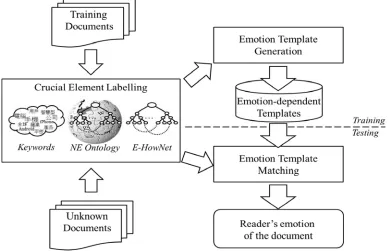
collects frequently co-occurring elements, and generates templates for each emotion. These templates are stored in the emotion-dependent knowledge base to provide domain-specific knowledge for our emotion detection. During the detection process, an article is first labelled by the CEL as well. Subsequently, the ETM applies an alignment-based algorithm that utilizes our knowledge base to calculate the similarity between each emotion and the article to determine the main emotion of this article. Details of these components will be disclosed in the following sections.
Figure 1. Architecture of our system.
3.1 Crucial Element Labelling (CEL)
34 Yung-Chun Chang et al.
denoted as k, is the number of on-emotion documents containing w; the number of off-emotion documents containing w, N(w^¬ei), is denoted as l. Altogether, the formula expresses the ratio of two likelihood functions. To simplify the formula, we also define m as the number of on-emotion documents with no word w (that is, m = N(ei) - k), and n as that of off-emotion documents (n = N(¬ei) – l). The probabilities p(w), p(w|ei), and p(w|^ei) are estimated using maximum likelihood estimation. A word with a large LLR value is closely associated with the reader-emotion. We rank the words in the training dataset based on their LLR values and select the top 200 to compile an emotion keyword list.
( | ) (1 ( | )) ( | ) (1 ( | )) ( , ) 2log
( ) (1 ( ))
k m l n
i i i i
i p w e p w ek l p w em n p w e
LLR w e
p w p w
(1)
Figure 2. Architecture of named entity ontology.
Linguistic Template Extraction for Recognizing Reader-Emotion 35
context. To remedy this problem, this paper adopts a novel structure to construct the NE ontology (NEO) for labelling crucial elements based on the levels of organization mentioned in (Lee et al. 2005) and (Wang et al. 2010). Figure 2 depicts the architecture of the NE ontology, which includes an emotion layer, a semantic layer, and an instance layer. There are eight types of emotions in the emotion layer, namely “Angry”, “Worried”, “Boring”, “Happy”, “Odd”, “Depressing”, “Informative” and “Warm”. Moreover, each semantic class in the semantic layer denotes a general semantic meaning of named entities that can be aggregated from many emotions, including "政治人物 (Politician)", "疾病 (Disease)" and others. The instance layer represents 6323 named entities extracted from documents across eight emotions by the Stanford NER. In order to minimize the labour cost of instance generalization, we utilize Wikipedia to semi-automatically label NEs with their semantic classes as a way of generalization. Only NE labels for persons, places and organizations are taken into consideration, and Wikipedia’s category tags are used to label NEs recognized by the Stanford NER1. We select the category tag to which the most topic paths are associated as the main semantic label for NEs in documents. A topic path is the classification hierarchy of a certain category; it can be considered as the traversal from general categories to more specific ones. A category name with more associated topic paths is considered to be more suitable to represent a NE for its appropriate scope of semantic coverage. For example, a query “歐巴馬 (Obama)” to the Wikipedia would return a page titled “巴拉克•歐巴馬 (Barack Obama)”. Within this page, there are a number of category tags such as “民主黨 (Democratic Party)” and “美國總 統 (Presidents of the United States)”. These two category tags contain three and seven topic paths, respectively. Suppose “美國總統(Presidents of the United States)” is the one with more topic paths, our system will label “巴拉克•歐巴馬 (Barack Obama)” with the tag “[美國總 統 (Presidents of the United States)]”. Domain experts further annotated each named entity by their corresponding semantic classes for the purpose of generalization if the NE term not included in Wikipedia to its category tags. Each instance in the instance layer can connect to multiple semantic classes according to the generalized relations. For example, named entity “喬丹 (Jordan)” can be generalized to “國家 (country)” and “人名 (people)”. In this manner, we can transform plain NEs to a more general class and increase the coverage of each label.
Finally, to incorporate even richer semantic context into our semantic template, we use the Extended HowNet (Chen et al., 2005), which is an extension of the HowNet (Dong et al. 2010). Extended HowNet contains a structured representation of knowledge and semantics. It connects approximately 90000 words in the CKIP Chinese Lexical Knowledge Base and HowNet, and includes additional highly frequent words that are specific in Traditional Chinese. It also contains a different formulation of each word to better fit its semantic
36 Yung-Chun Chang et al.
representation, as well as the distinct definition of function and content words. A total of four basic semantic classes were applied, namely object, act, attribute, and value. Moreover, in comparison to HowNet, EHowNet possesses a layered definition scheme and complex relationship formulation, and uses simpler concepts to replace schemes as the basic element when defining a more complex concept or relationship. To illustrate the content of the EHowNet, let us take the definition of “血癌 (leukemia)” in EHowNet in Definition 1 as an example. In the most compact sense, leukemia is a type of cancer that originates from disorder of blood (cells); therefore, EHowNet presents the phenomenon and its occurring position for the term in the Simple Definition. To further detail its meaning, EHowNet goes an extra mile and explains both “cancer” and “blood” in the Expanded Definition. We can see that the EHowNet not only contains semantic representation of a word, but also its relations to other words or entities. This enables us to combine or dissect the meaning of words by using its semantic components. Following the method in (Shihet al. 2012), we extracted the main definition of each word as the semantic class label.
Definition 1:
Simple Definition:
{癌症|cancer:position={血液|blood}}
Expanded Definition:
{disease|疾病:position={BodyFluid|體液:telic={transport|送:patient={gas|
氣:predication={respire|呼吸:patient={~}}},instrument={~}}},qualification={serious|嚴重}}
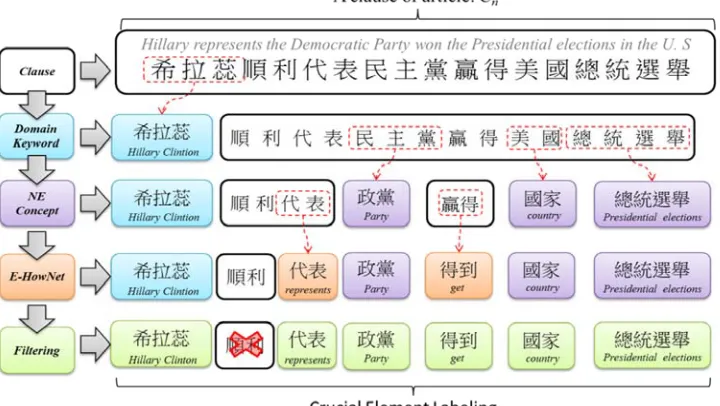
We exploit the taxonomies in EHowNet, which include lexical categories, synonyms, and semantic relations between different words or sets of words. With the resources stated, the CEL can transform words in the original documents into their corresponding semantic labels. Our research assigns clause as the unit for semantic labelling. To illustrate the process of CEL, consider the clause Cn = “希拉蕊順利代表民主黨贏得美國總統選舉 (Hillary Clinton represents the Democratic Party and won the Presidential election in the U.S.)”, as shown in Figure 3. First, “希拉蕊(Hillary Clinton)” is found in the keyword dictionary and tagged. Then NEs like “民主黨 (Democratic Party)” and “總統選舉 (Presidential elections)” are recognized and tagged as “{政黨 (Party)}” and “{總統選舉 (Presidential elections)}”. Subsequently, other terms such as “代表 (represent)” and “贏得 (won)” are labelled with their corresponding E-HowNet senses if they exist. Finally we can obtain the sequence: “[希
拉 蕊 ]:{ 代 表 }:{ 政 黨 }:{ 得 到 }:{ 國 家 }:{ 總 統 選 舉 } ([Hillary
Linguistic Template Extraction for Recognizing Reader-Emotion 37
(represented by curly-bracketed slots) match all words that belong to their specific class. Since different annotation knowledge bases are processed through in a specific-to-general order, the proportion of overlapping annotations are relatively low. In the occasion when there is an overlap between the matched keywords, the longest keyword will be reserved. The labelling process not only effectively prevents errors caused by Chinese word segmentation, but also groups the synonyms altogether by using semantic labels. This enables us to generate distinctive and prominent semantic templates in the next stage.
Figure 3. Crucial element labelling process.
3.2 Emotion Template Generation
Linguistic Template Extraction for Recognizing Reader-Emotion 41
Figure 5. Illustration of an emotion template matching process.
Algorithm 1: Emotion Template Matching
Input: A emotion template et = {st1, …,stm}, st: slots; A sequence of crucial elements from a clause cs = {ce1, …, cen}
Output: Matching score σ between et and cs BEGIN
1: pos← 0; σ← 0; 2: FOR i = 1 to m DO
3: isMatched ← false;
4: pos← current matched position in CE;
5: IF found cej EQUAL TO sti after pos THEN 6: σ←σ + MatchedScore(cej);
7: isMatched ← true; 8: END IF
9: IF isMatched != trueTHEN
10: σ←σ- DeletionScore (sti); 11: σ←σ- InsertionScore (cej); 12: END IF
13: END FOR
14: Output σ
END
44 Yung-Chun Chang et al.
4.2 Results and Discussion
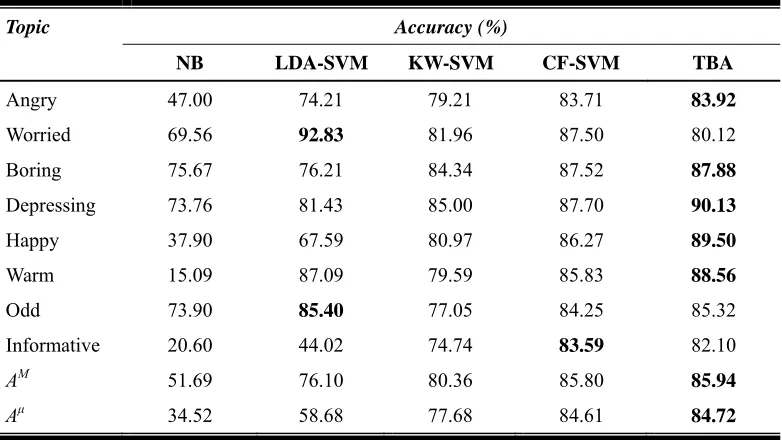
The performances of emotion detection systems are listed in Table 2. As a baseline, the Naïve Bayes classifier is a keyword statistics-based system which can only accomplish a mediocre performance. Since it only considers surface word weightings, it is difficult to represent inter-word relations. The overall accuracy of the Naïve Bayes classifier is 36.84%, with the emotion “Warm” only achieving 15% accuracy.
On the contrary, the LDA-SVM included both keyword and long-distance relations, and greatly outperforms the Naïve Bayes with an overall accuracy of 76.1%. It even achieved the highest accuracy of 92.83% and 85.40% for the emotion “Worried” and “Odd”, respectively, among all five methods. As we can see, the KW-SVM can bring about substantial proficiency in detecting the emotions with 77.70% overall accuracy. This indicates that reader’s emotion can be recognized effectively by using only the LLR scores of keywords, since the likelihood of a word existing in a certain emotion is not random. Those with a larger LLR value are considered as closely associated with the emotion (Manning & Schütze, 1999). The TBA can further improve the basic keyword-based method with rich context and semantic information, thus achieving the best overall accuracy of 84.72%.
Table 2. Accuracy of emotion detection systems.
Topic Accuracy (%)
NB LDA-SVM KW-SVM CF-SVM TBA
Angry 47.00 74.21 79.21 83.71 83.92
Worried 69.56 92.83 81.96 87.50 80.12
Boring 75.67 76.21 84.34 87.52 87.88
Depressing 73.76 81.43 85.00 87.70 90.13
Happy 37.90 67.59 80.97 86.27 89.50
Warm 15.09 87.09 79.59 85.83 88.56
Odd 73.90 85.40 77.05 84.25 85.32
Informative 20.60 44.02 74.74 83.59 82.10
AM 51.69 76.10 80.36 85.80
85.94
Aμ 34.52 58.68 77.68 84.61
84.72
Linguistic Template Extraction for Recognizing Reader-Emotion 45
“Happy” instances belong to the news category sports. It is also observed that an instance with the news category sports has a 31% chance of having the true class “Happy”. Hence, the high accuracy of “Happy” emotion can be the result of people’s general enthusiasm over sports rather than the result of a particular event. On top of that, the TBA can generate distinct semantic templates to capture alternations of similar combinations to achieve the optimal outcome. For instance, a semantic template generated by our proposed system, “{國家
country}:[發生occur]:[地震earthquake]:{劫難disaster}”, belongs to the emotion "Depressing". It is perceivable that this template is relaying information about disastrous earthquakes that occurred in a certain country, and such news often induce negative emotions among the readers. This example demonstrates that the automatically generated semantic templates are comprehensible for humans and can be utilized to effectively detect reader’s emotion. Nevertheless, our system could not surpass the LDA-SVM in the emotion “Worried”. It may be attributed to the fact that semantic templates generated in this emotion have inadequate quality. We examined some of the templates within this emotion and found that they mostly contain very general semantic classes, such as “{機 構 institution}:{組 織 organization}:{政 黨
party}:{實現 realize}:{程度 degree}:{念頭 thought}”, thereby reducing its accuracy. Despite the “Worried” emotion, we were able to identify distinctive semantic templates for the other emotions. For instance, the template “[婦女 women]:{救助 help}:[小孩 child]:{當作 treat}:{人
human}:[認為consider]” was generated for the emotion “Warm”, and it is reasonable that news about a woman helping a child would evoke a warm feeling in the readers’ mind. The ability to generate such emotion-specific templates is considered as the main reason for TBA to outperform other systems.
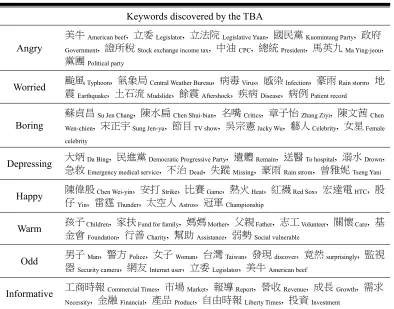
As a last touch, we dig into the top keywords in each emotion category as an analysis of the news trend, listed in TABLE 3. As stated in the previous section, we observe that keywords related to “Happy” are mostly terms about sports, such as team names (e.g., “熱火
Miami Heat” and “紅襪Boston Red Sox”) or player names (e.g., “陳偉殷Wei-Yin Chen”, a pitcher for the Baltimore Orioles). Similar findings had been made before as well (Chen et al. 2008). This is certainly a good indication for the performance of a sports team over a specified period of time. On the other hand, “Angry”-related keywords consist largely of political parties or public issues. For instance, the most noticeable word “美牛United States beef” indicates the heated dispute on the import policy of beef from United States to Taiwan, which has been an issue in Taiwan-U.S. relations and leads to a domestic political unrest. Numerous political terms showed up in the top list too, such as “國民黨Kuomintang”, “立法院legislature”, and “立委
legislator”. This highlights the extracted emotion keywords are highly correlated with reader’s emotion, thus tagging them in the emotion template helps our method discriminate reader-emotion.
46 Yung-Chun Chang et al.
severe weather or casualties. The phrase “大炳Da Bing” refers to a Taiwanese performer who died in 2012 (around the time of our data retrieval) due to drug abuse. On the off chance that sports players suffered from low performance temporarily, they might show up in the category too due to readers’ compassion. Theoretically if we have sufficient patterns containing negation terms, we will be able to generate representative templates that can give rise to the scores in negative emotions. However, in our current data set, the relatively low portion of negative cases affects little more than the score of positive emotion, hence affecting the system performance. We acknowledge that this is an important task and should be studied in our future work. Lastly, not surprisingly, the Warm category contains words associated with mostly social care or volunteer providing charity or assistance to social vulnerable groups, while economic news dominates the Informative emotion.
Table 3. A top 10 keyword list of each reader-emotion generated from TBA.
Keywords discovered by the TBA
Angry
美牛American beef, 立委Legislator, 立法院Legislative Yuan, 國民黨Kuomintang Party, 政府
Government, 證所稅Stock exchange income tax, 中油CPC, 總統President, 馬英九Ma Ying-jeou,
黨團Political party
Worried 颱風Typhoon, 氣象局Central Weather Bureau, 病毒Virus, 感染Infection, 豪雨Rain storm, 地
震Earthquake, 土石流Mudslide, 餘震Aftershock, 疾病Disease, 病例Patient record
Boring
蘇貞昌Su Jen Chang, 陳水扁Chen Shui-bian, 名嘴Critics, 章子怡Zhang Ziyi, 陳文茜Chen Wen-chien, 宋正宇Sung Jen-yu, 節目TV show, 吳宗憲Jacky Wu, 藝人Celebrity, 女星Female celebrity
Depressing 大炳急救Da Bing, Emergency medical service, 民進黨Democratic Progressive Party, 不治Dead, 失蹤Missing, 遺體Remain, 豪雨送醫Rain strom, To hospital, 曾雅妮溺水Tseng Yani Drown,
Happy 仔陳偉殷Yin, 雷霆Chen Wei-yin, Thunder, 安打太空人Strike, Astros, 比賽冠軍Game, Championship 熱火Heat, 紅襪Red Sox, 宏達電HTC, 殷
Warm 孩子Children, 家扶Fund for family, 媽媽Mother, 父親Father, 志工Volunteer, 關懷Care, 基
金會Foundation, 行善Charity, 幫助Assistance, 弱勢Social vulnerable
Odd 男子Man, 警方Police, 女子Woman, 台灣Taiwan, 發現discover, 竟然surprisingly, 監視
器Security camera, 網友Internet user, 立委Legislator, 美牛American beef
Informative 工商時報Necessity, 金融Commercial Times, Financial, 產品市場Product, Market, 自由時報報導Report, Liberty Times, 營收Revenue, 投資Investment 成長Growth, 需求
Linguistic Template Extraction for Recognizing Reader-Emotion 47
learning-based methods which are generally not human understandable, the generated templates can be acknowledged as the fundamental knowledge for each emotion and are comprehensible to the human mind.
5.
Conclusion
With the rapid growth of computer mediated communication applications, the research on emotion classification has been attracting more and more attention recently from enterprises toward business intelligence. Recognizing reader-emotion concerns the emotion expressed by a reader after reading the text, and it holds the potential to be applied in fields that differ from writer-emotion detection applications. For instance, users are able to retrieve documents that contain relevant contents and at the same time produce desired feelings by integrating reader-emotion into information retrieval. In addition, reader-emotion detection can assist writers in foreseeing how their work will influence readers emotionally. In this research, we presented a flexible template-based approach (TBA) for detecting reader-emotion that simulates the process of human perception. By capturing the most prominent and representative pattern within an emotion, TBA allows us to effectively recognize the reader-emotion of text. Results of our experiments demonstrate that the TBA can achieve a higher performance than other well-known methods of reader-emotion detection. In the future, we plan to refine our TBA and employ it to other natural language processing applications. Also, further studies can be done on combining statistical models into different components in our system.
Acknowledgement
This research was supported by the Ministry of Science and Technology of Taiwan under grant MOST 103-3111-Y-001-027.
Reference
Bashaddadh, O.M.A. & Mohd, M. (2011). Topic detection and tracking interface with named entities approach. In Proceedings of International Conference on Semantic Technology and Information Retrieval, 215-219.
Blei, D.M., Ng, A.Y., & Jordan, M.I. (2003). Latent dirichlet allocation. Journal of Machine Learning Research, 3, 993-1022.
48 Yung-Chun Chang et al.
Chen, Y., Lee, S., Li, S., & Huang, C. (2010). Emotion cause detection with linguistic constructions. In Proceedings of the 21th International Conference on Computational Linguistics, 179-187.
Cortes, C. & Vapnik, V. (1995). Support vector networks. Machine Learning, 20, 1-25. Das, D. & Bandyopadhyay, S. (2009). Word to Sentence Level Emotion Tagging for Bengali
Blogs. In Proceedings of the 47th Annual Meeting of the Association for Computational Linguistics, 149-152.
Dong, Z.D., Dong, Q., & Hao, C.L. (2010). Hownet and its computation of meaning. In Proceedings of the 23rd International Conference on Computational Linguistics: Demonstrations, 53-56.
Garey, M.R. & Johnson, D.S. (1979). Computers and intractability: A Guide to the Theory of NP- Completeness. W. H. Freeman & Co. New York, NY, USA.
Johnson, D.S. (1974). Approximation algorithms for combinatorial problems. Journal of Computer and System Sciences, 9(3), 256-278.
Read, J. (2005). Using Emotions to Reduce Dependency in Machine Learning Techniques for Sentiment Classification. In Proceedings of the 43th Annual Meeting of the Association for Computational Linguistics Student Research Workshop, 43-48.
Lovász, L. (2005). Random walks on graphs: A survey. Combinatorics, Paul erdos is eighty, 2(1), 1-46.
Lee, C.S., Jian, Z.W., & Huang, L.K. (2005). A fuzzy ontology and its application to news summarization. IEEE Transactions on Systems, Man, and Cybernetics, Part B: Cybernetics, 35(5), 859-880.
Lin, H.Y., Yang, C.H., & Chen, H.H. (2007). What Emotions Do News Articles Trigger in Their Readers? In Proceedings of 30th Annual International ACM SIGIR Conference, 23-27.
Lin, K.H., Yang, C.H., & Chen, H.H. (2008). Emotion Classification of Online News Articles from the Reader’s Perspective. In Proceedings of International Conference on Web Intelligence, 220- 226.
Manning, C.D. & Schütze, H. (1999). Foundations of Statistical Natural Language Processing. MIT Press.
McCallum, A. & Nigam, K. (1998). A comparison of event models for Naïve Bayes text classification. In Proceedings of AAAI/ICML-98 Workshop on Learning for Text Categorization, 41-48.
Mishne, G. (2005). Experiments with mood classification in blog posts. In Proceedings of the 1st Workshop on Stylistic Analysis of Text for Information Access.
Linguistic Template Extraction for Recognizing Reader-Emotion 49
Pang, B., Lee, L., & Vaithyanathan, S. (2002). Thumbs up?: sentiment classification using machine learning techniques. In Proceedings of the ACL-02 conference on Empirical methods in natural language processing, 79-86.
Patwardhan, S. & Peterson, T. (2003). Using WordNet-based Context Vectors to Estimate the Semantic Relatedness of Concepts.
Purver, M. & Battersby, S. (2012). Experimenting with distant supervision for emotion classification. In Proceedings of the 12th Conference of the European Chapter of the Association for Computational Linguistics, 482-491.
Quan, C. & Ren, F. (2009). Construction of a Blog Emotion Corpus for Chinese Emotional Expression Analysis. In Proceedings of Conference on Empirical Methods in Natural Language Processing, 1446-1454.
Ricardo, B.Y. & Berthier, R.N. (2011). Modern Information Retrieval: The Concepts and Technology Behind Search. New York: Addison Wesley.
Salton, G. & Buckley, C. (1988). Term-weighting approaches in automatic text retrieval. Information Processing and Management, 24(5), 513-523.
Shih, C.W., Lee, C.W., Tsai, T.H., & Hsu, W.L., (2012). Validating Contradiction in Texts Using Online Co-Mention Pattern Checking. ACM Transactions on Asian Language Information Processing, 11(4), 17. doi: 10.1145/2382593.2382599 http://doi.acm.org/10.1145/2382593.2382599
Si, J., Mukherjee, A., Liu, B., Li, Q., Li, H., & Deng, X. (2013). Exploiting Topic based Twitter Sentiment for Stock Prediction. In Proceedings of The 51st Annual Meeting of the Association for Computational Linguistics, 24-29.
Tang, Y.J. & Chen, H.H. (2012). Mining Sentiment Words from Microblogs for Predicting Writer-Reader-emotion Transition. In Proceedings of 8th International Conference on Language Resources and Evaluation, 1226-1229.
Thayer, R.E. (1989). The Biopsychology of Mood and Arousal, Oxford University Press. Wang, M.H., Lee, C.S, Hsieh, K.L., Hsu, C.Y., Acampora, G., & Chang, C.C. (2010).
Ontology-based multi-agents for intelligent healthcare applications. Journal of Ambient Intelligence and Humanized Computing, 1(2), 111-131.
Wu, C.H., Chuang, Z.J., & Lin, Y.C. (2006). Emotion recognition from text using semantic labels and separable mixture models. ACM Transactions on Asian Language Information Processing, 5(2), 165-183.
Yang, C.H., Lin, H.Y., & Chen, H.H. (2009). Writer Meets Reader: Emotion Analysis of Social Media from both the Writer’s and Reader’s Perspectives. In Proceedings of International Conference on Web Intelligence, 287-290.
50 Yung-Chun Chang et al.
Yang, Y.H., Liu, C. C., & Chen, H. H. (2006). Music emotion classification: A fuzzy approach. In Proceedings of the 14th Annual ACM International Conference on Multimedia, 81-84.
Zhang, L. & Liu, B. (2010). Extracting and Ranking Product Features in Opinion Documents. In Proceedings of the 23rd International Conference on Computational Linguistics, 1462-1470.
Zou, F., Wang, F.L., Deng, X., Han, S., & Wang, L.S. (2006). Automatic construction of Chinese stop word list. In Proceedings of the 5th WSEAS International Conference on Applied Computer Science, 1010-1015.