University of Warwick institutional repository: http://go.warwick.ac.uk/wrap
A Thesis Submitted for the Degree of PhD at the University of Warwick
http://go.warwick.ac.uk/wrap/46789
This thesis is made available online and is protected by original copyright. Please scroll down to view the document itself.
JHG 05/2011
Library Declaration and Deposit Agreement
1. STUDENT DETAILS
Please complete the following:
Full name: ………. University ID number: ………
2. THESIS DEPOSIT
2.1 I understand that under my registration at the University, I am required to deposit my thesis with the University in BOTH hard copy and in digital format. The digital version should normally be saved as a single pdf file.
2.2 The hard copy will be housed in the University Library. The digital version will be deposited in the University’s Institutional Repository (WRAP). Unless otherwise indicated (see 2.3 below) this will be made openly accessible on the Internet and will be supplied to the British Library to be made available online via its Electronic Theses Online Service (EThOS) service.
[At present, theses submitted for a Master’s degree by Research (MA, MSc, LLM, MS or MMedSci) are not being deposited in WRAP and not being made available via EthOS. This may change in future.]
2.3 In exceptional circumstances, the Chair of the Board of Graduate Studies may grant permission for an embargo to be placed on public access to the hard copy thesis for a limited period. It is also possible to apply separately for an embargo on the digital version. (Further information is available in the Guide to Examinations for Higher Degrees by Research.)
2.4 If you are depositing a thesis for a Master’s degree by Research, please complete section (a) below. For all other research degrees, please complete both sections (a) and (b) below:
(a) Hard Copy
I hereby deposit a hard copy of my thesis in the University Library to be made publicly available to readers (please delete as appropriate) EITHER immediately OR after an embargo period of ………... months/years as agreed by the Chair of the Board of Graduate Studies.
I agree that my thesis may be photocopied. YES / NO (Please delete as appropriate)
(b) Digital Copy
I hereby deposit a digital copy of my thesis to be held in WRAP and made available via EThOS.
Please choose one of the following options:
EITHER My thesis can be made publicly available online. YES / NO(Please delete as appropriate)
OR My thesis can be made publicly available only after…..[date] (Please give date)
YES / NO(Please delete as appropriate)
OR My full thesis cannot be made publicly available online but I am submitting a separately identified additional, abridged version that can be made available online.
YES / NO (Please delete as appropriate)
JHG 05/2011
3. GRANTING OF NON-EXCLUSIVE RIGHTS
Whether I deposit my Work personally or through an assistant or other agent, I agree to the following:
Rights granted to the University of Warwick and the British Library and the user of the thesis through this agreement are non-exclusive. I retain all rights in the thesis in its present version or future versions. I agree that the institutional repository administrators and the British Library or their agents may, without changing content, digitise and migrate the thesis to any medium or format for the purpose of future preservation and accessibility.
4. DECLARATIONS
(a) I DECLARE THAT:
I am the author and owner of the copyright in the thesis and/or I have the authority of the authors and owners of the copyright in the thesis to make this agreement. Reproduction of any part of this thesis for teaching or in academic or other forms of publication is subject to the normal limitations on the use of copyrighted materials and to the proper and full acknowledgement of its source.
The digital version of the thesis I am supplying is the same version as the final, hard-bound copy submitted in completion of my degree, once any minor corrections have been completed.
I have exercised reasonable care to ensure that the thesis is original, and does not to the best of my knowledge break any UK law or other Intellectual Property Right, or contain any confidential material.
I understand that, through the medium of the Internet, files will be available to automated agents, and may be searched and copied by, for example, text mining and plagiarism detection software.
(b) IF I HAVE AGREED (in Section 2 above) TO MAKE MY THESIS PUBLICLY AVAILABLE DIGITALLY, I ALSO DECLARE THAT:
I grant the University of Warwick and the British Library a licence to make available on the Internet the thesis in digitised format through the Institutional Repository and through the British Library via the EThOS service.
If my thesis does include any substantial subsidiary material owned by third-party copyright holders, I have sought and obtained permission to include it in any version of my thesis available in digital format and that this permission encompasses the rights that I have granted to the University of Warwick and to the British Library.
5. LEGAL INFRINGEMENTS
I understand that neither the University of Warwick nor the British Library have any obligation to take legal action on behalf of myself, or other rights holders, in the event of infringement of intellectual property rights, breach of contract or of any other right, in the thesis.
Please sign this agreement and return it to the Graduate School Office when you submit your thesis.
Exploring Online Customer Experience:
Website Features, Customer Activities, and
Repurchase Intentions
Xiangyu Kong
This thesis is submitted in partial fulfilment of the requirements for the degree of Doctor of Philosophy in Industrial and Business Studies
Warwick Business School The University of Warwick
i
Brief Contents
Brief Contents ... i
Detailed Contents ... ii
List of Tables ... vii
List of Figures ... x
Acknowledgement ... xi
Declaration ... xii
Executive Summary ... xiii
1. Introduction... 1
2. e-Service ... 11
3. Customer Experience ... 28
4. Research Questions ... 52
5. Research Paradigms ... 64
6. Research Method ... 70
7. Research Design ... 76
8. Study 1 Retail Website Features... 96
9. Study 2 Online Customer Activities ... 102
10. Study 3 Customer Experience and Repurchase Intention ... 107
11. Principle Components Analysis ... 118
12. Findings and Discussions ... 166
13. Conclusion ... 182
References ... 196
Appendix A. List of Websites ... 207
Appendix B. Interview Procedure and Questions ... 208
Appendix C. Interview Recording Sheet ... 210
Appendix D. Online Questionnaire for Pilot Study ... 211
ii
Detailed Contents
Brief Contents ... i
Detailed Contents ... ii
List of Tables ... vii
List of Figures ... x
Acknowledgement ... xi
Declaration ... xii
Executive Summary ... xiii
1. Introduction... 1
1.1. Background ... 1
1.2. Purpose ... 2
1.3. Conceptual Framework ... 3
1.4. Thesis Outline ... 5
2. e-Service ... 11
2.1. Introduction ... 11
2.2. Nature of e-Service ... 12
2.2.1. Definitions of e-Service ... 12
2.2.2. Typology of e-Service ... 14
2.2.3. Conceptual Frameworks... 16
2.3. e-Service Design ... 18
2.3.1. Experience-Based Design ... 18
2.3.2. e-Service Process Design ... 19
2.4. e-Service Analyses and Evaluations ... 21
2.4.1. e-Service as a Whole ... 22
2.4.2. e-Service as a Set of Parts ... 23
2.5. Customer Experience in e-Service ... 23
2.6. Conclusion ... 25
3. Customer Experience ... 28
3.1. Introduction ... 28
iii
3.2.1. The Concept of Customer Experience ... 29
3.2.2. Conceptual Frameworks... 30
3.3. Why – Benefits of Customer Experience ... 33
3.3.1. Customer Satisfaction ... 33
3.3.2. Customer Expectations ... 34
3.3.3. Customer Loyalty ... 34
3.3.4. Behavioural Intentions ... 35
3.4. When – Customer Experience Timeline ... 36
3.4.1. Pre-Service Experience ... 37
3.4.2. Service Experience – Start and End ... 38
3.4.3. Service Experience – Peaks and Trend ... 39
3.4.4. Post-Service Experience ... 41
3.5. How – Managing Customer Experience ... 41
3.5.1. Factors and Determinants of Customer Experience ... 42
3.5.2. Design of Customer Experience ... 46
3.5.3. Tools for Evaluation and Assessment ... 48
3.6. Conclusion ... 49
4. Research Questions ... 52
4.1. Introduction ... 52
4.2. Gaps to Fill ... 53
4.3. Preliminary Study ... 54
4.3.1. Purpose ... 54
4.3.2. Methods ... 55
4.3.3. Samples ... 56
4.3.4. Findings ... 58
4.4. Research Questions ... 60
4.5. Drawing the Boundaries ... 61
5. Research Paradigms ... 64
5.1. Introduction ... 64
5.2. Research Strategy ... 64
5.3. Ontological Considerations... 67
iv
5.5. Summary ... 69
6. Research Method ... 70
6.1. Introduction ... 70
6.2. Survey as Research Method ... 70
6.3. Types of Survey ... 73
6.4. Three Studies ... 74
6.5. Conclusion ... 75
7. Research Design ... 76
7.1. Introduction ... 76
7.2. Study 1 Retail Website Features ... 76
7.2.1. Purpose ... 76
7.2.1. Data Collection ... 77
7.2.2. Population and Sampling Frame ... 78
7.2.3. Data Processing and Analysis ... 81
7.3. Study 2 Online Customer Activities ... 81
7.3.1. Purpose ... 81
7.3.1. Data Collection ... 81
7.3.2. Sample Frame ... 83
7.3.3. Data Analysis ... 84
7.3.4. Further Processing ... 85
7.4. Study 3 Customer Experience & Repurchase Intentions ... 85
7.4.1. Purpose ... 85
7.4.2. Data Collection Method ... 86
7.4.3. Questionnaire Design ... 86
7.4.4. Pilot Study ... 88
7.4.5. Sample Frame and Sample Size ... 91
7.4.6. Level of Measurement ... 92
7.4.7. Invalid Cases ... 92
7.4.8. Parametric or Non-Parametric – Test of Normality ... 93
7.4.9. Correlation – Test of Relationships ... 94
7.5. Principal Components Analysis ... 94
v
8. Study 1 Retail Website Features... 96
8.1. Introduction ... 96
8.2. Data Collection and Processing ... 96
8.3. Websites Profile ... 98
8.4. Results ... 98
8.5. Conclusion ... 101
9. Study 2 Online Customer Activities ... 102
9.1. Introduction ... 102
9.2. Response Rate and Data Saturation ... 102
9.3. Respondent Profile ... 103
9.4. Online Customer Activities ... 103
9.5. Retail Website Features and Online Customer Activities ... 104
9.6. Conclusion ... 105
10. Study 3 Customer Experience and Repurchase Intention ... 107
10.1. Introduction ... 107
10.2. Response Rate ... 107
10.3. Respondents Profile ... 109
10.4. Descriptive Results ... 111
10.5. Tests of Normality ... 114
10.6. Correlations ... 116
10.7. Conclusion ... 117
11. Principle Components Analysis ... 118
11.1. Introduction ... 118
11.2. Procedures of PCA ... 119
11.2.1. Variables and Factors ... 119
11.2.2. Process of Principle Component Analysis ... 119
11.2.3. Dealing with Cross-loaded Variables ... 124
11.2.4. Reliability Analysis ... 125
11.2.5. Four Categories of Data ... 127
11.3. Output of PCA and Reliability Analysis ... 128
11.3.1. Students – Customer Experience ... 128
vi
11.3.3. Customers – Customer Experience ... 142
11.3.4. Customers – Repurchase Intention (eigenvalue>1) ... 149
11.3.5. Customers – Repurchase Intention (factor No.= 4) ... 156
11.4. Result ... 163
12. Findings and Discussions ... 166
12.1. Introduction ... 166
12.2. Summary of Findings ... 167
12.3. Overview of Types of Retail Website Features ... 168
12.4. Types of Retail Website Features in Online Customer Activities ... 171
12.4.1. Search ... 171
12.4.2. Compare ... 174
12.4.3. Checkout ... 176
12.4.4. Enquire... 178
12.1. Conclusion ... 180
13. Conclusion ... 182
13.1. Introduction ... 182
13.2. Answers to Research Questions ... 182
13.3. Theoretical Contributions ... 186
13.4. Practical Implications ... 188
13.5. Research Limitations ... 188
13.6. Opportunities for Future Research ... 189
13.6.1. Filling the gaps identified in the literature review ... 190
13.6.2. Testing the Findings of This Research ... 192
13.6.3. Engaging with Service Providers and Service Designers ... 194
13.7. Conclusion ... 194
References ... 196
Appendix A. List of Websites ... 207
Appendix B. Interview Procedure and Questions ... 208
Appendix C. Interview Recording Sheet ... 210
Appendix D. Online Questionnaire for Pilot Study ... 211
vii
List of Tables
Table 1.1 Structure of Thesis ... 10
Table 4.1 Findings of Preliminary Study ... 58
Table 4.2 Drawing the Boundaries ... 61
Table 6.1: Relevant Situations for Different Research Methods (Yin, 2003 & 2009) .. 72
Table 7.1 Study 1 – Coding Schedule ... 78
Table 7.2 Study 3 Description of Retail Website Features ... 90
Table 8.1 Study 1 – Descriptions and Frequencies ... 100
Table 9.1 Study 2 – Respondent Profile ... 103
Table 9.2 Retail Website Features in Activities... 105
Table 10.1 Study 3 – Respondents Profile ... 110
Table 10.2 Study 3 – Descriptive Results (students) ... 112
Table 10.3 Study 3 – Descriptive Results (customers) ... 112
Table 10.4 Study 3 – Kolmogorov-Smirnov Test of Normality ... 115
Table 10.5 Study 3 – Spearman’s rho Correlation Coefficients ... 116
Table 11.1 Data Categories for Exploratory Factor Analysis ... 127
Table 11.2 Students – CE: Correlation Matrix ... 129
Table 11.3 Students – CE: KMO and Bartlett's Test ... 129
Table 11.4 Students – CE: Communalities ... 130
Table 11.5 Students – CE: Total Variance Explained ... 131
Table 11.6 Students – CE: Component Matrix ... 131
Table 11.7 Students – CE: Pattern Matrix ... 132
Table 11.8 Students – CE: Structure Matrix ... 133
Table 11.9 Students – CE: Component Correlation Matrix ... 133
viii
Table 11.11 Students – RI: Correlation Matrix ... 136
Table 11.12 Students – RI: KMO and Bartlett's Test ... 136
Table 11.13 Students – RI: Communalities ... 137
Table 11.14 Students – RI: Total Variance Explained ... 138
Table 11.15 Students – RI: Component Matrix ... 138
Table 11.16 Students – RI: Pattern Matrix ... 139
Table 11.17 Students – RI: Structure Matrix ... 140
Table 11.18 Students – RI: Component Correlation Matrix ... 140
Table 11.19 Students – RI: Reliability Analysis ... 141
Table 11.20 Customers – CE: Correlation Matrix ... 143
Table 11.21 Customers – CE: KMO and Bartlett's Test ... 143
Table 11.22 Customers – CE: Communalities ... 144
Table 11.23 Customers – CE: Total Variance Explained ... 145
Table 11.24 Customers – CE: Component Matrix ... 145
Table 11.25 Customers – CE: Pattern Matrix ... 146
Table 11.26 Customers – CE: Structure Matrix ... 147
Table 11.27 Customers – CE: Component Correlation Matrix ... 147
Table 11.28 Customers – CE: Reliability Analysis ... 148
Table 11.29 Customers – RI (eigenvalue>1): Correlation Matrix ... 150
Table 11.30 Customers – RI (eigenvalue>1): KMO and Bartlett's Test ... 150
Table 11.31 Customers – RI (eigenvalue>1): Communalities ... 151
Table 11.32 Customers – RI (eigenvalue>1): Total Variance Explained ... 152
Table 11.33 Customers – RI (eigenvalue>1): Component Matrix ... 152
Table 11.34 Customers – RI (eigenvalue>1): Pattern Matrix ... 153
Table 11.35 Customers – RI (eigenvalue>1): Structure Matrix ... 154
Table 11.36 Customers – RI (eigenvalue>1): Component Correlation matrix ... 154
ix
Table 11.38 Customers – RI (factor No.= 4): Correlation Matrix ... 157
Table 11.39 Customers – RI (factor No.=4): KMO and Bartlett's Test ... 157
Table 11.40 Customers – RI (factor No.= 4): Communalities ... 158
Table 11.41 Customers – RI (factor No.= 4): Total Variance Explained ... 159
Table 11.42 Customers – RI (factor No.= 4): Component Matrix ... 159
Table 11.43 Customers – RI (factor No.= 4): Pattern Matrix ... 160
Table 11.44 Customers – RI (factor No.= 4): Structure Matrix ... 161
Table 11.45 Customers – RI (factor No.= 4): Component Correlation Matrix ... 161
Table 11.46 Customers – RI (factor No.=4): Reliability Analysis ... 162
Table 11.47 Summary of PCA Results ... 163
Table 11.48 Retail Website Features and Their Types ... 165
Table 12.1 Summary of Findings ... 168
Table 12.2 Sorted Retail Website Features ... 169
Table 12.3 Search ... 171
Table 12.4 Types of Retail Website Features in Search ... 174
Table 12.5 Compare ... 175
Table 12.6 Types of Retail Website Features in Compare ... 176
Table 12.7 Checkout ... 176
Table 12.8 Types of Retail Website Features in Checkout ... 178
Table 12.9 Enquire ... 179
Table 12.10 Types of Retail Website Features in Enquire ... 180
x
List of Figures
Figure 1.1 Internet Retail Sales in the UK ... 1
Figure 1.2 Conceptual Framework ... 5
Figure 2.1: The Internet and Service ... 14
Figure 2.2 Fulfilment-Product Classification Scheme ... 15
Figure 2.3: Conceptual Model for Understanding and Improving e-Service Quality .. 16
Figure 2.4 'Sand Cone' model of e-Service ... 17
Figure 3.1 An example of hierarchical categorisation of customer experience ... 31
Figure 7.1 Structure of Research ... 95
Figure 10.1 Study 3 – Response Structure (students) ... 108
xi
Acknowledgement
I am deeply grateful to my supervisor, Professor Robert Johnston, for his constant motivation, inspiration, and patience. His support and guidance helped me all the time in the completion of my PhD study. This thesis would not have been possible without him.
I would like to show my gratitude to my other colleagues in the Operations Management Group at Warwick Business School for their support, advice and encouragement.
I am indebted to my parents, Fanbo Kong and Yan Li, and my grandma, Shulan Chen, for their loving and never-ending support, emotional, moral and financial. It is to them that this thesis is dedicated.
xii
Declaration
Except for commonly understood and accepted ideas, or where specific reference is made, the work reported in this thesis is my own, and includes nothing that is the outcome of work done in collaboration. No part of this thesis has been previously submitted to any university for any degree, diploma or other qualification.
Xiangyu Kong
xiii
Executive Summary
The purpose of this research is to provide a better understanding of customer experience as to how it could be used to contribute to experience-based design in the context of online retail services. The review of literature suggested that a good customer experience may bring various benefits to service organisations. However, many of the existing studies appear to be focused on traditional face-to-face services rather than e-services. Moreover, although it is proposed that services should be designed based on the customer experience, little literature was available to suggest how it could be done.
This research studied three key areas in the online retail service context, the features offered on retail websites, the activities performed by customers, and the customers’ perceived influences of each feature on their experience and repurchase intention. Each of these areas was investigated by an individual study using different data collection methods and data sources. Study 1 investigated the retail website features by analysing 60 retail websites. Study 2 enquired the online customer activities by interviewing 52 university students. Study 3 researched each retail website feature’s perceived influences on customer experience and repurchase intention by surveying 1680 university students and 233 customers of an online retailer. The studies identified twenty retail website features (e.g. search box, filter, and express checkout), four online customer activities (i.e. Search, Compare, Checkout, and Enquiry), and provided evidence which demonstrated a correlation between customer experience and repurchase intention.
xiv experience (and repurchase intention) in similar ways. In order to identify the similarities of the features with similar influences, analysis was undertaken by linking retail website features with their associated online customer activities.
The result suggested that there are four types of retail website features that appear to influence customer experience (and repurchase intention) differently: i.e. optional automatic features (e.g. enable customers to choose whether or not to save addresses and payment details for future use), non-optional automatic (e.g. automatically suggest alternative or additional products), optional non-automatic features (e.g. enable customers to browse categories), and features involve real person interaction (e.g. enable customers to chat with customer service agent on the website). Although all the four types of features appear to have positive influences on customer experience (and repurchase intention), it seems that the optional non-automatic features have the most positive influences, and the features involves real person interaction have the least positive influences. However, the result showed that there are no clear differences between the influences on customer experience of the optional automatic features and the non-optional automatic features.
1
1.
Introduction
1.1.
Background
The internet plays an important role in people’s lives. According to UKOM (UK Online Measurement, 2010), British people spent 884 million hours online in April 2010, which is 65% more than they did in three years previously. At the same time, shopping online has become increasingly popular in the UK. The average weekly value for Internet retail sales rose from £169.3 million in November 2006 to £593.4 million in November 2010 (Office for National Statistics, 2011), which is over 250% increase in four years (see Figure 1.1). At the same time, the percentage that Internet retail sales in total retail sales in the UK has increased significantly as well. In November 2006, it only accounted for 3% of total retail sales in the UK. After three year, this number increased to 9.5% (Office for National Statistics, 2011, Figure 1.1).
Figure 1.1 Internet Retail Sales in the UK
0.0% 2.0% 4.0% 6.0% 8.0% 10.0%
£0m £100m £200m £300m £400m £500m £600m £700m
Nov-06 Nov-07 Nov-08 Nov-09 Nov-10
Internet Retail Sales in the UK
Average weekly value for Internet retail sales
2 However, compared to the rapid growth of Internet retail, the design of retail websites has barely changed. All retail websites look similar to each other and offer more or less the same features (supported by data presented in Chapter 8). Research on online retail service design is limited (see section 2.3 in Chapter 2). Although many studies are carried out under a broader research area of e-service, most of them appear to have a marketing or technology focus, while a relatively small number of research projects focus on the operations and design of e-service.
In the general service literature, it is suggested that service operations and design should be based on customer experience (Bate and Robert 2006). Efforts have been invested in many relevant topics, such as service quality (Zeithaml et al. 2002), customer satisfaction (Grace and O'Cass 2004), customer loyalty (Crosby and Johnson 2006), and the customer experience (Johnston and Kong 2009). However, experience-based design has failed to attract as much research interest as other topics. Although the number of studies in this area seems has taken off in the last a few years, few of these focused on online retail services.
1.2.
Purpose
3 2003), or a single-function e-service such as online library systems (Han and Liu 2010). Few studies were found to systematically analyse a more complicated e-service, such as online retail service. This may be partly because the emotional attribute of customer experience and the complexity of technology used in these e-services have created some difficulties.
The purpose of this research is to explore how customer experience may be used to contribute to experience-based design in the context of online retail services.
1.3.
Conceptual Framework
This research attempts to look at the source of the customer experience, i.e. the features offered on retail websites, and identify the patterns as to how these retail website features influence customer experience and repurchase intention. By understanding the underlying mechanisms, experience-based design of online retail service may be improved. However, in order to provide an incentive for online retail service providers to improve the customer experience of their services, the relationship between customer experience and repurchase intention is also investigated.
The conceptual framework of this research includes the following six elements:
4 criteria for the design of the retail website;
Retail Website Feature – what the online retail service provider offers on
their website to facilitate and interact with their customers (e.g. keyword search box, categories of products);
Customer – who visits the retail website, uses the retail website features, and
experiences the service;
Online Customer Activity – a group of a customer’s actions that fulfil a need
of the customer on the retail website (e.g. actions taken to find a product or to make payment);
Customer Experience – a customer’s emotional evaluation of the service;
Repurchase Intention – a customer’s intention to purchase again from the
service provider after the evaluation of the service (includes but not limited to the emotional evaluation).
This conceptual framework suggests the following four relationships:
Customer experience on a retail website is determined by what a customer
wants to do on a retail website (i.e. online customer activity) and what the online retail service provider offer on their retail website (i.e. retail website features).
A customer performs online customer activities to fulfil his/her needs.
5 for the design of the retail website to facilitate and interact with their customers, aiming to fulfil the customers’ needs.
A customer’s repurchase intention is based on the customer experience
he/she receive during the service transaction.
By investigating these elements and their relationships, opportunities can be created to explore how customer experience may contribute to the experience-based design in the context of online retail services.
The conceptual framework is summarises and presented in Figure 1.2. This research is proposed, designed and conducted based on this framework. The details of this research are explained in this thesis.
Customer
needs Online Customer Activities
int
e
ra
cti
o
n
evaluation Customer Experience
Repurchase Intentions
Online Retail Service Provider
design Retail Website Features
Figure 1.2 Conceptual Framework
1.4.
Thesis Outline
6 Chapter 1 Introduction
This chapter introduces the background and the purpose of this research, summarises the conceptual framework, and provides an outline of this thesis.
Chapter 2 e-Service
This chapter reviews the relevant literature in the context of this research, relating to e-service. It does not aim to cover all the research on e-service, but to focus on a few issues that are relevant to this research. It identifies the gaps and research opportunities, and leads the discussion to the next chapter on customer experience.
Chapter 3 Customer Experience
This chapter provides a comprehensive review of the topic of this research, namely customer experience. Gaps in the literature are identified, and opportunities for further research are proposed.
Chapter 4 Research Questions
7 Chapter 5 Research Paradigms
This chapter discusses the philosophical considerations of this research. The research strategy, ontological considerations, and epistemological issues are visited and discussed.
Chapter 6 Research Method
This chapter explains and justifies the research method chosen for this research. It explains why a survey is suitable for this research and what the different types of surveys are.
Chapter 7 Research Design
This chapter presents the detailed design of the three individual studies and further analysis. It shows how each proposed research questions are planned to be answered.
Chapter 8 Study 1 Retail Website Features
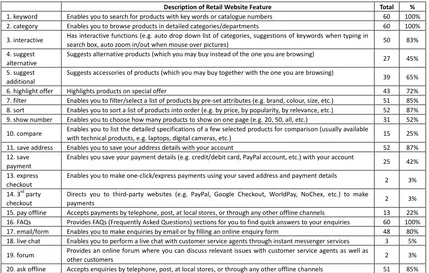
This chapter reports on the results of Study 1 on retail website features. By analysing the data collected from 60 retail websites in the UK, 20 retail website features have been identified.
8 This chapter presents the results of Study 2 on online customer activities. Based on 52 interviews with university students in the UK who regularly shop online, it is found that Search, Compare, Checkout, and Enquire are the four main online customer activities that customers perform on retail websites. In addition, each of the retail website features identified in Study 1 are associated with one of the online customer activities by working with friends and colleagues.
Chapter 10 Study 3 Customer Experience and Repurchase Intention
This chapter illustrates the results of Study 3 on customer experience and repurchase intention. Survey data were collected from university students as well as customers of an online retailer in the UK. The result shows a significant positive correlation between retail website features’ influences on customer experience and repurchase intention.
Chapter 11 Principle Components Analysis
9 Chapter 12 Findings and Discussions
This chapter summarises and discusses the findings of this research aiming to answer the main research question. The descriptions of the four types of retail website features are produced, and their influences on customer experience and repurchase intention are compared.
Chapter 13 Conclusion
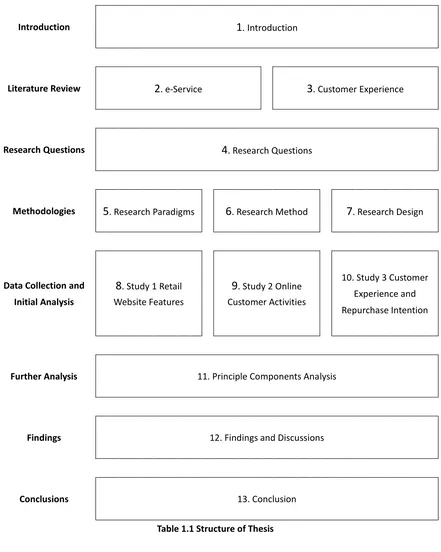
10 Table 1.1 summarises the structure of this thesis.
Introduction 1. Introduction
Literature Review 2. e-Service 3. Customer Experience
Research Questions 4. Research Questions
Methodologies 5. Research Paradigms 6. Research Method 7. Research Design
Data Collection and
Initial Analysis
8. Study 1 Retail Website Features
9. Study 2 Online Customer Activities
10. Study 3 Customer
Experience and Repurchase Intention
Further Analysis 11. Principle Components Analysis
Findings 12. Findings and Discussions
[image:28.595.105.546.118.670.2]
Conclusions 13. Conclusion
11
2.
e-Service
2.1.
Introduction
E-service has been defined by many researchers as services delivered through electronic devices (e.g. Boyer et al. 2002; Rowley 2006). Some common applications of e-service include mobile phones, ATM machines, vendor machines, library self-checkout systems, and the Internet. Based on these discussions, research on e-service was undertaken on various topics. However, research gaps exist, and are waiting to be filled by future research.
The objective of this chapter is to review the e-service literature relevant to this research, in order to identify the gaps in the current body of knowledge and set the context of this research. The following topics will be covered in this chapter:
Nature of e-Service, which summarises the definitions, typologies, and
conceptual frameworks used in current research;
e-Service Design, which explores how e-service is designed ;
e-Service Analyses and Evaluations, which discusses how e-service is
evaluated and analysed;
Customer Experience in e-Service, which focuses on the customer experience
12
Conclusion, which summarises the gaps and opportunities for future research
in the e-service area.
2.2.
Nature of e-Service
This section reviews the discussions on the nature of e-service in the current literature. It first summaries the definitions of e-service, and proposes a definition to be used in this research. Then, different types of e-services suggested by researchers are reviewed, and the context of the research is located. Finally, it reviews the conceptual frameworks that have guided many studies in e-service, and the focus of this research is set out. Thus, this section proceeds through the following topics:
Definitions of e-Service;
Typology of e-Service;
Conceptual Frameworks.
2.2.1.
Definitions of e-Service
There appear to be two main streams of definitions of e-service. One suggests that all services delivered through electronic devices and channels should be categorised as e-service. For example, the electronic provision of a service to customers (Saanen
13 performances whose delivery is mediated by information technology (Rowley 2006).
The other argues that e-services should include only services delivered through the Internet, rather than any other electronic devices or channels. For example, all interactive information services that are delivered on the Internet using advanced telecommunications, information and multi-media technologies (Boyer et al. 2002); a web-based service delivered through the internet (Surjadjaja et al. 2003); any service or functionality that can be accessed by a business or a consumer programmatically on the Internet, using standard representation and protocols (Su et al. 2003); and the use of electronic networks and associated technologies via the internet to enable, improve, enhance, transform or invent a business process or system to complete tasks, solve problems, conduct transactions or create value for current or potential customers (Lin et al. 2007).
14 For the purposes of this research, e-service is defined as ‘interactive information service delivered through electronic channel’, which includes but not limited to the Internet, mobile network, and information kiosks. Online retail service is a type of e-service using electronic channels to facilitate the delivery of goods or services.
2.2.2.
Typology of e-Service
Within the defined e-service area, a few frameworks for classifying e-services are proposed by researchers. One popular typology is by the nature of products that an e-service is providing. For example, Voss (2000) came up with a model which sees the e-service sells services (eService) and e-service sells physical goods (eCommerce) as the two ends of a continuum, and suggested that services can be delivered with goods together or alone over the internet (Figure 2.1).
15 (Voss 2000)
Later, a more specific model was proposed by Francis and White (2004) on the internet retailing area. This extended the Voss (2000) model and segmented internet retailing into four categories by product (goods or services) and fulfilment process (offline or electronic) (Figure 2.2).
Figure 2.2 Fulfilment-Product Classification Scheme
(Francis and White 2004)
16 These typologies have set out the boundaries of different types of e-services and guided many researchers in the area. Many studies on e-service are focused on, or categorised by the features described in these models. This study focuses on the B2C e-services selling goods.
2.2.3.
Conceptual Frameworks
After identifying the different types of e-service, more detailed research frameworks are proposed. Zeithaml et al. (2002) adapted Parasuraman et al. (1985)’s service quality model, and applied it to the e-service area. They suggested that in order to fulfil customers’ requirements and expectations, there are four gaps to be filled when e-service organisations interact with their customers (Figure 2.3).
Figure 2.3: Conceptual Model for Understanding and Improving e-Service Quality
17 From a more practical perspective, the ‘sand cone’ model (Voss 2000) provides a framework for operations strategy and service system design in e-service. The author suggested that there are three levels of service, i.e. foundation, customer-centred and value-added services, which build up the pyramid of services on the internet. He differentiated these three levels as the services that are expected from customers, the services that differentiate the organisation from its competitors, and the services that excite the customer.
Figure 2.4 'Sand Cone' model of e-Service (Voss 2003)
18 experiences, i.e. what excites the customers.
2.3.
e-Service Design
There appear to be a large number of studies focused on the design of e-services. Two types of designs are covered in the literature. The one that attracts more attention is the design of service processes, mostly from the service providers’ perspectives. The other promotes experience-based design, which focuses on the design that aims for customer experience enhancement. This section reviews the relevant literature, under those two topics:
Experience-Based Design;
e-Service Process Design.
2.3.1.
Experience-Based Design
Experience-based design is a design concept that focuses on the customer experience, rather than the system or process (Bate and Robert 2006). It suggests that the goal of design should be to enhance customer experience, and the final user or customer of the service should be involved during the design process (Abels et al.
19 service providers (Pickles et al. 2008). However, only a small number of studies on e-service design appear to have undertaken this approach (Taylor et al. 2003). Although the current literature on experience-based design in e-service is limited, there appears to be an increasing number of publications on e-service customer experience (see section 2.5 for more details), which may potentially support the concept of experience-based design in the near future.
2.3.2.
e-Service Process Design
Although there are many researchers who focus on the e-service process design, most of them address issues within a specific discipline, for example retail, library or mobile. The number of studies on the general e-service process design is relatively small. This section aims to answer the question of ‘what should be designed’, based on existing studies. Four main themes emerged as being the most widely and intensively studied by researchers: information, interaction, audio and visual features, as well as function features.
20 that the more the service provider presents information about their identity , the more likely the customers will trust them (Chou et al. 2009). Kuster and Vila (2011) noted that price and product information must be provided on a retail website.
Regarding interaction, an earlier study showed that human interaction is critical in forming customers’ trust in e-service. However, later research has suggested that interactions within a virtual community may enhance customer loyalty (Ellonen and Kuivalainen 2008) and the interactions with technology seem to have displaced the importance of human interactions (Haytko and Simmers 2009). The different results from these two studies may imply a dynamic change in people’s views on interactions with their online service providers.
21 Function features usually directly contribute to the core service that a website provides. However, only a few of them appear to be of interest to researchers. Eschenfelder (2003) has identified ‘classification categories’ as one of the key design elements of retail websites. However, Tateson and Bonsma (2003) criticized the fact that asking shoppers to come up a keyword for search or find the right product category may negatively influence the possibility of browsing and impulse purchase. Ghaphery et al. (2001) found that the use of quick links is very common on library websites. Gofman and Moskowitz (2009) developed a method of optimising the landing page of websites to increase consumer acceptability and general customer experience.
2.4.
e-Service Analyses and Evaluations
22 section reviews the literatures that following these two directions:
e-Service as a Whole;
e-Service as a Set of Parts.
2.4.1.
e-Service as a Whole
Those who see e-service as a whole tend to measure the whole process without differentiating customers’ needs in different parts of the service. Many of the proposed measurements of quality dimensions fall into this category. For example, Sahadev and Purani (2008) proposed four components of e-service quality: efficiency, fulfilment, system availability and privacy. This model does not specify which part of the service it is measuring. It seems to suggest that all part of the service should be measured from these four dimensions.
More examples are available, such as Barnes and Vidgen (2003)’s WebQual (usability, information quality, and service interaction), Parasuraman et al. (2005)’s E-S-QUAL (reliability, responsiveness, access, flexibility, ease of navigation, efficiency, assurance/trust, security/privacy, price knowledge, site aesthetics, and
customization/personalization), Bauer et al. (2006)’s eTransQual
23 Weaven (2009)’s E-ServQual (personal needs, site organisation, user-friendliness, and efficiency).
2.4.2.
e-Service as a Set of Parts
In contrast, some researchers seem to suggest that customers may have different preferences for different parts of e-service. This is implied by their studies on one or more parts of the e-service. For example, Collier and Bienstock (2006) suggested that other than website interactivity, outcome and recovery are also important to e-services; Aberg and Shahmehri (2000) studied the web assistant systems that allows customers to call for human assistance; Boyd (2005) indicated that synchronous communication channels may provide a better service than those asynchronous channels; Breitsohl et al. (2011) studied the e-business complaint management. These studies indicate that the different parts of e-service may be evaluated according to different criteria by customers. However, these studies also show that there is no systematic categorization of all the parts that a service may consist of.
2.5.
Customer Experience in e-Service
24 expectations in terms of the activity (Demangeot and Broderick 2006) and has the potential to produce an emotional connection between the customer and the service provider (Gupta and Vajic 1999). Research shows that customer experience has become a key element of the service product and is valued even more than the service’s tangible value (Pine and Gilmore 1999). Although customer experience has been identified as an important factor by researchers, emotional characteristics made it difficult to measure, and hence redirected research interests to other aeras, such as quality, satisfaction and loyalty. In the e-service area, a few studies have drawn direct attention to the customer experience.
25 proposed three online shopping components that form online shopping experience (interactivity, transaction, and fulfilment). Other things that may influence customer experience are generally website design features (Chung and Tan 2004), including online catalogue (Tateson and Bonsma 2003), interface (Ding et al. 2007) and sound (Fiore and Kelly 2007).
However, little literature was found to have studied what customer experience can bring to service providers. Ha and Perks (2005) suggested that experience may help to achieve brand trust, and Al-maghrabi et al. (2011) implicitly indicated that positive customer experience may lead higher intentions to re-use an e-service.
Considering the limited knowledge of customer experience in e-service, which is a core interest of this research, a review of customer experience in the broader general service context is needed, which is presented in the next chapter.
2.6.
Conclusion
Following the review of e-service literature that is related to this research, a few gaps in the current body of knowledge emerged, and are explained as below. These gaps imply opportunities for future research in the e-service area.
26 The current conceptual frameworks have provided a detailed guideline for e-service research. However, there seems to be limited empirical research on some of the areas.
In the Zeithaml et al. (2002)’s model, it appears that many current studies are
concerned with the information gap between customers and service providers, and little attention was paid to the design and communication gap, which are both in the operations management area.
In comparison, the Voss (2003) model provided a more practical guideline as
to the value of service; however, the three levels of service are not very well differentiated by researchers.
e-Service Design
It is proposed that e-service should be designed based on customer’s
experience (e.g. Bate and Robert 2006). However, few researchers have provided an operational approach as to how to use customer experience in e-service design.
The literature review identified four main themes of e-service process design:
27 e-Service Analyses and Evaluations:
Existing studies usually analyse and evaluate e-service as a whole process or
as a set of parts. However, these parts of service are divided by what to be evaluated, but ignore the customers’ requirements and purposes of using the service.
Customer Experience in e-Service
Much of the existing literature in e-service has attempted to identify the
determinants of customer experience. However, there appears to be little on what customer experience can bring to service providers in the e-service context.
28
3.
Customer Experience
3.1.
Introduction
The notion of customer experience was first addressed in the mid/late 1990s (Carbone and Haeckel 1994; Johnston 1999; Pine and Gilmore 1999), and is receiving more and more attention from researchers (Schmitt 2003; Shaw and Ivens 2002; Voss 2003). This concept has appealed to practitioners as many organisations now refer to this while designing and promoting their services. It is suggested that customers experience should be a company’s first concern (Meyer and Schwager 2007) and a considerable number of studies have been conducted. However, customer experience is also rather elusive on account of its intangibility and emotional nature, and through it being a customer-based / perceived construct (Johnston and Kong 2009).
This chapter provides a review of the existing literature on customer experience, which appears to cover four areas:
What – Perceptions and Definitions, which examines different perceptions of
29
Why – Benefits of Customer Experience, which explains what benefits
customer experience can bring to service providers;
When – Customer Experience Timeline, which explores customer experience
in different phases of a service process;
How – Managing Customer Experience, which focuses on how customer
experience is managed in service context; and concludes with;
Conclusion, which presents the gaps and opportunities emerged from this
chapter of literature review on customer experience.
3.2.
What – Perceptions and Definitions
The term ‘customer experience’ has been perceived and presented in many different ways by researchers to serve different research interests. Since it is very important to be clear about what the research object is and how people perceive it, this section reviews literature on different perceptions of the concept of customer experience, and relevant conceptual structures.
3.2.1.
The Concept of Customer Experience
30 coalesced (Padgett and Allen 1997) emotional (Dewey 1963; Edvardsson et al. 2005; Sandstrom et al. 2008) and mental (Edvardsson et al. 2005) feeling (Padgett and Allen 1997) that are subjectively (Meyer and Schwager 2007) perceived by the customers (Carbone and Haeckel 1994; Edvardsson et al. 2005) during the interaction (Gupta and Vajic 1999), encounter (Carbone and Haeckel 1994), or progress (Carbone and Haeckel 1994; Dewey 1963; Gupta and Vajic 1999) of the product and/or service consumption (Edvardsson et al. 2005; Padgett and Allen 1997).
3.2.2.
Conceptual Frameworks
There appear to be four types of conceptual frameworks that are proposed in order to understand the nature of customer experience and promote further research.
31 service, and in combination, provide an overall customer experience.
Figure 3.1 An example of hierarchical categorisation of customer experience (O'Loughlin et al. 2004)
32 The above two types of framework or categorisation seem to suggest that different types of customer experience should be analysed and evaluated differently, but little advice was given as to guide how it should be done.
The third type of framework emphasises the importance of the context of customer experience. Pullman and Gross (2004) suggested that the service context is one of the primary concerns for experience design and management. It should be a combination of carefully selected service products that facilitate the interaction between customers and the service provider (Gupta and Vajic 1999). Bitner (1992) addressed context as ‘servicescape’, which suggests that the environmental dimensions of service is a key point for service experience.
The structure of the last type of research frameworks appears to be less well formed than the above three. It focuses on the transactional experience, according to O'Loughlin et al. (2004), and sees customer experience as a collection of ‘clues’.
33 extended the work and categorised experience clues into three main groups: functional clues, mechanic clues, and humanic clues.
3.3.
Why – Benefits of Customer Experience
Meyer and Schwager (2007) suggested that customer experience should be a company’s first concern. Berry and Carbone (2007) also argued that great organizations systematically manage customer experience aiming to establish strong emotional connections with their customers. Many have claimed that positive customer experience consistently creates values that are appreciated by customers (Berry and Carbone 2007; Berry et al. 2002; Chen and Chen 2010; Hoch 2002; Voss 2004). However, it seems that there is no systematic analysis of what benefits customer experience can bring to the service providers. Following an initial literature review in the relevant area, it appears that four benefits have attracted the most research interest, while others exist:
Customer Satisfaction;
Customer Expectations;
Customer Loyalty;
Behavioural Intentions.
3.3.1.
Customer Satisfaction
34 effect on satisfaction. Chen and Chen (2010) also found a direct effect of the quality of experience on satisfaction. According to Oliver (1997), satisfaction is defined as the level of consumer’s fulfilment response to a product or service feature. It is the judgement of a customer after the evaluation or assessment of a service experience. It directly affects customers’ likelihood of repurchase (Flanagan et al. 2005).
3.3.2.
Customer Expectations
Meyer and Schwager (2007) argued that people’s expectations are set in part by their previous experiences with a company’s offerings. Holloway and Beatty (2003) suggested that service quality expectations vary greatly, especially depending on the experience level of the customer and perceived reputation of the organisation. It appears that customer experience is a key issue in forming customer expectations.
3.3.3.
Customer Loyalty
35 has considerable competitive advantage (Jones and Farquhar 2003). According to Dick and Basu (1994), loyalty is an interaction between two components: a) the relative attitude that a customer has towards a company or brand, and b) the intention to repurchase that brand or from that company. Jones and Farquhar (2003) argued that the loyalty of a consumer is determined by the strength of the relationship between attitude and behaviour. In order to build customer loyalty, managing each customer’s experience is perhaps the most important ingredient (Crosby and Johnson 2007). Pullman and Gross (2004)’s research shows that the type of customer emotions evoked in a hospitality setting significantly influences loyalty behaviours. In addition, Mascarenhas et al. (2006) research indicates that lasting customer loyalty is approachable by implementing total customer experience management.
3.3.4.
Behavioural Intentions
36 satisfaction.
3.4.
When – Customer Experience Timeline
37 In this section, current studies are reviewed in the following structure:
Pre-Service Experience;
Service Experience – Start and End;
Service Experience – Peaks and Trend;
Post-Service Experience.
3.4.1.
Pre-Service Experience
38 Edvardsson et al. (2005) proposed seven benefits or principles of providing customers with a pre-purchase service experience:
1) Add unique and personalized value to the service;
2) Connect with the customer by means of exposure to the organization’s norms and values;
3) Learn more about customers’ needs and desires to be used during service development and in quality improvement efforts;
4) Increase loyalty;
5) Create a unique identity;
6) Manage customer expectations and quality-in-use; and
7) Improve sales. ( p.157-158)
3.4.2.
Service Experience – Start and End
Start
39 performance during the service encounter receives more favourable judgements than a decreasing performance. The result shows that a good start does not have as much impact as a good end in generating customer satisfaction and purchase intentions in services. The researchers suggest that the start experience has more influence on building expectations of the final service result.
End
In addition to Hansen and Danaher (1999) research, which shows the importance of the end experience, Carmon and Kahneman (1996) also found the global retrospective evaluations of queuing experiences to be dominated by the final affective state. They suggested that the ‘end rule’ applies to goal-directed experiences. Hansen et al. (2004) research in restaurant service experience indicates that payment, as the main component within the last stage of the meal experience, represents an important part of the service; when customers experience the payment process in an unsatisfactory way, it can have a negative effect on their experiences as a whole. However, Verhoef et al. (2004) research shows a negative effect on the end utility of the service call on customer satisfaction. Although they have proposed several possible reasons, none of them has been tested yet.
3.4.3.
Service Experience – Peaks and Trend
40 Ariely and Carmon (2000) argued that when people summarize experiences, they appear to extract only a few defining features (gestalt characteristics) of these sequences, and combine them into an overall summary evaluations of the sequences, rather than simply combine the intensity of their actual experiences. These defining features include “particular salient characteristics such the most intense state (peak) and the final state (end) of the experience” (p192). Verhoef et al. (2004) argued that although it was assumed that firms should deliver a consistent performance during a service encounter in the early service literature, research in psychology states that in addition to the average performance, the peaks in the performance are important. The authors considered the service process to be a sequence of events, studied the service calls of a large European financial service provider, and found that although the average utility of the service call was a significant predictor of the experienced utility (customer satisfaction), the positive peak of the sequence had a positive effect on the experienced utility.
Trend
41 customers who experience inconsistent starts and ends are more extreme in their judgements than those who experience consistent performances. Furthermore, positive trends seemed to result in stronger purchase intentions, compared to the neutral and negative trends
3.4.4.
Post-Service Experience
Zeithaml and Bitner (1996) argued that post-service experience evaluation can also be difficult for service customers, particularly for credence services, such as medical and legal services. Mano and Oliver (1993) investigated the underlying dimensionality of three aspects of the post-consumption experience – product evaluation, product-elicited effect, and product satisfaction, and integrated these concepts through a suggested causal framework. They argued that adopting a two-dimensional view of post-consumption emotional experience suggests that 1) pleasantness is of a different composition to low-arousal positive affect; and 2) hedonic evaluation is mostly affective while utilitarian evaluation is mostly cognitive. Their results show that “satisfaction response is not easily tied down, because it does not respond as a pure affect nor does it exist in the absence of feeling” (Mano and Oliver 1993).
3.5.
How – Managing Customer Experience
42 this section discusses how organizations manage customer experience through operations. Research in this area can be categorized into three main groups:
Factors and Determinants of Customer Experience;
Design of Customer Experience;
Tools for Evaluation and Assessment.
3.5.1.
Factors and Determinants of Customer Experience
Researchers have identified various factors that may possibly influence customer experience, which includes the service context, employees, other customers, waiting time, and the frequency of customer visits.
43 been recognized by researchers, it seems that not many researchers are studying its impact intensively. The research remains on the identifying level, with few practical suggestions regarding how to manage the service context.
The second factor being discussed is the impact of employee behaviours on customer experience. The employees have been identified as a very useful tool to improve service functions (Haeckel et al. 2003) Research on employee’s influence on customer experience has attracted research interest. Hoffman et al. (1995) found it was difficult to recover any service failure that caused by employee’s behaviour. (Voss and Zomerdijk 2007) suggested the satisfied and motivated employee is a key to excellent service. Organisations can reinforce the brand experience within a particular touch point by controlling employee behaviours (Crosby and Johnson 2007). Specht et al. (2007) also found the customers judge service encounters on the basis of service employees’ effort and abilities.
44 suggested that employee customization is a competitive advantage of organizations, and can be thought of along two behavioural dimensions: interpersonal adaptive behaviour, which refers to an employee altering various interpersonal communication elements to meet what they perceive to be the unique needs of individual consumers, and service offering adaptation. This refers to tailoring or creating a unique bundle of service attributes or benefits, based on an individual consumer’s needs. Sarel and Marmorstein (1998)’s findings suggest that perceived employee effort during the delay can be enhanced by 1) employee training; 2) delivery process improvement; and 3) customer education and information. Besides this, an effective apology is also very important. All these methods focus on improving employee skills, but, the kind of skills employees need to provide an excellent service experience is still to be questioned. Further research into specific industries is desired.
45 Fisk 1997). This implies guiding customers’ behaviour during the service encounter could be considered as a way of influencing customer experience by organizations. However, little literature is available regarding this issue.
Dawes and Rowley (1998) presented two case studies to illustrate that waiting experience can be managed to create a positive experience. They argued that the nature of the waiting experience is that customers have to accept the fact of the service they are seeking is not currently available. A generally acceptable strategy would seem to be to seek to embed the waiting experience into the total service experience, so that customers do not perceive any discontinuity, or indeed start to welcome the waiting experience in its own right, although this must be managed in different ways in different environments (Dawes and Rowley 1998).
In addition, Morgan and Rao (2003) suggested that the frequency of customer visits is another factor that may influence customer experience. They argued that a positive experience may revert to a neutral one if changes are not made frequently enough. On the other hand, they did not mention whether the experience would revert to a negative experience.
46 the perceived social power of customers also affects their perception of experience. Mascarenhas et al. (2006) suggested that customer experience is captured in three interactive elements: physical moments, emotional involvement, and its value chain moments.
3.5.2.
Design of Customer Experience
“While operations management research has focused on service design, the area of experience design has received less attention” (Pullman and Gross 2004, p.552). However, due to the importance of customer experience, an increasing number of researchers showed their interest in experience-based design recently. McLellan (2000) suggested that the goal of experience design is to make experience functional, purposeful, engaging, compelling, and memorable. Johnston (1999) suggested that the design of a service need to be consistent with its service concept. According to Cole-Colander (2003), designing customer experience aims at transferring design thinking from the retail sector and leading to an agenda for change.
47 improve performance, safety and governance. According to Carbone and Haeckel (1994), experience design can be divided into four phases; 1) acquisition of service experience design skills; 2) data collection and analysis; 3) service clue design; and 4) implementation and verification. Fang and Salvendy (2003) suggested the nineteen most important design rules for customer-centred website design, and three important issues that customers are aware of: 1) attributes; 2) trust; and 3) graphics. In addition, Johnston and Kong (2009) identified a ten-stage road map for improving customer experience in a study of four different types of service organisations
In addition to the design process, Edvardsson et al. (2005) introduced a concept of ‘experience room’, which allows service providers to simulates the service experience so that customers may ‘test-drive’ the service. They suggested that service providers should take consideration of the following six dimensions when designing the ‘experience room’: 1) physical artefacts, 2) intangible artefacts, 3) technology, 4) customer placement, 5) customer involvement, and 6) interaction with employees.