Actions Speak Louder than Words: Evaluating Parsers in the Context of
Natural Language Understanding Systems for Human-Robot Interaction
Sandra K ¨ubler, Rachael Cantrell, Matthias Scheutz
Indiana University
{skuebler,rcantrel,mscheutz}@indiana.edu
Abstract
The standard ParsEval metrics alone are often not sufficient for evaluating parsers integrated in natural language understand-ing systems. We propose to augment in-trinsic parser evaluations by exin-trinsic mea-sures in the context of human-robot inter-action using a corpus from a human co-operative search task. We compare a con-stituent with a dependency parser on both intrinsic and extrinsic measures and show that the conversion to semantics is feasible for different syntactic paradigms.
1 Introduction
Human-robot interactions (HRI) in natural lan-guage (Scheutz et al., 2007) pose many chal-lenges for natural language understanding (NLU) systems, for humans expect robots to (1) gener-ate quick responses to their request, which re-quires all processing to be done in real-time, (2) to rapidly integrate perceptions (e.g., to resolve refer-ents (Brick and Scheutz, 2007)), and (3) to provide backchannel feedback indicating whether they un-derstood an instruction, often before the end of an utterance. As a result, NLU systems on robots must operate incrementally to allow for the con-struction of meaning that can lead to robot action before an utterance is completed (e.g., a head-turn of the robot to check for an object referred to by the speaker). Hence, the question arises how one can best evaluate NLU components such as parsers for robotic NLU in the context of HRI.
In this paper, we argue that intrinsic parser eval-uations, which evaluate parsers in isolation, are insufficient for determining their performance in HRI contexts where the ultimate goal of the NLU system is to generate the correct actions for the robot in a timely manner. For high performance of a parser with respect to intrisic measures does not
imply that the parser will also work well with the other NLU components. A correct but overly com-plex parse passed to the semantic analysis unit, for example, may not result in the correct meaning interpretation and will thus fail to generate cor-rect actions. Similarly, fragmented input from the speech recognizer may not lead to any parsable se-quence of words, again likely resulting in incorrect robot behavior. Hence, we need an extrinsic eval-uation to determine the utility and performance of a parser in the context of other NLU components at the level of semantics and action execution.
To this end, we introduce an evaluation archi-tecture that can be used for extrinsic evaluations of NLU components and demonstrate its utility for parser evaluation using state-of-the-art parsers for each of the two main parsing paradigms: the Berkeley constituent parser (Petrov and Klein, 2007) and MaltParser (Nivre et al., 2007b), a de-pendency parser. The evaluation compares in-trinsic and exin-trinsic measures on the CReST cor-pus (Eberhard et al., 2010), which is representa-tive of a broad class of collaborarepresenta-tive instruction-based tasks envisioned for future robots (e.g., in search and rescue missions). To our knowledge, no previous extrinsic parser evaluation used con-versions to semantic/action representations, which can be performed for different parser types and are thus ideally suited for comparing parsing frame-works. Moreover, no previous work has presented a combined intrinsic-extrinsic evaluation where the extrinsic evaluation uses full-fledged seman-tic/action representations in an HRI context.
2 Previous Work
Evaluating different types of parsers is challeng-ing for many reasons. For one, intrinsic evalu-ation measures are often specific to the type of parser. The ParsEval measures (precision and re-call) are the standard for constituent parsers, at-tachment scores for dependency parsing. Yet,
none of these measures is ideal: the ParsEval mea-sures have been widely criticized because they fa-vorflat annotation schemes and harshly punish at-tachment errors (Carroll et al., 1998). Addition-ally, there is no evaluation scheme that can com-pare the performance of constituent and depen-dency parsers, or parsers using different underly-ing grammars. Convertunderly-ing constituents into de-pendencies (Boyd and Meurers, 2008), evens out differences between underlying grammars. How-ever, it is well known that the conversion into a different format is not straightforward. Clark and Curran (2007), who convert the CCGBank to Dep-Bank, report an F-score of 68.7 for the conversion on gold data. Conversions into dependencies have been evaluated on the treebank side (Rehbein and van Genabith, 2007), but not on the parser side; yet, the latter is critical since parser errors result in unpredicted structures and thus conversion errors. Intrinsic parsing quality has been shown to be insufficient for comparing parsers, and adding ex-trinsic measures to the evaluation can lead to in-conclusive results, in comparing two dependency parsers (Moll´a and Hutchinson, 2003), three con-stituent parsers (Preiss, 2002), and for a deep and a partial parser (Grover et al., 2005).
We propose to use intrinsic and extrinsic mea-sures together to assess tradeoffs for parsers em-bedded in NLU systems (e.g., low-intrinsic/high-extrinsic quality is indicative of parsers that work well in challenging systems, while intrinsic/low-extrinsic quality is typical of high-performance parsers that are difficult to interface).
3 An Evaluation Framework for HRI
For evaluation, we propose the roboticDIARC ar-chitecture (Scheutz et al., 2007) which has been used successfully in many robotic applications. In addition to components for visual perception and action execution, DIARC consists of five NLU components. The first two components, a speech recognizer, and a disfluencyfilter whichfilters out common vocal distractors (“uh”, “um”, etc.) and common fillers (“well”, “so”, etc.) will not be used here. The third component optionally per-forms trigram-based part of speech (POS) tagging. The fourth component, the parser to be evaluated, which produces the constituent tree or dependency graph used by thefifth component, theλconverter, to produce formal semantic representations. If the semantic representation indicates that a command
needs to be executed, the command is passed on to an action interpreter (which then retrieves an exist-ing action script indexed by the command or, if no such script is found, forwards the request to a task planner, which will plan a sequence of actions to achieve it (Schermerhorn et al., 2009)).
The semantic conversion process makes use of combinatorial categorial grammar (CCG) tags associated with lexical items, which are essen-tially part-of-speech tags enriched with informa-tion about the word’s arguments. Given a word and the appropriate CCG tag, the correspond-ing semantic representations are retrieved from a semantic lexicon. These representations are λ-expressions expressed in a fragment offirst-order dynamic logic sufficiently rich to capture the lan-guage of (action) instructions from the corpus (c.f. e.g., (Goldblatt, 1992)). Expressions are repeat-edly combined using β-reduction until all words are converted and (preferably) only oneλ-free for-mula is left (Dzifcak et al., 2009).
For example, the sentence “do you see a blue box?” is translated as check-and-answer(∃x.see(self, x)∧box(x)∧blue(x)). check-and-answeris an action that takes a formula as an argument, checks its truth (if possible), and causes the robot to reply with “yes” or “no” depending on the outcome of the check operation1.
The conversion from dependency graphs to se-mantic representations is straightforward: When a dependent is attached to a head, the dependent is added to the CCG tag, resulting in a conve-nient format for semantic conversion. Then each node is looked up in the dictionary, and the defi -nition is used to convert the node. For the exam-ple above, the parse graph indicates that “a” and “blue” are syntactic arguments of “box”, “you” and “a blue box” are arguments of “see”, and the clause “you see a blue box” is an argument of “do”. Based on the lexical definitions, the phrase “a blue box” is combined into the expres-sion (∃x.box(x) ∧ blue(x)). As argument of the verb “see”, it is then combined into the expression
(∃x.see(self, x)∧box(x)∧blue(x)), and ultimately check&answer(∃x.see(self, x)∧box(x)∧blue(x)).
The conversion for constituent trees is less straightforward since it is more difficult to au-tomatically identify the head of a phrase, and to connect the arguments in the same way. We use a slightly different method: each node in the
tree is looked up in the dictionary for a suitable word/CCG tag combination given the words dom-inated by the node’s daughters. The λ conver-sions are then performed for each sentence after the parserfinishes producing a parse tree.
4 Experimental Setup
For parser evaluations, we use an HRI scenario where processing speed is critical (often more important even than accuracy) as humans expect timely responses of the robot. Moreover, a parser’s ability to produce fragments of a sentence (instead of failing completely) is highly desirable since the robot can ask clarification questions (if it knows where the parse failed) as opposed to offline pro-cessing tasks as humans are typically willing to help. This is different from a corpus, where no clarification question can be asked. Correctness
here is determined by correct semantic interpreta-tions that can be generated in the semantic analysis based on the (partial) parses. While these aspects are often of secondary importance in many NLU systems, they are essential to a robotic NLU archi-tecture. Since we experiment with a new corpus that has not been used in parsing research yet, we also present an intrinsic evaluation to give a ref-erence point to put the parsers’ performance into perspective with regard to previous work.
More specifically, we investigate two points: (1) Given that spoken commands to robots are consid-erably shorter and less complex than newspaper sentences, is it possible to use existing resources, i.e., the Penn Treebank (Marcus et al., 1993), for training the parsers without a major decrease in accuracy? And (2), are constituent or dependency parsers better suited for the NLU architecture de-scribed above, in terms of accuracy and speed?
To answer these questions, we carried out two experiments: (1) The intrinsic evaluation. This is split into two parts: one that compares constituent and dependency parsers on our test data when both parsers were trained on the Penn Treebank; and one that compares the parsers trained on a small in-domain set. (2) The extrinsic evaluation, which compares the two parsers in the NLU architecture, is also based on in-domain training data.
Intrinsic and extrinsic measures: For thefirst experiment we use standard intrinsic parsing mea-sures: for the constituent parser, we report labeled precision (LP), labeled recall (LR), and labeled F-score (LF); for the dependency parser the labeled
attachment score (LAS). The second experiment uses the accuracy of the logical forms and the cor-rect action interpretation and execution as a mea-sure of quality. For this experiment, we also report the processing time, i.e., how much time the com-plete system requires for processing the test set from the text input to the output of logical forms.
Data sets: For the intrinsic evaluation, we used the Penn Treebank. For the constituent exper-iments, we used the treebank with grammatical functions since the semantic construction requires this information. The only exception is the ex-periment using the Berkeley parser with the Penn Treebank: Because of memory restrictions, we could not use grammatical functions. For the de-pendency parser, we used a dede-pendency version of the Penn Treebank created bypennconverter (Jo-hansson and Nugues, 2007).
For the in-domain experiments (intrinsic and extrinsic), we used CReST (Eberhard et al., 2010), a corpus of natural language dialogues obtained from recordings of humans performing a coopera-tive,remote search task. The multi-modal corpus contains the speech signals and transcriptions of the dialogues, which are additionally annotated for dialogue structure, disfluencies, POS, and syntax. The syntactic annotation covers both constituent annotation based on the Penn Treebank annota-tion scheme and dependencies based on the de-pendency version of the Penn Treebank. The cor-pus consists of 7 dialogues, with 1,977 sentences overall. The sentences are fairly short; average sentence length is 6.7 words. We extracted all commands (such as “walk into the next room”), which our robot can handle, and used those 122 sentences as our test set. We performed a 7-fold cross validation, in which one fold consists of all test sentences (i.e. commands) from one of the 7 dialogues. All the other folds combined with the declarative sentences from all dialogues served as training data. The number of commands per dia-logue varies so the evaluation was performed on the set of all test sentences rather than averaged over the 7 folds.
Berkeley parser MaltParser
training data POS acc. LP LR LF POS acc. LAS
Penn 86.9 47.2 44.8 46.0 88.1 40.6
CReST 67.8 56.7 48.9 52.5 92.8 70.5
Table 1: The results of the intrinsic evaluation.
For the dependency parser, we used MaltParser (Nivre et al., 2007b), a pseudo-projective depen-dency parser, which has reached state-of-the-art results for all languages in the CONLL 2007 shared task (Nivre et al., 2007a). We decided to use version 1.1 of MaltParser, which allows the use of memory-based learning (MBL) in the im-plementation of TiMBL2. MBL has been shown to work well with small training sets (cf., (Banko and Brill, 2001)). MaltParser was used with the Nivre algorithm and the feature set that proved optimal for English (Nivre et al., 2007b). TiMBL parame-ters were optimized for each experiment in a non-exhaustive search. When trained on the Penn Tree-bank, the parser performed best using MVDM, 5 nearest neighbors, no feature weighting, and In-verse Distance class weighting. For the experi-ments on the dialogue corpus, the default settings proved optimal. Since MaltParser requires POS-tagged input, we used the Markov model tagger TnT (Brants, 1999) to tag the test sentences for dependency parsing; the Berkeley parser performs POS tagging in the parsing process.
For the experiment based on the complete NLU architecture, we used an incremental reimple-mentation of the Nivre algorithm called Mink (Cantrell, 2009) as dependency parser. Mink uses the WEKA implementation of the C4.5 decision tree classifier (Hall et al., 2009) as guide. The confidence threshold for pruning is 0.25, and the minimum number of instances per leaf is 2.
5 Results
The results of theintrinsic parser evaluationare shown in Table 1. The POS tagging results for TnT (for MaltParser) are unexpected: the small in-domain training set resulted in an increase of accu-racy of 4.7 percent points. The result for the POS tagging accuracy of the Berkeley parser trained on CReST is artificially low because the parser did not parse 9 sentences, which resulted in missing POS tags for those sentences. All of the POS tag-ging results are lower than the TnT accuracy of
2http://ilk.uvt.nl/timbl/
96.7%, reported for the Penn Treebank (Brants, 1999). This is due to either out-of-domain data or the small training set for the training with CReST. When the parsers were trained on the Penn Treebank, the very low results for both parsers (46.0 F-score, 40.6 LAS) show clearly that pre-existing resources cannot be used for training. The low results are due to the fact that the test set con-sists almost exclusively of commands, a sentence type that, to our knowledge, does not occur in the Penn Treebank. A comparison between ParsEval measures and LAS is difficult. We refrained from converting the constituent parse to dependencies for evaluation because it is unclear how reliable the conversion for parser output is.
The results for the Berkeley parser trained on the dialogue data from CReST are better than the results trained on the Penn Treebank. However, even with training on in-domain data, the F-score of 52.5 is still considerably lower than state-of-the-art results for in-domain parsing of the Penn Treebank. This is partly due to our inclusion of grammatical functions in the parsing process as well as in the evaluation. Thus, the parsing task is more difficult than in other experiments. An-other possible reason for the low performance is the size of the training set. We must assume that the Berkeley parser requires a larger training set to reach good results. This is corroborated by the fact that this parser did not find any parse for 9 sen-tences. The dependency parser performs equally badly when trained on the Penn Treebank (40.6 LAS). However, when it is trained on in-domain data, it reaches an LAS of 70.5, which corrob-orates the assumption that TiMBL performs well with small data sets.
subse-( subse-(S subse-(VP subse-(VB hold) subse-(PRT subse-(RP on)) subse-(S subse-(VP subse-(VB let) subse-(S subse-(NP subse-(PRP me)) subse-(VP subse-(VB pick) subse-(PRT subse-(RP up)) (NP (DT those) (JJ green) (NNS boxes)))))))) )
Figure 1: Constituent parse for “hold on let me pick up those green boxes”.
quent parsing errors.
For the extrinsic evaluation in the context of the NLU system, we report exact match accu-racy for the logical forms. Since the semantic conversion fails on unexpected parser output, the quantitative semantic evaluation is based only on syntactically-correct sentences, although partially-correct parses are instructive examples, and thus are included in the discussion. More parses were
almost correct than perfectly so: 27% were per-fectly correct for the constituent parser, and 30% for the dependency parser.
Of these, 90% of dependency graphs were cor-rectly semantically combined. while just 64% of constituent trees were correctly combined. Mink was also faster: Averaged over a range of sentence lengths and complexities, the NLU system using Mink was roughly twice as fast as the one with the Berkeley parser. Averaged over 5 runs of 100 sentences each, Mink required approx. 180 ms per sentence, the Berkeley parser approx. 270 ms.
The most egregious problem area involves a typical phenomenon of spontaneous speech that an utterance does not necessarily correspond to a sen-tence in the syntactic sense: Many utterances con-tain multiple, independent phrases or clauses, e.g., “hold on let me pick up those green boxes”, as a single utterance. The ideal translation for this ut-terance is: wait(listener);get(speaker,{x|green(x)∧ box(x)})where “;” is the sequencing operator.
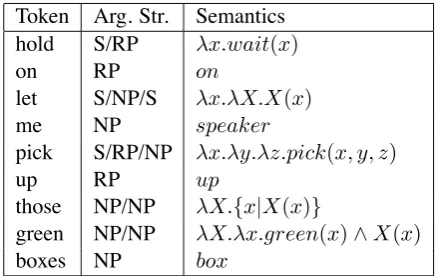
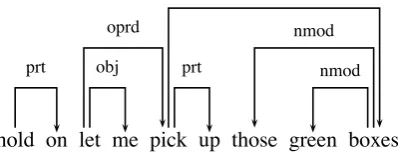
The constituent parse for the utterance is shown in Figure 1. This parse is partially correct, but the two commands are not treated as a conjunction of clauses; instead, the second command is treated as subordinate to the first one, This analysis results in the argument structure shown in Table 2, where each phrase takes its phrasal constituents as argu-ments. The semantic definitions and CCG tags are shown in Table 3. Some definitions do not have the same number of arguments as the CCG tags, in particular the verb “pick” with its raised sub-ject, which will be applied by the semantics of the verb “let”. The correspondence between the con-stituent parse and semantics output is shown in Ta-ble 4. The dependency parse is shown in Figure 2. The two commands are correctly analyzed as
in-Phr.:Head Arguments VP:hold (PRT=on,S)
VP:let (S)
S (NP=me,VP)
VP:pick (PRT=up,NP)
NP (DT=those,JJ=green,NNS=boxes)
Table 2: The argument structure based on the con-stituent parse.
Token Arg. Str. Semantics
hold S/RP λx.wait(x)
on RP on
let S/NP/S λx.λX.X(x)
me NP speaker
pick S/RP/NP λx.λy.λz.pick(x, y, z)
up RP up
those NP/NP λX.{x|X(x)}
green NP/NP λX.λx.green(x)∧X(x)
boxes NP box
Table 3: Semantics for the example sentence.
Head Dependents
HOLD on LET me, pick PICK up, boxes BOXES those, green
Table 5: Syntactic head/dependent relationships.
dependent clauses.
The parse results in the syntactic head and de-pendent relationships and the semantic head and dependent relationships for the words in the utter-ance, constructed from the definitions in Table 5. In the semantic analysis, “pick” is similar to the syntactic analysis in that it takes a noun phrase and a particle as its arguments. This results in the following combination: λx.λy.λz.pick(up, z, y) (up) (those green boxes)3. The first application applies “up” to x, resulting in the analysis:
λy.λz.pick(up, z, y) (those green boxes) which in turn
is converted into: λz.pick(up, z, those green boxes).
Constituency Semantic
1 N P1:boxes (DT=those,JJ=green) {x|green(x)∧boxes(x)}
2 V P1:pick (PRT=up,N P1) λz.pick(up, z,{x|green(x)∧box(x)}) 3 S1(N P2=speaker,V P1) pick(up, speaker,{x|green(x)∧box(x)}) 4 V P2:let (S1) pick(up, speaker,{x|green(x)∧box(x)}) 5 S2(V P2) pick(up, speaker,{x|green(x)∧box(x)})
6 V P3:hold (PRT=on,S2) wait(pick(up, speaker,{x|green(x)∧box(x)}))⇐error 7 S4(V P3)
Table 4: Correspondence between the constituent parse and the semantics output.
hold on let me pick up those green boxes
prt obj oprd
prt
nmod
nmod obj
Figure 2: The dependency analysis.
Here we find a systematic difference between the syntactic analysis and the intended semantic one: While syntactically, the adjective “green” is dependent on the head “boxes”, it is the opposite in the semantic analysis. The definition of “boxes” indicates that it is a predicate that takes as an argu-ment an abstract entity “x”, representing the real-world item that has the property of being a box. This predicate, box(x), is itself then applied to the predicate “green”, which has the definition λX.λ
x.green(x)∧X(x). The variableXrepresents the con-cept that will be applied. This application pro-duces λx.green(x)∧box(x)). Thus a conversion rule reverses dependencies within noun phrases.
6 Discussion
The results show that a considerable number of sentences could be parsed but not converted cor-rectly to logical form because of the way certain information is represented in the parses. Addi-tionally, a small difference in the parsers’ behav-ior, namely MaltParser’s ability to provide partial parses, resulted in a large difference in the usabil-ity of the parsers’ output – partial parses are not only better than parse failures, but may even be the expected outcome in an HRI settings, since they can be successfully translated to logical form.
While the same parser performed better under both intrinsic and extrinsic evaluation, this may not necessarily always be the case (see section 2). It is possible that one parser provides imperfect
parses when evaluated intrinsically but the infor-mation is presented in a form that can be used by higher applications. This occurred in our experi-ment in the case of the dependency parser, whose partial parses could be converted in completely correct semantic representations. I.e., while the parse may not be completely correct with regard to the gold standard, it may still provide enough in-formation to use for the higher component so that no information loss ensues.
One advantage of our extrinsic evaluation is that the conversion to semantics can be performed for a wide range of different syntactic annota-tions. While previous evaluations stayed within one parsing framework (e.g., dependency pars-ing), our evaluation included a constituent and a dependency parser (this evaluation can be ex-tended to “deeper” parsers such as HPSG parsers). Additionally, the conversion to semantics involves a wide range of syntactic phenomena, thus provid-ing a high granularity compared to extrinsic evalu-ations in information retrieval, where only specific sentence parts (e.g., noun phrases) are targeted.
7 Conclusions
syntac-tic paradigm, and the HRI setting requires evalu-ation metrics, such as the time behavior or the in-crementality of the parser, which are typically not considered.
Acknowledgment
This work was in part supported by ONR grants #N00014-10-1-0140 and #N00014-07-1-1049.
References
Michele Banko and Eric Brill. 2001. Scaling to very very large corpora for natural language disambigua-tion. InProceedings of ACL-EACL’01, pages 26– 33, Toulouse, France.
Adriane Boyd and Detmar Meurers. 2008. Revisiting the impact of different annotation schemes on PCFG parsing: A grammatical dependency evaluation. In Proceedings of the ACL Workshop on Parsing Ger-man, Columbus, OH.
Thorsten Brants. 1999.Tagging and Parsing with
Cas-caded Markov Models. DFKI, Universit¨at des
Saar-landes.
Timothy Brick and Matthias Scheutz. 2007. Incremen-tal natural language processing for HRI. In Proceed-ings of the Second ACM IEEE International
Confer-ence on Human-Robot Interaction, pages 263–270,
Washington D.C.
Rachael Cantrell. 2009. Mink: An incremental data-driven dependency parser with integrated conver-sion to semantics. InStudent Workshop at RANLP, Borovets, Bulgaria.
John Carroll, Ted Briscoe, and Antonio Sanfilippo. 1998. Parser evaluation: a survey and a new pro-posal. InProceedings of LREC 1998, pages 447– 454, Granada, Spain.
Stephen Clark and James Curran. 2007. Formalism-independent parser evaluation with CCG and Dep-Bank. InProceedings of ACL 2007, Prague, Czech Republic.
Juraj Dzifcak, Matthias Scheutz, and Chitta Baral. 2009. What to do and how to do it: Translating nat-ural language directives into temporal and dynamic logic representation for goal management and action execution. InProceedings of the IEEE International
Conference on Robotics and Automation (ICRA’09),
Kobe, Japan.
Kathleen Eberhard, Hannele Nicholson, Sandra
K¨ubler, Susan Gunderson, and Matthias Scheutz.
2010. The Indiana ”Cooperative Remote Search
Task” (CReST) Corpus. InProceedings of
LREC-2010, Valetta, Malta.
Robert Goldblatt. 1992. Parallel action: Concurrent dynamic logic with independent modalities. Studia
Logica, 51(3/4):551–578.
Claire Grover, Mirella Lapata, and Alex Lascarides. 2005. A comparison of parsing technologies for the
biomedical domain. Natural Language
Engineer-ing, 11:27–65.
Mark Hall, Eibe Frank, Geoffrey Holmes, Bernhard Pfahringer, Peter Reutemann, and Ian Witten. 2009. The WEKA data mining software: An update.
SIGKDD Explorations, 11(1).
Richard Johansson and Pierre Nugues. 2007. Ex-tended constituent-to-dependency conversion for English. InProceedings of NODALIDA 2007, Tartu, Estonia.
Mitchell Marcus, Beatrice Santorini, and Mary Ann Marcinkiewicz. 1993. Building a large annotated
corpus of English: The Penn Treebank.
Computa-tional Linguistics, 19(2):313–330.
Diego Moll´a and Ben Hutchinson. 2003. Intrinsic ver-sus extrinsic evaluations of parsing systems. In Pro-ceedings of the EACL 2003 Workshop on Evaluation
Initiatives in Natural Language Processing, pages
43–50, Budapest, Hungary.
Joakim Nivre, Johan Hall, Sandra K¨ubler, Ryan Mc-Donald, Jens Nilsson, Sebastian Riedel, and Deniz Yuret. 2007a. The CoNLL 2007 shared task on
dependency parsing. In Proceedings of
EMNLP-CoNLL 2007, Prague, Czech Republic.
Joakim Nivre, Johan Hall, Jens Nilsson, Atanas Chanev, G¨uls¸en Eryigit, Sandra K¨ubler, Svetoslavˇ
Marinov, and Erwin Marsi. 2007b. MaltParser: A language-independent system for data-driven de-pendency parsing. Natural Language Engineering, 13(2):95–135.
Slav Petrov and Dan Klein. 2007. Improved inference for unlexicalized parsing. InProceedings of
HLT-NAACL’07, Rochester, NY.
Judita Preiss. 2002. Choosing a parser for anaphora resolution. InProceedings of DAARC, Lisbon, Por-tugal.
Ines Rehbein and Josef van Genabith. 2007. Tree-bank annotation schemes and parser evaluation for
German. InProceedings of EMNLP-CoNLL 2007,
pages 630–639, Prague, Czech Republic.
Paul Schermerhorn, J Benton, Matthias Scheutz, Kar-tik Talamadupula, and Rao Kambhampati. 2009. Finding and exploiting goal opportunities in real-time during plan execution. InProceedings of the 2009 IEEE/RSJ International Conference on
Intelli-gent Robots and Systems, St. Louis.
Matthias Scheutz, Paul Schermerhorn, James Kramer,
and David Anderson. 2007. First steps