Stakeholders’ perceptions of the
constraints line managers experience in
effectively implementing HR practices
The effect of internal and external attributions of constraints concerning the implementation of HR practices on the effectiveness of line managers’ implementation of HR practices
Name: Isabelle Dewulf
Student number: s1156098
Study: Master of Business Administration
Track: Human Resource Management
E-mail: [email protected]
Supervisors
First supervisor: Dr. A.C. Bos-Nehles
Contents
Management summary ... 2
1. Introduction ... 7
1.1 HRM implementation ... 7
1.2 Line managers and their constraints concerning the implementation of HR practices 7 1.3 Focus on public service sector ... 8
1.4 Attribution theory ... 10
1.5 Different stakeholders’ perspectives on line managers’ effectiveness of implementing HR practices ... 11
2. Relevance ... 12
2.1 Theoretical relevance ... 12
2.2 Practical relevance ... 13
3. Research goal and research question ... 15
4. Thesis structure ... 16
5. Literature review ... 17
5.1 The importance of an effective implementation of HR practices ... 17
5.2 Line managers’ constraints in effectively implementing HR practices ... 19
5.3 Different stakeholders’ perspective on HRM implementation effectiveness ... 21
6. Method ... 27
6.1 Research population and data collection ... 27
6.2 Measurement ... 28
6.2.1 Dependent variable ... 29
6.2.2 Independent variables ... 29
6.2.3 Demographic control variables ... 34
6.3 Preliminary analysis ... 34
6.3.1 Factor analysis ... 34
7. Results ... 39
7.1 Line managers’ constraints in effectively implementing HR practices ... 39
7.1.1 Employees attributions ... 40
7.1.2 Line managers attributions ... 40
7.1.3 Line managers’ effectiveness of implementing HR practices ... 40
7.2 Internal and external attributions explain the effectiveness of implementing HR practices ... 42
7.3 Differences between line managers and employees how constraints concerning effective implementation of HR practices are viewed ... 44
7.4 Internal and external attributions interact with each other in explaining line managers’ effectiveness of implementing HR practices ... 44
7.5 Summary of hypotheses ... 46
8. Discussion ... 48
8.1 Line managers’ attributions ... 48
8.2 Employees’ attributions ... 48
8.3 Comparison to recent research ... 48
8.4 The effectiveness of line managers’ implementation of HR practices ... 49
8.5 Limitations ... 49
8.5.1 Research limitations ... 49
8.5.2 Practical limitations ... 49
8.5.3 Theoretical limitations ... 50
8.6 Implications ... 50
8.6.1 Practical implications ... 50
8.6.2 Theoretical implications ... 51
8.7 Suggestions for further research ... 51
9. Conclusion ... 52
References ... 53
Appendix A ... 59
Appendix B ... 61
Appendix C ... 63
Appendix D ... 65
Appendix E ... 67
stakeholders (line managers themselves and their employees) will be asked about the constraints line managers can experience in effectively implementing HR practices.
1.5 Different stakeholders’ perspectives on line managers’ effectiveness of implementing
HR practices
Bos-Nehles (2010) mentioned that line managers can give biased answers, because line managers might not want to admit their weaknesses in HRM implementation. The consequence could be an ineffective HRM implementation and this might result in a bad performance of the company. In view of the mentioned bias, it will therefore be more objective to ask more stakeholders for having a more objective view of the possible constraints line managers experience in an effective HRM implementation. By either comparing self-perception to the perceptions of others, self-enhancement bias will be controlled in order to achieve an objective measure of the constraints perceived by line managers in effectively implementing HR practices. Line managers are implementers of HR practices and employees are consumers of HR practices, because of this distinction it might be that line managers evaluate the quality of HRM implementation higher than employees do (Geare et al., 2006). The perspectives of the different stakeholders might be helpful for a more objective measure of the constraints line managers can experience in effectively implementing HR practices.
Using the attribution theory, the performance of line managers in implementing HR practices can be viewed in terms of personal (internal) or environmental (external) constraints. Given the fact that people tend to attribute success to themselves, there will be expected that line managers will give different answers than their employees when asked what their constraints are in effectively implementing HR practices. The present study will incorporate responses from line managers and their employees alike to come to measures that could possibly reduce limitations of the attribution theory of the line managers’ constraints in effectively
Moreover, organizations obtain insight into what extent the constraints that line managers’ experience in implementing HR practices correspond with the effectiveness of implementing HR practices. With this information, HR managers can support line managers in their work to reduce these constraints and increase the quality of implementation of HR practices. Overall, the results of this study can be used to improve the effectiveness of implementing HR
3.
Research goal and research question
The goal of this study is to assess to what extent internal and external attributions of
constraints concerning the implementation of HR practices correspond with the effectiveness of line managers’ implementation of HR practices.
This study examines this by taking into account the perceptions of the line managers as well as the perceptions of the employees. The focus of this study is if employees and line managers will give different attributions of constraints concerning the implementation of HR practices for the effectiveness of line managers’ implementation of HR practices. Furthermore, it is important to know if they gave external or internal attributions of constraint(s) concerning the implementation of HR practices and which constraint(s) are the most influencing factor(s). By determining if and which attributions of constraints concerning the implementation of HR practices correspond with the effectiveness of HRM implementation, the organization can optimize the process of an effective HRM implementation.
To find out to what extent internal and external attributions of constraints concerning the implementation of HR practices correspond with the effectiveness of line managers’ implementation of HR practices, the research question is:
4.
Thesis structure
The next chapter of this study concerns a literature study to find out what is already known about the importance of an effective implementation of HR practices, line managers’
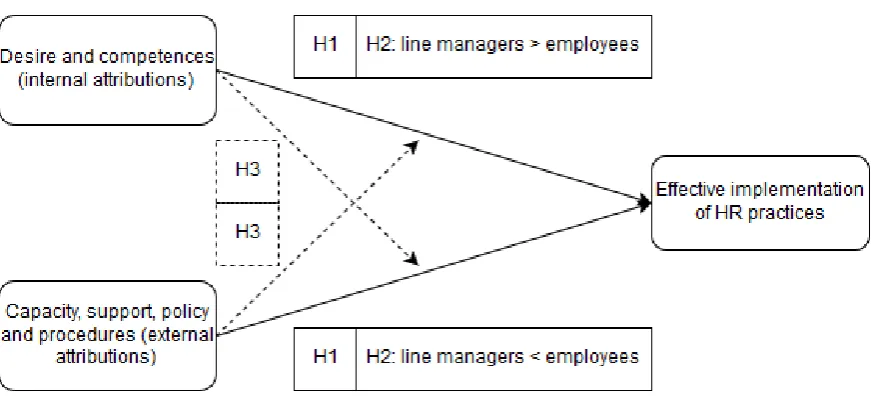
Hypothesis 3: Internal (desire and competences) and external (capacity, support, and policy and procedures) attributions interact positively with each other in explaining line managers’ effectiveness of implementing HR practices.
it does happen”
- The HR-department insists on administering data without mistakes”
- The employees working in the HR-department inform my line manager about the time
specific services need to be ready”
Furthermore, the following items were added. The new items were developed based on the existing topic of the questionnaire. Furthermore, the items were thusly developed that the items can also be converted for employees.
Items that were added for the questionnaire of line managers:
- “The HR-department is responsible for the time to obtain the right information that I need for implementing the HR-responsibilities and tasks”
- “Sufficient meetings are scheduled to discuss opportunities where I encounter when I
implement the HR-responsibilities and tasks”
Items that were added for the questionnaire of employees:
- “The HR-department is responsible for the time to obtain the right information that
my line manager need for implementing the HR-responsibilities and tasks”
- “Sufficient meetings are scheduled to discuss opportunities where my line manager
encounters when he/she implement the HR-responsibilities and tasks”
Policy and procedures
The concept policy and procedures consists of 8 items (e.g. “I work with contradictions in HR policy and procedures” and “My line manager works with contradictions in HR policy and procedures”) based on the validated questionnaire of Bos-Nehles (2010). For the concept policy and procedures several items were deleted for both questionnaires of this study for employees and line managers. These items were not asked to the employees since they cannot have the necessary insights, and consecutively deleted from the questionnaire for the line managers to guarantee comparability of the questionnaires.
For the questionnaire for this study the following items were deleted in the questionnaire for line managers:
- “I work with two or more groups who operate quite differently in performing HR
responsibilities”.
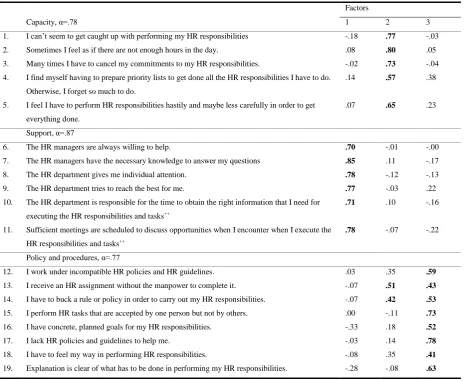
attributions and external attributions to check whether two components could be rediscovered for internal attributions (desire, competences) (Table 1) and three components (capacity, support and, policy and procedures) for external attributions (Table 2).
The Kaiser criterion is used to assess the number of dimensions in the questionnaires. If the number of components determined by the Kaiser criterion differs from the expected number of components then the confirmatory factor analysis is forced to the total of expected components. For the rotated factor loadings a minimum of .40 was handled to determine membership to components.
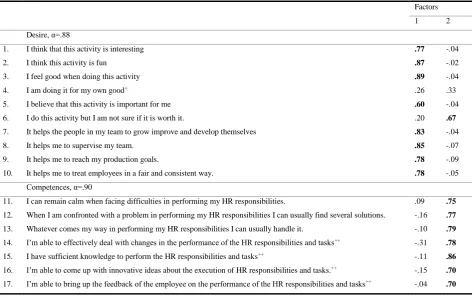
However, in this study the independent variable is distinguished between internal attributions and external attributions of constraints concerning the implementation of HR practices, therefore confirmatory factor analysis with principal components and varimax rotation is conducted on each independent variable. The factor analysis for the internal attributions found three dimensions where two dimensions were expected (desire and competences) (Table 1). For the external attributions five dimensions were found where three dimensions were expected (support, capacity and, policy and procedures) (Table 2). There is one item that displayed no factor loading for any one dimension above .40 and could therefore not be ascribed to either dimension; “I am doing it for my own good.” Another item thought to belong to the component desire displays a higher factor loading onto the component
competences (i.e. “I do this activity but I am not sure if it is worth it”). These items were kept in their original components to retain comparability with earlier results (Bos-Nehles, 2010).
For external attributions, two items display overlapping factor loadings with another
Table 1
Factor analysis for the independent variable (internal attributions, α=.81)
Factors 1 2 Desire, α=.88
1. I think that this activity is interesting .77 -.04
2. I think this activity is fun .87 -.02
3. I feel good when doing this activity .89 -.04
4. I am doing it for my own good+ .26 .33
5. I believe that this activity is important for me .60 -.04 6. I do this activity but I am not sure if it is worth it. .20 .67
7. It helps the people in my team to grow improve and develop themselves .83 -.04
8. It helps me to supervise my team. .85 -.07
9. It helps me to reach my production goals. .78 -.09 10. It helps me to treat employees in a fair and consistent way. .78 -.05
Competences, α=.90
11. I can remain calm when facing difficulties in performing my HR responsibilities. .09 .75
12. When I am confronted with a problem in performing my HR responsibilities I can usually find several solutions. -.16 .77
13. Whatever comes my way in performing my HR responsibilities I can usually handle it. -.10 .79
14. I’m able to effectively deal with changes in the performance of the HR responsibilities and tasks++ -.31 .78
15. I have sufficient knowledge to perform the HR responsibilities and tasks++ -.11 .86
16. I’m able to come up with innovative ideas about the execution of HR responsibilities and tasks.++ -.15
.70
17. I’m able to bring up the feedback of the employee on the performance of the HR responsibilities and tasks++ -.04 .70
+Factor loadings <.04
6.3.2 Reliability assessment
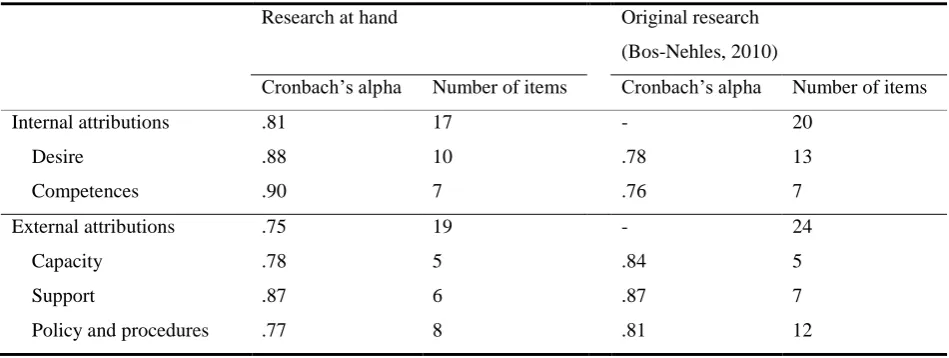
To test the internal consistency of the items of the questionnaire, reliability analyses on the sample of the three Dutch municipalities were performed. Reliability assessment addresses the homogeneity of the items in a construct or the extent to which item responses correlate with the total test score (Hinkin, 1995). The most commonly accepted measure is that of internal consistency reliability using Cronbach’s alpha. The Cronbach’s alpha gives an indication of the extent to which a number of items in a scale measure the same construct. In general, an alpha of .70 or higher is acceptable (Field, 2009). In Appendix D all the
Cronbach’s alpha’s of the subscales of the independent and dependent variables are shown and the independent variable is compared to the original research of Bos-Nehles (2010). The Cronbach’s alpha’s of the independent variable display an alpha of .70 or higher, which indicates good internal consistency. For the dependent variable with the seven factors, the construct recruitment and selection and career management have a Cronbach’s alpha <.70. The Cronbach’s alpha’s of internal attributions and external attributions of constraints concerning the implementation of HR practices are > .70 (Table 3).
Table 3.
Cronbach's alpha of constructs for the independent variable (internal attributions and external attributions)
Research at hand Original research
(Bos-Nehles, 2010)
Cronbach’s alpha Number of items Cronbach’s alpha Number of items
Internal attributions .81 17 - 20
Desire .88 10 .78 13
Competences .90 7 .76 7
External attributions .75 19 - 24
Capacity .78 5 .84 5
Support .87 6 .87 7
7.
Results
7.1 Line managers’ constraints in effectively implementing HR practices
Line managers experience several constraints in effectively implementing HR practices. The means, standard deviations and bivariate correlations of line managers’ constraints in
effectively implementing HR practices are shown in Table 4. In this table bivariate
correlations between all variables are shown, including the dependent variable. The first table shows the means, standards deviations and bivariate correlations for the employees (Table 4) and the second for the line managers (Table 5).
The effectiveness of implementing the HR practices (the dependent variable) was only measured via the employees. For answering the hypotheses the total means per municipality of the effectiveness of implementing the HR practices indicated by the employees were predicated to the respective line managers.
Bivariate correlations between the independent variables of employees and line managers are found (Tables 4 and 5), this implies that some constraints are dependent on each other. In the table of the employees (Table 4), competences correlate negatively with desire, and capacity correlates negatively with desire. It is possible that if a line manager is not interested in HR, he/she also will not develop his/her skills further and he/she will invest little to no time in HR. Capacity correlates positively with competences. That might mean that if a line manager invests time in HR, he/she will also develop his/her skills. Furthermore, policy and procedures correlates negatively with desire and correlates positively with competences and capacity. In the table of the line managers (Table 5) support correlates negatively with desire. When HR managers do not support the line managers, line managers might lose interest in HR. It is also possible that when a line manager is not motivated, he/she will not looking for support.
Furthermore, a few constraints are also dependent on the subscales of the effectiveness of implementing the HR practices for the employees (Table 4). Desire correlates positively with recruitment and selection and people management. Desire correlates negatively with training and development. Competences correlates positively with staffing and, training and
7.1.1 Employees attributions
The means show that employees seem to be not clear on what internal and external constraints line managers experience when implementing HR practices (Range = [1; 5]; Minternal = 2.94,
SDinternal =0.48 and Mexternal = 2.96, SDexternal=0.40) (Table 4). According to the employees line
managers seem not to experience different hindering from internal constraints or external constraints in implementing the HR practices. Employees seem to attribute a lack of support
as the most hindering compared to other constraints (Range = [1; 5]; Msupport = 2.59,
SDsupport=0.67) (Table 4).
7.1.2 Line managers attributions
Line managers themselves seem to perceive internal constraints as most hindering in
implementing HR practices (Range = [1; 5]; Minternal = 1.73, SDinternal =0.38) (Table 5). This is
a striking result since it was expected that line managers would indicate external attributions of constraints to be more hindering in implementing HR practices. The means show that line managers themselves seem to perceive competences as most hindering in implementing HR practices (Range = [1; 5]; Mcompetences= 1.64 SDcompetences=0.69) (Table 5). Line managers seem
to attribute a lack of competences as most hindering compared to other constraints.
7.1.3 Line managers’ effectiveness of implementing HR practices
Subordinates seem to perceive line managers’ HRM implementation effectiveness as reasonably high (Range =[1; 4]; MHRMimplementationeffectiveness= 2.53,
SDHRMimplementationeffectiveness=0.24) (Table 4). Three of the seven dimensions of HRM
implementation effectiveness have a mean higher than the total mean of 2.53. This may seem to indicate that the line managers are effective in implementing HR practices. The
subordinates seem to appear to be most satisfied with how their line managers perform recruitment and selection and personnel administration (Range = [1; 4]; Mrecruitmentandselection=
2.91, SDrecruitmentandselection=0.47 and Mpersonneladministration=3.07, SDpersonneladministration=0.67) and
least satisfied with career management (Mcareermanagement=2.07, SDcareermanagement=0.53) (Table
Table 4.
Means, standard deviations and correlations between the independent and dependent variable (employees)
M SD 1. 2. 3. 4. 5. 6. 7. 8. 9. 10. 11. 12. 13. 14.
1. HRM implementation effectiveness 2.53 0.24
2. Staffing 2.51 0.56 .46**
3. Recruitment and selection 2.91 0.47 -.05 -.43**
4. Training and development 2.56 0.68 .55** .60** -.41**
5. Career management 2.07 0.53 .40** -.20 .02 -.20
6. Evaluation and rewarding 2.40 0.65 .53** .30* -.33* .29* .17
7. People management 2.16 0.57 .42** -.31* .24 -.16 .66** -.01
8. Personnel administration 3.07 0.67 .44** .14 .05 .17 -.14 -.06 -.05
9. Internal attributions 2.94 0.48 .17 .22 .10 .30* -.22 -.05 -.11 .19
10. Desire 2.86 0.62 .16 -.14 .33* -.27* .20 -.11 .33* .24 .06
11. Competences 3.04 1.32 .04 .27* -.12 .41** -.31* .03 -.29* .01 .80** -.56**
12. External attributions 2.96 0.40 -.02 -.06 .05 -.01 .02 -.10 .10 -.02 .26* -.25 .37**
13. Capacity 3.17 0.74 -.03 .10 -.18 .11 -.09 .02 -.13 .00 .27* -.37** .45** .71**
14. Support 2.59 0.67 -.13 -.38** .29* -.24 .09 -.18 .31* -.13 -.05 .18 -.15 .42** -.15
15. Policy and procedures 3.17 0.61 .14 .19 -.04 .12 .02 -.01 -.03 .10 .27* -.30* .41** .69** .47** -.18
*
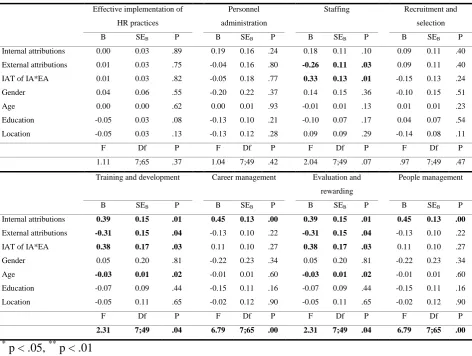
8). To determine the interaction term Z-scores were calculated from internal and external attributions, the Z-scores were then multiplied to arrive at the interaction term. The regression analyses show statistically significant explanatory value for training and development, career management, evaluation and rewarding, people management. For all measures of
effectiveness of HR practices internal attributions displays a statistically significant positive main effect. For training and development, and evaluation and rewarding, external attributions displays a statistically significant negative main effect. For training and development, and evaluation and rewarding, the demographic age displays a statistically significant negative main effect. For training and development, and evaluation and rewarding, the interaction term between internal and external attributions displays a statistically significant positive
interaction effect.
Hypothesis 3 stated: Internal (desire and competences) and external (capacity, support, and policy and procedures) attributions interact positively with each other in explaining line managers’ effectiveness of implementing HR practices.
Table 9.
Rejected and accepted hypotheses
Hypotheses Decision
Hypothesis 1: The effectiveness of line managers’ implementation of HR practices is attributed to internal (desire and
competences) and external attributions (capacity, support, and policy and procedures).
Partially supported, partially rejected
Hypothesis 2: In comparison with
employees, line managers attribute effective implementation of HR practices more to internal attributions (desire and competences) than to external attributions (capacity,
support, and policy and procedures).
Rejected
Hypothesis 3: Internal (desire and competences) and external (capacity, support, and policy and procedures) attributions interact positively with each other in explaining line managers’
effectiveness of implementing HR practices.
different stakeholders and dependent on which measure of HR effectiveness is target of improvement different internal or external factors have to be improved.
8.6.2 Theoretical implications
Recent research has not focused much on attribution theory in the context of working environment (cf. Snead Jr., Magal, Christensen & Ndede-Amadi, 2015; Wang, Hall and Rahimi, 2015; Bӧhm & Pfister, 2015). The study at hand did apply attribution theory to the context of working environment and found that with anonymity, the fatal attribution error did not occur. This finding is supported by other research suggesting that the fatal attribution error seems reducible by providing anonymity of response (Lajunen & Summala, 2003). The study at hand enhances the understanding of attribution theory including a related variable (i.e. anonymity).
8.7 Suggestions for further research
It seems advisable to develop a more reliable research instrument for measuring stakeholders’ opinions about the constraints line managers experience in implementing HR practices. The present study was hindered by employees having difficulties answering the questions about the external constraints their line managers’ experience. Further research should improve the questionnaire so that stakeholders can answer it more easily.
9.
Conclusion
The present study aimed at finding out to what extent internal and external attributions of constraints concerning the implementation of HR practices correspond with the effectiveness of line managers’ implementation of HR practices. Employees and line managers do make a difference in attribution of internal and external factors concerning the implementation of HR practices for the effectiveness of line managers’ implementation of HR practices. Line
managers attribute more external factors and less internal factors than employees to the
effectiveness of implementation of HR practices. Furthermore, internal and external factors do interact positively with each other to explain certain subscales of the effectiveness of line managers’ implementation of HR practices.
References
Arthur, J.B. (1992). The link between business strategy and industrial relations systems in
American steel minimills. Industrial and Labor Relations Review, 45(3), 488-506.
Bach, S., & Bordogna, L. (2011). Varieties of new public management or alternative models? The reform of public service employment relations in industrialized democracies. The International Journal of Human Resource Management, 22(11), 2281-2294.
Becker, B.E. & Huselid, M. A. (1998). High performance work systems and firm
performance: a synthesis of research and managerial implications. Research in
Personnel and Human Resources Management, 16, 53-101.
Biemans, P. (2013). Ontwikkelingen in de HRM-rol lijnmanagers en HR-afdeling. Tijdschrift
voor HRM, 22-50.
Böhm, G . & Pfister, H.R. (2015) How people explain their own and others’ behavior: a theory of lay causal explanations. Front. Psychology, 6-139.
Bos-Nehles, A., Riemsdijk, M. van, Kok, I. & Looise, J.C. (2006). Implementing Human
Resource Management successfully: a first-line management challenge. Management
revue, 17 (3), 256-273.
Bos-Nehles, A. (2010). The line makes the difference: line managers as effective HR partners.
PhD Thesis. The Netherlands: University of Twente.
Bos-Nehles, A.C., Riemsdijk, M. J. & Looise, J.K. (2011). Lijnmanagement
verantwoordelijk voor HR- implementatie; een uitdaging voor HRM. Tijdschrift voor
HRM, 32-45.
Boselie, P., Dietz, G., & Boon, C. (2005). Commonalities and contradictions in HRM and
performance research. Human Resource Management Journal, 15, 67–94.
Bowen, D. & Ostroff, C. (2004). ‘Understanding HRM – firm performance linkages: the
role of the ‘strength’ of the HRM system’. Academy of Management Review, 29 (2),
Boyne, G.A. (2003). Sources of public service improvement: A critical review and research agenda. Journal of Public Administration Research and Theory, 13(3), 367-394.
Boyne, G.A., Meier, K.J, O'Toole, Jr. J.L., & Walker, R. (2006). Public service performance: Perspectives on measurement and management. London: Cambridge University Press.
Brewster, C. and Holt Larsen, H. (2000). Responsibility in human resource management: the
role of the line. in Brewster, C. and Holt Larsen, H. (Eds), Human Resource
Management in Northern Europe, Blackwells, Oxford.
Collins, K. (2008). Exploring business. Upper Saddle River, NJ: Pearson Prentice Hall.
Cunningham, I. & Hyman, J. (1999). Devolving human resources responsibilities to the line. Personnel Review, 28 (1/2), 9-27.
Delaney, J.T. & Huselid, M.A. (1996). The impact of human resource management practices
on perceptions of organizational performance. Academy of Management Journal, 39
(4), 949-969.
Deci, E. L. (1971). Effects of externally mediated rewards on intrinsic motivation. Journal of Personality and Social Psychology, 18, 105–115.
Deci, E. L., & Ryan, R. M. (1985). Intrinsic motivation and self-determination in human
behavior. New York: Plenum.
Den Hartog, D., Boon, C., Verburg, R. M., & Croon, M. A. (2013). HRM, communication, satisfaction, and perceived performance: A cross-level test. Journal of Management, 39, 1637–1665.
Field, A (2009), “Discovering statistics using SPSS”. Third edition. London: SAGE Publications ltd.
Geare, A., Edgar, F., & Deng, M. (2006). Implementation and consumption of HRM:
stakeholder differences. Research and Practice in Human Resource Management, 14
(2), 24-48.
Gerhart, B., Wright, P., McMahan, G., and Snell, S. (2000). Measurement Error in Research
on Human Resources and Firm Performance: How Much Error is There and How
Gratton, L., & Truss, C. (2003). The three-dimensional people strategy: Putting human
resources policies into action. Academy of Management Executive, 17(3), 74-86.
Guay, F., Vallerand, R.J. & Blanchard, C. (2001). On the assessment of situational intrinsic
and extrinsic motivation: the situational motivation scale (SIMS). Motivation and
Emotion, 24 (3), 175-213.
Guest, D. (2011). Human resource management and performance: Still searching for some
answers. Human Resource Management Journal, 21, 3–13
Guest, D. & Bos-Nehles, A. (2012). HRM and performance: the role of effective
implementation. In: HRM and performance: Achievements and challenges. Wiley-
Blackwell, Chichester, 79 - 96.
Harris, L., Doughty, D. & Kirk, S. (2002). The devolution of HR responsibilities –
perspectives from the UK’s public sector. Journal of European Industrial Training, 26
(5), 218-229.
Hall, L and Torrington, D (1998) The Human Resource Function FT Pitman; London.
Heider, F. (1958). The psychology of interpersonal relations. New York: Wiley.
Hinkin, R.T. (1995). A review of scale development practices in the study of organizations.
Journal of Management, 21 (5), 967-988.
Huselid, M.A. (1995) The impact of human resource management practices on turnover,
productivity, and corporate financial performance. Academy of Management Journal,
38(3), 635-672.
Huselid, M.A., Jackson, S.E., & Schuler, R.S. (1997). Technical and strategic human resource
management effectiveness as determinants of firm performance. Academy of
Management Journal, 40, 171-188.
Jones, E. E., & Nisbett, 1972. R. E. The actor and the observer: Divergent perceptions of the causes of behavior. In E. E. Jones et al. (Eds.), Attribution: Perceiving the causes of
behavior. Morristown, N.J.: General Learning Press, 1972.
Kelley, H.H. (1973). The process of causal attribution. American psychologist, 28 (2), 107-
128.
Khilji, S.E., & Wang, X. (2006). ‘Intended’ and ‘implemented’ HRM: The missing linchpin
in strategic human resource management research. International Journal of Human
Resource Management, 17, 1171-1189.
Kwan, V., John, O., Kenny, D., Bond, M., & Robins, R. (2004). Reconceptualizing individual
differences in self-enhancement bias: an interpersonal approach. Psychological
Review, 111 (1), 94-110.
Lajunen, T. & Summala, H. (2003). Can we trust self-reports of driving? Effects of
impression management on driver behavior questionnaire responses. Elsevier, 97-107.
Larsen, H.H. & Brewster, C. (2003). ‘’Line management responsibility for HRM: what is happening in Europe?’’. Employee Relations, 25 (3), 228-244.
Luken, T. (2010). Problemen rond reflectie. De risico’s van reflecteren nader bezien. In P.W.J. Schramade (red.), Handboek effectief opleiden, 52, 263-290.
MacKinnon, D.P. (2008). Introduction to statistical Mediation Analysis. Lawrence Erlbaum
Associates.
Maxwell, G. A., & Watson, S. (2006). Perspectives on line managers in human resource
management: Hilton international’s UK hotels. The International Journal of Human
Resource Management, 17, 1152–1170.
McGovern, P., Gratton, L., Hope-Hailey, V., Stiles P. & Truss, C. (1997), Human Resource
Management on the line? Human Resource Management Journal, 7 (4), 12-29.
McGovern, P. (1999). HRM policies and management practices. In: L. Gratton, V. Hope-
Hailey, P. Stiles, & C. Truss. Strategic Human Resource Management, Oxford:
Oxford University Press.
Messersmith, J.G., Patel, P.C., & Lepak, D.P. (2011). Unlocking the black box: Exploring the
link between high-performance work systems and performance. Journal of Applied
Psychology, 96(6), 1105-1118.
Ministerie van Binnenlandse Zaken en Koninkrijksrelaties. (2001). De arbeidsmarkt in de collectieve sector. Investeren in mensen en kwaliteit. Commissie Van Rijn. Den Haag
System Practice and Action Research, 28(3), 273-288.
Sociaal en Cultureel Planbureau. (2004). Prestaties van de publieke sector. Een internationale vergelijking van onderwijs, gezondheidszorg, politie/justitie en openbaar bestuur. Den Haag. Sociaal en Cultureel Planbureau. (2012). Waar voor ons belastinggeld? Den Haag.
Tsui, A. (1987). Defining the Activities and Effectiveness of the Human Resource
Department: A Multiple Constituency Approach. Human Resource Management, 26,
35–69.
Tsui, A. (1990). A Multiple-Constituency Model of Effectiveness: An Empirical examination at the Human Resource Subunit Level. Administrative Science Quarterly, 35, 458–
483.
Ulrich, D. (1997). Measuring Human resources: An overview of practice and a prescription for results. Human Resource Management, 36(3), 303–320.
Wang, H., Hall, N.C. and Rahimi, S. ( 2015). Self-efficacy and causal attributions in teachers: effects on burnout, job satisfaction, illness, and quitting intentions. Teaching and Teacher Education, 47, 120-130.
Whittaker, S., & Marchington, M. (2003). Devolving HR responsibility to the line. Employee Relations, 25, 245–261.
Wright, P.M. & Nishii, L. (2006). Strategic HRM and organizational behavior: Integrating
multiple levels of analysis. Working paper 06-05. Ithaca, NY: CAHRS Cornell
Appendices
Appendix A
Table 10.
Gender distribution of line managers and employees
Line Managers Employees
Gender Percentage Frequency Percentage Frequency
Male 78.9 15 37.9 22
Female 21.1 4 62.1 36
Table 11.
Age distribution of line managers and employees
Line Managers Employees
Age Percentage Frequency Percentage Frequency
20-30 0 0 8.6 5
30-40 15.8 3 29.3 17
40-50 26.3 5 27.6 16
50-60 52.6 10 31/0 18
60 and older 5.3 1 3.5 2
Table 12.
Education level distribution of line managers and employees
Line Managers Employees
Education Percentage Frequency Percentage Frequency
No Education 0.0 0 0.0 0
VMBO/MAVO/LBO 0.0 0 6.9 4
MBO 5.3 1 24.1 14
HAVO/VWO 0.0 0 12.1 7
Table 13.
Experience as a line manager
Line managers
Years Percentage Frequency
0-1 year 5.3 1
1-2 years 10.5 2
2-5 years 47.4 9
5-10 years 36.8 7
Longer than 10 years 0.0 0
Table 14.
Line managers' span of control
Line managers
Span of control Percentage Frequency
Less than 10 employees 26.3 5
10-30 employees 36.8 7
30-50 employees 26.3 5
50 or more employees 10.5 2
Table 15.
How long do you work for your current manager?
Employees
Years Percentage Frequency
0-1 year 19.0 11
1-2 years 13.8 8
2-5 years 20.7 12
5-10 years 32.8 19
course, function and task oriented training).
Career development (Cronbach’s alpha=.69)
1. Career counseling .63 .05 -.06 .43 -.09 -.22 .20
2. Work meetings with your employees .67 -.36 -.00 .01 -.01 .20 .10
3. Assessment/progress meetings .43 -.19 -.02 -.05 -.08 -.07 .74
4. Career development and policy .53 -.03 -.07 .16 -.31 -.10 .21
Reward (Cronbach’s alpha=.83)
1. Determining salaries .13 .15 -.10 .75 -.37 .18 -.06
2. Increase or decrease in salaries -.04 -.03 -.13 .91 -.01 .06 -.12
3. Discussing salaries .02 .34 .10 .78 .03 -.10 .15
Supervision of employees (Cronbach’s alpha=.82)
1. Resolving conflicts between members of your team. .76 .06 -.06 .10 .33 -.24 -.03
2. Advise your employees .78 -.12 -.07 -.09 -.07 -.11 -.04
3. Maintaining harmonious group relationships within your team.
.76 -.02 .04 -.11 .14 .10 -.21
4. Kind support (personal conversations, individual oriented employee accompaniment)
3. Many times I have to cancel my commitments to my HR responsibilities. -.04 .12 -.00 .74 -.02
4. I find myself having to prepare priority lists to get done all the HR responsibilities I have to do. Otherwise, I forget so much to do.
-.27 .07 .17 .48 .34
5. I feel I have to perform HR responsibilities hastily and maybe less carefully in order to get everything done.
-.46 .35 .13 .47 .16
Support (Cronbach’s alpha=.86)
1 The HR managers are always willing to help. -.09 -.14 .68 -.05 .00
2 The HR managers have the necessary knowledge to answer my questions. .02 -.02 .85 .12 -.18
3 The HR department gives me individual attention. .17 .06 .78 -.09 -.11
4 The HR department tries to reach the best for me. -.11 -.17 .74 -.04 .19
5 The HR department is responsible for the time to obtain the right information that I need for executing the HR responsibilities and tasks++
.02 -.03 .71 .09 -.16
6 Sufficient meetings are scheduled to discuss opportunities when I encounter when I execute the HR responsibilities and tasks++
.09 -.04 .77 -.05 -.22
Policy and procedures (Cronbach’s alpha=.77)
1. I work under incompatible HR policies and HR guidelines. -.11 .13 .03 .38 .57
2. I receive an HR assignment without the manpower to complete it. -.16 -.22 -.12 .57 .40
3. I have to buck a rule or policy in order to carry out my HR responsibilities. -.06 -.07 -.11 .48 .55
4. I perform HR tasks that are accepted by one person but not by others. -.07 -.14 -.09 -.03 .67
5. I have concrete, planned goals for my HR responsibilities .25 -.33 .24 -.07 .50
6. I lack HR policies and guidelines to help me. -.09 .08 -.05 .12 .78
7. I have to feel my way in perform HR responsibilities+ -.44 .18 -.04 .21 .31
8. Explanation is clear of what has to be done in performing my HR responsibilities -.03 .30 -.22 -.14 .63
+Factor loadings <.04
Appendix D
Table 18.
Cronbach's alpha of constructs for the dependent variable
Dependent variable Cronbach’s alpha Number of items
1. Personnel administration .80 7
2. Staffing .81 4
3. Recruitment and selection .68 2
4. Training and development .76 2
5. Career management .69 4
6. Evaluation and rewarding .83 3
Table 19.
Cronbach's alpha of constructs and subscales for the independent variable
Research at hand Original research
(Bos-Nehles, 2010)
Cronbach’s alpha Number of items Cronbach’s alpha Number of items
Desire .88 10 .78 13
Intrinsic motivation .92 3 .84 3
Identified regulation n.a. 2 .73 3
Amotivation n.a. 1 .80 3
Value added .92 4 .93 4
Competences .90 7 .76 5
Occupational self-efficacy n.a. 7 .85 5
Capacity .78 5 .84 5
Role overload n.a. 5 .88 5
Support .87 6 .87 7
HR support behavior n.a. 6 .89 4
Policy and procedures .77 8 .81 12
Role conflict .77 4 .86 5
Appendix E
Questionnaire for line managers
Vragenlijst over de HR-rol van leidinggevenden
Het onderzoek
Deze vragenlijst gaat over de rol van leidinggevenden bij het uitvoeren van het HR-beleid en de mogelijke uitdagingen die zij daarbij ervaren. Door het aantrekken, ontwikkelen,
beoordelen en begeleiden van medewerkers hebben leidinggevenden namelijk ook een HR-rol. In dit onderzoek wordt er gevraagd naar uw eigen opvattingen en naar uw eigen ervaring als leidinggevende met HR-taken en verantwoordelijkheden.
Hierbij zal worden gevraagd naar de tijd die u aan HR-verantwoordelijkheden en taken besteedt, uw motivatie om de HR-activiteiten uit te voeren, uw eigen competenties voor HR, de ondersteuning van de HR-afdeling (HR-consultants) en de richtlijnen en procedures voor het uitvoeren van uw HR-taken.
Het invullen van deze vragenlijst zal maximaal 10 minuten in beslag nemen. De vragenlijst zal tot 1 januari online staan.
Vertrouwelijkheid en anonimiteit
Iedereen die deze vragenlijst ontvangt moet zich vrij kunnen voelen om de vragenlijst in te vullen. Daarbij zijn vertrouwelijkheid en anonimiteit van het grootste belang. Ik wil
benadrukken dat er vertrouwelijk met de data wordt omgegaan. De gegevens gebruik ik alleen voor mijn onderzoek. De vragenlijst zal dus niet voor andere doeleinden worden gebruikt. De gegevens die ik terugkoppel aan de gemeente zijn volledig anoniem. Ik zal de
onderzoeksresultaten uiteraard ook aan u terugkoppelen.
Ik stel het zeer op prijs dat u mee werkt aan deze vragenlijst!
Vragen?
Algemene gegevens
1.Wat is uw geslacht?
Vrouw
Man
2.Wat is uw leeftijd?
Vul uw antwoord hier in: ………….
3.Wat is uw hoogst genoten opleiding?
Geen/lager- of basisonderwijs VMBO/MAVO/LBO
MBO
HAVO/VWO
HBO/WO
4. In welke vestiging bent u werkzaam?
Vul uw antwoord hier in: …………..
5.Op welke afdeling bent u werkzaam?
Vul uw antwoord hier in: ………
6.Hoelang bent u werkzaam als leidinggevende op deze afdeling?
0 tot 1 jaar
1-2 jaar 2-5 jaar
5-10 jaar
Langer dan 10 jaar
7.Hoeveel werknemers heeft u onder uw leiding?
minder dan 10 werknemers
tussen de 10 en 30 werknemers
Motivatie HR-verantwoordelijkheden en taken uit te voeren
Ik zal u vragen stellen over uw leidinggevende functie met een focus op de motivatie van HR-verantwoordelijkheden en taken die u voor uw team moet uitvoeren. Leidinggeven betekent niet alleen het leiden, aansturen, motiveren en coachen van uw team. Leidinggevenden zijn ook verantwoordelijk voor bepaalde HR-activiteiten.
Hieronder vindt u uitspraken over uw eigen motivatie om HR-verantwoordelijkheden en taken uit te voeren. Kunt u voor de volgende stellingen aangeven in hoeverre u het ermee eens bent (van 1 t/m 5) ?
Waarom houdt u zich bezig met het uitvoeren van HR-verantwoordelijkheden en taken?
Kies het toepasselijk antwoord voor elk onderdeel van mee oneens = 1 en mee eens = 5
1 2 3 4 5
1. Ik vind dat het uitvoeren van deze activiteiten interessant is.
2. Ik vind het leuk deze activiteiten te verrichten.
3. Ik voel me prettig bij het uitvoeren van deze activiteiten.
4. Ik doe dit voor mijn eigen bestwil.
5. Ik geloof dat het verrichten van deze activiteiten belangrijk voor me is.
6.Ik voer deze activiteiten uit maar ik ben er niet van overtuigd dat ze de moeite waard zijn.
7. Het helpt de mensen in mijn team te groeien, zichzelf te verbeteren en te ontwikkelen.
8. Deze activiteiten helpen me mijn team aan te sturen.
9. Het helpt me bij het bereiken van mijn doelen.
Competenties van de leidinggevende voor het uitvoeren van HR-verantwoordelijkheden en taken
Hieronder vindt u uitspraken over uw eigen kennis en vaardigheden om uw
HR-verantwoordelijkheden en taken uit te voeren. Kunt u voor de volgende stellingen aangeven in hoeverre u het ermee eens bent (van 1 t/m 5)?
Kies het toepasselijk antwoord voor elk onderdeel: mee oneens = 1 en mee eens = 5.
1 2 3 4 5
1.Ik kan kalm blijven wanneer ik geconfronteerd word met moeilijkheden in het uitoefenen van mijn HR-verantwoordelijkheden en taken, omdat ik kan
terugvallen op mijn vaardigheden.
2. Wanneer ik geconfronteerd word met een probleem bij het uitoefenen van mijn HR-verantwoordelijkheden en taken, dan vind ik meestal verschillende oplossingen.
3.Wat er ook gebeurt in het uitvoeren van mijn HR-verantwoordelijkheden en taken, ik kan het gewoonlijk wel aan.
4. Ik ben in staat om effectief om te gaan met veranderingen in het uitvoeren van de HR-verantwoordelijkheden en taken.
5. Ik heb voldoende kennis om de HR-verantwoordelijkheden en taken uit te voeren.
6. Ik ben in staat om te komen met vernieuwende ideeën omtrent het uitvoeren van de HR-verantwoordelijkheden en taken.
Tijdbesteding aan HR-verantwoordelijkheden en taken
Kunt u aangeven in hoeverre u het met de volgende stellingen eens bent (van 1 t/m 5) ?
Kies het toepasselijk antwoord voor elk onderdeel: mee oneens = 1 en mee eens = 5.
1 2 3 4 5
1.Ik moet HR-activiteiten uitvoeren waar ik eigenlijk geen tijd of energie voor heb.
2.Mijn werkdag heeft onvoldoende uren om al de HR-verantwoordelijkheden en taken uit te voeren die men van mij verwacht.
3. Vaak moet ik mijn verplichtingen voor mijn HR-verantwoordelijkheden en taken afzeggen.
4. Het is nodig dat ik een prioriteitenlijstje maak om alle activiteiten die tot mijn leidinggevende taak behoren, te kunnen uitvoeren.
Ondersteuning bij het uitvoeren van uw HR-verantwoordelijkheden en taken
De volgende stellingen gaan over de ondersteuning die u van de HR-afdeling en speciaal van de HR-consultants krijgt. Kunt u voor de volgende stellingen aangeven in hoeverre u het ermee eens bent (van 1 t/m 5 )? Wat is uw mening over de ondersteuning die u van de HR-afdeling krijgt?
Kies het toepasselijk antwoord voor elk onderdeel: mee oneens = 1 en mee eens = 5.
1 2 3 4 5
1. De HR-consultant is altijd bereid mij te helpen.
2. De HR-managers beschikken over de kennis die nodig is om mijn vragen te beantwoorden.
3. De HR-consultant geeft mij individuele aandacht.
4. De HR-afdeling heeft het beste met mij voor.
5. De HR-afdeling zorgt voor het op tijd doorgeven van de juiste informatie die ik nodig heb om de HR-verantwoordelijkheden en taken uit te voeren.
Beleid en procedures voor het uitvoeren van uw HR-verantwoordelijkheden en taken
Hieronder vindt u een aantal uitspraken over het HR-beleid en de procedures die u ter
beschikking staan bij het uitvoeren van uw HR-verantwoordelijkheden en taken. Kunt u voor de volgende stellingen aangeven in hoeverre u het ermee eens bent (van 1 t/m 5)? Ik ervaar de volgende conflicten bij het uitvoeren van mijn HR-verantwoordelijkheden en taken:
Kies het toepasselijk antwoord voor elk onderdeel: mee oneens = 1 en mee eens = 5.
1 2 3 4 5
1. Ik werk met tegenstrijdig HR-beleid en –richtlijnen.
2. Ik krijg HR-verantwoordelijkheden en taken toegewezen zonder de bijbehorende menskracht om het uit te voeren.
3. Ik moet regels en gedragslijnen negeren om bepaalde HR-verantwoordelijkheden en taken uit te voeren.
4. Ik werk met twee of meer groepen die ieder op geheel verschillende wijze opereren, bij het uitoefenen van mijn HR-verantwoordelijkheden en taken.
5.Ik heb duidelijke, geplande doelstellingen voor mijn HR-verantwoordelijkheden en taken.
6. Ik mis richtlijnen en gedragsregels om me te helpen.
7. Ik moet gevoel krijgen voor het uitvoeren van mijn HR-verantwoordelijkheden en taken.
8. De uitleg van wat er moet gebeuren bij het uitvoeren van mijn HR-verantwoordelijkheden en taken is duidelijk.
Appendix F
Questionnaire for employees
Vragenlijst over de HR-rol van uw leidinggevende
Het onderzoek
Welkom bij de vragenlijst over de HR-verantwoordelijkheden en taken van uw
leidinggevende. Graag wil ik van u weten hoe tevreden u bent over de manier waarop uw leidinggevende zijn HR-taken uitvoert, hierbij kunt u bijvoorbeeld denken aan het aantrekken, ontwikkelen, beoordelen en begeleiden van zijn medewerkers.
Verder zal er worden gevraagd naar de mogelijke uitdagingen die uw leidinggevende ervaart bij het uitvoeren van zijn HR-taken. Wat zijn volgens u belemmeringen die uw
leidinggevende ervaart? Werknemers staan dicht bij de leidinggevenden en zijn volgens mij daarom de juiste beoordelaars. Er zal worden gevraagd naar de tijd die uw leidinggevende aan
HR-verantwoordelijkheden en taken besteedt, de motivatie van uw leidinggevende om zijn
activiteiten uit te voeren, zijn eigen competenties voor HR, de ondersteuning van de afdeling (consultants) en de richtlijnen en procedures voor het uitvoeren van zijn HR-taken.
Het zal soms lastig zijn om sommige vragen te beantwoorden over uw leidinggevende. Indien u bij zo'n vraag komt, probeert u zich dan zo goed mogelijk in te leven in de rol van uw leidinggevende.
Het invullen van deze vragenlijst zal max. 10 minuten in beslag nemen. De vragenlijst zal tot 1 januari online staan.
Vertrouwelijkheid en anonimiteit
Iedereen die deze vragenlijst ontvangt moet zich vrij kunnen voelen om de vragenlijst in te vullen. Daarbij zijn vertrouwelijkheid en anonimiteit van het grootste belang. Ik wil
benadrukken dat er vertrouwelijk met de data wordt omgegaan. De gegevens gebruik ik alleen voor mijn onderzoek. De vragenlijst zal dus niet voor andere doeleinden worden gebruikt. De gegevens die ik terugkoppel aan de gemeente zijn anoniem. Ik zal de onderzoeksresultaten uiteraard ook aan u terugkoppelen.
Vragen?
Heeft u vragen over dit onderzoek dan kunt u contact opnemen met I. Dewulf. E-mailadres: [email protected]
Algemene gegevens
1.Wat is uw geslacht?
Vrouw Man
2.Wat is uw leeftijd?
Vul uw antwoord hier in: ...
3.Wat is uw hoogst genoten opleiding?
Geen/lager- of basisonderwijs
VMBO/MAVO/LBO MBO
HAVO/VWO
HBO/WO
4.In welke vestiging bent u werkzaam?
Vul uw antwoord hier in: ...
5.Op welke afdeling bent u werkzaam?
Vul de naam van uw afdeling in: …..
6.Hoelang bent u werkzaam onder de leiding van uw huidige leidinggevende?
0 tot 1 jaar
1-2 jaar 2-5 jaar
5-10 jaar
Gebruik van HRM-verantwoordelijkheden door uw leidinggevende
Hoe tevreden bent u over de manier waarop uw directe leidinggevende de volgende taken uitvoert?
Personeeladministratie. Kies het toepasselijk antwoord voor elk onderdeel:
Zeer
tevreden Tevreden Ontevreden
Zeer
ontevreden Weet niet
Niet van
toepassing
1. Urenregistratie
2. Ziekteverzuim
3. Archivering
4. Vertalen van het organisatiebeleid
naar uw team
5. Veiligheid
6. Beheren en analyseren van de
gegevens (uit de
personeelsadministratie c.q.
personeelsinformatiesystemen voor
operationele doeleinden)
7. Kwaliteit van de arbeid
(arbeidsinhoud,
arbeidsomstandigheden,
arbeidsverhoudingen, ergonomie van
Motivatie van uw leidinggevende, HR-verantwoordelijkheden en taken uit te voeren
Hieronder vindt u uitspraken over de motivatie van uw leidinggevende om
HR-verantwoordelijkheden en taken uit te voeren. Kunt u voor de volgende stellingen aangeven in hoeverre u het ermee eens bent (van 1 t/m 5)? Waarom houdt uw leidinggevende zich bezig met het uitvoeren van HR-verantwoordelijkheden en taken?
Kies het toepasselijk antwoord voor elk onderdeel: mee oneens = 1 en mee eens = 5.
1 2 3 4 5
1. Mijn leidinggevende vindt het uitvoeren van deze activiteiten interessant.
2. Mijn leidinggevende vindt het leuk deze activiteiten te verrichten.
3. Mijn leidinggevende voelt zich prettig bij het uitvoeren van deze activiteiten.
4. Mijn leidinggevende doet dit voor zijn eigen bestwil.
5. Mijn leidinggevende gelooft dat het verrichten van deze activiteiten belangrijk voor
hem/haar is.
6. Mijn leidinggevende voert deze activiteiten uit maar hij/zij is er niet van overtuigd dat ze de
moeite waard zijn.
7. Het helpt de mensen in zijn/haar team te groeien, zichzelf te verbeteren en te ontwikkelen.
8. Deze activiteiten helpen zijn/haar team aan te sturen.
9. Het helpt hem/haar bij het bereiken van zijn/haar doelen.
Competenties van uw leidinggevende voor het uitvoeren van HR-verantwoordelijkheden en taken.
Hieronder vindt u uitspraken over de HR-kennis en vaardigheden van uw leidinggevende om de HR-verantwoordelijkheden en taken uit te voeren. Kunt u voor de volgende stellingen aangeven in hoeverre u het ermee eens bent (van 1 t/m 5) ?
Kies het toepasselijk antwoord voor elk onderdeel: mee oneens = 1 en mee eens = 5.
1 2 3 4 5
1. Mijn leidinggevende kan kalm blijven wanneer hij/zij geconfronteerd wordt met
moeilijkheden in het uitoefenen van zijn/haar HR-verantwoordelijkheid en taken, omdat hij/zij
kan terugvallen op zijn vaardigheden.
2. Wanneer hij/zij geconfronteerd wordt met een probleem bij het uitvoeren van zijn/haar
HR-verantwoordelijkheid en taken dan vindt hij/zij meestal verschillende oplossingen.
3. Wat er ook gebeurt in het uitvoeren van zijn/haar HR-verantwoordelijkheden en taken, hij/zij
kan het gewoonlijk wel aan.
4. Mijn leidinggevende is in staat om effectief om te gaan met veranderingen in het uitvoeren
van zijn/haar HR-verantwoordelijkheden en taken.
5. Mijn leidinggevende heeft voldoende kennis om de HR-verantwoordelijkheden en taken uit
te voeren.
6. Mijn leidinggevende is in staat om te komen met vernieuwende ideeën omtrent het uitvoeren
van de HR-verantwoordelijkheden en taken.
7. Mijn leidinggevende is in staat om feedback van de werknemer mee te nemen in het
Tijdbesteding van uw leidinggevende aan HR-verantwoordelijkheden en taken
Kunt u aangeven in hoeverre u het met de volgende stelling eens bent (van 1 t/m 5)?
Kies het toepasselijk antwoord voor elk onderdeel: mee oneens = 1 en mee eens = 5.
1 2 3 4 5
1.Mijn leidinggevende moet HR-activiteiten uitvoeren waar hij/zij volgens mij eigenlijk geen
tijd of energie voor heeft.
2. Zijn/haar werkdag heeft volgens mij onvoldoende uren om al de HR-verantwoordelijkheden
en taken uit te voeren die van hem/haar worden verwacht.
3. Volgens mij moet hij/zij vaak zijn verplichtingen voor zijn/haar HR-verantwoordelijkheden
en taken afzeggen.
4. Het is nodig dat hij/zij een prioriteitenlijstje maakt om alle activiteiten die tot zijn/haar
leidinggevende taak behoren, te kunnen uitvoeren.
5. Ik heb het gevoel dat hij/zij HR-verantwoordelijkheden en taken gehaast en wellicht minder
Ondersteuning bij het uitvoeren van HR-verantwoordelijkheden en taken van uw leidinggevende
De volgende stellingen gaan over de ondersteuning die uw leidinggevende van de HR-afdeling en speciaal van de HR-consultants krijgt. Kunt u voor de volgende stellingen aangeven in hoeverre u het ermee eens bent (van 1 t/m 5)? Wat is uw mening over de ondersteuning die uw leidinggevende van de HR-afdeling krijgt?
Kies het toepasselijk antwoord voor elk onderdeel: mee oneens = 1 en mee eens = 5.
1 2 3 4 5
1. De HR-consultants zijn altijd bereid mijn leidinggevende te helpen.
2. De HR-managers beschikken over de kennis die nodig is om de vragen van mijn
leidinggevende te beantwoorden.
3. De HR-consultant geeft mijn leidinggevende individuele aandacht.
4. De HR-afdeling heeft het beste met mijn leidinggevende voor.
5. De HR-afdeling zorgt voor het op tijd doorgeven van de juiste informatie die mijn
leidinggevende nodig heeft om zijn/haar HR-verantwoordelijkheden en taken uit te voeren.
6. Er worden voldoende vergaderingen gepland om moeilijkheden te bespreken waar mijn
leidinggevende tegenaan loopt bij het uitvoeren van zijn/haar HR-verantwoordelijkheden en
Beleid en procedures voor het uitvoeren van HR-verantwoordelijkheden en taken van uw leidinggevende
Hieronder vindt u een aantal uitspraken over het HR-beleid en de procedures die uw leidinggevende ter beschikking staat bij het uitvoeren van zijn/haar
HR-verantwoordelijkheden en taken. Kunt u voor de volgende stellingen aangeven in hoeverre u het ermee eens bent (van 1 t/m 5)? Mijn leidinggevende ervaart de volgende conflicten bij het uitvoeren van zijn/haar HR-verantwoordelijkheden en taken:
Kies het toepasselijk antwoord voor elk onderdeel: mee oneens = 1 en mee eens = 5.
1 2 3 4 5
1.Mijn leidinggevende werkt met tegenstrijdig HR-beleid en –richtlijnen.
2. Mijn leidinggevende krijgt HR-verantwoordelijkheden en taken toegewezen zonder de
bijbehorende menskracht om het uit te voeren.
3. Mijn leidinggevende moet regels en gedragslijnen negeren om bepaalde
HR-verantwoordelijkheid en taken uit te voeren.
4. Mijn leidinggevende voert HR-verantwoordelijkheden en taken uit die acceptabel zijn voor
de ene persoon maar niet worden geaccepteerd door anderen.
Voor mijn leidinggevende zijn/haar HR-verantwoordelijkheden en taken geldt:
Kies het toepasselijk antwoord voor elk onderdeel:
1 2 3 4 5
5.Mijn leidinggevende heeft duidelijke, geplande doelstellingen voor zijn/haar
HR-verantwoordelijkheden en taken.
6. Mijn leidinggevende mist volgens mij richtlijnen en gedragsregels om hem/haar te helpen.
7. Mijn leidinggevende moet gevoel krijgen voor het uitvoeren van zijn/haar
HR-verantwoordelijkheden en taken.
8. De uitleg van wat er moet gebeuren bij het uitoefenen van zijn/haar
HR-verantwoordelijkheden en taken is naar mijn mening duidelijk voor hem/haar.