Automatic semantic relation extraction from Portuguese texts
Leonardo Sameshima Taba, Helena de Medeiros Caseli
Federal University of S˜ao CarlosRod. Washington Lu´ıs Km. 235
leonardo [email protected], [email protected]
Abstract
Nowadays we are facing a growing demand for semantic knowledge in computational applications, particularly in Natural Language Processing (NLP). However, there aren’t sufficient human resources to produce that knowledge at the same rate of its demand. Considering the Portuguese language, which has few resources in the semantic area, the situation is even more alarming. Aiming to solve that problem, this work investigates how some semantic relations can be automatically extracted from Portuguese texts. The two main approaches investigated here are based on (i) textual patterns and (ii) machine learning algorithms. Thus, this work investigates how and to which extent these two approaches can be applied to the automatic extraction of seven binary semantic relations (is-a, part-of, location-of, effect-of, property-of, made-of and used-for) in Portuguese texts. The results indicate that machine learning, in particular Support Vector Machines, is a promising technique for the task, although textual patterns presented better results for the used-for relation.
Keywords:Semantic relation extraction, Information extraction, Text mining
1.
Introduction
The usage and importance of semantic information in Nat-ural Language Processing (NLP) tasks is growing by the minute. However, the rate at which semantic information can be produced and analyzed by humans is much less than that which is needed by NLP applications. As one of the efforts that will hopefully help bridge that gap, this paper presents an automatic semantic relation extraction method using lexical-syntactic data.
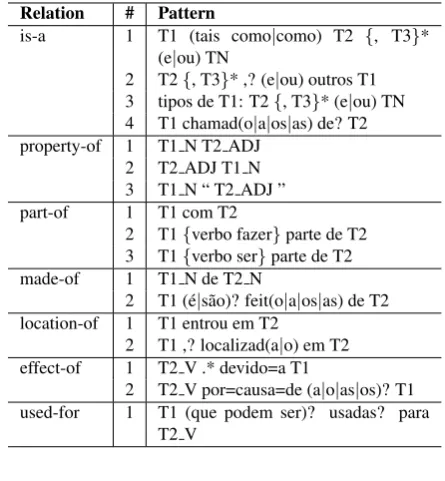
Semantic relation extraction is the task of finding semantic relations between terms in texts. There’s not a single formal definition for “semantic relation” and “term”. Therefore, in this paper, “semantic relation” stands for any relation, explicit or implicit, between terms on a semantic level. A “term” is a contiguous sequence of tokens, which in turn are defined as any sequence of characters separated by spaces. This work focuses on the Portuguese language, which still lacks high quality linguistic resources and tools, especially in the semantic level. Seven semantic relations are targeted: hyponymy (is-a), meronymy (part-of), locality (location-of), causality (effect-(location-of), property-of (something has a cer-tain property), made-of (something is made of some ma-terial) and used-for (something is used for a certain end). These relations are a subset of the ones used in the Open Mind Common Sense (OMCS) project1 and were cho-sen motivated by the needs of the Brazilian branch of the OMCS project2. In order to extract these seven relations automatically a textual pattern strategy and two supervised machine learning algorithms, C4.5 decision trees (Quinlan, 1993) and Support Vector Machines (Vapnik, 1995), were evaluated.
2.
Related work
There has been extensive work on the subject of seman-tic relation identification, mostly for the English language. The first researched approach was the textual patterns
1
http://openmind.media.mit.edu/
2http://www.sensocomum.ufscar.br/
paradigm, pioneered by Hearst (1992). In her paper, Hearst describes six textual patterns that indicate the presence of a hyponymy relation between two noun phrases. She also proposed an algorithm to find patterns that imply a seman-tic relationR. Hearst applied her patterns on encyclopedic and journalistic corpora and found that 63% of the identi-fied relations were of good quality.
Berland and Charniak (1999) follow Hearst’s algorithm, but search for meronymy relations. Their results, obtained by applying the patterns on a 100 million words journal-istic corpus, show that, on average, 55% of the relations found were correct. Girju and Moldovan (2002) also fol-low Hearst’s algorithm, looking for causality relations on a journalistic corpus and reporting a 65% accuracy.
Freitas and Quental’s (2007) work is one of the few that fo-cuses on the Portuguese language. They adapted Hearst’s patterns to Portuguese, creating 4 patterns that indicate hy-ponymy, and applied them to a corpus composed of around 2 million words of the public health domain. The results are compatible with Hearst’s, showing that 73% of the relations found were of high quality.
Noticing the shortcomings of the textual patterns approach – namely, high precision but low recall – and encour-aged by the increasing abundance of available textual data, researchers turned to machine learning (ML) techniques which leverage large quantities of text in order to try to find semantic relations.
sult can be that the features used by the ML classifiers can’t capture relevant information for the extraction of that rela-tion. The low number of training examples annotated for that relation also aggravates the weak performance of the classifiers.
Table 6: Experiment 2 – Results of the evaluation of deci-sion trees through10-fold cross-validationin terms of pre-cision, recall and F-measure
Relation Precision Recall F-measure
property-of 90.5% 80.0% 84.9%
is-a 76.9% 56.3% 65.0%
part-of 66.4% 37.2% 47.7%
location-of 62.2% 21.4% 31.8% effect-of 34.0% 10.4% 16.0%
made-of 33.3% 2.8% 5.2%
used-for 17.5% 5.1% 8.0%
Average 54.4% 30.4% 39.0%
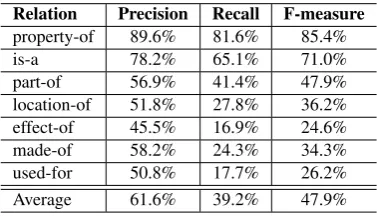
Table 7: Experiment 2 – Results of the evaluation of SVMs through 10-fold cross-validationin terms of precision, re-call and F-measure
Relation Precision Recall F-measure
property-of 89.6% 81.6% 85.4%
is-a 78.2% 65.1% 71.0%
part-of 56.9% 41.4% 47.9%
location-of 51.8% 27.8% 36.2% effect-of 45.5% 16.9% 24.6%
made-of 58.2% 24.3% 34.3%
used-for 50.8% 17.7% 26.2%
Average 61.6% 39.2% 47.9%
6.3.
Experiment 3
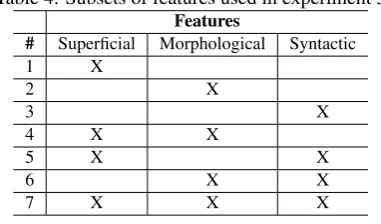
The performance of the classifiers trained with each subset of features and evaluated through 10-fold cross-validation is shown in Table 8. From the values presented it is possible to note that the ML methods have better results when all features are used in the training of the classifiers (subset 7).
6.4.
Experiment 4
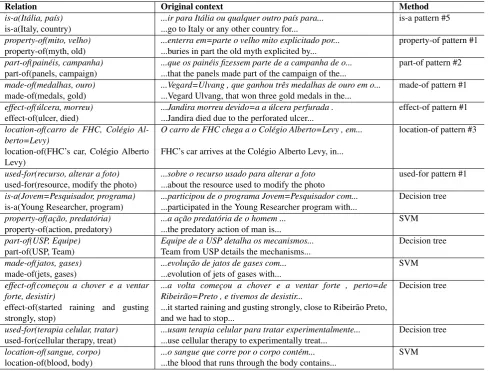
The last experiment’s results are presented on Tables 9 and 10. These results show that the algorithms and data used in the training had a good generalization capacity when confronted with a corpus of a different genre. The graph on Figure 2 summarizes the results obtained by textual patterns (applied on the CETENFolha corpus) and the decistion tree and SVM classifiers (trained and tested on CETENFolha) for each one of the 7 semantic relations. Table 11 shows some examples of correctly identified rela-tion instances using both textual patterns and ML strategies.
6.5.
Comparison with related works
Considering the is-a relation, we can compare this work with those of (Hearst, 1992) (for English) and (Freitas and
Table 9: Experiment 4 – Results of the decision tree clas-sifier tested over the FAPESP corpus in terms of precision, recall and F-measure
Relation Precision Recall F-measure
property-of 89.1% 83.3% 86.1%
is-a 60.0% 26.2% 36.4%
part-of 59.5% 35.0% 44.1%
location-of 39.1% 10.9% 17.0% effect-of 40.0% 7.1% 12.1%
made-of 0.0% 0.0% 0.0%
used-for 38.5% 7.4% 12.3%
Average 23.3% 22.8% 23.0%
Table 10: Experiment 4 – Results of the SVM classifier tested over the FAPESP corpus in terms of precision, recall and F-measure
Relation Precision Recall F-measure
property-of 91.0% 84.3% 87.5%
is-a 57.6% 32.1% 41.2%
part-of 52.1% 37.1% 43.3%
location-of 39.6% 17.7% 24.5% effect-of 50.0% 8.3% 14.3%
made-of 36.4% 7.3% 12.1%
used-for 40.9% 13.2% 20.0%
Average 52.5% 28.6% 37.0%
Quental, 2007) (for Portuguese). Hearst obtained a pre-cision of 63% and Freitas and Quental got 73.4%, while experiment 1 (Table 5) resulted in an average precision of 61.1%. The application of decision trees and SVM clas-sifiers (Tables 6 and 7) resulted in 76.9% and 78.2% pre-cisions, respectively. The difference between these results can be attributed to the different methods and corpora used in each work. Recall can’t be compared as it wasn’t calcu-lated by the recalcu-lated works.
Table 8: Experiment 3 – Average results of 10-fold cross-validation for the classifiers trained with different subsets of features
Decision tree SVM
Subset Precision Recall F-measure Precision Recall F-measure
1 46.6% 23.3% 31.7% 0.0% 0.0% 0.0%
2 37.4% 16.1% 22.5% 34.4% 45.6% 39.2%
3 50.0% 7.2% 12.6% 0.2% 14.3% 0.4%
4 56.2% 27.9% 37.3% 64.7% 35.6% 45.9%
5 52.0% 29.0% 37.2% 48.0% 13.7% 21.3%
6 47.1% 18.8% 26.9% 60.2% 35.0% 44.2%
7 54.4% 30.4% 39.0% 61.6% 39.2% 47.9%
Table 11: Examples of correctly identified relation instances, the context in which they occurred and the method that identified them
Relation Original context Method
is-a(It´alia, pa´ıs) ...ir para It´alia ou qualquer outro pa´ıs para... is-a pattern #5 is-a(Italy, country) ...go to Italy or any other country for...
property-of(mito, velho) ...enterra em=parte o velho mito explicitado por... property-of pattern #1 property-of(myth, old) ...buries in part the old myth explicited by...
part-of(pain´eis, campanha) ...que os pain´eis fizessem parte de a campanha de o... part-of pattern #2 part-of(panels, campaign) ...that the panels made part of the campaign of the...
made-of(medalhas, ouro) ...Vegard=Ulvang , que ganhou trˆes medalhas de ouro em o... made-of pattern #1 made-of(medals, gold) ...Vegard Ulvang, that won three gold medals in the...
effect-of(´ulcera, morreu) ...Jandira morreu devido=a a ´ulcera perfurada . effect-of pattern #1 effect-of(ulcer, died) ...Jandira died due to the perforated ulcer...
location-of(carro de FHC, Col´egio Al-berto=Levy)
O carro de FHC chega a o Col´egio Alberto=Levy , em... location-of pattern #3
location-of(FHC’s car, Col´egio Alberto Levy)
FHC’s car arrives at the Col´egio Alberto Levy, in...
used-for(recurso, alterar a foto) ...sobre o recurso usado para alterar a foto used-for pattern #1 used-for(resource, modify the photo) ...about the resource used to modify the photo
is-a(Jovem=Pesquisador, programa) ...participou de o programa Jovem=Pesquisador com... Decision tree is-a(Young Researcher, program) ...participated in the Young Researcher program with...
property-of(ac¸˜ao, predat´oria) ...a ac¸˜ao predat´oria de o homem ... SVM property-of(action, predatory) ...the predatory action of man is...
part-of(USP, Equipe) Equipe de a USP detalha os mecanismos... Decision tree part-of(USP, Team) Team from USP details the mechanisms...
made-of(jatos, gases) ...evoluc¸˜ao de jatos de gases com... SVM made-of(jets, gases) ...evolution of jets of gases with...
effect-of(comec¸ou a chover e a ventar forte, desistir)
...a volta comec¸ou a chover e a ventar forte , perto=de Ribeir˜ao=Preto , e tivemos de desistir...
Decision tree
effect-of(started raining and gusting strongly, stop)
...it started raining and gusting strongly, close to Ribeir˜ao Preto, and we had to stop...
used-for(terapia celular, tratar) ...usam terapia celular para tratar experimentalmente... Decision tree used-for(cellular therapy, treat) ...use cellular therapy to experimentally treat...
location-of(sangue, corpo) ...o sangue que corre por o corpo cont´em... SVM location-of(blood, body) ...the blood that runs through the body contains...
Concerning the remaining relations, we can cite (Girju et al., 2003) that extracts the part-of relation using C4.5 deci-sion trees. The researchers reported a precideci-sion of 83% and a recall of 72%, resulting in a F-measure of 77.1%. That score is considerably higher than the one obtained in exper-iment 2 (47.7% with decision trees and 47.9% with SVMs). Zelenko et al. (2003) focuses on the location-of relation and uses an SVM classifier with a parse tree kernel. The F-measure obtained was 83.3%, easily surpassing the results found in experiment 2 (31.8% for decision trees and 36.2%
for SVMs). It’s possible that the use of a specific kernel influenced the performance of the algorithm.
Girju, R., Badulescu, A., and Moldovan, D. (2003). Learn-ing semantic constraints for the automatic discovery of part-whole relations. In Proceedings of the 2003 Con-ference of the North American Chapter of the Associa-tion for ComputaAssocia-tional Linguistics on Human Language Technology - Volume 1, NAACL ’03, pages 1–8, Strouds-burg, PA, USA. Association for Computational Linguis-tics.
Girju, R., Nakov, P., Nastase, V., Szpakowicz, S., Tur-ney, P., and Yuret, D. (2007). Semeval-2007 task 04: Classification of semantic relations between nominals.
In Proceedings of the Fourth International Workshop
on Semantic Evaluations (SemEval-2007), pages 13–18, Prague, Czech Republic, June. Association for Compu-tational Linguistics.
Girju, R., Beamer, B., Rozovskaya, A., Fister, A., and Bhat, S. (2010). A knowledge-rich approach to identifying semantic relations between nominals. Information Pro-cessing and Management, 46(5):589–610.
Hall, M., Frank, E., Holmes, G., Pfahringer, B., Reute-mann, P., and Witten, I. H. (2009). The weka data mining software: An update. SIGKDD Explorations, 11(1):10–18, June.
Hearst, M. A. (1992). Automatic acquisition of hyponyms from large text corpora. InProceedings of the 14th Inter-national Conference on Computational linguistics - Vol-ume 2, pages 539–545, Nantes, France. ACL.
Joachims, T. (1998). Making large-scale svm learning practical. LS8 24, Universitt Dortmund.
Quinlan, J. R. (1993). C4.5: programs for machine learn-ing. Morgan Kaufmann Publishers Inc., San Francisco, CA, USA.
Snow, R., Jurafsky, D., and Ng, A. Y. (2005). Learning syntactic patterns for automatic hypernym discovery. In
Advances in Neural Information Processing Systems 17, pages 1297–1304. MIT Press.
Taba, L. S. (2013). Extrac¸˜ao autom´atica de relac¸˜oes semˆanticas a partir de textos escritos em portuguˆes do brasil. Master’s thesis, Universidade Federal de So Car-los.
Vapnik, V. (1995). The nature of statistical learning the-ory. Springer Verlag.