A set of open-source tools for Turkish natural language processing
C
¸ a˘grı C
¸ ¨oltekin
Universitiy of GroningenAbstract
This paper introduces a set of freely available, open-source tools for Turkish that are built around TRmorph, a morphological analyzer introduced earlier in C¸ ¨oltekin (2010a). The article first provides an update on the analyzer, which includes a complete rewrite using a different finite-state description language and tool set as well as major tagset changes to comply better with the state-of-the-art computational processing of Turkish and the user requests received so far. Besides these major changes to the analyzer, this paper introduces tools for morphological segmentation, stemming and lemmatization, guessing unknown words, grapheme to phoneme conversion,hyphenationand amorphological disambiguation.
Keywords:Turkish Morphology, finite-state tools, morphological disambiguation
1.
Introduction
This paper introduces a set of tools for Turkish natural language processing (NLP) that are built around a free, open-source morphological analyzer, TRmorph (C¸ ¨oltekin, 2010a). Namely, we introduce tools for morphological segmentation, stemming and lemmatization, guessing un-known words, grapheme to phoneme conversion, syllabi-fication/hyphenationand amorphological disambiguation. Similar to the current version of the morphological ana-lyzer, all tools are freely available with the terms of GNU Lesser General Public License (LGPL).1The source code of the analyzer and the other tools reported in this paper can be obtained fromhttps://github.com/coltekin/TRmorph. The most important feature of the tools presented here is the fact that they are developed and maintained following theopen-sourcesoftware development practices. As a re-sult, they can be customized for a particular purpose, and equally importantly, they are constantly improved by prob-lem reports, suggestions and contributions from the users. The rest of this article is organized as follows. The next sec-tion introduces some aspects of Turkish morphology that are relevant to the rest of the discussion in this paper. Sec-tion3provides an update on TRmorph, outlining important changes since it was first announced. Section 4describes the new finite-state tools, and Section5discusses a simple but effective morphological disambiguation tool. Lastly, the paper is concluded with a brief summary and notes on the future directions.
2.
Turkish morphology and NLP
Turkish is a morphologically complex language. The com-plex morphology is often demonstrated by the following popular example.(1) ˙Istanbul-lu-las¸-tır-ama-dık-lar-ımız-dan-mıs¸-sınız ‘You are (supposedly) one of those who we could not convert to an ˙Istanbulite’
The example above, consisting of 11 morphemes, is in-tended to demonstrate the complexity. It definitely is not
1
https://www.gnu.org/licenses/lgpl.html.
representative of a typical word. However, it is perfectly understandable by the native speakers, and, albeit rare, words of similar size can be observed in large corpora. More importantly, the rough translation indicates that a relatively complex sentence can be expressed by a single word.
Although Turkish words can be long, the word formation is rather regular. This makes it relatively easy to imple-ment the morphology in a finite-state formalism. However the complex word structure poses a number of other prob-lems for natural language processing applications. First, the traditional notion of the word as a stem and a set of suffixes belonging to a paradigm does not hold. For exam-ple, in (1) above, the word class changes multiple times by suffixation. This process is quite productive, and some of these ‘derivational’ suffixes can be attached to already in-flected words. Furthermore, parts of a word, as opposed to the complete word, can participate in syntactic relations. This requires sub-word units to be used in syntactic pro-cessing. Another practical reflection of the complex word structure is the problem of data sparseness that affects the machine learning methods applied to Turkish NLP. Since one can produce a large number of possible words forms from a single stem, most of these will never appear even in a large corpus.
The solution to these problems offered in the state-of-the-art Turkish NLP literature is to define sub-word units called inflectional groups(IGs, see e.g., Hakkani-T¨ur et al.,2002; Eryi˘git et al.,2008).
In this paper, we view an analysis string as a sequence of inflectional groups. Each IG contains a root or a deriva-tional suffix, acategorymarker, and a set ofinflectionsthat belong to the respective category. For example, the word evdekininkilerde ‘in the ones (e.g., books) that belong to the one (e.g., person) at home’ has the following IGs (rep-resented using TRmorph analysis symbols, slightly simpli-fied for readability):2
2The definition presented here is slightly different than other
1. evhNihloci: the rootev‘house’ with category noun hNiand locative inflectionhloci
2. hkiihNihgeni: the derivation hkii deriving a (pro)noun followed by genitive inflection
3. hkiihNihplihloci: the derivationhkiideriving an-other (pro)noun followed by plural and locative inflec-tions.
The inflectional groups allow a natural way to express syn-tactic relations between sub-word units, as well as reducing the data sparseness problem in machine learning methods used in NLP.
Another problem worth noting due to complex morphology is the large number of ambiguous analyses. The problem of ambiguity will be discussed at length in Section5.
Given the importance of the morphological analysis, it is not surprising that the development and improvement of morphological analyzers has been an active area of research for Turkish and related languages (e.g., Hankamer,1986; Oflazer,1994; Washington et al.,2012; S¸ahin et al.,2013; Kairakbay,2013).
3.
TRmorph: an update
TRmorph is an open source finite state morphological an-alyzer introduced in C¸ ¨oltekin (2010a). Since its introduc-tion, TRmorph has been used by many NLP researchers and practitioners. For example, it was used in information re-trieval ( ¨Ozdikis¸ et al.,2012; Hadımlı and Y¨ondem,2012); for testing unsupervised morphology learners (C¸ ¨oltekin, 2010b; Kılıc¸ and Bozs¸ahin,2012; Janicki, 2013); in cor-pora annotation (Ruhi et al.,2012);3for preparation of ex-periment materials (G¨unes¸ and C¸ ¨oltekin,2014); testing fi-nite state toolkits (Lind´en, Axelson, et al., 2013); in ma-chine translation systems (Forcada et al., 2009); and uti-lized at varying levels in development of analyzers for other languages, e.g., for Azeri,4 Kyrgyz (Washington et al.,2012) and Hungarian.5 Besides the academic use cited above, TRmorph has been in use by a number of commer-cial organizations, and the demo web page at present re-ceives about 30 queries per day.
During the last four years that it has been in public use, TRmorph has been in constant change. Besides minor im-provements or bug fixes in a software’s life cycle, there have also been a few major changes that are worth reporting here. The rest of the present section describes these major changes.
3.1.
Tagset change
The most important change visible to the users is a com-pletely revised morphological tagset. The earlier morpho-logical analyses consisted of the part-of-speech tag of the root and sequence of tags that correspond to the surface affixes. Although this works fine for many applications, state-of-the art (dependency) parsing methods for Turk-ish are based on so-called inflectional groups. The new tagset allows explicit identification of IGs within the anal-ysis strings, as well as fixing some inconsistencies in the
3
Also in preperation ofhttp://tscorpus.com/.
4
http://wiki.apertium.org/wiki/Apertium-aze.
5
https://gitorious.org/hunmorph-foma/pages/Home.
initial tagset. All morphological tags are described in the extensive manual included in the distribution.
3.2.
The lexicon
Another substantial change is a new lexicon. The ear-lier version of TRmorph used a modified version of lex-icon from the Zemberek project (A. A. Akın and M. D. Akın, 2007). The current lexicon of TRmorph is gener-ated semi-automatically from a large web-based corpus of about 800M tokens collected by crawling the Web with a procedure similar to one described in Baroni et al. (2009). The lexicon is built by using the unknown word guesser and disambiguator described below, as well as checking the au-tomatically extracted root forms against online dictionaries, and by hand-editing the results.
The initial motivation of the lexicon change was the con-cerns raised by some users from the industry about incom-patibilities of different open-source licenses used by Zem-berek and TRmorph. However, extracting a root lexicon from the Web and keeping it up to date is an attractive goal by itself. The refinement of the procedure outlined above and the lexicon itself is still in progress.
3.3.
Rewrite with a different FST formalism
Under the hood, the morphological description has been completely rewritten. TRmorph was initially written in SFST (Schmid,2005). The new version has been rewrit-ten using lexc and xfst languages from Xerox (Beesley and Karttunen,2003), using the free implementation Foma, (Hulden, 2009). TRmorph can also be used with HFST (Lind´en, Silfverberg, et al.,2009).The main reason behind rewriting the finite-state specifi-cation in another language was maintainability. Although SFST provides a familiar and complete FST description language, during development of TRmorph there were quite a few cases where the same automata needed to be repeatedly defined. Furthermore, the Xerox languages lexc and xfst have been around for a longer time, and are better known in the computational linguistics community. This also helps users who want to change the source code to fit their needs. These being said, similar problems arose dur-ing the rewrite of the system with the Xerox languages. To prevent some of the repetition and redundancy, TRmorph source code now includes C preprocessor directives which are preprocessed before compiling the code with lexc and xfst. The use of a preprocessor also enables a straight-forward method for conditional inclusion or exclusion of code fragments, providing a natural way to enable or dis-able some behavior in compile time.
3.4.
Options
of forms common in colloquial language found in social media, or on the Internet at large. The open source na-ture of TRmorph allows users to customize the analyzer to their needs by changing the source code of the analyzer. However, the FST formalisms used in describing the mor-phology are not necessarily easy to grasp even for experi-enced programmers. A significant amount of learning time is required before one can even do simple modifications. Mostly based on the requests from the users, new release of TRmorph allows some common options to be specified dur-ing the compile time. Example options include whether to accept common misspellings, analyze words written in all capital letters or to produce ‘+’ separated analysis strings similar to Oflazer (1994). This allow users to specify these common preferences without needing to learn the finite state language(s) the analyzer was implemented with.
4.
New finite-state tools
Since Turkish is a morphologically complex language, some common NLP tasks can only be done properly with the help of a morphological analyzer. Most of these tools share a common code base provided by the analyzer, and their usage is similar, since the ideal input for these tools is the analysis string rather than the surface form of a word. We also describe a number of tools that do not make use of the analyzer, but are included in the TRmorph distribution since they are relatively easy to implement within a finite-state framework.
4.1.
Morphological segmentation
Morphological segmentation is the task of finding the sur-face morphemes of a word. The result is interesting for various research purposes, such as in evaluating unsuper-vised morphological analyzers (e.g., C¸ ¨oltekin,2010b; Kılıc¸ and Bozs¸ahin,2012; Janicki,2013).
For an agglutinating language like Turkish, one can find almost a one-to-one correspondence with the morphemes and their surface forms. However, analysis looses the link between the underlying morpheme and its surface form. Furthermore in presence of zero morphemes, morphemes without a surface realization, one cannot even determine the number of surface morphemes.
The main TRmorph FST includes root and morpheme boundary symbols used internally for morphophonological rules that are sensitive to these boundaries. Since the sur-face forms of written words do not contain these bound-aries, they are deleted from the surface words in the regular analyzer. The segmentation tool, alongside a few others described below, shares a common strategy in its imple-mentation. The crucial part in the segmentation tool is a slightly modified finite state transducer that keeps the inter-mediate boundary symbols on the surface string. In its sim-plest form, the segmentation FST takes an analysis string, and generates a surface form with boundary markers. If the aim is to produce the segmented form of a surface word, the automata for segmentation and analysis can be com-posed to convert the surface form to a segmented surface form directly. This strategy will produce ambiguous results in some cases. For example, the wordevleriwill be seg-mented as bothev-ler-i ‘his/her houses’, andev-leri‘their
house’. Disambiguating the analysis first, and then generat-ing the segmented surface form would be desirable in most cases.
4.2.
A grapheme-to-phoneme converter
Turkish orthography is rather transparent with respect to standard pronunciation. One can build a straightforward mapping from orthographic form to a phonetic representa-tion with a number of alternarepresenta-tions sensitive to immediate phonetic or orthographic context. However, there are cer-tain aspects of pronunciation, particularly the placement of lexical stress in a word, that change depending on the mor-phological process. As a result, the mormor-phological analyzer is also necessary for proper grapheme-to-phoneme (g2p) conversion. The functionality of the g2p tool is similar to the earlier work described by Oflazer and Inkelas (2006). However, as well as being open source, the g2p tool de-scribed here also differs significantly from the architecture explained in Oflazer and Inkelas (2006).
As with the morphological analyzer, the g2p description follows G¨oksel and Kerslake (2005). The default lexical stress in Turkish is on the final syllable. And when most suffixes are added to a stem, the stress moves to the final syllable of the word. Some roots, especially of place names and some borrowings, exhibit exceptional stress, and some morphemes contain non-stressable syllables. In a simpli-fied form:
• If a stressable suffix is added to a root form with fi-nal stress, the stress moves to the fifi-nal syllable (of the added suffix).
• If a suffix with a non-stressable syllable is added to a stem, stress falls before the non-stressable syllable. The suffixes after that (stressable or not) do not change the position of the stress.
• The location of stress does not change with suffixation of root forms with exceptional stress. In the presence of the negative marker (-ma/-me), however, the stress falls on the syllable before the negative marker irre-spective or the stress placement on the root.
The description of the g2p system is fairly complete, and has been useful in some preliminary experiments in unsu-pervised learning of segmentation (C¸ ¨oltekin and Nerbonne, 2014). However, the grapheme-to-phoneme converter de-scribed here is relatively new and experimental. Particu-larly, the exceptional stress marking in lexicon is still in progress.
4.3.
Stemming lemmatization
Stemming is one of the common tasks in information re-trieval and many other NLP tasks. Since possible suffix sequence inventory for Turkish is rather large (and theoreti-cally infinite), the only way to achieve reasonable stemming is through morphological analysis. The present TRmorph distribution includes a stemmer that first analyzes the given word, and strips away all analysis symbols, leaving only the stem. One can optionally include the part of speech tag, and/or the derivational suffixes that immediately follow the root in the stemmer output.
4.4.
Unknown word guesser
Updating the lexicon of a morphological analyzer is one of the constant maintenance tasks. However, it is simply im-possible to add every im-possible root form to the lexicon. An unknown word guesser is useful for providing alternative analyses of unknown words. TRmorph now includes an un-known guesser which replaces the lexicon of the standard analyzer with a relatively permissive finite state automaton. The lexicon of the guesser allows arbitrary character strings (with some configurable restrictions) to be used as the root of an open-class word. If the guesser is combined with the analyzer using the priority union operation (Beesley and Karttunen, 2003), the guesser will only be used for the words that cannot be analyzed by the analyzer. This pro-duces analyses that stem from the lexicon when possible, but falls back to the guesser when analyzer fails.
Another possible use of the unknown word guesser is to identify unknown roots. A variation of guesser in combina-tion with a disambiguator was used during the construccombina-tion of the current TRmorph lexicon.
4.5.
Hyphenation and tag set conversion
Another simple but useful tool newly included in TRmorph is a FST for hyphenation. Hyphenation in Turkish can be done completely automatically, since the hyphenation is al-lowed at any syllable boundary, and the syllable structure can unambiguously be inferred form the orthographic form of a word.
Lastly, we introduce two experimental converters that con-vert between different morphological tagsets. First, a converter that converts from standard TRmorph tagset to a tagset compatible with the conventions used in the CHILDES database (MacWhinney and Snow,1990). Sec-ond, a converter from the common tagset (based on Oflazer, 1994) used in corpora from earlier studies to TRmorph tagset. The second converter is used for converting a well known disambiguated data set to TRmorph format for train-ing the disambiguator described in Section5.
5.
Morphological disambiguation
Morphological disambiguation is the task of selecting the most likely morphological analysis of a given word. It is similar to the part of speech tagging. However, the number of classes (size of the tagset) and the sparsity of the data due to large number of missing word forms complicate the problem.Even in languages with relatively simpler morphology, a word may have multiple analyses. The most straightfor-ward case of morphological ambiguity is when a particular stem belongs to multiple word classes, e.g., English word ‘book’ having a noun and verb sense. Similarly, ambiguous affixes may also contribute to the number of possible anal-yses of a word. For morphologically complex languages like Turkish, the number of ambiguous analyses is typically much higher. Depending on the semantic distinctions one wants to make in the tagset, some words may be analyzed in hundreds of different ways. As a result, morphological disambiguation is an important step in Turkish NLP, and has been a popular topic in Turkish NLP literature. TRmorph produces highly ambiguous results compared to the numbers reported in the literature using Oflazer’s ana-lyzer. With default options, TRmorph produces on average about 12 analyses per word. On the other hand, for exam-ple, Hakkani-T¨ur et al. (2002) reports an average ambiguity rate of less than two. The differences are, at least in part, due to the choices made during the design of these ana-lyzers. During the analysis TRmorph produces all possible analyses of a word, including very unlikely ones. For ex-ample, for any adjective (without any suffixes, or any other root ambiguity), TRmorph produces eight analyses. The reasons for this ambiguity include the fact that any adjec-tive in Turkish can be used as a (pro)noun referring to an object with relevant property; any noun or adjective may be used a predicate with present copula and ‘null’ person-number agreement; the null agreement on predicates may agree with third person singular and plural subjects; and the person-number agreement of a predicate may be at-tached the following question particle, or another predicate (in case of coordination). The cases of ambiguity are ex-plained in detail in the TRmorph manual.
Earlier disambiguators presented in the literature have been based on the analyses (tagset) of Oflazer (1994). Unfortu-nately, none of the earlier systems could be used with the output of TRmorph, either due to the lack of availability or due to the fact that the tagsets used in the analyzers differ substantially. The rest of this section reports a simple mor-phological disambiguator that works well with TRmorph output.
5.1.
Related work
models have not been in use despite substantially lower per-formance of later models.
The first statistical disambiguation work was reported by Hakkani-T¨ur et al. (2002). The method used in this study is essentially the same as a standard trigram HMM tag-ger POS tagtag-ger. However, to alleviate the data sparseness problem, they decompose the morphological analyses into IGs. The best model presented in Hakkani-T¨ur et al. (2002) achieves around 94% accuracy. Y¨uret and T¨ure (2006) in-troduce a method that learns morphological analysis of a given word from the features extracted only from surface form of the target word and its left and right neighbors. Y¨uret and T¨ure (2006) report an accuracy of 95.82%. In a more recent study, Sak et al. (2007) presents a disam-biguation system which takes the 50-best analyses of a sen-tences using the model of Hakkani-T¨ur et al. (2002), and re-ranks these analyses using a variation of the perceptron algorithm. The resulting disambiguation system achieves 96.28% accuracy.
Except the first two rule-based disambiguation systems, all recent studies make use of the same data set. However, the scores may not be directly comparable due to different testing settings.
5.2.
Data and preprocessing
The largest data set used in this study is the data set from Y¨uret and T¨ure (2006).6 This corpus seems to have orig-inated from study by Hakkani-T¨ur et al. (2002), and used by almost all subsequent studies. It contains newspaper text collected from online newspapers. The data consists of two parts. The first part contains approximately 1M semi-automatically disambiguated tokens. We will call this data set ‘1M’, The second part consists of approximately 1K hand-annotated tokens. We will call this set as ‘1K’ in this paper. As observed by others earlier, despite being hand-annotated, 1K also contains errors, which were not corrected in this study.
Since both 1M and 1K are analyzed using Oflazer’s (1994) morphological analyzer, the data had to be converted to TR-morph format. A large part of the data can be converted using the conversion utility included in the TRmorph dis-tribution. However, since there is no one-to-one mapping between the tagsets used by two analyzers, this is a best-effort conversion. Some of the tags of TRmorph never ap-pear on the resulting data set, and some information is lost during the conversion. Although the conversion utility pro-duces a single result for each analysis found in 1M and 1K, in about 5% of the cases, TRmorph does not generate the same surface string for the given analysis. Most of these cases are due to out-of-vocabulary words (mainly proper nouns), disagreements about POS tag of the root words in TRmorph lexicon and the corpus, different choices for in-cluding derived forms in the lexicon or analyzing them, and lastly, liberal use of word guesser to mark typos and non-word strings as non-words.
These two data sets allow rough comparisons of the results obtained in this study with the earlier studies in the liter-ature. To test the success of the disambiguation on the
6
Obtained from http://www.denizyuret.com/2006/11/turkish-resources.html on 2013-09-26.
Data set sent. tokens types
1M 50519 834924 111127
1K 41 861 524
web5K 302 5025 3079
metu1K 76 1142 773
Table 1: Number of sentences, tokens and types in the data sets used in this study.
target system, the native output of TRmorph, we also use two small data sets that are analyzed by TRmorph and dis-ambiguated manually. One of these data sets is a set of 357 sentences (approximately 5K tokens excluding punc-tuation) randomly selected from a Web corpus of approx-imately 800M tokens. As an attempt to test effects of a more balanced corpus, we also use a small data set of 164 sentences (approximately 2K tokens excluding punc-tuation) randomly selected from the METU corpus (Say et al.,2002). Similar to the web data, these sentences were an-alyzed by TRmorph and disambiguated manually. Table1 presents some statistics for each data set used in this study.
5.3.
Models of disambiguation without context
Despite the fact that there has been a relatively large num-ber of studies on morphological disambiguation of Turkish, it is surprising that none of the earlier studies considered a simple disambiguator that does not make use of the word context, but relies only on the features available in the word and its analyses.
Indisputably, the neighboring words are important for mor-phological disambiguation. Contextual differences are also the main motivation behind the disambiguation effort. Nev-ertheless, all words will have a ‘most likely’ interpretation, and finding the most common analysis of a word (or prefer-ably, scoring all the analyses of a word) is useful for a num-ber of reasons.
5.3.1. Model 1: a rote-learning disambiguator
First model we define here is a ‘rote-learning’ model that simply counts the analyses observed in the training data. During testing, it picks the analysis that was observed in the training with the highest frequency.
The model takes the analysis stringT as a whole, and esti-mates the probability of an analysis string using its relative frequency in the training corpus with add-one smoothing. During the test time we simply pick the analysis with the highestP(T). The ties are broken randomly.
5.3.2. Model 2: making use of analysis without root
Model 1 described in Section5.3.1counts complete analy-sis strings in the training data. This model will have diffi-culties estimating probabilities of a large number of analy-ses. Even for very frequent roots, it is unlikely (and theo-retically impossible) that all possible suffix sequences will be observed in the training data. However, if a particular sequence of suffixes is frequent, regardless of the root it follows, we expect the same sequence to be attached to un-observed roots with high probability as well.
The model we describe in this section decomposes an analysis string T into a root r and the part of the anal-ysis string excluding the root a. For example for anal-ysis string evhNihlocihkiihAdji, r is ev and a is hNihlocihkiihAdji. We are interested in the joint prob-ability of theranda, which can be factored as,P(r, a) =
P(r|a)P(a). As before, we estimate the probabilities from relative frequencies in the training corpus with add-one smoothing. Ties are again broken randomly, but ties are less of an issue for this model in comparison to Model 1.
5.3.3. Model 3: making use of IGs
Model 2 splits an analysis string into two. However, we can exploit the structure of the analyses for better estimation of the probabilities for rare or unknown words.
The model defined here, Model 3, makes use of the se-quence of IGs, and decomposes an IG into a root r or a derivation d and a sequences of inflection(s) i including the category marker. An analysis string is represented as at least one (r,i) tuple followed by a possibly unbounded number sequence of (d,i) tuples. For example the word evdeki‘the one at the house’ is represented as two IGs with the following components.
ev |{z}
r
hNihloci | {z }
i0
hkii |{z}
d1
hAdji | {z }
i1
. . .
Having this decomposition at hand, we make two indepen-dence assumptions. Namely, (1) an i is independent of other parts of the analysis given presentr or dand (2) a dis independent of other parts of the analysis given thei preceding it.
We estimate the probability of an analysis string with n derivations by
P(T) =P(i0)P(r|i0) n Y
k=1
P(dk|ik−1)P(ik|dk)
Note that we invert the conditional probability P(i0|r)as before.
Test set Model 1 Model 2 Model 3
10fold 0.90±0.001 0.94±0.001 0.93±0.001
1K 0.92±0.010 0.96±0.007 0.93±0.009
web 0.78±0.006 0.87±0.005 0.86±0.005 metu 0.76±0.013 0.84±0.011 0.84±0.011
Table 2: Accuracy of the disambiguation models trained on the 1M corpus. ‘10fold’ indicates 10-fold cross validation results, and otherwise, the corpus used for testing. The in-tervals are approximate standard errors assuming accuracy values follow the binary distribution.
5.4.
Experiments and Results
In all experiments reported below, we train all three models on the indicated training data. During testing, we analyze the surface words using TRmorph, pick the best analysis ac-cording to the model, and compare it with the gold-standard analysis. We present 10-fold cross validation results on the same corpus, and tests that are done on corpora with differ-ent properties.
The first set of result we present in Table 2 are accuracy of models trained on the 1M corpus. The most interesting finding at first sight is that Model 2 performs surprisingly well in 10-fold cross validation test and while testing on the 1K corpus. It rivals earlier more complex context-aware models tested on the same corpora, scoring about 2% below the best results obtained so far.
With respect to the different test sets used, the results are as expected. All models perform better on familiar cor-pora, and perform worse as the territory becomes more un-known. The web5K and metu1K corpora are different from the training data since they do not contain newspaper text only, and they are annotated directly using the TRmroph tagset. The differences between models are also as ex-pected. The baseline model, Model 1, performs the worst. So far, Model 2 seems to perform the best in all test scenar-ios, since it does not make the simplifying independence assumptions of Model 3.
The accuracy scores presented in Table 2 credit a model only if the gold-standard analysis receives the highest score. Figure1shows the ranks assigned to gold-standard analy-ses on the 1K corpus by each model trained on the 1M cor-pus. The figure demonstrates that misses by models 2 and 3 are mostly clustered in rank two or three. Both models in-clude the gold-standard analyses within the first two ranks in 99% of the cases.
It is clear from Table2that the performance of the models on web5K and metu1K is far behind the results obtained on the newspaper corpus used for training. The next set of experiments investigate the question of whether we can achieve better disambiguation using a small but more simi-lar training set.
1 2 3
Rank 5+ 4 3 2 1
Model
A
ccuracy
0.90
0.92
0.94
0.96
0.98
1.00
Figure 1: Rank assigned to the gold-standard analyses on the 1K corpus by each model trained on the 1M corpus. Note that the y-axis is cropped at 90% to show the differ-ences between the models clearly.
Test set Model 1 Model 2 Model 3
10fold 0.52±0.023 0.50±0.023 0.79±0.018 metu 0.52±0.015 0.53±0.015 0.77±0.012
1K 0.47±0.018 0.49±0.018 0.80±0.014
Table 3: Accuracy of the zero-context disambiguation mod-els trained on web5K corpus. ‘10fold’ indicates 10-fold cross validation results, and otherwise, the corpus used for testing. The intervals are approximate standard errors as-suming accuracy values follow the binary distribution.
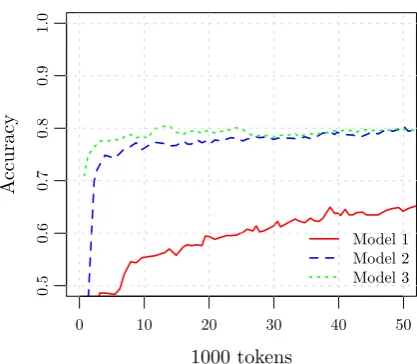
pay off if one has to work with a small training set. To show the differences in learning, Figure 2presents the learning curves for each model when trained on the 1M corpus in-crementally, and tested on metu1K. As expected, Model 1 is the slowest learner. Unlike when trained on web5K cor-pus, Model 2 performs better, but it stays behind Model 3 until about 30K tokens. The graph in Figure2presents re-sults only until 50K tokens to emphasize the changes at the beginning. Although the models 2 and 3 reach to a cer-tain level quickly at about 10K tokens, the small but steady increase in accuracy continues until the end the 1M corpus.
6.
Summary
In summary, this paper provides an update on major changes on TRmorph over the last four years; introduces a set of (finite-state) tools that are useful for speech and language processing; and describes a new morphological disambiguation model suitable to be used with TRmorph. It should also be stressed that most of the new and addi-tional tools are motivated by the users other than the author. The changes introduced and additional tools implemented over the last four years make TRmorph a more usable sys-tem for Turkish NLP. TRmorph and the associated tools are actively being developed. Besides constant improvements, the tool set is constantly being expanded with new tools and functionality.
0 10 20 30 40 50
0.5
0.6
0.7
0.8
0.9
1.0
1000 tokens
A
ccuracy
Model 1 Model 2 Model 3
Figure 2: The learning curve of the models trained incre-mentally on the 1M corpus, tested on metu1K. The x-axis is cropped below 0.5, and the y-axis do not show all 800K tokens to emphasize the differences with small training sets.
Even though the disambiguator presented here does not make use of any context, the performance of it is only about 2% behind the best performing disambiguators in the litera-ture. The first impression out of a preliminary error analysis suggests that the context is not utilized enough by the ear-lier models. Furthermore, the data set used by all models in the literature (including the present one) is highly specific, and contains many errors. A better disambiguation system is one of the clear directions for future studies.
7.
References
Akın, Ahmet Afs¸in and Akın, Mehmet D¨undar (2007). “Zemberek, an open source NLP framework for Turkic Languages.”
Baroni, Marco, Bernardini, Silvia, Ferraresi, Adriano, and Zanchetta, Eros (2009). “The WaCky wide web: a collec-tion of very large linguistically processed web-crawled corpora.” In:Language Resources and Evaluation43.3, pp. 209–226.
Beesley, Kenneth R. and Karttunen, Lauri (2003). “Finite-state morphology: Xerox tools and techniques.” In:CSLI, Stanford.
C¸ ¨oltekin, C¸ a˘grı (2010a). “A Freely Available Morpholog-ical Analyzer for Turkish.” In: Proceedings of the 7th International Conference on Language Resources and Evaluation (LREC 2010). Valetta, Malta, pp. 820–827. C¸ ¨oltekin, C¸ a˘grı (2010b). “Improving Successor Variety
for Morphological Segmentation.” In: Proceedings of the 20th Meeting of Computational Linguistics in the Netherlands. Utrecht, The Netherlands, pp. 13–28. C¸ ¨oltekin, C¸ a˘grı and Bozs¸ahin, Cem (2007). “Syllables,
Morphemes and Bayesian Computational Models of Ac-quiring a Word Grammar.” In:Proceedings of 29th An-nual Meeting of Cognitive Science Society. Nashville, pp. 887–892.
on Cognitive Aspects of Computational Language Learn-ing.
Eryi˘git, G¨uls¸en, Nivre, Joakim, and Oflazer, Kemal (2008). “Dependency Parsing of Turkish.” In: Computational Linguistics34.3, pp. 357–389.
Forcada, Mikel L., Tyers, Francis M., and Ram´ırez-S´anchez, Gema (2009). “The Apertium machine trans-lation platform: five years on.” In: Proceedings of the First International Workshop on Free/Open-Source Rule-Based Machine Translation, pp. 3–10.
G¨oksel, Aslı and Kerslake, Celia (2005).Turkish: A Com-prehensive Grammar. London: Routledge.
G¨unes¸, G¨uliz and C¸ ¨oltekin, C¸ a˘grı (2014). “Mapping to prosody: not all parentheticals are alike.” In: Parenthet-ical Verbs. Ed. by S. Schneider, J. Glikman, and M. Avanzi. Berlin: De Gruyter, (to appear).
Hadımlı, Kerem and Y¨ondem, MeltemTurhan (2012). “Two Alternate Methods for Information Retrieval from Turk-ish Radiology Reports.” In:Computer and Information Sciences II. Ed. by Erol Gelenbe, Ricardo Lent, and Georgia Sakellari. Springer London, pp. 527–532. Hakkani-T¨ur, Dilek Z., Oflazer, Kemal, and T¨ur, G¨okhan
(2002). “Statistical Morphological Disambiguation for Agglutinative Languages.” In: Computers and the Hu-manities36.4, pp. 381–410.
Hankamer, Jorge (1986). “Finite state morphology and left to right phonology.” In:Proceedings of the West Coast Conference on Formal Linguistics. Vol. 5. Stanford Lin-guistic Association.
Hulden, Mans (2009). “Foma: a finite-state compiler and library.” In: Proceedings of the 12th Conference of the European Chapter of the Association for Computational Linguistics: Demonstrations Session. Association for Computational Linguistics, pp. 29–32.
Janicki, Maciej (2013). “Unsupervised Learning of A-Morphous Inflection with Graph Clustering.” In: Pro-ceedings of the Student Research Workshop associated with RANLP, pp. 93–99.
Kairakbay, Bakyt M. (2013). “Finite State Approach to the Kazakh Nominal Paradigm.” In: Finite State Methods and Natural Language Processing, pp. 108–112. Kılıc¸, ¨Ozkan and Bozs¸ahin, Cem (2012). “Semi-supervised
morpheme segmentation without morphological analy-sis.” In: First Workshop on Language Resources and Technologies for Turkic Languages, LREC, pp. 52–56. Lind´en, Krister, Axelson, Erik, Drobac, Senka,
Hard-wick, Sam, Silfverberg, Miikka, and Pirinen, Tommi A. (2013). “Using HFST for creating computational linguistic applications.” In: Computational Linguistics. Springer, pp. 3–25.
Lind´en, Krister, Silfverberg, Miikka, and Pirinen, Tommi (2009). “HFST Tools for Morphology–An Efficient Open-Source Package for Construction of Morpholog-ical Analyzers.” In: State of the Art in Computational Morphology. Ed. by Cerstin Mahlow and Michael Pi-otrowski. Communications in Computer and Information Science. Springer, pp. 28–47.
MacWhinney, Brian and Snow, Catherine (1990). “The child language data exchange system: An update.” In: Journal of Child Language17.2, pp. 457–472.
Oflazer, Kemal (1994). “Two-level description of Turkish morphology.” In:Literary and Linguistic Computing 9 (2).
Oflazer, Kemal and Inkelas, Sharon (2006). “The architec-ture and the implementation of a finite state pronuncia-tion lexicon for Turkish.” In:Computer Speech and Lan-guage20.1, pp. 80–106.
Oflazer, Kemal and Kuru¨oz, ˙Ilker (1994). “Tagging and morphological disambiguation of Turkish text.” In: Pro-ceedings of the fourth conference on Applied natural lan-guage processing. Association for Computational Lin-guistics, pp. 144–149.
Oflazer, Kemal and T¨ur, G¨okhan (1997). “Morphological Disambiguation by Voting Constraints.” In:Proceedings of the 35th Annual Meeting of the Association for Com-putational Linguistics, pp. 222–229.
¨
Ozdikis¸, ¨Ozer, S¸enkul, Pınar, and O˘guzt¨uz¨un, Halit (2012). “Semantic expansion of tweet contents for enhanced event detection in Twitter.” In:IEEE/ACM International Conference on Advances in Social Networks Analysis and Mining (ASONAM). IEEE, pp. 20–24.
Ruhi, S¸¨ukriye, Eryılmaz, Kerem, and Acar, M. G¨unes¸ C. (2012). “A platform for creating multimodal and mul-tilingual spoken corpora for Turkic languages: Insights from the Spoken Turkish Corpus.” In:First Workshop on Language Resources and Technologies for Turkic Lan-guages, LREC, pp. 57–63.
S¸ahin, Muhammet, Sulubacak, Umut, and Eryi˘git, G¨uls¸en (2013). “Redefinition Of Turkish Morphology Using Flag Diacritics.” In: Proceedings of The Tenth Sympo-sium on Natural Language Processing (SNLP-2013). Sak, Has¸im, G¨ung¨or, Tunga, and Sarac¸lar, Murat (2007).
“Morphological Disambiguation of Turkish Text with Perceptron Algorithm.” In: CICLing 2007. Vol. LNCS 4394, pp. 107–118.
Say, Bilge, Zeyrek, Deniz, Oflazer, Kemal, and ¨Ozge, Umut (2002). “Development of a Corpus and a TreeBank for Present-day Written Turkish.” In: Proceedings of the Eleventh International Conference of Turkish Linguis-tics. Eastern Mediterranean University, Cyprus.
Schmid, Helmut (2005). “A programming language for fi-nite state transducers.” In: Proceedings of the 5th In-ternational Workshop on Finite State Methods in Nat-ural Language Processing (FSMNLP 2005). Helsinki, pp. 308–309.
Washington, Jonathan, Ipasov, Mirlan, and Tyers, Fran-cis M. (2012). “A finite-state morphological transducer for Kyrgyz.” In: Proceedings of the Eight International Conference on Language Resources and Evaluation (LREC’12). Ed. by N. Calzolari, Choukri K., Declerck T., M. U. Do˘gan, Maegaard B., J. Mariani, Odijk J., and S. Piperidis. Istanbul, Turkey.