A Study of Amended Biogas Production by Various
Bioaugmentation Techniques
D.Vinod Kumar
Abstract:Biogas or biomethane is quite oftenproduced by way of anaerobic digestion, or just lately by using thermochemical or a combination of thermochemical and organic tactics by way of syngas (CO and H2) fermentation. Novel laboratory biogas reactor prototypes were designed and constructed. The fates of pure hydrogen-producing cultures of Caldicellulosiruptor saccharolyticus and Enterobacter cloacae were adopted in time in
thermophilic and mesophilic natural
biogas-producing communities, respectively. Molecular biological systems were applied to be taught the altered ecosystems. A systematic learn in 5-litre CSTR digesters revealed that a key fermentation parameter within the preservation of an altered population stability is the loading expense of whole organic solids. Intensification of the biogas construction used to be located and the results corroborate that the improved biogas productivity is associated with the multiplied abundance of the hydrogen producers.
Keywords-e
I. INTRODUCTION
More than a few tactics had been developed for the medicationand removing of organic waste, often involving biologicalsystems [1, 2]. Applied sciences that convert healthy fabricinto biogas or hydrogen (H2) in fermentation strategiesare the only ones that at the same time allow the combinedadvantages of waste disposal and the iteration of pricelessvigor [3– 6]. Biogas, a renewable vigour carrier consisting most often of methane (CH4) and carbon dioxide (CO2),is the top-made from the anaerobic digestion of organicmaterial [7] and will also be exploited in various methods. Afterthe elimination of hint contaminations which includes hydrogensulfide, xyloxanes, and water, it may be burnt to generateheat or can be utilized as gas in gasoline engines, coupled to agenerator to produce electrical energy and heat. If the CO2 can beeradicated from the biogas, the
remaining fuel, often known asbiomethane, has the properties of purified average gas and maybe utilized in every applications to interchange fossil normal fuel astransportation fuel, raw fabric for the chemical enterprise, orin gas cells, which convert it to electricity with excessive effectivity[1]
Biogas production through anaerobic digestion technology has advanced tremendouslyover the years. Presently, due to high energy demand and environmental concerns as theworld’s population increases, the drive for anaerobic digestion processes is gainingmomentum within research and the industry for sustainable energy generation. In thisvein, there is an increasing focus on better feedstock utilization for
improved biogasproduction. Nevertheless, the
challenges of low biogas yield, high retention time, andhigh investment cost impede the maximum performance of biogas production inanaerobic digestion systems. These bottlenecks are highly dependent upon theavailability, composition, and degradability of the feedstock used for biogas production.Great potential lies in biogas production
from various feedstocks such as crop
residues,livestock residues, municipal waste, landfill waste, food waste, aquatic biomass, keratinwaste, and
lignocellulosic feedstocks because of their
fortransforming these feedstocks into biogas. However, these easily digestible feedstocks,
In the present study, systematic experiments were conducted in 5-liter continuously stirred tank reactor
(CSTR)reactors specifically designed for biogas
the real-life, large-scalebiogas production plants much better than the routinelyused batch systems and
some of the first results are reportedhere.
II. RELATED WORK
As discussed earlier, biomass that is easily processed is mainly used as feedstock foranaerobic digestion process. Common, easily processed, feedstocks include livestockmanure, food-processing wastes, and sewage sludge. On the other hand, biomass that isdifficult to process is in high abundance and
accumulates tremendously. This biomass,when
properly pretreated, can be a valuable feedstock for biogas production, therebyreducing environmental pollution and enhancing the recovery of renewable energy. Forinstance, lignocellulosic wastes have about 40–60 % cellulose and 20–40 %hemicellulose (Kang et al., 2014), which is a good potential carbon source for biogasproduction if made accessible to the microorganisms. In addition, keratin-rich wastes(e.g., feathers) are composed of about 91–93 % crude protein (Patinvoh et al., 2016;Salminen et al., 2003), which is an insoluble protein and when converted into solubleoligomers will be of great potential for biogas production. Moreover, approximately91% of the volatile solids of fruit wastes are degradable, depending on the fruit species(Schnürer & Jarvis, 2010), and food processing wastes also have good
potentials forbiogas production. The biogas
production potential of these feedstocks varies dependingon their composition, pretreatment process,
and concentration of biodegradablematerial.
Therefore, some of these feedstocks which are indigestible, hard to digest,slow to digest, or contain inhibitors are discussed as potential feedstocks for anaerobicdigestion. Challenges associated with these feedstocks are discussed as well.
A large fraction of the globally produced waste is composed of organic indigestiblematerials, which are not biologically degradable or their degradation is extremely slowand cost-inefficient. Landfills contain many indigestible compounds such as processedpaper and impregnated wood. Because of the indigestible and heterogeneous nature ofthese wastes, their
volumes increase exponentially posing an
environmental threat.According to the world bank, these materials make up the highest proportion ofmunicipal solid waste in high income countries, while they accounted for 27 % of theglobal solid waste generated in 2009 (TheWorldBank, 2010)
III. Materials and Methods
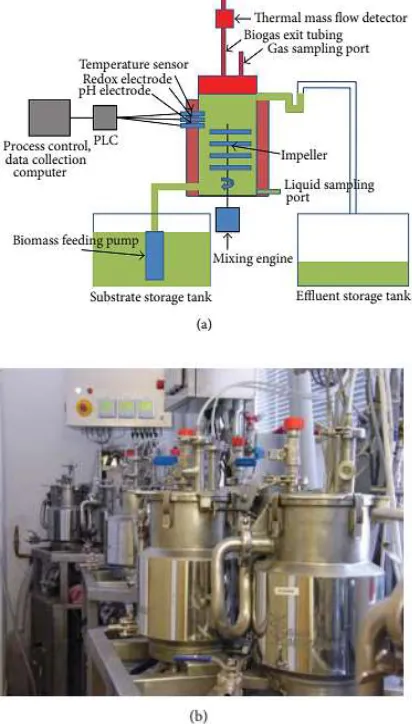
Explicitly designed reactorswith a working volume of 5L and a headspace of 1L werecustom-made from stainless steel by Biospin Ltd., Szeged,Hungary, and
the design is presented here for the first time.The
substrate is stored at ambient temperature in a reservoirand is mixed and mechanically pretreated by a shredderpump. It can be fed into the apparatus either continuouslyor intermittently, through a piston-type delivery system,which controls the substrate volume introduced into thereactor. Simultaneously with the feeding, the same volumeof fermented
material is removed through an overflow viaU-shaped
tubing in order to maintain a gas-tight closureand a constant working volume in the reactor. The biogasreactors are equipped with a spiral strip mixing device drivenby an electronic engine. free devices are operated by thesame electronic engine through a belt transmission in orderto maintain identical mixing conditions and to save onconstruction and operational costs. An electronically heatedjacket surrounds the cylindrical reactor body. Temperature ismeasured with a thermistor sensor, and constant temperature is maintained with an accuracy of ±0.5∘C. Electrodes for themeasurement of pH and redox potential are inserted throughthe wall of the reaction vessel, in
sealed sockets. Formation ofthe anaerobic
drained at the bottom,where samples for biomass analysis can likewise be removed. The top plate can be opened for inspection and cleaning. The plate is
fitted with a neoprene O-ring and is secured tothe ain
body by fleexible clamps. The evolved gas leaves
thereactor through fleexible tubing connected to the
top plate,where ports for gas sampling and the delivery of liquidsby means of syringes through silicone rubber septa are alsoinstalled (Figure 1).
Figure 1. Scheme of operation of the reactors used in this study,some of which are illustrated below.
Microorganism, Medium, and Culture
Conditions.Caldicellulosiruptor saccharolyticus
(DSM 8903) waspurchased from Deutsche
Sammlung von Mikroorganismenund Zellkulturen
GmbH and propagated at 70∘C on DSMZmedium 640
in anaerobic 50 mL hypovials (Supelco) untilOD600 = 0.5.Enterobacter cloacae (DSM30054) [24] was cultivated at30∘C on DSMZ medium 1 in sterile
Erlenmeyer flasks untilOD600 = 1.5.
Cell Growth and Viable Biomass Determination. Viablecell counts of C. saccharolyticus were determined by platingserially diluted cell suspensions in the stationary phaseon DSMZ medium 640
solidified with 2.5% (w/v) Gelrite Gellan Gum
(Sigma-Aldrich). Plating was performed
anaerobically in an anaerobic chamber (Bactron IV, SheldonManufacturing) [4, 5], and the plates were incubated at 70∘Cfor 3 to 4 days for the determination
of colony forming units.
Biogas Substrate.The substrate for anaerobic
digestionconsisted of a mixture of pig slurry (25% w/v) and choppedsweet sorghum (75%w/v). The sweet sorghum plant materialwas collected in fresh green form, chopped to pieces measuring less than 5
mm and stored frozen at −20∘C before use.An
inoculum from a thermophilic sewage sludge digester wasused to start the experiments involving C. saccharolyticus.
Gas Analysis.The composition of the evolved
biogaswas measured by taking 250 microL aliquots from the headspaceand injecting them into a gas chromatograph (6890N Network GC System, Agilent Technologies) equipped with a 5Åmolecular sieve
column (length 30 m, I.D. 0.53 megabore,film 25
mictom) and a thermal conductivity detector. Nitrogenwas used as carrier gas.
IV. CONCLUSION
A positive correlation was demonstrated between
theintensification of biogas production and the
elevated biogas production relative to the untreated controls. It is therefore envisaged that a rational designand engineering of the biogas-producing microbialcommunity is possible
REFERENCES
[1] B. K. Ahring, “Perspectives for anaerobic
digestion,” Advances inBiochemical
Engineering/Biotechnology, vol. 81, pp. 1–30, 2003.
[2] P. F. Pind, I. Angelidaki, and B. K. Ahring, “Dynamics of theanaerobic process: effects of
volatile fatty acids,” Biotechnologyand
Bioengineering, vol. 82, no. 7, pp. 791–801, 2003.
digestionof domestic sewage in closing the water and nutrient cycle atcommunity level,” Water Science and Technology, vol. 39, no. 5,pp. 187–194, 1999.
[4] G. Ivanova, G. Rákhely, and K. L. Kovács, “Hydrogen production from biopolymers by Caldicellulosiruptor saccharolyticusand stabilization of the system by immobilization,” International Journal of Hydrogen Energy, vol. 33, no. 23, pp.6953–6961, 2008.
[5] G. Ivanova, G. Rákhely, and K. L. Kovács, “Thermophilicbiohydrogen production from energy plants by Caldicellulosiruptor saccharolyticus and comparison with related studies,”International Journal of Hydrogen Energy, vol. 34, no. 9, pp.3659– 3670, 2009.
[6] Z. Herbel, G. Rákhely, Z. Bagi et al.,
“Exploitation of theextremely thermophilic
Caldicellulosiruptor saccharolyticus inhydrogen and biogas production from biomasses,” Environmental Technology, vol. 31, no. 8-9, pp. 1017–1024, 2010.
[7] Y. Miron, G. Zeeman, J. B. Van Lier, and G. Lettinga, “The roleof sludge retention time in the
hydrolysis and acidification oflipids, carbohydrates
and proteins during digestion of primarysludge in CSTR systems,” Water Research, vol. 34, no. 5, pp.1705–1713, 2000.
[8] E. L. Hendrickson, R. Kaul, Y. Zhou et al., “Completegenome sequence of the genetically
tractable hydrogenotrophicmethanogen
Methanococcus maripaludis,” Journal of
Bacteriology, vol. 186, no. 20, pp. 6956–6969, 2004.
[9] A. I. Leybo, A. I. Netrusov, and R. Conrad, “Effect ofhydrogen concentration on the community structure ofhydrogenotrophic methanogens studied by T-RELP analysis of16S rRNA gene amplicons,” Microbiology, vol. 75, no. 6, pp.683–688, 2006.
[10] Z. Bagi, N. fics, B. Bálint et al.,
“Biotechnological intensification of biogas
production,” Applied Microbiology and
Biotechnology,vol. 76, no. 2, pp. 473–482, 2007.
[11] H. J. G. Van De Werken, M. R. A. Verhaart, A. L. VanFossen etal., “Hydrogenomics of the
extremely thermophilic
bacteriumCaldicellulosiruptor saccharolyticus,”
Applied and EnvironmentalMicrobiology, vol. 74, no. 21, pp. 6720–6729, 2008.
[12] Q. Xia, T. Wang, E. L. Hendrickson, T. J. Lie, M. Hackett, and J.A. Leigh, “Quantitative proteomics
of nutrient limitation in thehydrogenotrophic
methanogen Methanococcus maripaludis,”BMC
Microbiology, vol. 9, article 149, 2009.
[13] J. Hofman-Bang, D. Zheng, P. Westermann, B. K. Ahring, andL. Raskin, “Molecular ecology of anaerobic reactor systems,”Advances in Biochemical Engineering/Biotechnology, vol. 81, pp.151–203, 2003.
[14] E. Nettmann, I. Bergmann, K. Mundt, B. Linke, and M. Klocke,“Archaea diversity within a commercial biogas plant utilizingherbal biomass
determined by 16S rDNA and mcrA
analysis,”Journal of Applied Microbiology, vol. 105, no. 6, pp. 1835–1850,2008.
[15] M. Klocke, E. Nettmann, I. Bergmann et al., “Characterizationof the methanogenic Archaea within two-phase biogas reactorsystems operated
AppliedMicrobiology, vol. 31, no. 3, pp. 190–205, 2008.
Author:
D.Vinod Kumar completed B.Tech in Bio