An Optimally Fair Coin Toss
Tal Moran∗ Moni Naor† Gil Segev‡
Abstract
We address one of the foundational problems in cryptography: the bias of coin-flipping pro-tocols. Coin-flipping protocols allow mutually distrustful parties to generate a common unbiased random bit, guaranteeing that even if one of the parties is malicious, it cannot significantly bias the output of the honest party. A classical result by Cleve [STOC ’86] showed that for any two-partyr-round coin-flipping protocol there exists an efficient adversary that can bias the output of the honest party by Ω(1/r). However, the best previously known protocol only guarantees O(1/√r) bias, and the question of whether Cleve’s bound is tight has remained open for more than twenty years.
In this paper we establish the optimal trade-off between the round complexity and the bias of two-party coin-flipping protocols. Under standard assumptions (the existence of oblivious transfer), we show that Cleve’s lower bound is tight: we construct anr-round protocol with bias O(1/r).
A preliminary version of this work appeared inProceedings of the 6th Theory of Cryptography Conference (TCC), pages 1–18, 2009.
∗Efi Arazi School of Computer Science, IDC Herzliya. Email: [email protected]. Supported by the European
Union’s Seventh Framework Programme (FP7) via a Marie Curie Career Integration Grant and by the Israel Science Foundation (Grant No. 1790/13). Most of this work was done while the author was a Ph.D. student at the Weizmann Institute of Science.
†Incumbent of the Judith Kleeman Professorial Chair, Department of Computer Science and Applied Mathematics,
Weizmann Institute of Science, Rehovot 76100, Israel. Email: [email protected]. Research supported in part by a grant from the I-CORE Program of the Planning and Budgeting Committee, the Israel Science Foundation, BSF and the Israeli Ministry of Science and Technology.
‡School of Computer Science and Engineering, Hebrew University of Jerusalem, Jerusalem 91904, Israel. Email:
1 Introduction
A coin-flipping protocol allows mutually distrustful parties to generate a common unbiased random bit. Such a protocol should satisfy two properties. First, when all parties are honest and follow the instructions of the protocol, their common output is a uniformly distributed bit. Second, even if some of the parties collude and deviate from the protocol’s instructions, they should not be able to significantly bias the common output of the honest parties.
When a majority of the parties are honest, efficient and completely fair coin-flipping protocols are known as a special case of secure multiparty computation with an honest majority [9] (assuming a broadcast channel). When an honest majority is not available, and in particular when there are only two parties, the situation is more complex. Blum’s two-party coin-flipping protocol [12] guarantees that the output of the honest party is unbiased only if the malicious party does not abort prematurely (note that the malicious party can decide to abortafter learning the result of the coin flip). This satisfies a rather weak notion of fairness in which once the malicious party is labeled as a “cheater” the honest party is allowed to halt without outputting any value. Blum’s protocol relies on any one-way function [26, 34], and Impagliazzo and Luby [28] showed that one-way functions are in fact essential even for such a seemingly weak notion. While this notion suffices for some applications, in many cases fairness is required to hold even if one of the parties aborts prematurely (consider, for example, an adversary that controls the communication channel and can prevent communication between the parties). In this paper we consider a stronger notion: even when the malicious party is labeled as a cheater, we require that the honest party outputs a bit.
Cleve’s impossibility result. The latter notion of fairness turns out to be impossible to achieve in general. Specifically, Cleve [14] showed that for any two-party r-round coin-flipping protocol there exists an efficient adversary that can bias the output of the honest party by Ω(1/r). Cleve’s lower bound holds even under arbitrary computational assumptions: the adversary only needs to simulate an honest party, and decide whether or not to abort early depending on the output of the simulation. However, the best previously known protocol (with respect to bias) only guaranteed
O(1/√r) bias [5, 14], and the question of whether Cleve’s bound was tight has remained open for over twenty years.
Fairness in secure computation. The bias of coin-flipping protocols can be viewed as a partic-ular case of the more general framework of fairness in secure computation. Typically, the security of protocols is formalized by comparing their execution in thereal modelto an execution in anideal model where a trusted party receives the inputs of the parties, performs the computation on their behalf, and then sendsallparties their respective outputs. Executions in the ideal model guarantee complete fairness: either all parties learn the output, or neither party does. Cleve’s result, however, shows that without an honest majority complete fairness is generally impossible to achieve, and therefore the formulation of secure computation (see [19]) weakens the ideal model to one in which fairness is not guaranteed. Informally, a protocol is “secure-with-abort” if its execution in the real model is indistinguishable from an execution in the ideal model allowing the ideal-model adversary to chose whether the honest parties receive their outputs (this is the notion of security satisfied by Blum’s coin-flipping protocol).
protocols guarantee complete fairness in the real model except with probability 1/p. In the context of coin-flipping protocols, any 1/p-secure protocol has bias at most 1/p. However, the definition of 1/p-security is more general and applies to a larger class of functionalities.
1.1 Our Contributions
In this paper we establish the optimal trade-off between the round complexity and the bias of two-party coin-flipping protocols. We prove the following theorem:
Theorem 1.1. Assuming the existence of oblivious transfer, for any polynomial r = r(n) there exists anr-round two-party coin-flipping protocol that is 1/(4r−c)-secure, for some constant c >0.
We prove the security of our protocol under the simulation-based definition of 1/p-security1, which for coin-flipping protocols implies, in particular, that the bias is at most 1/p. We note that our result not only identifies the optimal trade-off asymptotically, but almost pins down the exact leading constant: Cleve showed that any r-round two-party coin-flipping protocol has bias at least 1/(8r+ 2), and we manage to achieve bias of at most 1/(4r−c) for some constant c >0.
Our approach holds in fact for a larger class of functionalities. We consider the more general task of sampling from a distributionD= (D1,D2): partyP1receives a sample fromD1 and partyP2
receives a correlated sample fromD2 (in coin-flipping, for example, the joint distributionDproduces the values (0,0) and (1,1) each with probability 1/2). Before stating our result in this setting we introduce a standard notation: we denote by SD(D,D1⊗ D2) the statistical distance between the joint distributionD= (D1,D2) and the direct-product of the two marginal distributionsD1 andD2. We prove the following theorem which generalizes Theorem 1.1:
Theorem 1.2. Assuming the existence of oblivious transfer, for any polynomially-sampleable distri-butionD= (D1,D2)and polynomialr=r(n) there exists anr-round two-party protocol for sampling fromD that is SD(D,D1⊗D2)
2r−c -secure, for some constant c >0.
Our approach raises several open questions that are fundamental to the understanding of coin-flipping protocols. These questions include identifying the minimal computational assumptions that are essential for reaching the optimal trade-off (i.e., one-way functions vs. oblivious transfer), extending our approach to the multiparty setting, and constructing a more efficient variant of our protocol that can result in a practical implementation. We elaborate on these questions in Section 5, and hope that our approach and the questions it raises can make progress towards resolving the complexity of coin-flipping protocols.
1.2 Related Work
Coin-flipping protocols. When security with abort is sufficient, simple variations of Blum’s protocol are the most commonly used coin-flipping protocols. For example, an r-round protocol with bias O(1/√r) can be constructed by sequentially executing Blum’s protocol O(r) times, and outputting the majority of the intermediate output values [5, 14]. We note that in this protocol an adversary can indeed bias the output by Ω(1/√r) by aborting prematurely. One of the most significant results on the bias of coin-flipping protocols gave reason to believe that the optimal trade-off between the round complexity and the bias is in fact Θ(1/√r) (as provided by the latter variant of Blum’s protocol): Cleve and Impagliazzo [15] showed that in the fail-stop model, any two-party r-round coin-flipping protocol has bias Ω(1/√r). In the fail-stop model adversaries are
1In a preliminary version of this work we proved our results with respect to the definition of bias (see Section 2),
computationally unbounded, but they must follow the instructions of the protocol except for being allowed to abort prematurely.
Coin-flipping protocols were also studied in a variety of other models. Among those are collective coin-flipping in the “perfect information model” in which parties are computationally unbounded and all communication is public [2, 10, 18, 35, 36], and protocols based on physical assumptions, such as quantum computation [1, 3, 4] and tamper-evident seals [33].
Fair computation. The techniques underlying our protocols were directly inspired by a recent line of research devoted for achieving various forms of fairness in secure computation. Specifically, the technique of choosing a secret “threshold round”, before which no information is learned, and after which aborting the protocol is essentially useless was suggested by Moran and Naor [33] as part of a coin-flipping protocol based on tamper-evident seals, by Katz [29] for partially-fair protocols using a simultaneous broadcast channel, and by Gordon et al. [20] for completely-fair protocols for a restricted (but yet rather surprising) class of functionalities.
Various techniques for hiding a meaningful round in game-theoretic settings were suggested by Halpern and Teague [25], Gordon and Katz [21], and Kol and Naor [30]. Katz [29] also introduced the technique of distributing shares to the parties in an initial setup phase (which is only secure-with-abort), and these shares are then exchanged by the parties in each round of the protocol.
1.3 Subsequent Work
Multiparty coin flipping. Beimel, Omri and Orlov generalized our two-party protocol to the multi-party case where fewer than 2/3 of the parties are corrupt [7]. They showed an m-party
r-round protocol that can toleratetcorrupt parties (wherem/2≤t≤2m/3) with biasO(22k+1/r′), wherer′ =r−O(k) andk = 2t−m. In particular, when tand m are constant (butr grows with
n), this gives a protocol withO(1/r) bias.
Recently, Haitner and Tsfadia [24] managed to break the 2/3 barrier with the construction of a protocol for three parties with bias O(log2r/r). Their protocol requires a new technique—rather than relying on a “special round” at which the the value of the game changes abruptly for the parties (i.e., the expected output of the game is 1/2 before this round, and either 0 or 1 afterwards), the new protocol “smoothly” changes the value of the game. Haitner and Tsfadia show that this is necessary when there are more than two parties and arbitrary coalitions may be corrupted. Their results seem somewhat limited, however, to three parties; dealing with more than three parties and arbitrary corruptions remains an open problem (Haitner and Tsfadia conjecture that their technique can be extended to a logarithmic number of parties).
1/p-secure computation. Our results were recently extended by Gordon and Katz [22] to deal with the more general case of randomized functions, and not only distributions. Gordon and Katz showed that any efficiently-computable randomized functionf :X×Y → Z where at least one of
X and Y is of polynomial size has anr-round protocol that isO
(
min{|X|,|Y|} r
)
-secure. In addition, they showed that even if both domains are of super-polynomial size but the rangeZ is of polynomial size, thenf has anr-round protocol that is O
( |Z| √
r
)
-secure. Gordon and Katz also showed a specific
function f : X ×Y → Z where X, Y, and Z are of size super-polynomial which cannot be 1/p -securely computed for any p >2 assuming the existence of exponentially-hard one-way functions.
corrupt parties. Moreover, if the number of corrupted parties is less than 2/3, they construct a protocol that can handle a super-constant number of parties (up to log logn), as long as the domain offis of constant size. In the other direction, Beimel et al. show that no protocols exist for 1/p-secure computation of functions with polynomial-size domain if the number of parties is super-constant.
Coin flipping vs. one-way functions. Our work shows how to construct an optimally-fair coin-flipping protocol based on oblivious transfer, however, it has left open to find the minimal assumptions necessary for optimally-fair coin flipping. The work of Dachman-Soled et al. [16] took a step toward answering this question by showing that any black-box construction of an optimally-fair coin-flipping protocol based on a one-way function with n-bit input and output needs Ω(n/logn) rounds. Subsequently, Dachman-Soled et al. [17] took another step towards understanding the complexity of optimally-fair coin-flipping by showing that this task (with an arbitrary number of rounds) cannot be based on one-way functions in a black-box way, as long as the protocol is “oblivious” to the implementation of the one-way function (we refer the reader to [17] for more details on their notion of obliviousness).
Surprisingly, an even more fundamental question is still open: are one-way functions necessary at all for constructing fair coin-flipping protocols? While Impagliazzo and Luby [28] gave a positive answer for protocols with negligible, only recently have we begin to close the gap with regards to protocols that guarantee only non-negligible bias. Maji et al. showed that one-way functions are required forconstant-round protocols with bias 1/2−o(1) [32]. Haitner and Omri [23] showed that strong coin-flipping protocols with bias
√
2−1
2 and any number of rounds imply one way functions.
Berman et al. [11] subsequently improved this result, proving that coin-flipping protocols with any constant bias (and any number of rounds) imply one-way functions (the stronger result also applies to weak coin-flipping protocols). The question of whether protocols with non-constant bias and non-constant rounds can be constructed without one-way functions is still open, to the best of our knowledge.
1.4 Paper Organization
The remainder of this paper is organized as follows. In Section 2 we review several notions and definitions that are used in the paper (most notably, the definition of 1/p-secure computation). In Section 3 we describe a simplified variant of our protocol and prove its security. In Section 4 we describe a more refined and general variant of our protocol which settles Theorems 1.1 and 1.2. Finally, in Section 5 we discuss several open problems.
2 Preliminaries
In this section we review the definitions of coin-flipping protocols, 1/p-indistinguishability and 1/p -secure computation (taken almost verbatim from [22, 29]), security with abort, and one-time message authentication.
2.1 Coin-Flipping Protocols
A two-party coin-flipping protocol is defined via two probabilistic polynomial-time Turing machines (P1, P2), referred to as parties, that receive as input a security parameter 1n. The parties exchange
P2 interact (using uniformly chosen random coins), and then P1 outputs c1 and P2 outputs c2. It
is required that for all sufficiently large n, and every possible pair (c1, c2) that may be output by ⟨P1(1n), P2(1n)⟩, it holds thatc1 =c2 (i.e.,P1 andP2 agree on a common value). This requirement
can be relaxed by asking that the parties agree on a common value with sufficiently high probability2. The security requirement of a coin-flipping protocol is that even if one ofP1 and P2 is corrupted
and arbitrarily deviates from the protocol’s instructions, the bias of the honest party’s output remains bounded. Specifically, we emphasize that a malicious party is allowed to abort prematurely, and in this case it is assumed that the honest party is notified on the early termination of the protocol. In addition, we emphasize that even when the malicious party is labeled as a cheater, the honest party must output a bit. For simplicity, the following definition considers only the case in which P1 is corrupted, and an analogous definition holds for the case thatP2 is corrupted:
Definition 2.1. A coin-flipping protocol (P1, P2) has bias at most ϵ(n) if for every probabilistic
polynomial-time Turing machineP1∗ it holds that
Pr [(c1|c2)← ⟨P1∗(1n), P2(1n)⟩:c2 = 1]−
1 2
≤ϵ(n) +ν(n) ,
for some negligible functionν(n) and for all sufficiently largen.
2.2 1/p-Indistinguishability and 1/p-Secure Computation
1/p-Indistinguishability. A distribution ensemble X = {X(a, n)}a∈Dn,n∈N is an infinite
se-quence of random variables indexed by a ∈ Dn and n ∈ N, where Dn is a set that may
de-pend on n. For a fixed polynomial p(n), two distribution ensembles X = {X(a, n)}a∈Dn,n∈N and
Y = {Y(a, n)}a∈Dn,n∈N are computationally 1/p-indistinguishable, denoted X 1/p
≈ Y, if for every non-uniform polynomial-time algorithm D there exists a negligible function ν(n) such that for all sufficiently large n∈Nand for alla∈ Dn it holds that
|Pr [D(X(a, n)) = 1]−Pr [D(Y(a, n)) = 1]| ≤ 1
p(n) +ν(n) .
1/p-Secure computation. A two-party protocol for computing a functionalityF ={(f1, f2)}is a protocol running in polynomial time and satisfying the following functional requirement: if party
P1 holds input (1n, x), and party P2 holds input (1n, y), then the joint distribution of the outputs
of the parties is statistically close to (f1(x, y), f2(x, y)). In what follows we define the notion of 1/p-secure computation [22, 29]. The definition uses the real/ideal paradigm (following [13, 19, 27]) where we consider a completely fair ideal model (as typically considered in the setting of honest majority), and require only 1/p-indistinguishability rather than indistinguishability (we note that, in general, the notions of 1/p-security and security-with-abort are incomparable). We consider active adversaries, who may deviate from the protocol in an arbitrary manner, and static corruptions.
Security of protocols (informal). The security of a protocol is analyzed by comparing what an adversary can do in a real protocol execution to what it can do in an ideal scenario that is secure by definition. This is formalized by considering an ideal computation involving an incorruptible trusted party to whom the parties send their inputs. The trusted party computes the functionality on the inputs and returns to each party its respective output. Loosely speaking, a protocol is secure if any
2Cleve’s lower bound [14] holds under this relaxation as well. Specifically, if the parties agree on a common value
adversary interacting in the real protocol (where no trusted party exists) can do no more harm than if it was involved in the above-described ideal computation.
Execution in the ideal model. The parties areP1 andP2, and there is an adversaryAwho has
corrupted one of them. An ideal execution for the computation of F ={fn} proceeds as follows:
Inputs: P1 and P2 hold the security parameter 1n and inputs x ∈ Xn and y ∈ Yn, respectively.
The adversary Areceives an auxiliary input aux.
Send inputs to trusted party: The honest party sends its input to the trusted party. The cor-rupted party may send an arbitrary value (chosen byA) to the trusted party. Denote the pair of inputs sent to the trusted party by (x′, y′).
Trusted party sends outputs: If x′ ∈/ Xn the trusted party sets x′ to some default element
x0 ∈Xn(and likewise ify′ ∈/ Yn). Then, the trusted party choosesr uniformly at random and
sendsfn1(x′, y′;r) to P1 and fn2(x′, y′;r) to P2.
Outputs: The honest party outputs whatever it was sent by the trusted party, the corrupted party outputs nothing, and A outputs any arbitrary (probabilistic polynomial-time computable) function of its view.
We letIDEALF,A(aux)(x, y, n) be the random variable consisting of the view of the adversary and
the output of the honest party following an execution in the ideal model as described above.
Execution in the real model. We now consider the real model in which a two-party protocol
π is executed by P1 and P2 (and there is no trusted party). The protocol execution is divided into
rounds; in each round one of the parties sends a message. The honest party computes its messages as specified by π. The messages sent by the corrupted party are chosen by the adversary, A, and can be an arbitrary (polynomial-time) function of the corrupted party’s inputs, random coins, and the messages received from the honest party in previous rounds. If the corrupted party aborts in one of the protocol rounds, the honest party behaves as if it had received a special⊥symbol in that round.
Let π be a two-party protocol computingF. Let Abe a non-uniform probabilistic polynomial-time machine with auxiliary input aux. We let REALπ,A(aux)(x, y, n) be the random variable con-sisting of the view of the adversary and the output of the honest party, following an execution ofπ
whereP1 begins by holding input (1n, x), andP2 begins by holding input (1n, y).
Security as emulation of an ideal execution in the real model. Having defined the ideal and real models, we can now define security of a protocol. Loosely speaking, the definition asserts that a secure protocol (in the real model) emulates the ideal model (in which a trusted party exists). This is formulated as follows:
Definition 2.2 (1/p-secure computation). Let F and π be as above, and fix a function p =p(n). Protocolπ is said to 1/p-securely compute F if for every non-uniform probabilistic polynomial-time adversaryAin the real model, there exists a non-uniform probabilistic polynomial-time adversary S in the ideal model such that
{IDEALF,S(aux)(x, y, n)}(x,y)∈X×Y,aux∈{0,1}∗ 1/p
≈ {REALπ,A(aux)(x, y, n)}(x,y)∈X×Y,aux∈{0,1}∗
2.3 Security With Abort
In what follows we use the standard notion of computational indistinguishability. That is, two distribution ensembles X = {X(a, n)}a∈Dn,n∈N and Y = {Y(a, n)}a∈Dn,n∈N are computationally
indistinguishable, denoted X =c Y, if for every non-uniform polynomial-time algorithm D there exists a negligible functionν(n) such that for all sufficiently largen∈Nand for all a∈ Dn it holds
that
|Pr [D(X(a, n)) = 1]−Pr [D(Y(a, n)) = 1]| ≤ν(n) .
Security with abort is the standard notion for secure computation where an honest majority is not available. The definition is similar to the definition of 1/p-security presented in Section 2.2, with the following two exceptions: (1) the ideal-model adversary is allowed to choose whether the honest parties receive their outputs (i.e., fairness is not guaranteed), and (2) the ideal model and real model are required to be computationally indistinguishable. Specifically, the execution in the real model is as described in Section 2.2, and the execution in the ideal model is modified as follows:
Inputs: P1 and P2 hold the security parameter 1n and inputs x ∈ Xn and y ∈ Yn, respectively.
The adversary Areceives an auxiliary input aux.
Send inputs to trusted party: The honest party sends its input to the trusted party. The cor-rupted party controlled byAmay send any value of its choice. Denote the pair of inputs sent to the trusted party by (x′, y′).
Trusted party sends output to corrupted party: Ifx′ ∈/ Xnthe trusted party setsx′ to some
default elementx0∈Xn(and likewise ify′∈/ Yn). Then, the trusted party choosesruniformly
at random, computesz1 =fn1(x′, y′;r) andz2=fn2(x′, y′;r) toP2, and sendszito the corrupted
partyPi (i.e., to the adversary A).
Adversary decides whether to abort: After receiving its output the adversary sends either “abort” of “continue” to the trusted party. In the former case the trusted party sends ⊥ to the honest partyPj , and in the latter case the trusted party sendszj toPj.
Outputs: The honest party outputs whatever it was sent by the trusted party, the corrupted party outputs nothing, and A outputs any arbitrary (probabilistic polynomial-time computable) function of its view.
We letIDEALabortF,A(aux)(x, y, n) be the random variable consisting of the view of the adversary and the output of the honest party following an execution in the ideal model as described above.
Definition 2.3 (security with abort). Let F and π be as above. Protocol π is said to securely compute F with abort if for every non-uniform probabilistic polynomial-time adversary A in the real model, there exists a non-uniform probabilistic polynomial-time adversary S in the ideal model such that
{IDEALabortF,S(aux)(x, y, n)}(x,y)∈X×Y,aux∈{0,1}∗ c
={REALπ,A(aux)(x, y, n)}(x,y)∈X×Y,aux∈{0,1}∗ .
2.4 One-Time Message Authentication
1. The key generation algorithm Genreceives as input a security parameter 1n, and outputs an authentication keyk.
2. The authentication algorithm Mac receives as input an authentication key k and a message
m, and outputs a tag t.
3. The verification algorithmVrfyreceives as input an authentication keyk, a messagem, and a tagt, and outputs a bitb∈ {0,1}.
The functionality guarantee of a message authentication code is that for any messagemit holds that Vrfy(k, m,Mac(k, m)) = 1 with overwhelming probability over the internal coin tosses of Gen, MacandVrfy. In this paper we rely on message authentication codes that are one-time secure. That is, an authentication key is used to authenticate a single message. We consider an adversary that queries the authentication algorithm on a single messagem of her choice, and then outputs a pair (m′, t′). We say that the adversary forges an authentication tag if m′ ≠ m and Vrfy(k, m′, t′) = 1. Message authentication codes that are one-time secure exist in the information-theoretic setting, that is, even an unbounded adversary has only a negligible forgery probability. Constructions of such codes can be based, for example, on pair-wise independent hash functions [37].
3 A Simplified Protocol
In order to demonstrate the main ideas underlying our approach, in this section we present a simplified protocol. The simplification is two-fold: First, we consider the specific coin-flipping functionality (as in Theorem 1.1), and not the more general functionality of sampling from an arbitrary distribution D = (D1,D2) (as in Theorem 1.2). Second, the coin-flipping protocol will only be 1/(2r)-secure and not 1/(4r)-secure.
We describe the protocol in a sequence of refinements. We first informally describe the protocol assuming the existence of a trusted third party. The trusted third party acts as a “dealer” in a pre-processing phase, sending each party an input that it uses in the protocol. In the protocol we make no assumptions about the computational power of the parties. We then eliminate the need for the trusted third party by having the parties execute a secure-with-abort protocol that implements its functionality (this can be done in a constant number of rounds).
The protocol. The joint input of the parties, P1 and P2, is the security parameter 1n and a
polynomial r =r(n) indicating the number of rounds in the protocol. In the pre-processing phase the trusted third party chooses uniformly at random a value i∗ ∈ {1, . . . , r}, that corresponds to the round in which the parties learn their outputs. In every roundi∈ {1, . . . , r} each party learns one bit of information: P1 learns a bit ai, and P2 learns a bit bi. In every roundi∈ {1, . . . , i∗−1}
(these are the “dummy” rounds) the values ai and bi are independently and uniformly chosen. In
every round i∈ {i∗, . . . , r} the parties learn the same uniformly distributed bit c =ai = bi which
is their output in the protocol. If the parties complete allr rounds of the protocol, thenP1 and P2
output ar and br, respectively3. Otherwise, if a party aborts prematurely, the other party outputs
the value of the previous round and halts. That is, if P1 aborts in round i ∈ {1, . . . , r} then P2
3
outputs the valuebi−1 and halts. Similarly, if P2 aborts in round ithenP1 outputs the valueai−1
and halts.
More specifically, in the pre-processing phase the trusted third party chooses i∗ ∈ {1, . . . , r}
uniformly at random and definesa1, . . . , ar and b1, . . . , br as follows: First, it choosea1, . . . , ai∗−1∈ {0,1}and b1, . . . , bi∗−1∈ {0,1}independently and uniformly at random. Then, it choosesc∈ {0,1}
uniformly at random and letsai∗ =· · · =ar =bi∗ =· · ·=br =c. The trusted third party creates
secret shares of the valuesa1, . . . , ar and b1, . . . , br using an information-theoretically-secure
2-out-of-2 secret sharing scheme, and these shares are given to the parties. For concreteness, we use the specific secret-sharing scheme that splits a bitx into (x(1), x(2)) by choosingx(1)∈ {0,1}uniformly at random and lettingx(2)=x⊕x(1). In every roundi∈ {1, . . . , r}the parties exchange their shares for the current round, which enables P1 to reconstruct ai, and P2 to reconstructbi. Clearly, when
both parties are honest, the parties produce the same output bit which is uniformly distributed.
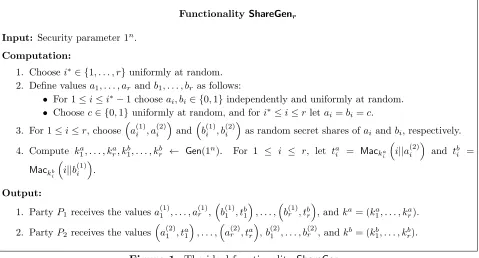
Eliminating the trusted third party. We eliminate the need for the trusted third party by rely-ing on apossibly unfairsub-protocol that securely computes with abort the functionalityShareGenr,
formally described in Figure 1. Such a protocol with a constant number of rounds can be constructed assuming the existence of oblivious transfer (see, for example, [31]). In addition, our protocol also relies on a one-time message authentication code (Gen,Mac,Vrfy) that is information-theoretically secure. The functionality ShareGenr provides the parties with authentication keys and
authenti-cation tags so each party can verify that the shares received from the other party were the ones generated byShareGenr in the pre-processing phase. A formal description of the protocol is provided
in Figure 2.
Functionality ShareGenr
Input: Security parameter 1n. Computation:
1. Choosei∗∈ {1, . . . , r} uniformly at random. 2. Define valuesa1, . . . , ar andb1, . . . , bras follows:
• For 1≤i≤i∗−1 chooseai, bi∈ {0,1} independently and uniformly at random. • Choosec∈ {0,1} uniformly at random, and fori∗≤i≤rletai=bi=c.
3. For 1≤i≤r, choose (
a(1)i , a(2)i )
and (
b(1)i , b(2)i )
as random secret shares ofai andbi, respectively.
4. Compute k1a, . . . , kar, k1b, . . . , kbr ← Gen(1n). For 1 ≤ i ≤ r, let tai = Macka i
( i||a(2)i
)
and tbi =
Mackb i
( i||b(1)i
) .
Output:
1. PartyP1receives the valuesa (1) 1 , . . . , a
(1) r ,
( b(1)1 , tb
1 )
, . . . , (
b(1)r , tbr
)
, and ka= (ka
1, . . . , kra).
2. PartyP2receives the values (
a(2)1 , ta 1 )
, . . . , (
a(2)r , tar
)
,b(2)1 , . . . , b(2)r , andkb= (k1b, . . . , krb).
Figure 1: The ideal functionality ShareGenr.
Protocol CoinFlipr
Joint input: Security parameter 1n. Preliminary phase:
1. PartiesP1 andP2 run protocolπfor computingShareGenr(1n) (see Figure 1).
2. IfP1 receives⊥from the above computation, it outputs a uniformly chosen bit and halts. Likewise, if P2 receives⊥it outputs a uniformly chosen bit and halts. Otherwise, the parties proceed.
3. Denote the output ofP1 fromπbya (1) 1 , . . . , a
(1) r ,
( b(1)1 , tb1
) , . . . ,
( b(1)r , tbr
)
, andka = (k1a, . . . , kar).
4. Denote the output ofP2 fromπby (
a(2)1 , ta 1 )
, . . . , (
a(2)r , tar
)
,b(2)1 , . . . , b(2)r , andkb= (k1b, . . . , kbr).
In each roundi= 1, . . . , r do: 1. P2 sends the next share toP1:
(a) P2 sends (
a(2)i , ta i
) toP1. (b) P1 receives
( ˆ a(2)i ,ˆta
i
)
from P2. IfVrfyka i
(
i||ˆa(2)i ,ˆta i
)
= 0 (or ifP1 received an invalid message or no message), thenP1 outputsai−1and halts (ifi= 1 it outputs a uniformly chosen bit). (c) If Vrfyka
i
(
i||ˆa(2)i ,ˆta i
)
= 1 thenP1 reconstructsaiusing the sharesa (1) i and ˆa
(2) i .
2. P1 sends the next share toP2: (a) P1 sends
( b(1)i , tb
i
) to P2. (b) P2 receives
( ˆ b(1)i ,ˆtb
i
)
from P1. If Vrfykb i
(
i||ˆb(1)i ,ˆtb i
)
= 0 (or if P2 received an invalid message or no message), thenP2 outputsbi−1 and halts (ifi= 1 it outputs a uniformly chosen bit).
(c) If Vrfykb i
(
i||ˆb(1)i ,ˆtb i
)
= 1 thenP2 reconstructsbi using the sharesb (1) i andb
(2) i
Output: P1andP2 outputarandbr, respectively.
Theorem 3.1. For any polynomial r=r(n), if protocolπ securely computes ShareGenr with abort,
then protocol CoinFlipr is 1/(2r)-secure.
Proof. We prove the (1/2r)-security of protocol CoinFlipr in a hybrid model where a trusted party for computing ShareGenr with abort is available. Using standard techniques (see [13]), it then
follows that when replacing the trusted party computingShareGenrwith a sub-protocol that security
computes ShareGenr with abort, the resulting protocol is 1/(2r)-secure.
Specifically, for every polynomial-time hybrid-model adversary A corrupting P1 and running
CoinFlipr in the hybrid model, we show that there exists a polynomial-time ideal-model adversary
S corrupting P1 in the ideal model with access to a trusted party computing the coin-flipping
functionality such that the statistical distance between these two executions is at most 1/(2r)+ν(n), for some negligible functionν(n). For simplicity, in the remainder of the proof we ignore the aspect of message authentication in the protocol, and assume that the only malicious behavior of the adversary A is early abort. This does not result in any loss of generality, since there is only a negligible probability of forging an authentication tag.
On input (1n,aux) the ideal-model adversarySinvokes the hybrid-model adversaryAon (1n,aux) and queries the trusted party computing the coin-flipping functionality to obtain a bitc. The ideal-model adversary S proceeds as follows:
1. S simulates the trusted party computing the ShareGenr functionality by sending A
indepen-dently and uniformly chosen shares a(1)1 , . . . , a(1)r , b1(1), . . . , b(1)r . If A aborts (i.e., if A sends
abort to the simulated ShareGenr after receiving the shares), then S outputs A’s output and
halts.
2. S chooses i∗ ∈ {1, . . . , r} uniformly at random.
3. In every roundi ∈ {1, . . . , i∗−1}, S chooses a random bit ai, and sends A the share a(2)i =
a(1)i ⊕ai. IfA aborts then S outputsA’s output and halts.
4. In every roundi∈ {i∗, . . . , r},S sendsAthe sharea(2)i∗+1=a (1)
i∗+1⊕c(recall thatcis the value
received from the trusted party computing the coin-flipping functionality). If A aborts then
S outputsA’s output and halts.
5. At the end of the protocolS outputsA’s output and halts.
We now consider the joint distribution ofA’s view and the output of the honest party P2 in the
ideal model and in the hybrid model. There are three cases to consider:
1. Aaborts before roundi∗. In this case the distributions are identical: in both models the view of the adversary is the sequence of shares, and the sequence of messages up to the round in whichA aborted, and the output ofP2 is a uniformly distributed bit which is independent of A’s view.
2. Aaborts in round i∗. In this caseA’s view is identical in both models, but the distributions ofP2’s output givenA’s view are not identical. In the ideal model,P2 outputs the random bit c that was revealed to A by S in round i∗ (recall that c is the bit received from the trusted party computing the coin-flipping functionality). In the hybrid model, however, the output of
P2 is the valuebi∗−1 which is a random bit that is independent ofA’s view. Thus, in this case
3. A aborts after round i∗ or does not abort. In this case the distributions are identical: the output ofP2 is the same random bit that was revealed to Ain round i∗.
Note that A’s view in the hybrid and ideal models is always identically distributed (no matter what strategyAuses to decide when to abort), and that the only difference is in the distribution of the honest party’s output conditioned onA’s view. Specifically, for any particular round ithe event in which the adversary aborts in roundioccurs with exactly the same probability in both models4. Thus, the above three cases imply that the statistical distance between the two distributions is at most 1/(2r).
Claim 3.2. In protocol CoinFlipr there exists an efficient adversarial party P1∗ that can bias the output of P2 by 1−2
−r 2r .
Proof. Consider the adversarial partyP1∗ that completes the pre-processing phase, and then halts in the first round i ∈ {1, . . . , r} for which ai = 0. We denote by Abort the random variable
corresponding to the round in whichP1∗ aborts, whereAbort=⊥ifP1∗ does not abort. In addition, we denote byc2 the random variable corresponding to the output bit ofP2. Notice that if P1∗ aborts
in roundj ≤i∗ thenP2 outputs a random bit, and ifP1∗ does not abort then P2 always outputs 1.
Therefore, for everyi∈ {1, . . . , r} it holds that
Pr [c2= 1 | i∗ =i] = i
∑
j=1
Pr [Abort=j | i∗ =i] Pr [c2 = 1 | Abort=j∧i∗=i]
+Pr [Abort=⊥ | i∗ =i] Pr [c2= 1 | Abort=⊥ ∧i∗ =i]
=
i
∑
j=1
Pr [a1 =· · ·=aj−1 = 1, aj = 0] Pr [c2 = 1 | Abort=j∧i∗ =i]
+Pr [a1 =· · ·=ai= 1] Pr [c2 = 1 | Abort=⊥ ∧i∗=i]
=
i
∑
j=1
1 2j ·
1
2 +
1 2i ·1
= 1
2 +
1 2i+1 .
This implies that
Pr [c2= 1] = r
∑
i=1
Pr [i∗ =i] Pr [c2= 1 | i∗ =i]
=
r
∑
i=1
1
r
( 1 2+
1 2i+1
)
= 1
2 +
1−2−r
2r .
4We state this explicitly because in some settings (that are inherently different from our setting), analyzing the
4 The Generalized Protocol
In this section we present a more refined and generalized protocol that settles Theorems 1.1 and 1.2. The improvements over the protocol presented in Section 3 are as follows:
Improved security guarantee: In the simplified protocol party P1 can bias the output of party P2 (by aborting in roundi∗), but partyP2 cannot not bias the output of partyP1. This is due
to the fact that party P1 always learns the output before party P2 does. In the generalized
protocol the party that learns the output before the other party is chosen uniformly at random (i.e., party P1 learns the output before party P2 with probability 1/2). This is achieved by
having the parties exchange a sequence of 2r values (a1, b1), . . . ,(a2r, b2r) (using the same
secret-sharing exchange technique as in the simplified protocol) with the following property: for odd values ofi, partyP1 learnsai before party P2 learnsbi, and for even values of iparty
P2 learns bi before partyP1 learnsai. Thus, partyP1 can bias the result only wheni∗ is odd,
and partyP2 can bias the result only when i∗ is even. The key point is that the parties can
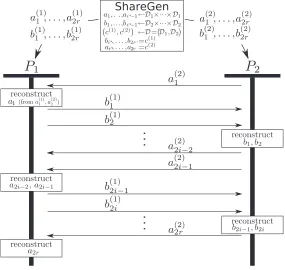
exchange the sequence of 2rshares in onlyr+ 1 rounds by combining some of their messages5. Figure 3 gives a graphic overview of the protocol.
We note that modifying the original protocol by just havingShareGen randomly choose which party starts would also halve the bias (since with probability 1/2 the adversary chooses a party that cannot bias the outcome at all). However, this is vulnerable to a trivial dynamic attack: the adversary decides which party to corrupt after seeing which party was chosen to start.
A larger class of functionalities: We consider the more general task of sampling from a distri-bution D= (D1,D2): party P1 receives a sample fromD1 and party P2 receives a correlated
sample from D2 (in coin-flipping, for example, the joint distribution D produces the val-ues (0,0) and (1,1) each with probability 1/2). Our generalized protocol can handle any polynomially-sampleable distributionD.
In the following we describe the generalized protocolSamplingr (Section 4.1), and then prove its security (Section 4.2).
4.1 Description of the Protocol
Joint input: Security parameter 1n, and a polynomially-sampleable distributionD= (D1,D2).
Preliminary phase:
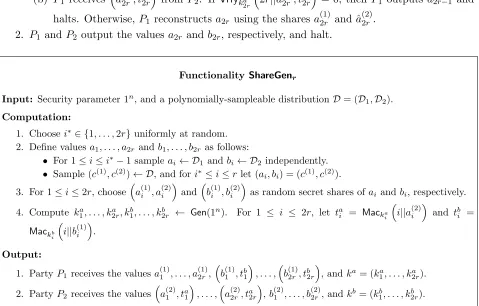
1. PartiesP1 and P2 run protocolπ for computingShareGenr(1n,D) (see Figure 4).
2. IfP1 receives⊥from the above computation, it outputs a random sample fromD1 and halts.
Likewise, if P2 receives ⊥ it outputs a random sample from D2 and halts. Otherwise, the
parties proceed.
3. Denote the output ofP1 from π by a(1)1 , . . . , a (1) 2r,
(
b(1)1 , tb1
)
, . . . ,
(
b(1)2r, tb2r
)
, andka1, . . . , ka2r.
4. Denote the output ofP2 from π by
(
a(2)1 , ta1
)
, . . . ,
(
a(2)2r, ta2r
)
,b(2)1 , . . . , b(2)2r, and k1b, . . . , k2br.
Figure 3: Overview of the generalized protocol
In round 1 do:
1. P2 sends a share toP1:
(a) P2 sends
(
a(2)1 , ta1
) toP1.
(b) P1 receives
( ˆ
a(2)1 ,ˆta1
)
from P2. If Vrfyka 1
(
1||aˆ(2)1 ,tˆa1
)
= 0, then P1 outputs a random
sample fromD1 and halts. Otherwise,P1 reconstructs a1 using the sharesa(1)1 and ˆa (2) 1 .
2. P1 sends a pair of shares toP2:
(a) P1 sends
(
b(1)1 , tb1
) and
(
b(1)2 , tb2
) toP2.
(b) P2 receives
( ˆ
b(1)1 ,tˆb1
) and
( ˆb(1)
2 ,ˆtb2
)
from P1. If Vrfykb 1
(
1||ˆb(1)1 ,ˆtb1
)
= 0, then P2 outputs
a random sample fromD2 and halts. Otherwise,P2 reconstructsb1 using the sharesb(1)1
andb(2)1 .
(c) If Vrfykb 2
(
2||ˆb(1)2 ,ˆtb2
)
= 0, then P2 outputs b1 and halts. Otherwise, P2 reconstructs b2
using the sharesb(1)2 and b(2)2 .
In each round j = 2, . . . , r do:
1. P2 sends a pair of shares toP1:
(a) P2 sends
(
a(2)2j−2, ta2j−2
) and
(
a(2)2j−1, ta2j−1
) toP1.
(b) P1receives
( ˆ
a(2)2j−2,tˆa2j−2
) and
( ˆ
a(2)2j−1,ˆta2j−1
)
fromP2. IfVrfyka 2j−2
(
2j−2||ˆa(2)2j−2,ˆta2j−2
(c) If Vrfyka 2j−1
(
2j−1||aˆ(2)2j−1,tˆa 2j−1
)
= 0, then P1 outputs a2j−2 and halts. Otherwise, P1
reconstructsa2j−1 using the sharesa(1)2j−1 and ˆa (2) 2j−1.
2. P1 sends a pair of shares toP2:
(a) P1 sends
(
b(1)2j−1, tb2j−1
) and
(
b(1)2j , tb2j
) toP2.
(b) P2 receives
( ˆ
b(1)2j−1,ˆtb2j−1
) and
( ˆb(1)
2j ,ˆtb2j
)
from P1. If Vrfykb 2j−1
(
2j−1||ˆb(1)2j−1,ˆtb2j−1
) = 0,
thenP2 outputsb2j−2 and halts. Otherwise, P2 reconstructsb2j−1 using the sharesb(1)2j−1
andb(2)2j−1.
(c) If Vrfykb 2j
(
2j||ˆb(1)2j ,ˆtb2j
)
= 0, then P2 outputsb2j−1 and halts. Otherwise,P2 reconstructs
b2j using the sharesb (1) 2j and b
(2) 2j .
In round r+ 1 do:
1. P2 sends a share toP1:
(a) P2 sends
(
a(2)2r, ta2r
) toP1.
(b) P1 receives
( ˆ
a(2)2r,ˆta2r
)
from P2. If Vrfyka 2r
(
2r||aˆ(2)2r,ˆta2r
)
= 0, then P1 outputs a2r−1 and
halts. Otherwise,P1 reconstructsa2r using the sharesa (1) 2r and ˆa
(2) 2r.
2. P1 and P2 output the valuesa2r and b2r, respectively, and halt.
Functionality ShareGenr
Input: Security parameter 1n, and a polynomially-sampleable distributionD= (D 1,D2). Computation:
1. Choosei∗∈ {1, . . . ,2r}uniformly at random. 2. Define valuesa1, . . . , a2r andb1, . . . , b2r as follows:
• For 1≤i≤i∗−1 sample ai ← D1 andbi ← D2 independently.
• Sample (c(1), c(2))← D, and for i∗≤i≤rlet (a
i, bi) = (c(1), c(2)).
3. For 1≤i≤2r, choose (
a(1)i , a(2)i )
and (
b(1)i , b(2)i )
as random secret shares ofaiand bi, respectively.
4. Compute ka1, . . . , k2ar, k1b, . . . , kb2r ← Gen(1n). For 1 ≤ i ≤ 2r, let tai = Macka i
( i||a(2)i
)
and tbi =
Mackb i
( i||b(1)i
) .
Output:
1. PartyP1receives the valuesa (1) 1 , . . . , a
(1) 2r,
( b(1)1 , tb
1 )
, . . . , (
b(1)2r, tb 2r
)
, and ka= (ka
1, . . . , k2ar).
2. PartyP2receives the values (
a(2)1 , ta 1 )
, . . . , (
a(2)2r, ta 2r
)
,b(2)1 , . . . , b(2)2r, andkb= (kb
1, . . . , kb2r).
Figure 4: The ideal functionality ShareGenr of the generalized two-party protocol.
4.2 Proof of Security
Theorem 4.1. For any polynomially-sampleable distributionD= (D1,D2)and polynomialr =r(n), if protocol π securely computes ShareGenr with abort, thenSamplingr is
SD(D,D1⊗D2)
2r -secure.
Proof. As in the proof of Theorem 3.1 we prove the security of the protocol in a hybrid model where a trusted party for computing ShareGenr with abort is available. For every polynomial-time
hybrid-model adversary A corrupting P1 and running Samplingr in the hybrid model, we show
that there exists a polynomial-time ideal-model adversary S corrupting P1 in the ideal model with
access to a trusted party that samples from Dsuch that the statistical distance between these two executions is at most SD(D,D1⊗D22r )+ν(n), for some negligible functionν(n). The proof for the case that P2 is corrupted is essentially identical, and therefore is omitted. For simplicity we ignore the
aspect of message authentication, and assume that the only malicious behavior ofAis early abort. This does not result in any loss of generality, since there is only a negligible probably of forging an authentication tag.
On input (1n,aux) the ideal-model adversarySinvokes the hybrid-model adversaryAon (1n,aux)
and queries the trusted party who sends to the parties a sample (c1, c2) drawn from the joint
distributionD= (D1,D2). At this pointS receives the valuec1 which was sent to the corruptedP1. S simulates the trusted party computing the ShareGenr functionality by sending A independently
and uniformly chosen shares a(1)1 , . . . , a(1)2r, b1(1), . . . , b(1)2r. If A aborts at this point then S outputs
A’s output and halts. Otherwise, S chooses i∗ ∈ {1, . . . ,2r} uniformly at random, and proceeds by sendingA shares a(2)1 , . . . , a(2)i∗+1 (in the order defined by the rounds of the protocol), where the
shares are defined as follows:
1. For everyi∈ {1, . . . , i∗−1},S samples a random ai← D1 and sets a(2)i =a (1) i ⊕ai.
2. For everyi≤ {i∗, . . . , r},S setsa(2)i∗ =a(1)i∗ ⊕c1 wherec1 is the value received from the trusted
party.
If at some point during the simulation Aaborts, thenS outputsA’s output and halts.
We now consider the joint distribution of the adversaries view and the output of the honest party
P2 in the ideal model and in the hybrid model, and show that the statistical distance between the
two distributions is as most SD(D,D12r⊗D2). As in the proof of Theorem 3.1, note that the adversary’s view is always identically distributed in both cases, and therefore we only need to consider the distribution ofP2’s output given the adversary’s view. There are two cases to consider, depending
on whetheri∗ is even or odd.
Case 1: i∗ = 2j∗ for some j∗ ∈ {1, . . . , r}. In this case P2 learns its output in roundj∗ and P1 learns its output in roundj∗+ 1, and we show that the two distributions are identical. There
are two cases to consider:
1. A aborts before round j∗+ 1. In both models if A aborts before round j∗+ 1 then he does not receive the sharea(2)i∗ =a(2)2j∗ since this share is sent by P2 only in roundj∗+ 1. Therefore, A’s view is independent ofP2’s output.
2. A aborts in roundj∗+ 1 or does not abort. In this case in both models A learns c1 and P2
outputsc2, where (c1, c2) are sampled from the joint distributionD= (D1,D2).
Case 2: i∗ = 2j∗−1 for some j∗ ∈ {1, . . . , r}. In this case both parties learn their outputs in round j∗ but P1 learns its output first. Informally, P1 can bias P2’s output only by aborting
in round j∗ after receiving P2’s message for this round. More formally, there are three cases to
1. Aaborts before roundj∗. In this case the distributions are identical: in both models the view of the adversary is the sequence of shares, and the sequence of messages up to the round in which A aborted, and the output of P2 is a random sample from D2 that is independent of A’s view.
2. Aaborts in roundj∗. In this caseA’s view is identical in both models, but the distributions of
P2’s output given A’s view are not identical. In the ideal model,P2 outputs the valuec2 that
is correlated to the value c1 that was revealed to A by S in round i∗ (i.e., (c1, c2) is sampled
from the joint distributionD= (D1,D2)). In the hybrid model, however, the output of P2 is
the value bi∗−1 which is a random sample from D2 that is independent of A’s view. Thus, in
this case the statistical distance between the two distributions is SD(D,D1 ⊗ D2). However, this case occurs with probability at most 1/2r since in both cases i∗ is odd with probability exactly 1/2 and is independent of A’s view until this round (that is, the probability that A aborts in roundj∗ is at most 1/r).
3. Aaborts in roundj∗+ 1 or does not abort. In this case the distribution are identical: in both modelsA learns c1 and P2 outputsc2, where (c1, c2) are sampled from the joint distribution D= (D1,D2).
This implies that the statistical distance between the two distributions is at most SD(D,2D1r⊗D2) and concludes the proof of the theorem.
We conclude this section by showing that Theorem 4.1 is tight for the coin-flipping functionality: there exists an efficient adversary that can bias the output of the honest party by essentially 1/(4r). This adversary is a natural generalization of the adversary presented at the end of Section 3.
Claim 4.2. In protocol Samplingr instantiated with the distribution D that outputs the values(0,0) and (1,1) each with probability 1/2, there exists an efficient adversarial party P1∗ that can bias the output of P2 by 1−2
−r 4r .
Proof. Consider the adversarial partyP1∗ that completes the pre-processing phase, and then halts in the first round j ∈ {1, . . . , r} for which a2j−1 = 0. We denote by Abort the random variable
corresponding to the round in whichP1∗ aborts, whereAbort=⊥ifP1∗ does not abort. In addition, we denote byc2 the random variable corresponding to the output bit ofP2. Notice that ifi∗ is even,
then P2 outputs 1 with probability 1/2. Now, suppose that i∗ = 2j∗−1 for some j∗ ∈ {1, . . . , r},
then there are two cases to consider:
Therefore, for everyj∗ ∈ {1, . . . , r} it holds that
Pr [c2 = 1 | i∗= 2j∗−1]
=
j∗
∑
j=1
Pr [Abort=j | i∗= 2j∗−1] Pr [c2= 1 | Abort=j∧i∗ = 2j∗−1]
+Pr [Abort=⊥ | i∗ = 2j∗−1] Pr [c2 = 1 | Abort=⊥ ∧i∗= 2j∗−1]
=
j∗
∑
j=1
Pr [a1 =· · ·=a2j−3= 1, a2j−1= 0] Pr [c2 = 1 | Abort=j∧i∗ = 2j∗−1]
+Pr [a1=· · ·=a2j∗−3=a2j∗−1= 1] Pr [c2 = 1 | Abort=⊥ ∧i∗ = 2j∗−1]
=
j∗
∑
j=1
1 2j ·
1 2+
1 2j∗ ·1
= 1
2 +
1 2j∗+1 .
This implies that
Pr [c2 = 1] = Pr [i∗ is even] Pr [c2 = 1 | i∗ is even]
+
r
∑
j∗=1
Pr [i∗= 2j∗−1] Pr [c2= 1 | i∗ = 2j∗−1]
= 1
2 · 1 2+
r
∑
j∗=1
1 2r
( 1
2 +
1 2j∗+1
)
= 1
2 +
1−2−r
4r .
5 Open Problems
Identifying the minimal computational assumptions. Blum’s coin-flipping protocol, as well as its generalization that guarantees bias of O(1/√r), can rely on the existence of any one-way function. We showed that the optimal trade-off between the round complexity and the bias can be achieved assuming the existence of oblivious transfer, a complete primitive for secure computation. A challenging problem is to either achieve the optimal bias based on seemingly weaker assumptions (e.g., one-way functions), or to demonstrate that oblivious transfer is in fact essential. Although meaningful progress was recently made in this direction for restricted black-box constructions by Dachman-Soled et al. [16, 17] (see Section 1.3), the general problem is still left open.
Efficient implementation. Our protocol uses a general secure computation step in the prepro-cessing phase. Although asymptotically optimal, the techniques used in general secure computation often have a large overhead. Hence, it would be helpful to find an efficient sub-protocol to compute theShareGenr functionality that can lead to a practical implementation.
The multiparty setting. Blum’s coin-flipping protocol can be extended to anm-partyr-round protocol that has biasO(m/√r), and several exciting results for restricted cases of the multi-party setting were recently achieved by Beimel, Omri and Orlov [7] and by Haitner and Tsfadia [24] (see Section 1.3). However, the general problem of identifying the optimal trade-off between the number of parties, the round complexity, and the bias is still left open.
References
[1] D. Aharonov, A. Ta-Shma, U. V. Vazirani, and A. C. Yao. Quantum bit escrow. InProceedings of the 32nd Annual ACM Symposium on Theory of Computing, pages 705–714, 2000.
[2] N. Alon and M. Naor. Coin-flipping games immune against linear-sized coalitions. SIAM Journal on Computing, 22(2):403–417, 1993.
[3] A. Ambainis. A new protocol and lower bounds for quantum coin flipping.Journal of Computer and System Sciences, 68(2):398–416, 2004.
[4] A. Ambainis, H. Buhrman, Y. Dodis, and H. Rohrig. Multiparty quantum coin flipping. In Proceedings of the 19th Annual IEEE Conference on Computational Complexity, pages 250–259, 2004.
[5] B. Averbuch, M. Blum, B. Chor, S. Goldwasser, and S. Micali. How to implement Bracha’s
O(logn) byzantine agreement algorithm. Manuscript, 1985.
[6] A. Beimel, Y. Lindell, E. Omri, and I. Orlov. 1/p-secure multiparty computation without honest majority and the best of both worlds. InAdvances in Cryptology – CRYPTO ’11, pages 277–296, 2011.
[7] A. Beimel, E. Omri, and I. Orlov. Protocols for multiparty coin toss with dishonest majority. In Advances in Cryptology – CRYPTO ’10, pages 538–557, 2010.
[8] M. Bellare and P. Rogaway. Code-based game-playing proofs and the
secu-rity of triple encryption. Cryptology ePrint Archive, Report 2004/331, 2004.
http://eprint.iacr.org/2004/331.pdf.
[9] M. Ben-Or, S. Goldwasser, and A. Wigderson. Completeness theorems for non-cryptographic fault-tolerant distributed computation. InProceedings of the 20th Annual ACM Symposium on Theory of Computing, pages 1–10, 1988.
[10] M. Ben-Or and N. Linial. Collective coin flipping. Advances in Computing Research: Random-ness and Computation, 5:91–115, 1989.