Available Online at www.ijcsmc.com
International Journal of Computer Science and Mobile Computing
A Monthly Journal of Computer Science and Information Technology
ISSN 2320–088X
IMPACT FACTOR: 6.017
IJCSMC, Vol. 8, Issue. 1, January 2019, pg.80 – 90
Web Based Resource
Management System Application
Glean Likis Mamengko
1, Riad Sahara, S.SI., MT
21,2
Faculty of Computer Science, Mercu Buana University, Indonesia
1
[email protected]; 2 [email protected]
Abstract— Service Management or well known as Event Organizer is an organisation or a group of people that are working on managing an event in order to make an organize event that already planned, a good management is needed by this organisation, unfortunately in this high technology era, this company haven’t utilize any technology to support human resource management. Because of it, this application is developed in order to support this organization to manage their human resource. This application inspired by Tibrewala, Philippe & Browne as its based. This application itself hopefully will give a better performance & value to the organization especially by an addition of report generator tools that help the organisation to evaluate their member performance by reviewing their working hours.
Keywords– Management, Human Resource, Reporting
I. INTRODUCTION
A. Research Problems
Based on the background described above, then the outline of the problem is:
1. How to generate a highly accurate schedule based on the criteria “1 day on duty & 1 day off”?
2. How to assign a resource into a very specific role in every event?
3. How to create a reporting tools that can generate a resource performance report in a certain period or condition?
4. How to record and manage changes historical on the system accurately?
B. Limitation of Research
In order for the research to be conducted is not too widespread, there are limits to this research:
1. The application “Resource Management System” are created for Service Management Organization.
2. There is three level function that we create in term of work flow which is Service Assistant, Service Director & Resource Manager / Department Head.
3. This application are created using web version in order to give the user flexibility to access this application
4. The developer only use PHP, SQL & XAMPP to build & maintain this application
C. Objectives & Benefit
The expected goal of this research are :
1. This application hopefully will give a better process in order to scheduling resources and assign the right people int the right role.
2. Additional tools that offered in this tool (Report Generator) would give the organization a better tool to generate resource performance in certain period in order to develop its own resource capability.
3. As a good application need a good historical record, hopefully this application can manage any record and changes that happen over the application so the data that shows is accurate.
And the benefits of this research are:
1. By the research and developing this application, we are hoping that this application can bring an efficiency int term of scheduling process, so by the process a reliable system & technology will decrease the time usage just to organize everyone schedule. 2. By using this application, it will give an additional value compare to others similar
organization that still rely on human capability to make an arrangement.
3. With this application, everyone can involve and get a better clarity also comfortable when they use this application since everyone can see the update real time and also the historical of any changes.
II. STUDYOFLITERATURE
A. Previous Research
several category which is a group of people who are taking an off every first & second day, the other are in second and third day and the rest is third and fourth. By using this criteria, TBP algorithm are capable to generate a precise scheduling of every certain period.
Next, according to Suseno & Efaoga Dhuha [2], “Three Shift Employee Scheduling Using TBP Algorithm”. In their research over the manufacturing company, they are found an issue that comparing an active & fully function machine that operate in the factory compare to the employee schedule that operate the machine is not even. By that case they are trying to create and develop a tool that able to manage the scheduling of the employee. The goal is to assign and divide the qualified employee schedule compare to their expertise and by using TBP Algorithm, it helps and success to generate a better scheduling to accommodate the active machine that operate in the factory.
After that, according to Nico R. M. Kyngäs, Kimmo J. Nurmi, and Jari R. Kyngäs [3], “The Workforce Scheduling Process Using the PEAST Algorithm”. They are finding that it is difficult and time consuming problem that every company or institution that has employees working on shifts or on irregular working days must solve. The workforce scheduling problem has a fairly broad definition. Most of the studies focus on assigning employees to shifts and their starting time, so they are using PEAST Algorithm to solve the issue. The usefulness of an algorithm depends on several criteria. The two most important are the quality of the generated solutions and the algorithmic power of the algorithm. We can steadily note that our PEAST algorithm realizes these criteria. It has been used to solve the time tabling problem and also scheduling problem..
The fourth, according to Jose M. Framinan a, Rubén Ruiz b [4], “Architecture of manufacturing scheduling systems: Literature review and an integrated proposal”. While the literature on manufacturing scheduling models and solution procedures is extensive, very little has been written on how to bring these models and procedures into practice. This has given rise to the so-called „„gap” between the theory and practice of scheduling, which has been widely documented in several studies, such as e.g., Ford et al., McKay et al., Olhager and Rapp, Graves, Dudek et al. and McKay et al.. In a quantitative study about scheduling research carried out by Reisman et al from a total of 184 reviewed papers, only 5 (less than a 3%) dealt with realistic production settings. In order to close this gap between scheduling models and procedures, and their implementation in a real manufacturing setting, the former should be translated into a system supporting scheduling decisions in a company, i.e., a piece of software with a number of functions to support scheduling. This implies carrying out a software development process to obtain a final product, i.e., a scheduling system at work. In such software development process, there are a number of technical, human and organisational issues which are critical and should be adequately managed to ensure a successful result.
and complex problems and even more difficult to determine optimal solutions that minimise costs, meet employee preferences, distribute shifts equitably among employees and satisfy all the workplace constraints. As a result of changing work environments and conditions, it is likely that rostering algorithms will need to be more general in the future. Given the resulting flexibility that will be required of the algorithms, it is likely that we will see a more integrated approach to roster solution developments. For example, it will be necessary to consider integrated solution frameworks that include CP, heuristic search, integer programming and simulation approaches to solve a multitude of subproblems within the context of solving the complex rostering problems of the future.
III.RESEARCHMETHODS
A. Business Process Running
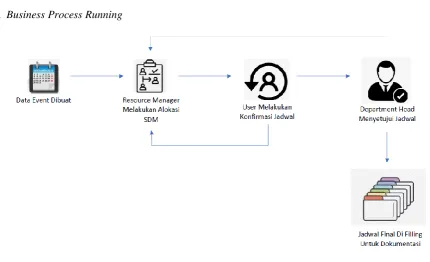
Figure 1 Business Process Running
Describing the current business process, resource manager create an event data over the system, and after that they are assigning the person manually one by one, once resource manager complete assigning a person for each event, he/she will blast the schedule over email, waiting them to confirm the schedule. Once the schedule confirm by the person, it will go directly to the department head for an approval, once the approval gained, it will be save the archive for filling [6].
B. Developing using prototype method
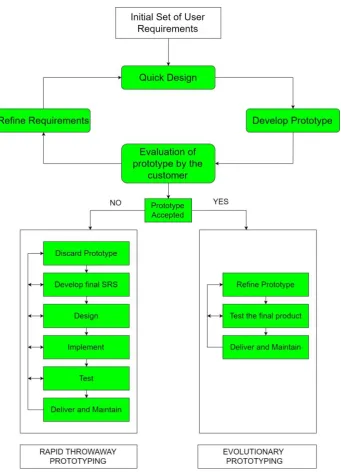
In this process model, the system is partially implemented before or during the analysis phase thereby giving the customers an opportunity to see the product early in the life cycle. The process starts by interviewing the customers and developing the incomplete high-level paper model. This document is used to build the initial prototype supporting only the basic functionality as desired by the customer. Once the customer figures out the problems, the prototype is further refined to eliminate them. The process continues till the user approves the prototype and finds the working model to be satisfactory [8].
1. Rapid Throwaway Prototyping –
This technique offers a useful method of exploring ideas and getting customer feedback for each of them. In this method, a developed prototype need not necessarily be a part of the ultimately accepted prototype. Customer feedback helps in preventing unnecessary design faults and hence, the final prototype developed is of a better quality.
2. Evolutionary Prototyping –
In this method, the prototype developed initially is incrementally refined on the basis of customer feedback till it finally gets accepted. In comparison to Rapid Throwaway Prototyping, it offers a better approach which saves time as well as effort. This is because developing a prototype from scratch for every iteration of the process can sometimes be very frustrating for the developers.
Advantages –
The customers get to see the partial product early in the life cycle. This ensures a greater level of customer satisfaction and comfort.
New requirements can be easily accommodated as there is scope for refinement.
Missing functionalities can be easily figured out.
Errors can be detected much earlier thereby saving a lot of effort and cost, besides enhancing the quality of the software.
The developed prototype can be reused by the developer for more complicated projects in the future.
Flexibility in design.
Disadvantages –
Costly w.r.t time as well as money.
There may be too much variation in requirements each time the prototype is evaluated by the customer.
Poor Documentation due to continuously changing customer requirements.
It is very difficult for the developers to accommodate all the changes demanded by the customer.
There is uncertainty in determining the number of iterations that would be required before the prototype is finally accepted by the customer.
After seeing an early prototype, the customers sometimes demand the actual product to be delivered soon.
Use –
Figure 2 Prototype Development Flow
C. Use Case Diagram
Use case diagrams are in fact twofold - they are both behaviour diagrams, because they describe behaviour of the system, and they are also structure diagrams - as a special case of class diagrams where classifiers are restricted to be either actors or use cases related to each other with associations. moved use cases out of behaviour modelling to UML supplementary concepts. So, it is an unfortunate quandary what kind of UML diagrams use case diagrams are. While support for business modelling was declared as one of the goals of the UML, UML specification provides no notation specific to business needs.
Business use cases were introduced in Rational Unified Process (RUP) to represent business function, process, or activity performed in the modelled business. A business actor represents a role played by some person or system external to the modelled business, and interacting with the business. Business use case should produce a result of observable value to a business actor.
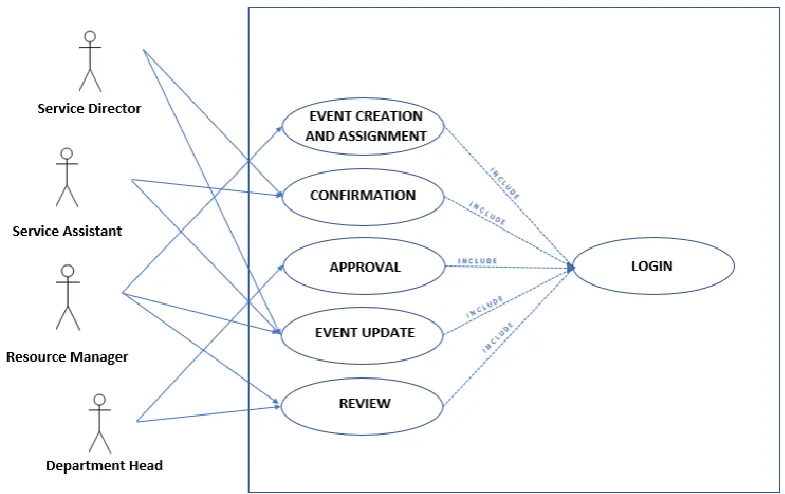
Major elements of the business use case diagram are shown on the picture below. Note again, both business use case as well as business actor are not defined in UML standard, so you will either need to use some UML tool supporting those or create your own business modelling stereotypes.
Figure 3 Use Case Diagram
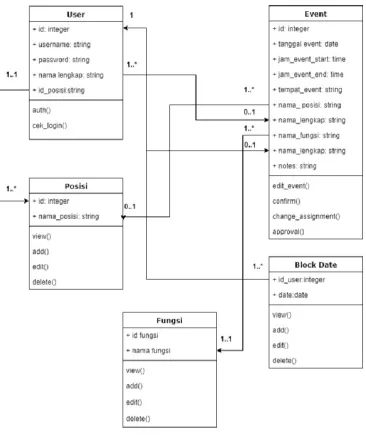
D. Proposed Class Diagram
Figure 4 Proposed Class Diagram
IV.RESULT AND DISCUSSION
A. IMPLEMENTATION
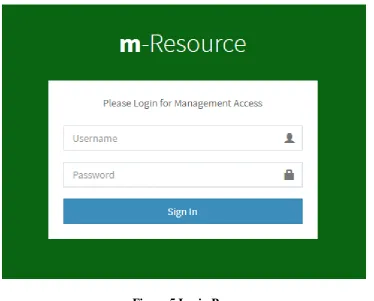
Figure 5 Login Page
Figure 5 is the login page display. This login page is like a gate that every user must pass before entering system. Each user enters a username and password that is in accordance with the data provided by the admin. In this page if the user incorrectly entered their credential, this login page will display a pop-up that failed to login and can't enter the application.
Figure 6 display several functions of the application. Some feature might not applicable for some user based on their clearance. From this display as administrator, user can control each of function based on request from the authorize user.
B. APPLICATION TESTING
Testing this application uses the Black Box Testing method, which focuses on the functional requirements of the software. Tests are carried out by running the Application. After the application is run, then we will run a test of all function contained in the application interface whether in accordance with the initial design stage. The following is a table of test scenarios:
No Tested Interface Testing Scenario Expected Result Result
1 Login (SA, SD, RM & DH)
Input username & password
User able to login based on their own credential
User successfully login to the application using their own credential 2 Login (SA, SD, RM &
DH)
Input wrong username & password
Invalid user credential will be denied by system
System denied the access and show invalid credential message
3 Add Reserved Date
User choose the date that want to be marked as blocked day
System will save the reservation date in the database
Reservation date are saved in the database
4 Confirm Assignment
User trying to accept the assignment that assign to a user
Confirmation will be saved in the database
System able to save the confirmation
successfully 5 Change Your
Assignment
User will appoint new person for an
assignment
System will replace the assign user to the new one
System showed an update assign user
6 Input Notes User add some notes into the event detail
Notes saved into the database
Notes are successfully saved
7 Everyone schedule User trying to see everyone schedule
System will generate a report of everyone schedule
Schedule report generated by system
8 Scheduled Event
Trying to see the see upcoming event schedule
System will generate all upcoming event listed on the database
System successfully showing an upcoming list
9 Create an Event Resource Manager create new event
New event created and saved on database
New event successfully created and saved
10 Report Generator User trying to generate a worktime report
System showing a report based on a criteria
Report has been generated successfully
11 Create a User Admin add a new user New user created on the system
V. CONCLUSIONS
With the implementation of the Resource Management Application, it can be concluded as follows:
1. This application will become more reliable due to it is web base application that everyone can access it through any device and platform.
2. This application help the organization to manage their resources by increase the efficiency of scheduling.
3. Report generator tool that provided within this application also helping this organization to improve their resource performance by manage and keep track of their resource activity and performance.
4. All log activity as creation, change assignment and update event data are saved into the system so it will help to avoid misunderstanding or inaccurate information.
5. This tool allow each resources to check and manage their schedule in the middle of tight schedule environment.
References
[1] D. S. a. L. Milana, “Perancangan dan Pembuatan Aplikasi Penyusunan Jadwal Kerja Dinas Jaga Perawat IGD Menggunakan Algoritma TPB,” Metris, vol. 16, pp. 29-34, 2015. [2] S. a. D. Efaoga, “Penjadwalan Tenaga Kerja untuk Tiga Shift Kerja dengan
Pengembangan Metode Algoritma Tibrewala, Philippe dan Browne,” PP, vol. 1, pp. 13 - 34, 2017.
[3] K. J. N. a. J. R. K. N. R. M. Kyngäs, “Workforce scheduling using the PEAST algorithm,” Lect. Notes Electr. Eng, vol. 275, pp. 359 - 372, 2014.
[4] J. M. F. a. R. Ruiz, “Architecture of manufacturing scheduling systems: Literature review and an integrated proposal,” Eur. J. Oper. Res, vol. 205, pp. 237 - 246, 2010.
[5] H. J. M. K. a. D. S. A. T. Ernst, “Staff scheduling and rostering: A review of applications, methods and models,” Eur. J. Oper. Res, vol. 153, pp. 3 - 27, 2004.
[6] A. Z. R. Alfrerio Risvan Effriandi, “Rancang bangun aplikasi penjadwalan shift kerja lembur menggunakan algoritma ant colony optimization (studi kasus : pusri 1b),” Ranc. bangun Apl. penjadwalan shift kerja lembur menggunakan Algoritm. ant colony Optim,” vol. 1, pp. 1 - 12, 2010.
[7] I. R. a. R. Sahara, “Analytical Hierarchy Process Algorithm Approach for Determining Best Employee,” Int. J. Comput. Sci. Mob. Comput, vol. 6, pp. 59 - 64, 2017.