Available online:
https://edupediapublications.org/journals/index.php/IJR/
P a g e | 1792Reducing On-line Video Replication Problems in Content Delivery
Networks by Using Adaptive Data Placement Scheme
S.Divya & E.Krishnaveni Reddy
1M.Tech Student, Department of CSE, Sridevi Women’s Engineering College, Village Vattinagulapally, MandalRajendra
Nagar,DistRangareddy, Telangana, India.
2Associate Professor, Department of CSE, Sridevi Women’s Engineering College, Village Vattinagulapally, MandalRajendra
Nagar,DistRangareddy, Telangana, India.
ABSTRACT— Content Delivery Networks have been widely
implemented to provide scalable cloud services. The Content
Delivery Networks (CDNs) are suffering with the
resource-saving video placement problem. Examines on-line video
replication and placement problems in Content delivery
networks an efficient video provisioning scheme should
simultaneously utilize system resources to reduce total energy
consumption and limit replication overhead. Tend to propose
a scheme known as Adaptive Data Placement (ADP) scheme
that may dynamically place & reorganize video replicas
among cache servers on subscribers’ arrival and departure.
Both the analyses and simulation results show that adaptive
information placement will reduce the number of activated
cache servers with restricted replication overhead.
Additionally, adaptive information placements performance is
approximate to the optimal solution and also the proposed
ADP scheme can achieve the more resource utilization on
content delivery networks.
I. INDTROUCTION
Unstable development of the requests for online
video streaming administrations, video specialist organizations
confront huge administration issues on the system framework
and figuring assets. As detailed, the overall video streaming
movement will involve roughly 69% of the aggregate
worldwide system activity in 2017. In this manner, the video
information is turning into the "greatest" enormous
information that adds to a gigantic measure of IT ventures, for
example, systems administration, stockpiling and figuring.
Furthermore, online ongoing video streaming administrations,
for example, web based conferencing, live TV and video visit
have been developing quickly as the most critical interactive
media applications. In this allude the transcoding
asdministrations that transcode live video information from
source inside a short deferral as online video transcoding.
Earlier work in server farm asset administration is
centered around putting one kind of asset at once: e.g., setting
stockpiling necessities expecting work calculation area is
settled or putting calculation prerequisites accepting
employment stockpiling area is settled. Uneven position
techniques can't reasonably exploit the vicinities and
heterogeneities that exist in current server farms. For instance,
a database examination application requiring high throughput
between its calculation and capacity components can profit by
being set on a capacity hub that has an adjacent accessible
calculation hub.
Available online:
https://edupediapublications.org/journals/index.php/IJR/
P a g e | 1793applications make developing interest for superior processing
foundations. This has prompted the development of substantial
scale processing server farms expending colossal measures of
electrical power. Regardless of the upgrades in vitality
effectiveness of the equipment, general vitality utilization
keeps on becoming because of expanding necessities for
processing assets. Aside from the staggering operational costs,
fabricating a server farm prompts extreme foundation costs as
server farms are typically worked to serve occasional pinnacle
loads bringing about low normal usage of the assets. In
addition, there are other critical issues that emerge from high
power utilization. Deficient or breaking down cooling
framework can prompt overheating of the assets decreasing
framework unwavering quality and gadgets lifetime. Various
practices can be connected to accomplish vitality proficiency,
for example, change of utilizations calculations, vitality
productive equipment, Dynamic Voltage and Frequency
Scaling (DVFS), terminal servers and thin customers, and
virtualization of PC assets.
The utilization of video streams displays solid every
day designs, with a huge top amid "prime time" hours. From a
system administrator's point of view, not just video streaming
will expend a great deal of system assets, it will likewise
require over provisioning the system for a pinnacle use that is
significantly higher than the normal, bringing about a
considerable measure of unused limit with regards to more
often than not. Video streams utilizing Dynamic Adaptive
Streaming over HTTP (DASH) or identical (Apple HLS,
Adobe HDS, and so on) display some generally particular
properties. (I) Video streams are seemingly perpetual,
extending from a couple of minutes for some YouTube clasps
to over a hour for some Netflix motion pictures; (ii) Video
streams are normally depicted in a show at the beginning of
the association, along these lines it is conceivable to know the
semantics of the stream early; (iii) Video streams are
unsurprising as in the grouping of bundles is foreordained by
the video stream's portrayal and the system conditions. Many
view a tremendous volume of movement focused over a
moderately brief time of the day as an issue. Would like to
show the properties of the video requests can be utilized
further bolstering our good fortune. Guarantee that it is
conceivable to time-move a critical portion of the activity on
the system amid prime-time by pre-getting the video streams
which would be downloaded from the server amid the
pinnacle hour to a server at the edge of the system when the
stream begins. The minimal cost for the system administrator
to pre-get movement is near zero in the event that it is utilizing
vacant limit. In the event that prefetching however includes
activity onto the system amid time of blockage, it compounds
the situation. Consequently, proposed to screen the system
clog, and to make the pre-getting of movement restrictive on
the measure of activity as of now in the system.
II. RELATED WORK
Early work in vitality aware resource administration
is given to cell phones with the goal of enhancing battery
lifetime. Later on, the setting has been moved to server farms
and virtual registering conditions, for example, Clouds.
Nathuji and Schwan have proposed a design of
vitality administration framework for virtualized server farms
where asset administration is partitioned into neighborhood
and worldwide approaches. On the neighborhood level, the
framework use visitor working framework's energy
administration procedures. Combination of VMs is dealt with
by worldwide approaches applying live movement to
reallocate VMs. Nonetheless, the worldwide arrangements are
not examined in detail considering QOS necessities.
Interestingly, our work concentrates on worldwide VM
assignment strategies considering strict SLA.
Available online:
https://edupediapublications.org/journals/index.php/IJR/
P a g e | 1794which will each reduce the number of switches and improve
transmission efficiency. In routing ways are projected among
different datacenters of a CDN, thereby lowering carbon
footprints and electricity costs and fulfilling users’ service
necessities as a result of we tend to specialize in local CDNs
wherever CSs are situated within the same place, routing
between CSs and datacenters was not the most concern.
Analysis has additionally investigated energy and resource
saving in CDNs. In user requests were classified into different
categories. To reduce operational prices, the routes of users
were established supported the loading and energy costs of
each cesium. The present study examined a CDN whose CSs
are remotely distributed and, thus, faces different challenges
and problems. Some studies have centered on reducing the
quantity of activated servers in native CDNs and have had
objectives the same as those of our study. The schemes
projected in situ every “workload” among servers supported servers’ “degrees of loading.” equally; the method projected in
allocates heavier workloads to servers with fewer resources to
improve resource utilization. This work models the location
problem as the traditional “1-D bin-packing” problem and
does not consider the multiple resources (for example band
breadth and storage space) of every cesium. This kind of
modeling fails to resolve our placement drawback, even once
generalized to multiple-dimension bin-packing, as a result of it
assumes every subscription has independent storage
necessities. In a very new technique referred to as CPA was
projected, that separates CSs into two groups: computation
servers and data servers. Under CPA, the requested services
are processed on the computation servers, wherever because
the data is hold on the info servers. This work additionally has
different assumptions and so cannot be adapted to video
stream provisioning. In capability management schemes for
information centers were mentioned. By activating the suitable
range of servers at the suitable time, there sponge time and
power consumption of the data-center is reduced. In an
analytical model was projected for balancing throughput
performance and power consumption. However, these works
have centered on the management of all-purpose machines
that serve user requests independently. They do not apply the
particular properties of video-on demand requests, like
combinatory space needs, as we tend to mentioned.
III. FRAME WORK
To achieve high resource utilization, our proposed
scheme, adaptive data placement, follows three principles: It
maintains only one OPS server in a system to enable most CSs
to achieve at least one aspect i.e., bandwidth or space of full
utilization; it maintains the exclusiveness of video clips i.e.,
allows at most one replica for each clip among the OPS and
SPF servers to improve space efficiency, which we
demonstrate in the next section; and it conducts less physical
replication to limit overhead. To increase the readability of the
pseudo code, the updating processes of the following variables
are not contained in the details of adaptive data placement
these parameters can be updated based on their definitions
after a subscription is added to or removed from a CS. The
only exception is OPS, which adaptive data placement must
determine and change during execution. Adaptive data
placement is composed of two main functions: ARRIVE and
DEPART, which are respectively executed when a
subscription enters and leaves a system. They are detailed in
Subsection A. Additional procedures required by DEPART
are detailed in Subsection B. Notably, in the primitive version
of adaptive data placement, also considered a periodical
readjustment and redistribution process, which periodically
swaps subscriptions between BWF and SPF servers to
increase the “production” of FUL servers. However, this
process yields heavy migration overhead and saves few
resources. Therefore, removed this part from the final version.
Available online:
https://edupediapublications.org/journals/index.php/IJR/
P a g e | 1795challenges of Content delivery networks. In several feasibility
concerns of using virtual machines, including reliability,
performance interference, and resource contention, has been
discussed. Traditional resource management studies have
placed files among a fixed number of servers and focused on
goals such as fulfilling users’ bandwidth requirement or
optimizing server use. In a file placement scheme was
proposed for balancing the loading of hard drives in servers.
Moreover, in an approach was designed to allocate video files
among multiple servers. This approach balances the load and
reduces the failure rate of services by deciding the number of
video replicas based on server number, video length, and
encoding rate. Under similar modeling, a genetic algorithm
was proposed in the discussed methods are based on different
assumptions that is fixed number of servers and objectives
load-balancing and are thus not suitable for solving our replica
placement problem. Some researchers have studied the inner
routing between servers or datacenters inside a Content
delivery networks. In using Content delivery networks to
conduct video conferences was discussed. Examined server
grouping and proposed a scheme that can both reduce the
number of switches and improve transmission efficiency.
Routing methods have been proposed among different
datacenters of a Content delivery networks, thereby lowering
carbon footprints and electricity costs and fulfilling users’
service requirements. Because focus on local Content delivery
networks where CSs are located in the same place, routing
between CSs and datacenters was not the main concern.
Research has also investigated energy and resource saving in
Content delivery networks. User requests were categorized
into different classes. To reduce operational costs, the routes
of users were established based on the loading and energy
costs of each CS. The current study examined a Content
delivery networks who’s CSs are remotely distributed and,
thus, faces different challenges and issues. Some studies have
focused on reducing the number of activated servers in local
Content delivery networks and have had objectives similar to
those of our study. The schemes proposed in each “workload”
among servers based on servers’ “degrees of loading.”
Similarly, the method proposed allocates heavier workloads to
servers with fewer resources to improve resource utilization.
This work models the placement problem as the traditional
“1-D bin-packing” problem and does not consider the multiple
resources for example bandwidth and storage space of each
CS. This type of modeling fails to solve our placement
problem, even when generalized to multiple-dimension
bin-packing, because it assumes each subscription has independent
storage requirements. A new method called CPA was
proposed, which separates CSs into two groups: computation
servers and data servers. Under CPA, the requested services
are processed on the computation servers, whereas the data is
stored on the data servers. This work also has different
assumptions and thus cannot be adapted to Video stream
provisioning. Capacity management schemes for data centers
were discussed. By activating the appropriate number of
servers at the appropriate time, there sponge time and power
consumption of the data-center can be reduced. In an
analytical model was proposed for balancing throughput
performance and power consumption. However, these works
have focused on the management of general-purpose machines
that serve user requests independently. They do not apply the
specific properties of video-on demand requests, such as
combinable space requirements, as we mentioned.
IV. EXPERIMENTAL RESULTS
In experiments, need to get the CSs from backup
database and these CSs are having Video files after that run
the ADP (Adaptive Data Placement) server in that ADP
(Adaptive Data Placement) server displays the how many CSs
are available in the system and also it displays how many
Available online:
https://edupediapublications.org/journals/index.php/IJR/
P a g e | 1796the user start the simulation. It will send the request by the 10
users to the CSs these 10 users are created by randomly. Here
3 CSs are get request from the 10 users and CSs are providing
the videos for users the ADP (Adaptive Data Placement)
server.
Fig 1: ADP Server
The ADP server will display the status of the users
request arrival or assigning and depart from CSs here users
depart from CSs in after completion of their file downloading
the downloaded video files are stored in users folder to view
the performance graph in the ADP(Adaptive Data Placement)
server to seen in below chart
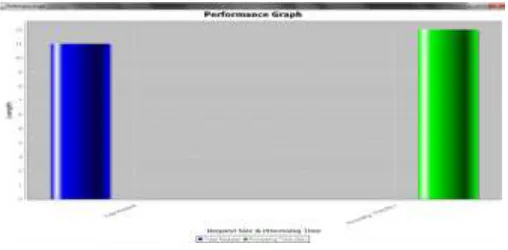
Fig 2: ADP server performance chart
ADP (Adaptive Data Placement) server performance
chart to see the Processing Time is higher than the Total
Request. Through our implementation can send the Video files
save the network bandwidth at lower cost then compare to
current techniques.
V.CONCLUSION
Presented an Adaptive Data Placement (ADP)
scheme to overcome the resource-saving video placement
problem on content delivery networks. The proposed ADP
scheme has two advantages: (i) the worstcase execution
distinction amongst ADP & the ideal arrangement can be
ensured, & (ii) the replication overhead on every entry or
flight of a guest is constrained. Since ADP depends on basic
suspicions, it can be connected to different sorts of CDNs to
enhance their asset and power productivity. From the
experimental results, proved that the proposed scheme
significantly outperforms compared with other existing
schemes and the proposed ADP scheme can improve the
resource efficiency along with limited replication overhead.
REFERENCES
[1] Y. Feng and B. Li, “Airlift: Video conferencing as a cloud
service using inter-datacenter networks,” in Proc. IEEE
Int. Conf. Netw. Protocols, 2012.
[2] X. Meng, V. Pappas, and L. Zhang, “Improving the
scalability of data center networks with traffic-aware
virtual machine placement,” in Proc. IEEE INFOCOM,
2010, pp. 1–9.
[3] P. X. Gao, A. R. Curtis, B. Wong, and S. Keshav, “It’s
not easy being green,” in Proc. ACM SIGCOMM, 2012,
pp. 211–222.
[4] Z. Zhou, F. Liu, Y. Xu, R. Zou, H. Xu, J. C. S. Liu, and
H. Jin, “Carbon-aware load balancing for geo-distributed cloud services,” in Proc. IEEE Modeling, Anal.
Available online:
https://edupediapublications.org/journals/index.php/IJR/
P a g e | 1797[5] H. Xu and B. Li, “Cost efficient datacenter selection for
cloud services,” in Proc. IEEE Int. Conf. Commun. China,
2012, pp. 51–56.
[6] P. Gill, M. Arlitt, Z. Li, and A. Mahanti, “YouTube traffic
characterization: A view from the edge,” in Proc. ACM
Internet Measurement Conf., 2007, pp. 15–28.
[7] L. Tsai and W. Liao, “Cost-aware workload consolidation
in green cloud datacenter,” in Proc. IEEE CLOUDNET,
2012, pp. 29–34.
[8] L. A. Barroso and U. Holzle, “The case for
energy-proportional computing, ”IEEE Comput., vol. 40, no. 12,
pp. 33–37, 2007.
[9] P. Bohrer, E. N. Elnozahy, T. Keller, M. Kistler, C.
Lefurgy, C. McDowell, and R. Rajamony, “The case for power management in web servers, ”Power Aware
Computing. Kluwer Academic Publishers, pp. 261–289,
2002.
[10]B. Li, T. Wo, Q. Li, and L. Zhong, “EnaCloud: An
energy-saving application live placement approach for
cloud computing environments,” in Proc. IEEE CLOUD,