ISSN(Online): 2319-8753 ISSN (Print): 2347-6710
I
nternational
J
ournal of
I
nnovative
R
esearch in
S
cience,
E
ngineering and
T
echnology
(An ISO 3297: 2007 Certified Organization)
Website: www.ijirset.com Vol. 6, Issue 9, September 2017
Improving Resource Efficiency and Power
Efficiency in Content Delivery Networks
V.Uma Rani1, Dr. B.Sateesh Kumar2, P.Sreeja3
Associate Professor, School of Information Technology (JNTUH), Kukatpally, District Medchal, Telangana, India1
Associate Professor, JNTUH College of Engineering, Jagitial, District Karimnagar, Telangana, India2
M.Tech Scholar, School of Information Technology (JNTUH), Kukatpally, District Medchal, Telangana, India3
ABSTRACT: Content Delivery Networks CDN’s improves your internet sites load time by taking your whole sites media (pictures, song, and so forth.) and distributing it to a worldwide caching network. When a tourist reaches your CDN-enabled web sites they will receive the basic factors (text, framework code, and so on.) out of your server as usual, but all of the media can be dealt with by using the CDNs global community of caching servers (additionally referred to as anodes).Content supply networks (CDNs) were greatly carried out to furnish scalable cloud offerings. Such networks help resource pooling with the aid of enabling virtual machines or physical servers to be dynamically activated and deactivated in line withcurrent consumer demand. This paper examines on-line video replication and placement issues in CDNs. A strong video provisioning scheme has got to concurrently (i) utilize method resources to scale back total power consumption and (ii) limit replication overhead. We advise a scheme referred to as adaptive data placement (ADP) that may dynamically position and reorganize video replicas amongst cache servers on subscriber’s arrival and departure. Both the analysis and simulation results exhibit that ADP can cut back the quantity of activated cache servers with confined replication overhead. Furthermore, Adapts performance is approximate to the foremost answer.
I. INTRODUCTION
A content material delivery neighborhood may be a geographically dispersed network of proxy servers and their understanding facilities. The goal is to distribute carrier spatially relative to finish-patrons to provide immoderate handiness and immoderate potency. CDNs serve an giant component to the net content material in presently, as good as web objects (text, snap shots and scripts), downloadable objects (media records, utility, files), functions(ecommerce, portals), reside streaming media, on demand streaming media, and social networks.
The interval of time CDN is an umbrella time period spanning totally one-of-a-kind varieties of content material delivery choices: video streaming, code downloads, web and mobile content material fabric acceleration, licensed/managed CDN, clear caching, and offerings to live CDN efficiency, load leveling, multi-CDN switch and analytics and cloud intelligence. CDN enterprises may just pass into thoroughly special industries like protection and WAN optimization.
ISSN(Online): 2319-8753 ISSN (Print): 2347-6710
I
nternational
J
ournal of
I
nnovative
R
esearch in
S
cience,
E
ngineering and
T
echnology
(An ISO 3297: 2007 Certified Organization)
Website: www.ijirset.com Vol. 6, Issue 9, September 2017
of server potency (both gift and old), as a way to optimize present throughout native networks. As soon as optimizing for cost, areas that discipline unit least luxurious would even be chosen or else. In most pleasurable hindrance, these 2 objectives subject unit inclined to align, as 'side servers' which would which could be near to the end-patron at the perimeter of the community would have an expertise in efficiency or price.
The higher than shows a typical native CDN whose servers are settled within the same place. The request of every traveler (A) is 1st processed and known by a entree server (B) and so directed to a cache server (CS) (C) within the server farm’s are usually virtual machines and might dynamically offer numerous services by capital punishment completely different contents loadedfrom a backhaul information (D). This cloud-based design will offer a high degree of measurability and suppleness for service provisioning as a result of it adaptively utilizes space for storing, computing power, and network information measure by activating completely different numbers of CSs. As mentioned in Refs. The employment of CSs is vital as a result of the common loading of one CS is usually well less than its most capability. Therefore, minimizing the amount of activated CSs is related to, if not adequate, minimizing the overall energy consumption owing to 2 reasons. First, supporting anactivated virtual/physical machine needs extensive power compared with the dynamic employment ofvisitors. Second, the system resources (e.g., network information measure and C.P.U. time) and power consumption needed byeach traveler is virtually identical. Several connected studies, like have targeted on analyzing or reducing the amount of activated CSs during a CDN.
II. RELATED WORK
Data grids, distributed databases and peer-to-peer (P2P) networks square measure 3 distributed systems that have some characteristics in common with CDNs. These 3 systems are delineated here in terms of needs, functionalities and characteristics.
Data grids – An information grid may be a data intensive computing surroundings that gives services to the users in numerous locations to get, transfer, and manipulate massive datasets hold on in distributed repositories. At the minimum, an information grid provides 2 basic functionalities: a superior, reliable information transfer mechanism, and a scalable duplicate discovery and management mechanism. An information grid consists of procedure and storage resources in numerous locations connected by high-speed networks. They’re particularly targeted to massive scientific applications like high energy physics experiments at the massive elementary particle Collider, natural philosophy comes Virtual Observatories, and macromolecule simulation Beograd that need analyzing quantity of knowledge. The information generated from an instrument, experiment, or a network of sensors is hold on at a principle storage web site and is transferred to alternative storage sites round the world for the asking through the information replication mechanism. Users question the native duplicate catalog to find the datasets that they need. With correct rights and permissions, the desired dataset is fetched from the native repository if it's gift there or otherwise it's fetched from an overseas repository. The information is also transmitted to a procedure unit for process. Once process, the results are also sent to an image facility, a shared repository, or to individual users’ desktops. Information grids promote surroundings for the users to investigate information, share the results with the collaborators, and maintain state data regarding the information seamlessly across structure and regional boundaries. Resources in a very information grid are heterogeneous and are touch multiple body domains. Presence of huge datasets, sharing of distributed information collections, having identical logical namespace, and restricted distribution {of information ofknowledge of information} are often thought-about because the distinctive set of characteristics for data grids. Information grids additionally contain some application specific characteristics. The general goal {of information ofknowledge of information} grids is to compile existing distributed resources to get performance gain through data distribution. Information grids are created by establishments close to share resources on some shared goal(s) by forming a Virtual Organization (VO). On the opposite hand, the most goals of CDNs are to perform caching of knowledge to modify quicker access by the end-users. Moreover, all the industrial CDNs are proprietary in nature – individual firms own and operate them.
ISSN(Online): 2319-8753 ISSN (Print): 2347-6710
I
nternational
J
ournal of
I
nnovative
R
esearch in
S
cience,
E
ngineering and
T
echnology
(An ISO 3297: 2007 Certified Organization)
Website: www.ijirset.com Vol. 6, Issue 9, September 2017
web site features a degree of autonomy, is capable of death penalty an area question, and participates within the execution of a worldwide question. A distributed info is often shaped by ripping one or by federating multiple existing databases. The distribution of such a system is clear to the users as they act with the system as one system. The dealings during a distributed info are clear and every transaction should maintain integrity across multiple databases. Distributed info’s have evolved to serve the requirement of enormous organizations that require to exchange existing centralized database systems, interconnect existing databases, and to feature new databases as new structure units are accessorial. Applications provided by DDB embody distributed dealing process, distributed question improvement, and economical management of resources. DDBs are dedicated to integrate existed various databases to supply an identical, consisting interface for question process with enlarged dependability and outturn. Integration of databases in DDBs is performed by one organization. Like DDBs, the complete network in CDNs is managed by one authoritative entity. However, CDNs dissent from DDBs within the incontrovertible fact that CDN cache servers don't have the involuntary property as in DDB sites. Moreover, the aim of CDNs is content caching, whereas DDBs are used for question process, improvement and management.
III. PROPOSED WORK
Overview:: Content Delivery Networks (CDNs) emerged as overlay networks on the net so as to supply higher support for delivering industrial content than was obtainable victimization basic, “best effort” net packet transport services.
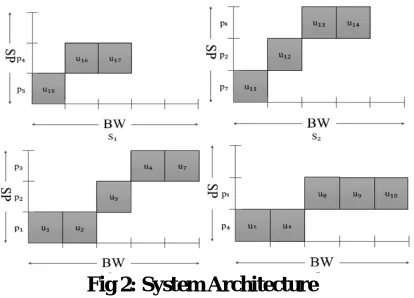
Fig 2: System Architecture
Because the volume, complexity, and heterogeneousness of net traffic has big and evolved, therefore too have the ISPs and CDNs that offer the services wont to deliver this traffic. The importance of CDNs at intervals the net system has big considerably over time – recent reports expect that CDNs can presently be handling over half the worldwide traffic on the net.
Typology of CDN Architectures:As was illustrated in previous sections, the CDN system has mature progressively advanced and consists of a large array of various CDN architectures and business models. Within the following, we offer a compartmentalization of CDN architectures presently deployed within the web. Key options that distinguish the various CDN ways embrace the strategy for deploying servers (e.g., the degree of distribution) and therefore the business models used (e.g., what performance characteristicsarestressed or what key applicationsarethe market focus). Table one summarizes our findings. The primary four varieties consult with multi-purpose CDNs supported completely different server preparation ways, whereas the fifth sort refers to specialized, single-purpose CDNs. The last 3 varieties describe new business models for delivering CDN services supported combining the resources of multiple market players.
ISSN(Online): 2319-8753 ISSN (Print): 2347-6710
I
nternational
J
ournal of
I
nnovative
R
esearch in
S
cience,
E
ngineering and
T
echnology
(An ISO 3297: 2007 Certified Organization)
Website: www.ijirset.com Vol. 6, Issue 9, September 2017
relies on common assumptions, it is often applied to varied forms of CDNs to boost their resource and power potency. To extend the readability of the pseudo code, the change processes of the subsequent variables don't seem to be contained within the details of ADP: P s, Sp, BWs, SPs, CN s; p ð Þ. These parameters are often updated supported their definitions when subscriptionis added to or removed from a CS. The only exception is OPS, which ADP must determine and change during execution. ADP is composed of two main functions: ARRIVE and DEPART, which are respectively executed when a subscription enters and leaves a system.
IV. EXPERIMENTAL RESULTS
Before running the ADP server, we need get the CSs from “backup” folder. These CSs are having video files. That ADP server displays the how many CSs are available in the system and also it displays how many videos have the each CS.
After run the ADP server, run the user. Then after Start the simulation andit will send the request by the 10 users to the CSs. These 10 users are created randomly. In my result 3 CSs are get requests from the 10 users and CSs are provide the videos for users. The ADP Server will display the status of the users request arrival or assigning and depart from CSs. Here, users depart from CSs is after completion of their file downloading. Downloaded video files are stored in “download” folder in the “users” folder.
View the Performance graph in the ADP server. In this graph we can see the total request and processing time.
V. CONCLUSION
ISSN(Online): 2319-8753 ISSN (Print): 2347-6710
I
nternational
J
ournal of
I
nnovative
R
esearch in
S
cience,
E
ngineering and
T
echnology
(An ISO 3297: 2007 Certified Organization)
Website: www.ijirset.com Vol. 6, Issue 9, September 2017
REFERENCES
[1] L. M. Vaquero, L. R.-Merino, J. Caceres, and M. Lindner, “A breakin the clouds: Towards a cloud definition,” in Proc. ACMSIGCOMM Comput.Commun. Rev., 2009, pp. 50–55.
[2] L. Tsai and W. Liao, “Cost-aware workload consolidation in greencloud datacenter,” in Proc. IEEE CLOUDNET, 2012, pp. 29–34.
[3] L. A. Barroso and U. Holzle, “The case for energy-proportionalcomputing,” IEEE Comput., vol. 40, no. 12, pp. 33–37, 2007.
[4] P. Bohrer, E. N. Elnozahy, T. Keller, M. Kistler, C. Lefurgy, C.McDowell, and R. Rajamony, “The case for power management inweb servers,” Power Aware Computing. Kluwer Academic Publishers, pp. 261–289, 2002.
[5] B. Li, J. Li, J. Huai, T. Wo, Q. Li, and L. Zhong, “EnaCloud: Anenergy-saving application live placement approach for cloudcomputing environments,” in Proc. IEEE CLOUD, 2009, pp. 17–24.
[6] Y. Ho, P. Liu, and J. Wu, “Server consolidation algorithmswith bounded migration cost and performance guarantees incloud computing,” in Proc. IEEE Utility Cloud Comput., 2011,pp. 154–161.
[7] M. Korupol, A. Singh, and B. Bamba “Coupled placement in modern data centers,” in Proc. IEEE Int. Parallel Distrib. Processing, 2009, pp. 1– 12.
[8] A. Gandhi, M. H.-BALTER, and R. Raghunathan, “AutoScale:Dynamic, robust capacity management for multi-tier data centers,” ACM Trans. Comput. Syst., vol. 30, no. 4, p. 14, Nov. 2012.
[9] A. Krioukov, P. Mohan, S. Alspaugh, L. Keys, D. Culler, andR. H. Katz, “NapSAC: Design and implementation of a power proportional web cluster,” in Proc. First ACM SIGCOMM,2010, pp. 102–108.