Investigation On Different Compositions To Develop A Composite
Materials Using Stir Casting Process And To Achieve The Better
Hardness
Mr. ANGADI VENKATESH received the B.Tech degree in mechanical engineering from Aditya Engineering College, JNTU, Kakinada, Andhra Pradesh, India, in 2017 year and pursuing M.Tech in ADVANCED MANUFACTURING SYSTEMS from Pydah College of engineering, JNTU, Kakinada, Andhra Pradesh, India
Mr. MD.I. Rehman, M.Tech. Asst. Prof. Department of Mechanical engineering from Pydah College of engineering, Kakinada, Andra Pradesh, India
ABSTRACT
The present research was conducted to investigate the effect of elemental metal such as TiO2 in
aluminium matrix on mechanical properties of stir casting of aluminium composite materials reinforced using simple foundry melting alloying and casting route.
The age hardening treatments were also applied to study the aging response of the aluminium matrix on strength, ductility and hardness. In this project we are going to take 3 different compositions and one pure al alloy for the testing purpose, here the 3 different compositions are developed using stir casting process. And the testing is done to see the grain size of the particles for different compositions and then find the tensile and load results for the better matrix reinforced material.
Later after the casting process we ate going to investigate the effects of the various Wire cut EDM process parameters on the surface quality, maximum material removal rates & micro structure and obtain the optimal sets of process parameters so that the quality and MRR of machined parts can be optimized.
Experiments are conducted on the composite material of 3 different compositions i.e. Al + tio2 (5%)
Al + tio2 (10%)
Al + tio2 (20%)
Pieces by varying parameters, The process parameters varied and their respective values are Pulse Time on - 105µsec, 115 µsec, 125µsec & Pulse Time off – 32 µsec, 42 µsec, 52 µsec, Discharge Current – 10Amp, 11Amp, 12Amp. Other parameters are kept constant such as Wire Feed – 2mm/s, Wire dia - 0.25mm; Coolant is Distilled water, Wire Tension – 7Kgf. The optimization is done by using Taguchi technique, considering L9 orthogonal array. Optimization is done in Minitab software.
INTRODUCTION
Casting
Casting is a manufacturing process in which a liquid material is usually poured into a mold, which contains a hollow cavity of the desired shape, and then allowed to solidify. The solidified
part is also known as a casting, which is ejected or broken out of the mold to complete the
propeller etc. can be cast easily in the required size rather than fabricating them by joining several small pieces.
Casting is the process of producing metal/ alloy component parts of desired shapes by pouring the molten metal / alloy into a prepared mould (of that shape) and then allowing the metal/alloy to cool and solidify. The solidified piece of metal/alloy is known as casting. Casting is the basic process in industry, so we never skip it from industry. To enhance the casting process, we must need to improve the quality of sand improves this quality. A core is essentially a body of materials which forms components of the mould. It possesses sufficient strength to be handled as an independent unit. Core is an obstruction which when positioned in the mould, naturally does not permit the molten metal to fill up the space occupied by the core. In this way a core produces hollow casting. Cores are required to create the recesses, undercuts and interior cavities that are often apart of castings. Cores are employed as inserts in mould to form design features that are otherwise extremely difficult to produce by simple moulding. The dry silica sand is used as a basic refractory material for pre-preparing core .This sand withstands for high temperature of metal poured in the mould.
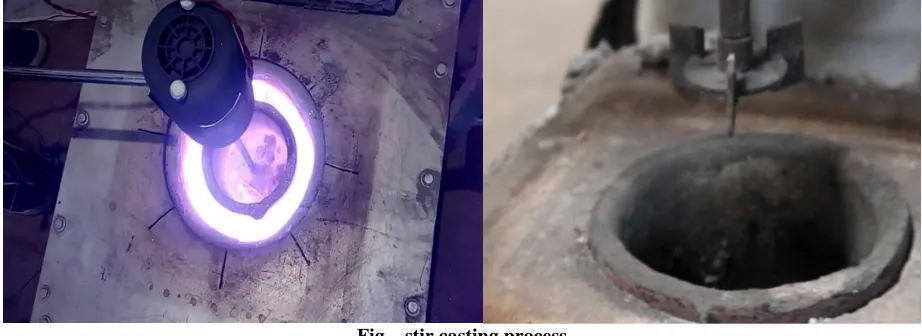
Fig – stir casting process
OBJECTIVE OF THE PRESENT WORK
The objective of the present work is to investigate the effects of the various Wire cut EDM process parameters on the surface quality, maximum material removal rates & micro structure and obtain the optimal sets of process parameters so that the quality and MRR of machined parts can be optimized.
Experiments are conducted on the composite material of 3 different compositions i.e. Al + tio2 (5%)
Al + tio2 (10%)
Al + tio2 (20%)
Pieces by varying parameters, The process parameters varied and their respective values are Pulse Time on - 105µsec, 115 µsec, 125µsec & Pulse Time off – 32 µsec, 42 µsec, 52 µsec, Discharge Current – 10Amp, 11Amp, 12Amp. Other parameters are kept constant such as Wire Feed – 2mm/s, Wire dia - 0.25mm; Coolant is Distilled water, Wire Tension – 7Kgf. The optimization is done by using Taguchi technique, considering L9 orthogonal array. Optimization is done in Minitab software.
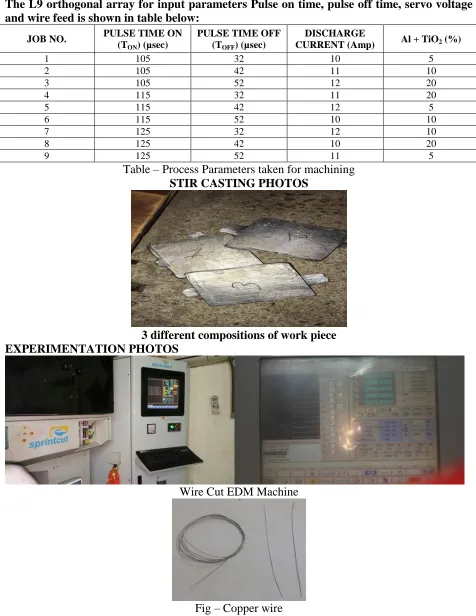
The L9 orthogonal array for input parameters Pulse on time, pulse off time, servo voltage and wire feed is shown in table below:
JOB NO. PULSE TIME ON
(TON) (µsec)
PULSE TIME OFF (TOFF) (µsec)
DISCHARGE
CURRENT (Amp) Al + TiO2 (%)
1 105 32 10 5
2 105 42 11 10
3 105 52 12 20
4 115 32 11 20
5 115 42 12 5
6 115 52 10 10
7 125 32 12 10
8 125 42 10 20
9 125 52 11 5
Table – Process Parameters taken for machining STIR CASTING PHOTOS
3 different compositions of work piece EXPERIMENTATION PHOTOS
Wire Cut EDM Machine
Piece before Machining
Final machined pieces MRR
In this project, Taguchi method is used to optimize the process parameters Pulse Time On, Pulse Time Off, Discharge Current and Wire Feed for higher material removal rates. The optimization is done in Minitab 17 software.
Fig - Effect of machining parameters on MRR for S/N ratio for Larger is better
SURFACE ROUGHNESS
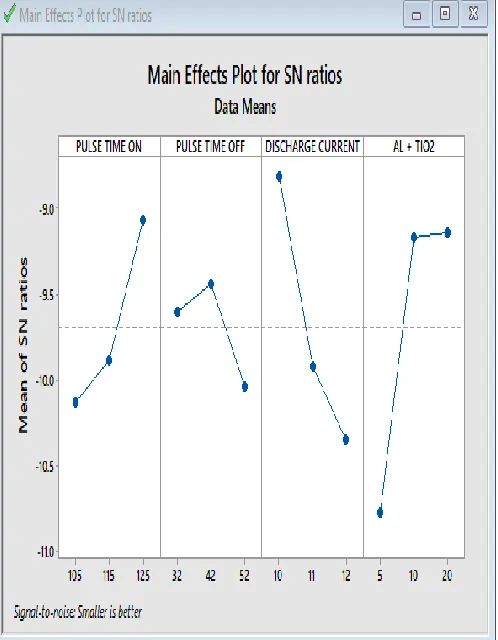
Taguchi method is used to optimize the process parameters Pulse Time On, Pulse Time Off, Discharge Current and Wire Feed for lesser Surface Roughness values.
MICROSTRUCTURE TEST REPORTS
CONCLUSIONS
Experiments are conducted on the work pieces by varying parameters. The process parameters varied and their respective values are Pulse Time on - 105µsec, 115 µsec, 125µsec & Pulse Time off – 32 µsec, 42 µsec, 52 µsec, Discharge Current – 10Amp, 11Amp, 12Amp. Other parameters are kept constant such as Wire Feed – 2mm/s, Wire dia - 0.25mm; Coolant is Distilled water, Wire Tension – 7Kgf. The optimization is done by using Taguchi technique considering L9 orthogonal array. Optimization is done in Minitab software. Tensile and Microstructure tests are performed on the pieces.
From the Optimization techniques, the following results can be obtained:
From Taguchi Method, for minimum Surface Roughness, the optimum Pulse Time on is 125µsec, Pulse Time off is 42µsec, Discharge Current is 10Amp and the best suited work piece is al + tio2 of 5%. For maximum MRR, the optimum Pulse Time on is 125µsec, Pulse Time off is 42µsec, Discharge Current is 12Amp and best suited work piece is al + tio2 of 10%.
From the Microstructure test reports it is found that the microstructure consists of grain structure higher and better for the 20% titanium composition mixed with aluminum.
REFERNCES
1. Evaluation of Optimal Parameters for machining with Wire cut EDM Using
Grey-Taguchi Method by S V Subrahmanyam, M. M. M. Sarcar
2. Performance Analysis of Wire Electric Discharge Machining (W-EDM) by Atul Kumar,
DR.D.K.Singh
3. Analysis of Process Parameters in Wire EDM with Stainless Steel Using Single Objective
Taguchi Method and Multi Objective Grey Relational Grade by M. Durairaja, D. Sudharsunb, N. Swamynathan
5. A Study to Achieve a Fine Surface Finish in Wire-EDM by J.T. Huang, Y.S. Liao and Y.H. Chen
6. Rajurkar K.P., Scott D, Boyina S., “Analysis and Optimization of Parameter
Combination in Wire Electrical Discharge Machining”, International Journal of Production Research, Vol. 29, No. 11, 1991, PP 2189- 2207.
7. Y. S. Tarng., Ma S.C., Chung L.K., “Determination of Optimal Cutting Parameters in
Wire Electrical Discharge Machining”, International Journal of Machine Tools and Manufacture, Vol. 35, No. 12, 1995, PP. 1693-1701.
8. J.Prohaszka, A.G. Mamalis and N.M.Vaxevanidis, “The effect of electrode material on
machinability in wire electro-discharge machining”, Journal of Materials Processing technology, 69, 1997, PP 233-237.
9. (A) Y.S. Liao, Y.Y. Chu and M.T. Yan, Study of wire breaking process and monitoring
of WEDM, International Journal of Machine Tools & Manufacture, 37 (1997) pp. 555-567. (B) Y.S Liao , J.T.Huang, A study on the machining parameter optimization of WEDM, Journal of Material Processing Technology,71(1997) pp. 487-493
10. Jose Marafona, Catherine Wykes., “A new method of optimizing MRR using EDM with