Formal verification of secure ad-hoc network
routing protocols using deductive model-checking
∗
Ta Vinh Thong
[email protected]
Budapest University of Technology and Economics,
Department of Telecommunications,
Laboratory of Cryptography and System Security (CrySyS)
TECHNICAL REPORT
Copyright
cTa Vinh Thong, CrySyS Lab.
2012
Contents
1 Introduction 4
2 Some attacks against secure routing protocols 5
2.1 Relay attacks . . . 5
2.2 An attack against the SRP protocol . . . 5
2.3 An attack against the Ariadne protocol . . . 6
2.4 Summary . . . 7
3 Motivation and Related works 8 4 The sr-calculus 9 4.1 Type system of thesr-calculus . . . 9
4.2 Basic definitions and terminology . . . 9
4.3 Simple type system for thesr-calculus . . . 10
4.4 Syntax and informal semantics of thesr-calculus . . . 12
4.5 Semantics . . . 15
4.5.1 The Structural Equivalence(≡) . . . 15
4.5.2 Reduction relation (→) . . . 17
4.5.3 Labelled transition system (−→α ) . . . 18
4.6 The connection between thesr-calculus and the appliedπ-calculus . . . 18
4.7 Equational Theory . . . 20
4.8 Examples . . . 20
4.8.1 Example for broadcasting and message loss . . . 20
4.8.2 Example for multiple broadcast sends and receives . . . 20
4.8.3 Example for mobility . . . 21
4.9 Attacker knowledge base, static equivalence, labeled bisimilarity . . . 22
4.10 Example on modelling the attacker knowledge base . . . 23
4.11 Example on labeled bisimilarity (≈N l ) . . . 24
5 Attacker’s ability and knowledge 25 6 Application of the calculus 25 6.1 Modelling the SRP protocol and the attack . . . 27
7 Weaker definition of security: up to barb ⇓ ACCEPT 32 8 A systematic proof technique based on backward deduction 32 8.1 BDSR: The backward deduction algorithm for source routing protocols . . . 33
8.2 General specification of on-demand source routing protocols . . . 38
8.3 Analysing the security of Ariadne . . . 38
8.4 Analysing the security of endairA . . . 44
9 sr-verif: On automating the verification 48 9.1 Assumptions on routing protocols and attacker model . . . 48
9.2 The concept of the verification method . . . 49
9.3 Specifying on-demand source routing protocols . . . 51
9.4 From protocol specification to logic rules . . . 55
9.4.1 Syntax of the logic rules . . . 55
9.4.2 Translation rules . . . 56
9.4.3 The resulting protocol rules . . . 60
9.4.4 Specifying the attacker rules . . . 64
9.7 The verification algorithm . . . 67
9.8 Termination . . . 73
9.9 Correctness and completeness . . . 76
9.10 Complexity . . . 77
9.11 Implementation . . . 79
Abstract
Ad-hoc networks do not rely on a pre-installed infrastructure, but they are formed by user devices in a self-organized manner. A consequence of this principle is that end-user devices must also perform routing functions. However, end-end-user devices can easily be compromised, and they may not follow the routing protocol faithfully. Such compromised and misbehaving nodes can disrupt routing, and hence, disable the operation of the network. In order to cope with this problem, several secured routing protocols have been proposed for ad-hoc networks. However, many of them have design flaws that still make them vulnerable to attacks mounted by compromised nodes. In this paper, we propose a formal verification method for secure ad-hoc network routing protocols that helps increasing the confidence in a protocol by providing an analysis framework that is more systematic, and hence, less error-prone than the informal analysis. Our approach is based on a new process algebra that we specifically developed for secure ad-hoc network routing protocols and a deductive proof technique. The novelty of this approach is that contrary to prior attempts to formal verification of secure ad-hoc network routing protocols, our verification method can be made fully automated, and provides expressiveness for explicitly modelling cryptographic privitives.
1
Introduction
In the recent past, the idea of ad-hoc networks have created a lot of interest in the research community, and it is now starting to materialize in practice in various forms, ranging from static sensor networks through opportunistic interactions between personal communication devices to vehicular networks with increased mobility. A common property of these systems is that they have sporadic access, if at all, to fixed, pre-installed communication infrastructures. Hence, it is usually assumed that the devices in ad-hoc networks play multiple roles: they are terminals and network nodes at the same time.
In their role as network nodes, the devices in ad-hoc networks perform basic networking func-tions, most notably routing. At the same time, in their role as terminals, they are in the hand of end-users, or they are installed in physically easily accessible places. In any case, they can be easily compromised and re-programmed such that they do not follow the routing protocol faithfully. The motivations for such re-programming could range from malicious objectives (e.g., to disrupt the operation of the network) to selfishness (e.g., to save precious resources such as battery power). The problem is that such compromised and misbehaving routers may have a profound negative effect on the performance of the network.
In order to mitigate the effect of misbehaving routers on network performance, a number of secured routing protocols have been proposed for ad-hoc networks (see e.g., [13] for a survey). These protocols use various mechanisms, such as cryptographic coding, multi-path routing, and anomaly detection techniques, to increase the resistance of the protocol against attacks. Unfor-tunately, the design of secure routing protocols is an error-prone activity, and indeed, most of the proposed secure ad-hoc network routing protocols turned out to be still vulnerable to attacks. This fact implies that the design of secure ad-hoc network routing protocols should be based on a systematic approach that minimizes the number of mistakes made in the design.
2
Some attacks against secure routing protocols
Several ”secure” routing protocols have been proposed in the recent past for wireless ad hoc networks. However, later most of them are turned out to be vulnerable to various attacks. In this section, we introduce some of these attacks that serves as the motivation of our work. First, we discuss the attack called as relay attack, which has already been modelled in the previous works [16, 5, 11]. Afterwards we give an overview of more subtle attacks against the SRP and the Ariadne protocols [9, 3]. We emphasize that these kinds of attacks cannot be modelled directly and conveniently in the previous works [16, 11, 22]. Our emphasis is deliberately on modelling and verifying these kinds of attacks.
2.1
Relay attacks
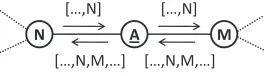
Relay attacks are such kind of attacks in which the attacker node forwards the received message unchanged. A typical relay attack scenario against on-demand source routing protocols is shown in the Figure 1. In this scenario the attacker nodeA receives the request message that includes the route specified by the list of node IDs [. . . , N]. At this point, nodeA should append its own identifier to the ID list above and forwards the request containing the ID list [. . . , N, A] to the node M. However, instead the attacker forwards the message unchanged toM. Then, nodeM appends it own identifier to the ID list and forwards it. This procedure continues until the request message reached the destination node. At this point after making verification steps the destination node sends back a reply message. The reply message propagates backward along the route in the request message. After a while the reply reaches node M and is forwarded ”backward”. Due to the wireless environment and the fact that the attacker node is within the transmission range of node M, the reply is intercepted by the attacker. When the attacker node receives the reply message it forwards it unchanged. At the end, the source node accepts the route [. . . , N, M, . . .] which does not exist in the current topology.
N A M
[…,N] […,N]
[…,N,M,…] […,N,M,…]
Figure 1: A typical relay attack scenario against on-demand source routing protocols.
2.2
An attack against the SRP protocol
SRP is a secure on-demand source routing protocol for ad-hoc networks proposed in [17]. The de-sign of the protocol is inspired by the DSR protocol [15], however, DSR has no security mechanisms at all. Thus, SRP can be viewed as a secure variant of DSR. SRP tries to cope with attacks by using a cryptographic checksum in the routing control messages (route requests and route replies). This checksum is computed with the help of a key shared by the initiator and the target of the route discovery process; hence, SRP assumes only shared keys between communicating pairs.
In SRP, the initiator of the route discovery generates a route request message and broadcasts it to its neighbors. The integrity of this route request is protected by a Message Authentication Code (MAC) that is computed with a key shared by the initiator and the target of the discovery. Each intermediate node that receives the route request for the first time appends its identifier to the request and re-broadcasts it. The MAC in the request is not updated by the intermediate nodes, as by assumption, they do not necessarily share a key with the target. When the route request reaches the target of the route discovery, it contains the list of identifiers of the intermediate nodes that passed the request on. This list is considered as a route found between the initiator and the target.
from the route request. The route reply contains the route obtained from the route request, and its integrity is protected by another MAC generated by the target with a key shared by the target and the initiator. Each intermediate node passes the route reply to the next node on the route (towards the initiator) without modifying it. When the initiator receives the reply it verifies the MAC of the target, and if this verification is successful, then it accepts the route returned in the reply.
The basic problem in SRP is that the intermediate nodes cannot check the MAC in the routing control messages. Hence, compromised intermediate nodes can manipulate control messages, such that the other intermediate nodes do not detect such manipulations. Furthermore, the accumu-lated node list in the route request is not protected by the MAC in the request, hence it can be manipulated without the target detecting such manipulations.
Figure 2: An attack scenario against the SRP protocol.
In order to illustrate a known attack on SRP, let us consider the network topology shown in Figure 2. Let us further assume that nodeN1 initiates a route discovery to nodeN3.
The attacker nodeAcan manipulate the accumulated list of node identifiers in the route request such thatN3receives the request with the list (N2, λ, N4), whereλis an arbitrary sequence of fake identifiers. This manipulation remains undetected, because the MAC computed byN1 does not protect the accumulated node list in the route request, and intermediate nodes do not authenticate the request. When the targetN3 sends the route reply,Aforwards it without modification toN1 in the name ofN2. As the route reply is not modified, the MAC of the targetN3verifies correctly at N1, and thus, N1 accepts the route (N1, N2, λ,N4, N3). However, this is a mistake, because there is no route via nodesN2,λ,N4.
2.3
An attack against the Ariadne protocol
In this subsection, we show the attack has been found in [9] against the Ariadne secure routing protocol.
Ariadne has been proposed in [14] as a secure on-demand source routing protocol for ad hoc networks. Ariadne comes in three different flavors corresponding to three different techniques for data authentication. More specifically, authentication of routing messages in Ariadne can be based on TESLA [18], on digital signatures, or on MACs. We discuss Ariadne with digital signatures.
reverse of the route obtained from the route request. The route reply contains the identifiers of the target and the initiator, the route and the list of digital signatures obtained from the request, and the digital signature of the target on all these elements. Each intermediate node passes the reply to the next node on the route (towards the initiator) without any modifications. When the initiator receives the reply, it verifies the digital signature of the target and the digital signatures of the intermediate nodes (for this it needs to reconstruct the requests that the intermediate nodes signed). If the verifications are successful, then it accepts the route returned in the reply.
Figure 3: A subtle attack against Ariadne. The figure on the left shows the communication during the route discovery, while the figure on the right illustrates that at the end of the route discovery phase, the source node accepts the routeS, V, W, A, D, which is not valid because the link between W andAdoes not exist.
Let us consider Figure 3, which illustrates part of a configuration where the discovered attack is possible. The attacker is denoted by A. Let us assume that S sends a route request towards D. The request reachesV that re-broadcasts it. Thus,Areceives the following route request message:
reqV = (rreq,S,D,ID,hV, (V), (sigV))
whereIDis the random request identifier,hV is the per-hop hash value generated byV, andsigV
is the signature ofV.
After receivingreqV the attacker waits for an another route request fromX:
reqX = (rreq,S,D,ID,hX, (V,W,X),(sigV,sigW,sigX)).
FromreqX,Aknows thatW is a neighbor ofV. AcomputeshA=H(A, H(W, hV)), wherehV is
obtained from req1, and H is the publicly known hash function used in the protocol. A obtains the signaturessigV,sigW fromreq2. Then,Agenerates and broadcasts the following request:
reqA= (rreq,S,D,ID,hA, (V,W,A) (sigV,sigW,sigA))
Later,D generates the following route reply and sends it back towardsS: rep= (rreq, D, S, (V,W,A), (sigV,sigW,sigA),sigD).
WhenAreceives this route reply, it forwards it toV in the name ofW. Finally,Swill output the route (S,V,W, A,D), which is a non-existent route.
2.4
Summary
3
Motivation and Related works
As we can see, the discussed attacks are very subtle, thus, it is hard to detect and reasoning about them manually. In addition, reasoning in the hand and pencil manner is error-prone, therefore a systematic and automatic method is required.
Our purpose in this paper is to provide a formal modelling of secure on-demand source routing protocols and a systematic and automatic method for detecting attacks similar to the attacks we introduced in the previous section. Each method proposed in the most important related works [11, 12, 22, 5, 16, 9, 3, 23, 21] has numerous drawbacks that we will discuss in the following: In works [9, 3] the authors model the operation of the protocol participants by interactive and probabilistic Turing machines, where the interaction is realized via common tapes. This model enables us to be concerned with arbitrary feasible attacks. The security objective function is applied to the output of this model (i.e., the final state of the system) in order to decide whether the protocol functions correctly or not. Once the model is defined, the goal is to prove that for any adversary, the probability that the security objective function is not satisfied is negligible.
The main drawback of this method is that the proof is not systematic and automated, and the framework is not well-suited for detecting attack scenarios once the proof fails. In this paper, we aim at improving these works by adding automated verification method based on deductive model-checking.
In order to give a formal and precise mathematical reasoning of the operation of routing protocol for wireless ad-hoc networks several process calculi have been proposed in the recent years. Among them the two works [11, 22] are closest to our work.
In [11] the author proposes the process algebra, called CMAN, for formally modelling the oper-arion of mobile ad-hoc networks. The advantage of this method is that it provides the modelling of cryptographic primitives and it is focused mainly on modelling mobility nature of mobile ad-hoc networks. The drawback of this method is that it cannot be directly used for modelling such attacks as the attacks scenario against the Ariadne or SRP protocols showed in the Section 2. In the attack scenario against the Ariadne protocol the attacker node waits, collects information it intercepts from the neighbor nodes and use them to construct an message that contains an incorrect route. CMAN does not provide syntax and semantics for modelling a knowledge base of the attacker node. In order to directly model these kind of attacks we propose the notion of the
active substitution with range in thesr-calculus.
In the work [22] the authors propose the process algebra that is called as theω-calculus. The main advantage of this calculus is that it provides the explicit modelling elements of broadcast communication and mobility. The main drawback of this method that it does not provide the syntax and semantics for modelling cryptographic primitives and attacker’s knowledge base. In contrast to these our calculus provides the modelling of cryptographic primitives and attacker accumulated knowledge.
The advantage of these process algebras is that the operation of mobile ad-hoc networks and several properties such as loop-freedom and security properties can be precisely and systematically described with them, however, the drawback of them is that the proofs and reasoning are still performed manually by hand.
Several works in the literature address the problem of automatic verification of routing proto-cols. In the works [23, 21] the authors investigate the problem of verifying loop freedom property of routing protocols. In [23] the LUNAR protocol is verified using the SPIN, and UPPAAL model-checkers; in [23] the authors verified the DYMO protocol using graph transformation. In contrast to these works we propose an automatic verification method focuses on verifying security properties of ”secure” routing protocols instead of loop freedom property.
The two works that are most related to our work are [5, 16]. In the work [5], and [16] the authors address the problem of verification security properties of secure routing protocols using the SPIN model-checker and CPAL-ES tools, respectively.
bytes [5] and broadcast communication with a sequence of unicast communication. In contrast to these works, our automatic verification method provides the modelling elements for cryptographic primitives and neighborhood.
4
The
sr
-calculus
In this section we define the proposedsr-calculus: its syntax and informal semantics, as well as its operational semantics. We call this calculus as sr-calculus, where the prefix sr refers to the wordssecurerouting.
The advantage of the sr-calculus is that it provides expressiveness for modelling broadcast communication, neighborhood, mobility, and transmission range like in CMAN [11] and the ω-calculus [22], and the explicit modelling of cryptographic primitives like in the appliedπ-calculus [10], however, compared to them it includes the novel definition ofactive substitution with range
that enables us to model attacker knowledge and attacks in the context of wireless ad-hoc networks. CMAN cannot be used to directly model the attacks we found against the well-known SRP and Ariadne protocols [9, 3]. In these attacks the attacker can receive information from several paths, the attacker node then collects and store these information and construct a message that contains an incorrect route.
Theω-calculus lacks of modelling cryptographic primitives, such as digital signature and hash-ing, and has been used for modelling loop-freedom properties of AODV. Hence, it also lacks sytax and semantics for modelling attacker’s knowledge set. In addition, neighbor nodes is organized into groups. However, it is not easy to determine groups in the topology.
Finally, the applied pi-calculus [10] provides active substitution that can be used to model actual attacker’s knowledge. However, it lacks syntax and semantics for broadcasting, neighbors and deals with Dolev-Yao attacker model, which is not true in case of MANET.
We combine the advantage of each in order to provide a calculus with which we can directly and conveniently modelling and proving security properties and reasoning about attacks discussed in Section 2.
4.1
Type system of the
sr
-calculus
In this subsection, we provide a basic type system for thesr-calculus. The main purpose of the type system is to reduce the number of the possible cases to be examined during formal security proofs. Based on the type system we are capable of capturing errors such as arity mismatch and errounous binding/substitution of terms. We adapt the type system proposed for the applied π-calculus, discussed in the chapter 4 of [7], which have been shown to be sound and complete. This type system includes a syntax and a semantics part, which discuss the declaration of the types and the rules for typing, for example, the type preserved property of transitions. In this paper, we only provide a brief overview of the type system in the chapter 4 of [7].
The type system catches the errors such as arity errors and matching of terms of different type. The type system does not include recursive types, so the type of processes such aschci.P is not defined.
4.2
Basic definitions and terminology
Definition 1. Type assignment is an assignmentv :T (oru:T)of a typeT tov(oru)that can be a name, a constant, a node ID or a variable.
Definition 2. A well-formed type environment Γ is a finite set of type assignments where all names and variables are distinct. The domain ofΓ is dom(Γ) = { v | ∃T.{ v : T} ∈ Γ} Definition 3. Let Γ and∆type environments. We say that Γ extends∆ if the following holds:
• if v ∈dom(∆)such that {v : T} ∈∆, then{v : T} ∈Γ.
If ∆ ={v1 :T1,. . . ,vn :Tn } and Γ ={u1 : T1,. . . , un :Tn } anddom(Γ)∩ dom(∆) =∅, then
∆ can be extended with Γ by taking their union, denoted by ∆]Γ.
4.3
Simple type system for the
sr
-calculus
The set of types is divided into the sets ofterm typesandprocess/behavior types. Within theterm types we distinguish among channel types, broadcast types, name types, variable types, constant types, andnode ID types.
Given a term typeTt, channel and broadcast channel types are constructed by the unary type
constructorsch(Tt) andbch(Tt), which are the types that is allowed to carry data with term type.
Let Γ be a type environment and Λ an expression which may be either a term, a process, or an extended process. A type judgment Γ` Λ :T is an assertion that the expression Λ has type T under the assumptions given in Γ. In particular, Γ`Λ : T, asserts the following depending on Λ. If Λ is a term, then T is term type Tt. Thus Γ ` t : Tt asserts that t has term type under
the assumptions of Γ. The so called behavior type, denoted byTproc, is introduced for processes.
Tpnetw and Tenetw is the Γ` P : Tproc asserts that process P respects the type assertions in Γ.
The judgment (`Γwell-formed) means that Γ is a well-formed type environment. The types for thesr-calculus are generated by the following grammar:
S, T ::=Tt|Tproc (Types)
Tt::= Tch |Tbr |Tstr (Term Types)
Tstr::= Tname |Tvar |Tf |Tconst (String Types)
Tname::= tn1 |. . .|tnn (Name Types)
Tvar ::= tv1| . . .|tvn (Variable Types)
Tf ::= f(Tstr1 , . . . , Tstrn ) (Function Types)
Tconst::=Treq/rep |tconsti (Constant Types)
Tch ::= ch(Tstr1 , . . . , Tstrn ) (Channel Types)
Tbr::= bch(Tstr1 , . . . , Tstrn ) (Broadcast Channel Types)
Tid ::= tl1 |. . .|tln (Node ID Types)
Tproc ::=tp1 |. . .|tpn (Process/Behavior Types)
Tpnetw ::= tpnet1 |. . .|tpnetn (Plain Network Types)
Tenetw ::= tenet1| . . .|tenetn (Extended Network Types)
where tn, tv, tl and tp, tpnet and tenetare name types, variable types, node ID types, process types, plain and extended network types, respectively. The abbreviation of x1 : T1,. . . , xn : Tn
is defined by~x: T. Of course, if a term~ thas a string type Tstr then it also has a term typeTt,
and ifthas been assigned to one of the typeTname,Tvar,Tf,Tconst then it implicitly has a type
Tstr. The reverse direction is not always true, hence, to avoid type conflict the most narrow type
should be assigned in the declaration. Note that within the set of term type the channel types are distinguished from the remaining string types because to reasoning about routing protocols we do not need to send channels, or need not to define a function that includes channel arguments. Within the constant type we define Treq/rep as the type for the special constants rreq and rrep
which are the parts of the routing messages.
Within a function types we distinguish types of each crypto function, such as, digital signature type, Tsig, one-way hash type, Thash, MAC function type, Tmac. We also define types of secret
key, Tskey, public keyTpkey, and symmetric shared keyTshkey. In this paper we only use these
three crypto functions, but of course any function types can be defined in the similar way. With these types we can ease the security verification, and reducing the number of possibilities.
Tskey ::= sk(Tid) (Secret Key Types)
Tpkey ::= pk(Tid) (Public Key Types)
Tsig ::= sign(Tstr,Tskey) (Digital Signature Types)
Thash::= hash(Tstr) (One-Way Hash Types)
Tmac ::= mac(Tstr,Tkey) (MAC Types)
The syntax, the reduction rules and the trasition rules for the typed appliedπ-calculus remains unchanged from the ones defined for the untyped applied π-calculus. In order to ensure that structural equivalence preserves well-typedness, we require that the type system assigns equal types to terms that are equated by the equational theory.
Definition 4. (Well formed environment)
• ` ∅ well-formed
• If (`Γ well-formed)andu /∈dom(Γ), then (` Γ ]uwell-formed).
Definition 5. (Type rules for terms) Let t ∈ T be a term, T a type, and Γ a well-formed type environment. Then the type judgmentΓ `T t : T holds if it can be derived by application of one
of the following rules.
• If ` Γwell-formed and u:T ∈Γ thenΓ `T u:Tstr
• If Γ `T t1 : Tstr1 . . .Γ `T tn : Tstrn , and the arity of f is n, then Γ `T f(Tstr1 , . . . , Tstrn ) :
Tstr, for each function name f.
Definition 6. (Type rules for plain processes) LetP ∈ P be a plain process,Γa well-formed type environment, and Tproc the behavior type. Then the judgment Γ `P P : Tproc holds if it can be derived by application of one of the following rules.
• If (`Γ well-formed)then(Γ `P nil:Tproc )
• If (Γ `P P : Tproc )and(Γ`P Q: Tproc ), thenΓ`T P | Q:Tproc.
• If (Γ `P P : Tproc )then If(Γ`P !P : Tproc )
• If (Γ ] {u: Tname} `P P :Tproc ) then(Γ`P νu.P : Tproc )
• If (Γ`T t1 : Tstr),(Γ`T t2 :Tstr),(Γ`P P : Tproc ),(Γ `P Q:Tproc )then (Γ`P [t1 = t2] P elseQ: Tproc ), and also(Γ `P [t1 =t2]P : Tproc ).
• If (Γ `T l : Tid), (σ is the set of li, where Γ `T li : Tid, for i ∈ {1, . . . , n}), (Γ `P P : Tproc ),(Γ`P Q:Tproc )then(Γ`P [l ∈σ]P elseQ:Tproc ), and also(Γ`P [l ∈σ]P : Tproc ).
• If (Γ ] {~x: T~str} `P P :Tproc )and(Γ `T c: ch(T~str))then (Γ`P c(~x).P :Tproc).
• If (Γ `T ~t: T~str)and(Γ `T c : ch(T~str))and(Γ `P P : Tproc )then(Γ `P ch~ti.P : Tproc
).
• If (Γ] {~x:T~str} `P P :Tproc )and(Γ`T br :bch(T~str))then(Γ`P br(~x).P :bch(T~str)).
• If (Γ `T ~t: T~str) and(Γ `T br : bch(T~str))and (Γ `P P : Tproc ) then (Γ `P brh~t i.P : Tproc ). In the rest of the paper to represent broadcast sending/receiving we simply useh~ti.P, and(x).P by removing brfrom the beginning.
• If (Γ `T t : Tstr)and(Γ `T x: Tvar)then(Γ `P {t/x} : Tproc ).
• If (`Γ well-formed)then(Γ `Nnet 0N :Tpnetw )
• If (Γ `T l : Tid),(Γ`P P :Tproc )then (Γ`Nnet bPcl :Tpnetw ).
• If (Γ `T l : Tid), (σ is the set of li, where Γ `T li : Tid, for i ∈ {1, . . . , n}), (Γ `P P : Tproc ) then(Γ`Nnet bPc
σ
l : Tpnetw ).
• If (Γ `Nnet bPc σ1
l :Tpnetw ) and(Γ `Nnet bPc σ2
l : Tpnetw ) then(Γ `Nnet bPc σ1 l1 | bPc
σ2 l2 :
Tpnetw ).
• If (Γ ] {n :Tname} `Nnet N : Tpnetw)then(Γ `Nnet νn.N : Tpnetw ).
If (Γ `Nnet N1 : Tpnetw )and(Γ `Nnet N2 :Tpnetw )then(Γ`Nnet N1 | N2 :Tpnetw ).
Definition 8. (Type rules for extended networks) Let E ∈ Enet be an extended network, Γ a well-formed type environment, andTpnetw the plain network type. Then the judgmentΓ`Enet E :
Tenetw holds if it can be derived by application of one of the following rules.
• If (Γ `Nnet N : Tpnetw)then(Γ `Enet N :Tenetw ).
• If (Γ `Enet Ei : Tenetw )and(Γ`Enet Ej : Tenetw )then(Γ `Enet Ei | Ej : Tenetw).
• If (Γ ] {n :Tname} `Enet E : Tenetw)then (Γ`Enet νn.E :Tenetw).
• If (Γ ] {x: Tvar} `Enet E : Tenetw) then(Γ`Enet νx.E : Tenetw).
• If (Γ `T t : Tstr),(Γ `T x : Tvar)and (σis the set of li, where Γ `T li : Tid, fori ∈ {1, . . . , n}), then(Γ `Enet b{t/x}
σc: T enetw).
4.4
Syntax and informal semantics of the
sr
-calculus
We assume an infinite set of names N andvariables V, where N ∩ V =∅. Further, we define a set ofnode identifiers (node ID) L, whereN ∩ L=∅. Each node identifier uniquely identifies a node, that is, no any node pair shares the same identifier.
We define a set of terms as
t::=req|rep|true|ACCEPT| c, n, m, k|li, la |x, y, z, v, w |f(t1, . . . , tk)
• req and rep are unique constants that represent the req and rep tags in route request and reply messages;
• true is a special constant that models the logical value 1;
• ACCEPT is a special constant. The source node outputs ACCEPT when it receives the reply message and all the verifications it makes on the reply are successful.
• c models communication channel;
• n,mandkare names and are used to model some data (e.g., a random nonce, a secret key);
• li, i can be numbers or letters not equal to a, and la are node IDs of the honest and the
attacker node, respectively;
• x,y, z, v andware variables that can represent any term, that is, any term can be bound to variables.
• Finally,f is a constructor function with aritykand is used to construct terms and to model cryptographic primitives, route request and reply messages. For instance, digital signature is modelled by the function sign(t1, t2), where t1 models the message to be signed andt2 models the secret key. Route request and reply messages are modelled by the functiontuple
We note that this definition of term is new compared to CMAN, theω-calculus, and the applied
π-calculus in that it includes the constants rep, req for modelling route discovery protocols, and process [l∈σ]P for examining the neighborhood.
The internal operation of nodes is modelled by processes. Processes can be specified with the following syntax, and inductive definition:
P,Q,R::= processes
chti.P unicast send
c(x).P unicast receive
hti.P broadcast send
(x).P broadcast receive
P|Q composition
νn.P restriction
!P replication
[ti=tj]P if
[ti=tj]P else Q if-else
[l∈σ]P in
[l∈σ]P else Q in-else
0 nil
let(x=t)in P let
We note that this definition of processes is novel compared to the ω-calculus in that it includes constructor and destructor applications. Constructor/destructor application is used to model cryp-tographic primitives. Compared to CMAN it includes also the posibility of unicast. Finally, it differs from the applied π-calculus in that it includes broadcast send and receive actions.
• The processchti.P represents the sending of messageton channelcfollowed by the execution ofP, andc(x).Prepresents the receiving of some message and binds it toxinP. For example, the communication betweenchti.P andc(x).P can be described as the reduction step of the parallel composition, namely, chti.P |c(x).P −→P | P{t/x}. These two processes model the unicast send and receive actions.
• The two processeshti.P, and (x).P represent the broadcast send and receive. Compared to the unicast case they does not contain the channel, which intends to model the fact that there is no any specified target.
• A composition P|Q behaves as processes P and Qrunning in parallel. Each may interact with the other on channels known to both, or with the outside world, independently of the other. Given a family of processes P1, P2, . . . Pk, we write Qi∈1...kPi, or Qi∈{1...k}Pi for
their parallel composition P1|P2|. . .|Pk.
• A restrictionνn.P is a process that makes a new, private name n, and then behaves asP.
• A replication !P behaves as an infinite number of copies ofP running in parallel.
• Processes [ti=tj]P and [l∈σ]P mean that ift1=t2 andl∈σ, respectively, then process
P is ”activated”, else they get stuck and stay idle.
• Processes [ti =tj]P else Qand [l∈σ]P else Qmean that ift1=t2 andl∈σ, respectively,
then processP is “activated”, otherwise,Qis “activated”.
• Thenil process 0does nothing.
A ”physical” node is defined as bPcσl, which represents a node with the identifierl behaves as P and its transmission range covers nodes with the identifiers in the setσ. Two nodes are neighbors if they are in each other’s range. We note that σ can be empty, denoted asbPcl, which means that the node has no connections.
A network, denoted as N, can be an empty network with no nodes: 0N; a singleton network
with one node: bPcl; the parallel composition of nodes: bP1cσ1 l1 | bP2c
σ2
l2, where σ1 and σ2 may
include l2 and l1 respectively; a network with name restriction, and the parallel composition of networks: N1|N2.
N ::=0N | bPcl |(bP1c
σ1 l1 | bP2c
σ2
l2)|νn.N |(N1| N2)
Note that bPcl2
l1 and bQc l1
l2 means the node l1 and node l2 are bidirectionally connected. νn.N
represents the creation of new namen, such as secret keys, a nonce and onlyN knows it.
We stress that we use the formbPcσl that is already proposed in CMAN, and not the definition of groups (where neighbor nodes is organized to the same group) as inω-calculus because we found that the topology of Mobile Ad-hoc Networks is usually represented as a graph and is given in the form of an adjacency matrix, thus, using the groups method in ω-calculus an algorithm can be required which extracts the cliques in the graph. Moreover, there can be redundant groups that should be handled properly for efficiency purpose. Finally, we prefer thebPcσl form because it gives us a possibility to model uni-directional links, which is not the case in ω-calculus. However, we note that CMAN does not include syntax and semantics for uni-directional links.
In order to model attacker’s knowledge base and modelling the attacks, where attacker waits, collects and stores information feasible and more convenient, we extend the definition of networks withthe substitution with range and the restriction on variables. Additionally, we adapt the the notion of active substitution for modelling the attacker’s actual knowledge.
Again, we emphasize that the notion of active substitution and static equivalence have been used in the applied π-calculus, however, it models the knowledge of a Dolev-Yao attacker who eavesdrops every message that has been sent by communicating partners without considering the attacker model in wireless ad-hoc networks.
We slightly modified the notion active substitution to model such an adversary who can only intercept messages sent by its neighbors. More precisely, the intercepting of broadcast information is restricted to only nodes in the broadcast range. Furthermore, we adapt the concept of active substitution for modelling the attacker’s knowledge set, which can continually change during the protocol. Finally, we emphasize that this is novel compared to all of the three calculi: CMAN, the
ω-calculus, and the appliedπ-calculus.
The definition of theextended network is as follows:
E::= extended network N plain network Ei|Ej parallel composition
νn.E name restriction νx.E variable restriction
b{t/x}σcactive substitution with range
• N is a plain network we already discussed above.
• Ei|Ej is a parallel composition of two extended networks.
• νn.E is a restriction of the namento E.
• b{t/x}σc, which is abbreviated as {t/x}σ in the rest of the paper: {t/x}σ means that the
substitution {t/x} is applied to any node that is in parallel composition with {t/x} and its identifier is in the set σ. Intuitively, we can say that σ is the range of the substi-tution {t/x}. Formally, we can explain the notion of active substitution with range by νx. {t/x}σ |Q
li∈σbQic σi li
. This formula in turn can be defined as νx.({t/x} |Aσ), where Aσ is the extended process (the notion of extended process A is presented in the applied π-calculus) that only includes the internal behavior of nodes in σ, and {t/x} is the active substitution known in the appliedπ-calculus.
We write f v(E), bv(E), f n(E), and bn(E) for the sets of free and bound variables and free and bound names ofE, respectively. These sets are defined as follow:
f v({t/x}σ)def= f v(t)∪ {x},f n({t/x}σ)def= f n(t)∪ {node IDs∈σ}
bv({t/x}σ)def= ∅,bn({t/x}σ)def= bn(t)
An extended network is closed when every variable is either bound or defined by an active substi-tution with range.
In the applied π-calculus, a frame is an extended process built up from 0 and active substi-tutions of the form {t/x} by parallel composition and restriction. Analogously, we follow this concept and we let the frame of network, denoted byϕN, be an extended network built up from
0N and active substitutions with range,b{t/x}σc(or simply{t/x}σ). Every extended networkE
can be mapped to a frame ϕN(E) by replacing every plain network embedded in E with empty
network0N. We distinguish the notations frame of network (ϕN) and frame of processes (ϕ) also
known in case of the appliedπ-calculus. For example, the frame of process E, where
E ={t1/x1}σ1 | {t2/x2}σ2 |. . .| {t
k/xk}σk |QibQic σi li
isϕN(E) ={t1/x1}σ1 | {t2/x2}σ2 |. . .| {tk/xk}σk.
The frame ϕN(E) can be viewed as an approximation of the behavior ofE that accounts for
thestatic knowledge exposed byE to its environment, but not forE’s dynamic behavior.
In the next section, we give the semantics of the calculus in order to reason about secure on-demand source routing protocols.
4.5
Semantics
First we define the structural equivalence relation which is used to simplify a process of large size to a smaller one that is the is equivalent to the original one. This relation is very important in proofs. We say that two processes are structurally equivelence, if they are identical up to structure.
4.5.1 The Structural Equivalence(≡)
In particular, structural equivalence relation is defined as the least equivalence relation satisfying bound name, bound variable conversion (also called asα-conversion) and the following rules:
(Rules for Processes:)
(Struct P-α) P≡x←y Q;P ≡n1←n2 Q
(Struct P-Par1) P|0≡P (Struct P-Par2) P1|P2 ≡P2|P1
(Struct P-Par3) (P1|P2)|P3 ≡P1|(P2|P3) (Struct P-Switch)νn1.νn2.P≡νn2.νn1.P (Struct P-Repl) !P ≡P|!P
(Struct P-Extr) νn.(P|Q)≡P|νn.Qifn /∈f n(P) (Struct P-Let) let x=t in P ≡P{t/x}
(Struct P-If1) [t=t]P ≡P
(Struct P-If2) [ti=tj]P≡0 (if ti 6=tj)
(Struct P-In1) [l∈σ]P ≡P (if l∈σ) (Struct P-In2) [l∈σ]P ≡0 (if lis not inσ) The meaning of each rule is the following:
• Struct P-α: P and Q are stuctural equivalent if Q can be obtained from P by renaming one or more bound names/variables in P, or vice versa. For instance, processes (x).P and (y).P are structural equivalent by renaming y tox. This is denoted by ≡x←y.
• Struct P-Par1: The parallel composition with the nil process does not change anything, the result is the same as the original parallel composition.
• Struct P-Par2: The parallel composition is commutative.
• Struct P-Par3: The parallel composition is associative.
• Struct P-Switch: The restriction is commutative.
• Struct P-Drop: Restriction does not affect the nil process, thus, we can drop it.
• Struct P-Extrusion: We can drop the restriction from process P whenP does not contain the restricted name as free name, that is, the restricted name does not occur inP.
• Struct P-Let: Both sides represent the binding of the term tto variablexin P.
• Struct P-If1, P-If2: If the two terms are the same then the execution of P begins, while if they are distinct then the process gets stuck.
• Struct P-In1, P-In2: If the node identifier l is in the setσ then the execution ofP begins, otherwise the process P gets stuck and stays idle.
The next additional rules are valid to structural equivalence:
P ≡Q, Q≡R P ≡R
P ≡P0 P|Q≡P0|Q
P ≡P0 νn.P ≡νn.P0
The first one means structural equivelence relation is transitive: ifP ≡QandQ≡RthenP ≡R; the second and third rules show that structural equivalence closed to replication and restriction. Similarly the rules for network can be defined:
(Rules for Networks:)
(Struct N-Par1) N|0N≡N
(Struct N-Par2) N1|N2≡N2|N1
(Struct N-Par3) (N1|N2)|N3 ≡N1|(N2|N3) (Struct N-Switch)νn1n2.N≡νn2n1.N
(Struct N-Extr) (νn.N1)|N2 ≡νn.(N1|N2) (if n /∈f n(N2)∪id(N1)) (Struct N-Node)bPcσl ≡ bQcσl (if P ≡Q)
(Struct N-Rest) bνn.Pcσl ≡νn.bPcσl
restriction on a node.
Again, we emphasize that this part is new compared to CMAN, and the ω-calculus in that it enables us to model the knowledge base of the attacker node. The knowledge of the attacker can improve after a series of communication steps. Also, this part is novel compared to the applied
π-calculus in that active substitution has range for modelling neighborhood.
Finally, the rules for the extended networkE are defined as follows:
(Rules for Extended Networks:)
(Struct E-Par1) E|0N ≡E
(Struct E-Par2) E1|E2 ≡E2|E1
(Struct E-Par3) (E1|E2)|E3 ≡E1|(E2|E3)
(Struct E-Extr) (νn.E1)|E2≡νn.(E1|E2) (if n /∈f n(E2)∪f v(E2)∪id(E1)) (Struct E-Switch)νn1n2.E≡νn2n1.E
(Struct E-Intro) νx.{t/x}σ≡0 N
(Struct E-Try) {t/x}σ|E≡ {t/x}σ|E{t/x}σ
(Struct E-Rewrite){t1/x}σ≡ {t2/x}σ (ift1=t2)
f n(E),f v(E) andid(E) represents the set of free names ofE, the set of free varibles ofE, and the set of node identifiers inE, respectively. The first five rules is similar and come straightforward from the rules on networks and processes. Rule (Intro) is used to introduce any active substitutions. The rule (Struct E-Rewrite) say that two active subtitutions with the same range σ, and terms are stucturally equivalent. Rule (Try) represents the trying to apply substitution {t/x}σ to the
extended networkE: For example, letE be
E =νn(˜ {t1/x1}σ1 |. . .| {tk/xk}σk | bQic σi
li |. . .| bQjc σj lj )
where ˜nis a collection of non-duplicated names. ThenE{t/x}σ, where ˜n /∈f n(t)∪f v(t)∪id(E),
is
νx.νn.(˜ {t1/x1}σ1 |. . .| {t
k/xk}σk | bQiclσii{t/x}σ |. . .| bQjc σj lj {t/x}
σ)
Intuitively, this means that the substitution is applied on every plain network. However, this substitution successes at bQic
σi
li only in case location li ∈σ, otherwise, it has no effect. This is
formally defined by the rules (E-Try) and (E-Subst):
(Struct E-Try-1) bQic σi li {t/x}
σ ≡
li∈σbQi{t/x}c σi li
(Struct E-Try-2) bQic σi li {t/x}
σ ≡
li∈/σbQic σi li
(Struct E-Subst-1){t/x}σ| bQ ic
σi
li ≡li∈σ{t/x} σ| bQ
i{t/x}c σi li
(Struct E-Subst-2){t/x}σ| bQ ic
σi
li ≡li∈/σ{t/x} σ| bQ
ic σi li
In the next subsection, we provide the reduction relation that are used to model the internal operation/computation of nodes, and to model a reduction step in case of networks.
4.5.2 Reduction relation (→)
(Internal reduction rules for processes:)
(Red P-Let) let x=t in P → P{t/x}
(Red P-If1) [t=t]P → P
(Red P-If2) [ti=tj]P → 0 (if ti 6=tj)
The operations (i) binding a variable to a term in a process; (ii) checking the equality of two terms; (iii) checking the presence of a node identifier in a set of node identifier; and (iv) destruc-tor computations such as checking digital signatures, are all internal operations of nodes. Next we introduce the internal reduction steps in a network. Internal (i.e., silent) steps that can be performed by nodes can be connection and disconnection, specifying the mobility of nodes:
(Reduction relations for mobility:)
(Red Connect) bPcσ1 l1 | bQc
σ2
l2 →{l1•l2}bPc σ1l2 l1 | bQc
σ2
l2, wherel2 is in σ1.
(Red Disconnect) bPcσ1l2 l1 | bQc
σ2
l2 →{l1◦l2}bPc σ1 l1 | bQc
σ2
l2, wherel2 is not inσ1.
The reduction relation (Red Connect) model the scenario in which the nodel2gets into the trans-mission range of the node l1. This reduction relation is denoted as →{l1•l2}. Its counterpart is
the reduction relation (Red Disconnect) is denoted as→{l1◦l2} and says that node l2 gets out of
the transmission range of the nodel1.
We note that although we have defined the rules for mobility, we will not use them in our proofs because we are only considering the analysis of the attacks discussed in Secition 2. Hence, we always assume that the topology does not changeduring the attack.
In order to reason about secure on-demand source routing protocols, and describing the operation semantics of the sr-calculus we introduce the labelled transition system of the calculus in the following subsection. Labelled transition system is very important in proofs, it captures such activities made by nodes that can be observed by the environment. This action, for instance, can be a broadcast sending or a broadcast receiving.
4.5.3 Labelled transition system (−→)α
We note that broadcast and unicast sending are non-deterministically executed, while receiving actions can take place at the same time.
The traditional operation semantics for processes is defined as a labelled transition system (P,G,→) whereP represents a set of (plain) processes,G is a set of labels, and→ ⊆ P × G × P. In our case it is the ternary relation (Enet,G,→) whereEnetrepresents a set of extended networks,
G is a set of labels, and→ ⊆ Enet× G × Enet. The following labelled transitions are specified in
this transition system in thesr-calculus.
(Labelled transition rules for networks)
(Ext BroadSend1) νn.˜ bhti.Pcσl νx.h−→xi:l{σ}νn.˜ ({t/x}σ| bPcσ l)
(Ext BroadSend2) bhti.Pcσl νx.−→hxi:lσ({t/x}σ| bPcσ l)
(Ext BroadRecv1) b(x).Qcσ2 l
(t)σ:{l∈σ}
−→ bQ{t/x}cσ2 l
(Ext BroadRecv2) νen.b(x).Qcσ2 l
(t)σ:{l∈σ}
−→ νen.bQ{t/x}cσ2 l
New names ˜n typically represent some secret key or nonce in secure on-demand source routing protocols. The rules (Ext BroadSend1-2) say that the node l has broadcast term t, hence, it is now available for nodes in its range, σ. This is modelled by {t/x}σ and νx, which restricts the
substitution to nodes within the range. The rules (Ext BroadRecv1-2) say that if the listening nodel is withinσ(which is the range of the node that sentt, denoted by (t)σ) then it obtainst.
4.6
The connection between the
sr
-calculus and the applied
π
-calculus
In this subsection, we interpret the semantics of the processes and the communication between nodes in thesr-calculus based on the semantics of the processes in the applied π-calculus.• Processhti.P can be interpreted as the processcnbrof Nhti.P in the appliedπ-calculus, where
channelcnbrof N is the communication channel shared between the broadcasting nodeNand
its neighbors.
• Process (x).P can be interpreted as the process cnbrof N(x).P in the applied π-calculus,
where cnbrof N is the communication channel shared between the broadcasting node and its
neighbors. The non-neighbor nodes ofN do not possescnbrof N. Hence, they will not receive
the broadcast message.
• Process [ti = tj]P can be interpreted by the process if (ti = tj) then P in the applied
π-calculus.
• Process [ti=tj]P elseQcan be interpreted by the process if (ti=tj)thenP elseQin the
applied π-calculus.
• Process [l∈σ]P can be interpreted by the processif (l=l1)then P else if (l=l2)then P
else . . .if (l =lm)then P, in the appliedπ-calculus, whereσ={l1, . . . ,lm}.
• Process [l∈σ]P else Qcan be interpreted by the processif (l =l1)then P else if (l =l2)
then P else. . .if (l=lm)thenP else Q, in the appliedπ-calculus, whereσ={l1, . . . ,lm}.
The communication among nodes in the sr-calculus can be interpreted as follows in the applied π-calculus:
• bchti.Pcσ1
l1 | bc(x).Qc σ2
l2 can be interpreted as follows: chti.P |R, whereRis as follows: if (l2 =li1)then c(x).Qelse if (l2 =li2)then c(x).Qelse. . .if (l2 =lim)then c(x).Qelse
c(x).c(x).Q
in the appliedπ-calculus, whereσ1={li1, . . . ,lim}. Intuitively, if (l2∈σ1) thenchti.P |R
becomeschti.P |c(x).Q, while in case (l2∈/ σ1)chti.P |Rbecomeschti.P |c(x).c(x).Q. The rationale behind the processchti.P |c(x).c(x).Qis that whenl2∈/ σ1nodel2will not receive t sent by l1 on channelc, hence,bchti.Pcσ1
l1 | bc(x).Qc σ2
l2 becomes bPc σ1
l1 | bc(x).Qc σ2 l2. This
is simulated by the applied π-calculus processchti.P |c(x).c(x).Q, because after sending t, the result process will be P |c(x).Q{t/x}, which is equivalent toP |c(x).Q. The reason is that according to the semantics of the applied π-calculus, c(x).Q{t/x} only binds t to the free occurrence ofxinc(x).Q, however,xis a bound variable inc(x).Q, hence, the binding
{t/x} will not apply.
• bhti.Pcσ1
l1 | b(x).Qc σ2
l2 can be interpreted as follows: cnbrN1hti.P | R, where cnbrN1 is the
channel shared among node N1, N1 = bhti.Pcσ1
l1, and its neighbors, and R is defined as
follows:
if (l2 =li1)then cnbrN1(x).Qelse if (l2=li2)then cnbrN1(x).Qelse . . .if (l2=lim)then
cnbrN1(x).Qelse cnbrN1(x).cnbrN1(x).Q
in the applied π-calculus, whereσ1 ={li1, . . . , lim}.
4.7
Equational Theory
The destructor applications (e.g., proposed in the spi-calculus), which basically is the inverse of functions, and are used to model verification computations on messages. Formally, it is the process let(x=g(t1, . . . , tn))in P else Q, which tries to evaluateg(t1, . . . , tn) if this succeeds,xis bound
to the result andP is executed, otherwise,Q is executed. For instance, a typical destructor can be verification of digital signature as checksign(sign(x, sk(y)),pk(sk(y))), where the constructor
pk(sk(y)) represents the public key generated from the given secret keysk(y).
To make the proofs and the system specification be more simpler, instead of using destructor applications, we use the notion of equational theory proposed in the applied π-calculus. An equational theoryEqis defined over the set of function symbolsP
. It contains a set of equations of the form t1 = t2, where terms t1, t2 are defined in P
. Like the destructor application it allows us to capture relationships between terms defined in P
. Equality modulo the equational theory, written =Eq, is defined as the smallest equivalence relation on terms, that containsEqand
is closed under application of function symbols, substitution of terms for variables and bijective renaming of names [10]. For instance,dec(enc(x, y),y) = x andchecksign(sign(x, y),pk(y)) = true
for a special constanttrue. Note that we write = instead of =Eqfor simplicity because in our case
it is clear from the context.
4.8
Examples
Next we show the application of active substitution with range and the defined labelled transition system on some example networks.
4.8.1 Example for broadcasting and message loss
The first example network illustrated in the Figure 4 includes three nodes. In this simple network, node P is assigned the identifier l1, nodeQ has identifierl2 and nodeR has the ID l3. Node P and nodeQare neighbors, but nodeP andR are not. Thus, whenP broadcasts messaget, only Qreceivest. The following labelled transitions model the procedure in whichP broadcastst, and onlyQreceives it.
Q
P
R
t t
Figure 4: An example network
bhti.P1c
l2
l1| b(y).Q1c l1
l2| b(z).R1cl3
νx.hxi:l1{l2} −→
{t/x}{l1,l2}| bP1cl2
l1| b(y).Q1c l1
l2| b(z).R1cl3
(t){l1,l2}:{l2∈{l1,l2}} −→
{t/x}{l1,l2}| bP
1c
l2
l1| bQ1{t/x}c l1
l2| b(z).R1cl3
.
This example includes only one broadcast step and there is no process replication. First, the rule (Ext BroadSend2) is applied, followed by (Ext BroadRecv1), which models the fact that Q receivest, because of l2∈ {l1, l2}.
4.8.2 Example for multiple broadcast sends and receives
P
R
Q
t
1t
2Figure 5: Another example network
bht1i.Pc{l3}
l1 | bht2i.Qc
{l3}
l2 | b!(y).Rc
{l1,l2} l3
νx.hxi:l1{l3} −→
{t1/x}{l1,l3}| bPc {l3}
l1 | bht2i.Qc
{l3}
l2 | b!(y).Rc
{l1,l2} l3
(t1){l1,l3}:{l
3∈{l1,l3}} −→
{t1/x}{l1,l3}| bPc{l3}
l1 | bht2i.Qc
{l3}
l2 | bR{t1/x} |!(y).Rc
{l1,l2} l3
νz.hzi:l2{l3} −→
{t1/x}{l1,l3}|{t2/z}{l2,l3}| bPc{l3} l1 | bQc
{l3}
l2 | bR{t1/x} |!(y).Rc
{l1,l2} l3
(t2){l2,l3}:{l3∈{l2,l3}} −→
{t1/x}{l1,l3}|{t2/z}{l2,l3}| bPc{l3} l1 | bQc
{l3}
l2 | bR{t2/z}|R{t1/x} |!(y).Rc
{l1,l2} l3
.
Each labelled transition step is similar as in the previous example with the only difference that each rule is applied twice due to the two broadcast communications.
4.8.3 Example for mobility
The next example illustrates the mobility of nodes and the message loss occur when the message sent by a nodeN1 has not been received by an another node, N2, because N2 has moved out of the transmission range ofN1. This scenario can be seen in the Figure 6. In this scenario, at first two nodesN1 andN2 have no connection, then, after thatN2 gets into the transmission range of the nodeN1. After this the messaget broadcast by N1 is received byN2. In the next reduction step,N2 moves out of the transmission range of N1, and then the messaget sent byN1 will not be intercepted byN2, thus, tis lost.
Figure 6: Example for mobility and message loss.
We let N1 and N2 be b!hti.P1cl1 and b!(x).P2cl2, respectively. At first, they are not connected.
After the reduction relation→{l1•l2} the node N2moves into the transmission range of the node
N1. Then nodeN1 broadcasts t, which is then received byN2. These steps are modelled by the labelled transitions νx.hx−→i:l1{l2} and (t)
{l1,l2}:{l2∈{l1,l2}}
−→ . After these labelled transition steps, the operation of nodesN1andN2 get into the statesP1 andP2{t/x}, respectively. As the next step, node N2 moved out of the transmission range ofN1. This is modelled by the reduction relation
→{l1◦l2}. At this time, nodeN1 again broadcastst, which now is not intercepted byN2.
b!hti.P1cl1| b!(x).P2cl2
→{l1•l2}
b!hti.P1c
l2
l1| b!(x).P2cl2
νx.hxi:l1{l2} −→
{t/x}{l1,l2} | bP1 |!hti.P1cl2
l1| b!(x).P2cl2
(t){l1,l2}:{l
2∈{l1,l2}} −→
{t/x}{l1,l2} | bP1 |!hti.P1cl2
l1| bP2{t/x} |!(x).P2cl2
→{l1◦l2}
{t/x}{l1,l2} | bP
1| !hti.P1cl1| bP2{t/x} |!(x).P2cl2
{t/y}{l1} | {t/x}{l1,l2} | bP1 |!hti.P1c
l1| bP2{t/x} |!(x).P2cl2
.
In the next subsection, we introduce the static equivalent and labeled bisimilarity in the new context, in particular, on wireless ad-hoc networks. We can use them to prove security properties of secure on-demand source routing protocols, as well as reasoning about attacks.
4.9
Attacker knowledge base, static equivalence, labeled bisimilarity
We letL(N) be the set of identifierli’s in the networkN, again we recall that eachli is a unique
name in the network, and identify each node of the network. Then we letconnectj(L(N))∈ C(N) be a set of all links in the j-th topology of the networkN. C(N) is the set of all possible topologies ofN.
Recall that an extended network is composed of active substitution with range and plain networks as follow:
E=νn.˜ ({t1/x 1}
σ1| {t 2/x
2}
σ2|. . .| {t
m/x m}
σm|N1|. . .|N r)
The output of the extended network E is defined by a frame ϕ, which is composed of name restrictions and a parallel composition of allactive substitutions:
ϕ=νn.˜ ({t1/x
1} | {t2/x2} |. . .| {tm/xm}). We note that in ϕthe rangesσ1, . . . ,σn are removed
from active substitutions with range.
Intuitively, the frame represents the output of the network. We note that while the attacker node knows only the messages sent by its neighbors the wireless environment knows all of the sent messages. By hearing everything the wireless environment can distinguish the operation of two networks. When an attack (against a routing protocol) is executed successfuly on a specific topology the wireless environment will be aware of it, because it can distinguish the correct from the incorrect operations.
Taking into account that in our adversary model the attacker is weaker than the Dolev-Yao attacker in the sense that he cannot eavesdrop all the messages sent in the network but only messages from its neighbors. On the other hand, the attacker can perform numerous computation steps based on its knowledge. Adapting the notion of frame, theaccumulated knowledge base of the attackeris defined as the frame with the identifierlaas parameter: ϕ(la). The frameϕ(la)
can be seen as the ”subset” of the frame ϕ, because it contains only such active substitution(s)
{ti/x i}
σi (i∈{1, . . . , m}) wherel
a ∈σi. That is,
ϕ(la)=ν˜n. {ti/x i}
σi|t
j /x j
σj
|. . .| {tk/x k}
σk
,
wherela∈σi,la ∈σj,. . . ,la ∈σk, and{i, j, . . . , k} ⊆ {1,2. . . , n}.
Definition 9. Two terms t1 andt2 are equal in a frame ϕ, and write[t1=t2]ϕ, if and only if
ϕ≡νen.ω,t1ω=t2ω, and{ne} ∩(f n(t1)∪f n(t2)) =∅for some names enand substitution ω.
Definition 10. Two closed frames ϕ and ψ are statically equivalent, and write ϕ ≈s ψ, when
dom(ϕ) =dom(ψ)and when, for all termst1 andt2, we have[t1=t2]ϕif and only if [t1=t2]ψ. We say that two closed extended networks are statically equivalent, and write E1≈sE2, when their frames are statically equivalent.
Lemma 1. Static equivalence is closed by structural equivalence, by reduction, and by application of closing evaluation contexts C[-].
Proof. Due to the definition of frame we use in static equivalent is the same as in the applied π-calculus. The proof is also the same as in [10].
Unlike the spi-calculus [1], which is designed for reasoning about security protocols, where one has to define the relation<that pairs two processes between which he wants to prove observational equivalence. Furthermore, one has to define the cipher environment and takes care about the attacker’s (processR that comes into contact with the two processes as a parallel composition) condition after each relation step, that is, one has to prove that secret key materials still not be obtained by the attacker (that is, names represents secret keys not become a free name ofR).
Finally, we define the labeled bisimilarity in the context of Mobile Ad-Hoc Network. The advantage of the labeled bisimilarity is that it does not depend on an arbitrary context but only on the frames which is well-known after each transition step.
In order to make the definition be intuitive in the context of Mobile Ad-Hoc Networks, in the next definition without corrupting the correctness we assume that
E1 consists of one plain networkN1, andE2 consists of one plain networkN2. Again, we note that we are considering only the reasoning about the attacks discussed in Section 2, hence, we assume that the topology remains unchanged during attacks
Definition 11. Labeled bisimilarity (≈N
l ) is the largest symmetric relation <on closed extended networks such that E1 < E2 implies: L(N1) = L(N2) and connecti(L(N1)) = connectj(L(N2)), and
1. E1 ≈s E2;
2. ifE1 −→E01, then E2 −→∗E20 andE10 < E20 for some E20; (This is the induction based on
internal reductions);
3. ifE1
α
−→E10 andf v(α)⊆dom(E1)andbn(α)∩f n(E2) =∅; then E2−→∗
α
−→−→∗E20 and
E10 < E02 for some E20. (This is the induction based on labeled relations). Here αcan be a broadcast, an unicast, or a receive action.
Intuitively, this definition means that the outputs of the two networks of same topology cannot be distinguished during their operation. In particular, the first point means that at first E1and E2 are statically equivalent; the second point says thatE1andE2 remains statically equivalent after internal reduction steps. Finally, the third point says that if the node l in E1 outputs (inputs) something then the node l in E2 outputs (inputs) the same thing, and the ”states” E10 and E20 they reach after that remain statically equivalent. Here, →∗ models the sequential execution of some internal reductions, or more formally, a transitive and reflexive closure of→.
Definition 12. Given E1 and E2 such that L(N1) = L(N2). We say that E1 and E2 are
la-beled bisimilar if they are lala-beled bisimilar in every same topology. That is, ∀connecti ∈ C(N1),
∀connectj∈ C(N2), such that connecti(L(N1)) =connectj(L(N2)): E1 ≈N l E2.
4.10
Example on modelling the attacker knowledge base
Let us consider the example topologies in the Figure 7. Next we demonstrate how to model that the attacker node collects information, namely, how the attacker builds its knowledge base during the route discovery phase.
First, we consider the scenario on the left side. Let N1 be bP1c{l2,la}
l1 , N2 be bP2c
{l1,la}
l2 , N3 be bP3c
{la,l4}
l3 , N4 be bP4c
{la,l3}
l4 , and NA be bPAc
{l1,l2,l3,l4}
la . Then the topology on the left of the
Figure 7 is specified as:
netw1
def
= bP1c{l2,la} l1 | bP2c
{l1,la}
l2 | bPAc
{l1,l2,l3,l4}
la | bP3c
{la,l4} l3 | bP4c
{la,l3} l4
After the broadcasting of the requestreq1 by nodeN1 netw1 gets into the statenetw01.
netw1
νx.hxi:l1{l2,la}
−→ netw01, where
netw01 def= {req1/x}{l2,la} | bP0
1c {l2,la} l1 | bP2c
{l1,la}
l2 | bPAc
{l1,l2,l3,l4} la | bP3c
{la,l4} l3 | bP4c
Figure 7: On the left is the topology in which an attack is found against the SRP protocol: Node N1initiates the route discovery towards nodeN3, and nodeNA is the attacker node. On the right
is the topology in which an attack is found against the Ariadne protocol: Node NS initiates the
route discovery towards nodeND, and nodeNA is the attacker node.
The active substitution with range {req1/x}{l2,la} means that the attacker node intercepts the
request req1 because la∈ {l2, la}. Thus, at this time the knowledge base of the attacker node is
increased withreq1. The processP10is the process we reach fromP1after broadcastingreq1. After N2 broadcastsreq2, the networknetw01 reaches the statenetw001:
netw01
νy.hyi:l2{l1,la}
−→ netw001, where
netw001
def
= {req2/y}{l1,la} | {req1/x}{l2,la} | bP10c{l2,la} l1 | bP
0 2c
{l1,la}
l2 | bPAc
{l1,l2,l3,l4}
la |
bP3c{la,l4} l3 | bP4c
{la,l3} l4
The active substitution with range {req2/y}{l1,la} means that the attacker node intercepts the
request req2 because la∈ {l1, la}. Hence, at this point the knowledge of the attacker node has
been extended with req1 and req2. Formally, let us assume that the initial knowledge of the attacker is zero, then we haveϕ(la) = {req2/y} | {req1/x}.
The scenario on the right side in the Figure 7 can be described in the same manner as in the scenario on the left side.
We note that this ability of the sr-calculus is novel compared to CMAN and theω-calculus. With this ability thesr-calculus can be used to directly modelling the attacks found against the SRP and Ariadne protocols, which is not the case in CMAN and theω-calculus.
4.11
Example on labeled bisimilarity (
≈
N l)
Let us consider the example network and scenario netw1 in the Figure 8 that is similar to the case in the Figure 5. In addition, let us consider the another networknetw2, which has the same topology (node identifiers and neighborhood) as netw1. However, innetw2 the first node has the internal operationht3i.P0 in which the messaget3is broadcast instead oft1as in the case ofht1i.P, wheret16=t3.
Figure 8: The two networksnetw1 and netw2 have the same topology but the operations of the leftmost nodes differ (P and P’).
netw1
def
= bht1i.Pc{l3}
l1 | bht2i.Qc
{l3}
l2 | b!(y).Rc
{l1,l2} l3
νx.hxi:l1{l3} −→
{t1/x}{l3}| bPc {l3}
l1 | bht2i.Qc
{l3}
l2 | b!(y).Rc
{l1,l2} l3
{t1/x}{l3}| bPc{l3}
l1 | bht2i.Qc
{l3}
l2 | bR{t1/x} |!(y).Rc
{l1,l2} l3
νz.hzi:l2{l3} −→
{t1/x}{l3}|{t2/z}{l3}| bPc{l3} l1 | bQc
{l3}
l2 | bR{t1/x} |!(y).Rc
{l1,l2} l3
(t2){l3}:{l2∈{l3}} −→
{t1/x}{l3}|{t2/z}{l3}| bPc{l3} l1 | bQc
{l3}
l2 | bR{t2/z}|R{t1/x} |!(y).Rc
{l1,l2} l3
.
netw2
def
= bht3i.P0c {l3}
l1 | bht2i.Qc
{l3}
l2 | b!(y).Rc
{l1,l2} l3
νx.hxi:l1{l3} −→
{t3/x}{l3}| bP0c{l3}
l1 | bht2i.Qc
{l3}
l2 | b!(y).Rc
{l1,l2} l3
(t3){l3}:{l2∈{l3}} −→
{t3/x}{l3}| bP0c {l3}
l1 | bht2i.Qc
{l3}
l2 | bR{t1/x} |!(y).Rc
{l1,l2} l3
νz.hzi:l2{l3} −→
{t3/x}{l3}|{t2/z}{l3}| bP0c{l3} l1 | bQc
{l3}
l2 | bR{t1/x} |!(y).Rc
{l1,l2} l3
(t2){l3}:{l2∈{l3}} −→
{t3/x}{l3}|{t2/z}{l3}| bP0c {l3} l1 | bQc
{l3}
l2 | bR{t2/z}|R{t1/x} |!(y).Rc
{l1,l2} l3
.
It is easy to see that netw1 and netw2 are not labeled bisimilar, because their outputs, that is their frames{t1/x}|{t2/z} and{t3/x}|{t2/z}can be distinguished because oft1 6=t3.
5
Attacker’s ability and knowledge
The computation ability of the attacker is an unchanged set, denoted byAc, of constructor
func-tions such as computing encryption, hash, and digital signature, compose a message tuple etc. The knowledge of the attacker is composed of initial knowledge (denoted by Kinit) and gained
knowledge (denoted byKgain). Typically,Kinit often contains the node IDs of the neighborhood
of the attacker, and pre-shared keys. Hence, formally, when modeling the initial knowledge we initiate the frame ϕ(la) with the substitution (with the range {la}, hence, not available for the
honest nodes) of the initial knowledge on new variables. Thereafter, the frameϕ(la) is periodically
extended with new knowledge (i.e.,Kgain), and whenever the attacker compute a message for his
purpose it can use its whole knowledge and computation ability.
The computation ability of the attacker node is the set B of functions such as encrypt(t,k),
hash(t), mac(t,k), sign(t,k), etc. To capture the attacker’s ability for message verification, setB
also contains equations fromP, such asdec(enc(x, y),y) = x and checksign(sign(x, y),pk(y)) =
true for a special constanttrue. In the processes of the attacker, the parameters of these functions and equations can only those that appear inϕ(la).
To make the behavior of the attacker systematic, we assume that the attacker tries all the possible moves (selecting possible functions, equations with the available parameters). To reduce the number of possibilities we can explicitly add the type-respect binding of the parameters to functions and equations. For instance, insign(t,k), fromϕ(la) only the terms of type DATA can
be bound to t, and only terms of type PRIVATEKEY can be bound to k. Moreover, in case of source routing protocols, usually, the patterns (skeletons) of the accepted reply and request are known. Hence, by reasoning in a backward manner that which kind of message parts the attacker need to have in order to compose the reply or request that includes an invalid route but fullfils the pattern of accepted message, we can systematically make the analysis and greatly reducing the number of possibilities.
6
Application of the calculus
In this section we demonstrate the usability of thesr-calculus by modelling the SRP protocol and the attack scenario we discussed in Section 2.