Even More Practical Key Exchanges for the Internet using
Lattice Cryptography
Vikram Singh∗ Arjun Chopra†
Abstract
In 2014, Peikert described the first practical lattice-based key exchange that is provably secure and provides perfect forward security. However, his presentation lacks concrete pro-posals for parameters. We aim to provide a clear description of how the algorithm can be implemented along with some analysis for potential parameters.
Previously in 2015, Singh considered the simpler case, as chosen by Bos, Costello, Naehrig and Stebila in 2014, of cyclotomic rings with power-of-two degree. In this work we focus on the case of cyclotomic rings with degreep−1 for primep. This allows for a greater degree of flexibility in choosing lattice dimension, which determines the security level and efficiency of the scheme. We describe the necessary arithmetic setup and then present Peikert’s Diffie-Hellman-like key exchange along with security, correctness and implementation analysis.
Keywords: Cryptography, Lattice, Ring-LWE, Ring Learning With Errors, Key Ex-change, IKE, TLS
1
Introduction
Lattice-based primitives, and schemes based on ring learning with errors (ring-LWE) [10, 11] in particular, are increasingly viewed as offering the most promising post-quantum alternatives to classical Diffie-Hellman key exchanges or RSA key transport. They are efficient in terms of both computation and key size and provide strong provable security guarantees against classical and quantum adversaries. Most importantly, they have been shown to work within real-world protocols such as Internet Key Exchange (IKE) and Transport Layer Security (TLS) [14, 3].
The scheme presented by Peikert [14] is a Diffie-Hellman-like key exchange based on ring-LWE over a cyclotomic ring R. Alice chooses a private key s0 ∈ R and error term e0 ∈ R, both
sampled from a “small” distribution, and uses these to construct her public keyb=a·s0+e0.
If Bob’s public key is c = a·s1 +e1 then they can arrive at an approximate shared secret
∗
[email protected]. Principal Consultant, VS Communications. †
s0·c=s0·a·s1+s0·e1 ≈s0·a·s1+s1·e0 =s1·b sinces0·e1−s1·e0 is small. To convert
this approximate agreement into an exact agreement, Bob sends Alice an additional string of “masking bits”. These masking bits are fed into a “reconciliation” technique which allows Alice to recover enough of Bob’s approximate shared secret so that they can both derive an exact shared secret.
Although intended to demonstrate the practicality of ring-LWE, Peikert’s description of his key agreement was still at a quite abstract level. Consequently, in [15] we considered the concrete case of power-of-two cyclotomic rings and were able to hide many of the complexities of ring arithmetic and give a cleaner explanation of the system. We now extend our analysis to prime cyclotomic rings where there is a much greater range of potential parameter choices available. This allows smaller keys than the power-of-two case [3, 15] while still avoiding the complication incurred for general cyclotomics. See [11] for the fully general case.
In Section 2 we establish the necessary setup, defining subgaussian random variables, the ring-LWE problem, and the cyclotomic rings we shall use including the power, decoding, and Chinese Remainder bases. We define the error distribution we shall use to randomly draw small ring elements. In Section 3 we sketch the key exchange and describe how masking bits and the reconciliation mechanism are used to generate key from the approximate shared secrets. The reconciliation mechanism is a slight variation on Peikert’s, which is cleaner but has the same effect.
In Section 4 we present Peikert’s basic key exchange algorithm in detail in the context of our implementation choices. We refer the reader to our earlier work, [15], for a presentation of Peikert’s development of provably actively secure key exchanges in order to protect against an adversary that can choose ciphertexts, and his development of provably secure authenticated key exchanges in order to assure each party that the key is agreed only with the holder of the desired certified identity.
In Section 5 we describe our parameter choices along with a consideration of their security, an analysis of correctness, and some initial findings on implementing the schemes. We suggest that our parameters are both more efficient and more secure than any previous work. We conclude in Section 6. Sample sage code is available in the Appendix of [15].
2
Preliminaries and definitions
For any integerq, letZq denote the quotient ringZ/qZ,i.e. the ring of integers modulo q. The elements of this ring can be considered in terms of a distinguished set of representatives, e.g.
the set {−(q−1)/2, . . . ,0, . . . , q−1}.
For any two subsets X, Y of an additive group, we define−X :={−x:x∈X} and X+Y :=
We define the infinity norm on a ring R with basis Y = {yj} to be ||r||∞ := maxj(rj) for
r = P
jrj ·yj ∈ R. We will be interested in the growth of individual basis coefficients of elements ofR and will perform our analysis on this infinity norm || · ||∞ rather the Euclidean
norm || · ||2 as this slows for tighter bounds.
2.1 Gaussian and subgaussian distributions
Early exposition of ring-LWE ([10]) relied on Gaussian distributions for all error sampling. For r >0, the Gaussian distribution Dr over Rwith parameter r has probability distribution function 1re(−πx2/r2). More recent works [11, 14] have updated these ideas to be based on the notion of a subgaussian distribution. For any δ ≥ 0, we say that a random variable X (or its distribution) over R is δ-subgaussian with parameter r > 0 if for all t ∈ R, the (scaled) moment-generating function satisfies
E[exp(2πtX)]≤exp(δ)·exp(πr2t2).
Subgaussians are useful to simplify the analysis and have many nice features, such as the sum of independent subgaussians is another subgaussian whose parameters can be calculated. Most importantly, as noted in [14], any B-bounded centered random variable X (i.e.,E[X] = 0 and |X| ≤ B always) is 0-subgaussian with parameter B√2π. Thus simple bounded distributions, such as uniform random from an interval, are subgaussian. We will utilise this fact to provide significant efficiency gains and simplification to our key establishment.
2.2 Ring-LWE
We now recall the ring-LWE probability distribution and (decisional) problem as presented in [14]; see [10] for a more general form.
Definition 1 (Ring-LWE Distribution). For an s∈ R and a distribution χ over R, a sample from the Ring-LWE DistributionAs,χ overRq×Rqis generated by choosing a←Rq uniformly at random, choosinge←χ, and outputting (a, b=a·s+e).
Definition 2 (Ring-LWE Decision). The decision version of the ring-LWE problem, denoted
R-DLWEq,χ,is to distinguish with non-negligible advantage between independent samples from
As,χ, where s←χ is chosen once and for all, and the same number of uniformly random and independent samples from Rq×Rq.
The main theorem of [10] can be stated informally as follows:
Theorem 1. Suppose that it is hard for polynomial-time quantum algorithms to approximate (the search version of) the shortest vector problem (SVP) in the worst case on ideal lattices in R to within a fixed poly(n) factor. Then any poly(n) number of samples drawn from the
This tells us that distinguishing the Ring-LWE Distribution from random or recovering its secret is hard, provided SVP is hard.
A main benefit of ring-LWE over traditional LWE and other lattice-based techniques is in efficiency. Whereas LWE requires the use of Ω(n) samples (ai, bi) ∈ Znq ×Zq, for ring-LWE, typically only a very small number of samples (a, b) ∈ R ×R are used.1 Essentially, ring-LWE offers a compact representation for the lattice in question. The reason for this is that each polynomial v ∈ R represents n vectors in the lattice, one for each multiple v ·xi for
i ∈ {0, . . . , n−1}.2 If a is fixed for all users, then the public key is just the element b ∈ R. We see that this results in smaller public keys for ring-LWE because LWE would have Ω(n2) modular values whereas ring-LWE can have only n.
2.3 Cyclotomic rings
Let R := Z[ζm]∼=Z[x]/hΦm(x)i be the mth cyclotomic ring, where Φ is defined by xm−1 =
Q
d|mΦd(x) andζm is a primitive mth root of unity. The degree of R is the degree of Φ, which is given by the Euler totient functionn:=φ(m). We shall mainly be interested in the quotient ring Rq :=R/qR∼=Zq[ζm] where all of our operations can be defined.
In order to access a larger set of potential parameter options, in this paper we will focus on the special case m prime. In this case,n=φ(m) =m−1 and Φm(x) = 1 +x+x2+· · ·+xn. We shall utilise prime q such that q ≡1 (mod m), as is required by the Security Proof stated in Theorem 2.7 of [10]. As in the previous work [15], this also allows arithmetic speed-ups using the Chinese Remainder basis: the ideal< q >:=qRfactors asm−1 prime ideals which provide the orthogonal components required by the Chinese Remainder Theorem. For the remainder of this paper, we considermandq of this form unless explicitly stated. We also drop the subscript
m on ζm.
2.3.1 Bases for cyclotomic rings
In [11], multiple bases for the cyclotomic ring R are defined. As we choose to work with m
prime, the power and powerful bases will coincide. Here we will describe the power, decoding, and Chinese remainder bases.
The power basis for R orRq is the natural basis of powers of ζ:
~
p:= (ζi)i=0,...,n−1
1A careful statement of the above worst-case hardness result shows that it deteriorates with the number of
samples; fortunately, all our applications require only a small number of samples.
2
The decoding basis d~ for the ring of integers R is defined in [11] as the scaled dual of the conjugate power basis. An equivalent and more concrete definition in our case is
di := n−1
X
j=i
ζj fori∈ {0, . . . , n−1}.
By inverting the definition, we have an O(n)-complexity change of basis mapping coefficients from the power to the decoding basis of R:
~
p·a = ˜d·
a0
a1−a0
a2−a1
.. .
an−1−an−2
If we write a∈ R in the power basis as a =p~·a, then the canonical embedding3 defines the
Chinese Remainder Theorem matrix CRT as the square matrix
σ(a) = CRT·a=
1 ω ω2 · · · ωn−1
1 ω2 ω4 · · · ω2(n−1)
..
. ... ... . .. ...
1 ωm−1 ω(m−1)2 · · · ω(m−1)(n−1) ·a
where the rows are indexed byZ∗mand the columns by{0,1, . . . , n−1}forn=m−1. Note that multiplication by CRT can be done by fast Fourier transform methods inO(nlogn) complexity.
In [11], the CRT matrix is defined as a general object over any commutative ring containing a primitivemth root of unity ω. By fixing a specific primitivemth root of unityζ inZq, we can turn the CRT matrix into an important and powerful tool for working in Rq. Asq was chosen withq ≡1 (mod m), the cyclotomic polynomial will factor completely moduloq:
xn+· · ·+x+ 1 = (x−ζ)(x−ζ2)(x−ζ3)· · ·(x−ζn)
for ζ a primitive mth root of unity in Zq and n= m−1. Thus, multiplication by CRT gives evaluation of the polynomial at each of themth roots of unity, that is, at the primitive rootζand each of its powers. Each polynomial in Rq has a unique representation from evaluating at the roots of unity, so this form can be used as a basis, the Chinese Remainder basis. While addition can be performed component-wise in all bases, the unique thing about the Chinese Remainder basis is that multiplication is also component-wise4: for any two polynomials z, z0 ∈ Rq and any c ∈ Zq, z(c)·z0(c) = (z·z0)(c). Naively multiplication would require summing O(n2)
3
The canonical embeddingσ:R→H⊂Cnis given byv7→(v(ωm))i i∈Z×m forωm:=e
2πi/m .
4
Lift z and z0 to Zq[x], and observe that adding multiples of the cyclotomic polynomial to z·z0 does not
cross-products of all pairs of coefficients but use of the Chinese Remainder basis brings that to
O(n)-complexity.
The Chinese Remainder basis~cis defined for Rq by
~cT :=~pT ·CRTq−1 , where CRTq := CRT (modq)
and thus admits O(nlogn) fast Fourier transform method conversion between itself and the power basis. We have shown we can convert between any of these bases and the Chinese Remainder basis inO(nlogn), hence can perform multiplication in O(nlogn).
2.4 Error distributions
In order that each party has some secret information that can be combined in Diffie-Hellman fashion to obtain a shared secret value accessible only to the two parties, it is necessary to produce the short error elements that act as private keys. The aim is to produce errors that are subgaussian with parameters as tight as possible, so that the security parameters of these errors can be nicely controlled once they have been combined to form shared secret values.
Previously ([15]) we generated the error terms by sampling each of the coefficients from a discrete Gaussian with parameter σ or a bounded uniform distribution with boundB. As the power and decoding bases coincide in the power-of-two case there was no ambiguity in which basis to use for the sampling. However, in the prime case we need to choose whether to sample with respect to the power basis or the decoding basis. It transpires that when multiplying error terms the noise growth is worse in the decoding basis (see Section 5.3.2) so we will instead opt for the better correctness properties of the power basis5.
The discrete Gaussian assigns to eachx∈Za probability proportional toe−x
2/(2σ2)
, normalized by the factor S = 1 + 2P∞
k=1e
−k2/(2σ2)
, given by DZ,σ(x) = S1e−x
2/(2σ2)
. To sample from Rq according to a discretised Gaussian distribution, we use the method in [3, 15]: precompute a lookup table T of size 52 where T[0] :=b2192/Scand
T[i] :=
2192· 1
S + 2
i
X
x=1
DZ,σ(x)
fori= 1, . . . ,50, and whereT[51] := 2192. We sample each coefficient by generating a 192-bit integertat random, finding the indexind∈[0,50] such thatT[ind]≤t < T[ind+ 1], and then generating an additional random bit for the sign sign∈ {−1,1}:
5This deviates slightly from the sampling method suggested by Ducas and Durmus [4], but it allows us to
GaussSample
Input: standard deviationσ
Output: error vector e
fori= 1, . . . , n
t←$ (0,2192)
indi= 0
repeat indi += 1 until
T[indi]≤t < T[indi+ 1]
signi ← {−$ 1,1}
ei=signi·indi
e←~p·(e1, . . . , en)
As in [15], we will set σ = 8/√2π ≈ 3.192 so that the discrete Gaussian DZn,σ approximates the continuous GaussianDσ extremely well.
In instantiations of ring-LWE, sampling the error terms from Gaussian distributions is typically by far the most expensive operation. As noted in Section 2.2 of [14], uniform sampling from a B-bounded interval is subgaussian with parameter B√2π, and uniform sampling of each coefficient is both simpler and significantly more efficient:
UniformSample Input: bound B
Output: error vector e
fori= 1, . . . , n
ei
$
← {−B, . . . , B}
e←~p·(e1, . . . , en)
As the discrete uniform distribution is itself subgaussian and need not attempt to closely ap-proximate a continuous distribution, we have more flexibility in setting the parameter B. In order to provide a fair comparison between the two alternatives, as in [15], we set B = 5 so that the standard deviation of the two distributions is approximately equal. Thus we can use a uniform random distribution choosing the coefficients from the set{−5, . . . ,5}.
3
Key generation and reconciliation mechanism
3.1 Description of the exchange
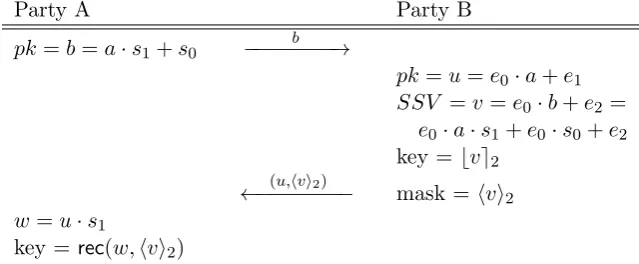
We begin with an informal sketch of how the key exchange works. In the basic key exchange, the first party creates a public keyb=a·s1+s0 and transmits that to the second party. Upon
receipt of the public key b, the second party creates his public key u = e0 ·a+e1 and his
version of the approximate shared secretv=e0·b+e2 =e0·a·s1+e0·s0+e2. Upon receipt
of the public key u and masking bits, the first party forms her version of the shared secret
w=u·s1 =e0·a·s1+e1·s1, and feedswand the received masking bits into the reconciliation
function to recover the key stream. Sinces0, s1, e0, e1, e2 are all small, w≈v and the masking
bits provide sufficient information for the two parties to exactly agree; however, for adversaries, the masking bits do not give any help in determining what the underlying key bit will be.
Party A Party B
pk=b=a·s1+s0 −−−−−−−−b →
pk=u=e0·a+e1
SSV =v=e0·b+e2 =
e0·a·s1+e0·s0+e2
key =bve2
(u,hvi2)
←−−−−−−−− mask =hvi2
w=u·s1
key = rec(w,hvi2)
Figure 1: Basic key exchange algorithm.
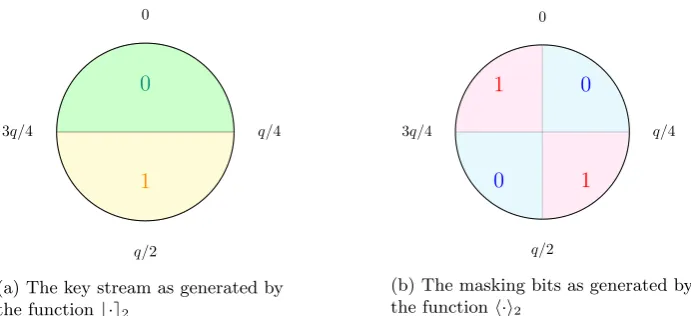
The key stream that the two users will agree upon will be generated by applying the modular rounding function b·e2 to each coefficient of the shared secret to round to the closer of 0 or q2.
In order for the two parties to achieve exact agreement, the second party also sends over the “masking bits” for his version of the approximate shared secret as generated by the functionh·i2
q/4
q/2 3q/4
0
0
1
(a) The key stream as generated by the functionb·e2
q/4
q/2 3q/4
0
0
0
1
1
(b) The masking bits as generated by the functionh·i2
Figure 2: The key stream and mask bits generating functions.
3.2 Randomized Rounding
For full detail on each of the functions required to generate the key stream and masking bits, the reconciliation function, and proofs of the claims, we refer the reader to [15]. For completeness we provide the necessary definitions and claims here.
We begin by partitioning the elements of v∈Zq into four quadrants as
I0 :=Zq∩[0, q/4) I10 :=Zq∩[q/4, q/2)
I00 :=Zq∩[q/2,3q/4) I1:=Zq∩[3q/4, q)
Then we define ourrandomized roundingprocedure to make probabilistic nudges on the bound-aries of the quadrants in order to balance the relative probabilities of I0∪I00 and I1∪I10. This
is defined for the two separate cases:
• q≡1 (mod4). |I0|>|I00|=|I1|=|I10|so we need to map out of I0. If v= 0, we draw a
uniform random bit and map 0 to either itself orq−1 depending on the bit. This moves an element from I0 toI1 with 50% probability. Independently, if v= (q−1)/4, we map
(q−1)/4 to either itself or (q+ 3)/4 depending on a random bit, thus moving an element from I0 toI10 with 50% probability.
• q≡3 (mod4). |I0|=|I00|=|I10|>|I1| so we need to map into I1. If v = 0, we draw a
uniform random bit and map 0 to either itself orq−1 depending on the bit. This moves an element from I0 toI1 with 50% probability. Independently, ifv= (3q−1)/4, we map
This randomized rounding procedure produces a similar effect to the dbl(·) procedure from [14], without the additional computational burden of mapping all elements of Zq into Z2q and with fewer random bits needing to be sampled. We will denote the randomized rounding of v by ¯v
and apply it before deriving mask and key bits.
3.3 Reconciliation mechanism
We define the modular roundingfunctionb·e2 :Zq→Z2 as
bve2 :=b
2
q ·ve (mod 2).
We will use bv¯e2 to generate the key stream, which will not be biased due to the use of ran-domized rounding. As in [14], we define thecross rounding functionh·i2 :Zq→Z2 as
hvi2 :=
4 q ·v
(mod 2).
Equivalently, h¯vi2 is the b∈ {0,1}such that ¯v ∈Ib∪Ib0. We use hv¯i2 to generate the masking
bit-string. If v is uniform random inZq, thenh¯vi2 will be biased inZ2 despite the randomized
rounding. Regardless of this bias, however,hv¯i2 hides bv¯e2 perfectly:
Claim 1. If v ∈Zq is uniform random and randomized rounded as outlined above, then bve2
is uniform random given hvi2.
LetE := [−q/8, q/8)∩Z, and define the reconciliationfunction rec :Zq×Z2→Z2 as
rec(w, b) :=
(
0 ifw∈Ib+E (mod q) 1 otherwise.
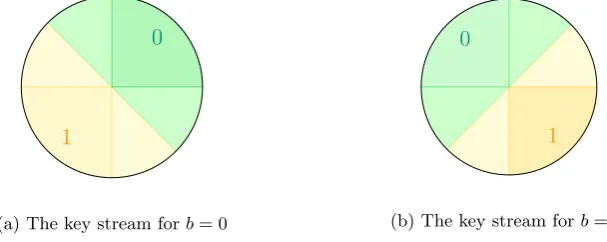
In effect, the reconciliation function takes the received mask bit b and uses this knowledge of the other party’s quadrant to tilt the key stream function b·e2 from Figure 2 by q/8:
0
1
(a) The key stream forb= 0
0
1
(b) The key stream forb= 1
Provided the difference between shared secrets |w−¯v| is no more than one-eighth q then the shared secrets are sufficiently close that the recipient can infer which quadrant ¯v was in, hence infer the key bit bv¯e2.
Claim 2. If w=v+e (modq) for some v∈Zq and e∈E, then rec(w,hvi2) =bve2.
We extend the rounding and reconciliation functions to the cyclotomic ring R by applying the functions coordinate-wise to the Zq-coefficients of the inputs with respect to the power basis. Formally, ifv∈Rqhas coefficientsvj ∈Zq, thenbve2 := (bvje2)∈Zn2 and similarly forhvi2. The
reconciliation function can be extended to rec :Rq×Zn2 →Zn2 by setting rec(w, b) := (rec(wj, bj)) wherewj ∈Zq are the coefficients of wand b= (bj)∈Zn2.
4
Ring-LWE Key Exchange
In [14], Peikert presents a ring-LWE based Diffie-Hellman-type key exchange algorithm that is provably passively secure, and then shows how to use this basic primitive to construct provably actively secure key exchanges and provably secure authenticated key exchanges. Each of the variants can be presented in the prime setting under consideration in this paper. However, for brevity, we will only present the basic key exchange; see [15] for the other variants.
The passively secure key encapsulation mechanism (KEM1) is constructed using the reconcil-iation technique from Section 3 to allow the two parties to derive an ephemeral key from a pseudorandom value inRq on which they approximately agree. The parameters for KEM1 will be (m, q, a, χ) where
• m is prime, and son=φ(m) =m−1;
• q is an odd prime integer such that q≡1 (mod m);
• ais a fixed element of the ring Rq :=Z/qZ[ζm]=∼Zq[x]/hΦm(x)i; and
• χ is an error distribution overRq.
We will denote by Sample(χ) the function used to sample error terms from χ. For exam-ple, this could be GaussSample(σ) for the discrete Gaussian with standard deviation σ, or UniformSample(B) for the uniform distribution on the interval {−B, . . . , B}.
Key generation samples error terms from χ to produce a private key (s0, s1), and combines it
with the generator a to form the public key. Note that decapsulation only needss1 so we can
KEM1.Generate
Input: Domain parameters (m, q, a, χ) Output: Private keys1 and public keyb
s0 ←Sample(χ)
s1 ←Sample(χ)
b←s1·a+s0 ∈Rq
Encapsulation6 takes the recipient’s public keyband produces a shared keyµand a ciphertext
c. The shared keys will belong to K = {0,1}n and their corresponding encapsulations will belong toC=Rq×Zn2.
KEM1.Encapsulate
Input: Recipient’s public keyb
Output: Shared keyµ and encapsulationc e0 ←Sample(χ)
e1 ←Sample(χ)
e2 ←Sample(χ)
u←e0·a+e1 ∈Rq
v←e0·b+e2∈Rq ¯
v←RandomizedRound(v)
µ← bv¯e2 ∈Zn2
c←(u,hv¯i2)∈Rq×Zn2
Decapsulation forms the approximate shared secret
w=u·s1=e0·a·s1+e1·s1 ≈e0·a·s1+e0·s0+e2 =e0·b+e2 =v
and uses the reconciliation mechanism from Section 3 to derive the shared secret key µ.
KEM1.Decapsulate
Input: Recipient’s private keys1 and encapsulation c
Output: Shared keyµ
(u, v0)←c w←u·s1 ∈Rq
µ←Rec(w, v0)
Lemma 1 (Lemma 4.1 from [14]). The KEM1 is IND-CPA secure, assuming the hardness of R-DLWEq,χ given two samples.
Proof. Analogous to the proof of Lemma 4.1 from [14].
6
5
Analysis
5.1 Instantiating the parameters
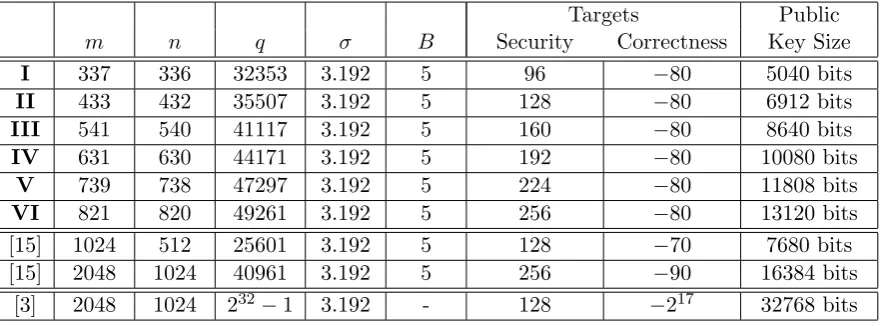
We would like to choose concrete parameters that can be tested as practical candidates. Allow-ing m to be any prime offers much greater flexibility for parameter selection than the power-of-two case. Our aim is to use this flexibility to reduce the public key length while maintaining security and correctness. In order to so, we refer to the guidance in Section 4.4 of [14] on how to set the lattice dimensionn=φ(m) and modulus q.
The security analysis in [14] gives a practical bound on the size of the modulus of q ≈n(3/2). We will also chooseq ≡1 (mod m) to maintain consistency with the proof of security for Ring-LWE. Thus, for a given m we search for the smallestq > n(3/2) that is congruent to 1 modulo
mand provides a failure rate of at most 2−80. We then select the pairs (m, q) with the smallest public keys that achieve a range of target security levels between 96 and 256 bits.
Targets Public
m n q σ B Security Correctness Key Size
I 337 336 32353 3.192 5 96 −80 5040 bits
II 433 432 35507 3.192 5 128 −80 6912 bits
III 541 540 41117 3.192 5 160 −80 8640 bits
IV 631 630 44171 3.192 5 192 −80 10080 bits
V 739 738 47297 3.192 5 224 −80 11808 bits
VI 821 820 49261 3.192 5 256 −80 13120 bits
[15] 1024 512 25601 3.192 5 128 −70 7680 bits
[15] 2048 1024 40961 3.192 5 256 −90 16384 bits
[3] 2048 1024 232−1 3.192 - 128 −217 32768 bits
Figure 4: Our parameters compared with previousm= 2` parameters.
5.2 Security
To estimate the security of each parameter set we rely on the analysis from [1], and the associated code [2], which provides approximate costs for a range of different attacks. Although intended for LWE, we will apply it to LWE by using the approach from [8]. This embeds the Ring-LWE problem in an Ring-LWE problem and allows the number of samples to vary. It is possible that this technique may cause issues with attacks which require very large numbers of samples, such as BKW, but these are not among the best attacks on the chosen parameters.
We also update the estimate of the cost of lattice sieving used in the lattice-based attacks. The assumption in [1] is that HashSieve [6] is used which has an asymptotic complexity of 20.3366k+o(k). To set the constant term they quote experimental results from [6] which suggest
a cost of 20.45k+12.31 cycles for smallk. However, more recent results using a parallel version of HashSieve [12] give a least-squares approximation of 20.3377k+17.76 cycles for lattice dimensions 86≤k≤96. This is a better match for the asymptotic complexity so we will estimate the cost of lattice sieving as 20.3377k+17.76 cycles for small k and 20.3366k+17.76 cycles more generally.
MitM BKW SIS Dec Kannan
Target bop mem L bop mem L bkz2 sieve L bop enum L bkz2 sieve L
I 96 305 301 9 184 176 169 126 116 28 104 88 21 113 104 15
II 128 388 384 9 230 222 214 185 150 40 160 144 45 176 133 15
III 160 482 478 9 282 273 265 258 184 44 216 200 45 258 167 16
IV 192 560 556 9 324 316 308 325 215 52 270 254 45 334 196 16
V 224 654 650 10 370 362 353 411 251 59 339 323 46 437 233 16
VI 256 725 721 10 408 400 391 481 280 65 395 380 46 521 261 16
Figure 5: Attack estimates for parameters with uniform noise (B = 5)
MitM BKW SIS Dec Kannan
Target bop mem L bop mem L bkz2 sieve L bop enum L bkz2 sieve L
I 96 295 292 9 184 175 168 125 115 28 102 86 21 112 103 15
II 128 376 372 9 229 221 213 183 149 40 159 143 45 174 132 15
III 160 467 463 9 281 273 264 254 185 48 214 198 45 253 165 16
IV 192 542 539 9 323 315 307 321 215 54 266 251 45 330 194 16
V 224 633 629 10 369 361 352 407 250 59 336 320 46 431 231 16
VI 256 702 698 10 407 399 390 476 277 63 390 374 46 514 259 16
Figure 6: Attack estimates for parameters with Gaussian noise (σ = 3.192)
For the meet-in-the middle (MitM) and BKW attacks, “bops” gives the cost in log2 cycles, “mem” gives the log2 memory requirements and L is the log2 number of LWE samples. For the distinguishing (SIS) and unique SVP (Kannan) attacks, “bkz2” and “sieve” give the cost of using BKZ 2.0 with pruned enumeration and lattice sieving, respectively. For the bounded-distance decoding (Dec) attack, “bops” gives the overall cost of the attack in cycles and “enum” gives the number of enumerations needed in the decoding stage. From Tables 5 and 6 it is clear that the best attacks on our parameters are comfortably above the target security levels.
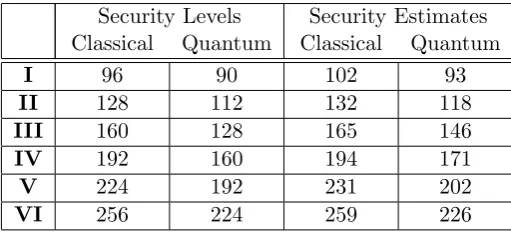
its security against a quantum attacker. In [7], Laarhoven et al. give a quantum variant of HashSieve with an asymptotic complexity of 20.286k+o(k). We introduce a quantum variant into the code from [2] by utilising this calculated quantum complexity and maintaining the constant as before. While quantum attacks may improve, and perhaps would be expected to once a quantum computer becomes available, these results provide an interesting insight into security in a post-quantum world.
Security Levels Security Estimates Classical Quantum Classical Quantum
I 96 90 102 93
II 128 112 132 118
III 160 128 165 146
IV 192 160 194 171
V 224 192 231 202
VI 256 224 259 226
Figure 7: Classical and quantum security for our parameters.
5.3 Correctness of the scheme
For the system described in Section 4, we need each coefficient of the error term to be bounded by q/8; that is, we must have that ||s0e0 +e2 −s1e1||∞ < bq/8c in order to be guaranteed
correctness of the algorithm. This comes from Claim 2 of Section 3, being the maximum difference between shared secret values such that the reconciliation function still produces the correct key. To conduct a direct analysis of the growth of the coefficients of the error term, we will consider the power and decoding bases separately, beginning with a consideration of multiplication in each basis.
5.3.1 Power basis
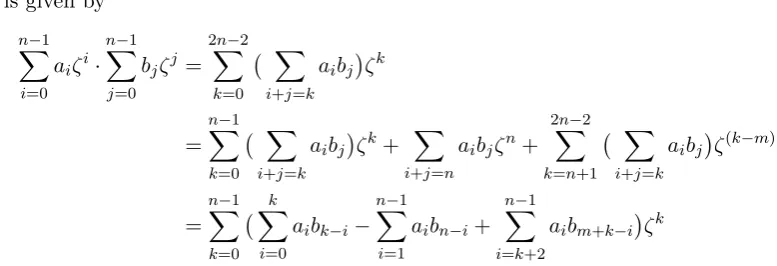
Multiplication in the power basis is fairly straightforward. Recall thatR:=Z[ζ] =Z[x]/hΦm(x)i= Z[x]/hxn+· · ·+x2+x+ 1i forζ a primitive mth root of unity and n=φ(m) =m−1. If we multiplyζi·ζj then we just need to reduce modulo the equation Φm(x) = 1 +x+x2+· · ·+xn, so ζn = −1 −ζ2 − · · · − ζn−1. Let a ∈ Rq be written as Pni=0−1aiζi, and similarly let
b = Pn−1
Rq is given by
n−1
X
i=0
aiζi· n−1
X
j=0
bjζj =
2n−2
X
k=0
X
i+j=k
aibj
ζk
= n−1
X
k=0
X
i+j=k
aibj
ζk+ X i+j=n
aibjζn+
2n−2
X
k=n+1
X
i+j=k
aibj
ζ(k−m)
= n−1
X
k=0
k
X
i=0
aibk−i− n−1
X
i=1
aibn−i+ n−1
X
i=k+2
aibm+k−i
ζk
Thus we see that each coefficient of a product of two elements in the power basis consists of a sum of 2n−2 terms, each term being the product of two independent random variables.
If we create the private keys and error vectors by drawing coefficients of the power basis uni-formly at random from {−B, . . . ,0, . . . , B}, then it is fairly simple to directly analyse the correctness of the system and compute specific probabilities of failure. In this case, each of the ai and bj are independent random variables following a uniform distribution over the set {−B, . . . ,0, . . . , B}. The product of two such random variables is itself a random vari-able over {−B2, . . . ,0, . . . , B2} and the sum of such variables yields a convolution of their distributions. Thus the coefficients of a product a· b are random variables with support
{−(2n−2)·B2, . . . ,0, . . . ,(2n−2)·B2}.
We can calculate the probability that ||s0e0+e2−s1e1||∞<bq/8c by considering the correct
convolution of probability distributions. If we wish to consider the probability of failure of the key exchange, we must recognise that there are n coefficients, each of which could exceed the
q/8 bound. However, the q/8 bound is only tight for coefficients falling at the boundary of a quadrant: {0,±bq/4e,bq/2e}. Most coefficients will not lie on or near these boundaries, which will lead to a higher permissible bound. For each of our proposed parameter sets, we calculate the probability that a coefficient exceedsq/8 or that a key exchange failure will occur and record these in Table 8.
I II II IV V VI
Target -80 -80 -80 -80 -80 -80
Coefficient Failure -91.751 -86.109 -92.112 -91.146 -89.272 -87.208 Agreement Failure -91.300 -85.204 -90.985 -89.782 -87.650 -85.401
Figure 8: log2 failure probabilities for uniform noise (B = 5).
If error terms are generated by sampling a Gaussian distribution, then each of the independent random variables ai, bj comes from a discretised Gaussian distribution centered at 0 and with variance σ2. By invoking (a generalisation of) the Central Limit Theorem7, we can say that
7
each of the coefficients of the product is well approximated by a Gaussian distribution centered at 0 with variance (2n−2)σ4, and to approximate the coefficients ofs0e0+e2 −s1e1 we can
consider a Gaussian distribution centered at 0 with variance 2(2n−2)σ4+σ2.We estimate the probability that a coefficient exceeds q/8 or that a key exchange failure will occur and record these in Table 9.
I II II IV V VI
Target -80 -80 -80 -80 -80 -80
Coefficient Failure -88 -83 -89 -88 -86 -84 Agreement Failure -88 -82 -87 -86 -84 -82
Figure 9: log2 failure probabilities for Gaussian noise (σ = 3.192).
5.3.2 Decoding basis
If we instead use the decoding basis for R, then describing the multiplication of two elements is slightly more complicated. Let d~={di} be the decoding basis forR as described in Section 2.3.1. The product of two or more error terms in the decoding basis should also be multiplied byg:= 1−ζ to help control the growth of these noise terms. The product of (1−ζ) times two basis elements can be computed using algebra and is given by the formula
(1−ζ)·di·dj =di+jmodm−di−1 modm−dj−1 modm+dn−1.
Let a∈ Rq be written as Pni=0−1aidi and similarly let b= Pnj=0−1bjdj ∈Rq and set dn := 0 =:
an=bn. Then the product of two elements a, bin the decoding basis is given by
(1−ζ)· n−1
X
i=0
aidi
· n−1
X
j=0
bjdj
=
n−2
X
k=0
n−1
X
i=0
aib(k−i)modm− n−1
X
i=0
aib(k+1)modm− n−1
X
j=0
a(k+1)modmbj
dk
+ n−1
X
i,j=0
aibj+ n−1
X
i=0
aib(m−2−i)modm
dn−1
Thus we see that in this case the average coefficient of a product of two elements in the decoding basis consists of a sum of 3n terms, each term being the product of two independent random variables. Moreover, the coefficient of the basis element dn−1 is a sum of n2 +n summands,
each the product of two independent random variables. Thus we can see that the error terms grow more rapidly in the decoding basis than in the power basis and so we prefer the use of the power basis.8 If we wish to quantify the penalty incurred from using the decoding basis
8
in another way, we can calculate the probability of failure if secrets are chosen uniformly from random. For example if we consider parameter set I, the probability that a coefficient will be over the q/8 bound increases from 2−91.8 in the power basis to 2−62.0 in the decoding basis,
excludingthe final coefficient of dn−1.
5.4 Timings
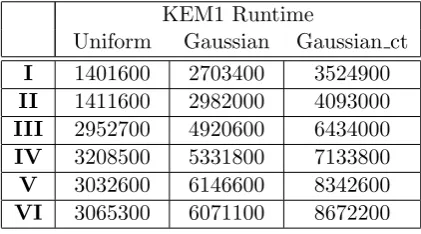
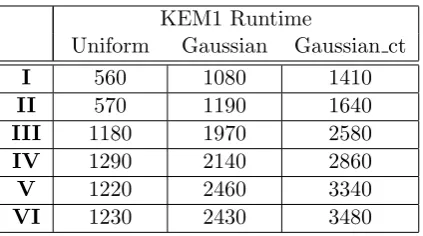
We have implemented the Ring-LWE ephemeral Diffie-Hellman key encapsulation mechanism of Section 4 in the lower level languageCin order to assess its performance. This code is available on the GitHub repository at https://github.com/vscrypto/ringlwe along with its bench-marking routines. We are grateful to the authors of [3] for the code accompanying their paper, from which we borrow the overall structure as well as the functions for performance timing, random number generation, and Gaussian sampling. The total runtime of the passively secure key exchange KEM1 is presented in Tables 10 and 11, made using a 1.9GHz Intel Core i5 4300U9 with code compiled using gccversion 4.9.2 with the -O3optimisation flag. The total runtime is the sum of the time for KEM1.Generate, KEM1.Encapsulate, and KEM1.Decapsulate. We include a constant time version of the Gaussian sampling method (gaussian ct) in order to eliminate a slight correlation of computation time to sampled value in the the standard version (gaussian). The uniform sampling method does not have this correlation. We shall investigate the anomaly that for uniform sampling, parameter sets IIIand IV are slower thanV andVI.
KEM1 Runtime
Uniform Gaussian Gaussian ct
I 1401600 2703400 3524900
II 1411600 2982000 4093000
III 2952700 4920600 6434000
IV 3208500 5331800 7133800
V 3032600 6146600 8342600
VI 3065300 6071100 8672200
Figure 10: Average cycle count of KEM1 for our parameters and sampling methods
borne out by experimentation where thedn−1 term can frequently be the cause of failure of the key exchange for
various choices of parameters, and the expected correctness of the key exchange is lower for the decoding basis than for the power basis. Happily, the power basis is also simpler to use. If the decoding basis is chosen for some reason, we advocate the dropping of the final coefficient term, as this will markedly improve the performance of the system.
9Processor has two cores which can each run two threads at 1.9GHz using Hyper Threading. The clock rate
KEM1 Runtime
Uniform Gaussian Gaussian ct
I 560 1080 1410
II 570 1190 1640
III 1180 1970 2580
IV 1290 2140 2860
V 1220 2460 3340
VI 1230 2430 3480
Figure 11: Average time of KEM1 in micro seconds (1 µs= 10−6 s) for our parameters and sampling methods
6
Conclusions
The ring learning with errors problem is a promising cryptographic primitive that is believed to be resistant to attacks by quantum computers. The decision ring-LWE problem naturally leads to a passively secure Diffie-Hellman-like unauthenticated key exchange protocol, which can readily be extended to an actively secure version and an authenticated version. We have examined these key exchange mechanisms and provided both practical analysis and more prac-tical parameter choices than were previously available. By considering prime cyclotomic rings, we are able to produce a wider array of parameter choices and achieve smaller public keys. The performance timings give a sense for an increased computational cost, and therefore a trade-off that may be appealing depending on the application. We also provide the first in-depth anal-ysis of a specific usage other than the power-of-two case, which has produced some interesting insights into the functioning of the decoding basis.
We plan to continue and expand upon this work in a number of ways. We plan to undertake further coding implementations to compare the performance against classical mechanisms like RSA or Diffie-Hellman. We would also like to explore related signature algorithms.
References
[1] M. R. Albrecht, R. Player, and S. Scott. On the concrete hardness of Learning with Errors.
http://eprint.iacr.org/2015/046.
[2] M. R. Albrecht. Sage code for [1].https://bitbucket.org/malb/lwe-estimator.
[3] J. W. Bos, C. Costello, M. Naehrig, and D. Stebila. Post-quantum key exchange for the TLS protocol from the ring learning with errors problem.http://eprint.iacr.org/2014/599.
[5] Y. Elias, K. E. Lauter, E. Ozman, and K. E. Stange. Provably weak instances of Ring-LWE. In submission. Avaliable at http://eprint.iacr.org/2015/106.
[6] T. Laarhoven. Sieving for shortest vectors in lattices using angular locality-sensitive hash-ing. http://eprint.iacr.org/2014/744.
[7] T. Laarhoven, M. Mosca and J. van de Pol. Finding shortest lattice vectors faster using quantum search.http://eprint.iacr.org/2014/907.
[8] T. Lepoint and M. Naehrig. A comparison of the homomorphic encryption schemes FV and YASHE. In David Pointcheval and Damien Vergaud, editors, AFRICACRYPT, volume 8469 of Lecture Notes in Computer Science, pages 318-335. Springer, 2014.
[9] R. Linder and C. Peikert. Better key sizes (and attacks) for LWE-based encryption. In
CT-RSA’11, pages 319-339, 2011.
[10] V. Lyubashevsky, C. Peikert, and O. Regev. On ideal lattices and learning with errors over rings.Journal of the AMC, 60(6):43:1-43:35, November, 2013. Preliminary version in
EUROCRYPT, pages 1-23, 2010.
[11] V. Lyubashevsky, C. Peikert, and O. Regev. A Toolkit for Ring-LWE Cryptography. In
EUROCRYPT’13, pages 35-54. 2013.
[12] A. Mariano, T. Laarhoven, and C. Bischof. Parallel (probable) lock-free HashSieve: a practical sieving algorithm for the SVP.http://eprint.iacr.org/2015/041.
[13] D. Micciancio and O. Regev. Lattice-based cryptography. In Daniel J. Bernstein, Jo-hannes Buchmann, and Erik Dahmaen, editors, Post-Quantum Cryptography, pages 147-191. Springer Berlin Heidelberg, 2009.
[14] C. Peikert. Lattice Cryptography for the Internet. In Michele Mosca, editor,Proc. 6th Inter-national Conference on Post-Quantum Cryptography (PQCrypto) 2014, LNCS 8772, pages 197-219. Springer, 2014. Full version available athttp://eprint.iacr.org/2014/070
[15] V. Singh. A Practical Key Exchange for the Internet using Lattice Cryptography.