A Note for the Ideal Order-Preserving Encryption
Object and Generalized Order-Preserving Encryption
Liangliang Xiao University of Texas at Dallas
I-Ling Yen
University of Texas at Dallas [email protected]
Abstract
Order-preserving encryption (OPE) preserves the order of data in their ciphertexts and, hence, allows range search on the encrypted data without needing to decrypt them. Security analysis of OPE schemes is very important because OPE is not a perfect encryption algorithm (the ciphertexts leak the ordering information of the plaintexts). Most of the existing security analysis for the OPE schemes are informal: they are either based on author-defined attacks or experiments. The authors in [4] initiates the cryptographic study of the OPE scheme. They define the security notion POPF-CCA to qualify the security of OPE. In POPF-CCA, the “ideal” OPE object is defined where the encryption function is uniformly randomly selected from all order-preserving functions (generally the “ideal” OPE object is not computationally feasible), and a (constructed) “real” OPE scheme is secure under POPF-CCA if it is computationally indistinguishable from the ideal object. In other words, although the “ideal” OPE object is not computationally feasible, it is used as the security goal, and a (constructed) “real” OPE scheme is secure if it is as secure as the “ideal” OPE object. Such approach conceives the assumption (but not clearly stated and proved) that the “ideal” OPE object is the most secure OPE. But the correctness of the assumption is an easily ignored problem.
In this paper, we investigate the security of the OPE in more depth. We first give example to show that the “ideal” OPE object may not always be the most secure OPE. It indicates that we need to use the “ideal” encryption object more cautiously in the security analysis of OPE. Additionally we extend the concept of OPE to generalized OPE (GOPE). Unlike OPE, the ciphertexts of GOPE may not be numbers, but GOPE still enables the comparisons on the encrypted data without needing to decrypt them. We present two GOPEs in polynomial-sized and superpolynomial-sized domains that satisfy stronger notions of security than that of the ideal OPE object, respectively.
Key Words: Order-preserving encryption; range query processing; ideal OPE object and gener-alized OPE; big jump attack and small jump attach; IND-OCPA and IND-OLCPA.
1
Introduction
on encrypted data without needing to decrypt them and expose them to potential attackers who may have compromised the system. The OPEs do not have perfect security since the ciphertexts leak the ordering information of the plaintexts. But on the other hand, when it is desirable to have a reasonable performance for range query processing while achieving a reasonable degree of security protection, the OPE scheme can be used as long as there is a good understanding of its security risks. However, how secure is the OPE scheme has not been sufficiently analyzed and further research is needed to investigate its security properties.
There are various constructions of the OPE scheme. In [3], the proposed OPE algorithm first generates a sequence of random numbers and then encrypts an integer x to the sum of the first
x random numbers. In [10], a sequence of strictly increasing polynomial functions are used to construct the OPE algorithm. The encryption of an integer x is the outcome of the iterative operations of those functions on x. In [7], the OPE algorithm is constructed by using a mapping function composed of partition and identification functions. The partition function divides the range into multiple partitions, and the identification function assigns an identifier to each partition. Then, the mapping function maps an integer x to an identifier. Since different integers may be mapped to the same identifier, the OPE algorithm may output false comparison results. In [1], the authors construct the OPE algorithm following three steps: modeling the input and target distributions, flattening the plaintext database into a flat database, and transforming the flat database into the cipher database. However, security analysis for these and other OPE algorithms has not been fully investigated.
Some partial security analysis has been performed on some OPE algorithms. In [1], the authors construct an OPE scheme and analyze its security, but the analysis has some limitations: (1) It assumes that the adversaries can only view ciphertexts. (2) The analysis is not based on crypto-graphic analysis, but based on experiments, i.e., they use Kolmogorov-Smirnov test to show that the distribution of the ciphertexts and the target distribution cannot be distinguished. The au-thors in [4] initiate the cryptographic study of the OPE scheme. They define the security notion IND-OCPA where the adversary can only query the left-or-right encryption oracle with ordered plaintext pairs. An encryption scheme is secure under IND-OCPA if the advantage of an efficient adversary (probability to distinguish whether the returned ciphertexts are encrypted from the left or the right plaintexts) is negligible. IND-OCPA is the highest security notion (with respect to indistinguishability and left-or-right encryption oracle) for OPE algorithms. However, it can be shown that the OPE scheme is susceptible to the big jump attack, and cannot be secure under IND-OCPA unless its ciphertext-space is exponential in the size of the plaintext-space. Then the paper takes an alternative approach: It defines the security notion POPF-CCA and constructs an OPE scheme that is secure under POPF-CCA. In POPF-CCA, the “ideal” OPE object is defined where the encryption function is uniformly randomly selected from all order-preserving functions (the “ideal” OPE object is not computationally feasible), and a “real” OPE scheme is secure if it satisfies the security implied by the ideal OPE object. In other words, although the “ideal” OPE object is not computationally feasible, it is used as the security goal, and a “real” OPE scheme is secure if it is computationally indistinguishable from the “ideal” OPE object. Such approach conceives the assumption (but not clearly stated and proved) that the “ideal” OPE object is the most secure OPE. But unfortunately, the assumption of the ideal OPE object has not been proved.
SEis secure under IND-OCPA, and prove that the ideal OPE objectSE∗for [m] and [n] is not secure under IND-OCPA. For SE the encryption function E maps 1 to a random element r in [1, n−1] and maps 2 to r+ 1. We compute the statistical distance between the probability distribution of ciphertexts for plaintext 1 and the probability distribution of ciphertexts for plaintext 2, and prove that it is negligibly small. Based on this fact, we prove that the success probability of every attack against SE in IND-OCPA is also negligibly small. For the ideal OP E object SE∗, we compute the statistical distance between the probability distribution of ciphertexts for plaintext 1 and the probability distribution of ciphertexts for plaintext 2, and prove that it is significant (greater than a positive constant). Based on this fact, we design an attack to distinguish left plaintext 1 and right plaintext 2 according to the returned ciphertexty by comparing the conditional probabilities Pr[y|1] and Pr[y|2]. We therefore prove that the success probability of the attack against SE∗ in IND-OCPA is non-negligible. Our proofs indicate that we need to use the “ideal” OPE object more cautiously in the security analysis of OPE.
Then we present two generalized OPE (GOPE) algorithms in polynomial-sized and superpolynomial-sized domains that satisfy stronger notions of security than the ideal OPE object, respectively. The difference between OPE and GOPE lies in that the ciphertexts of OPE are numbers while the ci-phertexts of GOPE are allowed to be general mathematical objects. Hence, the GOPE scheme requires a special comparison algorithm to compare the ciphertexts. First, we analyze the security of the ideal OPE object and show that it is not secure under IND-OCPA even in polynomial-sized domains. To demonstrate the existence of a GOPE algorithm that is secure under IND-OCPA in polynomial-sized domains, we constructSE2, in which the ciphertextyi for plaintextxi is a “set”.
An element in yi is a share of the relation between xi and xj, for all j 6= i. When comparing
xi and xj, the matching pair of shares from xi and xj, namely, si,j and sj,i, can be retrieved to
reconstruct the relation (xi< xj orxi > xj). We show thatSE2 is secure under IND-OCPA. Next,
we weaken the security notion from IND-OCPA to IND-OLCPA for OPE and GOPE schemes in superpolynomial-sized domains. To prevent an adversary from launching the big jump attack, IND-OLCPA has one more constraint to the adversary compared to IND-OCPA, the range of plaintexts in the oracle queries is bounded by a polynomialg1, i.e., the difference between the largest and the
smallest plaintexts in the oracle query is less than or equal tog1. However, it can be shown that
an efficient adversary can still have a non-negligible advantage against any OPE algorithm under IND-OLCPA. We design a small jump attack to prove this. Unlike the big jump attack where the range of plaintexts in the oracle queries ism−1, in the small jump attack, the range of plaintexts in the oracle queries is 3. Nevertheless, the lower bound on the advantage of an adversary against any OPE algorithm under IND-OCPA is 1; while the lower bound on the advantage of an adversary against any OPE algorithms under IND-OLCPA decreases to 1g, where g is a polynomial. With IND-OLCPA and considering superpolynomial-sized domains, we show that the ideal OPE object cannot achieve the lower bound on the advantage of an adversary. Hence, we construct another GOPE algorithm, SE3, which achieves the lower bound on the advantage of an adversary under IND-OLCPA.SE3 is constructed based on two building blocks SE4 and SE5. SE4 is adapted from
SE2 such that the ciphertext of a plaintextxi is a set, including the shares of the relations between
xi and g2−1 plaintexts that are closest to xi, where g2 is a polynomial. We prove that SE4 is
secure under IND-OLCPA if g2 ≥2g1+ 1. Note that SE4 can only support comparison between
two plaintexts whose difference is bounded by g2−1
2 . SE5 is designed to facilitate the comparison
between two plaintextsxi andxj, where|xi−xj| ≥ g22−1. Thus, ciphertextsyi andyj inSE5 should
preserve the order of the corresponding plaintexts xi and xj, when |xi −xj| ≥ g22−1. Note that
also guarantee that the ciphertexts yi and yj have a small statistical distance if |xi −xj| ≤ g1.
With these two requirements, we construct SE5 as follows: The ciphertexts of the first l(for some l, l > g1) plaintexts x1 to xl are randomly selected numbers. The ciphertext of xj, j > l, is
yj =yj−l+ 1. This way, the two requirements are satisfied. SinceSE3 includes SE4 and SE5, for
any pair of plaintexts, either SE4 or SE5 will fulfill the comparison task. Also, since the attacker
can only query plaintexts within the range g1, the ciphertexts fromSE4 are indistinguishable and
the ciphertexts fromSE5 have a small statistical distance. Thus, SE3 achieves the lower bound on the advantage of an adversary.
The rest of the paper is organized as follows. In Section 2 we introduce the primitives and how [4] proceeds the security analysis of OPE. In Section 3, we construct an example to prove that the ideal OPE object is not the most secure OPE. In Sections 4, 5, 6 we present two generalized OPE (GOPE) algorithms in polynomial-sized and superpolynomial-sized domains that satisfy stronger notions of security than the ideal OPE object, respectively. Specifically, in Section 4, we prove that the ideal OPE object is not secure under IND-OCPA in polynomial-sized domains. Then, the concept of the GOPE scheme and its construction is introduced. Also, we prove that GOPE is secure under IND-OCPA in polynomial-sized domains. In Section 5, we define the security notion IND-OLCPA, design the small jump attack, and derive a lower bound on the advantage of an adversary under IND-OLCPA in superpolynomial-sized domains. In Section 6, we show that the ideal OPE object does not achieve the lower bound on the advantage of an adversary under IND-OLCPA in superpolynomial-size domains. Also, a GOPE algorithm which can achieve the derived lower bound is constructed. Finally, we conclude the paper in Section 7.
2
Preliminaries
Let λ be the security parameter and ν be a negligible function. Let x ←−$ A denote that x is uniformly randomly selected from set A, x ←− X$ denote that randomized algorithm X returns valuex, andXY denote that algorithmX is accessible to oracleY. For positive integersm and n
satisfying m≤n, let [m] ={i|1≤i≤m} denote the domain of plaintexts and [n] ={i|1≤i≤n} denote the range of ciphertexts. The definition of the order-preserving encryption (OPE) scheme [4] is presented as follows.
Definition 2.1 (OPE scheme [4]). An OPE schemeSE = (K,E,D) is a deterministic symmetric-key encryption scheme, whereK:{0,1}∗ → {0,1}∗is a key generation algorithm,E : [m]×{0,1}∗ → [n] is a deterministic encryption algorithm, and D: [n]× {0,1}∗ →[m] is a decryption algorithm.
SE satisfies that
Pr[D(E(x, k), k) =x]>1−ν(λ)
for any x∈[m] and key k, and
E(x, k)<E(x0, k)
for any x < x0.
Definition 2.2 (IND-CPA). Let SE = (K,E,D) be a symmetric-key encryption scheme andb ∈ {0,1}. LetEk(LR(·,·, b)) be a left-or-right encryption oracle such that for queries{(xu0, xu1)}hu=1, it
returns
E(xub, k)←− E$ k(LR(xu0, xu1, b))
for 1≤u≤h. Let Abe an adversary that can access Ek(LR(·,·, b)) and finally returns a bit b0 as
a guess ofb. Consider the following experiment.
Experiment ExpIND-CPA-SE,A b
k←− K;$ b0 ←− A$ Ek(LR(·,·,b)); Returnb0
The encryption schemeSE is said to be secure under IND-CPA if for every probabilistic polynomial time (PPT) adversary A, the advantage ofA, defined by
AdvIND-CPASE,A = Pr[ExpIND-CPA-1SE,A = 1]−Pr[ExpIND-CPA-0SE,A = 1],
is bounded by a negligible function of the security parameter.
OPE schemes are not secure under IND-CPA because the ciphertexts leaks the ordering information of plaintexts. Consider the adversary queries (x10, x11) and (x20, x21), wherex10 < x20 and x11 ≥x21. If
b = 0, x10 and x20 will be encrypted, where x10 < x20; if b = 1, x11 and x21 will be encrypted where
x11 ≥x21. Since OPE preserves order, the adversary can distinguish whether the plaintexts are x10
and x20 or x11 and x21 by comparing the corresponding ciphertexts. Thus, the advantage of such adversary is 1.
Thus, the security notion is necessarily weakened to IND-OCPA (indistinguishability under ordered chosen-plaintext attack) [4], where the adversary is forbidden to query plaintexts with different orders.
Definition 2.3 (IND-OCPA [4]). IND-OCPA has the same definition as that of IND-CPA except that the adversary is only allowed to query {(xu0, xu1)}h
u=1, where the condition xu0 < xv0 ⇔ xu1 <
xv1,1≤u, v≤h is satisfied.
IND-OCPA is the highest security notion (with respect to indistinguishability and left-or-right encryption oracle) for OPE algorithms. However, it has been shown in [4] that OPE schemes are susceptible to the following the big jump attack under IND-OCPA.
Definition 2.4(Big jump attack [4]). Consider the following PPT adversaryABJ with three oracle queries in the experiment of security notion IND-OCPA.
Adversary ABJEk(LR(·,·,b)) x←− {1$ , ..., m−1}
y1 ←− Ek(LR(1, x, b))
y2 ←− Ek(LR(x, x+ 1, b))
y3 ←− Ek(LR(x+ 1, m, b))
In the big jump attack, the attacker chooses left plaintexts 1,x, andx+ 1, and the right plaintexts
x,x+ 1, andm, wherexis randomly selected from{1, ..., m−1}. From the ciphertexts, ify3−y2> y2−y1, then the attacker can guess that the right plaintexts were encrypted; if y3−y2 ≤y2−y1,
then the attacker can guess that the left plaintexts were encrypted. Since the distance between two ciphertexts can reflect, to some extent, the distance between the corresponding two plaintexts, such guess could have a high probability of being correct. The lower bound on advantage of the adversary has been derived in [4] and is cited in Lemma 2.5.
Lemma 2.5. AdvIND-OCPASE,A
BJ ≥1−
2 logn m−1.
Remark 1. Note that for efficient OPE, both logm and lognshould be bounded by a polynomial of λ. Therefore AdvIND-OCPASE,ABJ ≥ 1−ν(λ) if m is a superpolynomial of λ, which implies that it is impossible to construct an OPE that is secure under IND-OCPA if m is a superpolynomial of
λ. However, the lower bound on advantage of the adversary does not eliminate the possibility for designing an OPE scheme that is secure under IND-OCPA if m is bounded by a polynomial ofλ.
Because of the big jump attack, the authors in [4] take an alternative approach: They define the security notion POPF-CCA (pseudorandom order-preserving function under chosen-ciphertext attack) based on the ideal OPE object defined as follows.
Definition 2.6 (Ideal OPE Object [4]). Let [m] be the plaintext domain and [n] be the ciphertext range. The ideal OPE object SE∗ = (K∗,E∗,D∗) is defined as follows.
- K∗: It uniformly randomly selectsf ∈OP Em,n={f : [m]→[n]|x < x0 ⇔f(x)< f(x0)};
- E∗: For plaintextx, it returns f(x);
- D∗: For ciphertext y, it returns f−1(y).
For a “real” OPE scheme SE = (K,E,D), it is secure under POPF-CCA if it is computationally indistinguishable from the ideal OPE object SE∗ = (K∗,E∗,D∗). Formally, the security notion POPF-CCA is defined as follows.
Definition 2.7 (POPF-CCA [4]). Let the advantage of the adversary in POPF-CCA be
AdvPOPF-CCASE,A = Pr[k
$
← K :AE(k,·),D(k,·)= 1]−Pr[f ← K$ ∗ :AE∗(·),D∗(·) = 1].
The encryption schemeSE is said to be secure under POPF-CCA ifAdvPOPF-CCASE,A is bounded by a negligible function of the security parameter for every PPT adversary A.
Based on the security notion POPF-CCA, the authors in [4] construct a real OPE scheme and prove that it is secure under POPF-CCA. In other words, in their approach the ideal OPE object is used as the security goal and construct real OPE scheme to achieve that security goal. However, the problem is: is the ideal OPE object always the most secure OPE. We construct a counterexample to show the negative conclusion in the next section.
3
Counterexample and the Security Analysis
OPE scheme SE = (K,E,D) for [m] and [n] and prove that SE is secure under IND-OCPA, and prove that the ideal OPE object SE∗ for [m] and [n] is not secure under IND-OCPA.
Plaintext domain and ciphertext range: In this section, let m = 2 and n = 2λ where λ is the security parameter. Then the plaintext domain is [m] = {1,2} and the ciphertext range is [n] ={j|1≤j≤2λ}.
The real OPE scheme: First we construct a real OPE scheme SE = (K,E,D) as follows.
- K: It uniformly randomly selectsf ∈ {f : [m]→[n]|f(2) =f(1) + 1};
- E: For plaintextx, it returns f(x);
- D: For ciphertext y, it returnsf−1(y).
Unlike the ideal OPE object, in the real OPE scheme SE the encryption function is uniformly randomly selected from a subset of order-preserving functions. The encryption functionE has the property such that 1 is encrypted to a random elementrin [1, n−1] while 2 is encrypted tor+1. To show that the realOP EschemeSE is secure under IND-OCPA, we compute the statistical distance between the probability distribution of ciphertexts for plaintext 1 and the probability distribution of ciphertexts for plaintext 2, and prove that it is negligibly small. Based on this fact, we show that the success probability of every attack in IND-OCPA is also negligibly small.
Lemma 3.1. Let ∆be the statistical distance between E(1)and E(2). Then ∆ =ν(λ).
Proof. According to the definition ofE,E(i)∈[n] subjects to the probability distribution such that
Pr[E(1) =j] =
1
n−1 for 1≤j < n
0 for j=n and Pr[E(2) =j] =
0 for j= 1
1
n−1 for 1< j≤n
Thus
∆ = 1 2
X
j
|Pr[E(1) =j]−Pr[E(2) =j]|
= 1
n−1 = 1
2λ−1 =ν(λ).
Proposition 3.2. SE is secure under IND-OCPA. Specifically, AdvIND-OCPASE,A = ν(λ) for every PPT adversary A.
Proof. Note that the adversary has to query ordered plaintext pairs toLRin IND-OCPA and here are the all possible queries of the adversary: {(1,1)},{(2,2)},{(1,1),(2,2)},{(1,2)}, and{(2,1)}. We analyze the security of SE according to these queries.
(1) The adversary queries {(1,1)} toLR. In this case, since the left plaintext equals to the right plaintext, the returned ciphertexts cannot help the adversary to decide whether the left plaintext or right plaintext is encrypted. HenceAdvIND-OCPASE,A = 0.
(2) The adversary queries {(2,2)} or{(1,1),(2,2)} toLR. The situation is similar to that in (1) and henceAdvIND-OCPASE,A = 0.
(3) The adversary queries{(1,2)} toLR. According to Lemma 3.1,
(4) The adversary queries {(2,1)} to LR. The situation is similar to that in (3) and hence
AdvIND-OCPASE,A =ν(λ).
According to (1)-(4),AdvIND-OCPASE,A =ν(λ) for every PPT adversary A.
The ideal OPE object: According to Definition 2.6, the ideal OPE objectSE∗ = (K∗,E∗,D∗) is
defined as follows.
- K∗: It uniformly randomly selectsf ∈ {f : [m]→[n]|f(1)< f(2)};
- E∗: For plaintextx, it returns f(x);
- D∗: For ciphertext y, it returns f−1(y).
To show that the idealOP EobjectSE∗ is not secure under IND-OCPA, we compute the statistical distance between the probability distribution of ciphertexts for plaintext 1 and the probability distribution of ciphertexts for plaintext 2, and prove that it is significant (greater than a positive constant). Based on this fact, we design an attack to distinguish left plaintext 1 and right plaintext 2 according to the returned ciphertext y by comparing the conditional probabilities Pr[y|1] and Pr[y|2]. It can be shown that the success probability of the attack is non-negligible (greater than a positive constant).
Lemma 3.3. Let ∆∗ be the statistical distance between E∗(1) andE∗(2). Then ∆∗ = Ω(1).
Proof. Since|OP Em,n|= mn
and|{f ∈OP Em,n |f(i) =j}|= ji−−11
n−j m−i
, fori∈[m], E∗(i)∈[n] subjects to the negative hypergeometric distribution
j−1
i−1 n−j
m−i
n m
,1≤j≤n.
Thus
∆∗ = 1 2 X j
j−1 0
n−j m−1
n m
−
j−1 1
n−j m−2 n m = 1 2 X j
j−1 0
n−j
1
n
2
−
j−1 1
n−j
0 n 2 = P
j|n−2j+ 1|
2 n2
= n
2(n−1) ≥ 1
2 = Ω(1).
For the ideal OPE object, if 1 is encrypted to j, then 2 must be encrypted to [j+ 1, n], and hence there is more choices of the encryption of 2 if j is small; similarly if 2 is encrypted to j, then 1 must be encrypted to [1, j−1], and hence there is more choices of the encryption of 1 if j is large. Since the encryption function of the ideal OPE object is uniformly randomly selected from all order-preserving functions, 1 is more likelyto be encrypted to [1,n+12 ] and 2 ismore likely
Proposition 3.4. For the ideal OPE object SE∗ with the plaintext domain [m]and the ciphertext range[n], there exists an adversaryA who can distinguish plaintexts 1and 2with one oracle query under IND-OCPA such that AdvIND-OCPASE∗,A = Ω(1). In other words, the ideal OPE object SE∗ is
not secure under IND-OCPA.
Proof. Since|OP Em,n|= mn
and|{f ∈OP Em,n |f(i) =j}|= ji−−11
n−j m−i
, fori∈[m], E∗(i)∈[n] subjects to the negative hypergeometric distribution
j−1
i−1 n−j
m−i
n m
,1≤j≤n.
Note that
j−1 0
n−j m−1
n m
>
j−1 1
n−j m−2
n m
⇐⇒
n−j m−1
>(j−1)
n−j m−2
⇐⇒n−j−m+ 2>(j−1)(m−1)
m=2
⇐⇒n−j > j−1
⇐⇒j < n+ 1
2 .
Thus we construct the PPT adversaryAwith one oracle query in the experiment of security notion IND-OCPA as follows (note thaty6= n+1
2 sincen= 2
λ).
Adversary AEk∗(LR(·,·,b))
y ←− Ek∗(LR(1,2, b))
Return 0 if y < n+ 1
2
Return 1 if y > n+ 1
2 Then
AdvIND-OCPASE∗,A = Pr[ExpIND-OCPA-1SE∗,A = 1]−Pr[ExpIND-OCPA-0SE∗,A = 1]
= ∆∗= Ω(1).
Remark 2. The proofs in Lemma 4.1 and Proposition 4.2 can be generalized to show that the ideal OPE object is not secure under IND-OCPA for any plaintext domain [m] and ciphertext range [n].
We conclude the results in this section in the following theorem.
Theorem 3.5. The ideal OPE object SE∗ is not the most secure OPE for m = 2 and n = 2λ. Specifically, there exists a real OPE schemeSE secure under IND-OCPA while the ideal OPE object
SE∗ is not secure under IND-OCPA.
4
Ideal OPE and GOPE in Polynomial-sized Domain
4.1 Ideal OPE Object in Polynomial-sized Domain
Let SE∗ = (K∗,E∗,D∗) be the ideal OPE object [4]. Analogous to the proofs in Section 3, we
compute the statistical distance between the probability distribution of ciphertexts for plaintext 1 and the probability distribution of ciphertexts for plaintext 2, and prove that it is greater than a positive constant. Based on this fact, we design an attack to distinguish left plaintext 1 and right plaintext 2 according to the returned ciphertexty by comparing the conditional probabilities Pr[y|1] and Pr[y|2]. It can be shown that the success probability of the attack is a positive constant.
Lemma 4.1. Let SE∗ = (K∗,E∗,D∗) be the ideal OPE object with the plaintext domain [m] and the ciphertext range [n], where 2 ≤ m ≤ n. Let ∆ be the statistical distance between E∗(1) and
E∗(2). Then ∆ = Ω(1).
Proof. Since |SIFm,n|= mn
and |{f ∈SIFm,n |f(i) = j}|= ji−−11 n−j
m−i
, for i∈[m], E∗(i) ∈[n] subjects to the negative hypergeometric distribution
j−1
i−1 n−j
m−i
n m
,1≤j≤n.
Thus
∆ = 1 2 X j
j−1 0
n−j m−1
n m
−
j−1 1
n−j m−2
n m = 1 2 X j
1−(j−1)(m−1)
n−j−m+ 2
n−j m−1 n m = 1 2 X j
n−jm+ 1
n−j−m+ 2
m n
n−j n−1· · ·
n−j−m+ 2
n−m+ 1 .
Note that
n−jm+ 1
n−j−m+ 2 ≥ 1
2 ⇔2n−2jm+ 2≥n−j−m+ 2⇔j ≤
n+m
2m−1;
n−j n−1 ≥
m−1
m ⇔mn−mj ≥mn−m−n+ 1⇔j≤
n+m−1
m ;
· · ·
n−j−m+ 2
n−m+ 1 ≥
m−1
m ⇔mn−mj−m
2+ 2m≥mn−m2+m−n+m−1⇔j≤ n+ 1 m .
If 2nm ≥1, it can be verified that all the above inequalities hold for j≤ 2nm. Hence
∆≥ 1 2·
n
2m ·
1 2 ·
m n ·(
m−1
m )
m−1≥ 1
8e,
where (mm−1)m−1 = (1 + m1−1)−(m−1) ≥ 1
e form≥2. If n
2m <1, it can be verified that
n−jm+1
n−j−m+2 =
n−j
n−1 =· · ·=
n−j−m+2
n−m+1 = 1 for j= 1. Hence
∆≥ 1 2·
m n >
1 4.
Proposition 4.2. For the ideal OPE object SE∗ with the plaintext domain [m]and the ciphertext range [n], where 2 ≤m ≤n, there exists an adversary A1 who can distinguish plaintexts 1 and 2
with one oracle query under IND-OCPA such that AdvIND-OCPASE∗,A
1 = Ω(1).
Proof. Since |SIFm,n|= mn
and |{f ∈SIFm,n |f(i) = j}|= ji−−11 n−j
m−i
, for i∈[m], E∗(i) ∈[n]
subjects to the negative hypergeometric distribution
j−1
i−1 n−j
m−i
n m
,1≤j≤n.
Note that
j−1 0
n−j m−1
n m
>
j−1 1
n−j m−2
n m
⇔
n−j m−1
>(j−1)
n−j m−2
⇔n−j−m+ 2>(j−1)(m−1).
Consider the PPT adversary A1 with one oracle query in the experiment of security notion
IND-OCPA.
Adversary A1E
∗
k(LR(·,·,b))
y←− Ek∗(LR(1,2, b))
Return 0 ifn−y−m+ 2>(y−1)(m−1)
Returnb0 ←− {0$ ,1}ifn−y−m+ 2 = (y−1)(m−1) Return 1 ifn−y−m+ 2<(y−1)(m−1)
Then
AdvIND-OCPASE∗,A
1 = Pr[Exp
IND-OCPA-1
SE∗,A
1 = 1]−Pr[Exp
IND-OCPA-0
SE∗,A
1 = 1]
= ∆ = Ω(1).
Note that for encryption E∗ : [m]→[n], if the adversary retrieves plaintext ciphertext pair (x, y),
then E∗|{i|x+1≤i≤m} : {i | x+ 1 ≤ i ≤ m} → {j | y+ 1 ≤ j ≤ n} remains to be ideal OPE
encryption. Thus A1 can be extended to PPT adversary A2 to distinguish plaintexts x+ 1 and x+ 2, 1≤x≤m−2, with two oracle queries under IND-OCPA.
Corollary 4.3. For the ideal OPE object SE∗ with the plaintext domain [m] and the ciphertext range[n], where 2≤m≤n, there exists an adversaryA2 who can distinguish plaintexts x+ 1 and
x+ 2,1≤x≤m−2, with two oracle queries under IND-OCPA such that AdvIND-OCPASE∗,A
2 = Ω(1).
IND-OCPA.
Adversary A2Ek∗(LR(·,·,b))
x←− {1$ , ..., m−2}
y ←− Ek∗(LR(x, x, b))
y0 ←− Ek∗(LR(x+ 1, x+ 2, b))
Return 0 if n−y0−(m−x) + 2>(y0−y−1)(m−x−1)
Return b0 ←− {0$ ,1}ifn−y0−(m−x) + 2 = (y0−y−1)(m−x−1) Return 1 if n−y0−(m−x) + 2<(y0−y−1)(m−x−1)
Then AdvIND-OCPASE∗,A
2 = Ω(1) based on the same proof of Proposition 4.2.
Proposition 4.2 and Corollary 4.3 imply that the advantages of adversaries A1 and A2 against
SE∗ are greater than a positive constant, where 2 ≤m ≤n. Therefore, SE∗ is not secure under IND-OCPA in polynomial-sized domains.
4.2 Generalized OPE in the Polynomial-sized Domain
We define the concept of the generalized OPE (GOPE) scheme. Unlike OPE whose ciphertext-space is [n], GOPE adopts general mathematical objects as ciphertexts. Hence a special comparison algorithm is needed to compare the ciphertexts.
Definition 4.4(GOPE scheme). A GOPE schemeSE = (K,E,D,C) is a symmetric-key encryption scheme, where K : {0,1}∗ → {0,1}∗ is a key generation algorithm, E : [m]× {0,1}∗ → R is an encryption algorithm,D:R× {0,1}∗ →[m] is a decryption algorithm, andC:R×R→ {=, >, <}
is a comparison algorithm. SE satisfies that
Pr[D(E(x, k), k) =x]>1−ν(λ)
for any x∈[m] and key k, and
Pr[C(E(x, k),E(x0, k)) =w]>1−ν(λ)
for any xwx0 and w∈ {=, >, <}.
Next we construct the GOPE scheme SE2 = (K2,E2,D2,C2) withm being a polynomial of λ, and prove that it is secure under IND-OCPA. In SE2 the ciphertext y for plaintext x is a “set”. An
element iny is a share of the relation betweenxandx0, for all other plaintextsx0. When comparing
x and x0, the matching pair of shares from x and x0 can be retrieved to reconstruct the relation (x < x0 orx > x0). Let the symbol “<” encoded to 1∈Z3 and the symbol “>” encoded to 2∈Z3.
SE2 is constructed as follows.
-K2: Given the domain sizem, it randomly picks a permutationπof the set{(x, x0)|1≤x < x0≤
m}, and randomly generatesrxx0 ∈Z3 for 1≤x < x0 ≤m. It returns{π, rxx0 |1≤x < x0≤m};
- D2: For ciphertexty, it retrieves (any) two elements (i, s) and (i0, s0) from the sety, and returns plaintextx which appears in bothπ−1(i) and π−1(i0);
- C2: For ciphertexts y and y0, if y =y0, it returns =. Otherwise, it retrieves (i, s) from the set y
and (i, s0) from the sety0, ifs−s0 = 1, it returns<; ifs−s0 = 2, it returns >.
The efficiency, correctness, and security ofSE2 are presented in Lemma 4.5 and Theorem 4.6. Lemma 4.5. SE2 is efficient and correct.
Proof. The efficiency of SE2 and correctness of decryption algorithm can be easily verified. It suffices to verify the correctness of comparison algorithm. Forx =x0, sinceE2(x, k) =E2(x0, k), it
is correct for the comparison algorithm to return =. Forx6=x0, there exist uniquei, s, s0 such that (i, s)∈ E2(x, k) and (i, s0)∈ E2(x0, k). Ifx < x0,E2(x, k) ={...,(π(x, x0),1+rxx0), ...}andE2(x0, k) =
{...,(π(x, x0), rxx0), ...}, thus (1 +rxx0)−rxx0 = 1, hence it is correct for the comparison algorithm
to return <; ifx > x0,E2(x, k) ={...,(π(x0, x), rx0x), ...} andE2(x0, k) ={...,(π(x0, x),1 +rx0x), ...},
thusrxx0−(1 +rxx0) =−1 = 2, hence it is correct for the comparison algorithm to return >.
Theorem 4.6. SE2 is secure under IND-OCPA. Specifically,AdvIND-OCPASE2,A = 0.
Proof. Assume that the adversary queries {(xu0, xu1)}h
u=1 under IND-OCPA. According to the
re-striction under IND-OCPA, xu0 = xv0 ⇔ xu0 = xv0. Since it will not increase the advantage by querying two identical plaintexts pairs, it suffices to consider x10 < x20 < ... < x0h and x11 < x21 < ... < xh
1. Hence, the adversary views (E2(x10, k), ...,E2(xh0, k)) for b = 0, and the adversary views
(E2(x11, k), ...,E2(xh1, k)) otherwise. It suffices to prove that the above two probability distributions
are identical because it implies thatAdvIND-OCPASE2,A = 0.
We use mathematical induction onhto prove that the two probability distributions (E2(x10, k), ...,E2(xh0, k)) and (E2(x11, k), ...,E2(x11, k)) are identical. For h = 1, it is necessary to show that the
prob-ability distribution E2(x10, k) equals to the probability distribution E2(x11, k). We denote Π =
{(x, x0) | 1 ≤ x < x0 ≤ m}. Let Ij, 1 ≤ j ≤ m−1, be the probability distribution such that
Pr[I1 =i1, ..., Im−1 =im−1] = Qm−21
j=0(|Π|−j)
for (i1, ..., im−1)∈ Πm−1 and ij 6=ij0 ifj 6=j0. Let Sj,
1≤j≤m−1, be the uniform distribution onZ3. Then according to the construction of E2,
E2(x10, k) ={(Ij, Sj)|1≤j≤m−1}=E2(x11, k).
We assume that the two probability distributions are identical for h < h0. Forh=h0, we consider the following two conditional probability distributions
X =E2(xh
0
0 , k)| E2(x10, k) =y1, ...,E2(xh
0−1
0 , k) =yh0−1
and
Y =E2(xh10, k)| E2(x11, k) =y1, ...,E2(xh
0−1
1 , k) =yh0−1,
where yu ={(iuj, suj) ∈Π×Z3 |1≤j ≤m−1}, 1≤u≤h0−1. y1, ..., yh0−1 will affect E2(xh 0
0 , k)
(E2(xh10, k)). First, for 1 ≤ u ≤ h0 −1, there exists unique iuj (for some j) appears in E2(xh00, k) (E2(xh
0
j0) appears in yu0, 1 ≤ u0 6=u ≤h0−1; hence those iu
j0 will not appear in E2(xh
0
0 , k) (E2(xh
0
1 , k)).
Thus, let
¯
Πu ={iuj |iuj appears in yu but does not appear inyu0 for any 1≤u0 6=u≤h0−1},
1≤u≤h0−1. Then there exists iu
j ∈Π¯u such that (iuj, suj −1) appears in E2(xh
0
0 , k) (E2(xh
0
1 , k)),
1≤u≤h0−1. Note that the elements of a set do not have orders, without loss of generality, for 1≤u≤h0−1, let (Iu, Su) be the probability distribution such that Pr[(Iu, Su) = (iuj, suj−1)] = |Π¯1u|.
The rest probability distributions are similar to those for the situation ofh= 1. Let
¯
Π ={(x, x0)∈Π|(x, x0) does not appear inyu,1≤u≤h0−1}.
Forh0 ≤u≤m−1, letIu be the probability distribution such that Pr[Ih0 =ih0, ..., Im−1 =im−1] =
1 Qm−h0−1
j=0 (|Π¯|−j)
for (ih0, ..., im−1) ∈ Π¯m−h 0
and iu 6=iu0 if u 6=u0. LetSu,h0 ≤u ≤m−1, be the
uniform distribution onZ3. Then
X={(Iu, Su)|1≤u≤m−1}=Y. (1)
Consequently,
Pr[E2(x10, k) =y1, ...,E2(xh
0
0 , k) =yh0]
= Pr[E2(x10, k) =y1, ...,E2(xh
0
0 , k) =yh0]·Pr[X=yh0]
= Pr[E2(x11, k) =y1, ...,E2(xh
0
1 , k) =yh0]·Pr[Y =yh0] (induction hypothesis and (1))
= Pr[E2(x11, k) =y1, ...,E2(xh
0
1 , k) =yh0].
Hence it implies that the two probability distributions are identical for h = h0, which completes induction.
Remark 3. In order to improve the efficiency ofSE2,πandπ−1can be substituted with deterministic
symmetric-key encryption and decryption algorithms, andrxx0 can be generated by a pseudorandom
number generator. It is obvious that the improved scheme remains secure under IND-OCPA.
5
IND-OLCPA
Now we consider security notion for OP E schemes in superpolynomial-sized domains. Accord-ing to the big jump attack, if m is a superpolynomial of λ, then the adversary ABJ can have
AdvIND-OCPASE,ABJ ≥1−ν(λ) by using three oracle queries. From this we can conclude that IND-OCPA is too strong a security notion for OPE schemes in the superpolynomial-sized domain. Thus, we further weaken IND-OCPA and define the security notion IND-OLCPA (indistinguishability under ordered and local chosen-plaintext attack), where the range of the oracle queries is bounded by a polynomial of λ(to prevent the adversary from launching the big jump attack). The definition of IND-OLCPA is given as follows.
Definition 5.1 (IND-OLCPA). The security notion IND-OLCPA has the same definition as that of IND-CPA except that the adversary is restricted so that it can only query{(xu
for 1≤u, v≤h, and there exists a polynomialg1 such that
|xui −xvj| ≤g1(λ) (3)
for 1≤u, v≤h and 0≤i, j≤1.
We design the following attack (and call it the small jump attack) against OPE schemes under IND-OLCPA. Similar to the big jump attack, the small jump attack also decides whether the ciphertexts are encrypted from the left or the right plaintexts based on the differences in distances between the ciphertexts.
Definition 5.2(Small jump attack). Consider the following PPT adversaryASJ with three oracle queries in the experiment of security notion IND-OLCPA.
Adversary ASJEk(LR(·,·,b))
x←− {1$ , ..., m−3}
y1 ←− Ek(LR(x, x, b))
y2 ←− Ek(LR(x+ 1, x+ 2, b))
y3 ←− Ek(LR(x+ 3, x+ 3, b))
Return 1 if y3−y2< y2−y1; else return 0
In the small jump attack given above, the left plaintexts arex,x+1, andx+3, and the corresponding right plaintexts are x, x+ 2, and x+ 3, where x is randomly selected from {1, ..., m−3}. The following lemma show that the small jump attack can distinguish these two cases with non-negligible probability.
Lemma 5.3. There is no efficient OPE scheme that is secure under IND-OLCPA (because ofASJ)
ifm is a superpolynomial ofλ. Specifically, there exists a polynomialg such thatAdvIND-OLCPASE,ASJ ≥
1
g(λ)·g1(λ).
Proof. Letdi =E(i+ 1, k)− E(i, k) be the distance of the two ciphertexts, 1≤i < m. Suppose that
the adversary selects x=iin the small jump attack. Theny3−y2 =di+1+di+2 andy2−y1 =di
ifb= 0; y3−y2=di+2 andy2−y1 =di+di+1 ifb= 1. Therefore adversaryASJ returns correct b
if the following condition holds.
di+di+1> di+2 and di < di+1+di+2 (4)
Consequently, adversaryASJ may return incorrectbif either of the following two conditions (called small jump and small reverse-jump) holds.
di+di+1≤di+2 (5)
di ≥di+1+di+2 (6)
Note that condition (5) implies that the distance series increases faster than Fibonacci numbers, and condition (6) implies that the reversed distance series increases faster than Fibonacci numbers. Since the formula of Fibonacci Numbers is
1 √ 5
1 +
√ 5 2
i
− 1− √
5 2
and logdi must be bounded by a polynomial, it implies that condition (5) (resp. condition (6))
cannot consecutively happen superpolynomial times. Moreover, condition (6) cannot happen con-secutively after condition (5). Otherwise
di+di+1≤di+2 and di+1 ≥di+2+di+3⇒di+di+1+di+2+di+3 ≤di+2+di+1
⇒di+di+3≤0,
which causes contradiction.
Consider{(di, di+1, di+2)}mi=1−3. Suppose that (di, di+1, di+2) satisfies condition (5) or condition (6),
and m−3−iis a superpolynomial. Since condition (5) (resp. condition (6)) cannot consecutively happen superpolynomial times and condition (6) cannot happen consecutively after condition (5), there must exist polynomialgi such that (di+gi, di+1+gi, di+2+gi) satisfies condition (4). Hence the points in the set
{i|(di, di+1, di+2) satisfy condition (4)}
partition [m] into polynomial-sized segments. Let g·g1 be the maximum polynomial. Then there
are at least mg·−g3
1 many i’s such that (di, di+1, di+2) satisfies condition (4). Since adversary ASJ
returns correctb if it selectsx=iand (di, di+1, di+2) satisfies condition (4), AdvIND-OLCPASE,ASJ ≥
1
m−3 ·
m−3
g·g1
= 1
g·g1 .
Proposition 5.4. If the adversary repeats the small jump attack, then the lower bound on the advantage of the adversary will become 1g.
Proof. Since the range of plaintexts in the oracle queries is bounded byg1, the probability for some i in the set {i |(di, di+1, di+2) satisfy condition (4)} in the proof of Lemma 5.3 will fall into the
range is at least g1
m−3·
m−3
g·g1 =
1
g. Therefore the lower bound on the advantage of the adversary will
increase to 1g.
6
Ideal OPE and GOPE in the Superpolynomial-sized Domain
According to the same adversaries A1 in Proposition 4.2 and A2 in Corollary 4.3, the ideal OPE
object SE∗ does not achieve the lower bound on the advantage of the adversary 1g (Proposition 5.4) under IND-OLCPA in superpolynomial-sized domains. Next We design a GOPE scheme SE3 = (K3,E3,D3,C3) in the superpolynomial-sized domain, and prove that it achieves that lower bound. SE3 is constructed based on two building blocks: SE4 and SE5. SE4 is adapted fromSE1
and it is secure under IND-OLCPA; but it can only support “local” comparisons (i.e. comparisons for ciphertexts whose plaintexts are closeby). The ciphertexts ofSE5 have proper remote order to support “remote” comparisons (i.e. comparisons for ciphertexts whose plaintexts are far apart).
First we designSE4 = (K4,E4,D4,C4). Letg2 denote a polynomial. InSE4 the ciphertext of xcan
be compared withg2(λ)−1 (instead ofm−1) other ciphertexts whose plaintexts are close tox.
- E4: For plaintextx, it returns the ciphertext
y={(π(x0, x), rx0x)|x0 < x} ∪ {(π(x, x0),1 +rxx0)|x < x0 ≤g2(λ)} ifx≤ g2(λ)
2 ; y = {(π(x0, x), rx0x) | x − g2(λ)
2 < x
0 < x} ∪ {(π(x, x0),1 + r
xx0) | x < x0 ≤ x + g2(λ)
2 } if
g2(λ)
2 < x < m−
g2(λ)
2 ;
y={(π(x0, x), rx0x)|m−g2(λ)≤x0 < x} ∪ {(π(x, x0),1 +rxx0)|x < x0}ifx≥m−g2(λ)
2 ;
- D4: For ciphertexty, it retrieves (any) two elements (i, s) and (i0, s0) from the sety, and returns
plaintextx which appears in bothπ−1(i) and π−1(i0);
- C4: For ciphertexts y and y0, if y =y0, it returns =. Otherwise, it retrieves (i, s) from the set y
and (i, s0) from the sety0. Ifs−s0= 1, it returns <. If s−s0 = 2, it returns>.
The correctness, security, and efficiency ofSE4 are presented in Lemmas 6.1 and 6.2.
Lemma 6.1. The decryption ofSE4 is correct. Also for plaintextsx1, x2 ∈[m], the comparison of
E4(x1, k) and E4(x2, k) is correct if |x1−x2| ≤ g2(λ)
−1 2 .
Proof. The correctness of the decryption can be easily verified. Note that ciphertext of x1 (resp. x2) can compare with otherg2(λ)−1 ciphertexts whose plaintexts are close tox1(resp. x2). Hence
E4(x1, k) and E4(x2, k) are comparable if|x1−x2| ≤ g2(λ2)−1. The comparison is correct referring
to the proof of Lemma 4.5.
Lemma 6.2. Suppose that the range of oracle queries under IND-OLCPA is bounded by polynomial
g1. Then SE4 is secure under IND-OLCPA if g2 ≥2g1 + 1. Furthermore, SE4 can be revised to
achieve efficiency and remain secure under IND-OLCPA.
Proof. The security proof is analogous to that of Theorem 4.6. It is worthy to note that the condition g2 ≥2g1+ 1 will be used in the inductive step to guarantee two conditional probability
distributions are identical. The detailed proof is presented as follows.
Assume that the adversary queries{(xu0, xu1)}h
u=1 under IND-OLCPA. According to the restriction
condition (2) under IND-OLCPA, xu0 =xv0 ⇔xu0 =xv0. Since it will not increase the advantage by querying two identical plaintexts pairs, it suffices to consider x10 < x20 < ... < x0h and x11 < x21 < ... < xh1. Hence, the adversary views (E4(x10, k), ...,E4(xh0, k)) for b = 0, and the adversary views (E4(x11, k), ...,E4(xh1, k)) otherwise. It suffices to prove that the above two probability distributions
are identical because it implies thatAdvIND-OLCPASE4,A = 0.
We use mathematical induction onhto prove that the two probability distributions (E4(x10, k), ...,E4(xh0, k)) and (E4(x11, k), ...,E4(x11, k)) are identical. For h = 1, it is necessary to show that the probability distribution E4(x10, k) equals to the probability distribution E4(x11, k). We denote Π = {(x, x0) |
1 ≤ x < x0 ≤ m}. Let Ij, 1 ≤ j ≤ g2(λ) − 1, be the probability distribution such that
Pr[I1 = i1, ..., Ig2(λ)−1 = ig2(λ)−1] =
1 Qg2(λ)−2
j=0 (|Π|−j)
for (i1, ..., ig2(λ)−1) ∈ Π
g2(λ)−1 and i
j 6= ij0 if j 6= j0. Let Sj, 1 ≤ j ≤ g2(λ)−1, be the uniform distribution on Z3. Then according to the
construction ofE4,
E4(x10, k) ={(Ij, Sj)|1≤j ≤g2(λ)−1}=E4(x11, k).
the following two conditional probability distributions
X =E4(xh
0
0 , k)| E4(x10, k) =y1, ...,E4(xh
0−1
0 , k) =yh0−1
and
Y =E4(xh
0
1 , k)| E4(x11, k) =y1, ...,E4(xh
0−1
1 , k) =yh0−1,
where yu = {(iuj, sju) ∈Π×Z3 | 1 ≤j ≤ m−1}, 1 ≤ u ≤ h0−1. For oracle queries xui and xvj,
since|xui −xvj| ≤g1(λ)≤ g2(λ2)−1, they are comparable according to Lemma 6.1. Soy1, ..., yh0−1 will
affectE4(xh00, k) (E4(x1h0, k)). First, for 1≤u≤h0−1, there exists unique iuj (for some j) appears in E4(xh
0
0 , k) (E4(xh
0
1 , k)). On the other hand, there exists unique iuj0 (for some j0) appears in yu0,
1≤u0 6=u≤h0−1; hence those iuj0 will not appear in E4(xh
0
0 , k) (E4(xh
0
1 , k)). Thus, let
¯
Πu ={iuj |iuj appears in yu but does not appear inyu0 for any 1≤u0 6=u≤h0−1},
1≤u≤h0−1. Then there exists iuj ∈Π¯u such that (iuj, suj −1) appears in E4(xh
0
0 , k) (E4(xh
0
1 , k)),
1≤u≤h0−1. Note that the elements of a set do not have orders, without loss of generality, for 1≤u≤h0−1, let (Iu, Su) be the probability distribution such that Pr[(Iu, Su) = (iuj, suj−1)] = |Π¯1u|. The rest probability distributions are similar to those for the situation ofh= 1. Let
¯
Π ={(x, x0)∈Π|(x, x0) does not appear inyu,1≤u≤h0−1}.
For h0 ≤u≤g2(λ)−1, let Iu be the probability distribution such that Pr[Ih0 =ih0, ..., Ig
2(λ)−1 =
ig2(λ)−1] =
1 Qg2(λ)−h0−1
j=0 (|Π¯|−j)
for (ih0, ..., ig
2(λ)−1) ∈ Π¯
g2(λ)−h0 and i
u 6= iu0 if u 6= u0. Let Su, h0 ≤u≤g2(λ)−1, be the uniform distribution onZ3. Then
X ={(Iu, Su)|1≤u≤g2(λ)−1}=Y. (7)
Consequently,
Pr[E4(x10, k) =y1, ...,E4(xh
0
0 , k) =yh0]
= Pr[E4(x10, k) =y1, ...,E4(xh
0
0 , k) =yh0]·Pr[X=yh0]
= Pr[E4(x11, k) =y1, ...,E4(xh
0
1 , k) =yh0]·Pr[Y =yh0] (induction hypothesis and (7))
= Pr[E4(x11, k) =y1, ...,E4(xh
0
1 , k) =yh0].
Hence it implies that the two probability distributions are identical for h = h0, which completes induction.
To achieve efficiency ofSE4,πandπ−1can be substituted with deterministic symmetric-key
encryp-tion and decrypencryp-tion algorithms, and rxx0 can be generated by a pseudorandom number generator.
It is obvious that the revision is efficient and remains secure under IND-OLCPA.
Note that the original SE4 is given because it is easier to understand its GOPE construction. It
is revised to achieve better efficiency. For convenience, from this point onwards, SE4 refers to the revised version. Next we designSE5 = (K5,E5,C5). SinceSE4supports decryption and “local”
order to assure security, the ciphertexts should have small statistical distances if the corresponding plaintexts are close to each other. To achieve this, for 1 ≤i≤ l, SE5(i, k) are randomly selected
from [n0], where n0 and l are positive integers. Then the subsequent ciphertexts are gradually increased. The construction ofSE5 is shown as follows.
- K5: It randomly selects ri∈[n0] for 0≤i≤l−1 and returns (r0, ..., rl−1);
- E5: For plaintextx ∈[m], we compute a and b,a≥0 and 0 ≤b < l, such thatx−1 =a·l+b.
E5 returns ciphertext y=rb+a;
- C5: For ciphertextsy and y0, ify > y0, it returns >; ify < y0, it returns <.
The correctness ofSE5 is presented in Lemma 6.3.
Lemma 6.3. For plaintexts x1, x2 ∈ [m], the comparison of E5(x1, k) and E5(x2, k) is correct if
|x1−x2| ≥n0l+l.
Proof. Without loss of generality, we assume that x1 < x2. Then x2−x1 ≥n0l+l. Let xi−1 =
ai·l+bi satisfying ai≥0 and 0≤bi < l, 1≤i≤2. Then
n0l+l≤x2−x1= (a2−a1)·l+ (b2−b1)<(a2−a1)·l+l⇒a2−a1 > n0.
Hence,
E5(x1, k) =rb1 +a1< rb1 + (a2−n
0
) = (rb1−n
0
) +a2< rb2+a2 =E5(x2, k),
which implies that the comparison is correct.
If the queries by the adversary against SE5 are in the interval [cl+ 1,(c+ 1)l], for some c ≥ 0,
then the adversary cannot distinguish the corresponding ciphertexts because they are independent identical random variables generated by E5. If the queries involve plaintexts in two consecutive
intervals [cl+ 1,(c+ 1)l] and [(c+ 1)l+ 1,(c+ 2)l], then the advantage of the adversary is not 0, but it can be controlled byl and n0. The security ofSE5 is given in the following Lemma.
Lemma 6.4. Suppose that the range of oracle queries under IND-OLCPA is bounded by polynomial
g1. For polynomialg≥1, AdvIND-OLCPASE5,A ≤
1
g(λ) if l > g1(λ) and n
0 ≥g(λ)·g
1(λ).
Proof. Assume that the adversary queries {(xu
0, xu1)}hu=1 under IND-OLCPA. According to the
restriction condition (2) under IND-OLCPA, xu0 = xv0 ⇔ xu0 = xv0. Since it will not increase the advantage by querying two identical plaintexts pairs, it suffices to consider x10 < x20 < ... < xh0
and x1
1 < x21 < ... < xh1. Let xui −1 = aui ·l+bui satisfying aui ≥ 0 and 0 ≤ bui < l, then
E5(xui, k) =rbu i +a
u
i, 1≤u≤hand 0≤i≤1. Hence, the adversary views (rb1 0+a
1
0, ..., rbh0 +a
h
0) for b= 0, and the adversary views (rb1
1 +a
1 1, ..., rbh
1 +a
h
1) otherwise. Let ∆ be the statistical distance
between (rb1 0 +a
1 0, ..., rbh
0 +a
h
0) and (rb1 1 +a
1 1, ..., rbh
1 +a
h
1). Since AdvIND-OLCPASE5,A ≤∆, it suffices to
prove that ∆≤ 1
g(λ).
We study the properties of those probability distributions. Since
|(aui −avj)·l+ (bui −bjv)|=|xui −xvj| ≤g1(λ)< l,
it implies that |aui −avj| ≤1 and bui =bvj ⇒ aui =avj, 1≤u, v ≤h and 0 ≤i, j ≤1. Furthermore
bui =bvj ⇒aiu =avj andxu0 6=xv0 ifu6=vimplies thatbu0 6=bv0 ifu6=v. Thereforerb1 0+a
1 0, ..., rbh
0+a
h
are independent uniform distributions on [n0] +a10, ...,[n0] +ah0. Similarly,rb1 1+a
1 1, ..., rbh
1 +a
h
1 are
independent uniform distributions on [n0]+a11, ...,[n0]+ah1. Hence ∆ equals to the statistical distance between independent uniform distributions X1, ..., Xh on [n0] +a10, ...,[n0] +ah0 and independent
uniform distributionsY1, ..., Yh on [n0] +a11, ...,[n0] +ah1, i.e.
∆ = 1 2
X
wu∈([n0]+au0)∪([n0]+au1),1≤u≤h
|Pr[(X1, ..., Xh) = (w1, ..., wh)]−Pr[(Y1, ..., Yh) = (w1, ..., wh)]|.
Since |au0 −au1| ≤1 for 1≤u≤h, ∆≤ h·n0h−1+h·n0h−1
2n0h =
h n0 ≤
g1(λ)
n0 ≤ g(1λ).
SE3 = (K3,E3,D3,C3) is constructed by combiningSE4andSE5. In order to achieve full comparison capability,g2,l, andn0 are chosen to satisfy the condition g22−1 ≥n0l+l (Lemmas 6.1 and 6.3). In
order to achieve security, g2,l, and n0 are chosen to satisfy the conditionsg2≥2g1+ 1, l > g1, and n0 ≥g·g1 (Lemmas 6.2 and 6.4). We can solve these inequalities, and get l > g1,n0 ≥g·g1, and g2 ≥max{2(n0l+l) + 1,2g1+ 1} = 2(n0l+l) + 1. Specifically, we can set l =g1+ 1, n0 =g·g1,
and g2 = 2(n0l+l) + 1. SE3 encrypts plaintext x into (E4(x, k),E5(x, k)). Since g and g1 are
polynomials,SE3 is an efficient encryption scheme. Given two ciphertexts (E4(x1, k),E5(x1, k)) and
(E4(x2, k),E5(x2, k)), SE3 first compares E4(x1, k) and E4(x2, k) by using C4; if it fails, SE3 then
comparesE5(x1, k) andE5(x2, k) by usingC5. Also,E4(x, k) can be decrypted byD4. We summarize
these results in the following theorem.
Theorem 6.5. Suppose that the range of oracle queries under IND-OLCPA is bounded by poly-nomial g1. For any polynomial g ≥ 1, there exists an efficient GOPE scheme SE3 such that AdvIND-OLCPASE3,A ≤
1
g(λ) .
Proof. The proof is based on Lemmas 6.1 6.2 6.3 and 6.4.
7
Conclusion and Future Research
In this paper, we first prove that the ideal OPE object may not be the most secure OPE. To this end, we construct a “real” OPE scheme for the specific plaintext domain and ciphertext range and prove that it is secure under IND-OCPA, and prove that the ideal OPE object for the specific plaintext domain and ciphertext range is not secure under IND-OCPA. The results indicates that we need to use the “ideal” encryption object more cautiously in the security analysis of OPE.
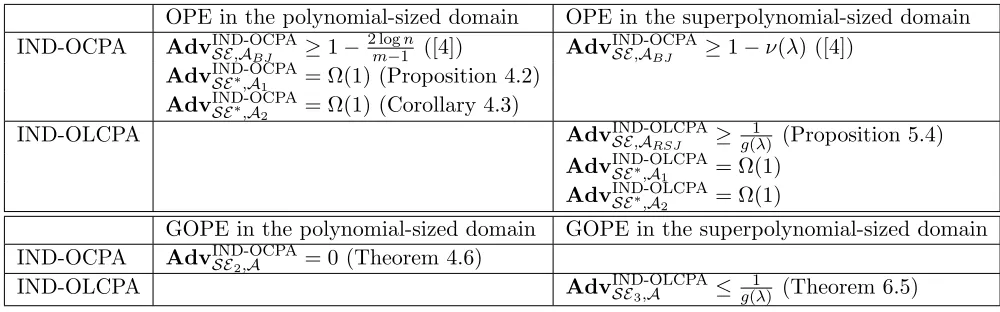
Section 6;A represents any PPT adversary, ABJ represents the big jump attack,ARSJ represents repeated small jump attacks, A1 represents the attack against the ideal OPE object defined in
Proposition 4.2,A2 represents the attack against the ideal OPE object defined in Corollary 4.3. OPE in the polynomial-sized domain OPE in the superpolynomial-sized domain IND-OCPA AdvIND-OCPASE,A
BJ ≥1−
2 logn
m−1 ([4]) Adv
IND-OCPA
SE,ABJ ≥1−ν(λ) ([4])
AdvIND-OCPASE∗,A
1 = Ω(1) (Proposition 4.2)
AdvIND-OCPASE∗,A
2 = Ω(1) (Corollary 4.3)
IND-OLCPA AdvIND-OLCPASE,ARSJ ≥ 1
g(λ) (Proposition 5.4) AdvIND-OLCPASE∗,A
1 = Ω(1)
AdvIND-OLCPASE∗,A
2 = Ω(1)
GOPE in the polynomial-sized domain GOPE in the superpolynomial-sized domain IND-OCPA AdvIND-OCPASE2,A = 0 (Theorem 4.6)
IND-OLCPA AdvIND-OLCPASE3,A ≤ 1
g(λ) (Theorem 6.5)
Table 1: Security of OPE and GOPE Schemes Under Various Security Notions
There are many unsolved problems that require further research. For instance, we prove that the ideal OPE object is not the most secure OPE for the specific plaintext domain [m] ={1,2}. Unfortunately the construction of the “real” OPE scheme cannot be generalized to other plaintext domains. Thus, it is still unknown whether the ideal OPE is the most secure OPE for plaintext domains with size greater than 2. The more important problem is: if the ideal OPE object is not the secure OPE for plaintext domains with size greater than 2, then what is the most secure OPE. For GOPE, we construct GOPE schemes SE2 and SE3 to achieve lower bounds on the advantage
of an adversary against OPE schemes under IND-OCPA in the polynomial-sized domain and under IND-OLCPA in the superpolynomial-sized domain. A natural question is: can GOPE schemes do better, i.e. can we construct GOPE schemes to exceed those bounds? We plan to conduct research to investigate these problems. Also, we plan to investigate other novel approaches to improve the design of OPE schemes.
References
[1] R. Agrawal, J. Kiernan, R. Stikant, and Y. Xu,Order-preserving encryption for numeric data,
ACM SIGMOD International Conference on Management of Data, pp. 563-574, 2004.
[2] G. Amanatidis, A. Boldyreva, and A. O’Neill,Provably-secure schemes for basic query support in outsourced databases, Working Conference on Data and Applications Security, pp. 14-30, 2007.
[3] G. Bebek.Anti-tamper database research: Inference control techniques,Technical Report EECS 433 Final Report, Case Western Reserve University, 2002.
[4] A. Boldyreva, N. Chenette, Y. Lee, and A. O’Neill, Order-preserving symmetric encryption,
[5] A. Boldyreva, N. Chenette, and A. O’Neill, Order-Preserving Encryption Revisited: Improved Security Analysis and Alternative Solutions,Crypto11, 2011.
[6] D. Boneh and B. Waters, Conjunctive, subset, and range queries on encrypted data,TCC, pp. 535-554, 2007.
[7] H. Hacigumus, B.R. Iyer, C. Li, and S. Mehrotra, Executing SQL over encrypted data in the database-service-provider model,ACM SIGMOD Conference on Management of Data, 2002.
[8] M. Halloush and M. Sharif,Global heuristic search on encrypted data (GHSED),International Journal of Computer Science Issues (IJCSI), 1:13-17, 2009.
[9] J. Li and E.R. Omiecinski, Efficiency and security trade-off in supporting range queries on encrypted databases,Data and Applications Security, pp. 69-83, 2005.
[10] G. Ozsoyoglu, D.A. Singer, and S.S. Chung, Anti-tamper databases: Querying encrypted databases,Conference on Database and Applications Security, 2003.
[11] E. Shi, J. Bethencourt, T-H.H. Chan, D. Song, and A. Perrig, Multi-dimensional range query over encrypted data,Symposium on Security and Privacy, pp. 350-364, 2007.
[12] D.X. Song, D. Wagner, and A. Perrig, Practical techniques for searches on encrypted data,