A Neighbor Knowledge with Zonal Routing
Protocol to Reducing Routing Overhead in
MANETs
M.Saravanan,
Department of Computer Science and Engineering, KPR Institute of Engineering and Technology,
Coimbatore,India.
D.Jagan,
Department of Computer Science and Engineering, Coimbatore Institute of Engineering,
Coimbatore,India.
ABSTRACT—In mobile ad hoc networks the nodes will be in a mobile state so there may be a frequent link breakages which leads to frequent path failures and route discoveries. Sending periodical message causes overhead. Reactive Routing protocol causes less overhead when compared to Proactive routing protocol. In the existing system they used neighbor coverage based probabilistic rebroadcast protocol(NCPR) for reducing routing overheads in MANETs. We used SBA and NCPR for finding routes. Since NCPR is a reactive routing protocol latency time will be higher, so we are combining the hybrid routing protocol (ZRP) along with NCPR to reduce the latency time. In our proposed system since both proactive and reactive concept are there it perform better for finding paths and the simulation result shows that the latency time is reduced.
Index Terms- mobile adhoc networks, NCPR, ZRP, probabilistic
rebroadcast, routing overhead.
I. INTRODUCTION
Mobile ad hoc networks (MANETs) consist of a collection of mobile nodes which may move freely. These nodes are dynamically self-organized into arbitrary network without any fixed infrastructure. One of the fundamental challenges in MANETs is the design of dynamic routing protocols with a good performance and less overhead. Many routing protocols have been proposed for MANETs such as Ad hoc On-demand Distance Vector Routing (AODV) and Dynamic Source Routing (DSR). These two protocols are on-demand routing protocols, and they could improve the scalability in MANETs by limiting the routing overhead when a new route is requested. However, due to the mobility of nodes in MANETs, frequent link breakages may occurs which may lead to frequent path failures and route discoveries, which can increase the overhead of routing protocols by sending the Hello packets and reduce the packet delivery ratio and increasing the end-to-end delay between the nodes. Thus, reducing the routing overhead in route discovery is a very essential problem. The conventional on demand routing protocols uses flooding to discover a route. They broadcast a Route Request (RREQ) packet to the networks, and the broad casting induces excessive redundant retransmissions of Route Request packet.
There are two types of routing protocols. They are proactive routing protocol and reactive routing protocol.
Proactive routing protocol maintains fresh lists of destinations and their routes by periodically distributing routing tables throughout the network. Its advantage is the low latency and its disadvantage is high routing overhead. Reactive routing protocol finds a route on demand by flooding the network with Route Request packets. Its advantage is low overhead and its disadvantage is high latency time in route finding. The Hybrid routing protocol is the combination of the advantages of proactive and reactive routing. The routing is initially established with some proactively prospected routes and then serves the demand from additionally activated nodes through reactive flooding. Proactive routing protocols are OLSR, Reactive routing protocols such as AODV, DSR, etc.,.
The coverage area concept is used to adjust the rebroadcast probability of a node. If a mobile node is located near to a sender, which means it takes a small additional coverage area and its neighbors may receive the same broadcasting message from others, thus its rebroadcast probability will be set lower. On the contrary, if a mobile node is located in the area far from sender, which means its additional coverage area is large. So it has to be set with high rebroadcast probability. The coverage area can be estimated from the distance between sender and receiver node, and the distance can be estimated by signal strength
There are two deterministic timer-based broadcast schemes:
Dynamic Reflector Broadcast (DRB) and Dynamic Connector Connector Broadcast (DCCB). This schemes can achieve full reach ability over an idealistic lossless MAC layer, and this schemes are robustness.
Robust Broadcast Propagation (RBP) protocol in wireless network is to provide near perfect reliability for flooding, and this protocol has a good efficiency. For broadcasting they presented a new perspective: which is not to make a single broadcast more efficient but to make more reliable from a single broadcast, which means by reducing the frequency of upper-layer invoking flooding to improve the overall performance of flooding.
probability-based, distance probability-based, counter-probability-based, location based and neighbor knowledge based approaches have been proposed to overcome the drawbacks of flooding. This paper proposes neighbor coverage based probabilistic rebroadcast protocol along with zone routing protocol for reducing routing overhead in MANETs. NCPR comes under a reactive routing protocol so its latency time is high. So we are adding the hybrid routing protocol (ZRP) to reduce the latency time. Hybrid routing protocol has been used to reduce the control overhead of proactive routing protocol and decrease the latency caused by route discovery in reactive routing protocol. In ZRP proactive routing protocol is Intra-Zone Routing Protocol(IARP) used inside the routing zones, reactive routing protocol is Inter-Zone Routing Protocol(IERP) used between routing zones.
II. RELATED WORK
Broadcasting is an effective mechanism for route discovery, but in broadcasting the routing overhead can be large, especially in high dynamic networks. The broadcasting causes large routing overhead and causes many problems such as redundant retransmissions, collisions and contentions. Thus, optimizing the broadcasting by route discovery is an effective solution for improving the routing performance.
In [1], Zhang proposed the number of rebroadcasts can effectively optimize the broadcasting. He found that the neighbor knowledge methods perform better than the area based method and the probability based method. He implements a novel scheme to calculate the rebroadcast delay for determining forwarding order. The nodes which have more common neighbors with the previous node have the lower delay. The rebroadcast probability is composed of two parts they are additional coverage ratio and the connectivity factor. By combining these two parts we can set a reasonable rebroadcast probability.
In [2], Kim proposed a probabilistic broadcasting based on coverage area and neighbour confirmation in mobile ad hoc networks. If a mobile node is located near to the sender, which means it takes small additional coverage and rebroadcast from this node can reach only less additional nodes, so its rebroadcast probability will be set to less value. On the other hand, if a mobile node is located far from sender, which means that the additional coverage from this node is more, its rebroadcast probability will be set to high value. The coverage area can be estimated from the distance between the sender and the receiver and the distance can be estimated by signal strength. He combines the advantages of probabilistic based and area based approach.
In [3], Sinha proposed the zone routing protocol with bidirectional link. The zone routing protocol employs a proactive (table driven) and reactive (on demand) methods to provide scalable routing in the ad-hoc network. However, in the presence of unidirectional links when ZRP is used some routes may remain undiscovered. They propose extensions to ZRP to support its deployment when unidirectional links occurs. In particular, we propose a query enhancement
mechanism that recursively builds a partial routes to a destination.
In [4], Hanashi proposed a dynamic probabilistic approach when nodes move according to the way point mobility and compare it with simple flooding AODV and fixed probabilistic scheme. Their approach dynamically set the rebroadcasting based on the number of neighbors nodes distributed in the ad hoc network. We set the rebroadcast probability of a host according to the number of neighbor nodes information available.
In [5], Khan proposed an angle-aware broadcasting algorithm as a contribution to address the broadcast storm problem. In this approach, rebroadcast probability is dynamically calculated, based on the angles covered by a node with respect to its neighbors, without using the latter knowledge information about the nodes or any complex calculations thereof. A dynamic angle aware probabilistic broadcasting algorithm sets the forwarding probability of a node based on the cover angle of a node with respect to its neighbors. If the covered angle is small, then the node has high retransmission probability; otherwise, the retransmission probability of a node will be low. In this scheme, the position of the sender and a node itself can be estimated by the Global Positional System or any other localization technique based on the angle of arrival or triangulation or signal strength indicators.
In [6], Mohammed proposed a new probabilistic counter-based method that significantly reduces the number of RREQ packets transmitted during route discovery operation. A new hybrid route discovery approach, known as probabilistic counter-based route discovery approach which combines the advantages of fixed probability-based and counter-based broadcast schemes to address the broadcast storm problem associated with existing on-demand routing protocols. We evaluate the new route discovery method by using AODV as it is one of the early routing protocols proposed in the literature that has been widely investigated and analyzed.
III. EXISTING SYSTEM
In the existing work, Neighbor coverage based probabilistic rebroadcast protocol which combines both neighbor coverage and probabilistic methods. In order to exploit the neighbor coverage knowledge, we need a novel rebroadcast delay to determine the rebroadcast order, and then to obtain a more accurate additional coverage ratio. In order to keep the network connective and to reduce the redundant retransmissions, we need a metric named connectivity factor to determine how many neighbors should receive the RREQ packet.
The rebroadcast probability consists of two parts: a) additional coverage ratio, and b) connectivity factor.
The number of rebroadcasts can be effectively optimize the broadcasting and the neighbor knowledge approach performs better than the area based method and the probability based method. Therefore,
1) In order to effectively exploit the neighbor coverage knowledge, we need a novel rebroadcast delay for determining the rebroadcast order, and then we can obtain a more accurate additional coverage ratio. 2) In order to keep the network connectivity and reduce
the redundant retransmissions, we need a connectivity metric to determine how many neighbors should receive the RREQ packet.
After that, by combining the additional coverage ratio and the connectivity factor, we introduce a rebroadcast probability, which can be used to reduce the number of rebroadcasts of RREQ packet, to improve the routing performance.
We use the upstream coverage ratio of an RREQ packet received from the previous node for calculating the rebroadcast delay, and use the additional coverage ratio of the RREQ packet and the connectivity factor for calculating the rebroadcast probability in the proposed protocol, which requires that each node needs its 1-hop neighborhood information.
To reduce the overhead of Hello packets, we avoid using periodical Hello mechanism. Since a node sending any broadcasting packets can be able inform to its neighbors about its existence. The broadcasting packets such as RREQ and route error (RERR) can play a role of Hello packets. Here using for following mechanism to reduce the overhead of Hello packets: Only when the time elapsed from the last broadcasting packet is greater than the value of Hello Interval, the node needs to send a Hello packet. The value of Hello Interval is equal to that of the original AODV protocol.
IV. PROPOSED SYSTEM
In the proposed work, the NCPR protocol is combined with the ZRP protocol. Because the NCPR is a reactive routing protocol, so it has a high latency. In order to reduce the latency time the NCPR is combined with ZRP protocol. The proactive concept is used for finding the paths and reactive is used for broadcasting. When the destination node is outside the node of the source node, then it checks the neighbor nodes zone which is recently communicated with the source node.
V. PROTOCOL IMPLEMENTATION AND PERFORMANCE EVALUATION
A. Protocol Implementation
The proposed NCPR with ZRP protocol is used to reduce the latency time in MANET’S. Note that the NCPR protocol needs HELLO packets to obtain the neighbor information , and also carry the neighbor list in the RREQ packet. Therefore some techniques are used to reduce overheads of HELLO packets and neighbor list in the
RREQ packet. Since NCPR is a reactive routing protocol the path finding will be of dynamic fashion. So the latency time of NCPR will be higher. In order to reduce the latency time we are combing the NCPR with ZRP which is a hybrid routing protocol. ZRP is the combination of proactive and reactive routing protocol. In NS-2 we are implementing the combination of NCPR and ZRP, since implementing in real time is costlier we are preferring the simulation. When we combine ZRP to NCPR each node has a zone. Some nodes have a overlapping zones. In ZRP the message is directly transferred from the source to destination if the destination node presents inside the zone of the source node. Else the source node sends the message to the border node and that border node checks whether the destination node is present inside its zone or not. If the node is present it transfer the message. So the time taken to transfer the message from source to destination is low when compared to NCPR.
In order to reduce the overhead of Hello packets, we do not use periodical Hello mechanism. Since a node sending any broadcasting packets can inform its neighbors of its existence, the broadcasting packets such as RREQ and route error (RERR) can play a role of Hello packets.
In order to reduce the overhead of neighbor list in the RREQ packet, each node needs to monitor the variation of its neighbor table and maintain a cache of the neighbor list in the received RREQ packet.
B. Probabilistic Rebroadcast
The probability of rebroadcasting the packet can be calculated. The Uncovered Neighbors Set and Rebroadcast Delay has to be determined. The Node nireceives an RREQ packet from its previous node s, it can use the neighbor list in the RREQ packet to estimate how many of its neighbors have not been covered by the RREQ packet from s. If the node ni has more neighbors uncovered by the RREQ packet from s, then the node ni rebroadcasts the RREQ packet, so that the RREQ packet can reach more additional neighbor nodes. To quantify this, we define the Uncovered Neighbors (UCN) set U( ni )of node ni
Broadcast characteristics of an RREQ packet are when the node ni can receive the duplicate RREQ packets from its neighbors, then the node ni could further adjust the U ( ni )with the neighbor knowledge. In order to sufficiently exploit the neighbor knowledge and avoid channel collisions, each node should set a rebroadcast delay based on the number of common neighbor nodes from the previous node. The choice of a proper delay is the key to success of the proposed protocol because the scheme used to determine the delay time which affects the dissemination of neighbor coverage knowledge. When a neighbor node receives an RREQ packet, it could calculate the rebroadcast delay according to the neighbor list in the RREQ packet and its own neighbor list based on the neighbor knowledge.
C. Simulation Environment
protocols using the NS-2 simulator. Broadcasting is a fundamental and effective data dissemination mechanism used for many applications in MANETs. In this paper, we have study one of the applications for route request in route discovery. In order to compare the routing performance of the proposed NCPR protocol with ZRP, we choose the Dynamic Probabilistic Route Discovery (DPR) protocol which is an optimization scheme for reducing the overhead of RREQ packet incurred in route discovery in recent literature, and the conventional AODV protocol.
We evaluate the performance of routing protocols based on the following performance metrics:
1) MAC collision rate: the average number of packets(including RREQ, route reply (RREP), RERR and CBR data packets) dropped resulting from the collisions at the MAC layer per second.
2) Normalized routing overhead: the ratio of the total packet size of control packets (such as RREQ, RREP,RERR and Hello) to the total packet size of data packets delivered to the destinations. For the control packets which are sent over multiple hops, each single hop is to be counted as one transmission. To preserve fairness, we use the size of RREQ packets instead of the number of RREQ packets, because the DPR and NCPR protocols include a neighbor list in the RREQ packet and its size is bigger than that of the original AODV.
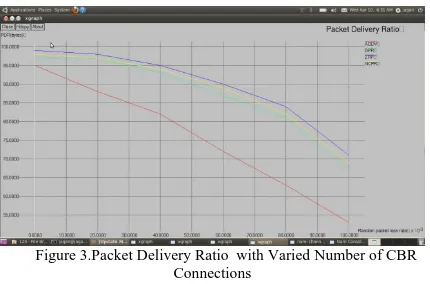
3) Packet delivery ratio: the ratio of the number of data packets which are successfully received by the CBR destinationsto the number of data packets generated by the CBR sources.
4) Average end-to-end delay: the average delay of successfully delivered CBR packets from source to destination node. It includes all possible delays from the CBR sources to destinations.
D. Performance with Various Number of CBR Connections
Figure 1. MAC Collision Rate with Varied Number of CBR Connections
Figure 1shows the effects of the traffic load on the MAC collision rate. Since the control packets and data share the same physical channel in the IEEE 802.11 protocol, as the number of CBR connections increases, the physical channel will be busier and then the collision of the MAC layer will be more severe. Both the DPR and NCPR & ZRP protocols do not consider load-balance, but they can reduce the redundant rebroadcast and alleviate the channel congestion, so as to
reduce the packet drops caused by collisions. Compared with the conventional AODV protocol, the NCPR&ZRP protocol reduces the MAC collision rate by about 95.3% on the average.
Figure 2. Normalized routing overhead with Varied Number of CBR Connections
Figure 2 shows the normalized routing overhead with different traffic load. As the traffic load increases, the routing overhead of the conventional AODV protocol significantly increases, but the overhead of the DPR and NCPR protocols are relatively smooth. By contrast, both the DPR and NCPR & ZRP protocols reduce the routing overhead.
Figure 3.Packet Delivery Ratio with Varied Number of CBR Connections
Figure 3 shows the packet delivery ratio with increasing traffic load. As the traffic load increases, the packet drops of the conventional AODV protocol without any optimization for redundant rebroadcast are more severe. Both the DPR and NCPR protocols increase the packet delivery ratio compared to the conventional AODV protocol, because both of them significantly reduce the number of collisions and then reduce the number of packet drops caused by collisions.
Figure 4 measures the average end-to-end delay of CBR packets received at the destinations with increasing traffic load. The End-To-End delay of the conventional AODV increases as the traffic load increases. In NCPR latency time is higher because of the reactive routing protocol. So we combined the NCPR and ZRP to reduce the latency time. The combination of NCPR and ZRP has decreased the latency time.
VI. CONCLUSION
In this paper we proposed to combine the probabilistic rebroadcast protocol based on neighbor coverage and zone routing protocol to reduce the routing overhead and latency time in MANETs. This neighbor coverage knowledge includes additional coverage ratio required by each node and the connectivity factor. Along with the NCPR we combined the ZRP which is both reactive and proactive routing protocol for reducing the latency time. The simulation result also show that the proposed system low latency time is required than the NCPR.
REFERENCES
[1] Xin Ming Zhang, En Bo Wang, Jing Xia, and Dan Keun Sung, “A Neighbor Coverage based Probabilistic Rebroadcast for Reducing Routing Overhead in Mobile Ad hoc Networks”, IEEE Transactions On Mobile Computing, vol. 12, no. 3, March 2013..
[2] Jae-soo Kim, Qi Zhang and Dharma P. Agrawal., “Probabilistic Broadcasting Based on Coverage Area and Neighbor Confirmation in Mobile Ad Hoc Networks”, at Global Telecommunications Conference Workshops,2004 .
[3] Prasun Sinha, Srikanth V. Krishnamurthy and Son Dao, “Scalable Unidirectional Routing with Zone Routing Protocol (ZRP) Extensions for Mobile Ad-Hoc Networks” , at Wireless Communications and Networking Confernce, WCNC. 2000 IEEE volume 3,2000.
[4] Abdalla M. Hanashi, Irfan Awan and Mike Woodward, “Improving Route Discovery of Dynamic Probabilistic Flooding in On-Demand Routing Protocols for MANETs”, 16th Telecommunications forum TELFOR 2008.
[5] Imran Ali Khan, Sajjad Ahmad Madani, Waqas Anwar and Khizar Hayat, “Location Based Dynamic Probabilistic Broadcasting for MANETs”, World Applied Sciences Journal 13 (11): 2296-2305, 2011.