An Efficient Data Placement Algorithm
For Hadoop
Heterogeneous Clusters
Mr.N.Velmurugan, Associate Professor Department of Information Technology K.L.N. College of Information Technology
Madurai,India.
e-mail id: [email protected]
Ms.C.SuhanyaDevi, PG student Department of Information Technology
K.L.N.College of Information Technology Madurai, India
e-mail id: [email protected]
Abstract— Cloud computing is one the of parallel distributed computing system that has become a frequently used computer application. MapReduce is an present programming model used in cloud computing. Hadoop is an open-source application of the MapReduce model. The current Hadoop implementation assumes that every node in a cluster has the same computing capacity and that the tasks are data-local, which may increase extra above and reduce MapReduce performance. This paper proposes a scheduling algorithm resolve the job execution problem in the heterogeneous environment. The proposed method can dynamically adapt and balance data stored in each node based on the computing capacity of each node in a heterogeneous Hadoop cluster. The proposed method can decrease data transfer time to achieve improved Hadoop performance. The experimental results show that the scheduling can decrease the time of execution and improve Hadoop performance in a heterogeneous cluster.
Keywords—Hadoop,Mapreduce,Hetergenneous
1.INTRODUCTION:
In Hadoop, there is a single master managing a number of slaves. The controlling node consists of a NameNode, DataNode, JobTracker, and TaskTracker,. A slave node acts as both a DataNode and TaskTracker, though it is conceivable to have data only worker nodes, and compute-only worker nodes. Namenode holds the filesystem metadata. The filles are broken up and spread over the datanodes. JobTracker schedules and manages jobs. TaskTracker executes the individual map and reduce functions. If a machine fails,Hadoop continues to operate the cluster by shifting work to the remaining machines.The input file, which resides on a distributed filesystem throughout the cluster, is split
into even-sized large piece replicated for fault-acceptance. Hadoop divides each MapReduce job into a set of tasks. Each large piece of input is processed by a map task, which outputs a list of key-value pairs. In Hadoop, the shufile phase occurs as the data is processed by the mapper. During execution, each mapper hashes the key of each key/value pair into bins, where each bin is associated with a reducer task and each mapper writes its output to disk to ensure fault acceptance. Since Hadoop assumes that any mapper is equally likely to produce any key, each reducer may possibly receive data from any mapper. The intermediate key/value pair from the map task is passed on to a partitioner which in turn calls the partitioner function. It takes as input the key/value pair and returns the reducer to which this key/value pair should be sent. In Hadoop,the default partitioner is HashPartitioner, which hashes a records key and the number of reducers to determine which partition (and thus which reducer) the record belongs to. The number of partitions is equal to the number of reduce tasks for the job.The amount of data received from each mapper to a reducer and the total size of data to be processed by the reduce task will only be known after the map tasks complete execution. This leads to a load imbalance because the reducer roles are fixed before the map tasks start in the current implementation.
computing ability of nodes. However, in a heterogeneous environment, some tasks run faster on a particular node than others. In addition, it is not straight forward to guarantee fairness among multiple jobs in heterogeneous environments.The value of a particular node depends on the job of which task is assigned to the node. Hence,simply adding up the number of nodes or relative speed that are used by a job does not account for the job's share. Thus, such differences in the value of nodes depend on the job. we call this job affinity.It must be considered when we want a job scheduler to ensure that each job receives its fair share of processing resources.
2.RELATED WORK:
Related work discussed about a mapreduce operation,submitting a mapreduce job
2.1 MAPREDUCE OPERATION
MapReduce operation consists of two functions.The Mapper function reads a stream of data and parses it into intermediate (key,value) pairs. When that is complete, the Reducer function is called once for each unique key that was generated by Map and is given the key and a list of all values that were generated for that key as a parameter. The keys are presented in sorted order.File placed in HDFS, is broken down into blocks. These blocks are then replicated across the different nodes (Data Nodes/ Slave Nodes/ Chunk Servers) in the cluster. File location is maintained by the NameNode by a corresponding entry of it location.Then the word count operation is done on the Created cluster by using a given mapper and reducer methods. In this algorithm each node i uses Hash function to find out its immediate neighbour.After finding the neighbour, each node calculates its neighbour node metrics such as CPU utilization or network traffic etc. Based on this neighbour node monitoring, if the neighbour node is underutilized corresponding node i can transfer its load to the neighbour node to balance the load equally. If the neighbour node is over utilized, then it automatically add one data node to manage the traffic.And also make the alert to the user about the rebalancing operation.
2.2Elastic Mapreduce (Emr)
Amazon Elastic MapReduce (Amazon EMR) is a web service that makes it easy to quickly and cost-effectively process huge volumes of data. Amazon EMR uses Hadoop, an open source framework, to allocate your data and processing
across are sizable cluster of Amazon EC2 instances. Amazon EMR is used in a change of applications, containing log analysis, web indexing, data warehousing, machine learning, economic analysis, scientific model, and bioinformatics. Customers launch millions of Amazon EMR clusters every year.
2.3SUBMITTING A MAPREDUCE JOB
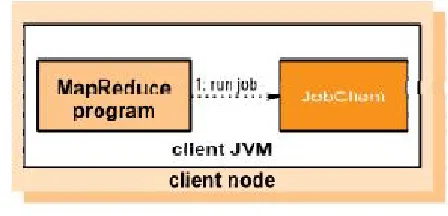
Figure 2.1 Mapreduce Job
The process of running a MapReduce job on Hadoop consists of 8 major steps.
Step1:The MapReduce program you've written tells the JobClient to run a MapReduce job.
Step2:This sends a message to the JobTracker which
produces a unique ID for the job.
Step3:The JobClient copies job resources, such as a jar file containing a Java code you have written to implement the map or the reduce task, to the shared file system,usually HDFS.
Step4:The resources are in HDFS, the JobClient can tell the JobTracker to start the job.
Step5:The JobTracker does its own initialization for the job. It calculates how to split the data so that it can send each "split" to a different mapper process to maximize throughput.
Step 6:It retrieves these "input splits" from the distributed file system.
Step 7:The TaskTrackers are continually sending heartbeat messages to the JobTracker.
Step 8:The JobTracker has work for them, it will return a map task or a reduce task as a response to the heartbeat.The TaskTrackers must to obtain the code to execute, so they get it from the share file system.
Step10:This child process runs your map code or your reduce code.
3. PROPOSED SYSTEM
In proposed system Resource allocation and job scheduling using hadoop cluster.The job scheduling algorithm mostly using in heterogeneous environments. In this heterogeneity-aware scheduler method uses an advances algorithm of the job scheduling method. This algorthim the reduce the transaction time and increase the performance.the result heterogeneity aware scheduler can decrease the time of execution and improve the hadoop performance in a heterogeneous cluster.
3.1Heterogeneous Cluster process
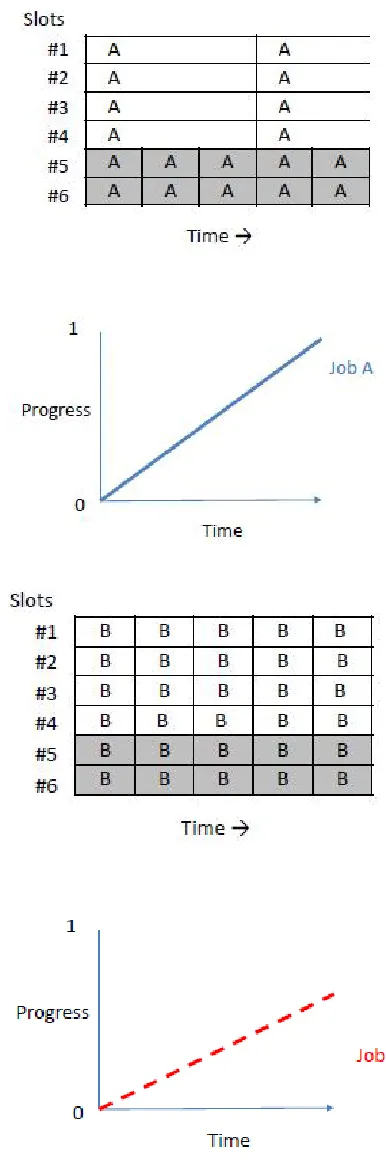
Heterogenous task of job A runs three times faster on a slot of N1 than N2, whereas job B runs on N1 as fast as on N2. Figure illustrates how they will be scheduled if the cluster runs only one job. White and gray cells represent the slots of N1 and N2, respectively.
The letter in each cell indicates the job occupying the slot. The graph below shows the progress of each job over time. he graph at the bottom-left shows the progress of each job over time. It is drawn only to the point at which there are enough tasks to schedule. Note that the translucent lines describes the progress each job would make if they occupied the whole cluster without sharing. The graphs on the right side track the change in the slot share and the progress share of each job. Even though each job occupies the same number (three) of slots at all times, the progress share of job A often falls below its fair share (0.5) because many tasks of job A run on slots of N2, which is not suitable for the job. As a result, job A is making less than half progress compared to the job that occupies the whole cluster. Obviously, job A is under-served in this scenario even though the job received enough slot-share.In contrast, Figure shows an example of progress share-based scheduling. The graph at the bottom-left shows that both jobs A and B are making more Progress than they might otherwise.
3.3Scheduler
To calculate the progress share of each job, the MapReduce system should be aware of the per-slot computing rate (CR).
To that end, each job goes through two phases:
calibration and normal. When a job is submitted, it
starts with the calibration phase. In this phase, at least
one map task is launched on each type of node. By
measuring the completion time of these tasks, the
scheduler can determine the CR. Once the scheduler
knows the CR, the job enters the normal
phase.During the normal phase, the scheduler works
similar to the Hadoop fair scheduler. When a slot
becomes available, a job of which the share is less
than its minimum or fair share is selected. However,
if there is another job with a significantly higher
computing rate on the slot, the scheduler chooses that
job to improve overall performance. This is similar to
the “delay scheduling" mechanism in the Hadoop fair
scheduler.By using progress share, the scheduler can
make an appropriate decision. As a result, the cluster
is better utilized In addition, each job receives a fair
amount of computing resources.
3.1Number of pending jobs
4. CONCLUSION
This paper proposes a this heterogeneity-aware
scheduler algorithm for the heterogeneous cluster.The
be applied in a homogeneous environment.The
proposed heterogeneity-aware scheduler algorithm is
based on the different computing capacities of nodes
to allocate data blocks and improve data locality and
increasseing the performance.
5. REFERENCES
[1]Amazon Elastic MapReduce, http://aws.amazon.com/elasticmapreduce/.
[2]Apache, http://httpd.apache.org/. [3]Hadoop, http://hadoop.apache.org/.
[4]Hadoop Distributed File System, http://hadoop.apache.org/docs/stable/hdfs_design.htm [5]HadoopMapReduce,http://hadoop.apache.org/docs /stable/mapred_tutorial.html.
[6]HadoopYahoo,http://www.ithome.com.tw/itadm/a rticle.php?c=49410&s=4.
[7] Q. Chen, D. Zhang, M. Guo, Q. Deng, S. Guo, SAMR: a self-adaptive MapRe-duce scheduling algorithm in heterogeneous environment, in: 2010 IEEE 10th International Conference on Computer and Information Technology (CIT), IEEE, 2010, pp.2736–2743.
[8]J. Dean, S. Ghemawat, MapReduce: simplified data processing on large clusters, in: OSDI ’04, Dec. 2004, pp.137–150.
[9] B. He, W. Fang, Q. Luo, N. Govindaraju, T. Wang, Mars: a MapReduce framework on graphics processors, in: ACM 2008, 2008, pp.260–269. [10]G. Lee, B.G. Chun, R.H. Katz, Heterogeneity-aware resource allocation and scheduling in the cloud, in: Proceedings of the 3rd USENIX Workshop on Hot Topics in Cloud Computing, HotCloud, vol.11, 2011.