Is Range Management
a Profession?’
JACK F. HOOPER AND JIM B. GRUMBLES Assistant Professor, Department of Range Science,
Utah State University, Logan, and Regional Technical Specialist, Dow Chemical Co.,
Lubbock, Texas.2
Highlight
There is a lack of understanding among range managers of the meaning of the word “professional” and little ap preciation of the obligations which professional recognition imposes. Many range managers are sub-professional and range management may be a sub-professional vocation. If you want to be identified as other than a second class citi- zen, read on to see what you can do.
What is a profession? At one time, only a few vocations, such as law or medicine, were considered professions. A profession was a vocation which re- quired a well-rounded education of its members. The professional’s attitude was one of responsibil- ity toward clients and a feeling of pride for service rendered. Professionals had special privileges of freedom from formal control and felt that their performance could be accurately assessed only by fellow professionals.
In recent years, the terms profession and profes- sional have been given a broader interpretation. The terms have become identified with doing thing for pecuniary considerations. Thus, we have “professional” ball players and golfers. Also, three general classes of professions have been proposed:
(1) the “learned” professions, requiring at least three years of post-baccalaureate education; (2) the “baccalaureate” professions, requiring at least a Bachelor degree, and at most, not more than two years of graduate study; and (3) “technical” profes- sions, requiring one to two years of post-secondary education (Spurr, 1968). Range management, if it is a profession, would probably be classed as a bac- calaureate profession. However, the traditional and still prevailing image of a professional is a person who has mastered a certain body of knowledge, pos- sesses expert skills, is committed to a life career, and observes high ethical standards. It is this im- age that resource management vocations such as range management have been seeking.
Recent information assembled at Utah State [Jniversity in cooperation with the Office of the Executive Secretary of the American Society of Range Management indicates there is little under-
lReceived June 20, 1968; accepted for publication October 18, 1968.
2 Formerly Asso ciate Professor, Department of Range Sci- ence, Utah State University, Logan.
standing of the term “professional” and little ap- preciation of the obligations which professional recognition imposes.
Professional Recognition
Why Professional Recognition is Desired.-Sev- era1 motivations have been advanced for seeking professional recognition: (1) to share the distinc- tion and prestige accorded members of a recognized profession; (2) the awareness that professional men normally encounter less sales resistance in market- ing of their services; (3) to play some part in ad- vancing the general welfare-in making the world a better place in which to live; and (4) as a tactic in intervocation struggles to reserve a certain sphere of activity for the vocation. These motivations on the part of those seeking professional recognition are reinforced by pressures of society for (a) better education and (b) a more intelligent application of the organized body of present knowledge (AIREA, 1967).
Criteria of a Profession.-Various criteria have been advanced to help identify a profession. A vo- cation is a profession if it:
(1)
(2)
(3)
(4)
(5)
(6)
(7)
(8)
(9)
(10)
(11)
(12)
(13)
is of vital importance to society;
commands an organized body of knowledg;e with which even the beginner must be thor- oughly familiar before he can practice effi- ciently;
involves essentially intellectual operations ac- companied by large individual responsibility; is learned in nature and its members are con- stantly resorting to the laboratory and the seminar for a fresh supply of facts;
is not merely academic and theoretical, but is definitely practical in its aims;
possesses a technique capable of communica- tion through a highly specialized educational discipline;
is self organized with activities, duties, and responsibilities which completely engage its participants and develop group consciousness; i.e., it has a professional society;
has definite standards of competence that it enforces as a condition of admission to mem- bership;
has definite standards of integrity and con- duct that it enforces upon its individual mem- bers (a code of ethics);
is composed entirely of experienced practi- tioners;
has a standard of good work (high standards of performance);
is more responsive to public interest than are unorganized and isolated individuals;
is recognized by the public as being a profes- sion (adapted from AIREA, 1967).
80 HOOPER AND CRUMBLES
Does Range Management fit the Criteria?-The Table 1. Membership status of undergraduate and gradu- fact that the concept of range management is not ate degree recipients by institution.
widely known lends credence to the belief that
range management may not be an important voca- Total Present Not Never
tion (criterion 1). However, the western range con- University grad- members members members uates (%) (%) (%) reported Years sists of between 600 and 700 million acres, and pro- r..&M-,,.*
vides about half the feed for 22 million cattle, 0L4I,L,ILuIy a c more than half the feed for 15 million sheep, and
essentially all the feed for 4 million deer, one mil- lion elk and other game and wildlife. It is the watershed that supports over 30 million acres of irrigated land, provides water for industry, and for generating electrical power, and provides culinary water to 30 million users. It also is the recreational playground for millions of Americans. These uses of the range lands indicate that range management ought to be an important vocation.
There should be little argument that range man- agement fits or should fit criteria 3, 5, and 6. There is probably some question if range management fulfills criteria 2, 8, 9, 10, 11, and 12. There is no accrediting of range schools (Z), interest, not com- petence, is sufficient for membership (8), the by- laws state that the Board of Directors has the right to approve or reject membership in the ASRM, but gives no reasons for rejection other than non-pay- ment of dues, and there is almost no barrier to a person with little or no training in range manage- ment being employed as a range manager, even for the federal government (9), although a “Proposed Creed” was published (Amer. Sot. Range Manage., 1965); experience is not one of the conditions for membership (IO); nowhere in the ASRM by-laws is a work standard set (11); and the ASRM does not appear to be more responsive to public interest (12).
Even more questionable is the applicability of criteria 4, 7, and 13. It is fairly safe to assume that range management is not recognized by the public as a profession (criterion 13). The applicability of criteria 4 and 7 were evaluated in a poll.
Polls of Range Students
Graduates.-Fourteen schools graduating range managers were canvassed to obtain the membership status of former students (Table 1). Names of graduate and undergraduate students with a degree in range management were compared with records of membership in the office of the Executive Sec- retary. Of the students graduating in range man- agement with a B.S. degree, only 42% are presently members of ASRM, 38% were never members. Twenty percent were members but have since failed to renew membership. Of students receiving advanced degrees, 72% are presently members, 19% were never members, and 9% have dropped out.
Of the schools in the undergraduate category, the highest percentage for former students pres-
Undergraduates
U. of Ariz. BYU California Cola. St. u. U. of Neb. U. of Nev. New Mexico No. Dak. St. U Oregon St. U. So. Dak. St. U. Texas Tech. usu
Wash. St. U. U. of Wyom.
Advanced
Ariz. California Cola. Kan. Neb. Nevada No. Dak. Oregon So. Dak. usu
960 42 58 38 -
245 72 28 19 -
77 35 65 49 15
28 50 50 36 5
36 39 61 53 10
163 43 57 48 15
18 61 39 34 All Grad.
8 13 87 50 15
51 33 67 41 5
10 60 40 20 15’
47 57 43 22 All Grad.
85 63 37 8 8
71 39 61 30 10
294 40 60 58 15
40 53 47 39 15
72 44 56 25 5
44 61 39 21 -
24 50 50 38 10
37 71 29 24 -
11 37 63 11 -
5 80 20 20 -
15 87 13 7 -
14 79 21 14 -
29 83 17 14 -
4 75 25 0 -
62 82 18 16 -
ently members is 63y0, the lowest is 13%. Of schools in the graduate category, the highest percentage of former students who are presently members is 87?“, the lowest is 37%.
Utah State U. Graduates.-To ascertain the rea- sons for lack of membership, a questionnaire was sent to the non-members who had graduated from Utah State University over the past 15 years in hopes of gaining some insight as to why they were not members of the American Society of Range Management. According to the membership rec- ords of the Society, the students being polled had never been members or failed to renew member- ship.
RANGE MANAGEMENT PROFESSION 81
Table 2. Summary (percentage values) of questionnaire sent to Utah State University graduates who are not or who never have been members of ASRM.
1.
2. Journal
3.
Society (ASRM)
Membership-what discourages you from being a member? a. fees too high
b. neglect, no reason C. no value to me d. no time to be active e. no active section nearby f. no comment
Meetings-do you attend ASRM meetings regularly?
a. Chapter b. Section c. National d. none e. no comment
Do you have access to the J.? Should the Society publish both
technical and popular journal; Do you consider the Journal:
a. too technical 44%
b. not technical enough 2%
C. satisfactory 35%
d. no comment 19%
Suggested changes:
a. less technical accent-more practicality
b. lower dues
C. closer contact with members d. make it more professional e. no comment
27% 15% 28% 15% 7% 8%
6%
23%3% 57% 11%
No com-
Yes No ment
53% 41% 6%
30% 52% 18%
27% 7% 8% 4% 54%
most respondents (68%) indicated they did not at- tend any ASRM meetings or had no comment. Various reasons were given as excuses for not at- tending meetings. A few respondents mentioned that they had no active chapter nearby. Several employees of Federal agencies said that, as em- ployees, they were not encouraged to go to meet- ings.
One-half of the respondents (53%) had access to the Journal. About one-half also felt that there were too many technical articles being published which were of no use to them as range managers. One-third (35%) f ound the Journal satisfactory as to technical and popular content. About one-half (52%) did not favor two separate publications, 30% favored two journals, and 18% had no com- ment.
The most popular suggestion made by those polled as a way of providing greater interest in the Society was to change to a less technical accent. There was a great desire to have more practical papers printed in the Journal with less emphasis
on the mechanics of research methods. Most of the criticism seemed to be aimed at the Journal rather
than the Society. It would be concluded from this that these former students only knew the ASRM from reading the Journal.
It can be further concluded from these polls that Range Management does not fit criteria 4 and 7. The majority of the practitioners are not constantly resorting to the laboratory or seminar (or the Jour- nal) for a fresh supply of facts (4). Also, although self organized, the vocation does not completely engage its participants or develop group conscious- ness. In short, range management does not have a totally professional society (7).
Present Students.-Of the undergraduate stu- dents (Table l), 38% had never been members. To help determine why students do not become mem- bers while in school or upon graduation, a poll of students presently enrolled in Range Science on the USU and Brigham Young University campuses was made. Fifty-one questionnaires were completed and returned; 39 from USU and 12 from BYU. Of those responding, 50% were members. When questioned about dues, 38% of those polled indi- cated increased dues were a hardship which pre- vented their affiliation (this hardship would prob- ably also apply to recent graduates). Forty percent indicated they never attended ASRM meetings at all and 35% attended student chapter meetings only. Although participation was low, it was in- teresting that 57% wanted required accreditation of range schools and 63% wanted more range courses in Civil Service requirements. The poll in- dicated that students had little understanding of ASRM affairs.
Range Management Su b-Professional.-Based on
the 13 criteria, Range Management appears to be a discipline which does not have professional status. Definitely, it is a discipline composed, at least in part, of sub-professionals. There may be individ- uals who are professionals in the truest sense of the word, but by and large, the vocation (composed of those who work for government agencies and those in other range related positions) is sub-professional. One of the greatest single pieces of evidence is that many of the practitioners are not interested in de- veloping new concepts and fail to keep up with latest developments.
What Can Be Done
If range management is sub-professional, and if many practitioners are sub-professional, then those individuals who are genuinely interested in range management might ask: “What can we do about making the vocation into a profession and what can be done about the lack of professionalism?” Among the possible answers are the following:
82
HOOPER AND GRUMBLESrange management to include more than just do- mestic livestock on “native” range. Range man- agers are, above all, range resource managers. Among the areas where range scientists and man- agers should have competence are wildlife range, range watershed, and recreation. This does not mean that the more traditional spheres of influence of range managers should be ignored. On the con- trary, there is much work that will need to be done. The livestock industry perhaps has more capital invested per man than any industry in the United States, yet it has one of the lowest returns on capi- tal of any industry. This indicates there is much work and reorganization to be done to make the domestic livestock industry more viable. However, it will take more than cliches and rules of thumb to help the livestock industry. It will take real ex- pertise. Imagine where the level of expertise for heart surgeons would be if doctors didn’t read med- ical journals because they were too technical. If range managers were heart surgeons, we would probably still be wondering why the heart goes “thump-thump.”
2. Identify our Expertise: The area of speciali- zation for range managers should be identified (Hooper, 1969) and both Civil Service and land management agencies should insist upon compe- tency of training in this specialization for range manager assignments.
3. Promote Participation: Develop Society chap- ters to get closer to the members. Have seminar or discussion group type meetings where timely and controversial subjects are discussed instead of the type meeting where only papers are read. Encour- age more range rides and other meetings to get members together to discuss problems. Group con- sciousness is one of the avenues toward a more pro- fessional society and usually a person benefits from an organization in proportion to what he puts into the organization.
4_ Provide for Continuing Education: Since pro- fessional training today is largely measured by aca- demic achievement, have government agencies en- courage attendance at chapter, state, and national meetings. Have short courses or refresher courses under the auspices of the ASRM in range man- agement subjects including such aspects as public relations, personnel management, economics, psy- chology, sociology, speaking, and writing. The pro- fession must be self elevating and should not rely on universities to offer short courses. In short, en- courage new thought and a dynamic approach to range problems. This education program might encourage more range managers to read the Jour- nal, instead of just saying it is too technical.
5. Have Several Grades of Membership in ASRM: Each grade would be for a different level of exhib- ited competence and for different occupations.
Al-
though there are legitimate arguments against sev- eral grades of membership (Spurr, 196S), grades of membership such as student, affiliate, associate, and fellow, with graduated fees may encourage more participation and a more professional society.
6. Develop a Code of Ethics: Responsibility sep- arates the professional from the craftsman. A code which dictates high ethical standards of perform- ance and service is essential to professionalism (Lammi, 1968).
7. Publicize Society Activities: Report public service activities, scholarships, chapter, state, and national meetings. This will help advertise our expertise.
8. Reward Achievement: Give awards for the best article in the Journal. Perhaps expand the “Rancher of the Year” award of the sections to a national “Range Manager Award.” We have al- ready a precedent for a “Certificate of Merit.” Let’s do a better publicity job so that we might advertise our expertise.
9. Try to do Something about the Environment in Government which Discourages Innovation and At- tendance at Meetings: Professionals seek recogni- tion from fellow members and expect to be judged by their peers with comparable training. This causes a dual loyalty both to the profession and to the organization (Sayles and Strauss, 1966). Stu- dents in range management show interest in ad- vancing range management by wanting required accreditation of schools and more range courses on Civil Service exams. However, when these stu- dents get on the job, they seem to lose interest in their society and its advancement. This loss of in- terest may be, at least partially, blamed on bureau- cratic red tape. Although there may be a dual loyalty, bureaucracy is not necessarily a bar to in- novation and professional commitments (Wilen- sky, 1964). Since many range managers work for government agencies, bureaucracy may hinder, but need not by itself, prohibit the professionalization of range management.
STOCKING-RATE GUIDE 83
within the limits of his knowledge, at a superior level (Colbert, 1968).
Conclusion
A few of the possibilities that exist for elevating the status of the discipline called range manage- ment to that of a profession and for developing professionalism among range managers have been presented. There are numerous others. Many members of the discipline are worried about the image of Range Management. Based on the cri- teria presented, it is evident that the Society and the members of the vocation must work to improve the discipline before there can be public recogni- tion. Most importantly, we need to develop a sense of professionalism among all range managers and particularly within the ASRM. We may be plac- ing too much emphasis on selling an image (New- port, 1968). By so doing, we are treating the fever rather than the infection. A poor image is the fever; poor performance and an inadequately de- fined area of expertise are the infection. A sales- man must have a salable product before he can sell
9
A Stocking-Rate Guide for
Beef Production on
Blue-Grama Range’
R. E. BEMENT
Range Scientist, Crops Research Division, Agricultural Research Service, U.S.D.A., Fort Collins, Colorado
Highlight
A stocking-rate guide for cattle on blue-grama range was developed at Central Plains Experimental Range. The guide is based on the amount of herbage left ungrazed at the end of the summer season as it relates to gain per ani- mal and gain per acre. Maximum dollar returns per acre from yearlings were obtained when 300 lb of air-dry herb- age were left at the end of the season. The average opti- mum stocking rate was 2.6 acres/yearling month.
Approximately 30 million acres of shortgrass range are ,grazed annually by livestock in the Cen- tral-Great-Plains. Ranching enterprises today are
lA contribution from the Central Plains Experimental Range, Crops Research Division, Agricultural Research Service, U.S. Department of Agriculture, in cooperation with Colorado Agricultural Experiment Station. Published with the approval of the Director of the Colorado Agricul- tural Experiment Station as Scientific Paper No. 1208. Re- ceived May 29, 1967; accepted for publication November 9, 1968.
anything and range managers, at present, do not have much of a product (a well demonstrated per- formance capability and an area of expertise) to sell.
LITERATURE CITED
AMERICAN INSTITUTE OF REAL ESTATE APPRAISERS. 1967. The appraisal of real estate. R. R. Donnelley and Sons Co. Chicago, Ill. 474 p.
AMERICAN SOCIETY OF RANGE MANAGEMENT. 1965. Pro- posed creed for members of the American Society of Range Management. J. Range Manage. 18:169.
COLBERT, FRANCIS T. 1968. Letter dated July 16, 1968.
HOOPER, JACK F. 1969. The uniqueness of range manage- ment. J. Range Manage. 22:64-65.
LAMMI, J. 0. 1968. Professional ethics in forestry. J. For-
estry 66: 11 l-l 14.
NEWPORT, CARL A. 1968. To achieve professionalism, im- prove performance. J. Forestry 66:28-29.
SAYLES, LEONARD R., AND GEORGE STRAUSS. 1966. Human behavior in organizations. Prentice-Hall, Inc. Englewood Cliffs, N.J. p. 75-79.
SPURR, STEPHEN H. 1968. Forestry as a profession. J. For-
estry 66: 26-28.
WILENSKY, HAROLD L. 1964. The professionalization of everyone. Am. J. of Sociology 70:137-158.
8 9
plagued with increasing operation costs and a pla- teaued level of income. This situation demands an increasing requirement for more efficient grazing practices. The quantity and quality of forage available to livestock, and the use they make of it, determine grazing efficiency. Grazing efficiency is readily altered by changes in stocking rate. At Cen- tral Plains Experimental Range, light-stocking rates result in high animal daily gains and low animal gain per acre; while moderate- to heavy-stocking rates result in low animal daily gains and high aru- ma1 gain per acre.
This paper presents a stocking-rate guide for
blue-grama range grazed from May 1 to October 3 1. The stocking-rate guide is not based on per- cent utilization but is based on herbage left un- grazed at the end of the grazing season. The amount of ungrazed herbage is a quantitative fac- tor that can be readily recognized and related to gain per animal and gain per acre.
Methods
Central Plains Experimental Range, located 38 miles northeast of Fort Collins, Colorado, has an average annual precipitation of 12 inches. An aver- age of 8.3 inches falls during the period May 1 to September 30. Blue-grama grass (Bou teloua gracilis
(HBK.) Lag. ex Steud.) is the dominant forage spe- cies.
STOCKING-RATE GUIDE 83
within the limits of his knowledge, at a superior level (Colbert, 1968).
Conclusion
A few of the possibilities that exist for elevating the status of the discipline called range manage- ment to that of a profession and for developing professionalism among range managers have been presented. There are numerous others. Many members of the discipline are worried about the image of Range Management. Based on the cri- teria presented, it is evident that the Society and the members of the vocation must work to improve the discipline before there can be public recogni- tion. Most importantly, we need to develop a sense of professionalism among all range managers and particularly within the ASRM. We may be plac- ing too much emphasis on selling an image (New- port, 1968). By so doing, we are treating the fever rather than the infection. A poor image is the fever; poor performance and an inadequately de- fined area of expertise are the infection. A sales- man must have a salable product before he can sell
9
A Stocking-Rate Guide for
Beef Production on
Blue-Grama Range’
R. E. BEMENT
Range Scientist, Crops Research Division, Agricultural Research Service, U.S.D.A., Fort Collins, Colorado
Highlight
A stocking-rate guide for cattle on blue-grama range was developed at Central Plains Experimental Range. The guide is based on the amount of herbage left ungrazed at the end of the summer season as it relates to gain per ani- mal and gain per acre. Maximum dollar returns per acre from yearlings were obtained when 300 lb of air-dry herb- age were left at the end of the season. The average opti- mum stocking rate was 2.6 acres/yearling month.
Approximately 30 million acres of shortgrass range are ,grazed annually by livestock in the Cen- tral-Great-Plains. Ranching enterprises today are
lA contribution from the Central Plains Experimental Range, Crops Research Division, Agricultural Research Service, U.S. Department of Agriculture, in cooperation with Colorado Agricultural Experiment Station. Published with the approval of the Director of the Colorado Agricul- tural Experiment Station as Scientific Paper No. 1208. Re- ceived May 29, 1967; accepted for publication November 9, 1968.
anything and range managers, at present, do not have much of a product (a well demonstrated per- formance capability and an area of expertise) to sell.
LITERATURE CITED
AMERICAN INSTITUTE OF REAL ESTATE APPRAISERS. 1967. The appraisal of real estate. R. R. Donnelley and Sons Co. Chicago, Ill. 474 p.
AMERICAN SOCIETY OF RANGE MANAGEMENT. 1965. Pro- posed creed for members of the American Society of Range Management. J. Range Manage. 18:169.
COLBERT, FRANCIS T. 1968. Letter dated July 16, 1968.
HOOPER, JACK F. 1969. The uniqueness of range manage- ment. J. Range Manage. 22:64-65.
LAMMI, J. 0. 1968. Professional ethics in forestry. J. For-
estry 66: 11 l-l 14.
NEWPORT, CARL A. 1968. To achieve professionalism, im- prove performance. J. Forestry 66:28-29.
SAYLES, LEONARD R., AND GEORGE STRAUSS. 1966. Human behavior in organizations. Prentice-Hall, Inc. Englewood Cliffs, N.J. p. 75-79.
SPURR, STEPHEN H. 1968. Forestry as a profession. J. For-
estry 66: 26-28.
WILENSKY, HAROLD L. 1964. The professionalization of everyone. Am. J. of Sociology 70:137-158.
8 9
plagued with increasing operation costs and a pla- teaued level of income. This situation demands an increasing requirement for more efficient grazing practices. The quantity and quality of forage available to livestock, and the use they make of it, determine grazing efficiency. Grazing efficiency is readily altered by changes in stocking rate. At Cen- tral Plains Experimental Range, light-stocking rates result in high animal daily gains and low animal gain per acre; while moderate- to heavy-stocking rates result in low animal daily gains and high aru- ma1 gain per acre.
This paper presents a stocking-rate guide for
blue-grama range grazed from May 1 to October 3 1. The stocking-rate guide is not based on per- cent utilization but is based on herbage left un- grazed at the end of the grazing season. The amount of ungrazed herbage is a quantitative fac- tor that can be readily recognized and related to gain per animal and gain per acre.
Methods
Central Plains Experimental Range, located 38 miles northeast of Fort Collins, Colorado, has an average annual precipitation of 12 inches. An aver- age of 8.3 inches falls during the period May 1 to September 30. Blue-grama grass (Bou teloua gracilis
(HBK.) Lag. ex Steud.) is the dominant forage spe- cies.
84 BEMENT
Emergency Optimum Waste
UNGRAZED HERBAGE (lbs per acre)
1.4 1.8 - 2.6 3.4
AVERAGE STOCKING RATES (acres per yearling per month
318
FIG. 1. Stocking-rate guide for beef production on upland grama pastures grazed May 1 through October 31.
blue-
tinued through 1963. Three half-section pastures were stocked from May 1 to October 31 to give light, moderate, or heavy grazing. The three pas- tures used to develop this stocking-rate guide in- cluded primarily upland range sites on soils of the Ascalon and Shingle series.
Animal days of grazing, animal gains, and herb- age utilization were reported by Klipple and Cos- tello (1960) for the 14-year period 1940 through 1953. Similar measurements were made in five years of the period from 1954 through 1963. Thus complete data were available for 19 years. Fifty- seven grazing periods (19 years x 3 grazing intensi- ties) were used to develop the stocking- rate guide.
Utilization estimates were made using the pas- ture-comparison method (Bement and Klipple, 1959), where herbage remaining ungrazed at the end of the season was the factor upon which the utilization judgment was made.
Animal daily gain and animal gain per acre were calculated for each grazing intensity in each of the 19 years studied. Daily gain and gain per acre were plotted in relation to herbage remaining ungrazed for each of the
57
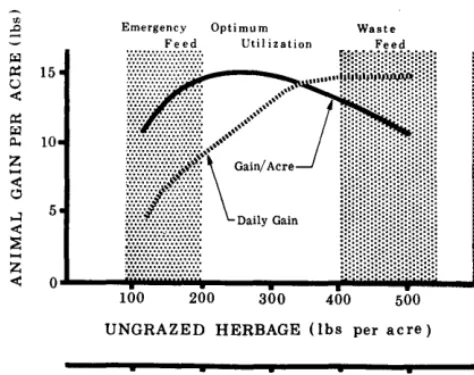
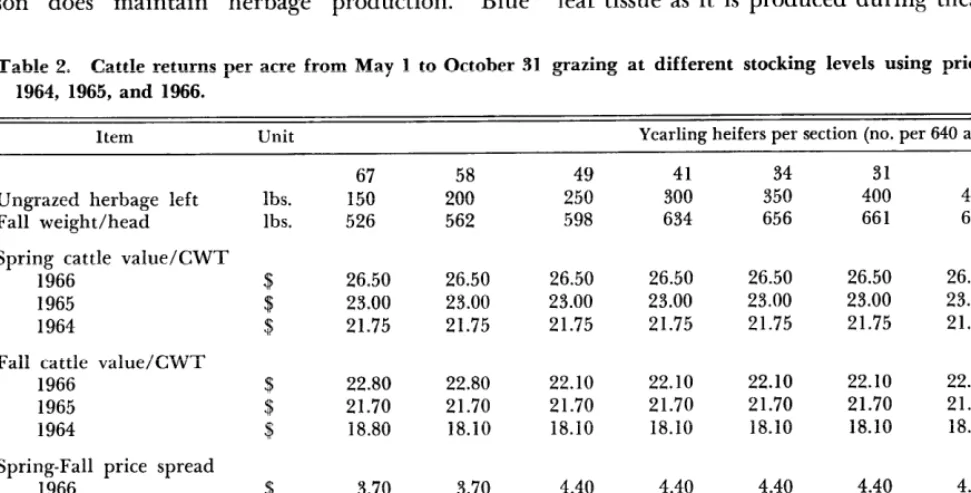
grazing periods. Gain-per-acre and daily-gain curves were fitted to the data and standard deviations were computed. The combi- nation of the daily-gain curve, gain-per-acre curve, ungrazed herbage, and average stocking rate re- sulted in the stocking-rate guide (Fig. 1).Cattle sale data for the years 1964, 1965, and 1966 were used to evaluate the effects of stocking rate on cattle return per acre. Cattle return per acre, as used here, was the dollar value returned per acre by the cattle that grazed the vegetation. Labor, land, sale, and transportation costs were not included. Death losses for the yearling heifers on upland pastures were negligible and were omitted.
Spring cattle prices were those received for similar cattle at the auction sale in Greeley, Colorado. Fall cattle prices were those received at the annual Crow Valley Livestock Association Sale conducted at the Experimental Range.
The amount of herbage remaining ungrazed at the end of the season can be readily estimated to within 50 lb/acre by a trained observer. For this reason, average stocking rates which left 150, ZOO, ,250, 300, 350, 400, 450, and 500 lb/acre of un-
grazed herbage were selected from the stocking-rate guide to study cattle return per acre. The average number of animals per section (640 acres) and aver- age animal gain per season were calculated from the stocking-rate guide for each of the selected stocking rates. Cattle prices for 1964 through 1966 were applied to the calculated beef production to estimate cattle return per acre at each of the se- lected stocking rates.
Results
The stocking-rate guide (Fig. 1) shows animal gain per acre and animal daily gain in relation to ungrazed herbage remaining at the end of the graz- ing season and approximate stocking rate. The standard deviation for the animal-daily-gain curve is +0.27 lb/day, and for the gain-per-acre curve is * 0.97 lb/acre.
Maximum average gains of 15 lb/acre were ob- tained at a stocking rate of 2.2 acres/yearling per month. At this stocking rate approximately 250 lb of air-dry herbage were left on the ground at the end of the grazing season. Maximum average daily gains of 1.45 lb/ animal were made by leaving at least 350 lb of herbage at the end of the season; this required at least 3.2 acres/yearling month.
STOCKING-RATE GUIDE
85
Table 1. Cattle returns per acre from May 1 to October 31 grazing at different stocking levels using 1966 price data.
Item Unit Ungrazed herbage left (lb.)
Yearling heifers/section (640 acres)
Acres/heifer month
Gain/acre Gain/head/day
Gain/head 6 mo. (180 days)
Spring weight/head Fall weight/head
Spring cattle value/CWT (May ‘66)
Spring cattle value/head
Fall cattle value/CWT (Nov ‘66)
Fall cattle value/head Sale return/head Sale return/section
Spring cost of cattle
Interest on spring cost @ 5% 6 mo.
Misc. costs @ $l.l6/head (spray 20$,
salt lO$, tax 864)
Interest plus misc. costs
Cattle return per section
Cattle return per acre
lb. No.
;lZ: lb. lb. lb. lb.
150 200 250 300 350 400 450 500
67 58 49 41 34 31 29 28
1.60 1.85 2.19 2.63 3.12 3.45 3.70 3.80
13.09 14.58 15.07 14.82 13.63 12.62 11.74 11.46
0.70 0.90 1.10 1.30 1.42 1.45 1.45 1.45
126 162 198 234 256 261 261 261
400 400 400 400 400 400 400 400
526 562 598 634 656 661 661 661
26.50 26.50 26.50 26.50 26.50 26.50 26.50 26.50
106.00 106.00 106.00 106.00 106.00 106.00 106.00 106.00
22.80 22.80 22.10 22.10 22.10 22.10 22.10 22.10
119.93 128.14 132.16 140.11 144.98 146.08 146.08 146.08
13.93 22.14 26.16 34.11 38.98 40.08 40.08 40.08
933.31 1284.12 1281.84 1398.51 1325.32 1242.48 1162.32 1122.24
7 102.00 6148.00 5194.00 4346.00 3604.00 3286.00 3074.00 2968.00
177.55 153.70 129.85 108.65 90.10 82.15 76.85 74.20
77.72 67.28 56.84 47.56 39.44 35.96 33.64 32.48
255.27 220.98 186.69 156.21 129.54 118.11 110.49 106.68
678.04 1063.14 1095.15 1242.30 1195.78 1124.37 1051.83 1015.56
1.06 1.66 1.71 1.94 1.87 1.76 1.64 1.59
Discussion grama does not have a smooth seasonal growth
When 300 lb of herbage remain ungrazed at the curve at Central Plains Experimental Range. It close of the season, animal production is at an op- grows in spurts as moisture becomes available. It timum and herbage production is probably near is not unusual for this grass to grow and then be- optimum for this type of livestock operation. Leav- come dormant two or three times during the sum- ing 300 lb of herbage at the end of the grazing sea- mer season. Grazing cattle remove portions of the son does maintain herbage production. Blue leaf tissue as it is produced during these spurts of
Table 2. Cattle returns per acre from May 1 to October 31 grazing at different stocking levels using price data from 1964, 1965, and 1966.
Item Unit Yearling heifers per section (no. per 640 acres)
Ungrazed herbage left lbs.
Fall weight/head lbs.
Spring cattle value/CWT
1966 1965 1964
$ 26.50 26.50 26.50 26.50 26.50 26.50 26.50 26.50
$
23.00 23.00 23.00 23.00 23.00 23.00 23.00 23.00$ 21.75 21.75 21.75 21.75 21.75 21.75 21.75 21.75
Fall cattle value/CWT 1966
1965 1964
Spring-Fall price spread
1966 1965 1964
Cattle return per acre 1966
1965 1964
67 58 49 41 34 31 29 28
150 200 250 300 350 400 450 500
526 562 598 634 656 661 661 661
22.80 22.80 22.10 22.10 22.10 22.10 22.10 22.10
21.70 21.70 21.70 21.70 21.70 21.70 21.70 21.70
18.80 18.10 18.10 18.10 18.10 18.10 18.10 18.10
3.70 3.70 4.40 4.40 4.40 4.40 4.40 4.40
1.30 1.30 1.30 1.30 1.30 1.30 1.30 1.30
2.95 3.65 3.65 3.65 3.65 3.65 3.65 3.65
1.06 1.66 1.71 I .94 1.87 1.76 1.64 1.59
1.96 2.40 2.63 2.70 2.49 2.32 2.17 2.10
86 BEMENT
growth. Under heavy stocking rates much of the new leaf tissue is removed, leaving little photosyn- thetic material for herbage production. Under light stocking less new leaf tissue is removed and more photosynthetic material is available for pro- duction. The amount of photosynthetic material working during these spurts of growth influences the quantity of herbage produced.
The most important effect of heavy grazing on vegetation was a reduction in herbage yield (Klipple and Costello, 1960). Klipple and Bement (1961) reported that herbage yields lowered by heavy graz- ing could be restored by the use of a light stocking rate. Hyder et al. (1966) found that species compo- sition of the vegetation on these pastures was not affected by 23 years of summer grazing at heavy in- tensities.
An operator must consider vegetation, livestock, and economics as he makes management decisions of: 1) when a pasture should be stocked, 2) what rate of stocking should be used, 3) when the live- stock should be taken off, and 4) where they should go. This stocking-rate guide will be helpful in mak- ing management decisions for upland blue-grama ranges similar to those at Central Plains Experi- mental Range. In all but 4 of the 24 years of this study the stocking-rate guide would have provided a sound basis for the stocking-rate decision.
In April, when the stocking-rate decision is made, there is no way of knowing what kind of season is to follow. Wide yearly and seasonal fluctuations in forage production as well as annual and seasonal variations in forage quality will occur.
In drouth years, similar to 1954, forage produc- tion is negligible. In such a case the range and livestock manager must decide when to move and where to go. He may decide to stay in a pasture even though there are less than 200 lb of herb- age remaining because blue-grama ranges respond quickly if adequate moisture is received. In using this emergency feed he must consider the lowered animal gains and the amount of growing season re- maining if adequate rains were to come.
On the other hand, there will be years similar to 1957 when blue-grama yield was not above average but early moisture produced an abundance of Rus- sian thistle (Salsola kali var. tenuifolia Tausch). The cattle avidly grazed the thistle from June through September. In this case, animal-daily gains of two lb were realized for the 180-day season. Daily gain would be much higher than that ex- pected from the guide in such a year, and properly increased stocking rates could improve the gain per acre.
In order to make wise stocking-rate adjustments during the grazing season, more information is needed: 1) to evaluate the quality of forage avail- able at any given time, and 2) to determine the amount of leaf tissue needed to sustain fast herb- age growth. The quantity of forage of a given quality needed to make optimum gains should also be known. When an operator can evaluate each of his pastures on the basis of quality and quantity of forage available as well as the quantity of leaf tis- sue required for rapid growth, he can better make the decisions of when and where to move. Until this information is available, the stocking-rate guide developed at Central Plains Experimental Range will help him with his initial stocking and will be of some assistance in making later adjust- ments.
LITERATURE CITED
BEMENT, R. E., AND G. E. KLIPPLE. 1959. A pasture-com- parison method of estimating utilization of range herbage on the Central Great Plains. J. Range Manage. 12:296- 297.
HYDER, D. N., R. E. BEMENT, E. E. REMMENGA, AND C. TER- WILLIGER, JR. 1966. Vegetation-soils and vegetation-graz- ing relations from frequency data. J. Range Manage. 19: 11-17.
KLIPPLE, G. E., AND DAWD F. COSTELLO. 1960. Vegetation and cattle responses to different intensities of grazing on short-grass ranges on the Central Great Plains. U.S. Dep. Agr. Tech. Bull. 12 16. 82 p.
KLIPPLE, G. E., AND R. E. BEMENT. 1961. Light grazing- is it economically feasible as a range-improvement prac- tice. J. Range Manage. 14:57-62.
ASRM Directory
Influence of Animals on
Pristine Conditions on the
Canadian Grasslands’
RAYMOND E. ENGLAND AND ANTOON DeVOS
Ph.D. Candidate and Professor, Department of Geography and Planning, University of Waterloo,
Waterloo, Ontario, Canada.
Highlight
In an attempt to get a clearer picture of pristine land- scape conditions in the Canadian grasslands and the natu- ral processes affecting that landscape, the authors perused a wide cross-section of the writings of early explorers, fur traders, and adventurers. The authors concluded that over- grazing by bison probably was significant at least locally, and that this overgrazing, in association with trampling, rubbing and wallowing, contributed to the creation and maintenance of environmental conditions favorable to a variety of other wildlife.
In recent years, there has been increasing interest in the study of landscape change. A considerable amount of this interest has focused on the temper- ate grasslands of North America. However, most studies of landscape change on the temperate grass- lands have been preoccupied with discussing the validity of the climatic and fire hypotheses of grass- land formation, an issue of longstanding academic debate. The divergent views expressed on this sub-
ject alone serve only to emphasize the fact that our knowledge of the formation and maintenance of grassland c onditions is far from conclusive. Such controversies, we feel, cannot be resolved until we grapple with two basic problems: (1) the piecing together of an accurate description of the pristine grasslands, and (2) the determining of the nature and relative importance of the “natural” processes which were at work on the pristine grasslands.
The failure to grapple successfully with the above problems renders questionable the validity of any conclusions which might otherwise be drawn. A case in point is the work of Weaver and Clements (1938, p. 524), who claimed that the short grass prairie association is a disclimax induced by man through the agency of domestic cattle and sheep grazing. They held that in pristine times the pres- ent short grass prairie was in fact mixed <grass prairie and that this latter state is the true climax. This view was maintained by Clements (1936, cited by Larson, 1940) under the conviction that “ani- mals must also be considered members of the cli- max, and the word biome was proposed for the pur- pose of laying stress upon the mutual roles of plants and animals.” Thus, for the present short
lReceived April 28, 1967; accepted for publication Septem- ber 30, 1968.
grass prairie to have been mixed grass prairie in pristine times would require, in Clement’s think- ing, that grazing at a level less than moderate must have persisted. Larson (1940) questioned this as- sumption and attempted to demonstrate from his- torical records that the number of ungulates, pre- dominantly bison, grazing the North American grasslands could have been and, from early ac- counts, appear to have been, more than sufficient to have maintained at least a moderate grazing pressure upon the area presently delimited as the short grass prairie association. He thus contends
that the short grass plains is not a disclimax main- tained by domestic stock but rather that it is the same association as probably existed under bison grazing. Therefore, he concludes, it is in fact the climax, the only variable being that one agent (do- mestic cattle) has supplanted another (bison).
With this in mind, we wish to present a brief report on our evaluation of the effects of native grazing animals on the pristine grasslands of west- ern Canada. This evaluation is based on historical documents covering the period 1690 to 1880. These time limits were chosen with some care. The 1690’s mark the beginning of landscape documentation in the journals and diaries of the first whites to enter western Canada. Much of this early material is useful in indicating, although not fully establish- ing, the general pristine conditions. The 1880’s has been set as the upper time limit to avoid any in- volvement in a study of landscape at the time of increasing white population and associated activi- ties such as ranching and “sod busting.” Even by that time, the biome had already been subjected to rather severe disruption by the virtual extermina- tion of the bison.
Bison
In the early period of exploration, no feature of the plains landscape succeeded in capturing the imagination more than did the great numbers of bison (Bison bison) dwelling there. The commonly quoted estimates of pristine bison population are those made by E. T. Seton (1929). Based on a series of assumptions about carrying capacity, range area, habits, and population trends, Seton estimated a population of from 40 to 60 million bison in North America.
No attempt is made in this paper to estimate the maximum bison population that existed in western Canada, since the herds were transitory and the evi- dence available is insufficient to accomplish any worthwhile estimate except on a gross conjectural level. Soper (1964) has acknowledged this inability to accurately estimate the pristine bison popula- tion in Alberta and merely states that “undoubtedly abundance was comparable to other parts of the range.” This does not seem at all unfounded in
88 ENGLAND AND DeVOS
LOCATION MAP
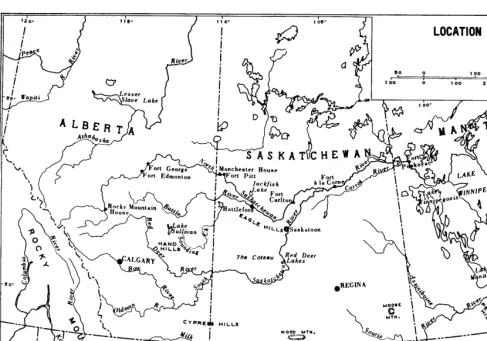
FIG. 1. Map of locations mentioned in discussion of grasslands of western Canada.
light of the numerous accounts of vast bison herds in Canada which are to be found in all the early journals2 Suffice it to say, therefore, that some millions were probably present on the grasslands of western Canada during any one year.
The important question is not so much how many bison were present, but rather just what ef- fect large populations would have had upon the landscape. Earlier reference was made to Larson’s hypothesis that bison grazing was heavy enough to maintain a short grass association in areas of the plains that, in their absence, might otherwise have exhibited a mixed grass aspect. Larson (1940), un- able to present any early direct observations of heavy grazing or overgrazing by bison, came to his conclusions on the basis of rather limited historical material regarding the general appearance of the landscape. Curtis (1962), although conceding that bison undoubtedly overgrazed some areas of the North American grasslands in pristine times, con- tends that their wandering nature would in all probability have resulted in their not returning to a specific area for several years. During this un-
2 Hendry, 1754, p. 333; Cocking, 1772, p. 104; Thompson, 1787-88, p. 54; M’Gillivray, 1794, p. 3 1; Kane, 1846.
grazed period, he suggests, the rangeland would re- cover. Similarly, Clark (1962) maintains that “the weight of opinion is that the bison did not graze as heavily [as cattle and sheep].” Nevertheless, we are convinced, after perusing a number of the jour- nals of early travellers in the grasslands of western Canada, that bison did overgraze, and that this may have been quite significant, at least locally. Obser- vations of local overgrazing are recorded, or infer- red, in the diaries of David Thompson, Edward Umfreville, Alexander Henry, Captain Palliser, Sullivan, and others.
Thompson (Glover, 1962) during his winter so- journ with the Piegan Indians in 1787-88, recorded
the following in his narratives:
CANADIAN GRASSLANDS 89
is beginning to be on the ground.” On this occa- sion at least the old man’s prediction proved cor- rect, as Thompson observed. Such a statement, though not direct evidence of overgrazing, does im- ply that, in the experience of the Indians, bison would frequently occupy a region until they had consumed almost all the forage available and then they would move on. (See location map, Fig. 1.)
Another resident on the North Saskatchewan in the 1780’s was Edward Umfreville. After quitting the employ of the Hudson’s Bay Company, he manned the North West Company’s most westerly post up river from Manchester House. Umfreville (Warkentin, 1964) noted overgrazing by bison in his narratives published in 1790. He wrote:
“In vallies and humid situations, the grass grows to a great height, which fattens our horses in a short time; but the buffalo usually makes choice of hilly, dry ground, to feed on, the blades of grass on which are small, short, and tender. When a nu- merous herd of these animals stay any length of time in one place, the ground is absolutely barren there for the remainder of the season, the grass be- ing eat off as close as if shaved with a knife. . . .”
In 1801, Alexander Henry (Coues, 1897, cited by Bird, 1961, p. 58) gave his impressions of the effect of the bison on the grasslands as follows:
“The country from Red River to this mountain [Pembina Hills near Canada-United States bound- ary] is one level plain, without a hill or stone. The grass would be rather long were it not for the buf- falo.”
In the journal of Captain Palliser (1863), evi- dence for overgrazing can also be found.
“Oct. 2, 1857. We camped on the second of the Red Deer Lakes; buffalo very numerous, and have eaten the grass down considerably, and have not left much for the horses.”
Sullivan (see Palliser, 1863, p. 84) recorded simi- lar problems in finding adequate forage for his horses because of overgrazing by bison near Eagle Hills.
Macoun (1882) c aims that Pallisers’ unfavorable 1 impression of the plains surrounding Hand Hills was due to the overgrazing of the area by bison. He points out that the Hand Hills area was called in the Cree language the “Store,” because bison were always frequenting the area. When Captain Palliser was there, he did see a number of bison and described the landscape around the base of the Hills as a bare, arid plain. When Macoun visited the area, however, the bison were gone and only waving expanses of rather luxuriant grass cover were present.
Inferences of overgrazing can frequently be drawn from records which at one point mention considerable bison numbers and at another allude to poor pasturage. Such accounts do not necessarily
establish a cause and effect relationship. Neverthe- less, other types of evidence can be gleaned from general descriptions of the grassland landscape which do not correspond to present conditions. An example of the latter might be cited from the jour- nal of Matthew Cocking (Burpee, 1908) who re- corded a short grass aspect to the country approxi- mately 20 miles southwest of Fort La Corne. Such a description does not correspond to present day conditions. Another example can be cited from the journal of Paul Kane who encountered vast num- bers of bison near Edmonton House in 1846. Kane mentioned that the immense herd he encountered filled the air with so much dust as to be almost suf- focating. It should be borne in mind that this area of Alberta in question is not a semi-arid short grass area, but rather a relatively moist area normally supporting a rather luxuriant grass cover. Assum- ing that 1846 was not an abnormally dry year, the amount of overgrazing and trampling of the sod must have been considerable to cause the condi- tions described by Kane.
Another effect which the bison may have had on the plains landscape is the destruction of woody vegetation. Soper (1941) in his study of the wood bison, has discussed how these animals destroy woody vegetation by rubbing to reduce the irrita- tion from harassment by flies and by trampling down shrubbery and saplings especially near water- ing areas. Plains bison were subject to the same type of fly irritations and undoubtedly looked for sources of remedy similar to those of the wood bison. The plains bison’s affection for rubbing is obvious from the polished surfaces of various gla- cial erratics scattered along the Alberta foothills. Around many of these erratics are depressions formed by the trampling of countless bison. Moss (1932) felt that the bison may have been significant in hindering the southward extension of the aspen parkland in Alberta. However, Roe (1939) has con- cluded that bison were of little or no significance in extending the grasslands or in deforesting areas, but he does recognize with reservations that the bison were “enemies of regeneration.” Certainly, historical evidence for any large scale destruction of areas of woody vegetation in the grasslands is meager. Alexander Henry (Coues, 1897, cited by Bird, 1961, p. 58), who travelled throughout North Dakota and Manitoba in the first years of the nine- teenth century, penned the following description in 1801 in North Dakota:
90 ENGLAND AND DeVOS
grow in the points of wood. The bare ground is more trampled by these cattle than the gate of a farmyard. . . .”
Both Palliser (1863) and Sullivan encountered numerous bison paths through brushlands near the Red Deer Lakes and along the Battle River respec- tively. It should be noted that these sightings are also near water. Grant (1879), in his account of the Sandford Fleming expedition, mentions in two places that fossil bison trails were seen converging on sloughs. In one instance, he interprets the trails as indications of past landscape conditions.
“The tracks of former times are indented in the ground like old furrows and run in parallel lines to the salt lakes, as if in those days the prairie had been covered with wood, and the beasts had made their way through in long files of thousands.” Grant here has conjectured a cause for the pattern of these fossil trails. If he is correct in assuming the area was once wooded, one might suggest with certain reservations that the bison, through their frequent visits, may have played a role in bringing about the destruction of the woody vegetation. However, other possible agents, such as browsing, drought, and fire, must also be considered. When one considers the importance of water sources to bison and the great numbers that must have fre- quented various sloughs, it would seem justifiable to assume that their effect on trampling down veg- etation and retarding the spread of woody vegeta- tion could have been considerable. This is espe- cially true since, as Bird (1961) points out, the borders of sloughs are frequently among the first areas where woody vegetation becomes established. Also, large herds of bison seeking relief from fly irritation must surely have done considerable dam- age to isolated groves of woody vegetation. But, as Roe (1939) cautions, this does not necessarily im- ply widespread elimination of woody vegetation.
In addition to rubbing, bison have an affection for wallowing, and many of the old wallows are still perceptible on the landscape. Cocking (Bur- pee, 1908, p. 82) implies in his journal that bison wallows were very widespread, as the following statement would indicate:
“Oct. 9,
1772.
All over the Country where Buf- falo resort are many hollow places in the ground, made by the Bulls in the covering season.”The possible significance of these wallows has been discussed by Bird (1961). He points out that such localized disturbed areas may have been im- portant in the subsequent “invasion” of grasslands by woody vegetation by providing areas of bare ground and little competition. Similarly, he points out that the wallows could have been important in creating “favourable egg-laying sites on the dry prairie” for the Rocky Mountain grasshopper (Melanoplus spretus).
Antelope
There were other ungulates conspicuous in the western landscape in pristine times and they simi- larly deserve attention. The pronghorn antelope (Antilocapra am,ericana) was one of these.
It has been estimated that the pronghorn ante- lope was as numerous, if not more so, than the bison (Rand, 1945). This would, therefore, neces- sitate there having been a population of some tens Qf millions.
The present range of antelope in western Can- ada is much more restricted than it appears to have been in former times. The 1945 range, according to Rand (1945), had as its northern limit the Win- tering Hills, Sullivan Lake, and Kirkpatrick Lake north of the Red Deer River in Alberta, and just north or south of the South Saskatchewan River in Saskatchewan. The western limit lay about the Milk River forks in Alberta, and the eastern limit just west of Wood Mountain in Saskatchewan. Soper’s map (1964, p. 370) of antelope distribution in Alberta indicates that the pronghorn’s range is even more restricted today.
The historical range extended to the North Saskatchewan River well east into Manitoba and northwest to Rocky Mountain House, Alberta. This extended range persisted well into the nine- teenth century when Kane (1925) in 1846 recorded, “immense number of cabrees or prairie antelope” along the North Saskatchewan between Forts Carl- ton and Pitt; Palliser recorded antelope in the Bow Valley in 1858; and as late as 1872 members of the Sandford Fleming expedition recorded antelope in the Jackfish Lake region some miles north of the present day city of Battleford, Saskatchewan. A very questionable reference is made in the journal of Daniel Williams Harmon (Lamb, 1957) to the presence of antelope (cabri) in the isolated grass- lands of the Peace River. However preposterous this may seem, it might warrant further study.
CANADIAN GRASSLANDS 91
suitable habitat brought about by the extermina- tion of bison.
Humphrey (1962) states that, “Because antelope frequent open grassland where the dominant plants are, or appear to be, grasses, it is commonly as- sumed that grasses constitute the bulk of antelope forage.” However, Einarson’s (1948) and Buech- ner’s (1960) studies on food habits indicate that browse and forbs constitute the bulk of the prong- horn’s diet. It would, therefore, appear that an abundance of forbs and browse is important for maintaining a large population of antelope. Browse and forbs are frequently more common under heavy grazing and, in Dyksterhuis’ system for assessing range trend, such plants are often the increasers or invaders. Humphrey (1962) states that, “In view of the large number of forbs that are eaten in quan- tity by the pronghorn antelope, it would seem that ranges overgrazed by domestic livestock and repre- senting subclimax successional stages would pro- vide a better habitat than climax grassland. This however, as pointed out by Buechner, is not the case. Antelope were found to do well on moder- ately overgrazed cattle range because they have the ability to adapt to foods that are not preferred by cattle.” The important point is that large popula- tions of antelope appear to be compatible with overgrazed conditions despite the degree of over- grazing, i.e. heavy or moderate. Since the antelope apparently existed in great numbers while at the same time there existed a very large bison popula- tion, it does not seem unfounded to postulate that perhaps bison, by at least moderately overgrazing the range, created a more suitable habitat for ante- lope. Buechner (1960) and Longhurst (1960) have alluded to this possible compatability of antelope and bison.
Moose
The moose (Alces alces) is generally considered a creature indigenous only to the wooded country north of the grasslands and the wooded mountain and foothill region west of the grasslands. Peterson (1955) in his study of the moose, relies upon Preble3 for information on the historic range of the moose in North America. However, Preble appears to have defined the historic range of the moose in western Canada solely on the basis of the early ex- ploration and natural history literature relating to the northern forest areas. Therefore, one is left with the impression that the moose did not range into the more open grasslands. This may not have been the case, however.
In attempting to establish the historic range of the moose in relation to the grasslands, we have found the journal of Anthony Hendry a most in- teresting source. In 1754-55, Hendry travelled on
3 Preble, 1908, cited by Peterson, 1955.
the plains from the Fort Poskoyac region down the Carrot River, across to the Saskatchewan River near Battleford, across Sounding Creek, to the lower reaches of the Red Deer River and back via the South Saskatchewan River. On August 13, 1754, Hendry records entering the Muscoty plains, a term applied by the early explorers to the grassland re- gion, the common haunt of the bison. He does not record leaving these plains until October 29, 1754. During that period alone, he records the kill of 48 moose. Similarly, he refers to days on which several and even a great many were killed.
We do not wish to imply that the moose were by any means as numerous as bison, antelope, or even elk on the relatively open grasslands of Canada. However, they apparently were present in suffi- cient numbers to warrant recognition as a signifi- cant part of the biome. Their presence raises an interesting question in light of the importance of browse in moose’s winter diet (Pimlott, 1960). Namely, was there more browse available on the pristine grasslands, or were the considerable num- bers of moose recorded by Hendry distributed in ribbon patterns along river and creek bottoms?
Elk and Mule Deer
Elk (Cervus canadensis) and mule deer (Odocoi- Zeus hemionus) were also prominent in the pristine biome of western Canada. There is no evidence in the literature to indicate the presence of the Vir- ginia deer (Odocoileus virginianus). The elk has been virtually exterminated on its prairie range, but the mule deer has persisted, though perhaps in reduced numbers. When the bison dwindled, at- tention was turned to them as sources of food. Exactly how numerous elk and mule deer were is almost impossible to estimate, except within the grossest limits. However, the fate of the elk was determined even before it could have become a nuisance to growing agriculture. For an indication of the abundance of elk in early times, we again rely primarily upon the journal of Anthony Hendry, for of all the early travellers his accounts are the most quantitative. During his sojourn in the grass- lands, he recorded, in addition to moose, the kill- ing of 109 elk, and, in addition, he made reference to kills of several and a great many elk. On Janu- ,ary 3, 1755, Hendry (Burpee, 1907, p. 345) recorded
sighting a herd of approximately 300 elk.