www.ijiset.com
291
A Simulation Based Analysis and Classification of
Workload For Resource Allocation
Chethan NP 1
P
, Mrs.Pushpalatha R P 2
P
and Dr.Ramesh BoraiahP 3
P
1,2
P
Department of Computer Science and Engineering, VTU PG Centre, Mysuru, Karnataka, India.
P
3
P
Department of Computer Science and Engineering, Malnad college of engineering, Hassan, India.
ABSTRACT
42T
Cloud computing0T42T0Tis changing our lives in many ways.
Cloud computing offers high scalability, flexibility and cost-effectiveness to meet emerging computing requirements. User who is going to adopt0T0Tcloud
computing0T0Tservices will certainly expect the kind of
improved performance compared to other cloud computing environment. There are several factors available to improve the performance in cloud. Workload can be considered as one of the key factor to achieve high performance in Cloud. Classifying the workload would be a good solution to improve the performance. Analysing different characteristics of workload and classifying them within a Cloud computing environment is critical. As there is lack of support for analysis and classify the workload for various reasons like insufficient availability of real-world datacenter tracelogs, complexity in analysing workloads and virtualization layer overhead. These elements adds lack of methodologies to analyse different characteristics of workload in cloud. To tackle the above issues, we propose a simulation model,
to capture the behavioural patterns of different user
profiles and to support analysis and classification of
workload for resources utilization in cloud
environments. This paper presents a novel approach for characterizing workloads in the context of both user and task in order to derive a model to capture resource estimation and utilization patterns. The proposed model is implemented as an by extension of the CloudSim simulator.
KEYWORDS: Cloud Computing, Workload
Classification ,Workload Analysis, Characterization of Workload ,Cloud trace.
1.
INTRODUCTION:
Cloud computing refers to0T0Tapplications0T0Tand services
offered over the Internet. User can access your data
from a smartphone, a tablet, a laptop or a desktop
wherever you have an Internet connection.
Examples of cloud computing include
online0T0Tbackup0T0Tservices,0T0Tsocial networking0T0Tservices,
and personal data services such as Apple's
Mobile_Me. 42TDropbox:0T42T0TOne of the most popular
options, this service lets you share files and photos0T .0T
Cloud computing is being driven by providers
including0T0TGoogle,0T0TAmazon.com, and0T0TYahoo. Cloud
service can adopted by all kinds of users, be they
individuals or large enterprises. Cloud computing
provides several benefits such as dynamic
scalability, rapid elasticity and pay per use feature.
Virtualization technology has become fundamental
in modern computing environments such as cloud
computing[10]. By running multiple virtual
machines on the same hardware, virtualization
allows us to achieve a high utilization of the
available hardware resources. Moreover,
virtualization brings advantages in security,
reliability, scalability and resource management.
Workload is defined as:" The amount of work
performed by an entity in a given period of time ".
The amount of work handled by an entity gives an
estimate of the efficiency and performance of that
entity. In computer science, the term workload refers
www.ijiset.com
292
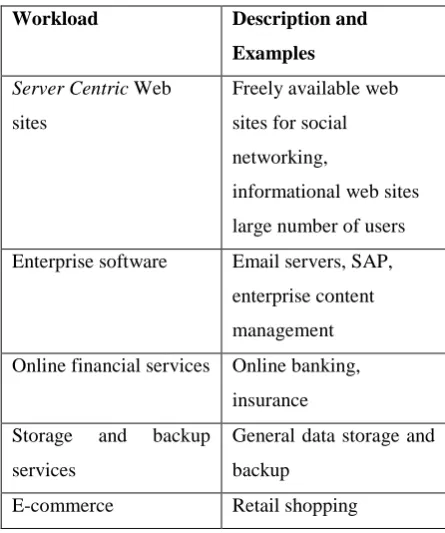
work. Running a web server or a web server farm, orbeing a Hadoop data node - these are all valid workloads.0T table 1 will give some of the common
workload in cloud computing environment.
42T
Workload 42TDescription and
Examples
16T
Server Centric 16TWeb
sites
Freely available web
sites for social
networking,
informational web sites
large number of users
Enterprise software Email servers, SAP,
enterprise content
management
Online financial services Online banking,
insurance
Storage and backup
services
General data storage and
backup
E-commerce Retail shopping
table 1:Common Workloads in Cloud Computing
Workload in cloud comprises of two components:
tasks and users. Tasks are defined as the
fundamental unit of computation assigned or
performed in the Cloud and User is defined as the
actor responsible for creating and configuring the
volume of tasks to be processed. The workload
comprises of a set of tasks, where every task belongs
to a single job. A job may have multiple tasks. In
order to better understand and describe tasks and
improve the ability of Cloud, the analyzing of tasks
is essential. The aim of workload analysis is to look
at different aspects or characteristics of an enterprise
application to determine the feasibility of moving
the application in the Cloud. Even though there is a
growing need for universal accessibility of real-data
centre tracelogs , but still such data is not easily
available. There might be several reasons for it, such
as confidentiality of organizations data,
confidentiality of client’s data and organizational
policies.
CloudSim is a simulation tool that allows cloud
developers to test the performance of their
provisioning policies in a repeatable and
controllable environment[17]. CloudSim is a library
for the simulation of cloud scenarios. It provides
essential classes for describing data centers,
computational resources, virtual machines,
applications, users, and policies for the management
of various parts of the system such as scheduling
and provisioning. Using these components, it is easy
to evaluate new strategies governing the use of
clouds, while considering policies, scheduling
algorithms, load balancing policies, etc. It is flexible
enough to be used as a library that allows cloud
developers to add a desired scenario by writing a
Java program. By using CloudSim, organizations,
R&D centers and industry-based developers can test
the performance of a newly developed application in
a controlled and easy to set-up environment.
1.1
Available Cloud Tracelogs:
The workload can be either the synthetic or genuine
workload. The synthetic workloads are valuable to
carry out the controlled experiment. For
performance evaluation of complex multitier
applications, the synthetic workload generation
methods are required for example, in Banking,
E-Commerce, Business deployed in the cloud
computing environments. The important is that, the
produced workload called synthetic workload should
maintain the same attributes and behaviour of
genuine workload [14]. At the present, there are a
limited number of certifiable Cloud computing
tracelogs are accessible This is generally because of
the business and confidentiality concerns of users
www.ijiset.com
293
vendors that has provided dataset from their Cloudcomputing clusters are GOOGLE, YAHOO,
PlanetLab etc . As of late, Google has contributed by
contributed two versions of tracelogs from their
Hadoop MapReduce clusters[11]. Yahoo! which
was made accessible for selected universities from
their M45 Hadoop cluster.
The paper is organized as follows: Section II
provides an insight into the related work. Section III
and IV present the existing and proposed systems
respectively. Section V presents the Simulation
setup and configurations. Results are presented in
Section VI. Finally, Conclusion and Future Work
are given in Section VII.
2.
RELATED WORK:
A substantial amount of research has been devoted
to the problem of analysis and classification of
workload in cloud computing environment. In this
section, the most relevant approaches are described,
their limitations and gaps are also discussed.
Mishra, et al. [1] describe an approach to construct
Cloud computing workload classifications based on
task resource consumption patterns. It is applied to
the first version of Google tracelogs . The proposed
approach identifies the workload characteristics,
constructs the task classification, identifies the
qualitative boundaries of each cluster, and then
reduces the number of clusters by merging adjacent
clusters. The approach presented is useful to create
the classification of tasks. However it does not
perform intra-cluster analysis to derive a detailed
workload model. Finally, it is entirely focused on
task modeling, neglecting the user patterns which
are as important as the tasks in the overall workload
model.
Aggarwal et al. [5] describe an approach to
characterize Hadoop jobs. The analysis is performed
on a data set spanning 24 hours from one of
Yahoo!’s production clusters. This data set features
metric generated by the Hadoop framework. The
main objective of this work is to group jobs with
similar characteristics using clustering to analyze the
resulting centroids. This work only focuses on the
usage of the storage system, neglecting other critical
resources such as CPU , Memory , Disk space and
network.
Xiaoyang et al[8]. In this paper, diverse sort of
analysis such as coarse-grained analysis, cluster
analysis and inner-cluster analysis were used to
analyze task as well as task modeling. For analysis
of workload they have utilized dataset from the
second version of the Google MapReduce Cloud
tracelog that features traces from over 12,000
servers over period of a month , which provides the
normalized CPU, Memory and disk utilization per
task in a timestamp every 5 minutes. Additionally,
they have chosen CPU and Memory utilization
attributes as dimensions of task model and compared
it. And they have used k value of k-means clustering
and some proper attributes can improve the accuracy
of model. The experiment was done using
MATLAB.
Solis et al. [11] provides an approach for
characterizing Cloud workload based on user and
task patterns using the second version of the Google
tracelog. It presents coarse-grain statistical
properties of the tracelog. This work has a number
of limitations; the analysis performed is confined to
only 2 days as opposed to the entire tracelog time
span. Also, the cluster analysis and intra-cluster
analysis do not contain sufficient detail to quantify
the diversity of workload, instead presenting
high-level observations. Finally, the validation of the
simulated model against that of the empirical data is
www.ijiset.com
294
one single execution, and does not consider morerigorous statistical techniques.
Kuvulya et al. [12] present a statistical analysis of
MapReduce traces. The analysis is based on 10
months of MapReduce from the yahoo M45
supercomputing cluster . Here, the authors present a
set of coarse-grain statistical characteristics of the
data related to resource utilization, source of
failures, and job patterns. This work provides a
detailed description of job completion times, but
only provides very general information about the
resource consumption and user behavioural patterns.
Sudha Pelluri et al[14] In this paper the real
workload characteristics are used to generate the
synthetic workload such that, the generated
workload has similar characteristics and behavior as
the real workload. The characteristic of real
workload has been analyzed in IBM SPSS. The
analyzed result was placed in the VMware
workstation with Faban running on it.They have
been able to generate synthetic workload which we
are going to use in resource provisioning , load
balancing energy management and other related
research problems.
Rasheduzzaman et al.[15] This paper presents task
shape and workload characterization of Google’s
compute cluster. The methodology for workload
characterization consists of: (1) presenting the state
of transitions of different job and how they are
scheduled, failed, finished, and killed, (2)analyzing
resource requests of memory, disk space and
CPU-core using statistical tool, (3) showing the behaviour
of different task type using cumulative distribution
function, and (4) identifying the common job groups
from resource usage table by using bisecting
k-means algorithm. The results of clustering analysis
show that the largest clusters are very short time low
memory core active jobs , while the smallest clusters
are very long active jobs. This means that cluster
management system do not need to keep inactive
jobs in memory.
From the study of the related work it is clear that
there are few available production tracelogs to
analyze workload patterns in Cloud environments.
By analysing these related work, we can identify
the gaps that need to be addressed in order to
achieve more realistic workload patterns. The
analysis need to be other than croase-grain statics
and cluster analysis. The workload is driven not only
by task characteristics but also include the user
behavioral patterns.
3. Problem statement and motivation:
Workload analysis and characterization problems
have been addressed over the last years, resulting in
models for generation of synthetic workloads similar
to those observed on real systems .
3.1
Challenges in Analysis and
Classification of
Workload:
Analysis and classification of workload is especially
challenging when applied in a highly dynamic
environment such as cloud computing environment
for various reasons[9]:
1. Only limited genuine cloud tracelogs available for
analysis. This is Due to business and confidentiality
reasons.
2. Due to the massive size and complexity of
workload, in-depth statistical analysis and
classification of workloasd, within a large-scale
production Cloud is complex.
3. There is a lack of methodologies to characterize
the workload, due to behavioural patterns of
workload in cloud computing environment.
3.2
Significance
of Workload
www.ijiset.com
295
Classification of workload in cloud computing
environment benefits both cloud suppliers and
researchers, as it enables a more in-depth
understanding of the entire system as well as
offering a practical way to improve data center
functionality.
• Cloud suppliers can enhance the resource
management mechanisms to effectively
improve the productivity and maintain
Quality of Service of their systems. For
example, identifying the heterogeneity of
task to reduce performance interference of
physical servers or analyzing the
correlation of failures to resource
consumption.
• For researchers, simulation of Cloud
workload enables evaluation of theoretical
mechanisms supported by the
characteristics of Cloud data centers.
Nowadays, simulation-based approaches
become popular in industry and academy to
evaluate cloud computing systems,
application behaviours and their security,
the evaluation of these policies without
deployment and execution of the
applications in expensive large-scale
environments.
Advantages of Workload Classification:
• Different patterns of Workload can be
identified like different attribute,
constraints etc.
• Understanding the different characteristics
of workload, leads to better resources
management, so that performance is
improved.
• Workload can be analyzed at the group
level, rather than at the individual server
level.
4. METHODOLOGY:
Although previously approaches offer some insights
about workload characteristics, they do not provide
a structured model which can be used for conducting
simulations. The approaches, previously described
completely focus on tasks, neglecting the impact of
user behaviour. The workload is always driven by
the users, therefore realistic workload models must
include both user behavioural patterns and tasks
characteristics. Only some of the workload
characteristics like cpu, memory, network were
considered.
The proposed system, it aims to provide a validated
simulation model that includes parameters of tasks
and users. It used the data from the Planetlab trace
log. The proposed model is implemented as an by
extension of the CloudSim simulator.
4.1
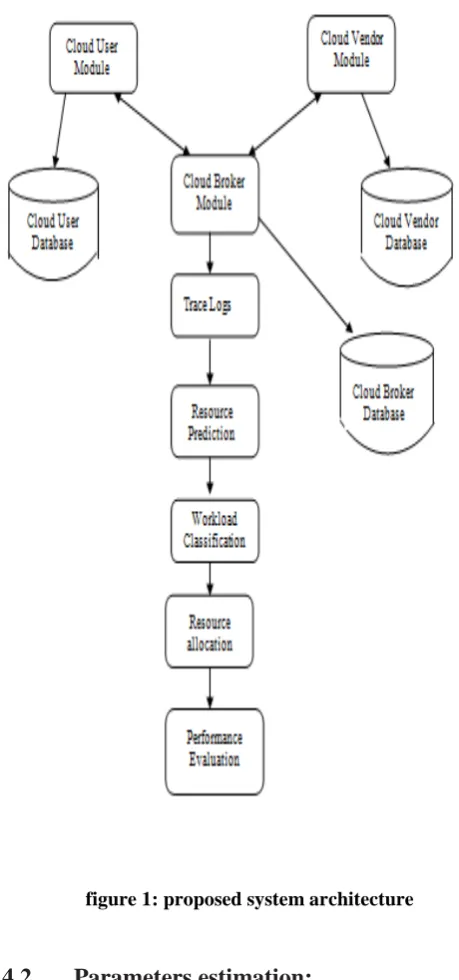
Proposed system architecture: The
proposed methodology ,begins with creation ofcloud environment like creating Datacenters,
Brokers, Accessing tracelogs. After accessing the
tracelogs, the required resources are predicted and
classification of workload is performed. Here we are
using the Planetlab tracelogs as dataset. Cluster
analysis is the task of grouping a set of objects in
such a way that objects in the same group are more
similar to each other than to those in other groups.
Here, tasks with similar resource consumption are
grouped together and required resources are
allocated to complete the process. Finally
performance model like time taken to complete the
process is shown in chart. figure 1: proposed system
www.ijiset.com
296
figure 1: proposed system architecture4.2
Parameters estimation:
As mentioned earlier workload in cloud comprises
of two components: tasks and users[1].
Users are responsible for driving the volume and
behaviour of tasks based on the amount of resources
requested for their execution. Therefore, three
important characteristics that will refer to as
dimensions are fundamental to describe the users shape: the submission rate (α), Memory (ϕ) and the estimation ratios for CPU (β).
Tasks are defined by the type and amount of work
dictated by users, resulting in different duration and
resource utilization patterns. Consequently, essential dimensions to describe tasks are: Memory (π), length (χ) and average resource utilization for CPU (ϒ) .
The Cloud workload can be described as a set of
users with profiles U submitting tasks classified in
profiles T, where each user profile uRiR is defined by the probability functions of α β and ϕ, and each task profile tRiR by χ , ϒ and π determined from the
tracelog analysis. The model components are
formalized as below:
K-means clustering algorithm follows the
partitioned clustering approach. It involves the
partitioning of given data set into the particular
number of groups called clusters. Each cluster is
associated with a center point called centroid. Each
cluster point is assigned to a cluster with the closest
centroid.
4.3
Modules:
There are 5 modules present in the
proposed system,
Cloud Environment Generator: In this,
we create the cloud environment
parameters such as creation of Datacenters,
Brokers, Hosts, VM's, Cloudlets .
Cloud User Model: The cloud users will
consider the file storage process in the
cloud vendors.
Analysis and workload classification:
The analysis of user and task characteristics
within the tracelog and classify the
workload based on threshold value.
Clustering and resource allocation: Here,
cluster the workload as low loaded and
high loaded workload. By clustering we
www.ijiset.com
297
similar resource consumption. After thatthe required resources are allocated.
Performance Evaluation: By plotting
charts, time efficiency for classifying and
allocating resource can be found.
4.4
Simulation:
In order to characterize and analyze the workload of
similar large-scale Cloud data centers under a
projected set of operating conditions, we
implemented the task and user model parameters as
an extension to the CloudSim framework.
CloudSim is a Java based framework that enables
the simulation of complete Cloud Computing
environments.
NetBeans is used to develop the application which is
simulated in the CloudSim simulator. 20 data
centers, 25 data centre brokers and 40 virtual
machines were created. The virtual machines are
then allocated to the brokers, and 40 jobs or
cloudlets were provisioned to these brokers. The
workload is classified as Low and High workload.
Finally, the resources are collected and clustering is
performed to allocate the required resources.
4.5
Result :
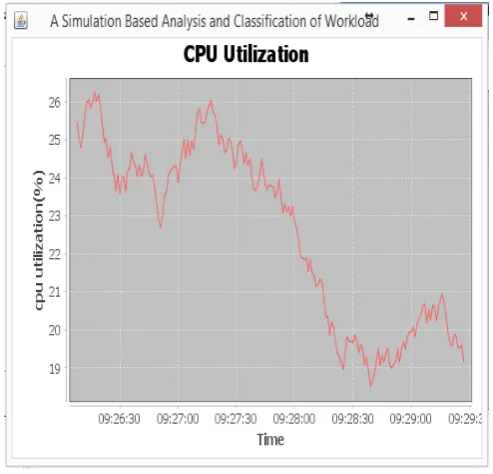
The following results were obtained after the
simulation. Figure 2 shows the graph obtained after
simulation. It shows the time taken to execute the
proposed system and percentage of cpu utilization.
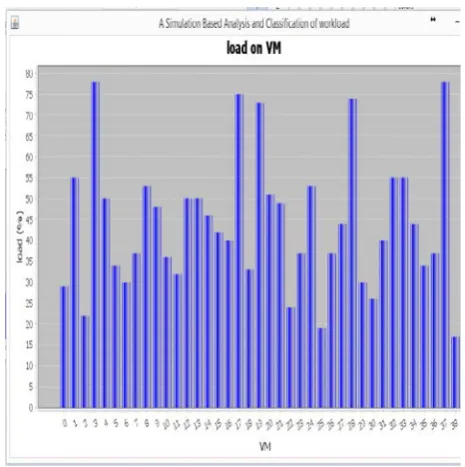
Figure 3 shows the percentage of workload on VM.
Conclusion and Future Work:
This paper presents an examination that quantifies
the diversity of Cloud workloads and derives a
workload model from a large-scale construction
Cloud datacenter. The obtainable examination and
model captures the distinctiveness and behavioral
patterns of user and task . The derivative model is
implemented by means of the CloudSim
construction and comprehensively validated during
empirical comparison and statistical tests.
Future research includes extending the model to
include tasks constraints based on server
characteristics; this will allows us to analyze the
impact of hardware heterogeneity on workload
behaviour. Other extensions include analyzing the
workload from the jobs perspective specifically
modelling the behaviour and relationship of users
and submitted jobs, analyzing workload energy
consumption.
www.ijiset.com
298
figure 3: percentage of workload on VMU
REFERENCES
1) "Towards Characterizing Cloud Backend Workloads:Insights from Google Compute Clusters", by Asit K. Mishra,Joseph L. Hellerstein,Walfredo Cirne,Chita R. Das, interning at Google during summer 2009.
2) "Metrics based Workload Analysis Technique for IaaS Cloud " , by Sukhpal Singh , Inderveer Chana ,International Conference on Next Generation Computing and Communication Technologies (ICNGCCT 2014), Dubai, UAE.
3) "An Analysis of the Server Characteristics and Resource Utilization in Google Cloud",by Peter Garraghan, Paul Townend, Jie Xu , 2013 IEEE International Conference on Cloud Engineering.
4) "Quality-of-service in cloud computing: modeling techniques and their applications",by Danilo Ardagna, Giuliano Casale, Michele Ciavotta, Juan F Pérez and Weikun Wang, Ardagna et al. Journal of Internet Services and Applications 2014.
5) “Characterization of Hadoop jobs using
unsupervised learning,” Aggarwal, S. Phadke, and M. Bhandarkar, in Proc. 2nd Int. Conf.Cloud Comput. Technol. Sci., 2010.
6) "Workload Classification for Efficient Auto-Scaling of Cloud Resources", by Ahmed
Ali-Eldin, Johan Tordsson,Erik Elmroth, and Maria Kihl, May 21, 2013.
7) "A Simulation Based Analysis and Modeling of Workload Patterns using the CloudSim Toolkit", by Abhilasha Singh, International Journal of Scientific Engineering and Research (IJSER),ISSN (Online): 2347-3878, Impact Factor (2014).
8) "Modeling the Task of Google MapReduce Workload", by Xiaoyang Lin, Piyuan Lin, Peijie Huang, Linxiao Chen, Ziwei Fan, Peisen Huang, 2015 15th IEEE/ACM International Symposium on Cluster, Cloud and Grid Computing.
9) "Experimentally Prove The Workload Complexities of a Large Scale Utility Cloud", by S.Muthukaruppan, R.Ebenezer Princy, International Journal of Advance Research In Science And Engineering ,IJARSE, Vol. No.4, Issue 03, March 2015 .
10) "Workload Classification Model for Specializing Virtual Machine Operating System", by Xinkui Zhao, Jianwei Yin, Zuoning Chen, 2013 IEEE Sixth International Conference on Cloud Computing.
11) " An Approach for Characterizing Workloads in Google Cloud to Derive Realistic Resource Utilization Models", by Ismael Solis Moreno, Peter Garraghan, Paul Townend, Jie Xu, 2013 IEEE Seventh International Symposium on Service-Oriented System Engineering.
12) “An analysis of traces from a production
MapReduce cluster,” S. Kavulya, J. Tan, R.
Gandhi, and P. Narasimhan, in Proc. IEEE/ACT Int. Conf. Cluster, Cloud Grid Comput., 2010. 13) "Workload modeling for resource usage
analysis and simulation in cloud computing" by Deborah Magalhães, Rodrigo N. Calheiros ,RajkumarBuyya,Danielo G. Gomes, Computers and Electrical Engineering 47 (2015)
14) "Synthetic Workload Generation in Cloud", by Sudha Pelluri, Keerti Bangari, Volume: 04 Special Issue: 06 | NCEITCS-2015 | May-2015 15) "Task Shape Classification and Workload
www.ijiset.com
299
16) "America’s Data Centers Are Wasting HugeAmounts of Energy" ,by Pierre Delforge , Natural resources Defense Council.