Compact Multi-keyword Ranked Scrutiny Scheme using Cryptographic
Method in Cloud Data
S Siva Jyothi
1, P Yejdani Khan
21
PG Scholar, Dept of CSE, A1 Global institute of Engineering & Technology, Markapur, Prakasam Dist, AP.
Email: [email protected]
2
Associate Professor,Dept of CSE, A1 Global institute of Engineering & Technology, Markapur,
Prakasam Dist, AP.
Abstract: Cloud computing is modern technology as a new computing model in number of
business domains. Large numbers of large scale departments are startingto shift the data on to the
cloud environment. With the advantage of storage as a service many enterprises are moving their
valuable data to the cloud, since it costs less, easily scalable and can be accessed from anywhere
any time. Improved dynamic multi-keyword ranking search scheme with top key via encrypted
cloud data that simultaneously supports dynamic update operations as deleting and inserting
documents. Greedy depth first search algorithm is provided for efficiency multi keywords on
place and index structure. Cryptography is one of the establishing trust models. Searchable
security is a cryptographic method to provide security. In number of researchers have been
working on developing security and efficient searchable encryption methods. We take new
effective cryptographic techniques based on data structures like CRSA and B-Tree to enhance
the level of security. We propose new multi-keyword search query over encrypted cloud data in
retrieving top k scored documents.The vector space model and TFIDF model are used to
construct index and query generation. This paper focuses on multi keyword search based on
ranking over an encrypted cloud data (MRSE). The search uses the feature of similarity and inner
product similarity matching. We propose to support the top-k Multi-full-text search security and
performance analysis show that the proposed scheme guarantees a high safety and practicality
and dynamic update operations, such as deleting and inserting documents. The experimental
results show that the overhead in computation and communication is low.
Index Terms: Advanced Symmetric Encryption Certified Authority, Cloud data, -Multi
keyword Retrieval, Cloud data, Data security, Ranked Search, Similarity Matching.
Cloud computing is a term used to describe
a set of IT services that are provided to a
customer over a network on a leased basis
and with the ability to scale up or down their
service requirements. Clouds are large pools
of easily usable and accessible virtualized
resources. These resources can be
dynamically reconfigured to adjust to a
variable load (scale), allowing optimum
resource utilization. It‟s a pay-per-use
model in which the Infrastructure Provider
by means of customized Service Level
Agreements (SLAs)[1] offers guarantees
typically exploiting a pool of resources.
Organizations and individuals can benefit
from mass computing and storage centers,
provided by large companies with stable and
strong cloud architectures.Security and
privacy concerns have been the major
challenges in cloud computing. The
hardware and software security mechanisms
like firewalls etc. have been used by cloud
provider. These solutions are not sufficient
to protect data in cloud from unauthorized
users because of low degree of transparency
[2]. Since the cloud user and the cloud
provider are in the different trusted domain,
the outsourced data may be exposed to the
vulnerabilities [2] [3]. Thus, before storing
the valuable data in cloud, the data needs to
be encrypted [5]. Data encryption assures
the data confidentiality and integrity. To
preserve the data privacy we need to design
a searchable algorithm that works on
encrypted data [6]. To protect data privacy,
confidentiality, and data security, sensitive
data like personal health records, e-mails,
tax documents, photo albums, financial
transactions, and so on, have to be encrypted
by data owners before outsourcing to the
public cloud [7]. However, the traditional
plaintext keyword search data utilization
service is obsolete. Downloading all the data
and decrypting at the data user side is
trivially impractical duo to huge amount of
bandwidth cost is required in cloud scale
systems. The data can be easily searched and
utilized otherwise no purpose of storing data
in the cloud. Thus, exploring effective and
privacy preserving search over encrypted
cloud data is of most prominence. This is a
very challenging issue; it degrades
performance of system usability and
scalability. It is very difficult to meet the
requirements of system usability,
performance, and scalability, by considering
the large number of on-demand data users
and large number of outsourced data
documents in the cloud. To meet effective
data retrieval, the huge amount of
documents demands the cloud server to
perform relevance ranking as a result,
instead returning all result documents. Such
the most relevant data rapidly, rather than
burdensome sorting through every match in
the content collection [8]. Ranked search
eliminates the unnecessary network traffic
by sending only most relevant documents,
which is very much desirable in
“pay-as-you-use” cloud model. Such ranked systems
should not leak any keyword related
information to the cloud server for privacy
protection. Such ranking systems should
support fuzzy keyword and multi-keyword
search, as a single keyword search often
gives far too harsh results. A general
approach to protect the confidentiality of
data is to encrypt the data before
outsourcing. However, this will result in an
enormous cost in terms of data, ease of use.
For example, the existing techniques for
keyword-based information retrieval, which
are widely used on the plaintext data, cannot
be applied directly to the encrypted data.
Download all data in the cloud and to
decrypt locally is obviously impractical. To
solve the above problem, researchers have
some general purpose solutions with fully
homomorphic encryption or blind RAMs [9]
constructed. These methods are not practical
due to their high computational cost for both
the cloud Sever and users. Proposed scheme
to achieve flexible search sub-linear search
time and deal with the deletion and insertion
of documents. The safe kNN algorithm is
used to encrypt the index and query vectors,
and in the meantime to ensure precise
meaning score calculation between
encrypted index and query vectors [10]. To
various attacks reflected in different threat
models we construct two secure search
rules: the dynamic top-k multi-keyword
space search procedure in the known cipher
text model and the improved dynamic Top-k
multi-keyword space search procedure in the
known background model.
2. RELATED WORK
Many searching techniques over encrypted
cloud data have proposed. S. Deshpande
[11] suggested a technique searching over
encrypted cloud data using fuzzy keywords.
They used Edit distance to quantify keyword
similarity and developed two techniques on
constructing fuzzy keyword sets to achieve
optimized storage and representation
overheads. Cong wang et al. [12] Has
proposed a method ranked keyword search
over encrypted cloud data using keyword
frequency and order preserving encryption.
It supports only single keywords at a time. Is
the keyword frequency deciding document
file score. Rank given to every file based on
the relevance score of that file. Top ranked
files have sent to users instead all files. To
enrich search functionality N. Cao et al. [13]
conjunctive keywords search. It is privacy –
preserving multi-keyword ranked search
technique using symmetric encryption. M.
Chou et al. [14] proposed a solution for
fuzzy multi-keyword search over encrypted
cloud data using privacy aware Bed
Tree.They used a co-occurrence probability
approach to identify useful multi-keywords
for publishing data, documents and relevant
fuzzy keyword sets constructed using edit
distance. They constructed index tree for all
data, documents, where each leaf node
having the hash value of a keyword, one or
two data vectors that represents n- gram of
that keyword and bloom filters for each edit
distance value.Chi Chen, has proposed a
hierarchical clustering method to more
search support semantics and the demand for
fast passphrase -Search meet in a big data
environment [15] .The proposed hierarchical
approach clusters the documents on the basis
of minimum relevance threshold , and then
partitions The resulting hierarchical cluster
is reached , therestriction on the maximum
size of the cluster [15] . In the search phase
can achieve a linear computational
complexity compared to an exponential
increase in the size of document collection
this approach. To verify the authenticity of
the search results, a structure called
minimum hash sub tree is designed in this
paper. The proposed method has an
advantage over the traditional method in the
Rank Privacy as relevant documents.
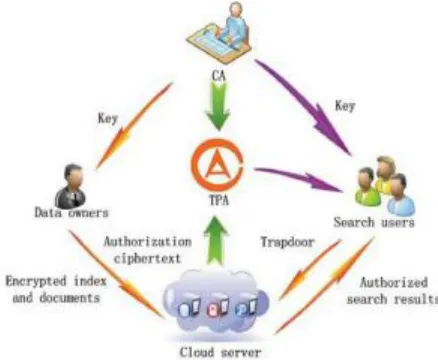
Fig No 1. Hash Sub Tree Designed
3. SYSTEM MODEL
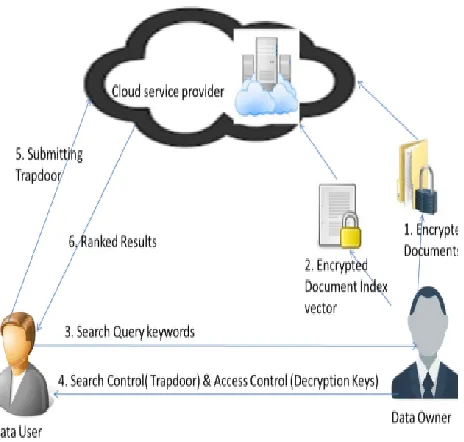
We considered a cloud computing system
model involves three different entities.
Those are Data Owner, Cloud Service
Provider and Data. The responsibility of
each entity is as follows: Data Owner (DO):
DO has a collection data documents DC=
{d1, d2…, dm} with sensitive information
to be outsourced to the cloud server. To
provide data privacy, the documents are
encrypted before outsourcing. DO creates a
dictionary based on keywords extracted
from the all m documents based on Term
Frequency Inverted Document Frequency
(TFIDF) [16] which is described in section
4. The dictionary includes synonyms of each
keyword from the thesaurus [17]. The
each keyword may have t synonyms, so that
the dictionary size is n × t. DO creates an
index vector for each document based on the
keywords extracted from the document. The
size of the index vector is equal to the
number of keywords in the dictionary that is
an. Each dimension in the index vector
stores sum of the frequency of keyword and
corresponding synonyms in the dictionary is
denoted as term frequency (TF) in our
system. Index vectors of all documents are
encrypted before outsource to the cloud. DO
create query vector based on keywords
entered by Data user. To provide user
privacy, query vector encrypted, as
Trapdoor and send to Data user. The data
owner sends search access control to the
authorized data user.
A. Data users:
Data users are the users who accessing
sensitive data from the cloud. The cloud
server searches keywords or synonyms
related to documents, which are interested to
data user and sends to the data owner. The
data user receives trapdoor and searches
access control of data owner and sends
trapdoor and access control to the cloud
server to retrieve required documents from
the cloud.
B. Cloud Service Provider (CSP):
Cloud server receives encrypted documents
and encrypted index vectors from data
owner and stores into data owner‟s cloud
storage. Cloud server having the capability
to take the data request from user and check
the search access control of the user. It will
retrieve the documents from cloud storage
depending upon the privileges to access
number of documents. To increase the
document retrieval accuracy from cloud
server, the top scored (ranked) documents
return to data user from the cloud server.
The architecture of multi-keyword synonym
query over encrypted cloud data.
C. Threat model:
The cloud server is measured as
“honest-but-curious” [18] in our proposed scheme.
The cloud server follows the proposed
method specification and also examines data
in its cloud storage and data which are
received from data user during the
processing to learn additional information.
We consider one threat model for our
system with different attack capabilities that
is as follows: Known ciphertext model: In
this model, the cloud server knows only
encrypted documents and encrypted index
vectors, which are outsourced from data
Fig No 2 System Model
4. PROPOSED SYSTEM
The first symmetrical searchable encryption
(SSE) scheme and the search of the scheme
is linear in the size of the data collection.
Proposed formal security definitions for SSE
and developed a system based on Bloom
filter. It is proposed that two systems (SSE
-1 and 2) that the optimal search time is
reached. Your SSE 1 scheme is secure
against attacks Chosen- Keyword (CKA1)
and SSE -2 is secure against adaptive
chosen- keyword attacks (CKA2). These
early works are single keyword Boolean
search schemes that are very simple in terms
of functionality. After plenty of plants have
been proposed under different threat models
to search various search functions, such as
single keyword search, similarity search
more keyword Boolean search space and
multi keyword search on place, etc. Multi -
keyword Boolean search allows achieve the
user to enter multiple query keywords to
request appropriate documents. Among
these works, combining keyword search
systems give only the documents that
contain all of the query keywords.
Disjunctive Keyword Schemes return all
documents that contain keywords proposed
[19] .Predicate search schemes a subset of
the query, both connecting divisive to
support search. All these schemes More
Keyword retrieve search results based on the
presence of keywords, which can provide
not acceptable result ranking functionality
[20]. Proposed guide can achieve sublinear
search time flexible and deal with the
deleting and inserting documents. The safe
kNN algorithm used to encrypt the index
and query vectors, in the meantime accurate
relevancy score calculation between
encrypted index and query vectors [21]
.Ensure to withstand various attacks in
different threat models, build two secure
search systems: the dynamic top k multi-
keyword search scheme selected in the
known ciphertext model, and improved
dynamic top k multi- keyword space search
procedure in the known background
model.For our system, we choose the B-tree
match between search query and data
documents. Specially, we use inner data
correspondence, i.e., the number of query
keywords appearing in document, to
evaluate the similarity of that document to
the search query. Each document is
converted to a balanced B-tree according to
the keywords and encrypted using CRSA.
Whenever user wants to search, he/she
creates a trapdoor for the keywords. Our aim
is to design and analyse the performance of
multiple keywords ranked search scheme
using Commutative RSA algorithm and
B-tree data structure for searchable index B-tree.
1. Commutative Encryption (CRSA):
The RSA cryptosystem is one of the
optimum public key cryptography
approaches. However, its overall robustness
gets limited due to one way encryption and
majority of existing RSA schemes suffer
from reorder issues. Therefore, in order to
make this system least complicated and
more efficient, an approach called
Commutative RSA has been proposed. In
this scheme, the order in which encryption
has been done would not affect the
decryption if it is done in the same order.
Encryption is the standard method for
making a communication private. With the
many cryptographic approaches, our system
follows the commutative RSA algorithm.
The mathematical scheme for performing
this encryption is described by a pseudo
algorithm.
2. BMS Tree Index Construction:
In the process index tree construction, we
generate node for each document in the
document collection. These nodes are act as
leaf nodes in the tree. The internal nodes are
formed based on these leaf nodes. The index
tree construction process is described in the
algorithm 1. An example of BMS index tree
for our scheme which is constructed on
plaintext. The data structure of the node is
defined as (ID, F, child [], DID), where ID is
a unique id generated using GenID()
function, F is index vector, child[] is
pointers to children of the node and DID is a
document ID. In the algorithm, we used two
variables Current Node Collection and
Temp Node Collection to store collection of
nodes. Current Node Collection stores the
set of currently processing nodes which have
no parents and Temp Node Collection stores
set of newly formed nodes. Fu[i] always
stores the biggest TF value of wiamong its
children. The possible largest relevance
score of its children is estimated using this
technique.
For each data document Ddid in DC do
Construct leaf node l for Ddid
l.ID=GenID(), l.child[i]=null for i=1,…, b; l.DID=DID, and F[i]=TFDdid,ki for i=1,…,
n;
Insert l to CurrentNodeCollection;
End for While the number of nodes in
CurrentNodeCollection is more than 1 do
For each five of nodes u1, u2, u3, u4, and
u5 in
CurrentNodeCollection do
Generate a parent node u for u1, u2, u3, u4,
and u5with u.ID=GenID(), u.child[i] = uifor
i = 1to 5; u.DID = 0, and D[i] = max{ui.F[j]
for i=1 to 5} for each j=1 to n;
Insert u to TempNodeCollection;
End for
The remaining nodes (less than 5 nodes) in
CurrentNodeCollection generate a parent
node u like above;
Insert u to TempNodeCollection;
Replace CurrentNodeCollection with
TempNodeCollection and then free the
TempNodeCollection;
End while
Return only one node, left in the
CurrentNodeCollection called the root node;
3. Search Process using DFST:
The search process of MSRQE scheme is
the recursive function upon the BMS tree
name as Depth First Search Technique
algorithm. We create a result documents as
RankedList, whose element is denoted as
(Score, DID). Here, the score is the
relevance score between Fdid and query
vector Q, which is calculated using
formula(1). The RankedList stores top k
scored documents to query. The elements of
RankedList are in descending order
according to score function during the
search process. The DFST algorithm is
presented in algorithm 2. Kth score is a
smallest relevance score in RankedList.
Algorithm 2 DFST(Index Tree Node u)
If the node u is not a leaf node then
If Score(Fu, Q) >kth score then
Sort the children of u in descending order
according to scores of children
For i=1 to the number of children of u do
GDFS(u.child[i]);
End for
Return;
End if
Else
If Score(Fu, Q) >kth score then
Delete the element with a smallest
relevance score from
RankedList;
Insert a new element (Score (Fu, Q), u.ID)
and sort all elements of RankedList in
descending order;
End if
Return;
End if.
Designing searchable encryption schemes,
the structures obtained with sub- linear
search time, In particular, dynamic search is
simple, highly parallel and can easily handle
updates. Specifically, for n documents on m
keywords and with p cores (processors)
indicated available and it supports complex
queries and multi- client settings using SSE
as a black box. To ensure that our data
structures and related business activities
which is support for dynamic databases and
it support terabyte -Scale databases in these
richer / complex encrypted search settings.
The dynamic expansion maintains the
optimum index size and only basic size
information.
4. MRSE FRAMEWORK
For easy presentation, operations on the
data documents are not shown in the
framework since the data owner could easily
employ the traditional symmetric key
cryptography to encrypt and then outsource
data. With focus on the index and query, the
MRSE system consists of four algorithms as
follows
1. Setup(ℓ) Taking a security parameter ℓ as
input, the data owner outputs a symmetric
key as SK.
2. BuildIndex(F, SK) Based on the dataset
F, the data owner builds a searchable index I
which is encrypted by the symmetric key SK
and then outsourced to the cloud server.
After the index construction, the document
collection can be independently encrypted
and outsourced.
3. Trapdoor(fW) With t keywords of
interest in fW as input, this algorithm
generates a corresponding trapdoor TfW.
4. Query(TfW, k, I) When the cloud server
receives a query request as (TfW, k), it
performs the ranked search on the index I
with the help of trapdoor TfW, and finally
documents sorted by their similarity with
fW.
The representative privacy guarantee in the
related literature, such as searchable
encryption, is that the server should learn
nothing but search results. With this general
privacy description, we explore and
establish a set of strict privacy requirements
specifically for the MRSE framework. As
for the data privacy, the data owner can
resort to the traditional symmetric key
cryptography to encrypt the data before
outsourcing, and successfully prevent the
cloud server from prying into the outsourced
data.
5. RESULTS AND DISCUSSION
The proposed scheme, data users can
achieve different requirements on search
precision of privacy by the standard
deviation of adjustment that can be treated
as a compensation parameter. The
comparison of systems with a recent work
that achieves high search efficiency.
BDMRS scheme calls the search results by
exact calculation of document vector and
query vector. Thus, top- k search accuracy
of BDMRS scheme is 100 %. But based and
similarity Multi- keyword square search
pattern, the basic scheme in suffering from
loss of precision due to the accumulation of
sub-vectors with the index construction .
The test is repeated 16 times, and the
average accuracy of 91 %. During the
search, when the relevance of the node is
greater than the minimum relevance in
results Rlist, examines the cloud server, the
children of the node; otherwise it returns. So
many nodes not accessed during a real
search. We denote the number of leaf nodes
that contain one or more keywords in the
query. It is generally greater than the
number of documents required k, but far less
than the cardinality of the document
collection n. As a balanced binary tree, the
height of the index n is log will be
maintained, and the complexity of the
calculation is ranked relevance O (m).
Figure 3: Time Comparison
The graph the comparison of the search
computation time in seconds of our
proposed system against the RSA based
system. For two keywords search, the time
taken by the RSA based scheme is
proposed system takes approximately 0.5
seconds less. As the number of keywords
increased for search, the computation time
for search also increases linearly in both
schemes. But CRSA based scheme is found
to perform better. Thus it is evident that
encryption algorithm CRSA with B Tree as
index tree performs better than RSA and B
tree Combination
6. CONCLUSION
We intend to provide feasible solutions for
multi-keyword synonym ranked query
problems over encrypted cloud data while
preserving strict system wise privacy in
cloud computing paradigm. The first one
multi-keyword search, the second synonym
based search, third similarity ranked search
and the last is efficient data retrieval with
BMS tree and DFST searching algorithm.
Our example illustration further shows
efficient and accurate top k documents
retrieval of proposed scheme with sub-linear
time complexity. Multi rank keyword search
scheme is proposed, which not only supports
true multi-keyword search on space, but also
the dynamic deletion and insertion of
documents. We build a special keyword
balanced binary tree as the index. In
addition, the search process may be
performed in parallel to reduce the time,
cost. The security of the system is protected
against two threat models through secure
top-k retrieval algorithm. The experimental
results show the effectiveness of our
proposed scheme. Thorough analysis
investigating privacy and efficiency
guarantees of proposed schemes is given,
and experiments on the real-world dataset
shows our proposed scheme introduces low
overhead on both computation and
communication.
7. FUTURE WORK
The future work would concentrate on using
Elliptic Curve Cryptography (ECC)
encryption technique for better performance.
Further, we intend to analyze the behavior of
our proposed system(s) for multiuser
environment.The dynamic operation such as
updating and deletion has to assume with
privacy and security policies.
8. REFERENCES
[1] K. Ren, C. Wang, Q. Wang et al.,
“Security challenges for the public cloud,”
IEEE Internet Computing, vol. 16, no. 1, pp.
69–73, 2012.
[2] Cloud Security Alliance, „Security
Guidance for Critical Areas of Focus in
Cloud Computing,‟
[3] R. Brinkman, „Searching in encrypted
data,‟ in University of Twente, PhD thesis,
2007.
[4] S. Kamara and K. Lauter,
„Cryptographic cloud storage,‟ in RLCPS,
January 2010, LNCS. Springer, Heidelberg.
[5] A. Singhal, „Modern information
retrieval: A brief overview,‟ IEEE Data
Engineering Bulletin, vol. 24, no. 4, pp. 35–
43, 2001.
[6] W. K. Wong, D. W. Cheung, B. Kao,
and N. Mamoulis, „Secure knn computation on encrypted databases,‟ in Proc. of
SIGMOD, 2009.
[7] S. Kamara and K. Lauter,
“Cryptographic Cloud Storage,” Proc. 14th Int‟l Conf. Financial Cryptography and Data
Security, Jan. 2010.
[8] Zhihua Xia, Xinhui Wang, Xingming
Sun, and Qian Wang, “A Secure and
Dynamic Multi-keyword RankedSearch
Scheme over Encrypted Cloud Data,” IEEE
Transactions on Parallel and Distributed
Systems, 2015
[9] KawserWazedNafi, TonnyShekhaKar,
SayedAnisulHoque, Dr. M. M. A Hashem,
“A Newer User Authentication, File
encryption and Distributed Server Based
Cloud Computing security architecture
“Lecturer, Stamford University, Bangladesh,
(IJACSA) International Journal of Advanced
Computer Science and Applications, Vol. 3,
No. 10, 2012
[10] Chinua Xia, Xinhui Wang,” A Secure
and Dynamic Multi-keyword Ranked Search
Scheme over Encrypted Cloud Data”, DOI
10.1109/TPDS. 2401003, IEEE Transactions
on Parallel and Distributed Systems, 2015.
[11] S. Deshpande, "Fuzzy keyword search
over encrypted data in cloud
computing",World Journal of Science and
Technology, vol. 2, no. 10, (2013).
[12] D.X.Song,D. Wagner and
A.Perrig,"Practical techniques for searches
on encrypted data, In Security and Privacy",
2000. S&P 2000,IEEE, (2000).
[13] N. Cao,C. Wang, M. Li, K. Ren, and
W. Lou,"Privacy-preserving multi-keyword
ranked search over encrypted cloud data",
INFOCOM, 2011 Proceedings IEEE,
(2011).
[14] C. Wang, KuiRen, Shucheng Yu, Urs,
K.M.R "Achieving usable and
privacy-assured similarity search over outsourced
cloud data", INFOCOM, 2012 Proceedings
IEEE, (2012)
[15] Chi Chen, Xiaojie Zhu, “An Efficient
Method”, Member, IEEE, IEEE DOI
10.1109/TPDS.2425407, IEEE Transactions
on Parallel and Distributed Systems, 2015.
[16] Yi Yang, Hongwei Li, Wenchao Liu,
Haomiao Yao, Mi Wen,” Secure Dynamic
Searchable Symmetric Encryption with
Constant Document Update Cost”, School of
Computer Science and Engineering,
University of Electronic Science and
Technology of China, Globecom -
Communication and Information System
Security Symposium, 2014.
[17] Chi Chen, Xiaojie Zhu, “An Efficient
Privacy-Preserving Ranked Keyword Search
Method”, Member, IEEE, IEEE DOI
10.1109/TPDS.2425407, IEEE Transactions
on Parallel and Distributed Systems, 2015.
[18] Hongwei Li, Dongxiao Liu, Kun Jia,
and XiaodongLinss“Achieving Authorized
and Ranked MultikeywordSearch over
Encrypted Cloud Data” School of Computer
Science and Engineering, University of
Electronic Science and Technology of
China. IEEE ICC - Communication and
Information Systems Security
Symposium,2015
[19] Zhangjie Fu, KuiRen, JiangangShu,
Xingming Sun “Enabling Personalized
Search over Encrypted OutsourcedData with
Efficiency Improvement”, DOI
10.1109/TPDS.2506573, IEEE Transactions
on Parallel and Distributed System, 2015
[20] Wenhai Sun, Bing Wang, Ming
Cao,”Privacy-preserving Multi-keyword
Text Search in the Cloud
SupportingSimilarity-based Ranking “asia
ccs‟13, May 8– 10, Hangzhou, China.
Copyright 2013 acm 978-1-4503-
1767-2/13/05, 2013.
[21] KawserWazedNafi, TonnyShekhaKar,
SayedAnisulHoque, Dr. M. M. A Hashem,
“A Newer UserAuthentication, File
encryption and Distributed Server Based
Cloud Computing security architecture
“Lecturer,Stamford University, Bangladesh,
(IJACSA) International Journal of Advanced
Computer Science and Applications, Vol. 3,
No. 10, 2012 [12] Chinua Xia, Xinhui