ISSN 2348 – 7968
Image Restoration Using Lucy Richardson Algorithm For X-Ray
Images
G.Suseela1, S. Ahmed Basha2 K.Prasasd Babu3 K.Sudhakar4
1
M.Tech DSCE 14G31D0605, JNTUA/SJCET/ Yemmiganur, Kurnool, Andhra Pradesh 518360, India
2
Assistant Professor, ECE Department, JNTUA/SJCET/, Yemmiganur, Kurnool, Andhra Pradesh 518360, India
3
Assistant Professor, ECE Department, JNTUA/SJCET/, Yemmiganur, Kurnool, Andhra Pradesh 518360, India
4
Associate Professor & HOD,ECE Department, JNTUA/SJCET/, Yemmiganur, Kurnool, Andhra Pradesh 518360, India
Abstract
Digital images restoration from their degraded measurement has always been a problem of great interest. A specific solution to the problem of image restoration is generally determined by the nature of degradation phenomena. So it is highly dependent on the nature of the noise present there. In this project Lucy Richardson algorithm (LRA) is implemented on the X-ray image using Matlab and restoration is processes is observed. LRA is a non blind technique of image restoration, used to restore a degraded image that has been degraded by a known PSF. It is an iterative procedure in which the pixels of the observed image are represented using the PSF. Image restoration is an emerging field of image processing in which the focus is on recovering an original image from a degraded image. The degraded image can be a result of a known degradation or unknown degradation. Hence image restoration can be defined as a process of recovering a sharp image from a degraded image which is blurred by a degradation function, commonly by a Point Spread Function (PSF). The Point Spread Function describes the response of an imaging system to a point source or point object
.
Keywords: LRA, X ray images, Matlab, PSF.
1. Introduction
Restoration of digital images from their degraded measurement has always been a problem of great interest. A specific solution to the problem of image restoration is generally determined by the nature of degradation phenomena. So it is highly dependent on the nature of the noise present there. Given the noise function, one can use the Richardson-Lucy Algorithm to restore the degraded image. This algorithm was introduced by W.H. Richardson (1972) and L.B. Lucy (1974).
An image is nothing but a huge collection of numbers known as pixels. In particular a gray image is an image in which the value of each pixel is a single sample, that is it carries only intensity information. So a pixel in a given image is just the intensity at that particular point. The pixel value is a number between 0 and 1 (both inclusive). 0 denotes the total absence (i.e. black) and 1 denotes the total presence (i.e. white).
ISSN 2348 – 7968
IMAGE RESTORATION
Image restoration uses a priori knowledge of the degradation. It models the degradation and applies inverse process. It formulates and evaluates the objective criteria of goodness. The distortion can be modeled as noise or a degradation function. To restore an image from a noise model, different filters like median filter, homomorphic filters are used. To get rid of periodic noises, butterworth low pass filter, butterworth band reject filters and notch filters are used. To restore an image from linear degradation, inverse and pseudo inverse filtering, wiener filtering and blind de-convolution are used.
A simplified version for the image restoration process
model is
y (i
,
j )
=
H
f (i
,
j )
+
n(i
,
j )
Where
y
(i
,
j
)
is the degraded image,f
(i
,
j
)
is the original image, H an operator that represents thedegradation process
n
(
i
,
j
)
the external noise which is assumed to be image independentNoise Models
In image processing there are different noise models available.
Gaussian Noise can be represented as
Rayleigh’s noise can be represented as
Salt and Pepper noise can be represented as
The Point Spread Function describes the response of an
The Blind Deconvolution Algorithm can be used
effectively when no information about the distortion (blurring and noise) is known. The algorithm restores the image and the point-spread function (PSF) simultaneously. The accelerated, damped Richardson-Lucy algorithm is used in each iteration. Additional optical system (e.g. camera) characteristics can be used as input parameters that could help to improve the quality of the image restoration. Blind deconvolution is the problem of recovering a sharp version of an input blurry
image when the blur kernel is unknown. Mathematically
y
=
k
⊗
x
Where x is a visually plausible sharp image, and k is a non negative blur kernel, whose support is small compared to the image size.
Richardson-Lucy Deconvolution Algorithm:
ISSN 2348 – 7968
2. PSF& Lucy Richardson algorithm
The point spread function (PSF) describes the response of an imaging system to a point source or point object. A more general term for the PSF is a system's impulse response, the PSF being the impulse response of a focused optical system. The PSF in many contexts can be thought of as the extended blob in an image that represents an unresolved object. In functional terms it is the spatial domain version of the transfer function of the imaging system. It is a useful concept in Fourier optics, astronomical imaging, medical imaging, electron microscopy and other imaging techniques such as 3D microscopy (like in confocal laser scanning microscopy) and fluorescence microscopy. The degree of spreading (blurring) of the point object is a measure for the quality of an imaging system. In non-coherent imaging systems such as fluorescent microscopes, telescopes or optical microscopes, the image formation process is linear in power and described by linear system theory. This means that when two objects A and B are imaged simultaneously, the result is equal to the sum of the independently imaged objects. In other words: the imaging of A is unaffected by the imaging of B and vice versa, owing to the non-interacting property of photons. The image of a complex object can then be seen as a convolution of the true object and the PSF. However, when the detected light is coherent, image formation is linear in the complex field. Recording the intensity image then can lead to cancellations or other non-linear effects. The steps involved in Lucy Richardson and PSF are as shown below
Step 1: Read Image
Step 2: Simulate a Blur and Noise
Step 3: Restore the Blurred and Noisy Image
Step 4: Iterate to Explore the Restoration
Step 5: Control Noise Amplification by Damping
Step 6: Create Sample Image
Step 7: Simulate a Blur
Step 8: Provide the WEIGHT Array
Step 9: Provide a finer-sampled PSF
.
3. Results
ISSN 2348 – 7968
Fig. 1 Images of X-ray deblurring.
ISSN 2348 – 7968
ISSN 2348 – 7968
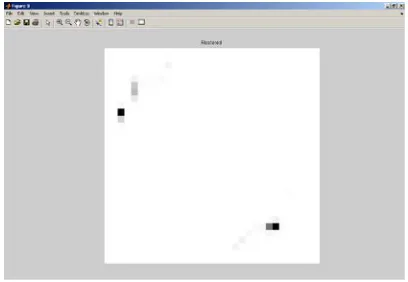
Fig. 3 PSF outputs.
4. Conclusions
The results show how to use the Lucy-Richardson algorithm to deblur images. It can be used effectively when the point-spread function PSF (blurring operator) is known, but little or no information is available for the noise. The blurred and noisy image is restored by the iterative, accelerated, damped Lucy-Richardson algorithm.
References
[1] Amandeep Kaur, Vinay Chopra, “A comparative study and analysis of image restoration techniques using different image formats,” International Journal of Science and Emerging Technologies with latest trends, 2, 1, pp. 7-14, 2012.
[2] M.R. Banham and A.K. Katsaggelos,''Digital Image Restoration,''IEEE Signal Processing Magazine, Vol. 14, No.2, pp.24-41, March 1997.
[3] M. Ben-Ezra and S.K. Nayar, “Motion-based motion deblurring,”IEEE Transactions on Pattern Analysis and Machine Intelligence, Vol. 26, No. 6, pp. 689-698, June 2004.
[4] X. Jiang, D. C. Cheng, et. Al. “Motion Deblurring,” University of Muenster, Department of Mathematics and Computer Science, 2005.
[5] R. C. Gonzalez and R. E. Woods, “Digital Image Processing Second Edition,”Prentice-Hall India, 2007. [3] A. Name, "Dissertation Title", M.S.(or Ph.D.) thesis, Department, University, City, Country, Year.
[6] G. Li, Y. Ito, et. Al., “A discrete wavelet transform based recoverable image processing for privacy protection,” IEEE International Conference on Image Processing, pp. 1372-1375, October 2008.
[7] M. S. Hsieh, “Perceptual Copyright Protection using