A new remote data integrity checking scheme for cloud storage
Yan Xiangtao1*, Li Yifa11Information engineering university, Zhengzhou, China [email protected]
Abstract Abstract Abstract
Abstract: Cloud storage services enable user to enjoy high-capacity and high-quality storage with less overhead, but it also brings many potential threats, for example, data integrality, data availability and so on. In this paper, we propose a new remote integrality and availability checking
scheme for cloud storage. This new scheme can check mass file's integrality and availability with less storage, computation and communication resource. The new scheme also supports data dynamic update, public verifiability and privacy preserving.
Key Key Key
Key WordsWordsWordsWords:cloud storage; data security; data integrality
1
1
1
1 Introduction
Introduction
Introduction
Introduction
Advances in networking technology and increase in the need for computing resources have prompted many organizations to outsource their storage needs[1].This new storage model is commonly referred to as cloud storage, which has the same characteristics as cloud computing in
terms of agility, scalability, elasticity. Now, there are many well know cloud storage service, for example, Microsoft's Azure storage service, Amazon's S3, Google Cloud Storage and so on.
Cloud storage service has many advantages[2]. With this service, users do not need to install
physical storage devices in their own data-center or offices. They can get a myriad of virtual storage resources that might not be affordable just from a common Web browser, and don't need a
complete understanding of the infrastructure. In addition, the storage maintenance tasks, such as backup, data replication, and purchasing additional storage devices are offloaded to the
responsibility of a service provider, allowing organizations to focus on their core business. It seems that the only thing users have to do is to pay for this service ,which is always very cheap.
While the benefits of using a cloud storage are clear, it introduces significant security and privacy risks. In cloud storage, the data is uploaded to the cloud without leaving a copy in their local computers. This feature means that the control of the data has exceeded user's own physical
worlds. To advance the adoption of cloud storage, proactive measures must be taken to ensure data security in this new environment. In fact, it seems that one of the biggest hurdle is concern over the integrity of data[1][2].
In order to solve remote integrity checking problem in cloud storage, a lot of works have been done[3,4,5,6,7,8,9,10,11,12,13,14], focusing on various conditions of application and attempting to achieve different goals. Ateniese et al.[4][8] define the "provable data possession"(PDP) model
for ensuring possession of files on un-trusted storages. Their scheme utilizes the RSA-based homomorphic authenticators for auditing outsourced data and suggests randomly sampling a few
blocks of the file. However, the schemes of Ateniese et al. have to set a prior bound on the number of audits and doesn't support public audit ability. Juels et al.[5] describe a "proof of
retrievability"(POR) model and give a more rigorous proof of their scheme.Their scheme use
*
spot-checking and error-correcting codes to ensure both "possession" and "retrievability" of
remote data files. But these operations make the number of challenges is a fixed prior, prevent any efficient extension to support updates and public audit ability. Erway et al.[10] was the first to
propose dynamic PDP scheme.They developed a skip lists based method to enable provable data possession with dynamic support. however, the efficiency of their scheme remains in question. In
[11],Wang et al. provided a dynamic architecture for public checking. The challenge-response protocol in their paper can both determine the data correctness and locate possible errors. However, the inefficient performance greatly affects the practical application of their scheme.
while all above schemes provide methods for assurance on the correctness of remotely stored data, none of them integrate efficient checking, dynamic update, public verifiability and privacy preserving for data storage in cloud.That is the problem we are going to tackle in this paper.
The rest of the paper is organized as follows. Section 2 introduce the architecture of the scheme, design goals and the adversary mode. Section 3 provide the detailed description of our scheme. The security analysis and performance evaluation is given in the section 4. Finally, section 5
conclude the remark of the whole paper.
2
2
2
2 Architecture,
Architecture,
Architecture,
Architecture, Design
Design
Design
Design Goals
Goals
Goals
Goals and
and
and
and Adversary
Adversary
Adversary
Adversary Model
Model
Model
Model
2.1 2.1 2.1
2.1 ArchitectureArchitectureArchitectureArchitecture ofofofof thethethethe schemeschemeschemescheme
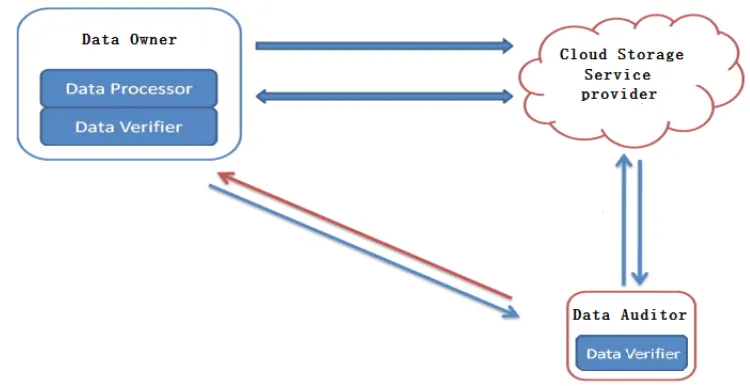
Here, we use a basic architecture which is partly as the same as[1]. At its core, the architecture
consist of three parties:a data owner (DO), that creates data and processes it in some way before it is sent to the cloud; a data auditor (DA), that checks whether the data in the cloud has been tampered with; a cloud storage service provider (CSSP), that provides cloud storage service to the
cloud user.
To use the integrity checking function, DO should begin by downloading a application that
consists of a data processor and a data verifier. Upon its first execution, DO generates a key, which is used to check integrity of its data, support public verifiability and privacy preserving. DA is a
third party auditor, whom is authorized by DO to verify the integrity of cloud data on demand without retrieving a copy of the whole data. Whenever DO wants to upload data to the cloud, the data processor is invoked. It computes some integrity-checking value, which is used to check the
integrity of the remote data, then sent the data to the cloud. Whenever DO(or DA) wants to verify the integrity of her data, the data verifier is invoked. It interacts with CSSP and ascertains the integrity of the data.
The architecture of the scheme is illustrated in Figure 1. In addition, it is important that all the core components should be either open-source or verified by the third trusted party for security.
2.2 2.2 2.2
2.2 DesignDesignDesignDesign GoalsGoalsGoalsGoals
(1) Integrity checking: the proposed scheme should correctly check the remote data integrity in cloud storage without a copy of the data in local.
(2)Security analysis: give a security analysis of the proposed scheme, which shows that it is
(3)Privacy preserving, public verifiability and dynamic data operation support: The design
should be as efficient as possible to ensure the seamless integration of privacy preserving, public verifiability and dynamic data operation.
(4)efficiency: The theoretical results should demonstrate that our protocol is efficient.
Figure 1:architecture of the scheme
2.3 2.3 2.3
2.3 ThreatThreatThreatThreat ModelModelModelModel
In our scheme, we assume that the security threats come from two different sources, CSSP and malicious adversary. On the one hand, the malicious adversary may have knew all the details of
the scheme, can quietly pollute the original data files by modifying or introducing its own fraudulent data to prevent the original data from being retrieved by the DO. On the other hand, the
CSSP is self-interested, un-trusted. It may hide the data corruptions caused by server hacks or Byzantine failures to maintain reputation. Moreover, wo also assume that all the communication channels between each other is security and the key stored locally on DO or DA is secret from the
CSSP and adversary.
3
3
3
3 The
The
The
The Proposed
Proposed
Proposed
Proposed Scheme
Scheme
Scheme
Scheme
In this section, we describe our integrity checking scheme, in which the verifier stores only a
single cryptographic key and a precompute value, irrespective of the size of the file it seeks to verify, as well as a small amount of some dynamic state. Firstly, we present the definitions for the
necessary expressions. Secondly, a basic integrity checking scheme is proposed for single file. Then, we extent our basic scheme to support batch files checking. Finally, we describe the integrity checking in privacy preserving, public verifiability and some dynamic states.
3.1 3.1 3.1
3.1 definitiondefinitiondefinitiondefinition ofofofof expressionexpressionexpressionexpression
)
,
(
m
l
blocks. The length of each block is
l
. If the last block is short thanl
,fill with 0 for padding.)
,
(
)
1
(
pk
sk
KeyGen
l→
:This is a probabilistic algorithm run by the DO to generate keys. Ittakes as input a security parameter
1
l(l-bits), and outputs a public keypk
and a secret keysk
.With given parameter
1
l , it randomly chooses two distinct large prime numbers p and q,suchthat p2|q−1. LetGbe the p2order cyclic subgroup of Zq. Assume that gis the generator ofG.
Then, it randomly Chooses two nonzero integers e and d , e≠d . pk=q is public to
everyone ,while
sk
=
(
e
,
d
,
g
,
p
)
is kept secret by the verifies.)) ( ), ( ( ) ,
(m sk f1 m f2 m lue
GenCheckVa → :This function is used by the DO to generate a checking
value, which is used for verify the response from the CSSP for future. For the data file
n
m
m
m
=
1L
, computes:∑ =
=
n i i i m eg
m
f
(
)
11 ∑ = −
=
n i i i pm ieg
m
f
1 1)
(
2 chal skChallenge( )→ :This is a probabilistic procedure run by the verifiers(DO or DA) to create
a challenge for the CSSP. It takes as input secret key
sk
, and outputs a challenge valuechal.Withgiven
sk
=
(
e
,
d
,
g
,
p
)
, the function picks two random numbers,r1and s, computeschal:) ,
(g x e r1pq dp2
chal= s = + +
) ( ) ,
(pk chal y m esponse
GenR → :This function is used by the server CSSP to generate a response
to a challenge valuechal. Given data file
m
=
(
m
1,
L
,
m
n)
, the CSSP computes :∑ =
=
n i i i m x sg
m
y
(
)
(
)
1} , { )) ( ), ( ), ( ,
(sk f1 m f2 m y m true false
Verify → :This function is used by the verifiers(DO or DA) to
check the validity of the response. The verifiers compute f m f m r s
) )) ( )( ( ( 1 2
1 , if
s r
m f m
f ( )( ( )) )
( 1
2
1 =y(m), output "
true
", otherwise output "false".3.2 3.2 3.2
3.2 ourourourour integrityintegrityintegrityintegrity checkingcheckingcheckingchecking schemeschemeschemescheme
3.2.1 3.2.1 3.2.1
3.2.1 basicbasicbasicbasic schemeschemeschemescheme
security parameter is noted asl. Then, our basic scheme can be constructed in two phases,SetupSetupSetupSetup andcheck.check.check.check.
Setup Setup Setup
Setup: As initialization, DO generates the public key pair
(
pk
,
sk
)
by executing)
,
(
)
1
(
pk
sk
KeyGen
l→
, sendspk
to the CSSP and keepssk
secret. Once DO wants to uploadfile m, they invokes the function
Pad
(
m
,
l
)
to cut file m into a ordered collection of lisometricblocks, assume the result is
m
=
m
1m
2L
m
n . Then, they computes the checking-value)) ( ), (
(f1 m f2 m ofmby using
GenCheckVa
lue
(
m
,
sk
)
, which is secretly kept in local.Check: Check: Check:
Check:The verifiers ( DO or DA ) useChallenge(sk)→chalto generate the challenge value
chal , send it to the CSSP. Once the CSSP get the challenge value chal , they invoke )
, (pk chal esponse
GenR to generate response value y(m) . After receiving the corresponding
response value y(m), the verifiers check the response by invoking Verify(sk,f1(m),f2(m),y(m)).
If the output istrue, then we believe that the file m is stored correctly in the remote servers, also
we believe not.
3.2.2 3.2.2 3.2.2
3.2.2 batchbatchbatchbatch ofofofof filesfilesfilesfiles checkingcheckingcheckingchecking schemeschemeschemescheme
The integrity checking scheme of batch of files is extend over the basic scheme. Assume that
we have to check files which is a finite ordered at one time, for example
M
=
{
M
1,
M
2,
L
,
M
h}
,for each
i
∈
{
1
,
2
,
L
,
h
}
, the fileM
i can be padded intol
i blocks, that is:h
i
m
m
m
M
i il i ii
=
1 2L
,
1
≤
≤
. Denoted that the checking value of fileM
iis( f1(Mi), f2(Mi)),which is computed before upload, the blocks of all checking files is
∑
==
h i il
H
1. Then the check
process is operate as blow:
The challenge value is generated as the same as the basic scheme. When the CSSP receive the
challenge valuechal form verifiers, they compute the response like that:
∑ ∑ = = ∑ − =
=
h i i l j ij j i k k l m x x sg
M
Y
1 11 1
)
(
)
(
.Once the verifiers receive the the response Y(M) , they consider that whether
s r l e h i i e h i i i j j i j j l i j j l
M
f
M
f
M
Y
(
)
(
(
)
(
(
)
)
1)
1 1 1 1 1 1 1 2 1 1
∑
=
− = ∑ − = ∑ − = + = =∏
∏
is equal to Y(M). If not, they believe that3.3 3.3 3.3
3.3 dynamicdynamicdynamicdynamic updateupdateupdateupdate
In practical scenarios, the client may frequently perform block-level operations on the data files.The most general forms of these operations we consider in this paper are modification,
appending.
Block Block Block
Block modificationmodificationmodificationmodification: Assume that DO wants to modify the i-th block
m
iof her file m. Denotethe modified data block by
m
*i and the corresponding modified checking value byf
1update(
m
)
,)
(
2
m
f
update . Then, DO modify the checking value like this:i i i im em
e update
g g m f m
f1 ( )= 1( ) */
i i i i
pm ie pm ie
update
m
f
m
g
g
f
2(
)
=
2(
)
−1 */
−1Block Block Block
Block appending:appending:appending:appending:Assume that DO wants to append the block
m
*to her filem
=
m
1L
m
n.Then, DO modify the checking value like this:
* 1
) ( )
( 1
1
m e
update n
g m f m
f = +
*
) 1 ( 2
2
(
)
(
)
pm e n
update n
g
m
f
m
f
=
+3.4 3.4 3.4
3.4 PublicPublicPublicPublic VerificationVerificationVerificationVerification andandandand PrivacyPrivacyPrivacyPrivacy PreservingPreservingPreservingPreserving
For public verification, the DO generate the keys
(
pk
,
sk
)
and the corresponding checking valueof files for DA, which is processed as the same as itself. Then DA use these value to make the
checking scheme as above. In addition, because the challenge value
chal
is chosen randomly andthe response value
y
(
m
)
orY
(
m
)
will not leak the information of the files(for the difficulty ofthe discrete logarithm). So, we believe that our scheme can support public verification and privacy preserving.
4
4
4
4 Security
Security
Security
Security and
and
and
and Efficiency
Efficiency
Efficiency
Efficiency Analysis
Analysis
Analysis
Analysis
In this section, we present a analysis of the security and the efficiency of our proposed scheme. Our security analysis focuses on the adversary model define in section 2. The evaluation of efficiency is presented via comparison with other scheme.
4.1 4.1 4.1
4.1 securitysecuritysecuritysecurity analysisanalysisanalysisanalysis
cheat the verifier with non-negligible probability. All our proofs are derived on the probabilistic
base with probability assurance.
Theorem Theorem Theorem
Theorem 1111: For file
m
=
m
1L
m
n , if the problem of discrete logarithm and big-integerfactorization is difficult, then our schemes can guarantee the correctness of checking with
probability
q
1
, while
q
is the public key.Proof:
For basic scheme, when DO or DA check the responsey(m), they process like this:
s r s r pqm ie m e s p m x m x s m f m f g g g g m y n i i i n i i i n i i i n i i i ) )) ( )( ( ( ) ) ( ( ) ( ) ( )
( 1 1 1
1 1 2 1 1 2 1 mod = = = = ∑ ∑ ∑ ∑= − = = =
From the expression of above, we can know that if the file is correctly stored, the response from the honest CSSP can pass the checking scheme. If there is some wrong on the storage or the
response value is forked by the CSSP, for general, we denote the wrong response as a random
valuey*(m), then, in the checking process, if it can pass the checking scheme, that mean:
s r m f m f m
y ( ) ( ( )( ( ))1) 2 1 *
=
Forr1,sare chosen randomly, anybody except verifies can not get the value from the challenge
response
chal
(the difficulty of discrete logarithm and big-integer factorization).We know that theprobability of expression above is
q
1 .
For the batch checking scheme, the proof is the same as above, it is omitted for short. #
4.2 4.2 4.2
4.2 PerformancePerformancePerformancePerformance AnalysisAnalysisAnalysisAnalysis
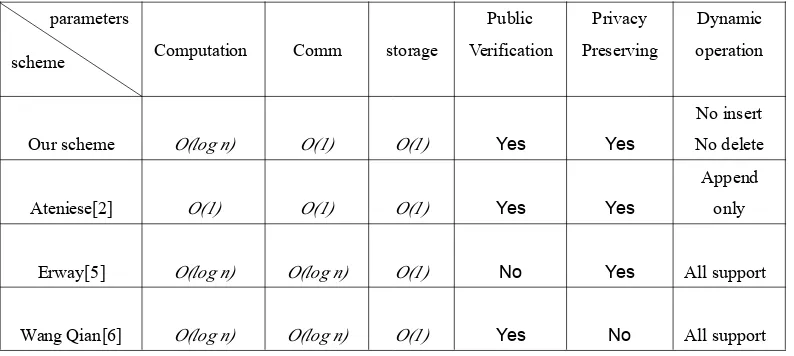
In this section, we consider the communication, storge and computation costs of our scheme. The detail description of the results is demonstrated in figure 2:
scheme parameters
Computation Comm storage
Public Verification Privacy Preserving Dynamic operation
Our scheme O(log n) O(1) O(1) Yes Yes
No insert
No delete
Ateniese[2] O(1) O(1) O(1) Yes Yes
Append
only
Erway[5] O(log n) O(log n) O(1) No Yes All support
Wang Qian[6] O(log n) O(log n) O(1) Yes No All support
5
5
5
5 Conclusion
Conclusion
Conclusion
Conclusion
In this paper, we investigated the problem of data integrity in cloud data storage. To solute this
problem, we proposed an effective and flexible challenge/response scheme with public verification, privacy preserving and dynamic data support. According to the analysis of security
and efficiency, we believe that our scheme is amenable to real-world application. The data owners can have a strong evidence that their data in cloud is stored correctly by using the protocols we proposed.
References
References
References
References
[1] S. Kamara, K. Lauter. Cryptographic Cloud Storage[A].Lecture Notes in Computer Science.
Financial Cryptography and Data Security[C].Berlin:Springer,2010:136-149.
[2] L.M. Kaufman.Data Security in the World of cloud computing[J].Security & Privacy, IEEE, 2009,7:61-64.
[3] M. Einar, N. Maithili, T. Gene. Authentication and integrity in outsourced databases[J]. ACM Transactions On Storage. 2006,2(2):107-138.
[4] G. Ateniese, R. Burns, R. Curtmola, et al. Provable data possession at untrusted stores[A]. Proceedings of CCS 2007[C]. Alexan-dria, VA, USA, 2007.598-609.
[5] A. Juels, B. Kaliski. Pors: proofs of retrievability for large files[A]. Proceedings of CCS 2007 [C]. Alexandria, VA, USA, 2007. 584-597.
[6] H. Shacham, B. Waters. Compact proofs of retrievability[A].Proceedings of ASIACRYPT 2008[C]. Melbourne, Australia, 2008.90-107.
[7] F. Sebe, J. Domingo-Ferrer, A. Martinez-Balleste, et al. Efficient Remote Data Possession
Checking in Critical Information Infrastructures. IEEE Trans. Knowledge and Data Eng., 2008.1034-1038.
[8] G. Ateniese, R.D. Pietro, L.V. Mancini, et al. Scalable and efficient provable data possession
[A]. Proceedings of the 4th international conference on security and privacy in Communication networks[C]. Istanbul, Turkey:ACM, 2008.
[9] C. Wang, Q. Wang, K. Ren, et al.. Ensuring data storage security in cloud computing[A]
Proceedings of IW QoS 2009[C], Charleston, South Carolina, USA, 2009.
[10] C. Erway, A. Kupcu, C. Papamanthou, et al. Dynamic provable data possession [EB/OL]
Cryptology ePrint Archive, Report 2008/432, 2008.
[11] Q. Wang, C. Wang, J. Li, et al. Enabling public verifiability and data dynamics for storage
security in cloud computing[J]. Lecture Notes in Computer Science, 2009, Volume 5789/ 2009:355-370.
[12] K.D. Bowers, A. Juels, A. Oprea. Proofs of retrievability: Theory and implementation.[A] In: Proc. of the 2009 ACM Workshop on Cloud Computing Security, CCSW 2009, Co-Located with the 16th ACM Computer and Communications Security Conf., CCS 2009. New York: Association for Computing Machinery, 2009. 43−54.
[13] S. Kamara, K. Lauter.Cryptographic Cloud Storage[A].Lecture Notes in Computer Science. Financial Cryptography and Data Security[C].Berlin:Springer,2010:136-149.