Integrating IDS Alert Correlation and OS-Level Dependency Tracking
Yan Zhai, Peng Ning, Jun Xu Cyber Defense Laboratory Department of Computer Science
North Carolina State University Raleigh, NC 29695-8207 {yzhai, pning, junxu}@ncsu.edu
Abstract
Intrusion alert correlation techniques correlate alerts into meaningful groups or attack scenar-ios for the ease to understand by human analysts. However, the performance of correlation is under-mined by the imperfectness of intrusion detection techniques. Falsely correlated alerts can be mis-leading to analysis. This paper presents a practi-cal technique to improve alert correlation by inte-grating alert correlation techniques with OS-level object dependency tracking. With the support of more detailed and precise information from OS-level event logs, higher accuracy in alert correla-tion can be achieved. The paper also discusses the application of such integration in improving the ac-curacy of hypotheses about possibly missed attacks while reducing the complexity of the hypothesizing process. A series of experiments are performed to evaluate the effectiveness of the method, and the re-sults demonstrate significant improvements on cor-relation results with the proposed technique.
1 Introduction
Intrusion detection has received a lot of attention in the past two decades. However, current intrusion detection systems (IDSs) often generate huge num-bers of alerts as well as numerous false positives and false negatives. These problems make the re-ports from IDSs very hard for security administra-tors to understand and manage. Many researchers and vendors have proposed various alert correlation
techniques (e.g., [6, 7, 17]) to make large numbers of IDS alerts more understandable and at the same time reduce the impact of false positives and false negatives.
Recent alert correlation techniques can be di-vided into three categories: similarity-based cor-relation (e.g., [3, 5, 15, 17]), corcor-relation by match-ing with pre-defined attack scenarios (e.g., [6, 7]), and correlation based on the prerequisite (also called preconditions) and consequence (also called postconditions) of individual attacks (e.g., [4, 10]). Each technique has its advantages and disadvan-tages. However, the correctness of correlation re-sults is strongly affected by the false positives and false negatives among IDS alerts.
Thus, it is desirable to find additional ways to inte-grate other information sources to further improve alert correlation.
In this paper, we propose to harness OS-level event logging and dependency tracking to improve the accuracy of alert correlation. OS-level depen-dency tracking is a recently developed technique to analyze the system operation history toward a given object. It tracks dependency-causing events such as process forking and file operations in the system event log, and spans up a tree of system objects connected by these events from the target object. Though a very useful tool for forensics ap-plications, backtracker has two limitations. Firstly, because it is system call oriented, the complexity of tracking and tracking results can be very high. For example, during a normal system run, the resulting dependency graph of such a tracking (using Back-tracker [8]) can contain up to tens of thousands of objects and hundreds of thousands of edges. Such complexity with tracking is obviously time and re-source consuming, while the tracking results are also hard to understand. Secondly, the tracking is highly dependent on the availability of so-called “detection points”, which are significant evidence of system being attacked. However, such “detec-tion points” are not usually available, making it in-convenient to use in security administration. In-tegrating event logging and dependency tracking tools with alert correlation can potentially address the above limitations, and at the same time improve the performance of alert correlation.
Our integration method is based on the follow-ing observations: Firstly, most attacks have corre-sponding operations on specific OS-level objects. Secondly, other than a few exceptions, if one attack prepares for another, the later attack’s correspond-ing operations would be dependent on the earlier one’s. Because logging these system calls is more straightforward than detecting attacks using rules and signatures, such information is considerably more accurate and trustworthy than the IDS alerts. Utilizing such information will improve the perfor-mance of alert correlation.
Given the alert correlation results and an OS-level dependency tracking tool, the integration is done in two phases. The first phase is to
iden-tify the system objects corresponding to the IDS alerts based on their semantics. The second phase is to verify the relationships demonstrated in the correlation result or discover the missed relation-ships among the alerts by tracking the dependencies among their corresponding system objects using a dependency tracking tool such as Backtracker.
The contribution of this paper is the develop-ment of a framework to integrate the information from OS-level event logging and dependency track-ing into IDS alert correlation. With the support of OS-level event logs, we can achieve better accu-racy in the final result than the original alert correla-tion method. We also discuss how such integracorrela-tion can facilitate the hypotheses about possibly missed attacks. Finally, we evaluate the effectiveness of this scheme by performing a series of experiments. Our experiment results show that the integration can greatly improve the correctness of correlation and help making hypotheses about possibly missed attacks. For example, in our experiment, our ap-proach can totally remove the false correlations in all three attack scenarios.
The remainder of this paper is structured as be-low. Section 2 briefly introduces the background of alert correlation and OS-level dependency tracking. Section 3 discusses the details on how to integrate OS-level object dependency tracking into alert cor-relation. Section 4 gives experimental results used to evaluate our approach. Section 5 discusses re-lated work. Section 6 concludes and points out some future directions.
2 Background
knowledge is the only such tool available.
2.1 Alert Correlation Based on Prerequisites and Consequences of Attacks
Here we give a brief overview of the alert cor-relation method in [10]. This method correlates intrusion alerts using the prerequisites and conse-quences of attacks. Intuitively, the prerequisite of an attack is the necessary condition for the attack to be successful. For example, the existence of a vulnerable service is the prerequisite of a remote buffer overflow attack against the service. The con-sequence of an attack is the possible outcome of the attack. For example, gaining the root access from a remote machine may be the consequence of a ftp buffer overflow attack. In a series of at-tacks where earlier ones are launched to prepare for later ones, there are usually connections between the consequences of the earlier attacks and the pre-requisites of the later ones. Accordingly, we iden-tify the prerequisites (e.g., existence of vulnerable services) and the consequences (e.g., gain certain privilege) of attacks, and correlate the detected at-tacks (i.e., alerts) by matching the consequences of previous alerts to the prerequisites of later ones.
The correlation method uses logical formulas, which are logical combinations of predicates, to represent the prerequisites and consequences of at-tacks. The correlation model represents the at-tributes, prerequisites, and consequences of known attacks as alert types. The correlation process is to identify the prepare-for relations between alerts, which is done with the help of prerequisite sets and expanded consequence sets of alerts. Given an alert, its prerequisite set is the set of all predi-cates in the its prerequisite, and its expanded con-sequence set is the set of all predicates in or implied by its consequence. An earlier alertt1prepares for a later alertt2 if the expanded consequence set of t1 and the prerequisite set of t2 share some com-mon predicates. Intuitively, an earlier alert pre-pares for a later one if the consequence of the ear-lier one “contributes” to the prerequisite of the later one. An alert correlation graph is used to repre-sent a set of correlated alerts. An alert correlation graphCG= (N, E)is a connected directed acyclic
graph, whereN is a set of alerts, and for each pair
n1, n2 ∈N, there is a directed edge fromn1 ton2
inEif and only ifn1prepares forn2.
The advantage of this method is that the corlation result is easy to understand and directly re-flects the possible attack scenarios. However, as the correlation is solely based on IDS alerts, the result highly depends on the quality of the IDS alerts. For example, the result may contain false correlations when there are false alerts.
2.2 Backtracker
Backtracker is an OS-level dependency tracking tool [8]. Backtracker monitors specific types of OS-level objects, i.e., processes and files. The ob-jects are kept in a log with their properties such as the uid of the objects. It also monitors spe-cific dependency-causing system calls like process forking, file reading, and memory sharing, which together are called “high-control events” in [8]. Given the information of a specific object such as thepidof a process or theinode number of a file, Backtracker identifies the previous objects and sys-tem calls that could have potentially affected a tar-get object, and displays chains of events in a depen-dency graph. In a Backtracker dependepen-dency graph, each node A represents an OS-level object, and each edge A → B represents that object B is de-pendent on object A. Moreover, an edgeA ↔ B
is used to represent that objects A and B are po-tentially dependent on each other. As mentioned earlier, the major limitations of Backtracker are the complexity of its results and the inconvenience to use because of its dependency on the availability of “detection points”. In its later version [14], the tool can also track dependencies between remote hosts by tracking the logged socket ids.
uncom-mon. Thus, it is reasonable to assume that most at-tacks will have their corresponding OS-level events logged by Backtracker.
3 Integrating Alert Correlation and OS-Level Dependency Tracking
Our integration is to identify the relevancy be-tween the relationships among IDS alerts and the dependencies among OS-level objects, and then use the OS-level dependencies to verify or discover the relationships among IDS alerts. To identify such relationships, we first look into attacks’ OS-level behaviors.
From the operating system’s point of view, an at-tack is a set of OS-level events that access or mod-ify a set of system objects. The OS-level objects and operations corresponding to an attack can be derived from the semantics of the attack. In our model, such semantics consist of two parts: one is the prerequisites and consequences of attacks, and the other is the correspondence between the pred-icates in attacks prerequisites or consequences and the OS-level objects on the host. With such infor-mation, we can identify the OS-level objects corre-sponding to the attacks on the host. For example, given an attack that exploits a vulnerable service as its prerequisite and yields a shell as its conse-quence, we can identify the corresponding service process and shell process for this attack.
Accordingly, the OS-level objects correspond-ing to an attack can be divided into two sets: the prerequisite object set, which are the objects de-rived from the attack’s prerequisite, and the con-sequence object set, which are the objects derived from the attack’s consequence. These two sets may overlap, because some attacks’ consequences may affect their prerequisite objects. By backtracking among the OS-level objects, we can also find de-pendencies among those objects at the OS level. Though different from the prepare-for relation used in alert correlation, such OS-level dependencies can be utilized to verify or discover the prepafor re-lations among the alerts.
In our framework, we first extract necessary in-formation from the alerts to identify the corre-sponding OS-level objects. We then verify the
dependencies among alerts by using the OS-level dependencies among their corresponding objects, and thus improve the alert correlation based on the causal relationship. Moreover, by identifying the OS-level objects corresponding to the specific evi-dence indicating possibly missed attacks, and gen-erating a forest of dependent objects by tracking back from these objects, we can improve the per-formance of existing methods [11, 18] for hypothe-sizing about possibly missed attacks.
An attack has to have impacts on the local system in order to be observable in the OS-level log. Since some unsuccessful attacks do not have the same impact on system objects as successful ones, our method only guarantees improvement of alert correlation for the alerts of successful attacks, though it may provide positive results for some failed attack attempts.
3.1 Identifying OS-Level Objects Correspond-ing to Intrusion Alerts
Now we discuss how to find the OS-level objects accessed by the attacks which trigger IDS alerts. We call this process the mapping of IDS alerts to OS-level objects.
We summarize the semantics carried by an alert that can be used to identify the corresponding OS-level objects. Firstly, an IDS alert comes with a timestamp, which indicates when the attack hap-pens. Secondly, given an alert, we have the knowl-edge about how the attack works and how the sys-tem should behave in response to it. For example, given a Snort alert “FTP EXPLOIT wu-ftpd 2.6.0”, we know that the corresponding attack exploits a vulnerable wu-ftpd server and forks a root shell. Finally, given local system’s configuration, we can identify which OS-level objects correspond to each predicate in attacks’ prerequisites and conse-quences. For example, a predicate “Samba server” may correspond to “/usr/sbin/smbd” process on a given computer. Below we discuss how each type of knowledge is used to map the alerts.
OS-level object or event is associated with a time period, which is the lifetime of the object or event. (The original Backtracker toolkit does not provide exact timestamp information. We slightly modified Backtracker’s source code and added this function-ality.) Given a fixed time period T = [t1, t2], an object o can be accessed during T if o′s lifetime
[ts, te]overlaps withT. Given the timestamp of an
alert, we can estimate an approximate time window during which all the relevant OS-level activities oc-cur, and then narrow down the scope of OS-level objects that need to be examined. Such a time win-dow has to be relaxed to accommodate delays in OS-level operations and the clock discrepancy be-tween the IDS sensor and the OS.
Given the name of an alert, we have the cor-responding attack’s prerequisite and consequence from experts’ knowledge. According to [10], the prerequisite of an attack is a logical combina-tion of predicates, and the consequence of an at-tack is a set of predicates. Each of those pred-icates is associated with some OS-level objects such as services, processes, and files. Thus, for each predicate in attacks’ prerequisites and con-sequences, we can identify the corresponding file or process on the host computer, and represent them as (predicate, OS-level object) pairs in the knowledge base. For example, given a pair (Samba service(host IP), “/usr/sbin/smbd”) in the knowledge base, whenever there is predi-cate of Samba service(host IP), we can locate its corresponding process of “/user/sbin/smbd”. Thus, after identifying the predicates in an attack’s prerequisite and consequence, we can identify the OS-level objects corresponding to those predicates on the host computer. Based on whether the corre-sponding predicate belongs to attack’s prerequisite or consequence, those objects can be divided into prerequisite objects and consequence objects.
There are additional constraints for the mapped objects. Firstly, some predicate implies con-straints on the properties of its corresponding OS-level objects. For example, the predicate
Root shell(host IP) implies the privilege of its corresponding OS-level object is root, which is rep-resented by uid = 0for the corresponding object in Backtracker’s log. We represent such a
con-straint along with the object mapping information in the knowledge base in the form of (predicate,
OS-level object,constraint). In the above exam-ple, we may have a triple (Root shell(host IP),
/usr/bin/sh, uid = 0) to indicate that the
predicate Root shell is mapped to a process
/usr/bin/sh, and the process’suidshould be0. Secondly, if we focus on successful attacks, we expect to see the prerequisite and conse-quence of a successful attack at the OS level. In other words, for each predicate p in an at-tack’s prerequisite and consequence, there must be at least one object o in the mapped object set corresponding to p, unless the logging tool does not monitor objects corresponding to such predi-cates. For example, assume the prerequisite and the consequence of a Samba buffer overflow at-tack areV ulnerable Samba service(dstIP)and
Root shell (dstIP), respectively. If this attack is successful, there must be OS-level objects cor-responding to these predicates in the object sets. Thus, if such OS-level objects do not exist, the alert must represent a false alert or a failed attack.
Finally, the system activities corresponding to an attack should all be related in Backtracker de-pendency graph. Moreover, the consequence of an attack should be dependent on the prerequisite of the attack at the OS-level. Thus, for each conse-quence object corresponding to an attack, it should be a prerequisite object, or dependent on some prerequisite objects of the attack. Thus, we have the dependency constraint: Given alert A and its mapped prerequisite object setPAand consequence
object set CA, for each consequence object o in
CA, if PA is not empty, there should exist paths
from objects in PA to o in Backtracker’s
depen-dency graph unlesso is also inPA. If such paths
do not exist, the corresponding consequence ob-jectoshould not be associated with the given alert. For example, given an alert with prerequisite ob-ject set{service process}and consequence object set{shell process, f ile f oo}, ifservice process
is not connected to shell process in the Back-tracker dependency graph, the consequence object
shell processshould not be included in the conse-quence object set.
and with OS-level dependency tracking tools, the number of false correlations can be potentially re-duced by verifying the dependencies between the corresponding objects. Below we discuss in detail how to identify the OS-level dependencies among alerts with OS-level dependency tracking, and how to use such dependencies to achieve better accuracy in alert correlation.
3.2 OS-Level Dependencies among IDS Alerts
After IDS alerts are mapped to groups of objects within particular time periods in the Backtracker dependency graph, some groups are connected with each other through objects and events in the depen-dency graph while others are not. It is not difficult to see that an later object is dependent on an earlier object if there exists a path in the dependency graph from the earlier object to the later object. Such paths among these object groups reveal the depen-dencies between their corresponding alerts. How-ever, such dependencies can be not only malicious attack behaviors but also normal system activities, which makes it different from the prepafor re-lations used in alert correlation. To find out the security-relevant dependencies interested by alert correlation, below we discuss in further detail about these dependencies.
As we have mentioned, the OS-level objects cor-responding to an alert can be divided into two sub-sets: the prerequisite object setOP, which are
de-rived from the attack’s prerequisite, and the conse-quence object setOC, which are derived from the
attack’s consequence. As discussed earlier, the con-sequence objects inOC should be dependent on the
prerequisite objects in OP. Moreover, two alerts
being correlated with each other means the earlier attack’s consequence “contributes” to the later at-tack’s prerequisite. Thus, at the OS level, such a prepare-for relation should be reflected by the paths from the earlier attack’s consequence object set to the later attack’s prerequisite object set (i.e., the later attack’s prerequisite objects are dependent on the earlier attack’s consequence objects). To distin-guish such dependencies from other dependencies, we say alertAis strongly connected with alertBif, in the Backtracker dependency graph, there exists a
path from one ofA’s consequence objects to one of
B’s prerequisite objects. Thus, if alertA prepares for alertB,Ashould be strongly connected withB.
3.3 Verifying the Dependencies among Corre-lated IDS Alerts
As discussed in [8], there are several types of tacks that can evade Backtracker. For example, at-tacks exploiting modified guest kernels and atat-tacks utilizing hidden channels. Such attacks cannot be accommodated by the techniques discussed in this paper. However, other than a few exceptions, Back-tracker is capable of tracking OS-level dependen-cies among most other types of attacks. In other words, in normal cases, if two alerts are not found strongly connected with each other, there should not be prepare-for relations between them.
Given an alert correlation graph, we can map the alerts to OS-level objects and check whether the correlated alerts are strongly connected in OS-level dependency graph. If two correlated alerts are not found strongly connected, the correlation between the two alerts are considered a false correlation. For example, assume A → B are a pair of correlated alerts. To verify this correlation, we first map the two alerts into OS-level object sets. If the mappings are successful, there will be corresponding prereq-uisite and consequence object sets: PA andCAof
alertA, as well asPBandCBof alertB. By
track-ing back from the objects inPB with Backtracker,
we can verify whether the two alerts are strongly connected. If there does not exist a path between objects inCA and objects inPB, we consider the
correlation betweenAandBfalse.
3.4 Facilitating Hypotheses of Missed Attacks
Integrating IDS alert correlation and OS-level event logging can also help in making hypotheses about possibly missed attacks. Several approaches [11, 18] have been proposed in making hypotheses about possibly missed attacks. Given evidence of attacks being missed, these methods search among known attack types of attacks to fill in the gaps between their correlation graphs and the evidence based on attacks’ prerequisites and consequences. However, such search processes can be computa-tionally expensive considering the size of the attack type knowledge base and the number of steps that could have been missed.
Integrating IDS alert correlation with OS-level dependency tracking can facilitate hypothesizing of missed attacks. Since the evidence studied as sign of missing attacks can be either IDS alerts or sys-tem objects, such evidence can also be mapped to groups of system objects. Assume evidence E is mapped to a set of OS-level objects. By tracking backward from these objects in the OS-level log, these objects can span a forest of system objects connected via various events. For any missed at-tack, unless it is one of the attacks that can evade the OS-level dependency tracking tool, part of its mapped objects must be in this spanned forest. Us-ing the information of the correspondence between predicates in attacks’ prerequisites/consequences and OS-level objects, this forest of objects can be converted to predicates. Then, the searching space for possibly missed attacks can be reduced to the set of attacks related to these predicates. Also, for each hypothesis candidate, we can validate it by trying to map it to OS-level objects. A hypothesis failing to be mapped is considered as invalid.
For example, an attacker attacks a host in the fol-lowing steps: (1) Attacker successfully launches a buffer overflow attack toward a vulnerable Samba server, which yields a root shell. (2) The attacker deletes the web page files via the shell. Now as-sume all those activities are missed by the IDS while the file deletion is detected by some file sys-tem integrity monitoring tool, which is taken as evi-dence indicating previous attacks being missed. By tracking back from the deleted file, the file is found
dependent on the following objects in the OS-level event log: a smbd process and a shell process forked by the smbd process. Thus, when search-ing for possibly missed attacks, we can limit the search within attacks related to Samba and shell. Since only Samba is an initial system service, we hypothesize there is a Samba-related attack missed. By trying to map each candidate attack to OS-level objects, we can eliminate the majority of invalid hy-potheses. The uncertainty within the remaining re-sults is affected by the knowledge we have about the local system (e.g., the version of Samba) and the attacks (e.g., the number of attack types in the knowledge base).
4 Experimental Results
We have performed a series of experiments to validate the effectiveness of our method. Because our method requires that Backtracker monitor the victim system involved in attacks, we were not able to use the data sets available for IDS evaluation (e.g., DARPA’s Grand Challenge Problem (GCP) datasets), which only include either tcpdump of at-tack traffic or simulated IDS alerts. To facilitate the evaluation, we developed three attack scenarios in our lab, in which an attacker launches a sequence of attacks against a computer monitored by Back-tracker and Snort.
at-tacks into the background traffic.
We only discuss the experimental results on Sce-nario 1 in detail in the main text. Description of the other two scenarios and additional information about these experiments can be found in the ap-pendix.
4.1 Details of Scenario 1
Our first attack scenario exploits the vulnerable Samba service on the target server. It includes the following 4 steps:
1. We launched 2 remote buffer overflow attacks exploiting the vulnerable Samba server. A re-mote root shell session was created for each of the attacks.
2. Through one of the root shell sessions, we transmitted a pre-compiled server (daemon) file for the DDoS tool TFN (Tribe Flood Net-work) to the target host.
3. We then started the TFN server on the target machine through the same root shell.
4. We used the TFN’s client program to commu-nicate with the TFN server on the target server, and directed the target to start SYN flood and UDP flood attacks against another computer.
The above attacks took about 5 minutes. Dur-ing this period, Backtracker logged 81,613 events. Moreover, the Snort sensor raised 26 alerts about these attacks:
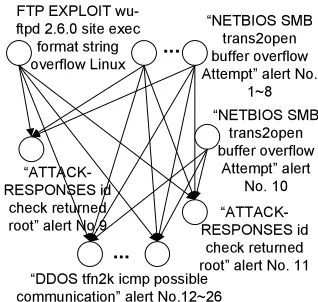
• 9 “NETBIOS SMB trans2open buffer over-flow attempt” alerts (No. 1–8 and No.10) for the buffer overflow attacks toward the Samba server,
• 15 “DDOS tfn2k icmp possible communica-tion” alerts (No. 12–26) for the control mes-sages sent to the TFN2K server daemon,
• 2 “ATTACK-RESPONSES id check returned root” alerts (No.9 and No.11) for the server’s responses to the “id” commands, and
• 2 “ATTACK-RESPONSES id check returned userid” alerts for the server’s responses to the “id” commands.
“DDOS tfn2k icmp possible communication” alert No.12~26
“NETBIOS SMB trans2open buffer overflow Attempt” alert No.
1~8 ...
“ATTACK-RESPONSES id
check returned root” alert No.9
...
“ATTACK-RESPONSES id
check returned root” alert No. 11 “NETBIOS SMB
trans2open buffer overflow
Attempt” alert No. 10 FTP EXPLOIT
wu-ftpd 2.6.0 site exec format string overflow Linux
Figure 1. Original Correlation Graph
The background traffic triggered 32 alerts related to the target server:
• 8 “SCAN nmap TCP” alerts,
• 23 “SNMP public access udp” alerts, and
• 1 “FTP EXPLOIT wu-ftpd 2.6.0 site exec for-mat string overflow Linux” alert.
Among the above 3 types of alerts, the third one is triggered by the failed attempt of wu-ftpd buffer overflow attack injected into the background traffic. Using the alert correlation method proposed in [10], we generated the correlation graph shown in Fig. 1. (The prerequisites and consequences of these alerts are given in Appendix B.) Obviously, it contains many false correlations due to the false positives within the reported alerts.
Using the Backtracker’s log and the semantics of these alerts, we mapped these alerts to a number of OS-level objects, as listed in Table 1.
“DDOS tfn2k icmp possible communication” alert No.12~26
“NETBIOS SMB trans2open buffer overflow Attempt” alert
No. 8
“ATTACK-RESPONSES id check returned root”
alert No.9
...
“ATTACK-RESPONSES
id check returned root”
alert No. 11 “NETBIOS SMB
trans2open buffer overflow Attempt” alert No. 10
(a) Without Hypothesized Attacks
“DDOS tfn2k icmp possible communication” alert No.12~26 “NETBIOS SMB trans2open
buffer overflow Attempt” alert No. 8
“ATTACK-RESPONSES id check returned root”
alert No.9
...
“ATTACK-RESPONSES id
check returned root” alert No. 11 “NETBIOS SMB trans2open buffer overflow Attempt” alert No. 10 Download tfn2k
server daemon through ftp Launch the tfn2k
server daemon
(b) With Hypothesized Attacks
Figure 2. New Correlation Graphs
Table 1. OS-level Objects Corresponding to the Alerts in Scenario 1
Alert Prerequisite Objects Consequence Objects
“NETBIOS SMB trans2open buffer overflow Attempt” No.8
{smbd 2717} {sh 2720}
“NETBIOS SMB trans2open buffer overflow Attempt” No.10
{smbd 2717} {sh 2725}
“ATTACK-RESPONSE id check re-turned root” No. 9
{sh 2722, /usr/bin/id 324551} Null
“ATTACK-RESPONSE id check re-turned root” No. 11
{sh 2727, /usr/bin/id 324551} Null
“DDOS tfn2k icmp possible com-munication” No.12 26
{td 2737} Null
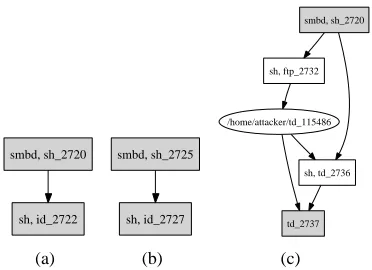
smbd, sh_2720
sh, id_2722
(a)
smbd, sh_2725
sh, id_2727
(b)
sh, ftp_2732
/home/attacker/td_115486
sh, td_2736
td_2737 smbd, sh_2720
(c)
Figure 3. Paths Between Alerts’ Corre-sponding Objects
the OS level. Otherwise, the correlation would be considered false. In this way, we can verify each of the correlations in the original correlation graph, remove those that are verified to be false, and fi-nally come up with a new correlation graph. The new correlation graph for scenario 1 is shown in Fig. 2(a). We can see it is the correct correlation graph of the reported Snort alerts based on the ac-tual attack scenario.
This indicates possible attacks have been missed between these two alerts. By backtracking from the prerequisite object set{td 2737}of the “DDOS tfn2k icmp possible communication” alert, a tree of OS-level objects are spanned. Because the conse-quence object set {sh 2720} of “NETBIOS SMB trans2open buffer overflow attempt” alert is among them, we focus on the paths linking the two object sets. Along the path connecting them as shown in Fig. 3(c), we found the following OS-level objects are involved: process object “f tp 2732”, file ob-ject “/home/attacker/td 115486”, and process object “td 2736”. Thus, instead of guessing all pos-sible ways to install a TFN daemon, which are nu-merous, we can limit the searching within the activ-ities related to the ftp and tfn2k server program. It is easy to hypothesize that the attacker downloaded the tfn2k server program via ftp and launched it via the shell. These hypotheses are shown in dotted cir-cles and lines in Fig. 2(b).
4.2 Overall Evaluation
Assume an alert correlation method outputs that an alert A prepares for another alert B. If both alerts are detections of actual attacks, and the attack corresponding to alertA is indeed used to prepare for the later attack corresponding to alert B, we consider this correlation as a true correlation. Oth-erwise, it is considered a false correlation. More-over, if one attack is used to prepare for another attack, but there is no correlation corresponding to these attacks (due to missing detection or incorrect correlation), we say there is a missing correlation. In our experiments, since we know the details of the attack scenarios, we can easily identify true, false, and missing correlations.
We use two metrics, false correlation rate and missing correlation rate, to evaluate the overall per-formance of alert correlation before and after inte-grating Backtracker’s results. Given a set of cor-related alerts, the false correlation rate is the ratio between the number of false correlations over the total number of correlations generated by alert cor-relation. The missing correlation rate is the ratio between the number of missing correlations over the total number of correlations between attacks.
Intuitively, false correlation rate shows how correct the identified correlations are, while missing corre-lation rate demonstrates how complete we can iden-tify the correlations between attacks. Obviously, the smaller these two metrics are, the better perfor-mance alert correlation has.
Fig. 4(a) shows the false correlation rates in all three attack scenarios. As we can see, our pro-posed method reduces the false correlation rate sig-nificantly in all three scenarios. Indeed, false cor-relations are completely removed in all scenarios. This is not surprising, because OS-level depen-dency provides another way to properly verify the correlation between alerts through trustworthy in-formation kept in OS-level logs.
Fig. 4(b) shows the missing correlation rates in the three attack scenarios. We can see significant reduction in missing correlation rate in all three scenarios. While the missing correlation rate is re-duced to 0 in scenarios 2 and 3, the missing corre-lation rate of the first scenario is still non-zero after making hypotheses. This is because the DDoS at-tack (via the tfn server) is neither detected by Snort, nor hypothesized by our approach.
Our experiments also showed that OS-level ob-ject dependency graphs can often be too compli-cated to understand in reality. For example, dur-ing the 30 minutes’ attacks in the third attack scenario, Backtracker logged more than 410,000
events, and the resulting dependency graph con-tains more than 4,000 nodes. Analyzing such a complicated graph requires a lot of human experts’ time and detailed knowledge about attacks’ OS-level behaviors. However, instead of analyzing the Backtracker dependency graph directly, our method uses it as complementary evidence for IDS alert correlation. Because the method verifies alert cor-relations instead of detects attacks, only moderate information about attacks’ OS-level behaviors is re-quired, and the verification of whether there exists strong connections between correlated alerts can be automatically done by computer programs instead of human experts.
0.0 0.0 0.0 0.6667 0.8889
0.8989
0.0 0.1 0.2 0.3 0.4 0.5 0.6 0.7 0.8 0.9 1.0
1 2 3
Scenario
F
a
ls
e
C
o
rr
e
a
lt
io
n
R
a
te
Original Method Proposed Method
(a) False Correlation Rate
0.5 0.5
0.75
0 0
0.1667
0 0.1 0.2 0.3 0.4 0.5 0.6 0.7 0.8
1 2 3
Scenario
M
is
s
in
g
C
o
rr
e
la
ti
o
n
R
a
te
Original Method Proposed Method
(b) Missing Correlation Rate
Figure 4. Compare between the Original Correlation Method [10] and the Proposed Method
hard to detect by all types of IDS, which are the attackers’ “legitimate” activities after the break-in. Without the OS-level dependency information pro-vided by Backtracker, it would be quite difficult to guess about such activities that prepare for the later attacks.
5 Related Work
Our technique is closely related to the alert cor-relation techniques based on prerequisites (also called pre-conditions) and consequences (also called post-conditions) of attacks proposed in [4, 10, 16] as well as OS-level dependency tracking techniques proposed in [8, 14]. These techniques have been discussed in the Introduction and Section 2. The work closest to ours is [14]. In [14], King et al. proposed to use the dependency analysis re-sult from Backtracker to study attacks within and across the hosts, as well as prospected the applica-tion of Backtracker in alert correlaapplica-tion. Although they demonstrated the potential benifit of combin-ing backtracker analysis with IDS alert analysis with some heuristic case studies, the main focus of the paper is about backtracking among remote hosts and they did not provide a specific method of combining the two kinds of analyses. The proposed analyses are done manually, which we have pointed out to be potentially very expensive and inpracti-cal. In our approach, after discussed the difference and resemblance between the OS-level dependen-cies and the dependendependen-cies among attacks, we pro-posed a specific method to automatically combine the analyses after the knowledge base is built.
Several techniques have also used local system information to reason about the causal relationships between IDS alerts. In [18], local system state in-formation is used to reason about the correlation of alerts. In [1], such information is used to ana-lyze the vulnerability of the system and study the potential attacks that could compromise the sys-tem. These techniques are complementary to the approach proposed in this paper.
Some approaches have been proposed in [11, 18] to make hypotheses about attacks possibly missed by IDSs. [11] makes hypotheses based on the pre-requisite and consequences of attack types when similarities are found between alerts in separate correlation graphs. [18] uses similar attack type knowledge to make hypotheses upon inconsisten-cies between observed facts and alert correlation graph. Our techniques can facilitate the hypothe-sis process by bringing additional information from OS-level dependency tracking, thus reducing the search space for the possibly missed attacks.
6 Conclusion and Future work
us-ing these constraints, we can verify the IDS alerts as well as the correlation between IDS alerts, and filter out false correlations. Moreover, the dependency between OS-level objects can also facilitate the hy-potheses of attacks possibly missed by the IDSs by tracking OS-level objects. Our experimental evalu-ation gave favorable results, showing that OS-level dependency tracking can significantly reduce false correlations when integrated with the alert correla-tion method.
The proposed method has several limitations. First, it depends on experts’ knowledge about at-tacks’ OS-level behavior. Second, it is not as effec-tive against kernel level attacks, which may corrupt the logs kept by, for example, Backtracker. Finally, to use OS-level information, we have to focus on at-tacks that have impacts on OS-level objects. Thus, it does not provide any performance guarantee for the correlation of failed attack attempts.
Several issues are worth doing in our future re-search. First, the current experiments were per-formed semi-automatically. To provide a useful tool, we will implement the proposed techniques as a fully automated tool. Second, we will investigate more techniques to integrate OS-level dependency tracking with techniques to hypothesize about pos-sibly missed attacks. Finally, we plan to perform more experiments in large scale environments such as the DETER test bed.
References
[1] P. Ammann, D. Wijesekera, and S. Kaushik. Scal-able, graph-based network vulnerability analysis. In Proceedings of the 9th ACM Conference on
Computer and Communications Security, pages
217–224, November 2002.
[2] BleedingSnort. Bleedingsnort. www. bleedingsnort.com. Accessed on Feb. 15, 2004.
[3] F. Cuppens. Managing alerts in a multi-intrusion detection environment. In Proceedings of the 17th
Annual Computer Security Applications Confer-ence, December 2001.
[4] F. Cuppens and A. Miege. Alert correlation in a cooperative intrusion detection framework. In
Proceedings of the 2002 IEEE Symposium on Se-curity and Privacy, May 2002.
[5] O. Dain and R. Cunningham. Building scenarios from a heterogeneous alert stream. In Proceedings
of the 2001 IEEE Workshop on Information Assur-ance and Security, pages 231–235, June 2001.
[6] O. Dain and R. Cunningham. Fusing a heteroge-neous alert stream into scenarios. In Proceedings
of the 2001 ACM Workshop on Data Mining for Security Applications, pages 1–13, Nov. 2001.
[7] H. Debar and A. Wespi. Aggregation and corre-lation of intrusion-detection alerts. In Recent
Ad-vances in Intrusion Detection, LNCS 2212, pages
85 – 103, 2001.
[8] S. King and P. Chen. Backtracking intrusions. In
Proceedings of the 2003 Symposium on Operating Systems Principles (SOSP), October 2003.
[9] B. Morin, L. M´e, H. Debar, and M. Ducass´e. M2D2: A formal data model for IDS alert cor-relation. In Proceedings of the 5th International
Symposium on Recent Advances in Intrusion De-tection (RAID 2002), pages 115–137, 2002.
[10] P. Ning, Y. Cui, and D. S. Reeves. Construct-ing attack scenarios through correlation of intru-sion alerts. In Proceedings of the 9th ACM
Con-ference on Computer and Communications Secu-rity, pages 245–254, Washington, D.C.,
Novem-ber 2002.
[11] P. Ning, D. Xu, C. Healey, and R. St. Amant. Building attack scenarios through integration of complementary alert correlation methods. In
Pro-ceedings of the 11th Annual Network and Dis-tributed System Security Symposium (NDSS ’04),
pages 97–111, February 2004.
[12] P. Porras, M. Fong, and A. Valdes. A mission-impact-based approach to INFOSEC alarm cor-relation. In Proceedings of the 5th International
Symposium on Recent Advances in Intrusion De-tection (RAID 2002), pages 95–114, 2002.
[13] M. Roesch. Snort - lightweight intrusion detection for networks. In Proceedings of the 1999 USENIX
LISA conference, 1999.
[14] D. L. S.T. King, Z.M. Mao and P. Chen. En-riching intrusion alerts through multi-host causal-ity. In Proceedings of the 2005 Network and
Distributed System Security Symposium (NDSS),
February 2005.
[15] S. Staniford, J. Hoagland, and J. McAlerney. Prac-tical automated detection of stealthy portscans.
Journal of Computer Security, 10(1/2):105–136,
2002.
[16] S. Templeton and K. Levitt. A requires/provides model for computer attacks. In Proceedings of
New Security Paradigms Workshop, pages 31 – 38.
ACM Press, September 2000.
[17] A. Valdes and K. Skinner. Probabilistic alert cor-relation. In Proceedings of the 4th International
[18] Y. Zhai, P. Ning, P. Iyer, and D. Reeves. Rea-soning about complementary intrusion evidence. In Proceedings of the 20th Annual Computer
Se-curity Applications Conference (ACSAC ’04),
De-cember 2004.
A Additional Attack Scenarios in the Ex-periments
A.1 Scenario 2
The attack scenario is as below:
1. Gain root shell from samba trans2open over-flow exploit.
2. Download the pre-compiled iroffer to the tar-get server.
3. Launch the iroffer program and turn the target server into part of the attack’s own P2P file sharing network.
4. Transferring files via this P2P network.
The Snort raised the following alerts toward the attack:
• 8 “NETBIOS SMB trans2open buffer over-flow attempt” alerts, and
• 1 “ATTACK-RESPONSES id check returned root” alert, and
• 1 “ATTACK-RESPONSES id check returned userid” alert, and
• 1 “BLEEDING-EDGE P2P iroffer IRC Bot offered files advertisement” alert.
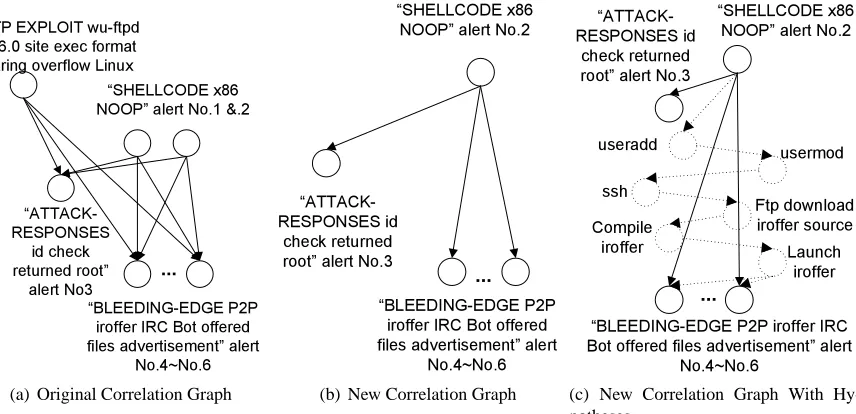
Using the same background traffic, and the orig-inal correlation graph is as shown in Fig.5(a). Sim-ilar to the analysis in Scenario 1, by mapping the alerts to the Backtracker log and verifying the de-pendencies between objectirof f er(pid = 3057)
and sh(pid = 2848), we have the new correla-tion graph as shown in Fig.5(b). The graph with hypotheses are shown in Fig.5(c), within which the hypothesized attacks and correlations are rep-resented in dotted line.
A.2 Scenario 3
The attack scenario is as below:
1. Gain root shell by exploiting the buffer over-flow vulnerability in icecast 1.3.11. (With 1 failed attempt.)
2. Through the root shell, add a new user. 3. Change the user group to root.
4. SSH to the target server using the newly gen-erated user account.
5. Download the gzipped source code of iroffer to the server.
6. Extract the source code and compile it. 7. Launch the iroffer service.
8. Transfer files from the target via the iroffer ser-vice.
The Snort raised the following alerts toward the attack:
• 2 “SHELLCODE x86 NOOP” alerts, and
• 1 “ATTACK-RESPONSES id check returned root” alert, and
• 1 “ATTACK-RESPONSES id check returned userid” alert, and
• 3 “BLEEDING-EDGE P2P iroffer IRC Bot offered files advertisement” alert.
The original correlation graph is as shown in Fig.6(a). Similar to the analysis in Scenario 1, we mapped the alerts to Backtracker’s log. By veri-fying the dependencies between the shellcode alert
(icecast(pid = 2983) → sh(pid = 2996) and
iroffer alert irof f er(pid = 11671) → socket :
/5143, we have the new correlation graph as shown in Fig.6(b). The graph with hypotheses are shown in Fig.6(c), within which the hypothesized attacks and correlations are represented in dotted line.
B Attack Knowledge Used in Our Experi-ments
“BLEEDING-EDGE P2P iroffer IRC Bot offered files advertisement” alert
No.11
“NETBIOS SMB trans2open buffer overflow
Attempt” alert No. 1~8
“ATTACK-RESPONSES
id check returned root”
alert No.9 FTP EXPLOIT
wu-ftpd 2.6.0 site exec format string overflow Linux
(a) Original Correlation Graph
“BLEEDING-EDGE P2P iroffer IRC Bot offered files advertisement” alert No.11
“NETBIOS SMB trans2open buffer overflow Attempt” alert No. 8
“ATTACK-RESPONSES id check returned root” alert No.9
(b) New Correlation Graph
“BLEEDING-EDGE P2P iroffer IRC Bot offered files advertisement” alert No.11
“NETBIOS SMB trans2open buffer overflow Attempt” alert No. 8
“ATTACK-RESPONSES id check returned root” alert No.9
Download iroffer through
ftp Launch the
iroffer program
(c) New Correlation Graph With Hy-potheses
Figure 5. Correlation Graphs in Scenario 2
“BLEEDING-EDGE P2P iroffer IRC Bot offered files advertisement” alert
No.4~No.6 “SHELLCODE x86 NOOP” alert No.1 &.2
“ATTACK-RESPONSES
id check returned root”
alert No3 FTP EXPLOIT wu-ftpd
2.6.0 site exec format string overflow Linux
...
(a) Original Correlation Graph
“BLEEDING-EDGE P2P iroffer IRC Bot offered files advertisement” alert
No.4~No.6 “SHELLCODE x86
NOOP” alert No.2
“ATTACK-RESPONSES id
check returned root” alert No.3
...
(b) New Correlation Graph
“BLEEDING-EDGE P2P iroffer IRC Bot offered files advertisement” alert
No.4~No.6
“SHELLCODE x86 NOOP” alert No.2
“ATTACK-RESPONSES id check returned root” alert No.3
useradd usermod
ssh
Ftp download iroffer source Compile
iroffer Launch iroffer
...
(c) New Correlation Graph With Hy-potheses
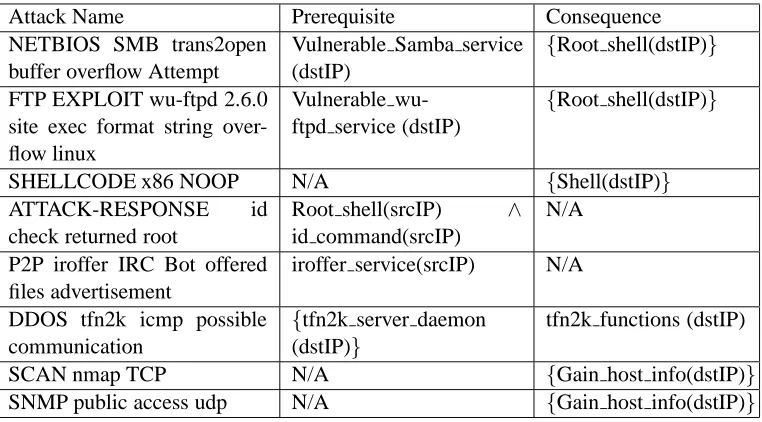
Table 2. Prerequisites and Consequences of Alerts (i.e., Detected Attacks) in Our Experiments. (All alerts have two attributes: Source IP Address (srcIP) and Destination IP Address (dstIP).)
Attack Name Prerequisite Consequence
NETBIOS SMB trans2open buffer overflow Attempt
Vulnerable Samba service (dstIP)
{Root shell(dstIP)}
FTP EXPLOIT wu-ftpd 2.6.0 site exec format string over-flow linux
Vulnerable wu-ftpd service (dstIP)
{Root shell(dstIP)}
SHELLCODE x86 NOOP N/A {Shell(dstIP)}
ATTACK-RESPONSE id check returned root
Root shell(srcIP) ∧
id command(srcIP)
N/A
P2P iroffer IRC Bot offered files advertisement
iroffer service(srcIP) N/A
DDOS tfn2k icmp possible communication
{tfn2k server daemon (dstIP)}
tfn2k functions (dstIP)
SCAN nmap TCP N/A {Gain host info(dstIP)}
SNMP public access udp N/A {Gain host info(dstIP)}
Table 3. OS-Level Objects Corresponding to the Predicates Appeared in Our Experiments
Predicate OS-level Object Constraint
Vulnerable Samba service (hostIP)
“/usr/sbin/smbd” N/A
Root shell(hostIP) “/usr/bin/sh” uid=0 Root shell(hostIP) “/usr/bin/bash” uid=0
Shell(hostIP) “/usr/bin/sh” N/A
Shell(hostIP) “/usr/bin/bash” N/A
id command(hostIP) “/usr/bin/id” N/A iroffer service(hostIP) “/home/attacker/iroffer” N/A tfn2k server daemon “/home/attacker/td” N/A
Table 4. Implications between Predicates
Predicate Implied Predicates Root shell(hostIP) {Shell(hostIP),
![Figure 4. Compare between the Original Correlation Method [10] and the Proposed Method](https://thumb-us.123doks.com/thumbv2/123dok_us/1521377.1186471/11.612.78.529.71.213/figure-compare-original-correlation-method-proposed-method.webp)