An Innovative Access for Competition and
Assistance Among Cloud Providers
“ Cloud Arbiter ”
Aishwarya Pachange1, Samrudhi Randive2, Shrikant Bhosale3, Mansi Bhonsle4
UG Student, Dept. of Computer Engineering, GHRCEM, Pune India1 UG Student, Dept. of Computer Engineering, GHRCEM, Pune India2 UG Student, Dept. of Computer Engineering, GHRCEM, Pune India3 Asst. Professor, Dept. of Computer Engineering, GHRCEM, Pune India4
ABSTRACT: Different service schemes by Cloud service providers has attracted customers in the recent past and is still evolving. Since the resources being handled within Clouds are not capable of being stored and the physical resources need to be changed very often, pricing the service in a way that would return profit on the initial capital investments to the service providers has been a major issue.The rush in demand for utilizing public Cloud resources has introduced many swaps between price, performance and recently reliability. The cloud provider, such as Amazon provides computing capacity in the form of virtual occurrence and charges customers a periodically changing price for the period they use the instance. The provider’s problem is then to find an optimal pricing policy, in face of debatable demand arrivals and separation, so that the average expected revenue is maximized in the long run. We adopt a revenue management framework to handle the problem. The competition among providers is formulated as a non-cooperative debatable game where the players are providers who act by recommending the price policy at the same time. The game is modeled as a Markov Decision Process whose solution is Markov Perfect Equilibrium. Then, we address the assistance among providers by presenting an innovative algorithm for determining a cooperation strategy that tells providers whether to satisfy users’ resource requests locally or expand them to a certain provider. The algorithm returns the optimal cooperation structure from which no provider unalterably differs to gain more revenue.
KEYWORDS:Cloud computing, dynamic pricing, cooperation, Markov Decision Process, Markov Perfect Equilibrium, game theory.
I.INTRODUCTION
The race among providers leads to acts of cloud resource pricing. Modeling this competition involves the description of the user’s choice behavior and the assesment of the influential pricing strategies of providers to adapt to the market state. To describe the user’s choice behavior, we employ a widely used discrete choice model, the multinomial legit model [2], which is defined as a utility functionwhose value is obtained by using resources requested from providers. From the utility function, we obtain the odds of a user choosing to be served by a certain provider. The choice probability is then used by providers to determine the excellent price policy. The fundamental question is how to determine the optimal price policy. When a provider joins the market, it implicitly participates in a competitive game established by existing providers. Thus, optimally playing thisgame helps providers to not only survive in the market, but also improve their credits. To give providers a means to solve this problem, we formulate the competition as a non-cooperative stochastic game [3].
II.MODEL AND ASSUMPTIONS
We start by introducing our model and assumptions. we consider providers which offer Infrastructure as a Service (IaaS) from which users can request a number of cloud resource occurence and expand their own platform for executing their applications[1]. There are a total of N providers on the cloud market. These jobholders offer a number of resource types denoted By M. Depending on the capacity of each resource type, providers define a per unit price to charge users for resource usage. We denote vector pi = (pi1; pi2; : : : ; piM) as the price vector of provider i where pij with j 2 [1; : : : ;M] is the per unit price of resource type j For each resource type of each provider, we additionally define the per unit benefit _ij , i.e., per unit benefit of resource type j offered by provider i, to reflect the relative capacity of the resource in satisfying the user’s computational needs[1].
A.FORMULATION
The credit maximization problem can be formulated as Follows. We assume that, in total, K users give away their resource requests among N providers. User k places a request for a bunch of resources rather than for individual items which is the usual case in the cloud environment. Therefore, the resource request of user k is represented by a vector rk = (rk1; rk2; : : : ; rkM) where rkj with j 2 [1; : : : ;M] is the required number of instances of resource type j. The state of the market is given by ω = (ω1 , ω2 , . . . , ωK )where ωk ∈ {1, . . . , N } is the identification/index of the provider to which user k sends his resource request, i.e., user k chooses to be served by provider ωk.[1]
βi = δ(ω, i) = (βi1 , βi2 , . . . , βiK ), βik = 1 if ωk = i; (1)
0 otherwise
Given the price approach pi = (pi1; pi2; : : : ; piM) and the individual state _i of provider i, the total husky revenueof provider i is defined as follows:
Rigross(βi pi) = Ri (δ(ω, i), pi ) = Σβik cki =Σβik Σ rkj pij .(2) B.RESOURCE PROVISION
The provider must also provision sufficient capacity to satisfy the service level agreement with the customers. Hence, cost rebate and credit generation are demanding to the success ofa cloud service provider. Consequently, key solutions for pricing, provisioning, and delivering quality of service are the determinant components of the business process in order to win in the aggressively rising market[5].
III. LITRATURE REVIEW
efficient pricing scheme based on mechanism design, and accept a genetic algorithm to repitatively optimize the pricing policy. The most related work to ours is where a pricing strategy is developed by solving an optimization problem for a cloud cache. These approaches are primarily of a one-shot nature without considering the effect of pricing on future demand and credit[4]. Another work commited to option theory in resource allocation for Clouds, proposes an approach based on the option theory to minimize cost and mitigate the risk for Cloud users [6]. They introduce a unique pricing plan based on the option that Cloud providers should provide for their own customers. Using option plan, customers can reduce the cost of using IaaS Cloud provider resources. Our work, on the other hand, mainly aims to increase profit and diminish risks for providers, which leads to better QoS for the customers. They analyze the use of real options in a contract market, to economically manage resource reservation in distributed IT environments . In fact, they use option as a contract to perform reservation for time and budget sensitive customers. Network consumers want to minimize expenses, whereas Network providers want to maximize their return on investment.
IV. PROPOSED SYSTEM
A.PROBLEM STATEMENT
Increasing resource appeals with different requirements from users bring new challenges which a single provider may not be able to satisfy, given that the resilience of cloud services and the availability of data stored in the cloud are the most important issues. Scaling up the infrastructure might be a solution for each provider, but it costs a lot to do so, and the infrastructure may be under-utilized when demand is low. A multiple cloud approach, which is referred to as Cloud-of-Clouds is a promising solution in which several providers cooperate to build up a Cloud-Cloud-of-Clouds system for allocating resources to users.
B.SYSTEM ARCHITECTURE
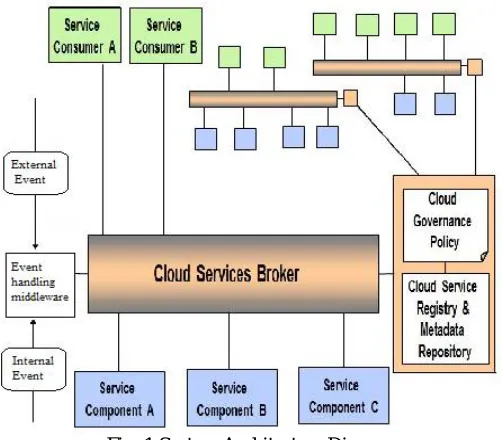
In this architecture, the Cloud Broker is responsible for coordinating the cooperation among providers, receiving users’ resource requests and also doing accounting management.
Fig. 1 System Architecture Diagram
C.ALGORITHM
Algorithm 1 Finding optimal price policies p
Input: Users’ resource requests and budgetary constraints:
rk and bk, k = 1 to K. Information about all providers: : ϕi , ψij , λij , co and j = 1 to M. Discount factor: γ.
Output: Optimal price policies: p
1:Make initial guesses for the value function v0 (ω) ∈ R M and the price policy p0 (ω) ∈ R M for each provider i = 1 to N in each state ω=Ω . Pick a random state to be the initial state of the market;
2: stop --- 0; /*stop condition*/; t 0 /*iteration*/ 3: while stop -- 6= 1 do
4: Update the value function Vˆ t (ω) and the price policy pt (ω) for all providers according to
p (i to t-1)refers to the price policies of providers other than provider i at iteration t -1;
5: cc ← maxω∈Ω (V t (ω) − Vt−1 / 1 + Vˆtω)
6: if cc < € then /*satisfied by all providers*/ 7: stop 1;
8: else
9: Compute the next state of the market; 10: t t + 1;
11: end if
12: end while
V. RESULTS
For all simulations, we set the discount factor γ = 0.95 which corresponds to a 5% interest rate, the convergence constraint = 1e−4 . The users’ preferences which follow the Gumbel distribution are generated with the location parameter µ = 3 and the scale parameter β = 4. We set the number of resource types offered by each provider M =
4 which is similar to that offered by Amazon EC2. We also use the per unit prices charged by Amazon to calculate the budgetary constraint for all users. The initial value for price policies of all providers is set to zero. Users’ resource requests are classified into three classes: small, medium and high demand classes which require a tuple of resources rj = (6, 5, 4, 2), rj = (25, 20, 15, 8) and rj = (60, 50, 40, 20), respectively[1].This reflects the real user behavior that a user in the small class often requests a few number of resource instances for testing and experimental purpose while a user in the high demand class needs more resources for running their application on the production level.
VI. CONCLUSION
requests. We presented a game-theoretic approach to address the former challenge. We integrated the discrete choice model, which describes the user’s choice behaviour based on the user’s utility, to allow providers to derive the probability of being chosen by a user. By modelling the stochastic game as an MDP, our numerical results prove the existence of an MPE from which providers cannot unilaterally deviate to improve their revenue. Our algorithm, which computes the equilibrium prices, is shown to converge quickly. Next, we introduced a novel approach for the cooperation among providers. The cooperation algorithm results ina win-win situation where both cooperation partners can improve their final revenue. The cooperation structure found by the algorithm is the optimal one for each provider.
ACKNOWLEDGEMENT
I express great many thanks to Prof. Mansi Bhonsle for her great effort of supervising and leading me, to accomplish this fine work. Also to college and department staff, they were a great source of support and encouragement. To my friends and family, for their warm, kind encourages and loves. To every person gave us something too light my pathway, I thanks for believing in us.
REFERENCES
[1] H. Xu and B. Li, “Dynamic Cloud Pricing for Revenue Maximization,”IEEE Trans. Cloud Comput., vol.1, no. 2, pp. 158–171, 2013.
[2] K. E. Train, “Discrete Choice Methods with Simulation,” Identity,vol. 18, no. 3, pp. 273–383, 2003. [3] M. J. Osborne, An Introduction to Game Theory. Oxford UniversityPress, 2004.
[4] R. Bellman, “A Markovian Decision Process,” Indiana Univ. Math.J., vol. 6, no. 4, pp. 679–684, 1957. [5] A. N. Toosi, R. K. Thulasiram, and R. Buyya, “Financial Option Market Model for Federated Cloud Environments,” in UCC 2012,Chicago, Illinois, USA, Dec. 2012, pp. 3–12. [6] A. Gera and C. H. Xia, “Learning Curves and Stochastic Models for Pricing and Provisioning Cloud Computing Services,” Service Science, vol. 3, no. 1, pp. 99–109, Mar. 2011.
[7] B. Javadi, R. K. Thulasiram, and R. Buyya, “Characterizing spot price dynamics in public cloud environments,” Future Generation Computer Systems, vol. 29, no. 4, pp. 988–999, Jun. 2013.
[8] B. Sharma, R. K. Thulasiram, P. Thulasiraman, S. K. Garg, and R. Buyya, “Pricing Cloud Compute Commodities: A Novel Financial Economic Model,” in CCGrid 2012, Ottawa, Canada, May 2012, pp. 451–457.
[9] D. Niu, C. Feng, and B. Li, “Pricing Cloud Bandwidth Reservations under Demand Uncertainty,” in SIGMETRICS’12, London, UK, June 2012, pp. 151–162.
[10] H. Xu and B. Li, “Maximizing Revenue with Dynamic Cloud Pricing: The Infinit e Horizon Case,” in IEEE ICC 2012, Ottawa, Canada, June 2012, pp. 2929–2933.
[11] F. Teng and F. Magoul`es, “Resource Pricing and Equilibrium Allocation Policy in Cloud Computing,” in CIT 2010, Bradford, UK, June 2010, pp. 195–202.
[12] M. Mihailescu and Y. M. Teo, “On Economic and Computational- Efficient Resource Pricing in Large Distributed Systems,” in CCGrid 2010, Melbourne, Australia, May 2010, pp. 838–843.
[13] G. Allon and I. Gurvich, “Pricing and Dimensioning Competing Large-Scale Service Providers,” Manufacturing Service Operations Management, vol. 12, no. 3, pp. 449–469, 2010.