Improvements of Blockchain’s Block Broadcasting:
An Incentive Approach
Abstract—In order to achieve a truthful distributed ledger, homogeneous nodes in Blockchain systems will propagate mes-sages on a P2P network so that they can synchronize the status of the ledger. Currently, blockchain systems target on achieving better scalability and higher throughput to support divergent applications which will lead to heavier message propagation, especially the broadcasting of blocks. The heavier traffic on the P2P network will cause longer latency of block synchronization, which may damage system consistency and expose the system to potential attacks. Even worse, when heavy communication consumes a lot of network capacity, nodes in the P2P network may not relay blocks to save their bandwidth. This may damage the efficiency of network synchronization.
In order to alleviate the problems, we propose an improved block broadcasting protocol which elaborates block data sharding and financial incentive mechanisms. In the proposed scheme, a block is sliced into pieces in order to keep the network traffic smooth and speed up content delivery. Any node which relays a piece of the block will get benefits with financial rewards. By applying data sharding, our proposed scheme speed up the block broadcasting and therefore shorten the synchronization time by 90%, which is shown in our simulation experiments. In addition, we carry out game theoretical analysis to prove that nodes are efficiently incentivized to relay blocks honestly and actively.
I. INTRODUCTION
In 2008, Nakamoto published his celebrated paper [1] in which introduced a practical blockchain consensus protocol and later was known asBitcoinprotocol. Bitcoin protocol is a novel scheme to maintain a distributed ledger which is safe-guarded by all peers in a decentralized system [2]. The advan-tages of blockchain, such as decentralization, irreversibility, and undeniableness, provide an approach to leverage verifiable interactions among non-trust peers in decentralized systems. As a trade-off, such decentralized consensus is expensive to achieve. Bitcoin, for instance, consumes enormous mining power but only generate a block about every 10 minutes which will provide about 7 Transaction Per Second (TPS) on average. Therefore, the urgent need for fast and cheap transaction processing in blockchain attracts lots of researches. A new version of Bitcoin is proposed which will increase block size [3] and use the lightning network to process frequent small transactions more efficiently [4]. Other works try to integrate DAG [5, 6] and network sharding [7, 8] into Bitcoin scheme and improve the throughput of blockchain using clever consensus design. Above improvements on throughput mainly have two effects: larger block size [3] and higher frequency of block generation [9].
However, we observe that the bottleneck of blockchain will also come to the network layer even if the consensus makes a breakthrough to provide high throughput. A simple calculation can illustrate this concern. The size of a basic transaction with one input and two outputs in Bitcoin is
about 250 bytes [10]. If we want to achieve 10000 TPS (Visa achieves about 24000 TPS) in blockchain, the overall throughput is at least 2.5 MB/s, which is a nonnegligible bandwidth cost. In fact, the size of transactions for smart contracts will be even much larger. In current blockchain consensuses, nodes with verification capability (aka full node) are usually required to synchronize all chain data. Blockchain systems are robust only with a significant number of full nodes. As a result, as long as the chain data is generated faster and a large number of full nodes are in function, the message propagation in blockchain P2P network should be much faster to maintain in-time synchronization. The overloaded P2P net-work layer can causelong synchronization latencyandabsence of incentive for broadcastingchallenges. We analyze the above two challenges and improve the block broadcasting scheme to solve them.
Synchronization latency means the latency from the gen-eration of a message to confirmation of the same message by all honest nodes. [11] addresses the strong correlation between the size of message and synchronization latency. Since there is the trend of larger blocks, we conduct that synchroniza-tion latency will significantly grow in future blockchain net-work. Slow synchronization can damage security properties of blockchain systems [12, 13], waste mining power [14], cause blockchain forks [11] and even expose the vulnerability of adversary attacks like selfish mining [15, 16]. In order to shorten synchronization latency, we divide each block into pieces and the piece is the basic unit of data transfer. Similar to P2P content delivery applications, transfer in pieces makes the most of each node’s communication bandwidth and make the broadcast more efficient [17]. In our simulation in Section VII-A, block sharding shorten the synchronization latency by about 90%.
pecu-niary incentive. In intuition, nodes are intended to download blocks because of the requirement of synchronization and meanwhile uploading is incentivized by the financial rewards. We formally analyze the incentive mechanism through game theoretical models in Section VI. From our simulation in Section VII, the blockchain-based incentive is sound and effective. The system will converge to the equilibrium of honest behavior as long as there is a sufficient initial fraction of honest nodes.
As for considerations of scalability, we keep the inter-action between uploaders and downloaders simple. Since the transfer of cryptocurrency requires extra transactions, we also minimize the number of such transaction calls using micro-payment channels [21]. Since micro-micro-payments require the submission of only one transaction after a large number of payments between two nodes, the number of extra transactions will not significantly increase in a long period, therefore the extra cost will not significantly influence the original perfor-mance of system scalability. We demonstrate our proposed block broadcasting protocol in Bitcoin environment and the protocol is suitable for other blockchain systems with block-based consensus.
Our contributions. First, we introduce a novel block broadcasting scheme with blockchain-based incentive mech-anism. The scheme is a generic approach for block-based blockchain systems to further improve the efficiency of block propagation. Section V elaborately depicts the protocol design, including interactions during block broadcasting.
Also, we use game theoretical model to analyze incentive for broadcasting and discuss the fairness of data transfer. We introduce an evolutionary game model to analyze the pro-posed incentive mechanism formally, which shows the stable equilibrium of active cooperation (Section VI-A). Besides, we use a repeated game model and learning model to analyze the fairness and cooperative behavior in the process of data transfer by pieces (Section VI-B).
At last, we carry out simulations and experiments in Section VII, which prove that proposed scheme speeds up synchronization and the incentive is sound and practical.
II. BACKGROUND
In this section, we introduce backgrounds of some related conceptions and technologies.
Bitcoin and blockchain. Blockchain is a distributed digital ledger over a peer-to-peer network that achieves de-centralized agreements between nodes with only minimal trust [2]. The ledger is organized in a special chain-like data structure which is maintained by all participants (i.e. nodes) in the system. The blockchain supports offline-verification but adversary parties cannot reverse the ledger once it is admitted by consensus, given the consumption that the majority of participants is honest.
In this paper, we use Bitcoin as an example of typical blockchain system to illustrate our proposed block broadcast-ing scheme. Bitcoin is the first application built on blockchain, also the first cryptocurrency, which is proposed in 2008 [1]. Therefore, Bitcoin presents all the nature of blockchain and
the soundness of Bitcoin is proved both practically and theo-retically.
Block broadcasting in Bitcoin.Blockchain P2P network is homogeneous and all full nodes (i.e. nodes who are able to perform verification on the ledger) keep a complete replica of the necessary information for verification, including blocks. A node who finds a new block take three methods, unsolicited block push,standard block relayanddirect headers announce-ment, to broadcast it [10]. Unsolicited block push usually happens when the node is exactly the generator of the found block. In this way, the node knows that no neighbor possesses this newly generated block so he directly sends the block data to neighbors. Except for the special situation that the node is the block generator, nodes execute standard block relay. We focus on improving standard block relayin this work. To be detailed, a typical standard block relay broadcast from node AtoB contains following steps: 1) AfterA discovers a new block,Asends an invmessage to its neighborB, telling him the existence of the new block. 2)B checks whether the block has already been included in its local storage. If not,Brequest the header fromA. 3)B checks the integrity ofheaders and request full block data.
Optionally, nodes can skip step 1 to directly broadcast headers to neighbors, and this method is calleddirect headers announcement.
Micropayment channel. Micropayment channel in Bit-coin allows users to make multiple blockchain transactions without committing all those transactions to the ledger. Light-ning network [4] implement the Hashed Time-Locked Contract (HTLC), which is an implementation of two-party micro-payment channel, to leverage fast off-chain transactions. The two parties can repeatedly update the state of the contract to perform transactions on small amounts, rather than publish each transaction on the ledger. In our design, we also apply HTLC to leverage frequent interactions between uploaders and downloaders.
III. RELATEDWORK
Bitcoin P2P network. Blockchain systems have spe-cial P2P protocols to leverage message propagation, which has been analyzed through real-world data [14, 11]. [14] performs thorough data collection and analysis on Bitcoin’s P2P network in 2014 and provides lots of interesting statistic results related to block propagation. The authors observed the significant propagation latency which may cause miners to mine dated blocks and waste computing power. [11] analyzed the Bitcoin broadcast protocol in details and proved that propagation latency is the main cause of chain forks. Also, the paper proposed some modifications on the broadcast protocol to speed up block propagation.
Our work not only further improve the efficiency of block broadcasting but also integrate an incentive mechanism for block relaying.
incentive for providing data in P2P systems, [20] integrates financial rewards into data transfer.
Also, blockchain provides a practical tool leveraging distributed financial exchange and blockchain-based incentive in decentralized applications is explored by several works [18, 19, 22, 23, 24, 25]. In the above systems, Blockchain plays the role as a transparent and reliable ledger which confirms the truthfulness of incentive mechanisms in a decentralized envi-ronment. Most of those systems also use the cryptocurrency or other blockchain-based tokens as the direct incentive.
In our work, we address block broadcasting in blockchain systems as a specific case of P2P content delivery and inte-grates a blockchain-based incentive model.
IV. MODELFORMULATION
In this section, we present a formulated model of blockchain’s block broadcasting in Section IV-A. We also address two main challenges in Section IV-B and specify our design goals as potential solutions to challenges in Sec-tion IV-C.
A. Model of Block Broadcasting
First, we introduce some conceptions in the process of block broadcasting. We then define a formulated model of blockchain message propagation.
Node. The node is the basic unit of synchronization in blockchain systems. Each node manages a local state of chain and tries to keep updating the state to the latest. Each node possesses multiple blockchain identities (aka address). Especially, only full nodes are able to generate new blocks. Our model focuses on full nodes.
Block. The block is one of basic data structures in blockchain. Blocks are generated by miners in the system, containing a set of transactions. The block usually has a hard-coded limitation of size, such as 1MB for Bitcoin in 2010. Each block has a header, which is a serialized piece of data containing crucial properties of a block, such as previous block hash, the nonce and the Merkle root. For block b, we denote by b.header as header part and b.body as the main body containing transactions.
P2P network. Blockchain’s P2P network is consist of homogeneous nodes. Each node has a few neighbors with whom the node exchange messages to achieve synchroniza-tion. Nodes are supposed to keep as few neighbors as possible to save communication bandwidth, as long as successful synchronization is guaranteed.
Next, we introduce some notations to formally model blockchain’s message propagation. We denote by G=hP,Ei
as the topology of blockchain P2P network where P is the set of nodes and E(p), p ∈ P presents the set of neighbors of the node p. For any e ∈ E(p), e ∈ P. In addition, we denote by R = hG, p, m,Ri as one blockchain message propagation process, in which G denotes the topology of a blockchain P2P network, p ∈ G.P presents the generator of the message m and R denotes a broadcast protocol. In real-world blockchain applications like Bitcoin, the message m should be transactions or blocks, which is required to be
propagated to all nodes. Since the data of blocks is in a much larger size than single transactions, which can affect the throughput of P2P propagation more significantly, our proposed broadcast protocol focuses on the propagation of newly generated blocks.
Using the above notations, we formally describe the process of blockchain’s block broadcasting. We assume the P2P network G is set up and all nodes in G.P reach a consensus on a broadcast protocol R before a broadcast B starts. Note that the topologyG must be a connected graph, which means each node must have at least one neighbor in function to exchange messages, or formally declared as p∈G.P,E(p)6=∅. Once a node, denoted byp0, successfully
generate a new blockb, a blockchain message propagationR takes place withR.p=p0 andR.m=b. Broadcast protocol
Rdefines the behavior of broadcast, which is triggered by the arrival of a message, for all nodes. The typical behavior has three parts:
• Checks on the message. First, the node checks whether the message is already available in his local storage. If so, there is no need to process the message further. Otherwise, the node verifies the integrity of the message. If the message is a block, for example, the node checks the validity of block header and transactions.
• Process the message. After verification passes, the node updates the status of his local chain according to the message. For example, add new blocks onto the chain graph or put new transactions into the transaction pool.
• Propagate the message. The node propagates the original message to all neighbors, except for the message source, so that invokes the same behavior of his neighbors. A synchronization starts at the generation of m and it is successful when all honest nodes have processed m. Espe-cially, the messagemrefers to a block in block broadcasting.
B. Challenges
According to the trend of higher throughput and scala-bility of Blockchain systems, we conduct that the Blockchain P2P network will be overloaded as mentioned in Section I. The overloaded P2P network causes two challenges:long synchro-nization latencyandabsence of incentive for broadcasting.
Long synchronization latency. Long synchronization latency, which means a long time for the network to reach a consensus on one message. In a typical Blockchain system like Bitcoin, long synchronization latency may be caused by: 1) Larger block size.As an empirical experiment [11] shows, the larger the blocks are, the longer time a point-to-point transfer takes so that the synchronization takes longer. 2) Number of full nodes.If the scale of the P2P network is large, a message takes longer to reach all nodes.
chain (longest chain in Bitcoin). If a new block is late to be observed and synchronized, the miner waste more time mining on the previous block without contributing to the best chain. 2) Soft forks. When more miners are mining on previous blocks because the message of the latest block does not arrive, there will be more soft forks on the previous blocks. 3)Selfish mining attack. The basic idea of selfish mining is to develop a private chain containing more than one block and broadcast multiple blocks at one time [16]. Different from normal miners, selfish miner avoids synchronization latency. As a result, selfish miner develops his private chain faster and demonstrates more mining power as he should have.
Absence of incentive for broadcasting. The com-munication cost of block broadcasting will be significant as Blockchain’s throughput increases. but in conventional Blockchain P2P network layer, there is no direct incentive to incentivize nodes propagate the messages they received. As a result, rational nodes have the motivation to refuse to relay blocks so that the efficiency of synchronization is further damaged.
C. Design Goals
To address two challenges of Blockchain P2P network, we declare design goals of the block broadcasting scheme from three aspects: fast synchronization,incentive for broadcasting as well as fairness in propagation process.
1) Fast synchronization. The new block broadcasting scheme should have better synchronization efficiency. In other words, it requires less time to broadcast a new block to honest nodes in the system. The system should be feasible to implement and stable to use on large scale. 2) Incentive for broadcasting. Under the incentive mech-anism, nodes are encouraged to relay blocks they re-ceived. The system should have a stable equilibrium on which a majority of system participants would like to follow broadcast protocol honestly and actively. 3) Fairness in propagation process. It is hard to guarantee
strict fairness of interactions between nodes without Trusted Third Party (TTP) but the unfairness remained in the system should be minimized by incentive. Also, the unfairness should not affect the normal execution of system protocol and incentive mechanism.
V. BLOCKBROADCASTINGPROTOCOL
In this section, we elaborately illustrate our proposed protocol of block broadcasting. The key idea of our protocol is slicing blocks into pieces which are transferred and verified independently. Along with the transfer of each piece, payments are also processed through micro-payment channels.
The illustration of the protocol is based on Bitcoin but the protocol is suitable for other block-based blockchain systems and fits in the model of blockchain’s block broadcasting mentioned in Section IV-A. When a block flows between two nodes, we name the sender and the receiver of the block data as uploader anddownloader, respectively.
We introduce related data structures and tools in Sec-tion V-A, the block sharding method in SecSec-tion V-B, P2P
messages in Section V-C and the overall workflow in Sec-tion V-D.
A. Related Tools
We first introduce some tools used in protocol design, including micro-payment channel, Merkle Tree and bloom filter.
Micro-payment channel. We define the functions of micro-payment channel [10] between two parties, which is a crucial application for our protocol to leverage financial incentive practically.
• C ← Setup(A, B, s): Two parties A and B setup the
channel and allocate an initial distribution of funds s. For example, initially A and B each owns 0.5 BTC and the total of fund is 1 BTC;
• C0←T ransf er(C, s0): When a transfer of fund happens, both parties perform a serial of interactions to update the state of the channel to assign a new fund distribution. For example, the new fund distributions0= (A: 0.4, B: 0.6) is assigned whenA transfer 0.1 BTC toB.
• T erminate(C): Terminate the micro-payment channel by submitting the final fund distribution to the ledger through one transaction.
T ransf er method can be called by each side and for multiple times as long as the channel is in function, without changing the status of blockchain ledger. Therefore, T ransf er is cheap to perform so that the micro-payment channel makes the frequent transfer of cryptocurrency scal-able.
Merkle Tree. Merkle Tree provides an approach of effective and secure verification on a large data structure. Note that Hash is a predefined safe hashing function. We adopt Merkle Tree to perform the verification on a single data piece, described in Section V-B.
• (r,P) ← GenM erkle(X): Generate a Merkle Tree taking a set of inputs X as leaves and return Merkle rootr and a mapping functionP.P(x), x∈X presents the corresponding path of the Merkle Tree from rootrto the leavex.
• {0,1} ←V rf yM erkle(x, r, p): Verifyxis a valid leave
in the Merkle Tree given Merkle root r and the path of xasp(p← P(x)).
Bloom filter. Suppose there is a large set with a size of M.Bloom filter is used to test whether an element is among theM elements in the set, but the bloom filter here is aM0 -length vector of bits and M0 could be much smaller thanM.
• f0←Add(f, x): Use an elementxto update bloom filter
f;
• {0,1} ← T est(f, x): Test whether x has been used as an input to updatef.
B. Block Sharding
In our block broadcasting protocol, for each block b, b.body is sliced to multiple pieces. Given a sharding method
S, the set of pieces is formally expressed as S(b) =
{b0, b1, . . . , bn}. The benefits of the sharding are
straight-forward. Similar to P2P content delivery or file sharing, transferring data in pieces is much faster in the P2P network, especially for large files. In the P2P environment, the multiple pieces can have various sources to download so that the method bypasses the limitation of uploaders’ bandwidth.
But different from most P2P applications, data in broad-casting, such as transactions and blocks, is crucial for blockchain consensus and therefore requires more strict veri-fication. We intend to make the transfer of each piece inde-pendently verifiable with the minimum communication cost. To achieve this, we adopt a Merkle Tree proof on the pieces. We add another block property named as piece rootinto the block headers. The piece root, as the name indicates, is a Merkle root from a Merkle Tree where each leaf is the hash of one piece. For a block b, the piece root b.header.pr is generated by (b.header.pr,P)← GenM erkle({Hash(pi) |
pi ∈ S(b)}). Before the uploader transfers any piece of
b to the downloader, downloader should have received and verified b.headerand therefore possess a valid piece root, as Section V-D depicts. When transferring a piece pt ∈ S(b),
the uploader offers a Merkle path pathpt ← P(Hash(pt))
along with the piece data to the downloader. After recevingpt
andpathpt, the downloader runsV rf yM erkleto verifypt’s
validity.
Since the block header, in Bitcoin, directly participants in mining process (i.e. block generation), under the assumption thatHashperforms safe hashing, attackers cannot modify in-header piece root at any case. Meanwhile, given a verified piece root, the attacker cannot produce any maliciousp0t6=pt
that passes either the verification of Merkle Tree of pieces.
C. P2P Messages
We define some important P2P messages used in our block broadcasting protocol. Our protocol inherits some mes-sages used in Bitcoin, such as inv indicating the discovery of a new item;getHeadersrequesting block headers;headers transferring the data of block headers.
Similar to getHeaders and headers, we have getPieces andpiecesfor requesting and transferring piece data. In details, messagegetPiecescontains one block hash (Hash(b.header) for block b) and at least one piece indexx(0≤x <|S(b)|). Messagepiecescontains at least one piece datapx∈ S(b)and
correlated Merkle path pathpx.
Besides, we define messagegetPossessionandpossession to leverage fast queries on vector of possession from down-loaders to updown-loaders. Message getPossession simply contains one block hash and message possessionresponses the corre-lated vector of possession.
D. Workflow of Block Broadcasting
Given defined tools and P2P messages, we describe the whole workflow of our block broadcasting protocol, focusing on interactions between one uploader and one downloader.
Uploader
Downloader
Header Transfer Piece Transfer
C
ryp
tocurrency
M
icropa
yme
nt
C
ha
nne
l
Block Hash Broadcast
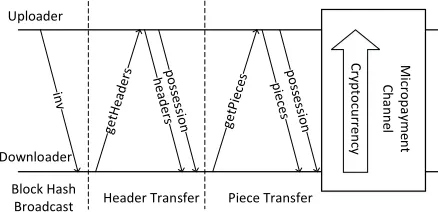
Fig. 1: Standard workflow of block broadcasting protocol. The arrows denote messages between the uploader and the downloader.
As Figure 1 depicts, block broadcasting process between one uploader and one downloader has several interactions. We denote by A as the uploader and B as the downloader for simplicity. We assume all nodes agree on a set of global configurations, such as the size of pieces and the format of messages. To simplify the presentation of the global config-uration, we suppose all honest nodes are homogeneous and each piece of block data is in the same size. Also, the size of blocks is limited so that each block is only sliced to a finite number of pieces.
Setup.AandB initialize their micro-payment channelC
through Setupand configure their broadcast strategy.
Block hash broadcast. AfterA receives or generates a valid block headerb.header,AsendsB aninvmessage con-taining block hash h ← HASH(b.header), which declares the identity of blockb.
Header transfer. B receives message inv and checks whether the block headerb.headeris valid and does not exist in his storage. If so, B sends back a getHeaders message to request the header. In response ofgetHeadersmessage, A sends back theheaders message containing complete data of b.header.Acan optionally sendpossessionmessage to inform b which pieces are available for requesting.
Repeated piece transfer. B randomly selects a piece through T est method on the latest A’s possession vector f. If B does not have any vector of possession, he can send a getPossessionmessage to request one fromA. ThenB sends a getPieces message which announces the block hashh and the index of a specific piecex.
A sends back pieces message containing block hash h, piece datapand Merkle path pathp. Also, Acan respond to
anotherpossession message ifA wants to update his posses-sion status. Note thatAmay receive pieces ofbsimultaneously during interactions with B and A should use new obtained pieces to update the possession vector throughAdd.
Received expected piece data p and its path pathp, B
first locally callsM erkleV rf y(Hash(p), b.header.r, pathp)
transfer if he wants.
Termination The repeated piece transfer can be termi-nated from any side by sending a special message or just waiting for the timeout. Assuming both sides are honest and follow the protocol, the termination is likely to happen when the downloader has no other pieces to request.
VI. ANALYSIS
In this section, we use game theoretical models to analyze our incentive mechanism. We first deploy an evolutionary model to analyze the efficiency of incentive in broadcasting. The peers should have incentive to become active honest uploaders and downloaders.
However, in the process of piece transfer, both sides have the possibility to cheat the other side, for instance terminating protocol in advance. The downloader, especially, has the chance to refuse paying the uploader. For this potential unfairness, we use a repeated game model to demonstrate how cooperation can take place and whether the threat can affect overall system performance.
A. Evolutionary Model of Incentive
We consider an evolutionary game model of block trans-fer process. One block transtrans-fer means the whole interactions between two nodes during processing one specific block, including header transfer and repeated piece transfer. Each node can act as downloader and uploader simultaneously, and we assume that nodes are strategic for the most profit. Each uploader or downloader has two strategies: cooperate (C) and defect (D), and the transfer is successful only when both sides take strategy C. Also, we assume one successful block transfer produces benefitαfor downloader and costsβfor the uploader. Meanwhile, the downloader pays πto the uploader.
Cost and payoff. In one single block transfer process, the downloader bears a cost of communication bandwidth and computation power but obtains necessary data for synchroniza-tion. So αshould be data value minus the costs. In the same way, uploader’s cost β includes bandwidth cost and computa-tion cost. Meanwhile, if the opposite side unexpectedly aborts the block transfer process, both downloader and uploader have an extra cost. Downloader must find another uploader while uploader may lose the last payment as described in Section VI-B. The extra costs for downloader and uploader are respectively denoted bytd andtu.
P =
C D
C α−π,−β+π −td,0
D 0,−tu 0,0
(1)
Matrix P in Equation 1 shows the payoff matrix for one block transfer (Pij denotes payoff when downloader uses
strategy i and uploader uses strategy j). In one generation of the evolutionary model, each node plays games with his neighbors, so the distribution of strategy C and D has an important influence on average payoff in one generation. We usexd denotes the fraction of strategy C among downloaders
while xu denotes the fraction of strategy C in uploaders.
Equation 2 shows expected payoff in one generation for each
TABLE I: Analysis of equilibrium points
Equilibrium point det(J) tr(J) result
xd= 0xu= 0 + - ESS
xd= 0xu= 1 + + Not stable
xd= 1xu= 0 + + Not stable
xd= 1xu= 1 + - ESS
xd=π−tβ+tu u xu=
td
α−π+td + 0 Saddle point
role and each strategy, in whichPS
i denotes payoff for rolei
(downloader or uploader) with strategyS. Therefore, the total payoff in one generation with for a strategy setS= (Sd, Su)
isPS =PSd
d +PuSu.
PC
d =xu(α−π+td)−td
PD
d = 0
PC
u =xd(−β+π+tu)−tu
PD
u = 0
(2)
Equilibrium Points. From the payoff we list above, we found: 1) When xu is small, which indicates restricted
resource, nodes trend to shift to strategy D as downloader since PdCmay below 0. Otherwise, cooperation is a better choice. 2) Whenxd is small, which indicates inactive downloader group
and few profits for uploaders, nodes trend to shift to strategy D as uploader since PdC may below 0. Otherwise, continuously providing download service earns more.
To further analyze this model, we use replicate dy-namic equations [26]: x˙i = xi[f(xi) −Φ(x)], Φ(x) = Pn
j=1xjf(xj).xidenotes proportion of a strategy.f is fitness
of a strategy, which equals to payoff analyzed in our model.
˙
xd =xd(1−xd)PdC
˙
xu=xu(1−xu)PuC
(3)
To find an Evolutionary Stable Strategy (ESS), the repli-cator dynamics equation should be equal to 0. Strategy C for uploader is stable only if xu = 0,1 or PuC = 0. In the same
way, strategy C for downloader is stable when xd = 0,1 or
PC
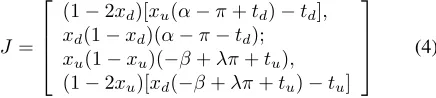
d = 0. We can use Jacobian matrix 4 to investigate ESS
in evolutionary game model. Possible equilibrium points are listed in Table I.
J =
(1−2xd)[xu(α−π+td)−td],
xd(1−xd)(α−π−td);
xu(1−xu)(−β+λπ+tu),
(1−2xu)[xd(−β+λπ+tu)−tu]
(4)
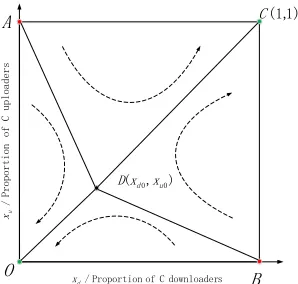
We paint five equilibrium points O(0,0), A(0,1), B(1,0), C(1,1), D(xd0, xu0) in one coordinate plate
(Fig-ure 2). From above analysis, the evolutionary game model has two ESS point: (0,0) and (1,1). Point(π−tuβ+tu, td
α−π+td),
denoted by (xd0, xu0), is the saddle point. If initial state
of system locates inside area OADB, system is more likely to converge to O. Otherwise, system has larger probability to evolve to C, which indicates cooperation equilibrium. We notice that free riding (point A) is unstable equilibrium point.
s downloader C of Proportion /
d x
up
lo
ad
er
s
C
of
Pr
op
or
ti
on
/
u
x
O A
B
) 1 , 1 ( C
) , (xd0 xu0 D
Fig. 2: Diagram of equilibrium points in evolutionary model. Points O, A, B, C and D denotes various possible equilibriums while arrows denotes the path of revolution.
Algorithm 1 Process of evolutionary model
1: Initialize simulation parameters. 2: Initialize topology graphG=hP,Ei. 3: Initialize strategy distribution(xd, xu).
4: loop
5: fori∈P do
6: forj∈ E(i)do
7: node i plays game (block transfer process) with nodej.
8: end for
9: end for
10: fori∈N do
11: Randomly select nodej∈ E(i).
12: Compute probability of learning processpi→j.
13: end for
14: Update strategy of nodes with probability matrixpi→j.
15: end loop
calculate the payoff for each node, run learning process and shift strategies for the next generation.
When nodes learn another node’s strategy with a specific probability at the end of each generation, we apply Fermi function [27, 28] as evolutionary updating rule. At the end of each generation, node i learns to follow another node j’s strategy with probabilitypi→j:
pi→j=
1 1 +eω(Pi−Pj)
Pi denotes payoff of nodei.ω is a selection intensity factor.
The larger theω is, the faster the system evolves.
In conclusion, if parameters are properly set to make (xd0, xu0) close to (0,0) and make sure there are enough
proportion of cooperators at the beginning of the system, the whole system will converge to overall cooperation and keep stable in the end. In other words, honest nodes are incentivized to relay blocks honestly and actively. The simulation of Algorithm 1 (Section VII-B) proves this analysis.
B. Repeated Game Model for Piece Transfer
Downloader requests a sequence of pieces from one uploader once the block header is obtained. This procedure is named as repeated piece transfer. The procedure can be regarded as a repeated game and one piece is transferred in each stage. The repeated game is finite but the number of stages is not common knowledge for both sides.
One stage consists of at least three steps:piece request, piece response and payment. Both sides take the trigger strategy: quit protocol in the next stage if the other side misbehaves. It accords with the reality that rational nodes will not be cheated twice. In intuition, a greedy downloader can skippayment step to get a free piece. Note that downloaders request piece in a randomized order and uploaders cannot predict at which stage the downloader will quit. Therefore the repeated game will satisfy the following conditions (denote by nas the maximum stage of the repeated game):
• In the first tstages, both sides cooperate. t∈[0, n].
• At staget+ 1, either side quits.
• After stage t+ 1, both sides quit and the protocol is terminated.
Cooperation behavior. In classic game theory, similar to finite repeated prisoner dilemma, such finite repeated game has Subgame Perfect Equilibrium (SPNE) where both sides will not cooperate from the beginning. However, participants are not completely rational. They usually have a belief that the other side will cooperate at the beginning. With the belief, nodes are greedy to take the risk to cooperate longer for better profits. As a result, both sides incline to deviate before the other side but intend to cooperate as much as they can.
There is a classical learning model which models coop-eration behavior in finite repeated prisoner dilemma observed in experiments [29]. Above this classic model, we define our learning model of repeated piece transfer game, in which one downloader and one uploader repeatedly play the finite repeated game (piece transfer game), once in one round. Downloader has a random demand λ for each round. Both sides respectively have an intended deviation stagetd andtu.
Note that if λ < td, downloader deviates in advance. The
learning process goes as follows:
• If one side observes that the opponent deviated before he intended to deviate, he has a probability p1 to shift his
intended deviation fromt tot−1.
• If one side observes that the opponent deviated in the
same period as he intended to, he has a probabilityp2 to
shift his intended deviation fromt tot−1.
• If one side observes that the opponent hadn’t deviate when he intended to deviate, he has a probability p3 to
shift his intended deviation fromt tot+ 1.
From this model, we notice that if td = tu = n, they
all incline to deviate earlier, which represents that downloader wants to cheat for one free piece and uploader want to avoid this. When td < tu downloader terminates the protocol so
early that misses more pieces to download. It is same for uploader when td > tu is observed. If they have the belief
Algorithm 2 Process of repeated game model with learning
1: Initialize maximum piece count n, topology graph G=
hP,Ei and probability parameters. 2: fori∈P do
3: Randomly initialize expected deviations for nodei. 4: end for
5: loop
6: fori∈P do
7: Randomly initialize a demand of piece within[1, n]. 8: Randomly selectj fromE(i)
9: nodeiplays game (piece transfer process) as down-loader with nodej.
10: Node i and j updates expected deviation as down-loader and updown-loader, respectively.
11: end for
12: end loop
Repeated game with learning. In each round of the repeated game (see Algorithm 2), each node plays repeated piece transfer game as a downloader with a random neighbor, executes learning algorithm and update expected deviation of the node and the neighbor. In this way, end behavior evolves through games between the nodes round by round.
According to our simulation results (Section VII-C), though exchange protocol without TTP can hardly be defi-nitely fair, the attractive rewards for cooperating makes the cooperation possible. The learning model shows an evolu-tion of end behavior, and as a result, nodes can perform stable cooperation, which means their expected deviation is dynamically stable around a not small number, after a period of evolution. Besides, the damage of betraying and fraud is limited in only one piece. So the potential unfairness in piece transfer process cannot affect system incentive and overall performance.
VII. EXPERIMENTS
We have three parts of the experiments. First, we develop a network simulating environment to evaluate how much our proposed protocol can speed up block synchronization. The second experiment is the simulation of the revolution-ary model, which proves that blockchain-based incentive is efficient to encourage active and honest block broadcasting. The third experiment is a simulation of the learning model introduced by Section VI-B, aiming to see whether nodes can achieve cooperation in repeated piece transfer.
A. Simulation on Synchronization Efficiency
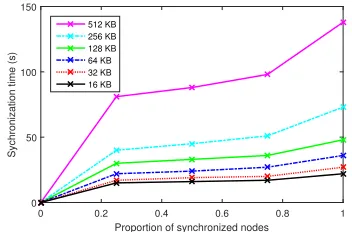
We simulate a typical P2P network using Network Sim-ulator 3 (NS3). The network contains 1000 nodes and 5000 links among nodes (10 neighbors for each node on average). Each link is assigned a predefined link delay randomly with an average of 100 ms. Also, we set the packet error rate to 0.001% and bandwidth to 70 Mbps, according to an investigation [30]. We simulate both Bitcoin’s standard block broadcasting and our proposed block broadcasting. In each execution of the simulation, we use different size of pieces, generate a 4 MB
0 0.2 0.4 0.6 0.8 1 Proportion of synchronized nodes
0 50 100 150
Sychronization time (s)
512 KB 256 KB 128 KB 64 KB 32 KB 16 KB
Fig. 3: Synchronization time with various piece size.
TABLE II: Parameters for simulation of system incentive
Parameter Description Value
|N| Count of nodes 1000
ω Learning coefficient 0.1
α Benefit for downloader 1.6
β Cost for uploader 1
π Payment from downloader to uploader 1.4
td Downloader cost 0.05
tu Uploader cost 0.10
block on one node, propagate the block to the whole network and record the latency of synchronization.
Figure 3 shows a strong correlation between synchroniza-tion efficiency and piece size. We use Bitcoin’s standard block broadcast as the baseline, which spends 571s, 653s, 729s, 930s to broadcast a 4MB block to 25%, 50%, 75% and 100% nodes, respectively. Compared with the baseline, block sharding can speed up the synchronization for 30 times and shorten the time cost by over 90%. From the simulation, the piece size of 16KB or 32KB is a wise choice for 4MB block broadcasting.
B. Simulation of System Incentive
We simulate the evolutionary model defined in Sec-tion VI-A using Algorithm 1. We use the same configures about network topology as that in Section VII-A.
Simulation parameters.The values of parameter α, β, td andtu depend on reality. First, we setβ= 1as a standard.
We estimated β much higher than tu and td because one
single failed block transfer will not hurt synchronization when the network topology is dense. Payment π should be larger thanβ and lower than α. We list the parameters in Table II. Assuming blockchain network is homogeneous, we apply the same parameters for all nodes.
Results. The simulation results are consistent with the analysis in Section VI-A. Figure 4 shows that the largerxdand
xuare, the easier convergence to successful All-C equilibrium
0.1 0.2 0.3 0.4 0.5 0.6 0.7 0.8 0.9 Initial proportion of C downloaders
0 0.2 0.4 0.6 0.8 1
Probability of convergence to All-C
xu=0.1
xu=0.2
xu=0.3
xu=0.4
xu=0.5
xu=0.6
(a) Relationship between probability of successful con-vergence andxd.
0.1 0.2 0.3 0.4 0.5 0.6 0.7 0.8 0.9 Initial proportion of C uploaders
0 0.2 0.4 0.6 0.8 1
Probability of convergence to All-C
xd=0.1 xd=0.2 xd=0.3 xd=0.4 xd=0.5 xd=0.6
(b) Relationship between probability of successful con-vergence andxu.
Fig. 4: Simulation results of evolutionary model on block transfer process.
TABLE III: Parameters for simulation of repeated piece trans-fer
Parameter Description Value
n Maxinum number of pieces 100
p1d, p1u Probability parameter of learning model 0.3-0.5, 0.4-0.6
p2d, p2u Probability parameter of learning model 0.2-0.4, 0.1-0.3
p3d, p3u Probability parameter of learning model 0.6-0.8, 0.6-0.8
C. Simulation of Repeated Piece Transfer
We simulate the repeated piece transfer in Section VI-B with learning process Algorithm 2. We still use the network topology in Section VII-A.
Parameters. We use the parameters in table III for learning algorithm described in Section VI-B. It is reasonable to assume probability parametersp3> p1> p2because nodes
are greedy for more profits and incline to last cooperation longer. Respectively, p1d, p2d, p3d denotes the parameters for
downloaders and p1u, p2u, p3u is for uploaders. Since nodes
have various characteristics, we use different random values within a range as the probability parameters for different nodes. Also, the demand for pieces for each node is randomly selected within the range of the maximum number of pieces.
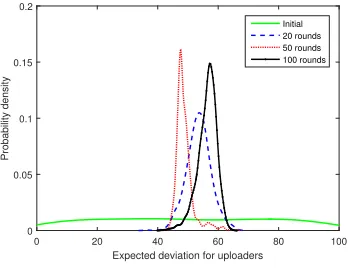
Results.If both sides are greedy enough (p3dandp3uare
large enough), the finite repeated game will reach a dynamic balance point. After 100 rounds of simulation, a significant
0 20 40 60 80 100 Expected deviation for downloaders
0 0.05 0.1 0.15 0.2
Probability density
Initial 20 rounds 50 rounds 100 rounds
(a) Probability density of expected deviation for down-loaders.
0 20 40 60 80 100
Expected deviation for uploaders 0
0.05 0.1 0.15 0.2
Probability density
Initial 20 rounds 50 rounds 100 rounds
(b) Probability density of expected deviation for upload-ers.
Fig. 5: Simulation results of repeated game model on piece transfer process. The curves present the distribution of ex-pected deviation after various number of rounds.
proportion of nodes have shifted their intended deviation closer to a balance point (around 60). This result represents the cooperation behavior of repeated games. Though the game doesn’t have a theoretical equilibrium, cooperation exists when nodes are not completely rational. For example, nodes have a belief in others’ cooperation behaviors at the beginning. Also, nodes are greedy for more profits so that the high payoff of co-operation encourages them to cooperate. Therefore, unfairness in piece transfer process will not destruct overall cooperation.
VIII. CONCLUSION
REFERENCES
[1] Satoshi Nakamoto. Bitcoin: A peer-to-peer electronic cash system. Consulted, 2008.
[2] Marc Pilkington. Blockchain technology: Principles and applications.Social Science Electronic Publishing, 2015. [3] Bitcoin improvement proposals.
https://github.com/bitcoin/bips, .
Accessed December 10, 2018.
[4] Joseph Poon and Thaddeus Dryja. The bitcoin light-ning network: Scalable off-chain instant payments. See https://lightning. network/lightning-network-paper. pdf, 2016.
[5] Anton Churyumov. Byteball: A decentralized system for storage and transfer of value, 2016.
https://byteball.org/Byteball.pdf.
[6] The zilliqa technical whitepaper, 2017.
https://docs.zilliqa.com/whitepaper.pdf.
[7] Loi Luu, Viswesh Narayanan, Chaodong Zheng, Kunal Baweja, Seth Gilbert, and Prateek Saxena. A secure sharding protocol for open blockchains. InProceedings of the 2016 ACM SIGSAC Conference on Computer and Communications Security, pages 17–30. ACM, 2016. [8] Eleftherios Kokoris-Kogias, Philipp Jovanovic, Linus
Gasser, Nicolas Gailly, Ewa Syta, and Bryan Ford. Om-niledger: A secure, scale-out, decentralized ledger via sharding. In 2018 IEEE Symposium on Security and Privacy (SP), pages 583–598. IEEE, 2018.
[9] Ittay Eyal, Adem Efe Gencer, Emin G¨un Sirer, and Robbert Van Renesse. Bitcoin-ng: A scalable blockchain protocol. InNSDI, pages 45–59, 2016.
[10] Bitcoin - open source p2p money.
https://bitcoin.org, . Accessed December
10, 2018.
[11] Christian Decker and Roger Wattenhofer. Information propagation in the bitcoin network. In Peer-to-Peer Computing (P2P), 2013 IEEE Thirteenth International Conference on, pages 1–10. IEEE, 2013.
[12] Juan A. Garay, Aggelos Kiayias, and Nikos Leonardos. The bitcoin backbone protocol: Analysis and applica-tions. In Advances in Cryptology - EUROCRYPT 2015 - 34th Annual International Conference on the Theory and Applications of Cryptographic Techniques, Sofia, Bulgaria, April 26-30, 2015, Proceedings, Part II, pages 281–310, 2015.
[13] Juan A. Garay, Aggelos Kiayias, and Nikos Leonardos. The bitcoin backbone protocol with chains of variable difficulty. InAdvances in Cryptology CRYPTO 2017 -37th Annual International Cryptology Conference, Santa Barbara, CA, USA, August 20-24, 2017, Proceedings, Part I, pages 291–323, 2017.
[14] Joan Antoni Donet Donet, Cristina P´erez-Sola, and Jordi Herrera-Joancomart´ı. The bitcoin p2p network. In International Conference on Financial Cryptography and Data Security, pages 87–102. Springer, 2014.
[15] Ayelet Sapirshtein, Yonatan Sompolinsky, and Aviv Zo-har. Optimal selfish mining strategies in bitcoin. In International Conference on Financial Cryptography and
Data Security, pages 515–532. Springer, 2016.
[16] Ittay Eyal and Emin G¨un Sirer. Majority is not enough: Bitcoin mining is vulnerable. Communications of the ACM, 61(7):95–102, 2018.
[17] Jin Li. On peer-to-peer (p2p) content delivery. Peer-to-Peer Networking and Applications, 1(1):45–63, 2008. [18] Yunhua He, Hong Li, Xiuzhen Cheng, Yan Liu, Chao
Yang, and Limin Sun. A blockchain based truthful incentive mechanism for distributed p2p applications. IEEE Access, 6:27324–27335, 2018.
[19] Jingzhong Wang, Mengru Li, Yunhua He, Hong Li, Ke Xiao, and Chao Wang. A blockchain based privacy-preserving incentive mechanism in crowdsensing appli-cations. IEEE Access, 6:17545–17556, 2018.
[20] Srijith K Nair, Erik Zentveld, Bruno Crispo, and An-drew S Tanenbaum. Floodgate: A micropayment in-centivized p2p content delivery network. In 2008 Pro-ceedings of 17th International Conference on Computer Communications and Networks, pages 1–7. IEEE, 2008. [21] Christian Decker and Roger Wattenhofer. A fast and scal-able payment network with bitcoin duplex micropayment channels. In Symposium on Self-Stabilizing Systems, pages 3–18. Springer, 2015.
[22] Bing Jia, Tao Zhou, Wuyungerile Li, Zhenchang Liu, and Jiantao Zhang. A blockchain-based location privacy pro-tection incentive mechanism in crowd sensing networks. Sensors, 18(11):3894, 2018.
[23] Qingsu He, Yu Xu, Yong Yan, Junsheng Wang, Qingzhi Han, and Lili Li. A consensus and incentive program for charging piles based on consortium blockchain. CSEE Journal of Power and Energy Systems, 4(4):452–458, 2018.
[24] J Weng, Jian Weng, J Zhang, M Li, Y Zhang, and W Luo. Deepchain: Auditable and privacy-preserving deep learning with blockchain-based incentive. Techni-cal report, Cryptology ePrint Archive, Report 2018/679. 2018. Available online: https . . . , 2018.
[25] Yongjun Ren, Yepeng Liu, Sai Ji, Arun Kumar Sangaiah, and Jin Wang. Incentive mechanism of data storage based on blockchain for wireless sensor networks. Mobile Information Systems, 2018, 2018.
[26] Josef Hofbauer and Karl Sigmund. Evolutionary games and population dynamics /. Cambridge University Press,, 1998.
[27] Arne Traulsen, Martin A Nowak, and Jorge M Pacheco. Stochastic dynamics of invasion and fixation. Physical Review E, 74(1):011909, 2006.
[28] Philipp M Altrock and Arne Traulsen. Deterministic evo-lutionary game dynamics in finite populations. Physical Review E, 80(1):011909, 2009.
[29] Reinhard Selten and Rolf Stoecker. End behavior in sequences of finite prisoner’s dilemma supergames a learning theory approach. Journal of Economic Behavior & Organization, 7(1):47–70, 1986.