Available Online atwww.ijcsmc.com
International Journal of Computer Science and Mobile Computing
A Monthly Journal of Computer Science and Information Technology
ISSN 2320–088X
IMPACT FACTOR: 6.017
IJCSMC, Vol. 7, Issue. 6, June 2018, pg.1 – 8
Partial Gray Scale Image Encryption
Based on DNA Encoding Technique
Sushma M P
1, Jithendra P R Nayak
2¹M.Tech Student, G. Madegowda Institute of Technology, Karnataka, India ²Assistant professor, Dept. of ECE, GMIT Mandya, Karnataka, India
1
[email protected]; 2 [email protected]
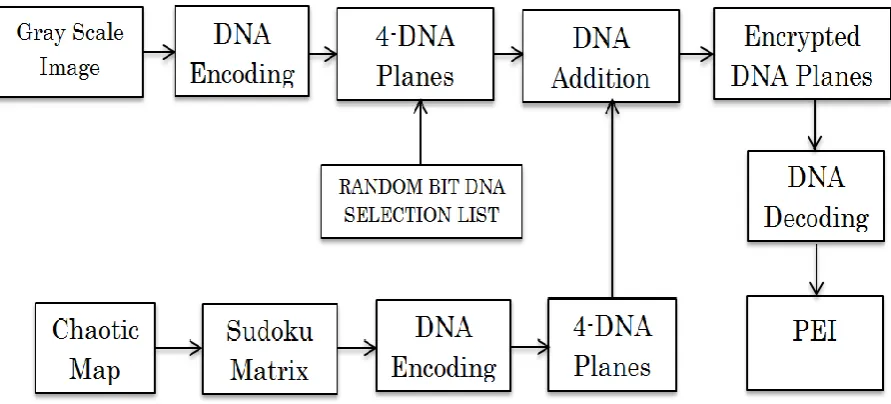
Abstract— Increasing need for telemedicine in healthcare industry created a great necessity to secure and transmit the data among medical centres. In this paper, DNA Based Approach for Partial gray scale Image Encryption have been presented. In this algorithm, original gray scale image split into eight binary layers. 4-DNA planes are obtained by applying the 4-DNA encoding process for original gray scale image. Based on the chaotic map sudoku like random image is generated. Random image also undergo DNA encoding process to produce 2 DNA sequence based bit planes. According to random bit plane selection table, select a 2-DNA planes and perform a DNA addition with the chaos based 2-DNA planes. Finally apply the DNA decoding process to get the Partial encrypted gray scale images. Simulation result shows that the proposed algorithm suitable for the medical information security.
Keywords— Partial image encryption (PIE), chaotic map, DNA addition
I. INTRODUCTION
With increasing use of computers leads to an increasing tendency to security and image fidelity verification. Transmitted images may have different applications, such as commercial, military and medical applications. So it is necessary to encrypt image data before transmission over the network to preserve its security and prevent unauthorized access. For example military and law enforcement applications require full encryption. Nevertheless, there is a large spectrum of applications that demands security on a lower level, as for example that ensured by partial encryption (PE) or selective encryption (SE). Such approaches reduce the computational requirements in networks with diverse client device capabilities. In several papers, the distinction between selective encryption (SE), partial encryption (PE) and soft encryption is not very clear. The goal of PE of an image is to encrypt only regions of interest (ROI) which are defined within specific areas of the image. The goal of SE is to encrypt a well-defined range of parameters or coefficients.
Chen’s Hyper-chaotic map in this image cipher. sara tedmori etc.al [5] explained a lossless symmetric key encryption based on the harr wavelet transform. image is tranformed into the frequency domain and important subbands are encrypted. this algorithm is designed to shuffle and reverse the sign of each frequency in the transformed image before the image frequencies are transformed back to the pixel domain. qiang zhang etc.al [11] presented a new image encryption based on DNA encoding combined with chaotic system. The algorithm uses chaotic system to disturb the pixel locations and pixel values and then DNA encodings according to quaternary code rules are carried out. At last the image encryption through DNA decoding is achieved. sukalyan som and sayani sen presented [4] a Non-adaptive Partial Encryption of Grayscale Images Based on Chaos. here original grayscale image into its corresponding binary eight bit planes then encrypted using couple tent map based pseudorandom binary number generator (PRBNG). Panuranga H T etc.al [2] all presented a partial image encryption for smart camera to increase the smartness of camera. this algorithm uses hill cipher and control the amount of encryption. Qiang zhang et.al introduced a [12] explained a novel image encryption based on DNA encoding combined with chaotic system is proposed. The algorithm uses chaotic system to disturb the pixel locations and pixel values and then DNA encodings according to quaternary code rules are carried out. The pseudo DNA operations are controlled by the quaternary chaotic sequences. At last the image encryption through DNA decoding is achieved. xingyuan etc.al [6] explained a (6)cryptanalysis on an image encryption based on Chebyshev chaotic map. This algorithm evaluate the following : (1) chosen plaintext attack break the scheme. (2) there exist equivalent keys and wea keys for the encryption scheme . (3) The scheme has low sensitivity to the changes of plain image. Panduranga H T etc.al [3] explains the partial image encryption using block wise shuffling and chaotic map. original image divided into several macro blocks and according chaotic sequence, pixels within the macro blocks are shuffled. The rest of this paper is organized as follows. Section IIexplains the basic theory for DNA encoding and addition. Section III briefly explain the concept of chaotic map. Section III-A describes the proposed partial encryption algorithm. The security of the scheme is evaluated in Section IV. Experimental results described in section V. Section VI concludes the paper.
II. DNA THEORY
A. DNA encoding
DNA computing is a form of computing which uses DNA, biochemistry and molecular biology, instead of the traditional silicon-based computer technologies. DNA computing, or more generally, bimolecular computing, is a fast developing interdisciplinary area. With the rapid development of DNA computing, the researchers presented many biological operations and algebra operations based on DNA sequence. Single-strand DNA sequence is composed by four bases, they are A, C, G and T, where A and T are complement to each other, so are C and G. In the modern theory of electronic computer, all information is expressed by binary system. But in DNA coding theory, information is represented by DNA sequences. So we use binary numbers to express the four bases in DNA sequence and two bits binary number to represent a base. In the theory of binary system, 0 and 1 are complementary, so we can obtain that 00 and 11, 01 and 10 are also complementary. We can use 00, 01, 10 and 11 to express four bases and the number of coding combination kinds is 4! = 24. Due to the complementary relation between DNA bases, there are only eight kinds of coding combinations that satisfy the principle of complementary base pairing in 24 kinds of coding combinations. Table 1 gives eight encoding rules: Example: The binary pixel value of an image is [00111010], so the corresponding DNA sequence is [ATGG] according to the first encoding rule, similarly according to the seventh decoding rule, the decoding sequence is [11001010]. In the proposed algorithm, we put the eight encoding and decoding rules mapped to the eight sub-region of (0,1), and using the seed generated by random number to choose different rules
B. The addition and subtraction operation of DNA sequence
III.CHAOTIC MAP
An important step in any digital chaotic encryption is the selection of the map. Chaotic maps have different behavior regarding complexity, chaotic properties cycle length, chaotic interval, periodic windows, etc., sensitivity to initial conditions and reaction to trajectory perturbations, etc., that influence the structure or behavior of the chaotic encryption system. In fact, some systems have been broken for not considering the weaknesses of the chosen chaotic map and efficiency, it is desirable to provide some independency between the cryptosystem and the chaotic map under consideration. This independency means that, a full knowledge of the selected chaotic map is not needed to fulfill the security and efficiency requirements of a good cryptosystem. For their mathematical simplicity there are two options: logistic map and tent map. The logistic map is represented by
The logistic map chaotic signal used has primary values of X0 2 [0; 1] and r€[3:57; 4].
IV.PROPOSED METHODOLOGY
Algorithm DNA Encoding process: 1: Consider Gray image I of any size mxn.
2: Pick up each input image pixel and converted into 8-bit binary values. 3: Divide 8-bit binary values into four bit-pairs.
4: Assign a DNA pattern for each two bits pairs. 5: Resultant sequence is DNA sequence.
Algorithm 2 DNA Decoding process: 1: Consider DNA sequence based matrix.
2: Pick each character and converted into 2-bit binary values to obtain a binary sequence.
3: Take 8-bit binary values at a time in binary sequence and convert it into a decimal value to obtain 1D array. 4: Convert 1D array into 2D matrix to get resultant encrypted image.
V. RESULT Information entropy analysis:
In information theory, entropy is the most significant feature of disorder, or more precisely unpredictability. To
calculate the entropy H(X) of a source x, we have:
……….2
where X denotes the test image, xi denotes the ith possible value in X, and Pr(xi) is the probability of X =xi, that
is, the probability of pulling a random pixel in X and its value is xi. For a truly random source emitting 2N
symbols, the entropy is H(X)=N. therefore, for a ciphered image with 256 gray levels, the entropy should ideally
be H(X)=8. If the output of a cipher emits symbols with entropy less than 8, there exists certain degree of
predictability, which threatens its security.
Mean Square Error:
Mean squared error (MSE) is defined as an average of the square of the difference between actual
image and encrypted image. The MSE is given by the equation
Where x (i, j) represents the original image and y (i, j) represents the encrypted image and i and j are the pixel
position of M x N image.
MSE is zero when x (i, j) =y (i, j).
Number of Pixel Change Rate (NPCR)”
If C1 and C2 are original image and encrypted image respectively. C1 (i, j) and C2 (i, j) are original image
pixel and encrypted image pixel respectively. The NPCR is then defined as,
X 100%...4
Where, D is bipolar array.
D (i, j) =
Peak Signal to Noise Ratio (PSNR):
The peak signal to noise ratio is evaluated in decibels and is inversely proportional to MSE. It is
given by the equation
………..5
Unified average changed intensity (UACI):
It is used measure the intensity rate difference between the original image and encrypted image.
……….6
If C1 and C2 are original image and encrypted image respectively. C1 (i, j) and C (i , j) are original image
pixel and encrypted image pixel respectively.
Universal Image Quality Index (UIQ):
The UIQ indicates the structural similarity between two images. The UIQ lies between [-1, 1] and the value closer to 1, the greater similarity in the images. Mathematically, UIQ is defined as in [7].
Structural Similarity Index Measure (SSIM):
From the Table-IV to Table-VI, we can observed that, amount of encryption varies as the changing of a bit planes varies. By changing the bit plane, we can control the amount of encryption as per our requirements and also for a lower bit plane changes, amount of encryption is very less and for a higher bit planes changes, amount of encryption is more.
VI.CONCLUSIONS
In this paper, DNA Based Approach for Partial Gray scale Image Encryption have been presented. In this algorithm, original Gray scale image split into eight binary layers. 4-DNA planes are obtained by applying the DNA encoding process for original Gray scale image. From the experimental results, we conclude that amount of encryption varies as the changing of the bit plane varies. This type of method useful in the medical information security, because small amount of encryption enough to secure the medical data and also reduces the computational cost. FPGA architecture of proposed algorithm can be used in the smart cameras.
R
EFERENCES
[1] Jawad Ahmad and Fawad Ahmed. Efficiency analysis and security evaluation of image encryption schemes. computing, 23:25, 2012.
[2] SK Naveenkumar, HT Panduranga, and Kiran. Partial image encryption for smart camera. In Recent Trends in Information Technology (ICRTIT), 2013 International Conference on, pages 126–132. IEEE, 2013.
[3] HT Panduranga, SK Naveenkumar, and Kiran. Partial image encryption using block wise shuffling and chaotic map. In Optical Imaging Sensor and Security (ICOSS), 2013 International Conference on, pages 1–5. IEEE, 2013.
[4] Sukalyan Som and Sayani Sen. A non-adaptive partial encryption of grayscale images based on chaos. Procedia Technology, 10:663–671, 2013.
[5] Sara Tedmori and Nijad Al-Najdawi. Image cryptographic algorithm based on the haar wavelet transform. Information Sciences, 269:21–34, 2014.
[6] Xingyuan Wang, Dapeng Luan, and Xuemei Bao. Cryptanalysis of an image encryption algorithm using chebyshev generator. Digital Signal Processing, 25:244–247, 2014.
[9] Zhou Wang, Alan C Bovik, Hamid R Sheikh, and Eero P Simoncelli. Image quality assessment: From error visibility to structural similarity. Image Processing, IEEE Transactions on, 13(4):600–612, 2004.
[10] Yue Wu, Yicong Zhou, Sos Agaian, and Joseph P Noonan. A symmetric image cipher using wave perturbations. Signal Processing, 102:122–131, 2014.
[11] Qiang Zhang, Ling Guo, and Xiaopeng Wei. Image encryption using dna addition combining with chaotic maps. Mathematical and Computer Modelling, 52(11):2028–2035, 2010.
[12] Qiang Zhang, Ling Guo, and Xiaopeng Wei. Image encryption using dna addition combining with chaotic maps. Mathematical and Computer Modelling, 52(11):2028–2035, 2010.