What can we learn from GRBs?
MarcoMuccino1,2,�,RemoRuffini1,2,3,4,YerlanAimuratov1,3,Laura M.Becerra1,2,Carlo L.Bianco1,2,MileKarlica1,3, Milos Kovacevic1,3, Julio D. Melon Fuksman1,2, Rahim Moradi1,2, Ana V. Penacchioni5,6, Giovanni B. Pisani1,2, Daria Primorac1,2, Jorge A. Rueda1,2,4, Soroush Shakeri2,7, Gregory V. Vereshchagin1,2, She-Sheng Xue1,2, and YuWang1,2
1Dip. di Fisica, Sapienza Università di Roma, Piazzale Aldo Moro 5, I-00185 Rome, Italy 2ICRANet-Pescara, Piazza della Repubblica 10, I-65122 Pescara, Italy
3Université de Nice Sophia-Antipolis, Grand Château Parc Valrose, Nice, CEDEX 2, France
4ICRANet-Rio, Centro Brasileiro de Pesquisas Fisicas, Rua Dr. Xavier Sigaud 150, Rio de Janeiro, RJ, 22290-180, Brazil 5University of Siena, Dept. of Physical Sciences, Earth and Environment, Via Roma 56, I-53100 Siena, Italy
6ASI Science Data Center, via del Politecnico s.n.c., I-00133 Rome Italy 7Department of Physics, Isfahan University of Technology, 84156-83111, Iran
Abstract.We review our recent results on the classification of long and short gamma-ray bursts (GRBs) in different subclasses. We provide observational evidences for the binary nature of GRB progenitors. For long
bursts the induced gravitational collapse (IGC) paradigm proposes as progenitor a tight binary system composed of a carbon-oxygen core (COcore) and a neutron star (NS) companion; the supernova (SN) explosion of the COcore triggers a hypercritical accretion process onto the companion NS. For short bursts a NS–NS merger is traditionally adopted as the progenitor. We also indicate additional sub-classes originating from different
progenitors: (COcore)–black hole (BH), BH–NS, and white dwarf–NS binaries. We also show how the outcomes of the further evolution of some of these sub-classes may become the progenitor systems of other sub-classes.
1 Introduction
Gamma-ray bursts (GRBs) are traditionally classified based on their duration [1–5]: short GRBs last2 s, while long GRBs last2 s.
Thanks to the extensive data collected byγ-ray tele-scopes, such as AGILE, BATSE, BeppoSAX, Fermi,
HETE-II, INTEGRAL, Konus/WIND and Swift, to more
sofisticated time-resolved spectral analyses, and to the the-oretical treatment of the fireshellmodel [6–8] it has be-come evident that both long and short bursts originate from binary progenitors and that they can be further subdivided into a variety of sub-classes, depending on the evolution of these binary systems [9–11].
Short bursts are associated to NS-NS or BH-NS merg-ers [12–22]: their host galaxies are of both early- and late-type, their localization with respect to the host galaxy of-ten indicates a large offset [23–29] or a location of mini-mal star-forming activity with typical circumburst medium (CBM) densities of∼10−5–10−4cm−3, and no supernovae
(SNe) have ever been associated to them.
Long bursts have been traditionally associated to the death of single massive stars [30]. The large majority of long bursts is related to SNe and are spatially corre-lated with bright star-forming regions in their host galaxies [31, 32] with a typical CBM density of∼1 cm−3[33, 34].
However, the above single progenitor model contrasts with �e-mail: [email protected]
the fact that most massive stars are found in binary systems [35], that most type Ib/c SNe occur in binary systems [36] and that SNe associated to long GRBs are indeed of type Ib/c [37]. Indeed, recently we have found evindence for multiple components in long GRB emissions evidencing the presence of a precise sequence of different astrophysi-cal processes [33, 34], which led to the formulation of the Induced Gravitational Collapse (IGC) paradigm [6, 38– 40] expliciting the role of binary systems as progenitors of the long GRBs. The IGC paradigm explains the GRB-SN connection by proposing as progenitors (orin-state) a tight binary system composed of a carbon-oxygen core (COcore)
undergoing a SN explosion and a companion neutron star (NS) [39–41]. The SN explosion triggers hypercritical ac-cretion onto the companion NS [39, 40, 42].
Recent observations of a prolonged 0.1–100 GeV high energy emission by theFermi-LAT instrument evidenced its correlation with both long [9] and short bursts [10] with isotropic energyEiso 1052erg. On the basis of this
corre-lation in such systems with different progenitors, we have identified the onset of the GeV emission with the moment of the formation of a black hole (BH) [9, 10]. This implies that systems with energy Eiso 1052 erg, which do not
exhibit GeV emission, do not form BHs.
- X-ray flashes (XRFs) with Eiso 1052 erg and
rest-frame spectral peak energy Ep,i 200 keV. These
sys-tems, already pioneered in a different context [43–45], originate in widely separated COcore–NS binaries with
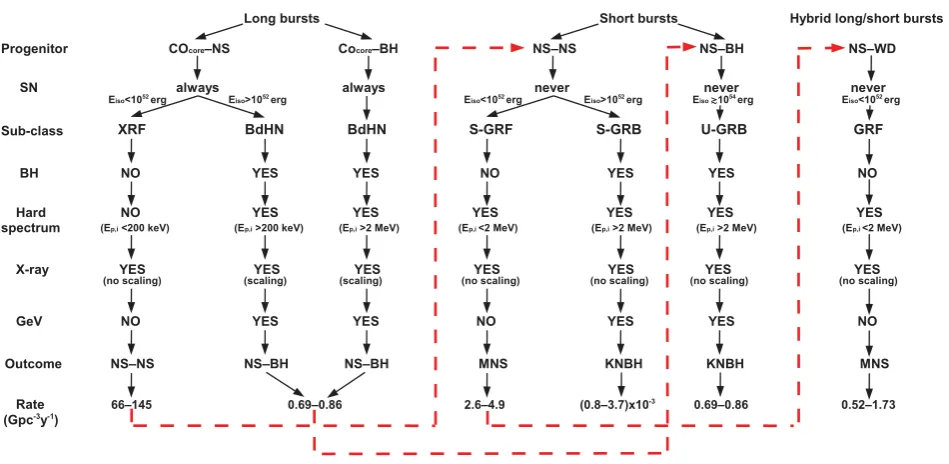
an orbital separation a > 1011 cm [41], therefore the hypercritical accretion onto the NS companion is insuf-ficient to induce gravitational collapse to a BH [39–41] and, therefore, as expected in our theory no GeV emis-sion is observed. The outcomes (orout-states) of XRFs are binaries composed of a new NS (νNS) produced from the SN explosion, and a massive NS (MNS) which accreted matter from the SN ejecta. Their occurrence rate isρXRF=100+−4534Gpc−3yr−1[42] (see figure 1).
- Binary-driven hypernovae (BdHNe) with Eiso
1052 erg andE
p,i 200 keV. BdHNe occur in tighter
binaries (a < 1011 cm), where the hypercritical accre-tion onto the companion NS leads to the formaaccre-tion of a BH [41] and, therefore, to the emission of the associ-ated prolonged GeV emission (observable when inside the LAT field of view). Specific constant power-law be-haviors are observed in their high energy GeV and X-rays luminosity light curves [9, 46, 47]. The out-states of BdHNe areνNS-BH binaries [41, 42, 48, 49]. The BdHN occurrence rate is ρBdHN = 0.77−+00..0908 Gpc−3yr−1
[42] (see figure 1).
For progenitor system composed of a COcore in binary
with an already formed BH [8, 42], leading to bursts with Eiso 1054erg andEp,i2 MeV, the observational
iden-tification is still pending. In these systems, which corre-spond to the late evolutionary stages of X-ray binaries as Cyg X-1 and Cyg X-3 [50], or microquasars [51], the hy-percritical accretion produces, asout-states, a more mas-sive BH and aνNS. Their occurrence rate can contribute to that of BdHNe, being COcore–BH a particular case of
BdHN progenitors (see figure 1).
In total analogy, the formation of a BH can occur in short bursts, depending whether or not the mass of the merged core of the binary system exceeds the NS criti-cal mass. For NS–NS binaries, which are the outcomes of XRFs, we have [10, 42, 48]:
- Short gamma-ray flashes (S-GRFs), withEiso1052erg
and Ep,i 2 MeV. They occur when the merged core
does not exceed the NS critical mass and does not collapse into a BH, but still remains as a MNS with some additional orbiting material to guarantee the an-gular momentum conservation. As a consequence, no GeV emission is expected from these systems and, in-deed, is not observed. The S-GRF occurrence rate is ρS−GRF =3.6−+11..40Gpc−3y−1[42] (see figure 1).
- Authentic short GRBs (S-GRBs) with Eiso 1052 erg
and Ep,i 2 MeV. They occur when a BH is formed
in the NS–NS merger. Thus, these systems exhibit GeV emission. Their occurrence rate isρS−GRB =1.9+−11..81
×
10−3Gpc−3y−1[42] (see figure 1).
We have recently proposed the existence of ultra-short GRBs (U-GRBs), a new hybrid sub-class of (yet unob-served) short bursts originating from the BdHNe out-states (νNS–BH binaries), which remain bound nearly in 100%
of the cases [48]. These systems represent a yet unac-counted family of merging NS-BH binaries in the cur-rent standard population synthesis analyses [48], there-fore, including other possible channels of formation for NS-BH binaries, the lower limit of the U-GRB occur-rence rate can be assumed equal to the BdHN rate, i.e., ρU−GRB0.77−+00..0908Gpc−3yr−1[42] (see figure 1).
Finally, we proposed another sub-class of sources orig-inating in NS–WD mergers: gamma-ray flashes (GRFs), a class of long GRBs occurring in a CBM environment with low density, e.g.,∼ 10−3 cm−3, typical of the halos of the
GRB host galaxies [42, 52, 53], not associated with SNe [54], and characterized by the presence of a macronova emission in the optical afterglow [55]. GRFs have 1051
Eiso1052erg and 0.2Ep,i2 MeV and, therefore, the
NS–WD merger forms a MNS and not a BH [42]. NS–WD binaries, are notoriously very common astrophysical sys-tems [56] and their possible formation channels have been studied [57, 58]; as proposed in Ref. [42], another less likely but yet possible channel of formation is the merger of a NS–WD binary produced from an S-GRF. The GRF rate of occurrence isρGRF =1.02−+00..7146Gpc−3y−1[42] (see
figure 1).
In all the above systems, the 1052erg limit is clearly a
function of the yet unknown precise value of the NS crit-ical mass. As already pointed out in Ref. [42] the direct observation of the separatrix energy between S-GRFs and S-GRBs, and also between BdHNe and XRFs, gives fun-damental informations for the determination of the actual value of maximum NS mass and for the minimum mass of the newly-formed BH.
In this paper we review the latest observational and theoretical results which led to above burst classification scheme. In Section 2, we briefly summarize the fireshell model. In Section 3, we describe the observational prop-erties of XRFs and BdHNe and their interpretation within the IGC paradism. In Section 4, we focus on the S-GRBs and specially on the theoretical interpretation of their GeV emission. In Section 4, we summarize our Conclusions.
2 The fireshell model
Before going into details in the observational and theoret-ical description of XRFs, BdHNe, S-GRFs and S-GRBs, we briefly summarize the fireshell model which is at the basis for the above classification of all bursts.
In the fireshell model [6–8], the GRB emission orig-inate from an optically thicke+e− plasma of total energy Etot
e+e−– the fireshell. Its expansion and self-acceleration is due to the graduale+e−annihilation [59]. Even after en-gulfing the baryonic massMBleft over by the progenitor
!"!"!"!"
!"!"!"!"!"!" #$
% !"!"!"!"!"!"!"
&'!"!"!"!"
$())(
*++,-./0+1/02+30+-014/0250678,/ 5/0+1/02+/0.3,065
4&# 5 ,7
" 9,/.3" :,/.3
4"#;93//<'74"#;:3//<'74"#;:3('74"#;93('74"#;:3('74"#;:3('74"#;93('7
%*= &*= &*> &*&*=
4 74 74 74 74 74 74 7
" 9,/.3" :,/.3" ,/.-" 9,/.3
Figure 1. Summary of the properties of the burst sub-classes discussed in the Introduction. The red dashed lines indicate the evolu-tionary tracks linking out-states and in-states of some of the sub-classes. Additional details can be found in Ref. [42].
[10, 63]; in the case of an axially symmetric dyadotorus, the resulting P-GRB spectrum is a convolution of thermal spectra of different temperatures which resembles more a power-law spectral energy distribution with an exponential cutoff[64, 65].
After transparency, the accelerated baryons propagate through and interact in fully radiative regime with the CBM, giving rise to the prompt emission [7]. The struc-tures observed in the prompt emission of a GRB depend on the CBM densitynCBM and its inhomogeneities [66–
68]. In both long and short bursts the CBM clouds have similar masses (1022–1024g), sizes (≈1015–1016cm), and
typical distances from the BH (≈ 1016–1017cm) [10, 33].
The observed prompt emission spectrum results from the convolution of a large number of comoving spectra with decreasing temperatures and Lorentz and Doppler factors, due to each collision with the CBM, over the surfaces of constant arrival time for photons at the detector [69, 70] over the entire observation time.
To conclude, the evolution of an optically thick baryon-loaded pair plasma, is generally described in terms of Etot
e+e− andBand it is independent of the way the pair plasma is created. This general formalism can also be applied to any optically thicke+e− plasma, like the one created viaν¯ν↔ e+e−mechanism in a NS merger as
de-scribed in [17, 71, 72].
3 XRFs and BdHNe in the IGC paradigm
We here focus on the comparison between XRF and BdHN sub-classes within the IGC paradigm, giving a special at-tention to the latest theoretical results on the BdHNe.
In the IGC scenario, both XRFs and BdHNe origi-nate in the hypercritical accretion process of the SN ejecta onto the NS binary companion. In this phenomenon
pho-tons are trapped in the accreting material and the accretion energy is lost through a large associated neutrino emis-sion [39, 40, 73, 74]. In the XRFs, the COcore-NS
bi-nary is widely separated (a 1011 cm), thus the
accre-tion rate<10−2M
�s−1can only push the binary compan-ion NS to become a MNS. The resulting emisscompan-ion, dubbed Episode 1, lasts∼ 102–104 s. Its spectrum is
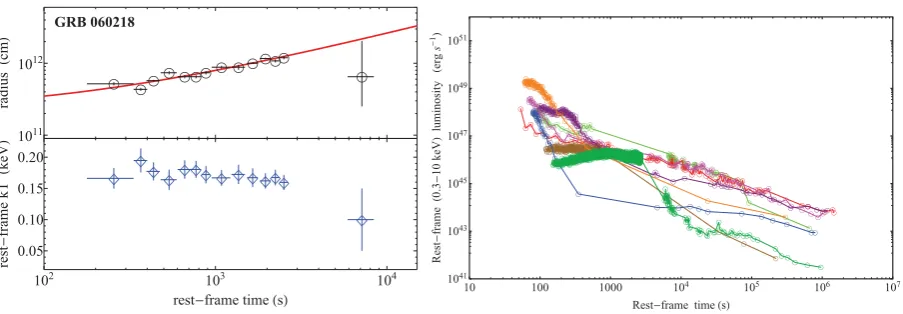
character-ized by: 1) a thermal component spectrum with tempera-tures in the range of 0.1–2 keV and corresponding radii of 1010–1012cm (see figure 2, left-panel), possibly
originat-ing from the outflow within the NS atmosphere driven out by Rayleigh-Taylor convection instabilities [40], and 2) a power-law component, possibly related to the excess of angular momentum of the system which necessarily leads to a jetted emission [41]. The long lasting X-ray emission does not exhibit any specific common late power-law be-havior (see figure 2, right panel) and can be explained by the emission of the SN ejecta shocked by the hypercriti-cal accretion emission of the XRF. This energy injection into the SN ejecta leads to the occurrence of a broad-lined SN Ic [75] with a kinetic energy larger than that of the traditional SNe Ic [42]. The absence of GeV emissions is implicit in the nature of the hypercritical accretion process not leading to a BH. Of course, all XRFs at redshiftz1 exhibit an optical SN with a luminosity similar to the one of SN 1998bw [76], which occurs after 10–15 days in the source cosmological rest-frame.
In the IGC paradigm, the shorter the COcore-NS binary
period, the larger the accretion rate and the values ofEiso
andEp,i, and correspondingly the shorter the prompt
emis-sion duration [41]. Indeed, in BdHNe the COcore-NS
bi-nary is more tightly bound (a1011cm) and the accretion
rates of the SN ejecta can be 10−2–10−1 M
1011 1012 radius cm
102 103 104
restframe times
0.05 0.10 0.15 0.20 rest frame kT keV GRB 060218
10 100 1000 104 105 106 107 1041 1043 1045 1047 1049 1051
Restframe times
Rest frame 0.3 10 keV luminosity erg s 1
Figure 2. Left panel: the evolution of the radius of the thermal component detected in GRB 060218 (black circles) and its linear fit (solid red curve) and of the corresponding frame temperature (blue diamonds). Reproduced from Ref. [77]. Right panel: rest-frame X-ray 0.3–10 keV luminosity light curves of selected XRFs: 050416A (red), 060218 (dark green), 070419A (orange), 081007 (magenta), 100316D (brown), 101219B (purple), and 130831A (green).
this reason BdHNe exhibit a more complex structure than XRFs composed of distinct Episodes.
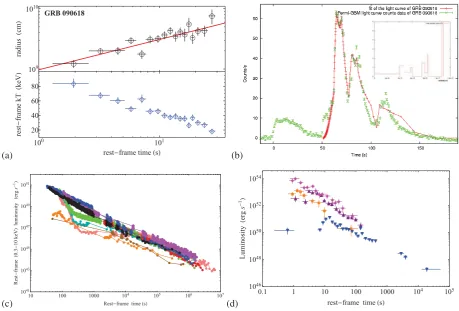
- Episode 1in BdHNe, like in the case of XRFs, also orig-inates in the hypercritical accretion process. The corre-sponding spectrum again exhibits: 1) an expanding ther-mal component with a decreasing temperature, typical radii of 109–1010cm and an average expansion speed of
∼108–109cm s−1(see figure 3 (a)), and b) a power-law
function [33, 34, 78].
- Episode 2corresponds to theγ-ray prompt emission of an authentic long GRB (see figure 3 (b)), stemming from the collapse of the companion NS to a BH and leading to the vacuum polarization process and the creation of an e+e− plasma. The analysis of the P-GRB emission indicates that BdHNe have a baryon load ofB≈10−4–
10−2and at transparency they reach a Lorentz factor of
Γ = 102–103. The prompt emission is produced by the interaction of the fireshell with the CBM clouds located at∼1016–1017cm from the burst site with average
num-ber density of∼1 cm−3[33, 78].
- Episode 3 occurs after the prompt emission in the X-rays. It composed of a steep decay characterized by the presence of an early X-ray flare, a plateau and a late power-law decay which we refer as to the after-glow. These three components are dubbed flare-plateau-afterglow (FPA) phase [79]. During the early X-ray flare phase (typically at a rest-frame time of∼ 102 s)
an expanding thermal component has been observed in its spectrum [9, 47, 79]. The inferred radii are typically
∼ 1012–1013 cm and they expand at mildly relativistic
speed with Γ 4 [9, 47, 78, 79]. The size of the cor-responding emitting region is clearly incompatible with the radii inferred from Episodes 1 and 2. When com-puted in the source cosmological rest-frame, the plateau and the late power-law decay exhibit new features (see figure 3 (c)): 1) the overlapping of the afterglow phases, which have typical slopes of−1.7α−1.3 and show a characteristic common power-law behavior [46]; the nested property, which shows that the duration (the
lu-minosity) of the plateau phase is inversely (directly) pro-portional to the energy of the GRB emission, i.e., the more energetic the source, the smaller (higher) the du-ration (the luminosity) of the plateau [47]. The use of the overlapping of the afterglows as a distance indica-tor has been explored by inferring the redshifts of GRB 101023 [34], and has been applied to predict the occur-rence of the SN associated to GRB 130427A before its discovery [80], later confirmed by the observations [81– 84]. In the IGC scenario, the FPA originates from the SN ejecta [9, 79]. In BdHNe the SN ejecta experiences an energy injection from GRB emission leading to the occurrence of a broad-lined SN Ic [75] with a kinetic energy larger than that of the traditional SNe Ic. This energy injection results in an isotropic energy emission of 1051–1052 erg for the FPA phase. In particular, the
X-ray flare can be modeled by considering the impact of the GRB on the SN ejecta and the propagation of the optically thick e+e− plasma into a medium largely
baryon-contaminated (B ≈ 10–102). A numerical
inte-gration starting at 1010cm all the way to 1012cm, where
the transparency is reached, gives a perfect agreement between the radius of the emitter at transparency and the observations, as well a coincidence of the observed time of the peak emission of the flare [79]. The plateau and the afterglow phases are still under study (M. Karlica et al., in preparation).
- Episode 4 corresponds to the optical SN emission ob-servable in all BdHNe atz1 after≈10–15 days in the cosmological rest-frame. All these SNe have a standard luminosity similar to the one of SN 1998bw [76]. - Episode 5 is identified with the distinctive long-lived
ob-servable only after the transparency emission, i.e., the P-GRB [42].
4 The S-GRBs in the NS–NS merger
paradigm
In Section 1 we discussed the rates of GRFs and S-GRBs, showing that S-GRFs are the most frequent events among the short bursts. This result is also in good agreement with the NS–NS binaries observed within our Galaxy: only a subset of them has a total mass larger than the NS critical massMNS
critand can form a BH in their
merg-ing process [10] if we assume that MNS
crit = 2.67M�for a
non-rotating, globally neutral NS within the NL3 nuclear model [87]. In this light S-GRBs are very important for inferring constraints onMNS
crit, on the NS equation of state,
and on the minimum mass of the newly-formed BH. To date, within the fireshell model we have analized five authentic S-GRBs: 090227B [63], 140619B [10], GRB 090510 [64], 081024B and 140402A [65]. The analyses of the P-GRB emission and the correlation be-tween the spikes of the prompt emission and CBM inho-mogeneities gave the most successful test for the fireshell model. S-GRBs share some remarkable analogies but also some differences with BdHNe in view of the simplicity of the underlying physical system of S-GRBs, which unlike the BdHNe, do not exhibit any of the extremely complex activities related to the SN (see Section 3).
- Episode 1here is related to the NS–NS merger activity before the gravitational collapse into a BH and possibly corresponds to faint precursors observed in some short bursts [64, 88]. Because of the compactness of the sys-tems this process at times is not observable.
- Episode 2 corresponds to the GRB emission from the NS-NS merger. Within the fireshell model it is com-posed of the P-GRB, which occur before the onset of the GeV emission, and the prompt emission (see figure 4, left panel). From the analysis of their P-GRB emis-sion, all S-GRBs have a standard values of the baryon load (B≈5×10⁻⁵), which is consistent with the crustal
masses of NS-NS mergers [10, 89], and of the Lorentz factors at the transparencyΓ ≈ 104[10, 63–65]. From the fit of the prompt emission (see figure 4, right panel), it came out that S-GRBs occur in a standard CBM with average density�nCBM� ≈10−5cm−3[10, 63–65], which
is typical of galactic halos where NS–NS mergers mi-grate, owing to natal kicks imparted to the binaries at birth [22].
- Episode 3, which corresponds to the traditional X-ray afterglow, differs from that of BdHNe which results from the interaction between the GRB and the SN ejecta. Work on this topic is still ongoing.
- Episode 4, identified with the optical emission of a SN, is here missing.
- Episode 5coincides with the GeV emission turning on soon after the P-GRB and being coeval with the prompt emission. With the exception of GRB 090227B, which was outside the nominalFermi-LAT field of view [86],
all S-GRBs consistently exhibit this emission, which ap-pears to be strictly correlated to that observed in the BdHNe. Since the presence of a BH is the only com-monality between BdHNe and S-GRBs, by analogy we assume that the GeV emission originate from the activ-ity of the newly-born BH produced in the merger [10]. The rest-frame 0.1–100 GeV luminosity light curves of all S-GRBs with LAT data follow a common power-law behavior with the rest-frame time which goes as t−1.29±0.06(see dashed black line in figure 5).
Table 1 lists the redshift, Ep,i, Eiso (in the rest-frame
energy band 1–10000 keV), and the GeV isotropic emis-sion energyELAT (in the rest-frame energy band 0.1–100
GeV) of all S-GRBs. The values ofELAT represent lower
limits to the actual GeV isotropic emission energies, since at late times the observations of GeV emission could be prevented due to instrumental threshold of the LAT. Using the maximum GeV photon observed energyEmax
GeVlisted in
table 1, we derive a lower limit on the Lorentz factor of the GeV emissionΓminGeVby requiring the optically thin condi-tion to the high energy photons [90]. For each S-GRB we estimate lower limits in each time interval of the GeV luminosity light curves in figure 5. Then,ΓminGeVfor each S-GRB has been then determined as the largest among the inferred lower limits. It follows that the GeV emission is produced by an ultrarelativistic outflows withΓminGeV300 (see table 1).
We propose that the GeV emission in S-GRBs is pro-duced by accretion onto the new-born BH of a certain amount of mass that remains bound to it because of the conservation of energy and angular momentum from the merger moment to the BH birth [64]. Lower limits on the amount of accreted mass can be attained by consid-ering the accretion process onto a maximally rotating Kerr BH. Depending whether the infalling material is in co- or counter-rotating orbit with the spinning BH, the maximum efficiency of the conversion of gravitational energy into ra-diation isη+=42.3% orη−=3.8%, respectively [91] and, therefore,ELATcan be expressed as
ELAT= fb−1η±Maccη±c2, (1)
where fb is the beaming factor which depends on the
ge-ometry of the GeV emission, andMη±
accis the amount of
ac-creted mass depending on the choice of the efficiency. The observational evidence that the totality of S-GRBs exhibit GeV emission and that its absence is due instrumental ab-sence of alignment between the LAT and the source at the time of the GRB emission suggest no significant beaming. Therefore, in the following we setfb≡1. The
correspond-ing estimates ofMη±
accin our sample of S-GRBs are listed
in table 1.
5 Conclusions
(a) 109 1010 radius cm
100 101
restframe times
20 40 60 80 rest frame kT keV GRB 090618 (b) (c)
10 100 1000 104 105 106 107
1041 1043 1045 1047 1049 1051
Restframe times
Rest frame 0.3 10 keV luminosity erg s 1 (d)
0.1 1 10 100 1000 104 105
1046 1048 1050 1052 1054
restframe times
Luminosity erg s 1
Figure 3. (a) The evolution of the radius of the thermal component detected in the Episode 1 of GRB 090618 (black circles) and its linear fit (solid red curve), and the decay of the corresponding rest-frame temperature (blue diamonds). (b) The fireshell simulation (red line) of the light curve of Episode 2 of the prototype GRB 090618 (green data). The small inset reproduces the CBM profile required for the simulation. Reproduced from Ref. [33]. (c) The rest-frame 0.3–10 keV luminosity light curves of selected BdHNe: 050525 (brown), 060729 (pink), 061007 (black), 080319B (blue), 090618 (green), 091127 (red), 100816A (orange), 111228A (light blue), and 130427A (purple) [79]. (d) The rest-frame 0.1–100 GeV luminosity light curves [86] of selected BdHNe: GRB 080916C (magenta circles), GRB 090902B (purple triangles), GRB 110731A (orange squares), GRB 130427A (blue reversed triangles).
500 2500 250 500 750 1000 counts s 500 2500 250 500 750 counts s 10 1 2 3 counts bin
1 0 1 2 3
tT0s 101
100 energy G eV
NaI-n9 (8-260 keV)
BGO-b1 (0.26-40 MeV)
LAT (0.1-100 GeV)
1.0 0.5 0.0 0.5 1.0 1.5
0 5 10
tT0s
photons
cm
2 s
0.1 1 10 100
1049 1050 1051 1052 1053 1054
restframe times
Rest
frame
0.1
100
GeV
luminosity
erg
s
Figure 5.The rest-frame 0.1–100 GeV isotropic luminosities of the S-GRBs: 081024B (orange empty diamonds), 090510 (gray filled circles), 140402A (red filled squares), and 140619B (green empty squares). All the light curves start after the P-GRB emission. The dashed black line marks the common behavior of all the S-GRB light curves which goes ast−1.29±0.06. Reproduced from Ref. [65].
GRB z Ep,i Eiso EmaxGeV ΓminGeV ELAT Maccη+ Maccη−
(MeV) (1052erg) (GeV) (1052erg) (M
�) (M�) 081024B 3.12±1.82 9.56±4.94 2.64±1.00 3 779 2.79±0.98 0.04 0.41
090227B 1.61±0.14 5.89±0.30 28.3±1.5 – – – – –
090510 0.903±0.003 7.89±0.76 3.95±0.21 31 551 5.78±0.60 0.08 0.86 140402A 5.52±0.93 6.1±1.6 4.7±1.1 3.7 354 4.5±2.2 0.06 0.66 140619B 2.67±0.37 5.34±0.79 6.03±0.79 24 471 2.34±0.91 0.03 0.35
Table 1.S-GRB properties:z,Ep,i, the maximum GeV photon observed energyEmaxGeV, the minimum Lorentz factor of the GeV emissionΓminGeV,Eiso,ELAT, and the amount of infalling accreting mass co-rotating (counter-rotating) with the BHMη+acc(Maccη−), needed
to explaingELAT.
bursts within the IGC paradigm [6, 38–40], and NS–NS (or NS-BH) binaries for short bursts, as widely accepted and confirmed by strong observational and theoretical ev-idences [12–22]. These paradigms have led to the clas-sification of GRBs in seven different sub-classes (see fig-ure 1). We here focus our attention on the sub-classes of XRFS, BdHNe, S-GRFs and S-GRBs.
In Section 2, we review the fireshell model for GRBs [6–8] and its essential role in order to disentangle the var-ious emission episodes characterizing each of the above sub-classes.
In Section 3, we summarize the commonalities and the differences between the observational properties of XRFs and BdHNe and provide their theoretical interpretation within the IGC paradigm, namely, whether or not the hy-percritical accretion process leads to the formation of a BH.
In Section 4, we outline the properties GRFs and S-GRBs originating in NS–NS mergers leading to a MNS and the formation of a BH, respectively. Then, we fo-cus on S-GRBs and on the key role of the P-GRB iden-tification for their description, as well as the analysis of
the GeV emission. We finally discuss in details the GeV emission uniquely observed in both BdHNe and S-GRBs, when within the Fermi-LAT FoV. In both cases it starts after the P-GRB emission and it is coeval with the occur-rence of the prompt emission [42]. Moreover, the rest-frame 0.1–100 GeV luminosities in BdHNe and S-GRBs share a common luminosity pattern, a precise power-law behavior with time∝t−1.2[9, 10, 42, 65, 85]. These
by requiring the optically thin condition to the high energy photons [90].
From the above consideration and the proposed classi-fication scheme some considerations follow.
- The knowledge of the separatrix energy of 1052 erg,
which discriminates between systems forming or not BHs and on which our classification scheme of GRBs is based, represents an observational constraints on the value of the NS critical massMcrit, certainly in the range
of 2.2–2.7 M�for a non-rotating NS depending on the equations of state [87], and the minimum mass of a BH. This value is consistent and can be derived in BdHNe by considering the hypercritical accretion process onto a NS leading to an energy release in form of neutrinos and photons, given by the gain of gravitational potential energy of the matter accreted in the NS. This includes the change of binding energy of the NS while accreting both matter and angular momentum [42].
- Most noteworthy, the existence of a precise common power-law behavior in the rest-frame 0.1–100 GeV lu-minosities of S-GRBs (see figure 5), following the BH formation, points to a commonality in the mass and spin of the newly-formed BH. This result is explainable with the expected mass of the merging NSs, each one of mass M ≈ 1.3–1.5M�[94], and the above expected range of the non-rotating NS critical mass, leading to a standard value of the BH mass and of its Kerr parameter [10]. - Finally, we discuss the gravitational wave (GW)
de-tectability by advanced LIGO (aLIGO) from S-GRBs. We have already shown that binaries in which each NS has a mass MNS = 1.34 M� = 0.5McritNS produce GW signals which are well below the signal to noise ratio S/N=8 needed for a positive detection by aLIGO: a pos-itive GW detection may occur only for sources located atz 0.14 for the aLIGO 2022+run, a redshift well above that of GRB 090510, to date the closest S-GRB located atz=0.903 [10, 95, 96].
M. M. and J. A. R. acknowledge the partial support of the project N 3101/GF4 IPC-11, and the target program F.0679 0073-6/PTsF
of the Ministry of Education and Science of the Republic of Kazakhstan.
References
[1] E.P. Mazets, S.V. Golenetskii, V.N. Ilinskii, V.N. Panov, R.L. Aptekar, I.A. Gurian, M.P. Proskura, I.A. Sokolov, Z.I. Sokolova, T.V. Kharitonova, As-trophysics and Space Science80, 3 (1981)
[2] J.P. Dezalay, C. Barat, R. Talon, R. Syunyaev, O. Terekhov, A. Kuznetsov, Short cosmic events -A subset of classical GRBs?, inAmerican Institute of Physics Conference Series, edited by W. S. Paciesas & G. J. Fishman (1992), Vol. 265 ofAmerican Insti-tute of Physics Conference Series, pp. 304–309 [3] R.W. Klebesadel, The durations of gamma-ray
bursts, inGamma-Ray Bursts - Observations, Analy-ses and Theories, edited by C. Ho, R.I. Epstein, E.E. Fenimore (Cambridge University Press, 1992), pp. 161–168
[4] C. Kouveliotou, C.A. Meegan, G.J. Fishman, N.P. Bhat, M.S. Briggs, T.M. Koshut, W.S. Paciesas, G.N. Pendleton, ApJ Letters413, L101 (1993)
[5] M. Tavani, ApJ Letters 497, L21 (1998),
arXiv:astro-ph/9802192
[6] R. Ruffini, C.L. Bianco, F. Fraschetti, S.S. Xue, P. Chardonnet, ApJ Letters 555, L117 (2001),
arXiv:astro-ph/0106534
[7] R. Ruffini, C.L. Bianco, F. Fraschetti, S.S. Xue, P. Chardonnet, ApJ Letters 555, L113 (2001),
arXiv:astro-ph/0106532
[8] R. Ruffini, C.L. Bianco, F. Fraschetti, S.S. Xue, P. Chardonnet, ApJ Letters 555, L107 (2001),
arXiv:astro-ph/0106531
[9] R. Ruffini, Y. Wang, M. Enderli, M. Muccino, M. Kovacevic, C.L. Bianco, A.V. Penacchioni, G.B. Pisani, J.A. Rueda, ApJ798, 10 (2015),1405.5723
[10] R. Ruffini, M. Muccino, M. Kovacevic, F.G. Oliveira, J.A. Rueda, C.L. Bianco, M. Enderli, A.V. Penac-chioni, G.B. Pisani, Y. Wang et al., ApJ 808, 190 (2015),1412.1018
[11] R. Ruffini, J.A. Rueda, M. Muccino, G.B. Pisani, Y. Wang, L.M. Becerra, M. Kovacevic, F.G. Oliveira, Y. Aimuratov, C.L. Bianco et al., ArXiv e-prints (2016),1602.02732
[12] J. Goodman, ApJ Letters308, L47 (1986) [13] B. Paczynski, ApJ Letters308, L43 (1986)
[14] D. Eichler, M. Livio, T. Piran, D.N. Schramm, Na-ture340, 126 (1989)
[15] R. Narayan, T. Piran, A. Shemi, ApJ Letters379, L17 (1991)
[16] P. Meszaros, M.J. Rees, ApJ Letters482, L29 (1997),
astro-ph/9609065
[17] S. Rosswog, E. Ramirez-Ruiz, M.B. Davies, MN-RAS345, 1077 (2003),astro-ph/0110180
[18] W.H. Lee, E. Ramirez-Ruiz, D. Page, ApJ Letters
608, L5 (2004),astro-ph/0404566
[19] E. Nakar, Physics Reports 442, 166 (2007),
astro-ph/0701748
[20] A. Endrizzi, R. Ciolfi, B. Giacomazzo, W. Kastaun, T. Kawamura, ArXiv e-prints (2016),1604.03445
[21] M. Ruiz, R.N. Lang, V. Paschalidis, S.L. Shapiro, ApJ Letters824, L6 (2016),1604.02455
[22] E. Berger, Annual Review of A&A 52, 43 (2014),
1311.2603
[23] K.C. Sahu, M. Livio, L. Petro, F.D. Macchetto, J. van Paradijs, C. Kouveliotou, G.J. Fishman, C.A. Mee-gan, P.J. Groot, T. Galama, Nature387, 476 (1997),
arXiv:astro-ph/9705184
[24] J. van Paradijs, P.J. Groot, T. Galama, C. Kouve-liotou, R.G. Strom, J. Telting, R.G.M. Rutten, G.J. Fishman, C.A. Meegan, M. Pettini et al., Nature386, 686 (1997)
[26] E. Troja, A.R. King, P.T. O’Brien, N. Lyons, G. Cusumano, MNRAS 385, L10 (2008),
0711.3034
[27] W. Fong, E. Berger, D.B. Fox, ApJ708, 9 (2010),
0909.1804
[28] E. Berger, New Astron. Rev. 55, 1 (2011),
1005.1068
[29] D. Kopaˇc, P. D’Avanzo, A. Melandri, S. Campana, A. Gomboc, J. Japelj, M.G. Bernardini, S. Covino, S.D. Vergani, R. Salvaterra et al., MNRAS424, 2392 (2012),1203.1864
[30] S.E. Woosley, J.S. Bloom, Annual Review of A&A
44, 507 (2006),astro-ph/0609142
[31] A.S. Fruchter, A.J. Levan, L. Strolger, P.M. Vreeswijk, S.E. Thorsett, D. Bersier, I. Bu-rud, J.M. Castro Cerón, A.J. Castro-Tirado, C. Conselice et al., Nature 441, 463 (2006),
arXiv:astro-ph/0603537
[32] K.M. Svensson, A.J. Levan, N.R. Tanvir, A.S. Fruchter, L.G. Strolger, MNRAS 405, 57 (2010),
1001.5042
[33] L. Izzo, R. Ruffini, A.V. Penacchioni, C.L. Bianco, L. Caito, S.K. Chakrabarti, J.A. Rueda, A. Nandi, B. Patricelli, A&A543, A10 (2012),1202.4374
[34] A.V. Penacchioni, R. Ruffini, L. Izzo, M. Muccino, C.L. Bianco, L. Caito, B. Patricelli, L. Amati, A&A
538, A58 (2012),1112.2970
[35] N. Smith, Annual Review of A&A52, 487 (2014),
1402.1237
[36] N. Smith, W. Li, A.V. Filippenko, R. Chornock, MN-RAS412, 1522 (2011),1006.3899
[37] M. Della Valle, International Journal of Modern Physics D20, 1745 (2011)
[38] R. Ruffini, M.G. Bernardini, C.L. Bianco, L. Caito, P. Chardonnet, M.G. Dainotti, R. Fraschetti, R. Guida, G. Vereshchagin, S. Xue,The Role of GRB 031203 in Clarifying the Astrophysical GRB Sce-nario, inESA Special Publication(2007), Vol. 622 ofESA Special Publication, p. 561,0705.2456
[39] J.A. Rueda, R. Ruffini, ApJ758, L7 (2012)
[40] C.L. Fryer, J.A. Rueda, R. Ruffini, ApJ Letters793, L36 (2014),1409.1473
[41] L. Becerra, F. Cipolletta, C.L. Fryer, J.A. Rueda, R. Ruffini, ApJ812, 100 (2015),1505.07580
[42] R. Ruffini, J.A. Rueda, M. Muccino, Y. Aimu-ratov, L.M. Becerra, C.L. Bianco, M. Kovacevic, R. Moradi, F.G. Oliveira, G.B. Pisani et al., ApJ832, 136 (2016),1602.02732
[43] J. Heise, X-Ray Flashes and X-Ray Counterparts of Gamm-Ray Bursts, inGamma-Ray Burst and Af-terglow Astronomy 2001: A Workshop Celebrating the First Year of the HETE Mission, edited by G.R. Ricker, R.K. Vanderspek (2003), Vol. 662 of Ameri-can Institute of Physics Conference Series, pp. 229– 236,astro-ph/0111246
[44] L. Amati, F. Frontera, J.J.M. in’t Zand, M. Ca-palbi, R. Landi, P. Soffitta, L. Vetere, L.A. Antonelli, E. Costa, S. Del Sordo et al., A&A426, 415 (2004),
astro-ph/0407166
[45] A.M. Soderberg, S.R. Kulkarni, E. Nakar, E. Berger, P.B. Cameron, D.B. Fox, D. Frail, A. Gal-Yam, R. Sari, S.B. Cenko et al., Nature442, 1014 (2006),
astro-ph/0604389
[46] G.B. Pisani, L. Izzo, R. Ruffini, C.L. Bianco, M. Muccino, A.V. Penacchioni, J.A. Rueda, Y. Wang, A&A552, L5 (2013),1304.1764
[47] R. Ruffini, M. Muccino, C.L. Bianco, M. Enderli, L. Izzo, M. Kovacevic, A.V. Penacchioni, G.B. Pisani, J.A. Rueda, Y. Wang, A&A565, L10 (2014),
1404.3946
[48] C.L. Fryer, F.G. Oliveira, J.A. Rueda, R. Ruffini, Physical Review Letters 115, 231102 (2015),
1505.02809
[49] L. Becerra, C.L. Bianco, C.L. Fryer, J.A. Rueda, R. Ruffini, ApJ833, 107 (2016),1606.02523
[50] R. Giacconi, R. Ruffini,Physics and astrophysics of neutron stars and black holes(1978)
[51] I.F. Mirabel, L.F. Rodríguez, Nature392, 673 (1998) [52] L. Caito, M.G. Bernardini, C.L. Bianco, M.G. Dain-otti, R. Guida, R. Ruffini, A&A 498, 501 (2009),
0810.4855
[53] L. Caito, L. Amati, M.G. Bernardini, C.L. Bianco, G. de Barros, L. Izzo, B. Patricelli, R. Ruffini, A&A
521, A80+(2010),1006.4842
[54] M. Della Valle, G. Chincarini, N. Panagia, G. Tagli-aferri, D. Malesani, V. Testa, D. Fugazza, S. Cam-pana, S. Covino, V. Mangano et al., Nature444, 1050 (2006),arXiv:astro-ph/0608322
[55] Z.P. Jin, X. Li, Z. Cano, S. Covino, Y.Z. Fan, D.M. Wei, ApJ Letters811, L22 (2015),1507.07206
[56] M. Cadelano, C. Pallanca, F.R. Ferraro, M. Salaris, E. Dalessandro, B. Lanzoni, P.C.C. Freire, ApJ812, 63 (2015),1509.01397
[57] T.M. Tauris, E.P.J. van den Heuvel, G.J. Savonije, ApJ Letters530, L93 (2000),astro-ph/0001013
[58] P. Lazarus, T.M. Tauris, B. Knispel, P.C.C. Freire, J.S. Deneva, V.M. Kaspi, B. Allen, S. Bogdanov, S. Chatterjee, I.H. Stairs et al., MNRAS 437, 1485 (2014),1310.5857
[59] R. Ruffini, J.D. Salmonson, J.R. Wilson, S.S. Xue, A&A350, 334 (1999),arXiv:astro-ph/9907030
[60] R. Ruffini, J.D. Salmonson, J.R. Wilson, S. Xue, A&A359, 855 (2000),arXiv:astro-ph/0004257
[61] A.G. Aksenov, R. Ruffini, G.V. Vereshchagin, Phys-ical Review Letters99, 125003 (2007),0707.3250
[62] A.G. Aksenov, R. Ruffini, G.V. Vereshchagin, Phys-ical Review D79, 043008 (2009),0901.4837
[63] M. Muccino, R. Ruffini, C.L. Bianco, L. Izzo, A.V. Penacchioni, ApJ763, 125 (2013),1205.6600
[64] R. Ruffini, M. Muccino, Y. Aimuratov, C.L. Bianco, C. Cherubini, M. Enderli, M. Kovacevic, R. Moradi, A.V. Penacchioni, G.B. Pisani et al., ApJ 831, 178 (2016),1607.02400
[66] R. Ruffini, C.L. Bianco, P. Chardonnet, F. Fraschetti, S. Xue, ApJ Letters 581, L19 (2002),arXiv:astro-ph/0210648
[67] R. Ruffini, C.L. Bianco, S.S. Xue, P. Chardon-net, F. Fraschetti, V. Gurzadyan, International Journal of Modern Physics D 13, 843 (2004),
arXiv:astro-ph/0405284
[68] R. Ruffini, M.G. Bernardini, C.L. Bianco, P. Chardonnet, F. Fraschetti, V. Gurzadyan, L. Vitagliano, S.S. Xue,The Blackholic energy: long and short Gamma-Ray Bursts (New perspectives in physics and astrophysics from the theoretical under-standing of Gamma-Ray Bursts, II), inXIth Brazilian School of Cosmology and Gravitation, edited by M. Novello & S. E. Perez Bergliaffa (2005), Vol. 782 of American Institute of Physics Conference Series, p. 42,arXiv:astro-ph/0503476
[69] C.L. Bianco, R. Ruffini, ApJ Letters633, L13 (2005),
arXiv:astro-ph/0509621
[70] C.L. Bianco, R. Ruffini, ApJ Letters620, L23 (2005),
arXiv:astro-ph/0501390
[71] R. Narayan, B. Paczynski, T. Piran, ApJ Letters395, L83 (1992),arXiv:astro-ph/9204001
[72] J.D. Salmonson, J.R. Wilson, ApJ578, 310 (2002),
astro-ph/0203349
[73] Y.B. Zel’dovich, L.N. Ivanova, D.K. Nadezhin, So-viet Astronomy16, 209 (1972)
[74] R. Ruffini, J. Wilson, Physical Review Letters 31, 1362 (1973)
[75] K. Maeda, K. Nomoto, ApJ 598, 1163 (2003),
astro-ph/0304172
[76] T.J. Galama, P.M. Vreeswijk, J. van Paradijs et al., Nature395, 670 (1998)
[77] S. Campana, V. Mangano, A.J. Blustin, P. Brown, D.N. Burrows, G. Chincarini, J.R. Cummings, G. Cusumano, M. Della Valle, D. Malesani et al., Na-ture442, 1008 (2006),arXiv:astro-ph/0603279
[78] R. Ruffini, Black Holes, Supernovae and Gamma Ray Bursts, inThirteenth Marcel Grossmann Meet-ing: On Recent Developments in Theoretical and Experimental General Relativity, Astrophysics and Relativistic Field Theories, edited by K. Rosquist (2015), pp. 242–314
[79] R. Ruffini, Y. Wang, Y. Aimuratov, L. Becerra, C.L. Bianco, M. Karlica, M. Kovacevic, L. Li, J.D. Melon Fuksman, R. Moradi et al., ArXiv e-prints (2017),
1704.03821
[80] R. Ruffini, C.L. Bianco, M. Enderli, M. Muccino, A.V. Penacchioni, G.B. Pisani, J.A. Rueda, N. Sa-hakyan, Y. Wang, L. Izzo, GRB Coordinates
Net-work14526, 1 (2013)
[81] A. de Ugarte Postigo, D. Xu, G. Leloudas, T. Kruehler, D. Malesani, J. Gorosabel, C.C. Thoene, R. Sanchez-Ramirez, S. Schulze, J.P. Fynbo et al., GRB Coordinates Network14646, 1 (2013)
[82] A.J. Levan, A.S. Fruchter, J. Graham, N.R. Tanvir, J. Hjorth, J. Fynbo, D. Perley, S.B. Cenko, E. Pian, Z. Cano et al., GRB Coordinates Network14686, 1 (2013)
[83] A.M. Watson, N. Butler, A. Kutyrev, W.H. Lee, M.G. Richer, C. Klein, O. Fox, J.X. Prochaska, J. Bloom, A. Cucchiara et al., GRB Coordinates Net-work14666, 1 (2013)
[84] D. Xu, A. de Ugarte Postigo, T. Kruehler, D. Malesani, G. Leloudas, J.P.U. Fynbo, J. Hjorth, S. Schulze, P. Jakobsson, Z. Cano et al., GRB Coor-dinates Network14597, 1 (2013)
[85] L. Nava, G. Vianello, N. Omodei, G. Ghisellini, G. Ghirlanda, A. Celotti, F. Longo, R. Desiante, R. Barniol Duran, MNRAS 443, 3578 (2014),
1406.6693
[86] M. Ackermann, M. Ajello, K. Asano, M. Axels-son, L. Baldini, J. Ballet, G. Barbiellini, D. Bastieri, K. Bechtol, R. Bellazzini et al., ApJ Supplement209, 11 (2013),1303.2908
[87] F. Cipolletta, C. Cherubini, S. Filippi, J.A. Rueda, R. Ruffini, Physical Review D92, 023007 (2015),
1506.05926
[88] E. Troja, S. Rosswog, N. Gehrels, ApJ 723, 1711 (2010),1009.1385
[89] R. Belvedere, J.A. Rueda, R. Ruffini, Journal of Ko-rean Physical Society65, 897 (2014)
[90] Y. Lithwick, R. Sari, ApJ555, 540 (2001)
[91] L.D. Landau, E.M. Lifshitz,The classical theory of fields(Course of theoretical physics - Pergamon In-ternational Library of Science, Technology, Engi-neering and Social Studies, Oxford: Pergamon Press, 4th rev.engl.ed., 1975)
[92] K. Boshkayev, J.A. Rueda, R. Ruffini, I. Siutsou, ApJ
762, 117 (2013),1204.2070
[93] R. Ruffini, G. Vereshchagin, S. Xue, Physics Reports
487, 1 (2010),0910.0974
[94] F. Özel, P. Freire, Annual Review of A&A54, 401 (2016),1603.02698
[95] F.G. Oliveira, J.A. Rueda, R. Ruffini, ApJ787, 150 (2014)