International Journal Of Advance Research In Science And Engineering http://www.ijarse.com
IJARSE, Vol. No.2, Issue No.8, August 2013 ISSN-2319-8354(E)
REVIEW ON THE EFFECT OF SUBSTITUTION IN
BASIC LITHIUM FERRITES
Ibetombi Soibam
Physics Department, National Institute of Technology Manipur, (India)
ABSTRACT
Lithium ferrite has emerged in recent years as a material that shows significant technological application, the properties being dependent on substitution to a large extent. This review article provides a summary of fundamental theoretical aspects of lithium ferrite and the effect of substitution.
Keywords: Lithium Ferrites, Dielectric constant, DC resistivity, Curie temperature,
Saturation-magnetization, Initial permeability
I.
INTRODUCTION
In order to meet the high performance demands of ferrites for fast emerging technologies, processing of ferrites
has gained tremendous importance. Li0.5Fe2.5O4 which possesses a spinel structure is a material of extensive
study both in its pure and in its substituted form. They are found to be used in certain applications like magnetic
components, microwave devices such as isolators, circulators, gyrators and phase shifters, memory core, power
transformers in electronics, antennae, etc.[1-6]. There are various factors which play the role in tailoring the
properties of basic ferrite material. Substitution type and amount, processing methods, finishing etc are few
which can be mentioned. As far as substitution is concern the metal ions can be distributed over the tetrahedral
A and octahedral B sites. Consequently there arise changes in ionic radii of metal ions, the
electronicconfiguration, theelectrostaticenergyofthespinel structures etc. and hence the properties of the
material. There are a number of substitution which may be divalent (Zn2+, Co2+, Ni2+, Mn2+, Mg2+ etc.), trivalent
(Al3+, Cr3+ etc.), tetravalent (Si4+, Sb4+, Ti4+, Ge4+ etc.) that had been used to tailored the properties of ferrite
materials for specific applications [7-16] . In this paper, the effect of few substitutions on the basic lithium
ferrite was reviewed.
II.
THEORETICAL BACKGROUND
The spinel structure ferrites have the general formula MFe2O4, where M represents a divalent metal ion. The
divalent metal ion can be one of the divalent ions of the transition elements or a combination of these ions or a
combination of ions having average valency of two, like 0.5Li1++0.5Fe3+ as in Li0.5Fe2.5O4. The trivalent ion and
tetravalent ion may completely or partly replaces the Fe3+ ions in MFe2O4. Gorter, Hafner, and Blasse have
International Journal Of Advance Research In Science And Engineering http://www.ijarse.com
IJARSE, Vol. No.2, Issue No.8, August 2013 ISSN-2319-8354(E)
29 |
P a g e
and Nishikawa first determined it [17-20]. The spinel crystal structure depends on the oxygen ion lattice, theradii of the oxygen ions (1.32Ao) being several times larger than the radii of the metallic ions (0.6Ao &1.0Ao).
The crystal structure was thought to be made up of the closest possible packing of oxygen ions, i.e. it forms an
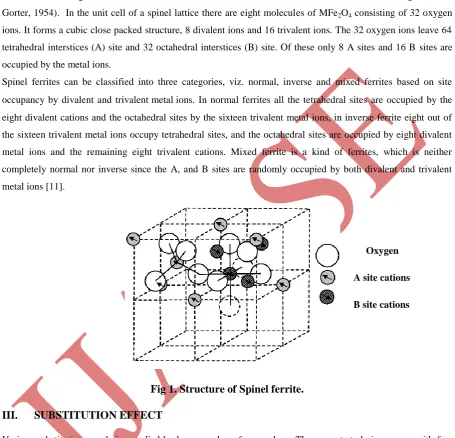
f.c.c. lattice leaving the tetrahedral or the A-site and the octahedral or the B-site as shown in Fig.1 (E. W.
Gorter, 1954). In the unit cell of a spinel lattice there are eight molecules of MFe2O4 consisting of 32 oxygen
ions. It forms a cubic close packed structure, 8 divalent ions and 16 trivalent ions. The 32 oxygen ions leave 64
tetrahedral interstices (A) site and 32 octahedral interstices (B) site. Of these only 8 A sites and 16 B sites are
occupied by the metal ions.
Spinel ferrites can be classified into three categories, viz. normal, inverse and mixed ferrites based on site
occupancy by divalent and trivalentmetalions. In normal ferrites all the tetrahedral sites are occupied by the
eight divalent cations and the octahedral sites by the sixteen trivalent metal ions, in inverse ferrite eight out of
the sixteen trivalent metal ions occupy tetrahedral sites, and the octahedral sites are occupied by eight divalent
metal ions and the remaining eight trivalent cations. Mixed ferrite is a kind of ferrites, which is neither
completely normal nor inverse since the A, and B sites are randomly occupied by both divalent and trivalent
metal ions [11].
Fig 1. Structure of Spinel ferrite.
III.
SUBSTITUTION EFFECT
Various substitutions are being studied by large number of researchers. The present study is concern with few
substitutions such as chromium, aluminium, silicon, zirconium and antimony.
3.1
CHROMIUM SUBSTITUTION
The increase in the substitution of trivalent Cr3+ increases the ac resistivity ascribed to a hopping mechanism
between Fe3+ and Fe2+ ions and the availability of ferrous ions on octahedral sites. Navdeep Gill et al [21]
studied lithium ferrite substituted with Cr3+ and found that the substitution of Cr3+ ion reduces the internal
magnetic field at A site as well as B sites. It produces ferromagnetic relaxation for higher contents of Cr3+ ions
and was explain based on super transferred hyperfine field and domain wall displacement. Kutznetsov et al [12]
studied Cr3+ substituted lithium ferrite prepared by self-propagating high combustion synthesis and observed Oxygen
A site cations
International Journal Of Advance Research In Science And Engineering http://www.ijarse.com
IJARSE, Vol. No.2, Issue No.8, August 2013 ISSN-2319-8354(E)
super-paramagnetic behaviour. Radhapiyari et al [22] investigated the effect of simultaneous substitution of Cr3+
and Sb5+ in lithium ferrites and observed that dc resistivity increased whereas saturation magnetization
decreases.
3.2
ALUMINIUM SUBSTITUTION
AA Sattar [23] studied the effect of Al content on lattice parameter, powder density, crystallite size, Curie
temperature, and magnetic properties. Experimental results revealed that the lattice constant, powder density,
and crystallite size decrease linearly with the increasing Al content in Li0.5Fe2.5AlxO4 samples. The saturation
magnetization, remanent magnetization, Curie temperature, and coercive force decrease significantly with the
increasing of Al content [24].
3.3
SILICON SUBSTITUTION
The substitution of Si increases the electrical resistivity and was explained as due to accumulation of silica on
grain boundaries. There is a continuous decrease in Curie temperature with increase in silicon content and was
explained due to the dilution of strength of the A–B interaction induced by silicon substitution [25]. The studies
revealed that the grain size and Ms both increases up to silicon concentration and then decrease with further
increase in concentration showing that the silicon substituted lithium ferrite samples exhibit a good potential,
electromagnetic wave absorber material because of its low dielectric constant in the frequency range 1–16MHz
in spite of its better magnetic properties compared to other substituted Li-ferrite material [6].
3.4
ZIRCONIUM SUBSTITUTION
The substitution of nonmagnetic Zr4+ ions in mixed Li-Zn ferrite leads to an increase in the saturation
magnetization (Ms) to a maximum value at concentration x=0.02, the behavior was explained using the cation
distribution between (A) and [B] sites. The initial permeability (μi) at room temperature attains maximum value
at Zr-concentration x=0.01 whose behaviour was explained using Globus [26]. The values of coercivity (Hc)
and remanence ratio (Br/Bs) for the investigated samples reached a minimum at x=0.01. This change was
explained using Brown`s relation. It is found that increase of concentration of Zr4+ up to x=0.05 has negligible
effect on values of the lattice parameter and Curie temperatures. The dc electrical resistivity showed a gradual
increase by about one order of magnitude.
3.5
ANTIMONY SUBSTITUTION
Evans and Swartzendruber studied Mössbauer effect under an external field of 50kG on Sb5+ substituted lithium
ferrite [27]. They found B-site cation disorder not nearly effective as A-site cation disorder. In spite of the large
concentration approximately 30% of diamagnetic ions on the B site, it results in collinear antiparallel Neel spin
structure of the material. Dehe and Suwatsky [28] studied Mössbauer effect on Li-Sb ferrite at 4.2K with and
without longitudinal magnetic field at 6T. The sample was found to have collinear Neel structure. The internal
International Journal Of Advance Research In Science And Engineering http://www.ijarse.com
IJARSE, Vol. No.2, Issue No.8, August 2013 ISSN-2319-8354(E)
31 |
P a g e
Mössbauer study. The observed Mössbauer spectra showed unresolved magnetic splitting. This was explained asexistence of small supertransferred hyperfine field interpreted in terms of indirect influence of B-site occupancy
on the A-O-B transfer. Chongtham et al [14] investigated the dielectric behaviour of Sb5+ substitution on lithium
ferrite and found that the dielectric constant decreases with substitution except for 0.15 Sb5+ concentrations.
Dispersion was observed for variation of loss tangent with frequency. The temperature variation showed
anomalous peak [14].
IV.
CONCLUSIONS
The effect on the various electrical and magnetic properties by substituting Cr3+, Al3+,Si4+, Zr4+, Sb5+ on lithium
ferrite based material has been reviewed. There occur changes in properties due to substitution. Hence the
materials can be used for desired a specific application, which requires the changes properties.
REFERENCES
[1] A.K. Singh, T. C. Goel, R. G .Mendiratta, Dielectric properties of Mn-substituted Ni-Zn ferrite,
Journal of .Applied Physics, 9, 2002, 6626.
[2] A.G. Fox, S.E Miller, M.T. Weiss, Behaviour and applications of ferrites in the microwave region,
Bell Syst. Tech.J., 34, 1955, 5.
[3] A. Goldman, Modern ferrite technology, Van Nostrand Reinhold, New York. 1990, 15
[4] N. C .Joshi, Anjali Verma, Nitendar Kumar, Satheesh Kumar, O.B. Islam, Nickel-substituted lithium zinc manganese ferrite for the suppression of radiated emission noise, Defence Science Journal, 57, 2007, 471.
[5] C. Kuroda, T. Kawashima, Temperature – stable Low noise ferrite memory cores, IEEE Trans. Magn. 3, 1969, 192.
[6] V Verma,Vibhav Pandey, R.K. Kotnala, Hari Kisan, Nitendar Kumar, P.C. Kothari, J.Alloys Compd, Influence of silicon substitution on the properties of lithium ferrite, 443,2007,178.
[7] G. Blasse, Crystal chemistry and some magnetic properties of mixed metal oxides with spinel
structure. Philips Res. Rep. 3, 1964, 96.
[8] C. E. Patton, C. A. Edmondson, T.H. Liu, Magnetic properties of lithium zinc ferrite, Journal of .Applied Physics., 53(3), 1982, 2431.
[9] I Soibam, S Phanjoubam, H N K Sarma, and C Prakash, Synthesis and Characterization of Ultra-fine Zinc substituted lithium ferrites by citrate precursor method, AIP Conference Proceedings, 1003, 2008, 136.
[10] I Soibam, Sumitra Phanjoubam , C Prakash, Mössbauer and magnetic studies of cobalt substituted lithium zinc ferrites prepared by citrate precursor method, Journal of Alloys and Compounds, 475, 2009, 328.
International Journal Of Advance Research In Science And Engineering http://www.ijarse.com
IJARSE, Vol. No.2, Issue No.8, August 2013 ISSN-2319-8354(E)
[12] M. V. Kuznetsov, Quentin A Pankhurst, Ivan P Parkin, Self-propagating high temperature synthesis of lithium-chromium ferrites Li0.5Fe2.5-xCrxO4(0 x 2.0), Journal of Physics D: Applied .Physics, 31, 1998, 2886.
[13]P Kisan, D R. Sagar, Prem Swarup, Electrical conduction and dielectric behaviour in zinc-substituted lithium ferrites, Journal of Less Common. Metal, 108, 1985, 345.
[14]S. Chongtham, S Phanjoubam, H.N.K. Sarma, R. Laishram, C. Prakash, Dielectric properties of Li-Sb Ferrites, Modern Physics letterB, 19, 2005, 849.
[15] R. K. Kotnala, Vivek Verma, Vibhav Pandey, V.P.S. Awana, R.P. Aloysius, P.C. Kothari, The effect of nano-SiO2 on the magnetic and dielectric properties of lithium cadmium ferrites, Solid. State
Commun. 143, 2007, 527.
[16] P.D. Baba, GM Argentina, WE Courtney,, GF Dionne, DH Temme, IEEE Trans. Mag., Mag-8 (1), 1972, 83.
[17]E.W. Gorter, Philips Res. Repts, Einthoven ,9, 1954, 295. [18]S. Hafner, Schweiz, Min, petrogr., Mitt, 40, 1960, 207. [19]G. Blasse, J. Inorg. Nucl. Chem., 25, 1963, 136.
[20] S. Nishikawa, “Structure of some crystal of the spinel groups”.Proc. Tokyo Math. Phys. Soc., 8, 1915, 199.
[21]Navdeep Gill & R. K. Puri, Mossbauer study of Li0.5Fe2.5-xCrxO4 ferrites, Spectrochimica Acta, 1985, 1005.
[22]R Laishram, S Phanjoubam, H N .K Sarma, C Prakash, Electrical and magnetic studies of the spinel system Li0.5+tCrxSbtFe2.5-x-2tO4, Journal of Physics D: Applied Physics, 32, 1999, 2151
[23]A. A. Sattar, H.M. El-Sayed, W.R. Agami, A.A. Ghani, Magnetic properties and electrical resistivity of Zr4+ substituted Li-Zn ferrite, Amer. J. Appl. Sc., 4 (2), 2007, 89.
[24]L. Neel, Analytical Physics, 3, 1948, 137.
[25]R. F. Soohoo Theory and application of Ferrites (USA: Prentice hall Inc. Englewood Cliffs) (1960) [26]A. Globus, P. Duplex and M. Guyot, Determination of initial magnetization curve from crystallites size
and effective anisotropy field, IEEE Trans. Magn., MAG-7, 1971, 617.