Semantic Security and Indistinguishability
in the Quantum World
June 1, 2016?
Tommaso Gagliardoni1, Andreas H¨ulsing2, and Christian Schaffner3,4,5
1 CASED, Technische Universit¨at Darmstadt, Germany
2 TU Eindhoven, The Netherlands
3
Institute for Logic, Language and Compuation (ILLC), University of Amsterdam, The Netherlands
4 Centrum Wiskunde & Informatica (CWI) Amsterdam, The Netherlands 5
QuSoft, The Netherlands
Abstract. At CRYPTO 2013, Boneh and Zhandry initiated the study of quantum-secure encryption. They proposed first indistinguishability def-initions for the quantum world where the actual indistinguishability only holds for classical messages, and they provide arguments why it might be hard to achieve a stronger notion. In this work, we show that stronger notions are achievable, where the indistinguishability holds for quantum superpositions of messages. We investigate exhaustively the possibilities and subtle differences in defining such a quantum indistinguishability notion for symmetric-key encryption schemes. We justify our stronger definition by showing its equivalence to novel quantum semantic-security notions that we introduce. Furthermore, we show that our new security definitions cannot be achieved by a large class of ciphers – those which are quasi-preserving the message length. On the other hand, we pro-vide a secure construction based on quantum-resistant pseudorandom permutations; this construction can be used as a generic transformation for turning a large class of encryption schemes into quantum indistin-guishable and hence quantum semantically secure ones. Moreover, our construction is the first completely classical encryption scheme shown to be secure against an even stronger notion of indistinguishability, which was previously known to be achievable only by using quantum messages and arbitrary quantum encryption circuits.
1
Introduction
Quantum computers [NC00] threaten many cryptographic schemes. By using Shor’s algorithm [Sho94] and its variants [Wat01], an adversary in possession of a quantum computer can break the security of every scheme based on factorization and discrete logarithms, including RSA, ElGamal, elliptic-curve primitives and many others. Moreover, longer keys and output lengths are required in order to
?
maintain the security of block ciphers and hash functions [Gro96,BHT97]. These difficulties led to the development of post-quantum cryptography [BBD09], i.e., classical cryptography resistant against quantum adversaries.
When modeling the security of cryptographic schemes, care must be taken in defining exactly what property one wants to achieve. In classical security mod-els, all parties and communications are classical. When these notions are used to provepost-quantumsecurity, one must consider adversaries having access to a quantum computer. This means that, while the communication between the ad-versary and the user is still classical, the adad-versary might carry out computations on a quantum computer.
Such post-quantum notions of security turn out to be unsatisfying in cer-tain scenarios. For instance, consider quantum adversaries able to use quantum superpositionsof messagesP
xαx|xiinstead of classical messages when commu-nicating with the user, even though the cryptographic primitive is still classical. This kind of scenario is considered, e.g., in [BZ13,DFNS14,Unr12,Wat09,Zha12]. Such a setting might for example occur in a situation where one party using a quantum computer encrypts messages for another party that uses a classical computer and an adversary is able to observe the outcome of the quantum com-putation before measurement. Other examples are an attacker which is able to trick a classical device into showing quantum behavior, or a classical scheme which is used as subprotocol in a larger quantum protocol. Another possibility occurs when using obfuscation. There are applications where one might want to distribute the obfuscated code of a symmetric-key encryption scheme (with the secret key hardcoded) in order to allow a third party to generate ciphertexts without being able to retrieve the key - think of this as building public-key en-cryption from symmetric-key enen-cryption using Indistinguishability Obfuscation. Because in these cases an adversary receives the classical code for producing encryptions, he could implement the code on his local quantum computer and query the resulting quantum circuit on a superporition of inputs. Moreover, even in quantum reductions for classical schemes situations could arise where super-position access is needed. A typical example are impossibility results (such as meta-reductions [DFG13]), where giving the adversary additional power often rules out a broader range of secure reductions. Notions covering such settings are often calledquantum-securitynotions. In this work we propose new quantum-security notions for encryption schemes.
To the best of our knowledge, no quantum semantic-security notions for classical encryption schemes have been proposed so far. For indistinguishability, Boneh and Zhandry introduced indistinguishability notions for quantum-secure encryption under chosen-plaintext attacks in a recent work [BZ13]. They con-sider a model (IND-qCPA) where a quantum adversary can query the encrypting device in superposition during a learning phase but is limited to classical com-munication during the actual challenge phase. However, in the symmetric-key scenario, this approach has the following shortcoming: If we assume that an adversary can get quantum access in a learning phase, it seems unreasonable to assume that he cannot get such access when the actual message of interest is encrypted. Boneh and Zhandry showed that a seemingly natural notion of quantum indistinguishability is unachievable. In order to restore a meaningful definition, they resorted to the compromise of IND-qCPA.
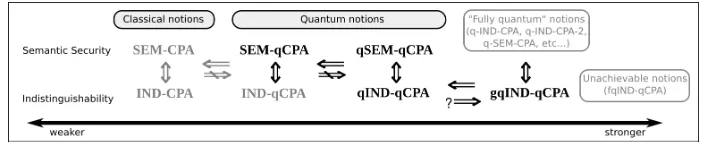
Our contributions.In this paper we achieve two main results. On the one hand, we initiate the study of semantic security in the quantum world, providing new definitions and a thorough discussion about the motivations and difficulties of modeling these notions correctly. This study is concluded by a suitable definition ofquantum semantic security under chosen plaintext attacks (qSEM-qCPA). On the other hand, we extend the fundamental work initiated in [BZ13] in finding suitable notions of indistinguishability in the quantum world. We show that the compromise that had to be reached there in order to define an achievable notion instead of a more natural one (i.e., IND-qCPA vs. fqIND-qCPA) can be overcome – although not trivially. We show how various other possible notions of quantum indistinguishability can be defined. All these security notions span a tree of possibilities which we analyze exhaustively in order to find the most suitable definition ofquantum indistinguishability under chosen plaintext attacks (qqCPA). We prove this notion to be achievable, strictly stronger than IND-qCPA, and equivalent to qSEM-IND-qCPA, thereby completing an elegant framework of security notions in the quantum world, see Figure2 below for an overview.
The ‘frozen smart-card’ example.In order to clarify why quantum security allows the adversary quantum superposition access to classical primitives - as opposed to the case of post-quantum security - we give a motivating example. In this mind experiment, we consider a not-so-distant future where the target of an attack is a tiny encryption chip, e.g., integrated into an RFID tag or smart-card. It is reasonable to assume that it will include elements of technology currently re-searched but undeployed (i.e., extreme miniaturization, optical electronics, etc.) Regardless, the chip we consider is a purely classical device, performing classical encryption (e.g. AES) on classical inputs, and outputting classical outputs.
Consider an adversary equipped with some future technology which subjects the device to a fault-injection environment, by varying the physical parameters (such as temperature, power, speed, etc.) under which the device usually oper-ates. As a figurative example, our ‘quantum hacker’ could place the chip into an isolation pod, which keeps the device at a very low temperature and shields it from any external electromagnetic or thermal interference. This situation would be analogous to what happens when security researchers perform side channel analysis on cryptographic hardware in nowaday’s labs, using techniques such as thermal or electromagnetic manipulation which were previously considered fu-turistic. There is no guarantee that, under these conditions, the chip does not start to show full or partial quantum behaviour. At this point, the adversary could query the device on a superposition of plaintexts by using, e.g., a laser and an array of beam splitters when feeding signals into the chip via optic fiber. It is unclear today what a future attacker might be able to achieve using such an attack. As traditionally done in cryptography, we assume the worst-case scenario where the attacker can actually query the target device in superposition. Classical security notions such as IND-CPA do not cover this scenario while our new notion qIND-qCPA does. This setting is an example of what we mean by ‘tricking classical parties into quantum behaviour’.
2
Preliminaries
In this section, we briefly recall the classical security notions for encryption schemes secure against chosen plaintext attacks (CPA). In addition, we revisit the two existing indistinguishability notions for the quantum world. We start by introducing notation we will use throughout the paper.
We say that a function f : N → R is polynomially boundediff there exists a polynomial p and a value ¯n ∈ N such that: for every n ≥ n¯ we have that f(n)≤p(n); in this case we will just writef = poly (n). We say that a function ε : N → R is negligible, if and only if for every polynomial p, there exists an np ∈ Nsuch that ε(n) ≤ p(n)1 for everyn ≥np; in this case we will just write ε= negl (n). In this work, we focus on secret-key encryption schemes. In all that follows we usen∈Nas the security parameter.
Definition 2.1 (Secret-key encryption scheme [Gol04]).Asecret-key en-cryption schemeis a triple of probabilistic polynomial-time algorithms(Gen,Enc,
Dec)operating on a message space M={0,1}m (wherem=poly(n)∈
N) that
fulfills the following two conditions:
1. The key generation algorithm Gen(1n) on input of security parameter n in unary outputs a bitstringk.
2. For all k in the range of Gen(1n) and any message x∈ M, the algorithms
Enc(encryption) and Dec(decryption) satisfyPr[Dec(k,Enc(k, x)) =x] = 1, where the probability is taken over the internal coin tosses ofEncandDec.
We writeKfor the range ofGen(1n) (the key space) andEnck(x) forEnc(k, x).
2.1 Classical Security Notions: IND-CPA and SEM-CPA.
We turn to security notions for encryption schemes. In this work, we will only look at the notions of indistinguishability of ciphertexts under adaptively cho-sen plaintext attack (IND-CPA), and semantic security under adaptively chocho-sen plaintext attack (SEM-CPA), which are known to be equivalent (e.g., [Gol04]).
Game-based definitions. In general these notions can be defined as a game between a challengerC and an adversaryA. First,C generates a legitimate key running k ←− Gen(1n) which he uses throughout the game. The game starts with a first learning phase. A challenge phase follows where Areceives a chal-lenge. Afterwards, a second learning phase follows, and finallyAhas to output a solution. The learning phases define the type of attack, and the challenge phase the notion captured by the game. We give all our definitions by referring to this game framework and by defining a learning and a challenge phase.
The IND challenge phase: Adefines a challenge template consisting of two equal-length messages x0, x1, and sends it to C. The challenger C samples a random bit b ←− {0$ ,1} uniformly at random, and replies with the encryption
Enck(xb).A’s goal is to guessb.
Definition 2.2 (IND-CPA). A secret-key encryption scheme is said to be IND-CPA secure if the success probability of any probabilistic polynomial-time adversary winning the game defined by CPA learning phases and an IND chal-lenge phase is at most negligibly (in n) close to1/2.
The SEM challenge phase: A sends C a challenge template (Sm, hm, fm) consisting of a poly-sized circuit Sm specifying a distribution over m-bit long plaintexts, an advise function hm : {0,1}m → {0,1}∗, and a target function fm:{0,1}m→ {0,1}∗. The challenger C replies with the pair (Enck(x), hm(x)) wherexis sampled according toSm.A’s challenge is to outputfm(x).
In the definition of semantic security it is not required thatA’s probability of winning the game is always negligible. Instead, A’s success probability is compared to that of a simulatorS that plays in areduced game: On one hand,S gets no learning phases. On the other hand, during the challenge phase,S does not receive the ciphertext but only the output of the advice function. This use of a simulator is what makes the notion hard to work with in proofs as one has to construct a simulator for every possibleAto prove a scheme secure.
Definition 2.3 (SEM-CPA). A secret-key encryption scheme is said to be SEM-CPA secure if for any probabilistic polynomial-time adversaryAthere ex-ists a probabilistic polynomial-time simulatorS such that the challenge templates produced by S andAare identically distributed and the success probability of A winning the game defined by CPA learning phases and a SEM challenge phase (computed over the coins of A, Gen, and Sm) is negligibly close (in n) to the success probability ofS winning the reduced game.
Semantic security models what we want an encryption scheme to achieve: An adversary given a ciphertext can learn nothing about the encrypted message which he could not also learn from his knowledge of the message distribution and possibly existing side-information (modeled byhm). Indistinguishability of ciphertexts is an equivalent technical notion introduced to simplify proofs.
2.2 Previous Notions of Security in the Quantum World
when the security parameter is implicit, therefore writing just|ϕi ∈ H. We will denote pure states with ket notation, e.g.,|ϕi, while mixed states will be denoted by lowercase Greek letters, e.g.ρ. We start by defining what we call aclassical description of a quantum state:
Definition 2.4 (Classical Description).Aclassical descriptionof a quantum stateρis a (classical) bitstring describing a quantum circuit S which (takes no input but starts from a fixed initial state|0iand) outputs ρ.
This definition will be used later in our new notions of security. We deviate here from the traditional meaning of ‘classical description’ referring to individual numerical entries of the density matrix. The reason is that our definition also covers the cases where those numerical entries are not easily computable, as long as we can give an explicit constructive procedure for that state. Clearly, every pure quantum state|ϕihas a classical description (given by a description of the quantum circuit which implements the unitary that maps|0ito|ϕi. The classical description of a mixed stateρAis given by the circuit which first creates a purification|ϕiARofρAand then only outputs theAregister. Note that a state admitting a classical description cannot be entangled with any other system.
For encryption, following the approach in [BZ13] and many other works, we define the following:
Definition 2.5 (Quantum Encryption Oracle [BZ13]). LetEnc be the en-cryption algorithm of a secret-key enen-cryption schemeE. We define thequantum encryption oracleUEnck associated withE and initialized with keykas (a family of ) unitary operators defined by:
UEnck:
X
x,y
αx,y|xi |yi 7→
X
x,y
αx,y|xi |y⊕Enck(x)i (1)
where the same randomness r is used in superposition in all the executions of
Enck(x)within one query6 – for each new query, a fresh independent ris used. The first indistinguishability notion proposed in [BZ13] replaces all classical communication betweenAandCby quantum communication.AandCare now quantum circuits operating on quantum states, and sharing a certain number of qubits (the quantum communication register). The definition for the new security game is obtained from Definition 2.2 by changing the learning and challenge phases as follows:
Quantum CPA learning phase (qCPA):Agets oracle access toUEnck.
Fully quantum IND challenge phase (fqIND):Aprepares the communica-tion register in the stateP
x0,x1,yαx0,x1,y|x0i |x1i |yi, consisting of twom-qubit states (the two input-message superpositions) and an ancilla state to store the ciphertext.C samples a bitb←− {0$ ,1} and applies the transformation:
X
x0,x1,y
αx0,x1,y|x0i |x1i |yi 7→
X
x0,x1,y
αx0,x1,y|x0i |x1i |y⊕Enck(xb)i.
6
A’s goal is to outputb.
The resulting security notion in [BZ13] is called indistinguishability under fully quantum chosen-message attacks (IND-fqCPA). We decided to rename it to fully quantum indistinguishability under quantum chosen-message attacks (fqIND-qCPA)in order to fit into our naming scheme: It consists of a quantum CPA learning phase and a fully quantum IND challenge phase.
Definition 2.6 (fqIND-qCPA). A secret-key encryption scheme is said to be fqIND-qCPA secure if the success probability of any quantum probabilistic polynomial-time adversary winning the game defined by qCPA learning phases and a fqIND challenge phase is at most negligibly close (inn) to 1/2.
As already observed in [BZ13], this notion is unachievable. The separation by Boneh and Zhandry exploits the entanglement of quantum states, namely the fact that entanglement can be created between plaintext and ciphertext.
Theorem 2.7 (BZ attack [BZ13, Theorem 4.2]). No symmetric-key en-cryption scheme can achieve fqIND-qCPA security.
Proof. The attack works as follows: The adversaryAchooses as challenge mes-sages the states|0miandH|0mi(whereH denotes them-fold tensor Hadamard transform), i.e. he prepares the register in the stateP
x 1 2m/2 |0
m, x,0mi. When the challengerC performs the encryption, we can have two cases:
– ifb= 0, i.e. the first message state is chosen, the state is transformed into
X
x 1 2m/2|0
m, x,Enc
k(0m)i=|0mi ⊗H|0mi ⊗ |Enck(0m)i;
– ifb= 1, i.e. the second message state is chosen, the state is transformed into
X
x 1 2m/2|0
m, x,Enc
k(x)i=|0mi ⊗
X
x 1
2m/2|x,Enck(x)i.
Notice that in the second case we have a fully entangled state between the second and the third register. At this point,Adoes the following:
1. measures (traces out) the third register; 2. applies againH to the second register; 3. measures the second register;
Theorem2.7implies that the fqIND-qCPA notion is too strong. In order to weaken it, the following notion of indistinguishability under adaptively chosen quantum plaintext attacks was introduced:
Definition 2.8 (IND-qCPA [BZ13]).A secret-key encryption scheme is said to be IND-qCPA secure if the success probability of any quantum probabilistic polynomial-time adversary winning the game defined by qCPA learning phases and a classical IND challenge phase is at most negligibly close (in n) to1/2.
In this definition, the CPA queries are allowed to be quantum, but the chal-lenge query is required to be classical. It has been shown that, under standard computational assumptions, IND-qCPA is strictly stronger than IND-CPA:
Theorem 2.9 (IND-CPA 6⇒ IND-qCPA [BZ13, Theorem 4.8]). If clas-sically secure PRFs exist and order-finding in prime groups is clasclas-sically hard, then there exists an encryption scheme E which is IND-CPA secure, but not IND-qCPA secure.
3
New Notions of Quantum Indistinguishability
IND-qCPA might be viewed as classical indistinguishability (IND) under a quan-tum chosen plaintext attack (qCPA). The authors in [BZ13] resorted to this definition in order to overcome their impossibility result on one seemingly nat-ural notion of quantum indistinguishability (fqIND-qCPA) which turned out to be too strong. This raises the question whether IND-qCPA is the only possible quantum indistinguishability notion (and hence no classical encryption scheme can achieve indistinguishability of ciphertext superpositions) or if there exists a stronger notion which can be achieved.
In this section we show that by defining fqIND-qCPA, there are many choices which are made implicitly, and that on the other hand there exist other possible quantum indistinguishability notions. We discuss these choices spanning a binary ‘security tree’ of possible notions. Afterwards, we obtain a small set of candidate notions, eliminating those that are either ill-posed or unachievable because of the BZ attack from Theorem 2.7. In all these notions, we implicitly assume ‘quantum CPA learning phases’, as in the case of IND-qCPA. However, we limit the discussion in this section to the design of a quantum challenge phase. In the end, we select a suitable ‘qIND-’notion amongst all the possible candidate ones.
3.1 The ‘Security Tree’
tree7. Some of them lead to unreasonable or ill-posed models, some of them yield unachievable security notions, and others are analyzed in more detail.
Game model: Oracle (O) vs. Challenger (C).This distinction decides how the game, and especially the challenge phase, is implemented. In the classical world, the following two cases are equivalent but in the quantum world they differ. In theoraclemodel, the adversaryAgets oracle access to encryption and challenge oracles, i.e., he plays the game by performing calls to unitary gates O1, . . . ,Oq. In this case Ais modeled as a quantum circuit which implements a sequence of unitary gatesU0, . . . , Uq, intertwined by calls to the Oi’s. Given an input state |ϕi, the adversary therefore computes the state:
UqOq. . . U1O1U0|ϕi.
The structure of the oracle gates Oi itself is unknown to A, who is only allowed to apply them in a black-box way. The fqIND notion uses this model.
In what we call the challenger model instead, the game is played against an external (quantum) challenger. Here, A is a quantum circuit which shares a quantum register (the communication channel) with another quantum circuit C. The main difference is that in this case we can also consider what happens if C has additional input or output lines out of A’s control. Moreover, A does not automatically gain access to the inverse (adjoint) of quantum operations performed by C, andC cannot be ‘rewound’ by the adversary, which would be far too powerful possibilities. This scenario also covers the case of ‘unidirectional’ state transmission, i.e., when qubits are sent over a quantum channel to another party, and they are not available afterwards until that party sends them back. Regardless, in security proofs in the (C) model, it is still allowed for an external entity (e.g. a simulator, or a reduction) to rewind the joint circuit composed by adversary and challenger together, if need be. However, we are not aware of any known reduction involving rewinding in this form for encryption schemes in the quantum world.
In order to keep consistency with this choice of the model, when also con-sidering qCPA queries, we implicitly assume the same access mode to theEnck oracle as in the qIND game. That is, if we are in the (O) scenario, during the qCPA phase A has quantum oracle access to Enck. In the (C) case, instead, superposition access toEnck is provided toAby an external challenger.
At first glance, the (O) model intuitively represents the scenario where A has almost complete control of some encryption device, whereas the (C) model is more suited to a ‘network’ scenario where Awants to compromise the security of some external target.
Plaintexts: quantum states (Q) vs. classical description (c).In the (Q) model, the twom-qubit plaintexts chosen by Afor the challenge template can be arbitrary (BQP-producible) quantum states and can be entangled with each other and other states. In the (c) model, instead, A is only allowed to choose classical descriptionsof twom-qubit quantum states according to Definition2.4,
7
thus being only allowed to send classical information toC: the challengerC will read the states’ descriptions and will build one of the two states depending on his challenge bitb.
In classical models, there is no difference between sending a description of a message or the message itself. In the quantum world, there is a big difference between these two cases, as the latter allows A to establish entanglement of the message(s) with other registers. This is not possible when using classical descriptions. It might intuitively appear that the (Q) model (considered for the fqIND-qCPA notion) is more natural. However, the (c) scenario models the case where Ais well aware of the message that is encrypted, but the message is not constructed byAhimself. GivingAthe ability to choose the challenge messages for the IND game models the worst case that might happen:Aknows that the ciphertext he receives is the encryption of one out of the two messages that he can distinguish best. This closely reflects the intuition behind the classical IND notions: in that game, the adversary is allowed to send the two messages not because in the real world he would be allowed to do so, but because we want to achieve security even for the best possible choice of messages from the adversary’s perspective. Hence, the (c) model is a valid alternative. Will further discuss the difference between these two models later.
Relaying of plaintext states: Yes (Y) vs. No (n). IfCisnot relaying(n), this means that the two plaintext states chosen by Awill not be ‘sent back’ to A (in other words: their registers will not be available anymore to Aafter the challenge encryption). In circuit terms, this means that at the beginning of the game,Cwill have (one or two) ancilla registers in his internal (private) memory. During the encryption phase, C will swap these register(s) with the content of the original plaintext register(s), hence transferring their original content outside ofA’s control.
If the challenger is relaying (Y) instead, this means that the two plaintext states will be left in the original register (or channel), and may be accessed by Aat any moment. This is the model considered for fqIND.
Again, the (Y) case is more fitting to those cases whereA‘implements locally’ the encryption device and has almost full control of it, whereas the (n) case is more appropriate when the game is played against some external entity which is not underA’s control. This is a rather natural assumption, for example, when states are sent over some quantum channel and not returned. We stress that this distinction in relaying is not trivial: it is not possible for A, in general, to simulate relaying by keeping internal states entangled with the plaintexts. As an example, consider the attack in Theorem 2.7: it is easy to see that this cannot be performed without relaying.
Type of unitary transformation: (1) vs. (2). In quantum computing, the ‘canonical’ way of evaluating a function f(x) in superposition is by using an auxiliary register:
X
x,y
αx,y|x, yi 7→
X
x,y
This way ensures that the resulting operator is invertible, even iff is not. We call thistype-(1)transformations: ifEnck is an encryption mappingm-bit plaintexts to `-bit ciphertexts, the resulting operator in this case will act onm+` qubits in the following way:
X
x,y
αx,y|x, yi 7→
X
x,y
αx,y|x, y⊕Enck(x)i,
where they’s are ancillary values. This approach is also used for fqIND. In our case, though, we do not consider arbitrary functions, but encryptions, which act asbijectionson some bit-string spaces (assuming that the randomness is treated as an input.) Therefore, provided that the encryption does not change the size of a message, the following transformation is also invertible:
X
x
αx|xi 7→
X
x
αx|Enck(x)i. (2)
For the more general case of arbitrary message expansion factors, we will consider transformations of the form:
X
x,y
αx,y|x, yi 7→
X
x,y
αx,y|ϕx,yi,
where the length of the ancilla register is|y|=|Enck(x)| − |x|andϕx,0=Enck(x) for every x– i.e., initializing the ancilla y register in the |0i state produces a correct encryption, which is what we expect from an honest quantum executor. One might ask what happens if the ancilla is not initialized to 0, and we leave the general case of arbitrary ancillas manipulation as an interesting open problem, but we stress the fact that this behavior is not considered in the case of honest parties. We call thesetype-(2) transformations8.
Notice that, in general, type-(1) and type-(2) transformations are very differ-ent: having quantum oracle access to a type-(2) unitaryUEnc(2) and its adjoint also gives access to the related type-(2)decryption oracle UDec(2) :P
xαx|Enck(x)i 7→
P
xαx|xi. In fact, notice that (U (2) Enc)
† = U(2)
Dec, while the adjoint of a type-(1) encryption operator, (UEnc(1))†, is generallynota type-(1) decryption operator. In particular, type-(2) operators are ‘more powerful’ in the sense that knowledge of the secret key is required in order to build any efficient quantum circuit imple-menting them. However, we stress the fact that whenever access to a decryption oracle is allowed, the two models are completely equivalent, because then we can simulate a type-(2) operator by using ancilla qubits and ‘uncomputing’ the resulting garbage lines (see Figure1) (as we will see, this will be the case for the challenger in our qIND notion).
3.2 Analysis of the models
By considering these 4 distinctions in the security tree we have 24 = 16 possi-ble candidate models to analyze. We label each of these candidate models by
8
Fig. 1.Equivalence between type-(1) and type-(2) in the case of 1-qubit messages. Left: building a type-(1) encryption oracle by using a type-(2) encryption oracle (and its inverse) as a black-box. Right: building a type-(2) encryption oracle by using type-(1) encryption and decryption oracles as black-boxes.
appending each one of the 4 labels of every tree branch in brackets. Clearly, 16 different definitions of quantum indistinguishability is too much, but luckily most of these are unreasonable or unachievable. To start with, we can ignore the following:
Leaves of the form (Oc . . .). In the O scenario, the oracle is actually a quantum gate inside A’s quantum circuitry. ThereforeA has the capability of querying the oracle on states which are possibly entangled with other registers kept byAitself.
Leaves of the form (OQn . . .). Again, the oracle is a gate which has no internal memory to store and keep the plaintext states sent byA.
Leaves of the form (. . . Y2). Relaying is not taken into account in type-(2) transformations. In these transformations, to some extent, one of the two plaintext registers is always relayed (after having been ‘transformed’ into a ci-phertext). If the other plaintext was to be relayed as well, this would immediately compromise indistinguishability (because one of the two states would be modified and the other not, and both of them would be handed over toA).
Excluding these options leaves us with 7 models, but it is easy to see that 3 of them are unachievable because of the attack from Theorem 2.7. This is the case for (OQY1) (which is exactly fqIND-qCPA), (CQY1), and (CcY1). Of the remaining 4, notice that (CQn1) and (Ccn1) are equivalent to the IND-qCPA notion from [BZ13]. The reason is that fromA’s perspective, a non-relayingCis indistinguishable from aCtracing out (measuring) the plaintext register (other-wise A and C could communicate faster than light). This measuring operation would make the ciphertext collapse into a single (classical) ciphertext. And since tracing out the challenge register and applying the type-(1) operatorUEnc(1) com-mute, one can consider (without loss of generality) the case thatAhimself first measures the plaintext register, and then initiates a classical IND query with C, therefore recovering a classical definition of IND challenge query9. Therefore,
9
using any of (CQn1) or (Ccn1) would lead to a weaker notion of quantum in-distinguishability. Since we are interested in achieving stronger notions, we will hence consider the more challenging scenarios (CQn2) and (Ccn2).
This argument also leads to the following interesting observation. Ultimately, whether a challenger (or encryption device) performs type-(1) or type-(2) oper-ations depends on itsarchitecturewhich we cannot say anything about - we will focus on the (. . .2) models in order to be on the ‘safe side’, as they lead to secu-rity notions which are harder to achieve. In order to design a secure encryption device, it is good advice to avoid the possibility that it can be accessed in type-(2) mode. For such a device, it would be sufficient to provide IND-qCPA security, which is weaker and therefore easier to achieve. Clearly, providing guidelines on how to construct encryption devices resilient to type-(2) access lies outside the scope of this work.
3.3 qIND
At this point we are left with only two candidate notions: (Ccn2) and (CQn2). From now on we will denote them as‘quantum indistinguishability of ciphertexts’ (qIND) and‘general quantum indistinguishability of ciphertexts’ (gqIND)resp., and we summarize the resulting challenge phases as follows.
Quantum IND challenge phase (qIND): A chooses two quantum states ρ0, ρ1 having efficient (poly-sized) classical descriptions, and sends to C a chal-lenge template consisting of these two classical descriptions according to Defini-tion2.4.Csamples a bitb and replies toAwith the state obtained by applying the type-(2) operatorUEnc(2)
k as defined in (2) toρb.A’s goal is to outputb.
General Quantum IND challenge phase (gqIND):Achooses two quantum statesρ0, ρ1, and sends them toC.C samples a bitb, discards (traces out)ρ1−b,
and replies toAwith the state obtained by applying the type-(2) operatorUEnc(2) k as defined in (2) toρb. A’s goal is to outputb.
Using these challenge phases and the notion of a qCPA learning phase, we define qIND-qCPA and gqIND-qCPA as follows.
Definition 3.1 (qIND-qCPA). A secret-key encryption scheme is said to be qIND-qCPA secure if the success probability of any quantum probabilistic poly-nomial time adversary winning the game defined by qCPA learning phases and the qIND challenge phase above is at most negligibly close (in n) to1/2.
Definition 3.2 (gqIND-qCPA). A secret-key encryption scheme is said to be gqIND-qCPA secure if the success probability of any quantum probabilistic polynomial time adversary winning the game defined by qCPA learning phases and the gqIND challenge phase above is at most negligibly close (in n) to1/2.
Theorem 3.3 (gqIND-qCPA ⇒ qIND-qCPA). Let E be a gqIND-qCPA secure symmetric-key encryption scheme. Then E is also qIND-qCPA secure.
The reason is that quantum states admitting an efficient classical description (used in qIND) are just a special case of arbitrary quantum plaintext states (used in gqIND). Despite this implication, we will mainly focus on the qIND notion in the following, and we will use the gqIND notion only as a comparison to other existing notions. The main reason for this choice is that in the context of classical encryption schemes resistant to superposition quantum access, we believe that it is important to not lose focus of what the capabilities of a ‘reasonable’ ad-versary should be. Namely, recall the following classical IND argument:allowing the adversary to send plaintexts to the challenger is equivalent to the fact that indistinguishability must hold even for the most favorable case from the adver-sary’s perspective. Such an argument doesnothold anymore quantumly. In fact, the (Q) model considered in gqIND presents the following issues:
– it allows entanglement between the adversary and the challenger:A could prepare a state of the formρAB= √12|00i+√12|11i, sendingρAas a plaintext but keepingρB;
– it allows the adversary to create certain non-reproduceable states. For ex-ample, consider the state|ψi=P
x∈X 1 √
|X||x, h(x)i, wherehis a
collision-resistant hash function. A could measure the second register, obtaining a random outcomey, and knowing therefore that the remaining state is the su-perposition of the preimages ofy,|ψyi=Px∈X:h(x)=y
1 √
|{x∈X:h(x)=y}||xi.
Acould then use|ψyias a plaintext in the challenge phase, but note thatA cannot reproduce|ψyifor a given valuey.
Both of the above examples are not reasonable in our scenario. Entanglement be-tweenAandC represents a sort of ‘quantum watermarking’ of messages, which goes beyond what a meaningful notion of indistinguishability should achieve. Knowledge of intermediate, unpredictable measurements also rendersAtoo pow-erful, because it givesAaccess to information not available toC itself - e.g., in the example aboveCwould not even know the value ofy. As it isCwho prepares the state to be encrypted, it is reasonable to assume that it isCwho should know these intermediate measurements, not A. In the example above, what Acould see instead (provided he knows the circuit generating the state, as we assume in qIND) is that the plaintext is a mixtureΨ =P
of measures of entanglement when analyzing the properties of quantum states -for example, indistinguishability of states can be shown by only resorting to the trace norminstead of the more generaldiamond norm.
Furthermore, it is important to notice that all our new results in Section6are unaffected by the choice of either qIND or gqIND. Our impossibility result from Theorem6.3holds for qIND, and hence also for gqIND because of Theorem3.3. On the other hand, the security proof of Construction 6.6 (Theorem 6.9) is given for gqIND, and holds therefore also for qIND. In fact, it remains unclear whether a separation between qIND and gqIND can be found at all in the realm of classical encryption schemes. We leave this as an interesting open question.
Finally, we note that the q-IND-CPA-2 indistinguishability notion for secret-key encryption of quantum messages introduced by Broadbent and Jeffery [BJ15, Appendix B] resembles our gqIND notion, and it is in fact equivalent to it in the case that the encryption operation is a symmetric-key classical functionality operating in type-(2) mode.
Theorem 3.4 (gqIND-qCPA ⇔q-IND-CPA-2).LetE be a symmetric-key encryption scheme. ThenE is gqIND-qCPA secure iffE is q-IND-CPA-2 secure.
A proof of the above theorem can be found in AppendixC. A generalization of q-IND-CPA-2 to arbitrary quantum encryption schemes, together with equiv-alent notions of quantum semantic security, was given and analized in [ABF+16]. All these security notions are given in the context of ‘fully quantum encryption’, in the sense that the encryption schemes considered in [BJ15] and [ABF+16]
are arbitrary quantum circuits acting natively on quantum data, while in this work we consider the quantum security of classical encryption schemes. The fully quantum homomorphic schemes which are shown to be secure in [BJ15], and the other quantum encryption schemes shown to be secure in [ABF+16], do not fall
into the category ofclassicalencryption schemes which we are studying here. On the other hand, as Theorem 6.9 shows, our Construction6.6 is the first known example of a classical symmetric-key encryption scheme which is secure even against these kinds of ‘fully quantum’ security notions.
4
New Notions of Quantum Semantic Security
In this section, we initiate the study of suitable definitions of semantic security in the quantum world. As in the classical case, we are particularly interested in notions that can be proven equivalent to some version of quantum indistinguisha-bility. So these definitions actually describe thesemanticsof the equivalent IND notions. As in the classical case, we present these notions in the non-uniform model of computation.
4.1 Classical Semantic Security under Quantum CPA
As a first notion of semantic security in the quantum world, we consider what happens if, like in the IND-qCPA notion, we stick to the classical definition but we allow for a quantum chosen-plaintext-attack phase. The definition uses a SEM-qCPA game that is obtained by combining qCPA learning phases with a classical SEM challenge phase as defined in Section2. As in the classical case, A’s success probability is compared to that of a simulator S that plays in a reduced game: S gets no learning phase and during the challenge phase it only receives the advicehm(x), not the ciphertext.
Definition 4.1 (SEM-qCPA).A secret-key encryption scheme is called SEM-qCPA-secure if for every quantum polynomial-time machine A, there exists a quantum polynomial-time machineS such that the challenge templates produced bySandAare identically distributed and the success probability ofAwinning the game defined by qCPA learning phases and a SEM challenge phase is negligibly close (inn) to the success probability of S winning the reduced game.
Spoiler. It is easy to see that the SEM-qCPA notion of semantic security is equivalent to IND-qCPA, see Theorem5.1.
In AppendixDwe discuss what happens if one also allows quantum advice states in this scenario, and why this option would not add anything meaningful.
4.2 Quantum Semantic Security
Here we definequantum semantic security under chosen-plaintext attacks (qSEM-qCPA). As in the classical case, we want the definition of semantic security to formally capture what we intuitively understand as a strong security notion. In the quantum case, there are several choices to be made. We start by giv-ing our formal definition of quantum semantic security, and justify our choices afterwards.
Quantum SEM (qSEM) challenge phase:Asends toCa challenge template consisting of classical decriptions of
– a quantum circuitGmtaking poly (n)-bit classical input and outputting m -qubit plaintext states,
– a quantum circuit hm taking m-qubit plaintexts as input and outputting poly (n)-qubit advice states,
– a quantum circuit fm taking m-qubit plaintexts as input and outputting poly (n)-qubit target states.
The challengerC samplesy←− {0$ ,1}poly(n)and computes two copies of the plaintext ρy = Gm(y). One is used to compute auxiliary information hm(ρy) and one to compute the ciphertext UEnckρyU
†
UEnckρyU
†
Enck, hm(ρy)
.A’s goal is to outputfm(ρy). We say thatAwins the qSEM-qCPA gameif no quantum polynomial-time distinguisher can distinguish A’s output from the target statefm(ρy) with non-negligible advantage.
In the reduced game,S receives no encryption, but only the auxiliary infor-mationhm(ρy) fromC. Analogously to the above case,Swins the qSEM-qCPA game if no quantum polynomial-time distinguisher can distinguish S’s output from the target statefm(ρy) with non-negligible advantage.
Definition 4.2 (qSEM-qCPA).A secret-key encryption scheme is called qSEM-qCPA-secure if for every quantum polynomial-time machine A, there exists a quantum polynomial-time machineS such that the challenge templates produced by S andA are identically distributed and the success probability ofA winning the game defined by qCPA learning phases and a qSEM challenge phase is neg-ligibly close (inn) to the success probability of S winning the reduced game.
When defining quantum semantic security, we have to deal with several is-sues: First, we have to define how the plaintext distribution is described. In the classical definition, the distribution is produced by a (classical) circuitGm run-ning on uniform input bits. We take the same approach here, but letGmoutput m-qubit plaintexts.
The second question is how to define the advice function. While the input should be the plaintext quantum stateρy, the output could be either quantum or classical. We decided to allow quantum advice as it leads to a more general model and it includes classical outputs as a special case. In order for the chal-lenger to compute both the encryption of the plaintext state ρy and the advice state hm(ρy) without violation of the no-cloning theorem, we exploit how we generate the message state. We simply runSm twice on the same classical ran-domnessyto generate two copies of the plaintext stateρy. Another option would have been to allow for entanglement between the plaintext message ρy and the advice statehm(ρy). Allowing such entanglement would model side-channel in-formation the attacker could obtain, for instance by learning the content of some internal register of the attacked device. However, the resulting notion would not be equivalent with qIND-qCPA anymore, because in qIND-qCPA, the challenge plaintexts are provided by their classical descriptions and can therefore not be entangled with the attacker.
Third, we have chosen to model the target function fm in the same way as the advice function hm, i.e. we allow arbitrary quantum circuits that might output quantum states. The reasoning behind allowing quantum output is again to use the strongest possible, most general model. Allowing quantum output however leads to the problem that, in general, we cannot physically test any-more if an adversaryAoutputs exactly the result of the target functionfm(ρy). One option would be to require A’s output to be close to fm(ρy) in terms of their trace distance. But two quantum states can be quantum-polynomial-time indistinguishable even if their trace distance is large10. Since we are only
inter-10
orthog-ested in computational security notions, we solve this problem by requiring QPT indistinguishability as success condition for winning the SEM game.
Spoiler. Our qSEM-qCPA notion of semantic security is equivalent to qIND-qCPA, and unachievable for those schemes which leave the size of the message unchanged (like most block ciphers), see Section6.1.
5
Relations
In this section we show relations between our new notions of indistinguishability and semantic security in the quantum world. It is already known [GM84,Gol04] that classically, IND-CPA and semantic security are equivalent. Our goal is to show a similar equivalence for our new notions, plus to show a hierarchy of equivalent security notions. Our results are summarized in Figure2.
Fig. 2.The relations between notions of indistinguishability and semantic security in the quantum world (previously known results in gray.)
We start by proving equivalence between IND-qCPA and SEM-qCPA.
Theorem 5.1 (IND-qCPA ⇔ SEM-qCPA). Let E be a symmetric-key en-cryption scheme. Then E is IND-qCPA secure iff E is SEM-qCPA secure.
We split the proof of Theorem 5.1 into two propositions – one per direc-tion. They closely follow the proofs for the classical case (see [Gol04, Proof of Th. 5.4.11]), we recall them as they work as guidelines for the following proofs.
Proposition 5.2 (IND-qCPA ⇒SEM-qCPA).
Proposition 5.3 (SEM-qCPA ⇒IND-qCPA).
of encryptions that the adversary’s success probability in this game must be negligibly close to its success probability in the real semantic-security game, which concludes the proof. The only difference in the -qCPA case is thatAand S are quantum circuits, and that S has to emulate the quantum encryption
oracle instead of a classical one. ut
Proof (of Proposition 5.3). We recall here the full proof as it is short. Assume there exists an efficient distinguisher A against the IND-qCPA security of E. Then we show how to construct an oracle machine MA that has access to
A and breaks the SEM-qCPA security of the scheme. MA runs A,
emulat-ing the quantum encryption oracle by simply forwardemulat-ing all the qCPA queries to its own oracle. As A executes an IND challenge query on m-bit messages (x0, x1),MAproduces the SEM template (Gm, hm, fm) withGmdescribing the uniform distribution over {x0, x1}, hm = 1n (or any other function such that hm(x0) = hm(x1)), andfm a function that fulfills fm(x0) = 0 and fm(x1) = 1 (i.e., the distinguishing function). Then MA performs a SEM challenge query
with this template, and given challenge ciphertextc, uses it to answerA’s query. If, at that point, A performs more qCPA queries, MA answers again by
for-warding all these queries to its own oracle. Finally,MAoutputsA’s output. As Adistinguishes encryptions ofx0andx1with non-negligible success probability, Awill return the correct value offm with recognizably higher probability than guessing. Ashm is independent of the encrypted message, no simulator can do better than guessing. Hence, MAhas a non-negligible advantage to output the
right value offm. ut
Next, we show equivalence between qIND-qCPA and qSEM-qCPA.
Theorem 5.4 (qIND-qCPA ⇔ qSEM-qCPA). Let E be a symmetric-key encryption scheme. Then E is qIND-qCPA secure iff E is qSEM-qCPA secure.
Again, we split the proof of Theorem5.4into two propositions.
Proposition 5.5 (qIND-qCPA ⇒qSEM-qCPA).
Proposition 5.6 (qSEM-qCPA ⇒qIND-qCPA).
Proof (of Proposition 5.6). This is also similar to the proof of Proposition 5.3. Given an efficient distinguisher Afor the qIND-qCPA game, our adversary for the qSEM-qCPA game is an oracle machine MA runningA and acting as
fol-lows. ConcerningA’s qCPA queries, as usualMAjust forwards everything to the
qSEM-qCPA challenger C. WhenA performs a challenge qIND query by send-ing the classical descriptions of two statesϕ0 and ϕ1, MAprepares the qSEM template (Gm, hm, fm), withGm outputingϕ0 for half of the possibley values andϕ1 for the other half,hm(ρy) = 1n, and fm the identity mapfm(ρy) =ρy. ThenMAperforms a qSEM challenge query with this template. Given challenge
ciphertext state UEnckϕbU
†
Enck (for b ∈ {0,1}), he forwards it as an answer to A’s challenge query. AsAdistinguishes UEnckϕ0U
†
Enck fromUEnckϕ1U
†
Enck with non-negligible success probability, A returns the correct value of b with non-negligible advantage over guessing. Then MA, having recorded a copy of the
classical descriptions ofϕ0 andϕ1, is able to compute the statefm(ϕb) exactly, and consequently win the qSEM-qCPA game with non-negligible advantage. As hmgenerates the same advice statehm(ρy) = 1n independently of the encrypted message, no simulator can do better than guessing the plaintext. This concludes
the proof. ut
Finally, we show the separation result between the two classes of security we have identified (we show it between IND-qCPA and qIND-qCPA). This shows that qIND-qCPA (and equivalently qSEM-qCPA) is a strictly stronger notion than IND-qCPA (which is equivalent to SEM-qCPA).
Theorem 5.7 (IND-qCPA; qIND-qCPA). There exists a symmetric-key
encryption schemeE which is IND-qCPA secure but not qIND-qCPA secure.
Proof (of Theorem 5.7). The scheme we use as a counterexample is the one from [Gol04](Construction 5.3.9). It has been proven in [BZ13] that this scheme is IND-qCPA secure if the used PRF is post-quantum secure. We exhibit a distinguisherAwhich breaks the qIND-qCPA security of this scheme with high probability. For ease of notation we restrict to the case of single-bit messages 0 and 1.Awill simply choose as challenge states:|ϕ0i=H|0i=√1
2|0i+ 1
√
2|1i, and |ϕ1i=H|1i= √1
2|0i − 1
√
2|1i. When the challenger C applies the type-2 transformation to either of these two states, it is easy to see that in any case the state is left unchanged. This is becauseUEnck just applies a permutation in the space of the basis elements, but |ϕ0iand|ϕ1ihave the same amplitudes on all their components, except for the sign. As these two states are orthogonal, they can be reliably distinguished by the adversary A who can then win the
qIND-qCPA game with probability 1. ut
6
Impossibility and Achievability Results
In this section we show that qIND-qCPA (and equivalently qSEM-qCPA) is impossible to achieve for encryption schemes which do not expand the mes-sage (such as stream ciphers and many block ciphers, without considering the randomness part in the ciphertext). Therefore, for a scheme to be secure ac-cording to this new definition, it is necessary (but not sufficient) to increase the message size during the encryption. Interestingly, such an increase happens in most public-key post-quantum encryption schemes, like for example LWE based schemes [LP11] or the McEliece scheme [McE78].
Then we propose a construction of a qIND-qCPA–secure symmetric-key en-cryption scheme. Our construction works for any (quantum-secure) pseudoran-dom permutation (PRP). Given that block ciphers are usually modelled as PRPs, it seems reasonable to assume that we can obtain a secure scheme when using block ciphers with sufficiently large key and block size. Hence, our construc-tion can be used to patch existing schemes, or as a guideline in the design of quantum-secure encryption schemes from block ciphers.
6.1 Impossibility Result
First we formally define what it means for a cipher to expand or keep con-stant the message size by defining thecore functionof a (secret-key) encryption scheme. Intuitively, the definition splits the ciphertext into the randomness and a part carrying the message-dependent information. This definition covers most encryption schemes in the literature.
Definition 6.1 (Core function). Let (Gen,Enc,Dec) be a secret-key encryp-tion scheme. We call the funcencryp-tionf :K × {0,1}τ× M → Y the core functionof the encryption scheme if, for someτ ∈N:
– for all k ∈ K and x∈ M, Enck(x) can be written as (r, f(k, r, x)), where r∈ {0,1}τ is independent of the message; and
– there exists a function f0 such that for all k ∈ K, r ∈ {0,1}τ, x ∈ M, we have:f0(k, r, f(k, x, r)) =x.
For example, in case of Construction 5.3.9 from [Gol04] (where Enck(x) is defined as (r, Fk(r)⊕x) for a PRFF) the core function isf(k, r, x) =Fk(r)⊕x, withf0(k, r, z) =z⊕Fk(r).
Definition 6.2 (Quasi–length-preserving encryption). We call a secret-key encryption scheme with core functionf quasi–length-preservingif
∀x∈ M, r∈ {0,1}τ, k∈ K ⇒ |f(k, x, r)|=|x|,
Continuing the above example, Construction 5.3.9 from [Gol04] is quasi– length-preserving.
The crucial observation is the following: For a quasi–length-preserving en-cryption scheme, the space of possible input and (core function) output bitstrings (with respect to plaintext and ciphertext) coincide, therefore these ciphers act as permutations on this space. This means that if we start with an input state which is a superposition of all the possible basis states, all of them with the sameamplitude, this state will be unchanged by the unitary type-(2) encryption operation (because it will just ‘shuffle’ in the basis-state space amplitudes which are exactly the same).
Theorem 6.3 (Impossibility Result). No quasi–length-preserving secret-key encryption scheme can be qIND secure.
Proof. Let (Gen,Enc,Dec) be a quasi–length-preserving scheme. We show an attack that is a generalization of the distinguishing attack in Theorem5.7.
1. for m-bit message strings, the distinguisherDsets the two plaintext states for the qIND- game to be:|ϕ0i=H|0mi,|ϕ1i=H|1mi, whereH is them -fold tensor Hadamard transformation. Notice that both these states admit efficient classical representations, and are thus allowed in the qIND game. 2. The challenger flips a random bit band returns|ψi=UEnck|ϕbi.
3. DappliesH to the core-function part of the ciphertext|ψiand measures it in the computational basis.D outputs 0 if and only if the outcome is 0m, and outputs 1 otherwise.
As already observed, applyingUEnck to H|0
mi leaves the state untouched: since the encryption oracle merely performs a permutation in the basis space, and since|ϕ0iis a superposition of every basis element with the same amplitude, it follows that wheneverb is equal to 0, the ciphertext state will be unchanged. In this case, after applying the self-inverse transformation H again, Dobtains measurement outcome 0m with probability 1. On the other hand, if b = 1, |ϕ1i=2m/21
P
y(−1) y·1m
|yiwherea·bdenotes the bitwise inner product between aandb. Hence,|ϕ1iis a superposition of every basis element where (depending on the parity ofy) half of the elements have a positive amplitude and the other half have a negative one, but all of them will be equal in absolute value. Applying UEnc,k to this state, results in 2m/21
P
y(−1) y·1m
|Enck(y)i. After re-applyingH, the amplitude of the basis state |0mibecomes P
y(−1)
y·1m+Enc
k(y)·0m which is easily calculated to be 0. Hence, the above attack gives D a way of perfectly distinguishing between encryptions of the two plaintext states. ut
This attack is a consequence of the well-known fact that, in order to perfectly (information-theoretically) encrypt a single quantum bit,twobits of classical in-formation are needed: one to hide the basis bit, and one to hide the phase (i.e. the signs of the amplitudes). The fact that we are restricted to quantum opera-tions of the formUEnck - that is, quantum instantiations of classical encryptions - means that we cannot afford to hide the phase as well, and this restriction allows for an easy distinguishing procedure.
6.2 Secure Construction
Here we propose a construction of a qIND-qCPA secure symmetric-key encryp-tion scheme from any family of quantum-secure pseudorandom permutaencryp-tions (see Appendix Afor formal definitions).
Construction 6.4. For security parametern, letm=poly(n)andτ =poly(n). Consider an efficient family of permutationsΠm+τ= (I, Π, Π−1)with key space KΠthat operates on bit strings of lengthm+τ, and consider a plaintext message space M = {0,1}m, key space K = KΠ, and ciphertext space C = {0,1}m+τ. The construction is given by the following algorithms:
Key generation algorithmk←−Gen(1n): on input of security parametern, the key generation algorithm runsk←− I(1m+τ) and returns secret keyk.
Encryption algorithm y←−Enck(x): on input of message x ∈ M and key k ∈ K, the encryption algorithm samples a τ-bit string r ←− {0$ ,1}τ uni-formly at random, and outputsy=πk(xkr)(kdenotes string concatenation).
Decryption algorithm x←−Deck(y): on input of ciphertext y ∈ C and key k∈ K, the decryption algorithm first runsx0=π−k1(y), and then returns the firstmbits of x0.
The soundness of the construction can be easily checked. The security is stated in the following theorem.
Theorem 6.5 (qIND-qCPA security of Construction6.4). IfΠm+τ is a family of quantum-secure pseudorandom permutations (qPRP), then the encryp-tion scheme(Gen,Enc,Dec)defined in Construction 6.4is qIND-qCPA secure.
In the next section, we prove the security of a more powerful scheme which includes the above theorem as special case of a single message block.
6.3 Length Extension
but new randomness for each block). This procedure is akin to a ‘randomized ECB mode’, in the sense that each message block is processed separately, like in the ECB (Electronic Code Book) mode, but in our case the underlying cipher is inherently randomized (since we use fresh randomness for each block), so we can still achieve qCPA security. For simplicity we consider only message lengths which are multiples ofm. The construction can be generalized to arbitrary mes-sage lengths using standard padding techniques. Moreover, the randomness for every block can be generated efficiently using a random seed and a post-quantum secure PRNG.
Construction 6.6. For security parametern, letm=poly(n)andτ =poly(n). Consider an efficient family of permutationsΠm+τ= (I, Π, Π−1)with key space KΠthat operates on bit strings of lengthm+τ, and consider a plaintext message spaceM={0,1}µm forµ∈
N, µ=poly(n), key spaceK=KΠ, and ciphertext
spaceC={0,1}µ(m+τ). The construction is given by the following algorithms:
Key generation algorithmk←−Gen(1n): on input of security parametern, the key generation algorithm runsk←− I(1m+τ) and returns secret keyk.
Encryption algorithm y←−Enck(x): on input of message x ∈ M and key k∈ K, the encryption algorithm splits x intoµ m-bit blocksx1, . . . , xµ. For
each block xi, the encryption algorithm samples a new τ-bit string ri $ ←− {0,1}τ uniformly at random, and outputs y
i =πk(xikri) (k denotes string concatenation). The ciphertext isy=y1k. . .kyµ.
Decryption algorithm x←−Deck(y): on input of ciphertext y ∈ C and key k∈ K, the decryption algorithm first splitsyintoµ m+τ-bit blocksy1, . . . , yµ. Then, it runs x0i = (π−k1(yi))m for each block (where (s)m refers to taking the firstmbits of bit string s). It returns the plaintextx0=x01, . . . , x0µ.
The soundness of the construction can be checked easily. For the security, we observe that splitting aµm-qubit plaintext state into µblocks ofm-qubits can introduce entanglement between the blocks. We will address this issue through the following technical lemma.
Lemma 6.7. Let E be the quantum channel that takes as input an arbitrarym -qubit state, attaches anotherτ qubits in state|0i, and then applies a permutation picked uniformly at random from S2m+τ to the computational basis space. LetT be the constant channel which maps anym-qubit state to the totally mixed state on m+τ qubits. Then,kE − T k≤2−τ+2.
Proof. In order to consider the fact that them-qubit input state might be en-tangled with something else, we have to start with a purification of such a state. Formally, this is a bipartite pure 2m-qubit state |φiXY = P
x,yαx,y|xiX|yiY whose m-qubit Y register is input into the channel and gets transformed into idX⊗ E(|φihφ|) = trΠ|ψihψ|where
|ψi= X
x∈{0,1}m,y∈{0,1}m,π∈S 2m+τ
By definition of the diamond-norm, we have to show that for any 2m-qubit state ρ, we have that k(id⊗ E)(ρ)−(id⊗ T)(ρ)ktr ≤ 2−τ+2. Due to the convexity of the trace distance, we may assume that ρ = |φihφ| is pure with |φiXY =
P
x,yαx,y|xiX|yiY. Hence, we obtain (idX⊗ E)(|φihφ|) = trΠ|ψihψ|
= 1 2m+τ!
X
x,x0,y,y0,π
αx,yαx0,y0|xihx0|
X⊗ |π(yk0)i hπ(y
0k0)|
C
= 1 2m+τ!
X
x,x0,y
αx,yαx0,y|xihx0| X⊗
X
π
|π(yk0)i hπ(yk0)|C
+ 1 2m+τ!
X
x,x0,y6=y0
αx,yαx0,y0|xihx0| X⊗
X
π
|π(yk0)i hπ(y0k0)|C
= X
x,x0,y
αx,yαx0,y|xihx0| X⊗
1 2m+τ
X
z
|zihz|C
+ X
x,x0,y6=y0
αx,yαx0,y0|xihx0|X⊗
1 2m+τ(2m+τ−1)
X
z6=z0 |zihz0|C
= trY |φihφ| ⊗τC+χXC = (idX⊗ T)(|φihφ|) +χXC, where we defined the “difference state”
χXC :=
X
x,x0,y6=y0
αx,yαx0,y0|xihx0|X⊗
1 2m+τ(2m+τ−1)
X
z6=z0
|zihz0|C.
In order to conclude, it remains to show thatkχXCktr≤2−τ+2. For theC -register χC = 2m+τ(21m+τ−1)
P
z6=z0|zihz0|C, one can verify that the 2m+τ eigen-values are (c·(2m+τ−1),−c,−c, . . . ,−c) wherec:= 1
2m+τ(2m+τ−1). Hence, the trace norm (which is the sum of the absolute eigenvalues) is exactlyc·2(2m+τ− 1) = 2−m−τ+1.
For theX-register, we splitχX into two partsχX =ξX−ξX0 where
ξX:=
X
x,x0
|xihx0|X y,y0
αx,yαx0,y0,
ξX0 :=X x,x0
|xihx0|X y
αx,yαx0,y,
and use the triangle inequality for the trace norm kχXktr = kξX −ξX0 ktr ≤ kξXktr +kξ0Xktr. Observe that kξXktr = k
P
x,yαx,y|xi
P
x0,y0αx0,y0hx0| ktr = k|sihs|ktr for the (non-normalized) vector|si:=P
theY register. Hence,ξX0 is positive semi-definite and its trace norm is equal to its trace which is 1. In summary, we have shown that
kχXCktr=kχXktr· kχCktr≤(kξX−ξX0 ktr)·2
−m−τ+1
≤(kξXktr+kξX0 ktr)·2−m−τ+1≤(2m+ 1)·2−m−τ+1≤2−τ+2.
u t
If we consider a slightly different encryption channelET which still mapsm qubits to m+τ qubits but where the permutation π is not picked uniformly from S2m+τ, but instead we are guaranteed that a certain set T ⊂ {0,1}m+τ of outputs never occurs, we can consider such permutations w.l.o.g. as picked uniformly at random from a smaller setS2m+τ−|T|. In this setting, we are inter-ested in the distance of the encryption operationET from the slightly different constant channelTT which maps all inputs to the (m+τ)-qubit state which is completely mixed on the smaller set {0,1}m+τ \T. By modifying slightly the proof of Lemma 6.7we get the following.
Corollary 6.8. Let ET andTT be the channels defined above. Then,
kET − TTk
≤
4
2τ− |T|/2m. (3)
We can now prove the security of Construction6.6. We give the proof for gqIND-qCPA, and then qIND-qCPA follows immediately from Theorem3.3.
Theorem 6.9 (gqIND-qCPA security of Construction6.6).IfΠm+τ is a family of quantum-secure pseudorandom permutations (qPRP), then the encryp-tion scheme (Gen,Enc,Dec)defined in Construction6.6 is gqIND-qCPA secure.
Proof. We want to show that no QPT distinguisherDcan win the gqIND-qCPA game with probability substantially better than guessing. We first transform the game through a short game-hopping sequence into an indistinguishable game for which we can bound the success probability of any suchD.
Game 0.This is the original gqIND-qCPA game.
Game 1.This is like Game 0, but instead of using a permutation drawn from the qPRP family Πm+τ, a random permutation π∈ S2m+τ is chosen from the set of all permutations over{0,1}m+τ. The difference in the success probability of D winning one or the other of these two games is negligible. Otherwise, we could use Dto distinguish a random permutation drawn fromΠm+τ from one drawn fromS2m+τ. This would contradict the assumption thatΠm+τ is a qPRP.
randomness is sampled twice only with negligible probability, the probability of winning these two games differs by at most a negligible amount.
Game 3.This is like Game 2 except that the answer to each query asked byD also contains the randomnessr1, . . . , rµused by the challenger for answering that query. Clearly, D’s probability of winning this game is at least the probability of winning Game 2.
When the modified gqIND game 3 starts,Dchooses two different plaintext states and sends them to the challenger, who will then choose one of them and send it back encrypted with fresh randomness ˆr1, . . . ,ˆrµ. LetQdenote the set of q·µ=poly(n) query values used during the previous qCPA-phase. We have to consider that from this phase,Dknows a setT ⊂ {0,1}m+τ of ’taken’ outputs, i.e. he knows that anyπ(xkˆri) will not take one of these values as ˆrihas not been used before. So, from the adversary’s point of view,πis a permutation randomly chosen from S0, the set of those permutations over{0,1}m+τ that fix these |T| values. In order to simplify the proof, we will consider a very conservative bound where |T| =q·µ·2m, and the size of S0 is |S0| = (2m+τ − |T|)! (notice that this bound is very conservative because it assumes that the adversary learns 2m different (classical) ciphertexts for every of the q·µ ‘taken’ randomnesses, but as we will see, this knowledge will be still insufficient to win the game.)
By construction, the encryption of aµm-qubit (possibly mixed) state σ is performed inµ separate blocks ofm qubits each. We are guaranteed that fresh randomness is used in each block, hence it follows from Corollary6.8thatEnck(σ) is negligibly close to the ciphertext state where the firstm+τqubits are replaced with the completely mixed state (by noting that |T|/2m =q·µ is polynomial in n in our case, and hence the right-hand side of (3) is negligible.). Another application of Corollary 6.8 gives negligible closeness to the ciphertext state where the first 2(m+τ) qubits are replaced with the completely mixed state etc. Afterµ applications of Corollary6.8, we have shown thatEnck(σ) is negligibly close to the totally mixed state on µ(m+τ) qubits. As this argument can be made for any cleartext stateσ, we have shown that fromD’s point of view, all encrypted states are negligibly close to the totally mixed state and therefore
cannot be distinguished. ut
Corollary 6.10 (qIND-qCPA security of Construction6.6).IfΠm+τ is a family of quantum-secure pseudorandom permutations (qPRP), then the encryp-tion scheme(Gen,Enc,Dec)defined in Construction 6.6is qIND-qCPA secure.
7
Conclusions and Further Directions
There are many other directions to investigate, once the basic framework of ‘indistinguishability versus semantic security’ presented in this work is com-pleted. A natural direction is to look at quantum CCA1 security in this frame-work. This topic was also initiated in [BZ13] relative to the IND-qCPA model; it would be interesting to extend the definition of CCA1 security to stronger notions obtained by starting from our qIND-qCPA model.
In Section3.3we left open the interesting question on whether it is possible at all to find a separating example between the notions of qIND and gqIND. That is, find a symmetric-key encryption scheme E which is qIND-secure, but not gqIND-secure. Finding such an example (or provable lack of) would shed further light on the security model we consider.
We have so far not taken into account models where the adversary is allowed to initialize the ancilla qubits used in the encryption operation used by the challenger (i.e. the |yi in |x, yi 7→ |x, y⊕Enck(x)i). These models lead to the study of quantum fault attacks, because they model cases where the adversary is able to ‘watermark’ or tamper with part of the challenger’s internal memory. Moreover, we have not considered superpositions of keys or randomness: these lead to a quantum study of weak-keyandbad-randomnessmodels. The authors of this paper are not aware of any results in these directions.
One outstanding open problem is to define CCA2 (adaptive chosen ciphertext attack) security in the quantum world. The problem is that in the CCA2 game the challenger has to ensure that the attacker does not ask for a decryption of the actual challenge ciphertext leading to a trivial break. While this is easily implemented in the classical world, it raises several issues in the quantum world. What does it mean for a ciphertext to be different from the challenge ciphertext? And, more importantly: How can the challenger check? There might be several reasonable ways to solve the first issue but, as long as the queries are not classical, we are not aware of any possibility to solve the second issue without disturbing the challenge ciphertext and the query states.
Our secure construction shows how to turn block ciphers into qIND-qCPA secure schemes. An interesting research question is whether there exists a general patch transforming an IND-qCPA secure scheme into a qIND-qCPA secure one. It is also important to study how our transformation can be applied to modes of operation different from Construction6.6.