© 2014, IJCSMC All Rights Reserved
457
Available Online at www.ijcsmc.comInternational Journal of Computer Science and Mobile Computing
A Monthly Journal of Computer Science and Information Technology
ISSN 2320–088X
IJCSMC, Vol. 3, Issue. 1, January 2014, pg.457 – 464
RESEARCH ARTICLE
Memetic Algorithm with Hybrid
Mutation Operator
Manju Sharma
Assistant Professor
PIET, Panipat
[email protected]
Abstract: Genetic Algorithms are the biologically inspired optimization algorithms that mimic the process of natural evolution. The performance of evolutionary algorithm in finding the optimal solutions can be broadly categorized into two strategies: exploration and exploitation, but it has been clearly shown in the literature that one cannot claim that which one is better than others in all the problems or all stages of the problems. Different operators used in evolutionary approaches are either inclined towards exploration or towards exploitation but problems need the operators having the blend of both. This paper studies different mutation operators and a hybrid mutation operator has been proposed, the behavior of which is controlled by the local search. So, in the early cycle of evolution it is more like exploration and gradually it shifts towards exploitation that prevents the algorithm to stick in local optima. The experiments have been conducted using TSP oliva30 and Eil51 benchmark problems and implementation is carried out using MATLAB. Results show the improvement of memetic algorithm with hybrid mutation operator over existing genetic algorithm with simple mutation operators.
Keywords— Genetic Algorithm; Mutation; Selection; Memetic Algorithm
I. INTRODUCTION
Evolutionary algorithms are the adaptive heuristics search algorithms that follows the Darwin concept of “Survival of the fittest” and mainly used for optimization problems for more than four decades [1]. This principle is similar to competition among individuals for limited resources present in nature that results in the fittest individuals dominating over the weaker ones. Some of the evolutionary algorithms are Genetic algorithms, Genetic programming, Evolutionary programming Evolutionary Strategies etc. Genetic algorithms are adaptive optimization algorithms that mimic the process of natural selection and genetics [2]. A generic genetic algorithm consists of following operations namely: Initialization, Selection, Crossover, Mutation and Replacement. Initialization refers to the generation of initial population by using some suitable encoding scheme that depends on the type of problem. Selection operator selects the individuals randomly or according to their fitness. Crossover and mutation are used to maintain diversity in the population. During replacement, the old individuals are replaced by new offspring’s. The cycle stops when the optimal result is achieved.
© 2014, IJCSMC All Rights Reserved
458
neighborhood of current solution [4]. Using a local search method within the framework of genetic algorithm can improve the exploiting ability of search without limiting its exploring ability. Mutation means altering of one or more genes values in a chromosome that maintains diversity from one generation of a population of chromosome to next generation. Mutation occurs during evolution according to user definable mutation probability. The main focus of this paper is to study different mutation operators and then proposed a local search based hybrid mutation in order to maintain balance between exploration and exploitation at end of the cycle.
II. LITERATURE REVIEW
Rakesh Kumar, Jyotishree [5] proposed a novel crossover operator that incorporates knowledge based on existing population and uses the principles of tabu search. The paper has compared two crossover operator namely PMX (Partially mapped Crossover) and proposed tabu crossover on the benchmark TSP Eil51 problem. It was found that the proposed crossover yielded better results than PMX. The performance of memetic and genetic algorithm has been investigated for the cryptanalysis on simplified data encryption standard problems (SDES) by Poonam Garg [6]. The result showed that memetic algorithm is superior for finding number of keys than genetic algorithm. Antariksha [7] proposed a hybrid genetic algorithm based on GA and Artificial Immune network Algorithm (GAIN) for finding optimal collision free path in case of mobile robot moving in static environment filled with obstacles. The results show that GAIN is better for solving such kind of problems. E. Burke et al. proposed a memetic algorithm based on Tabu search technique to solve the maintenance scheduling problem. The proposed algorithm performs better and can be usefully applied to real problems [8].
Malin et al [9] proposed a memetic algorithm for feature selection in volumetric data containing spatially distributed clusters of informative features in neuroscience application. They concluded that the proposed MA identified a majority of relevant features as compared to genetic algorithm. Manju Sharma et al proposed a tabu search based selective initialization hybrid algorithm that supplies more fit individuals in the beginning phase itself. The experiment has been conducted using TSP problem. The Implementation result shows that the proposed memetic algorithm performs better than the existing initialization scheme in terms of better solution [10]. Authors also proposed a hybrid polygamous selection operator that incorporates polygamy with local search that outperforms simple genetic algorithm as well as polygamy [11]. Swapna Devi et al [12] proposed a memetic algorithm where chemo taxis mechanism of Bacterial Foraging Optimization (BFO) is used as local search. The result shows that the proposed memetic algorithm is better in terms of speed of convergence and quality of solutions.
III. TYPESOFMUTATION
Types of Mutation
Insert Mutation
It is used in Permutation encoding. First of all, pick two allele values at random. Then move the second allele to follow the first, shifting the rest along to accommodate. Note that this preserves most of the order and the adjacency information [13].
Fig .1 Insert Mutation
Inversion Mutation
Inversion mutation is used for chromosomes with permutation encoding. In order to perform inversion, pick two alleles at random and then invert the substring between them [13]. It preserves most adjacency information and only breaks two links but it leads to the disruption of order information.
Fig.2 Inversion Mutation
Scramble Mutation
Scramble mutation is also used with permutation encoded chromosome. In this mutation, one has to pick a subset of genes at random and then randomly rearrange the alleles in those positions. Subset does not have to be contiguous.
Fig.3 Scramble Mutation
Swap Mutation
© 2014, IJCSMC All Rights Reserved
459
Fig .4 Swap Mutation
Flip Mutation
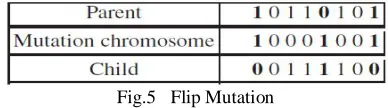
Based on a generated mutation chromosome, flipping of a bit involves changing 0 to 1 and 1 to 0. A parent is considered and a mutation chromosome is randomly generated [13]. For a 1 in mutation chromosome, the corresponding bit in parent chromosome is flipped (0 to 1 and 1 to 0) and child chromosome is produced. It is commonly used in binary encoding.
Fig.5 Flip Mutation
Interchanging Mutation
Two random positions of the string are chosen and the bits corresponding to thosepositions are interchanged [13].
Fig.6 Interchanging Mutation
Reversing Mutation
In case of reversing mutation applied for binary encoded chromosome, random position is chosen and the bits next to that position are reversed and child chromosome is produced [13].
Fig .7 Reversing Mutation
Uniform Mutation
The Mutation operator changes the value of chosen gene with uniform random value selected between the user specified upper and lower bound for that gene [13]. It is used in case of real and integer representation.
Creep Mutation
In creep mutation, a random gene is selected and its value is changed with a random value between lower and upper bound. It is used in case of real representation [13].
IV. MEMETIC ALGORITHM & LOCAL SEARCH
Hybrid genetic algorithm is formed by incorporation of problem specific information in a genetic algorithm at any level of genetic operation [14].The technique of hybridization of knowledge and global genetic algorithm is memetic algorithm. Memetic Algorithm is motivated by Dawkins notation of a meme. A meme is a unit of information that reproduces itself as people exchange ideas [15]. Memetic Algorithm binds the functionality of genetic algorithm with several heuristics search techniques like simulated annealing, tabu search, hill climbing etc. Before constructing an effective hybrid genetic algorithm, a number of issues should be carefully addressed. Two popular ways of hybridization depends on the concepts of “Baldwin effect” [16] and “Lamarckism” [17]. According to Lamarckism, the characteristics acquired by individual during its lifetime may become heritable traits. According to this approach both the fitness and genotype of individuals are changed during local optimization phase. According to Baldwinian search strategy, the local optimization can interacts and allow the local search to change the fitness of individual but genotype itself remain unchanged. Baldwinian search also have the effect of obscuring genetic differences and hindering the evolution process. This is known as Hindering effect [18]. This occurs as a result of different genotype mapping to the same phenotype. Most of the memetic algorithms are based on Lamarckism approach of hybridization.
In the proposed memetic algorithm, mutation operator is hybridized by using a local search technique namely hill climbing search. In principle, hill climbing algorithms perform a loop in which the currently known best solution individual is used to
produce one offspring Pnew. If this new individual is better than its parent, it replaces it. Then, the cycle starts all over again.
Algorithm
Hill-Climbing (problem) return state node: present, neighbor;
present := Make-Node(Initial-State(problem)); loop do
© 2014, IJCSMC All Rights Reserved
460
if (Value(neighbor) < Value(present))then return State(present) else current := neighbor end loop
end function
The returned state is a local maximum state.
V. PROPOSED HYBRID MUTATION
Mutation operator mainly depends on the type of encoding used in the problem. Mutation operator applicable in one encoding scheme sometimes leads to infeasible solution in other encoding scheme. By using any of the mutation operator one cannot achieve the optimal result. Still there is a scope of improvement in all the mutation in terms of performance. In this paper, a hybrid mutation operator is proposed which incorporates certain knowledge component along with existing mutation like inversion during mutation operation to generate better offspring using the principle of hill climbing search as shown in figure 1. In the proposed hybrid mutation one has to apply any problem specific mutation then do the improvement by using the hill climbing local search. Mutation prevents the algorithm to be trapped in a local minimum. Mutation plays the role of recovering the lost genetic materials as well as for randomly disturbing genetic information. It is an insurance policy against the irreversible loss of genetic material. If crossover is supposed to exploit the current solution to find better ones, mutation is supposed to help for the exploration of the whole search space. A simple mutation operator is not able to make small moves in the particular search area. In order to make a small move that may result into the better optimal result, one has to apply a local search. Let us consider the example of the permutated encoding TSP problem. In case of permutation encoding one can use the inversion mutation operator.
Fig.8 Flow Chart of Memetic algorithm with Proposed Hybrid Mutation
For example, suppose two parents are selected for crossover as below: Parent1: 4 3 6 2 5 1 9 7 8
Parent2: 6 4 7 1 5 2 9 8 3
And suppose crossover sites are chosen as 2 and 6. Children produces by PMX are as follows: Child1: 4 3 7 1 5 2 9 6 8
Child2: 7 4 6 2 5 1 9 8 3
Apply mutation operator, suppose inversion mutation. And suppose mutation sites are 3 and 6.
Mutated Child1: 4 3 2 5 1 7 9 6 8 Mutated Child2: 7 4 1 5 2 6 9 8 3
Apply hill climbing on mutated child Hybrid Child1: 4 7 2 6 1 3 9 5 8 Hybrid Child2: 3 4 2 5 1 6 9 8 7
Apply the hill climbing process on the mutated offspring until the improved solution is not obtained. Similarly one can use other operator like swap, scramble etc. The proposed mutation operator has the benefit of including the good solutions in search while avoiding the inferior ones.
VI. IMPLEMENTATION & OBSERVATION
© 2014, IJCSMC All Rights Reserved
461
and logistics. TSP problem is to find the shortest distance or Hamiltonian Path through a set of vertices, such that each vertex is visited exactly once [19]. Code considers the benchmark TSP problem namely Eil51 and oliva30 as the test problem. Parameters used for implementation are-
Population size: 50
Selection: Roulette wheel selection, Rank selection + Elitism
Crossover: PMX crossover.
Mutation: Inversion Mutation
Crossover probability (pc=0.7)
Mutation probability (pm=0.01)
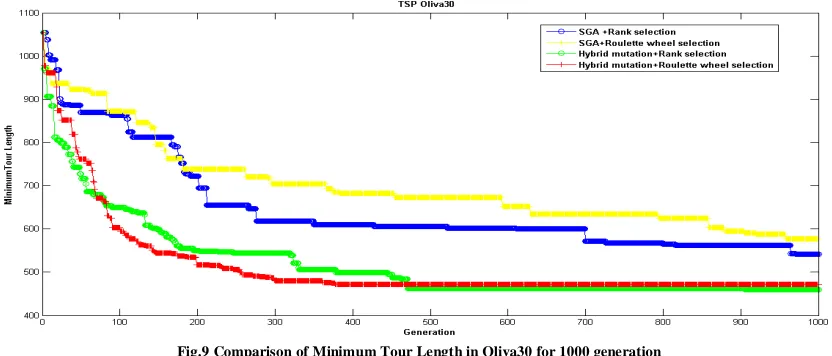
Minimum value of Tour length is computed and plotted to compare the performance of genetic algorithm and proposed hybrid mutation using roulette wheel and rank selection. Figure 9 and Figure 10 depicts the comparison of minimum tour length in two approaches for Oliva30 TSP problem in 1000 and 2000 generations respectively. Figure 12 and Figure 13 depicts the comparison of minimum tour length in two approaches for Eil51 TSP problem. Code checks the performance of genetic algorithm by using Roulette Wheel Selection (RWS) & Rank Selection (RS) first, then using the proposed hybrid mutation based memetic algorithm
Figure 11 and Figure 14 depicts the optimal tour Hamiltonian path for Eil51 and oliva30. Table 1 depicts the comparison of minimum tour length for different generation (Gen).
Fig.9 Comparison of Minimum Tour Length in Oliva30 for 1000 generation
Fig.10 Comparison of Minimum Tour Length in Oliva30 for 2000 generation
© 2014, IJCSMC All Rights Reserved
462
Fig.11 Oliva30 Hamiltonian pathFig.12 Comparison of Minimum Tour Length in EiL51 for 1000 generation
© 2014, IJCSMC All Rights Reserved
463
Optimal Tour [19] cities sequence in EiL51 is:
1 22 8 26 31 28 3 36 35 20 2 29 21 16 50 34 30 9 49 10 39 33 45 15 44 42 40 19 41 13 25 14 24 43 7 23 48 6 27 51 46 12 47 18 4 17 37 5 38 11 32
Fig.14 EiL51 Hamiltonian path
Table1. Results Comparison using different Iterations
Comparison (fmin) RWS RS Hybrid Mutation
+RWS
Hybrid Mutation+ RS
Gen=50 Oliver30 951.3 863 811.5 676.3
Eil51 1401 1321 1007 943.4
Gen=100 Oliver30 841.5 777.6 709.7 589.4
Eil51 1264 1124 914.1 741.4
Gen=200 Oliver30 793.7 732.8 659.9 580
Eil51 1254 1154 722 703
Gen=500 Oliver30 651.3 587.5 561.3 541.8
Eil51 1115 953 605 598
Gen=1000 Oliver30 576 541 471 460
Eil51 932.2 835.2 553.8 496.4
Gen=2000
Oliver30 505 471.2 451.4 419
Eil51 815.5 740.3 520.5 491.3
It has been observed from the Figures and results that the proposed hybrid mutation has outperformed genetic algorithm in terms of better exploration of search space that leads to the enhancement of convergence speed towards optimal solution. The proposed mutation operator is incorporating the problem specific knowledge to the traditional genetic algorithm that prevent algorithm to stick in genetic drift problem and maintains more diversity in population. Due to finite population size, genetic algorithm usually results in premature convergence. But in proposed hybrid mutation, due to the hybridization of suitable local search with mutation, the more fit offspring are generated that accelerates the search towards better optima.
VII. CONCLUSIONS
© 2014, IJCSMC All Rights Reserved
464
REFERENCES
[1] J. Holland, Adaptation in natural and artificial systems, University of Michigan Press, Ann Arbor, 1975.
[2] D.E. Goldberg, Genetic algorithms in search, optimisation, and machine learning, Addison Wesley Longman, Inc., ISBN 0-201-15767-5, 1989.
[3] W. E. Hart, “Adaptive global optimization with local search”, Doctoral Dissertation San Diego, University of California, 1994
[4] C. Reeves, "Genetic algorithms and neighborhood search evolutionary Computing: AISB Workshop, Lecture Notes in Computer Science, T. C. Fogarty, Ed. Leeds, UK: Springer-Verlag, pp. 115-130, 1994, vol. 865.
[5] Rakesh Kumar and Jyotishree, “Novel knowledge based tabu crossover in genetic algorithms”, International Journal of Advanced research in Computer science and software Engineering, vol 2, No. 8, pp 78-82, Aug 2012.
[6] Poonam Garg, “ A comparison between memetic algorithm and genetic algorithm for the cryptanalysis of simplified data encryption standard algorithm”, International Journal of Network Security and its Applications, vol 1, No. 1, pp 34-42 April 2009.
[7] Antariksha Bhaduri, “A mobile robot path planning using genetic artificial immune network algorithm”, Proceedings of World Congress on Nature and biologically Inspired Computing, NaBIC, IEEE, 2009, pp 1536-1539. [8] E. K. Burke and A. J. Smith, “A memetic algorithm for the maintenance scheduling problem”, Proceedings of
International Conf on Neural Information Processing and Intelligent Information, Springer 2010, pp 469-473. [9] Malin Bjornsdotter and Johan Wessberg, “A memetic algorithm for selection of 3D clustered featured with
applications in neuroscience”, Proceedings of International Conference on Pattern Recognition, IEEE, 2010, pp 1076-1079
[10] Manju Sharma, Sanjay Tyagi, “Novel Knowledge based selective tabu initialization in Genetic algorithm”, International Journal of Advanced Research in Computer Science and Software Engineering, Volume 3, Issue 5, May 2013, pp 764-770, ISSN: 2277 128X
[11] Manju Sharma, Sanjay Tyagi, “Hybrid Polygamous Selection: An improvement in Genetic Algorithm”, International Journal of Scientific & Engineering Research, Volume 4, Issue 6, June 2013, pp 1547-1552, ISSN 2229-5518.
[12] Devi Swapna, Jadhav Devidas G. and Pattnaik Shyam S, “Memetic algorithm & its application to function optimization and noise removal”. IEEE World congress on Information and Communication Technologies, 2011. [13] S.N. Sivanandam and S. N. Deepa., Introduction to Genetic Algorithms, Springer, ISBN 9783540731894, 2007. [14] P. Mascato and P. C. Cotta, “A gentle introduction to memetic algo-rithms”, Handbook of Metaheuristics, pp
105-144, 2003.
[15] R. Dawkins, “The selfish gene”, Oxford University Press, Oxford, 1976.
[16] K Ku., M. Mak, “Empherical analysis of the factors that affect the Baldwin effect, Parallel problem solving from nature”, Proc. Berlin, Heidelberg: Springer 5th International Conference, lecture notes in computer science, pp 481-90, 1998.
[17] G. M. Morris, G. M. Goodsell. , R. S. Halleday et al., “Automated docking using a Lamarckian genetic algorithm and an empherical bending free energy function”, Journal of Computational Chemistry, vol 19, pp 1639-62, 1998. [18] G. Mayley, "Landscapes, learning costs and genetic assimilation," Evolutionary Computation, vol. 4, pp. 213 - 234,
1996.