Hierarchical Attribute-based Signatures
Constantin-Cˇatˇalin Drˇagan, Daniel Gardham and Mark Manulis
Surrey Centre for Cyber Security, University of Surrey, UK
[email protected], [email protected], [email protected]
Abstract. Attribute-based Signatures (ABS) are a powerful tool allowing users with at-tributes issued by authorities to sign messages while also proving that their atat-tributes satisfy some policy. ABS schemes provide a flexible and privacy-preserving approach to authenti-cation since the signer’s identity and attributes remain hidden within the anonymity set of users sharing policy-conform attributes. Current ABS schemes exhibit some limitations when it comes to the management and issue of attributes. In this paper we address the lack of support for hierarchical attribute management, a property that is prevalent in traditional PKIs where certification authorities are organised into hierarchies and signatures are verified along roots of trust.
Hierarchical Attribute-based Signatures (HABS) introduced in this work support delegation of attributes along paths from the top-level authority down to the users while also ensuring that signatures produced by these users do not leak their delegation paths, thus extending the original privacy guarantees of ABS schemes. Our generic HABS construction also ensures unforgeability of signatures in the presence of collusion attacks and contains an extended traceability property allowing a dedicated tracing authority to identify the signer and reveal its attribute delegation paths. We include a public verification procedure for the account-ability of the tracing authority.
We anticipate that HABS will be useful for privacy-preserving authentication in applications requiring hierarchical delegation of attribute-issuing rights and where knowledge of delega-tion paths might leak informadelega-tion about signers and their attributes, e.g., in intelligent transport systems where vehicles may require certain attributes to authenticate themselves to the infrastructure but remain untrackable by the latter.
1
Introduction
Attribute-based Signatures. ABS schemes, introduced independently in [32] and [31], offer a flexible, privacy preserving primitive for authenticating messages. When presented with an attribute-based signature, verifiers are convinced that the signer owns a set of attributes satis-fying the signing policy, however, they do not learn the signer’s identity nor the set of attributes and hence provide for signer’s anonymity within a set of users holding policy-conform attributes. Users who are not in possession of such attributes are not able to produce valid ABS signatures, even if they collude and try to pool their attributes together. We note that while [32] enjoys an expressive policy, [31] drops this fine-grained control in favour of a more efficient threshold-based construction and such trade-off has commonly been seen in some later ABS schemes, e.g. [31, 21, 26]. ABS schemes can also be generalised to policy-based signatures [4].
Existing ABS constructions typically rely on zero-knowledge proofs in the signature generation phase, with a vast majority of schemes, e.g. [19, 35, 34, 4, 18, 22, 17], being proposed in the standard model based on bilinear maps and Groth-Sahai proofs [24]. A notable exception is the scheme in [26], which uses the RSA setting yet requires random oracles.
While anonymity makes ABS schemes interesting for fine-grained privacy-preserving authenti-cation, the ability to trace and identify signers for accountability is another useful property that has been considered in the context of several ABS schemes [18, 15, 22].
to issue attributes requires authorisation then some additional control mechanisms fordelegation of attribute-issuing rights would be needed.
From a more general view, it would require an ABS scheme to support a hierarchy of attribute authorities, managed by some top-level (root) authority, and enable delegation of issuing rights (for subsets of attributes) along various delegation paths consisting of intermediate authorities. With such hierarchy, signers would be able to obtain attributes only from authorities that are authorised to issue them. For practical purposes the hierarchy should be dynamically expandable, i.e., it should be possible to add intermediate authorities (at any level) at any time. This setting resembles conceptual similarity with traditional PKIs where certification authorities form a hier-archy. The main difference is that, in the context of ABS schemes, such hierarchical delegation imposes additional challenges on the privacy of signers since leakage of the delegation path from the ABS signature may compromise the signer’s anonymity by leaking information about the sub-sets of attributes that the signer might possess, e.g. if some authority is only responsible for a small number of attributes or otherwise has some identifying information (for example, geographic location) that could also be used to identify the signer. We note that a hybrid solution whereby the hierarchy is defined by the CAs, delegation is performed via traditional PKI certification and credentials issued to signers are standard ABS credentials would suffer from the same privacy-leaking problems. Therefore, hierarchical ABS schemes must incorporate a proof of validity of the delegation paths without disclosing any information about intermediate authorities, implying that verification must be done in relation to the public key of the top-level authority and not of the intermediate authorities.
This brings further challenges when it comes to accountability. The associated tracing mech-anism needs to identify not only the signer (as in the case of existing ABS constructions) but also delegation paths through which attributes were obtained. This is because the root authority may not be aware that some particular user was issued attributes by an intermediate authority. In addition, malicious intermediate authorities in the hierarchy can try to misuse their delegation rights and create further fake authorities or users to issue rogue ABS signatures. The delegation paths disclosed by the tracing algorithm would be able to detect this behaviour, thus extending accountability to intermediate authorities.
Our Contribution: Hierarchical ABS.In this paper we solve the aforementioned challenges by proposing Hierarchical ABS (HABS) to enable hierarchical management by a root authority and delegation of attribute-issuing rights. HABS extends the anonymity guarantees by hiding not only the signers and their attributes but also the delegation paths (i.e., intermediate authorities) that were used for these attributes. We call this new property path anonymity. HABS supports dynamic hierarchies, enables delegation of attribute-issuing rights to new authorities, and allows signers to obtain attributes from multiple authorities within the hierarchy with guarantees that the entire delegation path (incl. the signer) can be revealed by an independent tracing authority. Moreover, we require public verifiability for the output of this tracing procedure to address the case where the tracing authority tries to cheat. Needless to say, HABS offers extended unforgeabil-ity guarantees, expressed through thenon-frameability requirement, ensuring that only holders of policy-conform attributes can sign, and in particular, preventing collusions between signers and authorities. We formally define HABS and propose its generic construction from public key en-cryption, digital signatures and non-interactive zero-knowledge proofs of knowledge. Our HABS scheme can be instantiated using bilinear maps in the standard model under the DLIN,q-SDH and Simultaneous Flexible Pairing (SFP) [1] assumptions. Our HABS scheme supports a more general scenario where intermediate authorities and users can become part of multiple independent hier-archies, each managed by a separate root authority. We also discuss the revocation of delegation and signing rights in the context of HABS, which is known to be notoriously challenging for all hierarchical signature schemes (incl. PKIs).
Applications.HABS can find applications in traditional ABS scenarios (cf. [32]) while enabling hierarchical delegation of attributes. Due to their distinctive path-anonymity and path-traceability properties we anticipate further applications in privacy-preserving authentication where there is a need to also hide the intermediate authorities that were involved in issuing the attributes.
[27, 23], group signatures [38, 25] or identity-based signatures [29, 40] have all their limitations with regard to scalability and/or limited expressivity (cf. survey in [36]). As noted in [33] an attribute-based approach would bring substantial benefits and while [33] aims at realisations with heavier attribute-based credential systems, we believe that HABS could offer a more lightweight alternative. For example, the root authority can be some regulatory authority while manufacturers, authorized dealerships, local garages or testing facilities would define the hierarchy. Assume some town has a policy that bans diesel vehicles that did not pass an emission test. By viewing a vehicle’s fuel type and its emission test results as attributes issued by the manufacturer and some local testing facility, respectively, the vehicle would be able to prove its compliance with the town’s policy without disclosing any other information such as its make or which local facility performed the test.
2
Model of Hierarchical Attribute-based Signatures
In this section we describe the entities, their roles and define the algorithms for HABS. The involved entities are attribute authorities, users (signers), and a dedicated tracing authority.
Attribute Authorities.Theroot authority (RA) with its key pair (ask0,apk0) is at the top of
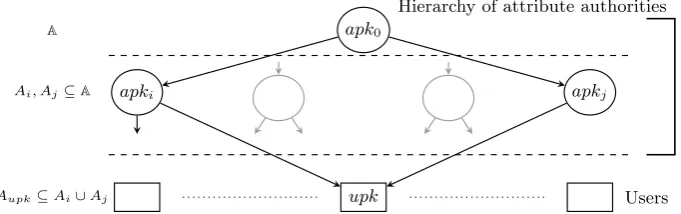
HABS hierarchy and defines its universe of attributesA. The RA can delegate subsets fromAto other authorities in the scheme, who are then able to delegate attributes from their subsets further, creating a dynamically expandable hierarchy of attributes (see Fig. 1). In order to be admitted to the hierarchy, eachintermediate authority (IA)needs to generate its own key pair (aski, apki),i >0 and become authorised by some already admitted authority by obtaining a subset of attributes. In addition to delegation of attributes, each authority can issue attributes from its set to the end users (signers). It is assumed that admitting authorities make sufficient checks on whether the entities they admit are eligible to receive the attributes.
Hierarchy of attribute authorities
Users apk0
apki apkj
upk
A
Ai, Aj⊆A
Aupk⊆Ai∪Aj
Fig. 1. Example of a HABS hierarchy where a user with public key upk receives its set of attributes Aupk⊆Ai∪Aj from two IAsiandj, who in turn receive their attribute setsAi andAjfrom the RA.
Users.Upon joining, each user generates its own key pair (usk,upk) and is issued with a subset of attributes by one or more authorities from the hierarchy. Any admitted user can generate a valid HABS signature on a message m with respect to some predicate Ψ using the secret key usk and the set of issued attributesA as long as this set contains some subsetA0 ⊆A that are needed to satisfyΨ, i.e. Ψ(A0) = 1. HABS signatures will be verified with respect toΨ and the RA’s public keyapk0. Note that, unlike authorities, users cannot delegate their attributes to other entities and
can be viewed as the lowest level of the hierarchy (see Fig. 1). We make use of a label?to denote the end of the delegation path, and prevent the user from further delegating his attributes. Note we sometimes usej to differentiate users.
Warrants.For delegation of attributes to intermediate authorities and for their issue to the sign-ers it is convenient to use warrants. That is, upon admission each HABS entity (IAs and signer) obtains awarrantwarrthat containsallattributesa∈A(along with their delegation paths) that the entity receives from the authority. However, upon signing we assume that a “reduced warrant”
warr containing only a reduced attribute setA0 for whichΨ(A0) = 1 will be used by the signer. Note that by warr[a], for a ∈warr, we denote the delegation path (apk0, . . . ,{apki,{upk, ?}}), starting with RA’s public keyapk0and ending with the entity’s public key, i.e.apkifor the IAior upkfollowed by a fixed label?(which is used to denote that this path cannot be extended further) for the corresponding user. We use|warr| to denote the total number of attributes inwarr and use|warr[a]|to refer to the length of the delegation path for the attribute a.
Tracing Authority. A dedicatedtracing authority (TA) with its own key pair (tsk, tpk) is re-sponsible for tracing HABS signatures. The extended tracing procedure in HABS outputs warr
Definition 1 (Hierarchical ABS Scheme).HABS:= (Setup,KGen,AttIssue,Sign,Verify,Trace, Judge)consists of the following seven processes:
• Setup(1λ) is the initialisation process where based on some security parameterλ∈
N, the public parameters pp of the scheme are defined, and the root and tracing authority independently generate their own key pair, i.e. RA’s(ask0, apk0)and TA’s(tsk, tpk). In addition, RA defines
the universeAof attributes, and a label? for users. We stress that due to dynamic hierarchy, the system can be initialised by publishing (pp,apk0, tpk)withA and?contained in pp. • KGen(pp)is a key generation algorithm executed independently by intermediate authorities and
users. Each entity generates its own key pair, i.e.,(aski, apki)fori >0 or(usk, upk). • AttIssue (aski,warri, A,{apkj|upkj}) is an algorithm that is used to delegate attributes to
an authority with apkj or issue them to the user with upk. On input of an authority’s secret keyaski,i∈N0, its warrantwarri, a subset of attributesAfromwarri, and the public key of the entity to which attributes are delegated or issued, it outputs a new warrant warr for that entity.
• Sign ((usk,warr),m, Ψ)is the signing algorithm. On input of the signer’s usk and (possibly reduced) warr, a messagem and a predicateΨ it outputs a signatureσ.
• Verify (apk0,(m, Ψ, σ)) is a deterministic algorithm that outputs 1 if a candidate signature
σon a message mis valid with respect to the predicate Ψ and 0 otherwise.
• Trace (tsk, apk0,(m, Ψ, σ))is an algorithm executed by the TA on input of its private key tsk
and outputs either a triple(upk,warr,π)ˆ if the tracing is successful or⊥to indicate its failure. Note thatwarr contains attributes and delegation paths that were used by the signer.
• Judge (tpk, apk0,(m, Ψ, σ), (upk,warr,ˆπ)) is a deterministic algorithm that checks a
candi-date triple(upk,warr,π)ˆ from the tracing algorithm and outputs 1 if the triple is valid and 0 otherwise.
The correctness property of HABS requires that any signature σ output by any signer with usk in possession of a legitimately issued warrantwarr that contains attributesa∈Asatisfying Ψ can be successfully verified and traced, and that a triple (upk,warr,ˆπ) output by the tracing algorithm for suchσpasses the public judgment procedure.
2.1 Security Properties
In this section, we define three security properties of HABS schemes: path anony- mity, non-frameability, andpath traceabilityand use game-based definitions assuming some PPT adversaryA that interacts with the entities using oracles. We note that our definitions extend earlier definitions for (multi-authority) ABS schemes, e.g. [32, 4, 18, 22], to account for the hierarchical setting and potential corruptions within the hierarchy. In addition, our definitions of path-anonymity and path-traceability focus on hiding resp. verifiable traceability of delegation paths from the signer’s warrant, a distinctive feature of HABS. Our modeling techniques for these properties are inspired by definitions behind anonymous proxy signatures [20] which do not apply directly to the attribute-based setting.
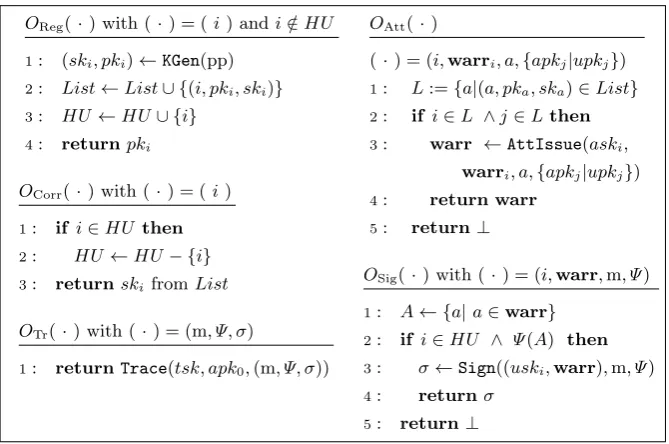
Oracles for A. The oracles available to a PPT adversary A are defined in Fig. 2 and their high-level description is provided in the following. In our oracles we take into account that only authorities can delegate and issue attributes whereas only signers can generate HABS signatures.
– OReg: A can register new IAs and users for whom, in response, a key pair will be honestly
generated and the public key given toA. The oracle uses lists to keep track of the established entities and their keys. Upon registration all entities are initially considered to be honest.
– OCorr: A can corrupt established entities. On input of the entity’s public keyA receives the
corresponding private key, as long as this entity has been previously established. The oracle keeps track of entities who were corrupted.
– OAtt:Acan ask an authority to either delegate attributes for another IA or to issue attributes to
a user, as long as both involved entities are registered. Note thatAcan define which attributes the oracle should use. If both entities are registered and the issuing entity has rights to issue attributes provided byAthen the output warrant warris given toA.
– OSig:Acan ask a signer to produce a HABS signature using the input warrantwarr, a message
OReg(·) with (·) = (i) andi /∈HU 1: (ski, pki)←KGen(pp)
2: List←List∪ {(i, pki, ski)} 3: HU←HU∪ {i}
4: returnpki
OCorr(·) with (·) = (i) 1: if i∈HU then
2: HU←HU− {i}
3: returnskifromList
OTr(·) with (·) = (m, Ψ, σ)
1: returnTrace(tsk, apk0,(m, Ψ, σ))
OAtt(·)
(·) = (i,warri, a,{apkj|upkj}) 1: L:={a|(a, pka, ska)∈List} 2: if i∈L ∧j∈Lthen
3: warr ←AttIssue(aski,
warri, a,{apkj|upkj}) 4: return warr
5: return⊥
OSig(·) with (·) = (i,warr,m, Ψ) 1: A← {a|a∈warr}
2: if i∈HU ∧ Ψ(A) then
3: σ←Sign((uski,warr),m, Ψ) 4: returnσ
5: return⊥
Fig. 2.Oracles used in the HABS security experiments.
– OTr:Acan ask the TA to perform the tracing procedure on its input, in which case its output
(which can also be⊥) is returned toA.
Path Anonymity.For HABS we extend the anonymity property of traditional ABS schemes to achieve privacy of the delegation path, i.e., not only to hide the signer but also all intermediate authorities that were involved in the delegation of attributes for that signer. Our game forpath anonymity in Fig. 3 requires the adversary to decide which user’s warrant and private key were used in the generation of the challenge HABS signatureσb. We consider a powerful two-stage PPT adversaryA= (A1,A2), who knows the private keys of the candidate signers and can moreover
establish its own HABS hierarchy (with IAs and users) by learning the secret keyask0of the root
authority. This also means that the adversary comes up with the candidate warrants warr0 and
warr1 for the two users in the challenge phase. Since HABS signatures do not aim to hide the length of the delegation paths nor the number of attributes used to satisfy the policy we require that both warrants are of the same size and that they both satisfy the predicateΨ output by the adversary. Since attributes are contained in warrants our definition also implies attribute-hiding.
Exppa-HABSb,A(λ)
1: (pp, ask0, tsk)←Setup(1λ)
2: (st,(usk0,warr0),(usk1,warr1), m, Ψ)← A1(pp, ask0:OReg, OCorr, OTr) 3: if |warr0|=|warr1| then
4: σ0←Sign((usk0,warr0),m, Ψ), σ1←Sign((usk1,warr1),m, Ψ) 5: if Verify(apk0,(m, Ψ, σ0)) = 1 andVerify(apk0,(m, Ψ, σ1)) = 1then 6: b0← A2(st, σb:OTr)
7: returnb0 ∧ A2 did not queryOTr(tsk,(m, Ψ, σb)) 8: return0
Fig. 3.Path-Anonymity Experiment
Definition 2 (Path Anonymity). A HABS scheme offers path anonymity if no PPT adversary Acan distinguish betweenExppa-0HABS,AandExppa-1HABS,Adefined in Fig. 3, i.e., the following advantage is negligible inλ:
AdvpaHABS,A(λ) =
Pr
h
Non-Frameability.Another fundamental property for HABS is
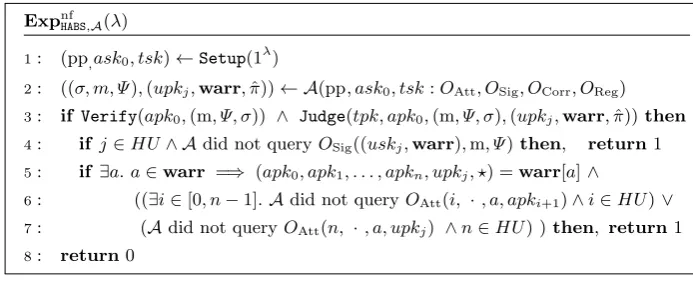
non-frameabili-tythat extends unforgeability to ensure only authorized authorities can delegate and only attribute policy-compliant users can sign. This property is formalized in Fig. 4, and requires the adversaryA to produce valid authorizations for attributes he does not satisfy: either as a valid HABS signature σfor some honest user with upk, or as a valid tracing information that includes a warrant warr
issued by an honest authority. In the latter, it is enough forAto provide a single attributeafor which the delegation path contains one honest authority i or an honest user with upk without queryingOAttfor that authority or user. We consider a PPT adversary A, who can admit IAs to
the HABS hierarchy using the RA’s private keyask0, and act on behalf of the TA usingtsk.
ExpnfHABS,A(λ)
1: (pp,ask0, tsk)←Setup(1λ)
2: ((σ, m, Ψ),(upkj,warr,πˆ))← A(pp, ask0, tsk:OAtt, OSig, OCorr, OReg) 3: if Verify(apk0,(m, Ψ, σ)) ∧ Judge(tpk, apk0,(m, Ψ, σ),(upkj,warr,πˆ))then 4: if j∈HU∧ Adid not queryOSig((uskj,warr),m, Ψ)then, return1 5: if ∃a. a∈warr =⇒ (apk0, apk1, . . . , apkn, upkj, ?) =warr[a]∧
6: ((∃i∈[0, n−1].Adid not queryOAtt(i, ·, a, apki+1)∧i∈HU)∨ 7: (Adid not queryOAtt(n, ·, a, upkj) ∧n∈HU) )then, return1 8: return0
Fig. 4.Non-Frameability Experiment
Definition 3 (Non-Frameability). A HABS scheme is non-frameable, if no PPT adversary A can win the experimentExpnfHABS,Adefined in Fig. 4, i.e., the following advantage is negligible inλ:
AdvnfHABS,A(λ) = PrhExpnfHABS,A(λ) = 1i.
Remark 1 In the non-frameability experiment we consider a strong adversary that has full con-trol of the hierarchy through the OReg and OAtt oracles. We capture the notion that malicious
authorities and colluding users should not be able to produce signatures on behalf of, and there-fore framing, honest users. This is a stronger notion of security than considered in some existing ABS schemes [32, 4].
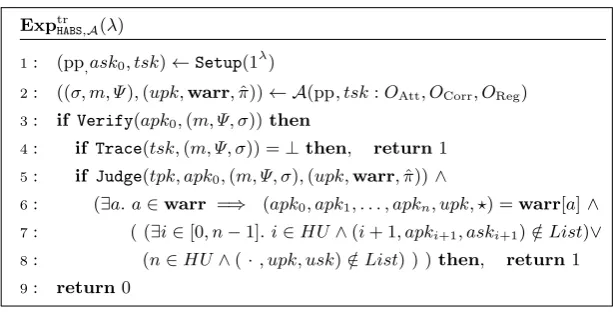
Path Traceability.The final property we consider for HABS is path traceability in Fig. 5 that offers accountability for the entire delegation path and the tracing authority, but also validity of the entities in that delegation path. The adversaryAis required to produce a valid HABS signatureσ that either cannot be traced, or can be traced to a warrantwarrthat contains at least one “rogue” entity (some authorityi or user with upk) within any of its delegation paths that has not been previously registered through the registration oracle, i.e., is not contained inList. For honest and registered authoritiesA can use the attribute-issuing oracle, which internally checks whether the public key of the entity for which the warrant needs to be issued has been registered before. This excludes a trivial attack whereA obtains a legitimate warrant for some rogue entity from some honest authority. In its attack we also equipAwith the TA’s private key.
Definition 4 (Path Traceability).AHABS scheme offers path traceability if no PPT adversary Acan win the experimentExptrHABS,Adefined in Fig. 5, i.e., the following advantage is negligible in λ:
AdvtrHABS,A(λ) = Pr
ExptrHABS,A(λ) = 1
.
3
Construction
Exptr HABS,A(λ)
1: (pp,ask0, tsk)←Setup(1λ)
2: ((σ, m, Ψ),(upk,warr,πˆ))← A(pp, tsk:OAtt, OCorr, OReg) 3: if Verify(apk0,(m, Ψ, σ))then
4: if Trace(tsk,(m, Ψ, σ)) =⊥then, return1
5: if Judge(tpk, apk0,(m, Ψ, σ),(upk,warr,πˆ))∧
6: (∃a. a∈warr =⇒ (apk0, apk1, . . . , apkn, upk, ?) =warr[a]∧ 7: ( (∃i∈[0, n−1]. i∈HU∧(i+ 1, apki+1, aski+1)∈/List)∨ 8: (n∈HU∧(·, upk, usk)∈/List) ) )then, return1
9: return0
Fig. 5.Path-Traceability Experiment.
3.1 Preliminaries
Here we briefly introduce some preliminary material that we make use of in the following sections.
Span Programs.For a given monotone boolean function Ψ :{0,1}n → {0,1}, amonotone span program forΨ overF is a pair (S,ρ) whereS∈MFl×tandρ: [l]→[n] is a labelling function that maps each row of S to an input variable ofΨ. For all inputs toΨ, we have the following property:
Ψ(x1, ..., xn) = 1⇔ ∃z∈F1×ls.t.zS= [1,0, ...,0] and (∀i:xρ(i)= 0 =⇒ zi= 0). That is,Ψ(x1, ..., xn) = 1 iff the rows of S indexed byis.t.xρ(i)= 1 span the vector [1,0,...,0]. Bilinear Groups.A tupleG:= (G1,G2,GT, G1, G2, e) is abilinear group ifG1 andG2 generate
the groupsG1 and G2 respectively, and e:G1×G2 →GT is a non-degenerate bilinear map. In particular, the following property holds:e(xa, yb) =e(x, y)ab fora, b∈Z,x∈G1 andy∈G2. Complexity Assumptions.
DLIN[6]: For a groupG:=hgiof prime orderp, given (ga, gb, gra, gsb, gt) fora, b, r, s, t∈ Zp, it is computationally infeasible to determine whethert=r+sor iftis random.
q-SDH[6]: ForG1:=hg1iandG2:=hg2i, both of prime order p, given a (q+2)-tuple (g1, g2, g
γ
2,
g2(γ2), ..., g(2γq)) as input, it is hard to output a pair (g11/(γ+x), x) for the adversary’s choice ofx∈Zp.
SFP[1]: For a bilinear groupGandGZ, FZ, GR, FU random generaters ofG1. Let (A,A), (B,˜ B) be˜
random pairs inG1×G2. Forj= 1, ..., q, letRj := (Z, R, S, T, U, V, W) that satisfies (1)e(A,A) =˜ e(Gz, Z)e(GR, R)e(S, T) and (2) e(B,B) =˜ e(FZ, Z)e(FU, U)e(V, W). Given (G, GZ, FZ, GR, FU, A,A, B,˜ B) and uniformly chosen˜ R1, ..., Rq, it is hard to find (Z∗, R∗, S∗, T∗, U∗, V∗, W∗) that fulfil relations (1) and (2) under the restriction thatZ∗6= 1 and Z∗=6 Z∈Rj for everyRj.
3.2 Building Blocks
3.3 Generic Construction
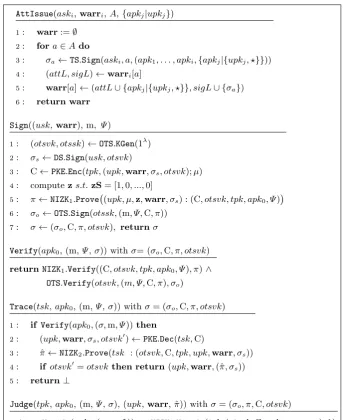
High-Level Overview.We use the above general building blocks to construct ourHABSscheme, which is specified in Fig. 6. In the following we provide a high-level intuition behind its construc-tion. Attribute authorities (RA and IAs) generate their key pairs (aski, apki),i∈N0for the tagged
signature schemeTS. The TA holds a key pair (tsk,tpk) for the public key encryption schemePKE. The public parameters pp of the scheme also contain trusted common reference stringscrs1 and
crs2 for the corresponding NIZK proofs.
Attributes a ∈ A are viewed as tags of the TS scheme whereas delegation paths attL := (apk0, . . . ,{apki,{upki+1, ?}}) are treated as messages. In order to create a warrant warr for
some authority or signer, the corresponding IA with itsaski will produce aTSsignature on each attributeaand its delegation path and include this signature intowarr[a] as part of the listsigL. Thus, a separateTSsignature is used for each attribute and its path such that the signer can later reduce itswarrto attributes that are needed for a policyΨ.
Each signer, after initialisation, holds a key pair (usk, upk) for the digital signature schemeDS. A signer withusk and a reducedwarrthat satisfiesΨ can generate a HABS signatureσfor some message m.
The reduced warr together with the signer’s public keyupk and a digital signatureσs with messageotsvkare encrypted in aPKEciphertext C under the TA’s public keytpkwith randomness µ. The signer generates a key pair (otssk, otsvk) for the one-time signature schemeOTSand uses itsusk to compute a digital signatureσs onotsvk.
We modelΨ as a monotone span programSwith a labelling function ρthat maps rows from
Sto attributes inA. The signer attests the satisfiability ofΨ w.r.t its attributes from the reduced
warrby computing a vector of integerszsuch that zS= [1,0, . . . ,0] and for anyzi 6= 0 we have ρ(i)∈warr. Then, the signer computes aNIZK1 proofπfor the statement (C, otsvk, tpk, apk0, Ψ)
using as witness previously computed (upk, µ,z,warr, σs) such that the following relation is sat-isfied:
PKE.Enc(tpk,(upk,warr, σs, otsvk);µ) = C∧DS.Verify(upk, otsvk, σs) ∧ zS= [1,0, . . . ,0] ∧ ∀i. zi6= 0 =⇒ ai=ρ(i) ∧ ((apk0, apki1, . . . , apkin, upk, ?)(σi1, . . . , σin, σu)) =warr[ai]
∧(∀1≤j≤n.TS.Verify(apki(j−1), σij, ai,(apk0, apki1, . . . , apkij)))
∧TS.Verify(apkin, σu, ai,(apk0, apki1, . . . , apkin, upk, ?))
.
The resulting HABS signatureσ contains the aforementioned C, π, andotsvk, along with an OTSsignature σo, generated usingotssk to bind these value together with the message mandΨ. The validity of such HABS signatureσcan be verified using public parameters of the scheme and RA’s public keyapk0by checking the validity of theNIZK1 proofπand theOTSsignatureσo.
The tracing algorithm, on input of a valid HABS signature ((σo,C, π, otsvk),
m, Ψ) usestskto decrypt the warrantwarrfrom the ciphertext C. The decrypted warrant contains all attributes and delegation paths, incl. signer’s public keyupk, and signatureσs.In addition, TA outputs aNIZK2proof ˆπfor the statement (otsvk,C, tpk,(apk0,warr, σs)) usingtskas its witness to prove the following relation:
PKE.Dec(tsk,C) = (upk,warr, σs, otsvk).
The output of TA on a valid HABS signature can be publicly judged by checking the validity of theNIZK2proof ˆπ.
4
Security Proofs
In this section we prove our main theorem by showing the construction in Fig. 6 satisfies path anonymity,non-frameability, andpath traceabilityfrom assumptions underlying its cryptographic building blocks.
Lemma 1 The generic HABSconstruction from Fig. 6 offers path anonymity, if NIZK1 andNIZK2
AttIssue(aski,warri,A,{apkj|upkj}) 1: warr:=∅
2: fora∈Ado
3: σa←TS.Sign(aski, a,(apk1, . . . , apki,{apkj|{upkj, ?}})) 4: (attL, sigL)←warri[a]
5: warr[a]←(attL∪ {apkj|{upkj, ?}}, sigL∪ {σa}) 6: return warr
Sign((usk,warr), m, Ψ)
1: (otsvk, otssk)←OTS.KGen(1λ)
2: σs←DS.Sign(usk, otsvk)
3: C←PKE.Enc(tpk,(upk,warr, σs, otsvk);µ) 4: computezs.t.zS= [1,0, ...,0]
5: π←NIZK1.Prove (upk, µ,z,warr, σs) : (C, otsvk, tpk, apk0, Ψ)
6: σo←OTS.Sign(otssk,(m, Ψ,C, π)) 7: σ←(σo,C, π, otsvk), returnσ
Verify(apk0, (m,Ψ,σ)) withσ= (σo,C, π, otsvk)
returnNIZK1.Verify((C, otsvk, tpk, apk0, Ψ), π)∧
OTS.Verify(otsvk,(m, Ψ,C, π), σo)
Trace(tsk,apk0, (m,Ψ,σ)) withσ= (σo,C, π, otsvk) 1: if Verify(apk0,(σ,m, Ψ))then
2: (upk,warr, σs, otsvk
0
)←PKE.Dec(tsk,C)
3: πˆ←NIZK2.Prove(tsk : (otsvk,C, tpk, upk,warr, σs)) 4: if otsvk0=otsvkthen return(upk,warr,(ˆπ, σs)) 5: return⊥
Judge(tpk,apk0, (m,Ψ,σ), (upk,warr, ˆπ)) withσ= (σo, π,C, otsvk)
returnVerify(apk0,(σ,m, Ψ)) ∧ NIZK2.Verify(tpk,(otsvk,C, upk,warr, σs),πˆ)
Fig. 6.Algorithms of our generalHABSscheme.
Proof. We follow a game-based approach and show that the advantage of the PPT adversary A in the path-anonymity experiment for the HABS construction from Fig. 6, is bounded by the advantages of the constructed adversaries for the underlying primitives. For simplicity, we assume that adversary A asks n user registration queries and the probability for sampling one of these users is 1/n.
Game G0: Let this be the experiment corresponding to Exp pa-b
HABS,A(λ) in Fig. 3, where the
adversaryA= (A1,A2) is required to distinguish between the signaturesσ0= (σ0o,C0, π0, otsvk0)
andσ1= (σo1,C1, π1, otsvk1).
Game G1: This game is obtained from the gameG0 where the restriction “A2 did not query
OTr(m, Ψ, σb)” is enforced by theOTroracle available toA2. This is done by aborting the game, ifA2
queries (m, Ψ, σb). We model this by adding the line “if (σo, C, π, otsvk)=(σo,b, Cb, πb, otsvkb) then returnabort”, when the adversary callsOTr(m, Ψ,(σo, C, π, otsvk)) andσb= (σo,b, Cb, πb, otsvkb). The gamesG0 andG1 preserve the same probability with respect to the adversaryA= (A1,A2).
Pr[G1= 1] = Pr[G0= 1].
Game G2: We define G2 as game G1 except on the outputs of OTr, where we replace the
forNIZK2 we replaceSetup bySimSetup. These changes are done to avoid the case whereAmay
”extract”tsk from NIZK2 proofs. Thus, for all future OTr oracle call we make use of a simulated
NIZK2 proof. We bind the probability of Ato distinguish between these games by the advantage
of the (multi-theorem) zero-knowledge adversaryBnizk2 forNIZK2. Hence,
|Pr[G2= 1]−Pr[G1= 1]| ≤AdvzkBzk,NIZK2(λ).
Game G3: Let G3 be the game obtained from G2 where the real NIZK1 proof πb from the challenge signature σb = (σo,b, Cb, πb, otsvkb) is replaced with the simulated proof π0b by calling NIZK1.Simon the inputs (Cb, otsvkb, tpk, apk0, Ψ). Similar to the previous step, by now forNIZK1
we replaceSetupbySimSetup. We bound the capabilities of the adversaryAto distinguish between gamesG2 and G3 by the advantage of the zero-knowledge adversary Bnizk1 for theNIZK1 proof
system. The adversaryBnizk1 executes all steps from gameG3, except for the calls toNIZK1 that
he replaces with oracle requests. There is only one sign challenge request performed only when the adversaryBnizk1constructs the signatureσb. Hence,
|Pr[G3= 1]−Pr[G2= 1]| ≤AdvzkBnizk1,NIZK1(λ).
GameG4:GameG4is identical to gameG3, except we abort ifA2queriesOTr(m, Ψ,(σo,C, π, otsvk)) if (C, otsvk) = (Cb, otsvkb). The adversary Ais able to distinguish between G3 and G4,
only if he can produce a validOTSsignatureσo for a statement (Cb, π, m, Ψ) and verification key otsvkb, without knowledge of the signing keyotsskb. Essentially, breaking the strong unforgeability ofOTS.
We bound the capabilities of the adversary A to distinguish between this two games by the advantage of the unforgeability adversaryBots for the OTSscheme that uses otsvkb as the public key. The adversaryBots on input otsvkb does all the steps described in game G4, except he does
not call OSig to produce σb, instead he uses his OTS signing oracle to receive a signature σbo for (m, Ψ,Cb, πb) and pass this to A2. Then, Bots waits for A2 to provide a valid input to OTr that
contains Cb,otsvkb andσo6=σob orπ6=πo, and use this as his forgery.
|Pr[G4= 1]−Pr[G3= 1]| ≤Adveuf-cmaBots,OTS(λ).
GameG5:This gameG5is the same asG4, except we abort ifA2 queriesOTr(m, Ψ,(σo,C, π, otsvk)) when C = Cb. The output of OTr remains unchanged between these two games, as the
oracle return⊥ifotsvkb from C is different fromotsvk received as input. GameG5preserves the
same probability asG4:
Pr[G5= 1] = Pr[G4= 1].
Game G6: LetG6 be the game obtained fromG5 where the ciphertext Cb from the challenge signatureσb = (σbo, Cb, π0b, otsvkb) is replaced with the C0. The distinguishing capabilities of the
adversaryA2, is bounded by the advantage of the IND-CCA2 adversaryBindfor thePKEencryption
scheme. This only applies for the caseb = 1. The adversary Bind performs all the steps in game G6 except the ones that require interaction withPKE, where he uses the oracle he has access to. A
single challenge query is performed between the calls toA1 andA2 calls.A2may askOTr queries
for any signature that does not contain the challenge ciphertext, andBindanswers them by calling the decryption oracle.
|Pr[G5= 1]−Pr[G6= 1]| ≤Advind-cca2B,PKE (λ).
The experimentG6provides as challenge toAthe exact same values independent of the random
bitb that Ais asked to guess. Additionally, due to zero-knowledge of NIZK2 used in G1, A does
not have access totsk. Therefore, the probability the adversary wins gameG6 is 12 and hence the
advantage ofAto win this experiment is 0.
Pr[G6= 1] =
1 2.
From the sequence of games above, the result of this lemma follows. ut
Lemma 2 The genericHABSconstruction from Fig. 6 is non-frameable, ifNIZK1 is sound,TSand
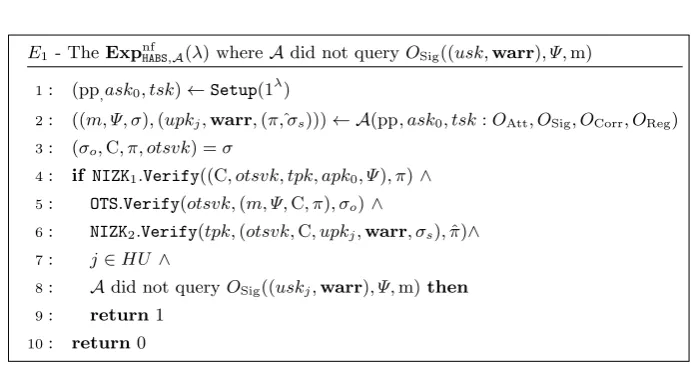
Proof. We model our proof by dividing the non-frameability experiment from Fig. 4 into two experiments based on the winning condition of the adversary A. The first experiment, denoted E1, is defined in Fig. 7, and captures the probability of the adversary A to create a forgery.
For readability, the algorithmsVerifyandJudge are inlined. The second experimentsE2follows
the exact same steps asE1 except that ”j ∈HU ∧ Adid not queryOSig((uskj,warr), Ψ,m)” is replaced by
00
∃a. a∈warr =⇒ (apk0, apk1, . . . , apkn, upkj, ?) =warr[a]∧
( (∃0≤i≤n−1.Adid not callOAtt(i, ·, a, apki+1)∧i∈HU)∨
(Adid not callOAtt(n, ·, a, upku) ∧n∈HU))
00
The probability of winning the non-frameability experiment is bounded by the probability of Awinning eitherE1 orE2:
PrhExpnfHABS,A(λ)i≤Pr[E1= 1] + Pr[E2= 1].
E1 - TheExpnfHABS,A(λ) whereAdid not queryOSig((usk,warr), Ψ,m) 1: (pp,ask0, tsk)←Setup(1λ)
2: ((m, Ψ, σ),(upkj,warr,( ˆπ, σs)))← A(pp, ask0, tsk:OAtt, OSig, OCorr, OReg) 3: (σo,C, π, otsvk) =σ
4: if NIZK1.Verify((C, otsvk, tpk, apk0, Ψ), π)∧ 5: OTS.Verify(otsvk,(m, Ψ,C, π), σo)∧
6: NIZK2.Verify(tpk,(otsvk,C, upkj,warr, σs),πˆ)∧ 7: j∈HU ∧
8: Adid not queryOSig((uskj,warr), Ψ,m)then 9: return1
10: return0
Fig. 7.ExperimentE1
We start with the first experimentE1that we will show has a negligible probability of success.
Intuitively, we want to argue over the values (upk0,warr0, m0, Ψ0),(σ0o,C0, π0, otsvk0) that corre-spond to the input and output of the OSig oracle. We show that they are not sufficient for the
adversaryAto create valid proofs and signatures (σo,C, π, otsvk) for the values (upk,warr, m, Ψ) different from (upk0,warr0, m0, Ψ0). More precisely, we take each element of the tuple (upkj,warr, m, Ψ) and try to reason about their relation with their prime counterpart from (upk0,warr0, m0, Ψ0). The first step considers if ”there has been anyOSig request that containsupkj”, which sets the direction for the rest of the proof. Next, we follow the same methodology by reasoning that the valueswarr0, m0, Ψ0 and otsvk0 have to coincide withwarr, m, Ψ, otsvk forAto actually produce valid proofs and signatures that pass the verification conditions inE1. For simplicity, we consider
the probability of any adversary to guess which oracle constructs the keys for a particular user is 1/n, given nuser registration oracle calls.
Game G0.The gameG0 is defined exactly asE1except on line ”Adid not queryOSig((uskj,
warr), m, Ψ)” that is replaced with a membership check (upku,warr, m, Ψ)∈/ sL for the listsL. This list sL is initialized empty at the beginning of the experiment, and gets updated with the inputs of theOSigoracle. Additionally, we introduce the listspLthat stores the input and output
of theOSigoracle. We have thatE1 andG0 have the same probability.
Pr[E1= 1] = Pr[G0= 1].
GameG1.This game is defined exactly asG0with the exception the additional testDS.Verify(upkj, otsvk, σs) performed over the output of the adversary (((σo,C, π, otsvk), m, Ψ),(upkj,warr,(ˆπ, σs))).G1 is
indistinguishable from G0 due to the soundness of NIZK1: the probability of generating a valid
Next, we reason if the adversary has submitted anyOSig request that contains upk, and use
the listsLto check this. We split the probability in game G1along two cases :
Pr[G1= 1] = Pr[G1= 1∧(upkj, ?, ?, ?)∈sL] + Pr[G1= 1∧(upkj, ?, ?, ?)∈/sL].
GameG2.The gameG2is obtained fromG1by adding the condition (upkj, ?, ?, ?)∈/ sL. The adversary inG2managed to create a valid digital signatureσsforupkuthat passesDSverification without having access to the user’s secret key (asj∈HU).
The capabilities of A in this experiment are bounded by the advantage of an unforgeability adversaryBs against the digital scheme DS that usesupkj. The coefficient 1/n is due to linking upkj with the user for whomAproduces the forgery.
Pr[G2= 1] = Pr[G1= 1∧(upkj, ?, ?, ?)∈/sL]≤ 1 n×Adv
euf-cma Bds,DS (λ).
Game G3. This game uses the exact steps performed by game G1, but in the setting where
A requested at least one signature that contains user upkj. There exists an adversary query ((upkj,warr0, m0, Ψ0),(σo0,C
0, π0, otsvk0))∈spLwith (warr, m, Ψ)6= (warr0, m0, Ψ0). Hence,
Pr[G3= 1] = Pr[G1= 1∧(upkj, ?, ?, ?)∈sL]
= PrG1= 1∧(upkj,warr0, m0, Ψ0),(σo0,C0, π0, otsvk0))∈spL
.
Using the method applied onG1, we reason on the relation between theOTSpublic keysotsvk
andotsvk0. We split game G3 based onotsvk=otsvk0 andotsvk6=otsvk0.
Pr[G3= 1] = Pr[G3= 1∧otsvk=otsvk0] + Pr[G3= 1∧otsvk6=otsvk0].
Game G4. We defineG4as the game G3 whereotsvk6=otsvk0. In this case, the adversaryA
is able to provide a forgery for theDSscheme by signing otsvk0 without knowledge ofusk
j. This is similar to the method of computing the bound forG2, except that nowAasks signature queries
forupk.
We can bind the capabilities of adversaryAin this game, by constructing a forgerB0
ds for the DSsigning scheme.B0
ds is identical toBds except onOSigqueries for upkj, thatBds0 answers using hisDS.Signoracle queries. We have,
Pr[G4= 1] = Pr[G3= 1∧otsvk6=otsvk0]≤
1 n×Adv
euf-cma B0
ds,DS (λ).
Game G5. The gameG5 uses the steps ofG3 with the additional restriction otsvk0 =otsvk.
With theupkj=upk0 restriction fromG3 we further transform this game in the view ofG1.
Pr[G5= 1] = Pr[G3= 1∧otsvk0 =otsvk]
= PrG1= 1∧(upkj,warr0, m0, Ψ0),(σo0,C
0, π0, otsvk))∈spL
.
Currently, we reduced that A has made a OSig query for (upkj,warr0, m0, Ψ0) different from (upkj,warr, m, Ψ), but with the sameOTSsignature public keyotsvk. We split the probability in G5 based on the equality test between (m, Ψ) and (m0, Ψ0).
Pr[G5= 1] = Pr[G5= 1∧(m, Ψ) = (m0, Ψ0)] + Pr[G5= 1∧(m, Ψ)6= (m0, Ψ0)].
GameG6.We define gameG6as the gameG5where (m, Ψ)6= (m0, Ψ0). That is, the adversary
A is able to provide a forgery for the OTS scheme by signing a message that contains (m0, Ψ0)
without knowledge ofotssk.
The capabilities of adversaryAin this case, are bounded by the advantage of the unforgeability adversaryBots for the OTSsignature scheme that uses otssk as the secret key. There might be a slight loss of accuracy as theBotsneeds to identify which is theOSigquery that uses (m0, Ψ0) among
allOSigqueries forupkj. He is able to do this with probability 1/kifAmakesksign queries for the
sameupkj value. The factor 1/nis given by the guessBotsmakes on which is the user registration oracle withupk.
Pr[G6= 1] = Pr[G5= 1∧(m, Ψ)6= (m0, Ψ0)]≤
1 n×
1 k×Adv
euf-cma Bots,OTS(λ).
Game G7. We define game G7 as the game G5 where (m, Ψ) = (m0, Ψ0). Because of the
(warr, m, Ψ)6= (warr0, m0, Ψ0) restriction, this leads towarr0 6=warr. Going a little bit further, and including the condition added by gameG5 with respect to gameG1, we have
Pr[G7= 1] = Pr[G5= 1∧(m, Ψ) = (m0, Ψ0)]
= Pr
G1= 1∧(upkj,warr0, m, Ψ),(σo0,C
0, π0, otsvk))∈spL
.
Given warr 6= warr0, we now show that C 6= C0. This is guaranteed by the correctness property of the encryption scheme PKE that builds C0. Let m0 = (upkj,warr, σs, otsvk) and m1 = (upkj,warr0, σ0s, otsvk) be two different messages that both encrypt to C
0. According to
the correctness ofPKE, C0 must decrypt with overwhelming probability to one of the two message. We divide the probability ofG6based on the equality of C and C0.
Pr[G7= 1] = Pr
G7= 1∧C = C0
+ Pr
G7= 1∧C6= C0
.
Game G8. LetG8 be the game defined by G7 with C6= C0. In such a case, the adversaryA
is able to create a forgery without knowledge ofotssk, that passed the verification in the body of experimentG7.
The probability of success for adversaryA in this game, is bounded by the advantage of the OTSforgerB0
ots which behaves exactly asBots from game G6. The difference in this case is given
by the output of the adversary. Here,Aprovides an OTSsignature that satisfies C6= C0, while in G6 the one-time signature is for (m, Ψ)6= (m0, Ψ0). Hence,
Pr[G8= 1] = Pr
G6= 1∧C6= C0
≤Adveuf-cmaB,OTS (λ).
Game G9. The gameG9 is defined asG7 where C = C0. In such a case, the adversaryAhas
managed to produce a ciphertext C that decrypts to two different messagesm0= (upkj,warr, σs, otsvk) andm1= (upkj,warr0, σs0, otsvk). We buildBcorr that performs the steps inG7 and waits
for A to provide an output (((σo,C, π, otsvk), m, Ψ),(upkj,warr,(ˆπ, σs))). Then, he uses that output to construct messagem0, and looks through the listspLfor the query the adversaryAhas
made that produced the same ciphertext C and buildsm1. Bcorr outputs the message that does
not appears when he does a decryption. For simplicity, this adversary also provides the randomness needed to produce the same ciphertext in the body of the correctness experiment.We have,
Pr[G9= 1] = Pr
G7= 1∧C = C0
≤AdvcorrectnessB
corr,PKE (λ).
From the sequence of games startingG0, . . . , G9, it follows that the probability ofE1is bounded
by unforgeability ofDS,OTS, and zero-knowledge ofNIZK1.
The experiment E2 deals with the case where the adversary Ais able to provide a forged TS
signature for an honest authorityapki and some attribute a. The capabilities of the adversaryA in this case is bounded by the unforgeability adversaryBts forTS. Hence,
Pr[E2= 1]≤
1 t×Adv
euf-cma Bts,TS (λ).
u t
Lemma 3 The generic HABS construction from Fig. 6 offers path traceability, if NIZK1 is sound
andTSis unforgeable.
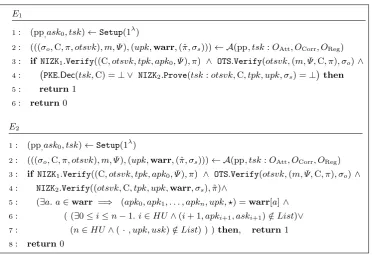
Proof. We divide the advantage of the path traceability adversaryAfor the experimentExptrHABS,A
in Fig. 5 by the two winning conditions for the adversary:
E1
1: (pp,ask0, tsk)←Setup(1λ)
2: (((σo,C, π, otsvk), m, Ψ),(upk,warr,(ˆπ, σs)))← A(pp, tsk:OAtt, OCorr, OReg) 3: if NIZK1.Verify((C, otsvk, tpk, apk0, Ψ), π) ∧ OTS.Verify(otsvk,(m, Ψ,C, π), σo)∧ 4: PKE.Dec(tsk,C) =⊥ ∨ NIZK2.Prove(tsk:otsvk,C, tpk, upk, σs) =⊥
then
5: return1
6: return0 E2
1: (pp,ask0, tsk)←Setup(1λ)
2: (((σo,C, π, otsvk), m, Ψ),(upk,warr,(ˆπ, σs)))← A(pp, tsk:OAtt, OCorr, OReg) 3: if NIZK1.Verify((C, otsvk, tpk, apk0, Ψ), π) ∧ OTS.Verify(otsvk,(m, Ψ,C, π), σo)∧ 4: NIZK2.Verify((otsvk,C, tpk, upk,warr, σs),πˆ)∧
5: (∃a. a∈warr =⇒ (apk0, apk1, . . . , apkn, upk, ?) =warr[a]∧ 6: ( (∃0≤i≤n−1. i∈HU∧(i+ 1, apki+1, aski+1)∈/List)∨ 7: (n∈HU∧(·, upk, usk)∈/List) ) )then, return1
8: return0
Fig. 8.Experiment Traceability
2. there exists a signature in the warrant, for some attribute introduced for a ”rogue” entity, that is not registered, by an honest authority, in experimentE2.
We have,
Pr
ExptrHABS,A(λ)
≤Pr[E1= 1] + Pr[E2= 1].
We start with experimentE1, where we use the soundness ofNIZK1to show thatPKE.Decand
NIZK2 cannot fail.
Game G0. The gameG0 is defined exactly asE1 in Fig. 8. From this, it immediately follows
that
Pr[G0= 1] = Pr[E1= 1].
Game G1. We define gameG1 asG0, except that we add the line 00∃µ.C =
PKE.Enc(tpk,(upk,warr, σs, otsvk))∧00
between lines 3 and 4. This new check performed byG1 is one of the conditions encoded in the
relation forNIZK1, andAis able to notice the difference between G0 and G1 if he can produce a
validNIZK1proof for a false statement (that does not have a witnessµ). We bind the probability of
Ato distinguish this games, by the advantage of the soundness adversaryBsound forNIZK1:Bsound
performs all steps inG1with the exception of those that require interaction withNIZK1 where he
uses his oracle access. Then, uses theNIZK1 proofπfrom the output ofAas his output. Hence,
|Pr[G0= 1]−Pr[G1= 1]| ≤AdvsoundBsound,NIZK1(λ).
Game G2. This game uses the correctness of thePKE to replace the test performed over the
encryption inG1 with the test over the decryption
00∃µ.
PKE.Enc(tpk,(upk,warr, σs, otsvk);µ) = C by
PKE.Dec(tsk,C) = (upk, warr, σs, otsvk)00.
Additionally, we remove the line ”PKE.Dec(tsk,C) = ⊥” as this can be canceled by the change above. The difference between these two games is bounded by the probability of an decryption to fail after an encryption, even on adversarial valid inputs. We construct adversaryBcorforPKEthat callsSetupandA. Then, it uses (tpk,(upk,warr, σs) as the message and µas the randomness.
GameG3.This game returns directly 0. The basis for this is that it should be hard for aNIZK2
proof created over a statement and witness that belong to the relation, to be declared invalid by the verification algorithm. We quantify this difficulty, by building an adversaryBcomthat tries to win the completeness experiment for NIZK2. Bcom calls Setup and A, then builds the statement (otsvk,C, tpk, upk,warr, σs) that is used to create a proof that will fail verification.
Pr[G2= 1] =|Pr[G2= 1]−Pr[G3= 1]| ≤AdvcompleteBcom,NIZK2(λ).
From the sequence of games startingG0, . . . , G3, it follows that the probability ofE1is bounded
by the soundness ofNIZK1.
Experiment E2 models the setting where adversary A is able to provide a valid warr that
contains validTSsignatures from an honest authorityapkito an entity,apki+1orupk, not registered
- not inList. This means, he is able to forge signatures under the name ofapkiwithout knowledge of the corresponding secret keyaski. We bind the probability ofAto win by the advantage of the forgerBts for TS. First,Bts needs to guess which authority A would use to forge a signature in the warrant, and does that with probability 1/tgiven exactlytregistration queries for authorities. Then, he uses the challenge public key for that authority, and answers all queries thatAmakes for that authority with hisTSsigning oracle calls. Finally,Bts looks at the output ofAfor signatures that contain that authority and has not been provided by his signing oracle.
Pr[E2= 1]≤
1 t×Adv
euf-cma Bts,TS (λ).
u t
Theorem 1. The HABS construction in Fig. 6 offers path anonymity,
non-frameability, and path traceability under the assumptions that PKE is IND-CCA2 secure, TS andDSare unforgeable,OTSis strongly unforgeable,NIZK1andNIZK2are both sound zero-knowledge
proofs.
Proof. The proof follows from Lemmas 1, 2 and 3.
4.1 Instantiating the HABS Building Blocks
Instantiation. We instantiate HABS in the bilinear group setting. For the digital signature DS we use the constant-sized structure preserving scheme by Abe et al. [1], whereas for TS we use their unbounded-message version of their scheme. These are unforgeable under the Simultaneous Flexible Pairing (SFP) [1] assumption. We use an encryption scheme by Camenish et al. [10] that is capable of encrypting message vectors for our IND-CCA2PKE, which relies on the DLIN assumption. Finally, for the one-time signatureOTSwe use the full Boneh-Boyen signature scheme [6], which is strongly unforgeable under theq-Strong Diffie-Hellman (q-SDH) assumption.
For the proofsNIZK1 and NIZK2, we use Groth-Sahai (GS) proof systems [24], the security of
which is also based on the DLIN assumption in the symmetric setting. These are efficient, non-interactive proof systems in the CRS model that are complete, sound, and zero-knowledge. Briefly, the GS proof system works by commiting to the elements of the witness and then showing they satisfy the source equation. The equation must take the form of either a Pairing Product Equation (PPE), a Multi-Scalar Multiplication Equation (MSME) or a Quadratic Equation (QE). We refer to [24] for full details and give an overview of our constructions forNIZK1 andNIZK2in Appendix
A.
linearly in this parameter. We note that use of a public hash function onotsvk before encryption immediately reduces the size ofPKEton+ 5 group elements.
To prove satisfiability of the signing predicate Ψ, a proof containing 2β elements fromZp is constructed, whereβ is the size of the span program S. The proof thatDSverifies is of constant size and requires 72 elements ofG.
Finally, the size of the proof inNIZK1that C was encrypted correctly is linear in the number of
delegations in the warrant, this is inevitable since we need to prove the validity for each authority-signature pair on the delegation path. Similarly, this is also the case for the proof of correctness for decryption of C inNIZK2.
We note that if we consider HABS in the setting where the maximum delegation path of an attribute has length 1, then the size of aHABSsignature is linear in the size of the policyΨ, which is consistent with other ABS schemes that also offer flexible signing policies, e.g., [32, 18, 22].
4.2 Other properties
In the following we discuss some further properties that can be adopted within our general HABS construction.
Revocation.Our generic HABS construction can be extended to support revocation of attribute authorites and users by means of public revocations listsRLauthenticated by the root authority. These lists would include public keys of revoked authorities and users. To enable detection of re-voked entities upon verification of HABS signatures, the proofNIZK1can be extended to prove that
for all attributes used to satisfy the policy none of the public keys in the corresponding delegation paths within the signer’s warrant warr is included into these lists. Since HABS signatures hide delegation paths this approach would preserve privacy by ensuring that no verifier can identify the revoked signer. Due to its complexity,O(rP
a|warr[a]|) where ris the number of revoked public keys, this method might not scale well and hence finding more efficient revocation mechanisms can be seen as an interesting open problem.
Independent hierarchies.Assume there are multiple HABS hierarchies, each managed by an independent root authority, and any (intermediate) authority or user should be able to receive attributes from different such hierarchies. Our general HABS construction naturally supports this scenario. In particular, warrants can include attributes (along with their signed delegation paths) that were issued to the entity by authorities belonging to other hierarchies and consequently the proof NIZK1 can enable generation of HABS signatures for predicatesΨ requiring possession of
attributes from these hierarchies.
5
Conclusion
The notion of Hierarchical ABS (HABS) introduced in this paper extends the functionality for existing (multi-authority) ABS schemes with some useful properties that can help to expand the application domain of ABS signatures, e.g. to intelligent transport systems. The extended proper-ties of HABS include: (1) support for dynamically expandable hierarchical formation of attribute authorities, managed by some root authority, (2) hierarchical delegation of attribute-issuing rights amongst the authorities, (3) the ability to issue attributes to signers by multiple authorities, possi-bly located at different levels of the hierarchy, (4) generated ABS signatures that hide signers, their attributes together with their delegation paths, (5) support for a publicly verifiable tracing proce-dure that enables accountability for all entities that were involved in the delegation and issue of an attribute to a signer. This brings ABS schemes closer to traditional hierarchically-organised PKIs while preserving the valuable privacy properties and security guarantees of the attribute-based setting. The proposed generic HABS construction makes use of standard cryptographic building blocks that can be instantiated in the setting of bilinear maps based on the DLIN,q-SDH and SFP assumptions. We discussed further how our HABS construction offers natural support for scenarios where the same authority or user is admitted to multiple, independently managed hierarchies and needs to bundle attributes obtained in these hierarchies to satisfy some predicate, and how it can be extended to revoke attribute authorities and signers.
and MM were supported by the EPSRC project TAPESTRY (EP/N02799X). The authors also thank the reviewers of CANS 2018 and Alfredo Rial for valuable comments.
References
1. M. Abe, G. Fuchsbauer, J. Groth, K. Haralambiev, and M. Ohkubo. Structure-Preserving Signatures and Commitments to Group Elements. In CRYPTO 2010, pages 209–236, 2010. https://eprint.iacr.org/2010/133.
2. M. Backes, S. Meiser, and D. Schr¨oder. Delegatable functional signatures. In PKC (1)’16, pages 357–386, 2016.
3. M. Belenkiy, J. Camenisch, M. Chase, M. Kohlweiss, A. Lysyanskaya, and H. Shacham. Randomizable Proofs and Delegatable Anonymous Credentials. InCRYPTO 2009, pages 108–125. LNCS 5677. 4. M. Bellare and G. Fuchsbauer. Policy-based signatures. In PKC 2014, pages 520–537, 2014. LNCS
8383.
5. M. Blum, P. Feldman, and S. Micali. Non-interactive Zero-knowledge and Its Applications. In STOC’88, pages 103–112, 1988.
6. D. Boneh and X. Boyen. Short Signatures Without Random Oracles. In EUROCRYPT 2004, pages 56–73. LNCS 3027, 2004.
7. X. Boyen. Mesh Signatures. InEUROCRYPT 2007, pages 210–227. LNCS 4515.
8. E. Boyle, S. Goldwasser, and I. Ivan. Functional signatures and pseudorandom functions. In PKC 2014, pages 501–519, 2014.
9. J. Camenisch, M. Drijvers, and M. Dubovitskaya. Practical uc-secure delegatable credentials with attributes and their application to blockchain. InACMCCS’ 17, pages 683–699, 2017.
10. J. Camenisch, K. Haralambiev, M. Kohlweiss, J. Lapon, and V. Naessens. Structure Preserving CCA Secure Encryption and Its Application to Oblivious Third Parties. Cryptology ePrint Archive, Report 2011/319, 2011.
11. J. Camenisch, I. Krontiris, A. Lehmann, G. Neven, C. Paquin, K. Rannenberg, and H. Zwingelberg. H2.1 abc4trust architecture for developers. abc4trust.eu, 2011.
12. J. Camenisch and A. Lysyanskaya. A signature scheme with efficient protocols. InSCN 2002, SCN 2002, pages 268–289. LNCS 2576, 2003.
13. D. Chaum. Security without identification: Transaction systems to make big brother obsolete. Com-mun. ACM, 28(10):1030–1044, 1985.
14. D. Chaum and E. van Heyst. Group signatures. In EUROCRYPT 1991, LNCS, pages 257–265. Springer, 1991.
15. S. Ding, Y. Zhao, and Y. Liu. Efficient traceable attribute-based signature. InIEEE TRUSTCOM 2014, pages 582–589, 2014.
16. C.-C. Dragan, D. Gardham, and M. Manulis. Hierarchical attribute-based signatures. IACR Cryptol-ogy ePrint Archive, 2018. https://eprint.iacr.org/2018/610.
17. A. El Kaafarani and E. Ghadafi. Attribute-based signatures with user-controlled linkability without random oracles. InCryptog. and Coding, pages 161–184, 2017.
18. A. El Kaafarani, E. Ghadafi, and D. Khader. Decentralized traceable attribute-based signatures. In CT-RSA 2014, pages 327–348. LNCS 8366, 2014.
19. A. Escala, J. Herranz, and P. Morillo. Revocable attribute-based signatures with adaptive security in the standard model. InAFRICACRYPT 2011, pages 224–241. LNCS 6737, 2011.
20. G. Fuchsbauer and D. Pointcheval. Anonymous proxy signatures. InSCN, volume 5229 of LNCS, pages 201–217. Springer, 2008.
21. M. Gagn´e, S. Narayan, and R. Safavi-Naini. Short Pairing-Efficient Threshold-Attribute-Based Signa-ture. InPairing 2012, pages 295–313. LNCS 7708, 2013.
22. E. Ghadafi. Stronger security notions for decentralized traceable attribute-based signatures and more efficient constructions. InCT-RSA 2015, pages 391–409. LNCS 9048, 2015.
23. S. Gisdakis, M. Lagana, T. Giannetsos, and P. Papadimitratos. SEROSA: service oriented security architecture for vehicular communications. InIEEE VNC’13, pages 111–118, 2013.
24. J. Groth and A. Sahai. Efficient non-interactive proof systems for bilinear groups. InEUROCRYPT 2008, pages 415–432, 2008. LNCS 4965.
25. J. Guo, J. P. Baugh, and S. Wang. A group signature based secure and privacy-preserving vehicular communication framework. InMobile NVE 2007, pages 103–108, 2007.
26. J. Herranz. Attribute-based Signatures from RSA. TCS, 527:73–82, 2014.
27. J.-P. Hubaux, S. ˇCapkun, and J. Luo. The security and privacy of smart vehicles.IEEE Security and Privacy, 2(3):49–55, 2004.
29. P. Kamat, A. Baliga, and W. Trappe. An identity-based security framework for vanets. In ACM VANET 2006, pages 94–95. ACM, 2006.
30. L. Krzywiecki, M. Sulkowska, and F. Zag´orski. Hierarchical ring signatures revisited – unconditionally and perfectly anonymous schnorr version. InSecurity, Privacy, and Applied Cryptography Engineering, pages 329–346, 2015.
31. J. Li, M. H. Au, W. Susilo, D. Xie, and K. Ren. Attribute-based Signature and Its Applications. In ACM ASIACCS 2010, pages 60–69. ACM, 2010.
32. H. K. Maji, M. Prabhakaran, and M. Rosulek. Attribute-based signatures. InCT-RSA 2011, pages 376–392, 2011.
33. G. Neven, G. Baldini, J. Camenisch, and R. Neisse. Privacy-preserving attribute-based credentials in cooperative intelligent transport systems. InIEEE VNC’17, pages 131–138, 2017.
34. T. Okamoto and K. Takashima. Decentralized attribute-based signatures. InPKC 2013, pages 125–142. LNCS 7778, 2013.
35. T. Okamoto and K. Takashima. Efficient attribute-based signatures for non-monotone predicates in the standard model. InPKC 2011, pages 35–52. LNCS 6571, 2011.
36. J. Petit, F. Schaub, M. Feiri, and F. Kargl. Pseudonym schemes in vehicular networks: A survey.IEEE Comm.s Surveys and Tutorials, 17(1):228–255, 2015.
37. R. L. Rivest, A. Shamir, and Y. Tauman. How to leak a secret. InASIACRYPT 2001, volume 2248 ofLNCS, pages 552–565. Springer, 2001.
38. K. Sampigethaya, M. Li, L. Huang, and R. Poovendran. AMOEBA: Robust Location Privacy Scheme for VANET. IEEE J-SAC, 25(8):1569–1589, 2007.
39. F. Schaub, Z. Ma, and F. Kargl. Privacy requirements in vehicular communication systems. InCSE’09, pages 139–145, 2009.
40. J. Sun, C. Zhang, Y. Zhang, and Y. M. Fang. An identity-based security system for user privacy in vehicular ad hoc networks. IEEE Trans. Parallel Distrib. Syst., 21(9):1227–1239, 2010.
41. M. Trolin and D. Wikstr¨om. Hierarchical Group Signatures. InICALP 2005, volume 3580 ofLNCS, pages 446–458. Springer, 2005.
42. R. Tsabary. An equivalence between attribute-based signatures and homomorphic signatures, and new constructions for both. InTCC (2)’17, pages 489–518, 2017.
A
Constructions of NIZK Proofs
Here we give an overview of the constructions for NIZK proofs NIZK1 and NIZK2 based on the
instantiation introduced in Section 4.1 and refer to the literature for further details. The instanti-ation described requires use a public hash functionHto map attributes into the tag space of the tagged-signature scheme.
For reference, the keys for the primitives TSand PKEare given below, respectively. All elements here belong to a groupG.
(ask, apk) = ( ˜α,β, γ˜ Z, δZ,{γi, δi}ki=1),
(GZ, FZ, GR, FU,{Gi, Fi}ki=1,{Ai,A˜i, Bi,B˜i}1i=0, S−1, V−1)
(tsk, tpk) = ({αi}n i=1,{βi}
n+4
i=0),(g1, g2, g3,{hi,1, hi,2}ni=1,{fi,1, fi,2}ni=0+4)
Construction of NIZK1.To create a proofNIZK1, we consider each statement of the language in
turn.
• For the span programS∈M|Ψ|,β(F) representing the predicateΨ, the signer proves they have knowledge of somezsuch thatzS= [1,0, ...,0]. This encodes what attributes are used to satisfy the predicate. We commit to the vectorzand show:
P|Ψ|
i=1(ziSi,1) = 1 and
P|Ψ|
i=1(ziSi,j) = 0 forj= 2, ..., β.
These areβ linear equations inZp and in the symmetric setting, the Groth-Sahai proof consists of 2β elements inZp.
•Show that for every attribute used to satisfy the predicate, we have a valid delegation path. That is, we prove:
zi 6= 0 =⇒ ∀apkij ∈ warr[ai]. TS.Verify(apkij,warr[ai][j], ai,(apki1, . . . , apkij)). We achieve
this by raising each pairing in the verification equations for the signatures in the delegation path of ai tozi. Then, ifzi6= 0,warr[a] is only a valid delegation path foraif eachTSsignature verifies. If
The unbounded-message scheme we use for our instantiation amounts to chaining together an arbitrary number of constant size signatures of a scheme also given in [1]. To realise this, the message is split into blocks. The intuition is to input thenth signature as part of the message of signaturen+ 1, which the structure preserving property ensures is possible. Verification requires verifying each signature in the chain w.r.t the message block, the verification key and the previous signature. In the instantiated scheme, it is actually sufficient to only sign on part of the previous signature, due to the signature binding property as detailed in original work [1]. Hence, we only need to consider how to construct the GS proof for the constant sized scheme, as the unbounded-message version amounts to verifying multiple constant-sized signatures. With this, we consider the verification equation for the constant sized signature.
The messages ml∈Gare the group elements of the public keys apkj and the attribute H(ai) split into message blocksw of sizek−2. A constant sized signature is created for each message block whereSw andVw are part of the signature for message block w−1, with the exception of S−1 andV−1 which are part of the verification keyapkj.
ATSsignature verifies if it satisfies the following equations.
¯ Gl=Gzli
k
l=1 A¯0=A
zi
0 A¯1=Az1i G¯R=GRzi G¯Z=GzZi S¯=S zi
e( ¯A0,A˜0)e( ¯A1,A˜1) =e( ¯GZ, Z)e( ¯GR, R)e( ¯S, T)e( ¯Gk, Sn−1)e( ¯Gk−1, Vn−1)Qkl=1−2e( ¯Gl, ml)
¯ Fl=Flzi
k
l=1 B¯0=B
zi
0 B¯1=Bz1i F¯Z =FZzi F¯U =FUzi V¯ =V zi
e( ¯B0,B˜0)e( ¯B1,B˜1) =e( ¯FZ, Z)e( ¯FU, U)e( ¯V , W)e( ¯Fk, Sn−1)e( ¯Fk−1, Vn−1)Q
k−2
l=1 e( ¯Fl, ml) Each constant sized signature consists of 7 elements fromG, and so the size of the signature on an unbounded message is 7· dn+1
k−2e, wherek is the size of the message space andnis the number of
message blocks. In the case thatkdoes not divide the number of messages to be signed, we append 1G to complete the message in the final block. This does not increase the size of the signature. To evaluate the verification equations in zero-knowledge, we are required to prove 2k+ 10 linear multi-scalar multiplication equations and 2 product pairing equations for each message block.
We prove the statement
“TS.Verify(apkin, σu, ai,(apk0, apki1, . . . , apkin, upk, ?)”
in much the same way, withupktaking the role of the final public key in the delegation path. We choose?to be some predefined fixed element fromG.
•Prove that the ciphertext was constructed correctly. We let the plaintextsti ∈Gfori= 1, ..., n be the group elements that comprise the public keys and signatures (ofTSandDS) in the warrant, and the public key of the one-time signatureotsvk. The randomness is given by µandµ0 (in Zp) and is part of the witness. To prove the correctness of the ciphertext (C, c1, ..., cn, u1, u2, u3), we
show the following relation holds [10].
u1=gµ1, u2=gµ 0
2 , u3=gµ+µ 0
3
ci=ti·hµi,1h
µ0
i,2,fori= 1, ..., n
C=Q3
i=0e(fˆ
µ i,1f
µ0
i,2, ui)·Q n+3
i=4 e(fˆ
µ i,1f
µ0
i,2, ci−3)
For a warrant containingn group elements, this proof requires n+3 linear MSME and one PPE, hence requires 2n+ 15 elements from G. Note n used here is equal to n+ 8 from the efficiency discussion in Section 4.1.
•ProveDSis constructed correctly. Since we instantiateDSwith the same scheme asTS, and hence we follow the same proof structure as above but withk= 2, i.e. there are only 2 messages which are comprised of the component parts of the one-time public keyotsvk.
In addition to the proof, each GS commitment is inG3, the
PKEciphertext consists of n+4 elements fromGwhile theOTS(including verification key) consists of 3 elements fromGand one fromZp.
Construction of NIZK2.Here we prove the following relation:
For the instantiation ofPKEabove, this is achieved by showing equality of the following equations. For the ciphertext (C, c1..., cn, u1, u2, u3) :
C=Q3
i=0e(uˆ
βi,1
1 u
βi,2
2 u
βi,3
3 , ui)·Qni=4+3e(uˆ βi,1
1 u
βi,2
2 u
βi,3 3 , ci−3)
ti=ci·(u αi,1
1 u
αi,2
2 u
αi,3
3 ) fori= 1, ..., n.