The DFSA Rulebook
Anti-Money Laundering,
Counter-Terrorist Financing and Sanctions
Module
(AML)
In this appendix as all the text is new it is not underlined or struck through in the usual manner. In this appendix underlining indicates new text and striking through indicates deleted text.
Contents
The contents of this module are divided into the following chapters, sections and appendices:
1
INTRODUCTION ... 1
1.1 Application ... 1
1.2 Responsibility for compliance with this module ... 1
1.3 Application table ... 3
2
OVERVIEW AND PURPOSE OF THE MODULE ... 4
3
INTERPRETATION AND TERMINOLOGY ... 7
3.1 Interpretation ... 7
3.2 Glossary for AML ... 7
4
APPLYING A RISK-BASED APPROACH ... 14
4.1 The risk-based approach ... 14
5
BUSINESS RISK ASSESSMENT ... 16
5.1 Assessing business AML risks ... 16
5.2 AML systems and controls ... 17
6
CUSTOMER RISK ASSESSMENT ... 19
6.1 Assessing customer AML risks ... 20
7
CUSTOMER DUE DILIGENCE ... 23
7.1 Requirement to undertake customer due diligence ... 24
7.2 Timing of customer due diligence ... 24
7.3 Customer due diligence requirements ... 25
7.4 Enhanced customer due diligence ... 28
7.5 Simplified customer due diligence ... 29
7.6 Ongoing customer due diligence ... 30
7.7 Failure to conduct or complete customer due diligence ... 32
8
RELIANCE AND OUTSOURCING ... 33
8.1 Reliance on a third party ... 33
8.2 Outsourcing ... 35
9
CORRESPONDENT BANKING, WIRE TRANSFERS, ANONYMOUS
ACCOUNTS AND AUDIT ... 36
9.1 Application ... 36
9.2 Correspondent banking ... 36
9.3 Wire transfers ... 37
9.4 Anonymous and nominee accounts ... 38
10
SANCTIONS AND OTHER INTERNATIONAL OBLIGATIONS ... 39
10.1 Application ... 39
10.2 Relevant United Nations resolutions and sanctions ... 39
10.3 Government, regulatory and international findings ... 40
11
MONEY LAUNDERING REPORTING OFFICER ... 42
11.1 Application ... 42
11.2 Appointment of a MLRO ... 42
11.3 Qualities of a MLRO ... 43
11.4 Responsibilities of a MLRO ... 43
12
AML TRAINING AND AWARENESS ... 45
12.1 Training and awareness ... 45
13
SUSPICIOUS ACTIVITY REPORTS ... 47
13.1 Application and definitions ... 47
13.2 Internal reporting requirements ... 47
13.3 Suspicious activity report ... 48
13.4 Tipping-off ... 49
14
GENERAL OBLIGATIONS ... 51
14.1 Groups, branches and subsidiaries ... 51
14.2 Group policies ... 51
14.3 Notifications ... 52
14.4 Record keeping ... 52
14.5 Annual AML return ... 54
14.6 Communication with the DFSA ... 54
14.7 Employee disclosures ... 55
15
DNFBP REGISTRATION AND SUPERVISION ... 56
15.1 Registration and notifications ... 56
15.2 Withdrawal of registration ... 56
15.3 Disclosure of regulatory status ... 57
16
TRANSITIONAL RULES ... 58
16.1 Application ... 58
16.2 General ... 58
1
INTRODUCTION
1.1
Application
1.1.1 (1) This module (AML) applies to:
(a) every Relevant Person in respect of all its activities carried on in or from the DIFC;
(b) the persons specified in Rule 1.2.1 as being responsible for a Relevant Person’s compliance with this module; and
(c) a Relevant Person, which is a DIFC entity, to the extent required by Rule 14.1.
except to the extent that a provision of AML provides for a narrower application.
(2) For a dealer in precious metals or precious stones, or a dealer in any saleable item of a price equal to or greater than $15,000, chapters 6 to 8 of this module apply only if it engages in any cash or cash-equivalent transaction with a customer equal to or above $15,000, whether the transaction is executed as a single operation or in several connected operations.
1.1.2 For the purposes of these Rules, a Relevant Person means: (a) an Authorised Firm other than a Credit Rating Agency; (b) an Authorised Market Institution;
(c) a DNFBP; or (d) an Auditor.
1.2
Responsibility for compliance with this module
1.2.1 (1) Responsibility for a Relevant Person’s compliance with this module lies with every member of its senior management.
(2) In carrying out their responsibilities under this module every member of a Relevant Person’s senior management must exercise due skill, care and diligence.
(3) Nothing in this Rule precludes the DFSA from taking enforcement action against any person including any one or more of the following persons in respect of a breach of any Rule in this module:
(b) members of a Relevant Person’s senior management; or (c) an Employee of a Relevant Person.
1.3
Application table
Guidance
* Partially applicable. Relevant Persons should consider these chapters and determine which provisions apply.
Relevant Person Chapters
1 2 3 4 5 6 7 8 9 10 11 12 13 14 15 16
Authorised Person
X XRepresentative Office
X X X X
X XAuditor
X
X XReal estate developer or agency
X X X X X X X XLaw firm, notary firm, or other independent legal business
X
Accounting firm, audit firm or insolvency firm
X
Company service provider
X
Single Family Office
X
Dealer in precious metals or precious stones
*
*
*
X X X
*
*
2
OVERVIEW AND PURPOSE OF THE MODULE
Guidance
1. The AML module has been designed to provide a single reference point for all persons and entities (collectively called Relevant Persons) who are supervised by the DFSA for Anti-Money Laundering (AML), Counter-Terrorist Financing (CTF) and sanctions compliance. Accordingly it applies to Authorised Firms, Authorised Market Institutions, Designated Non-Financial Businesses and Professions (DNFBP), and Auditors, but to each in different degrees. The AML module takes into consideration the fact that Relevant Persons have differing AML risk profiles. A Relevant Person should familiarise itself with this module, and assess the extent to which the chapters and sections apply to it.
2. The AML module cannot be read in isolation from other relevant legislation or developments in
international policy and best practice and, to the extent applicable, Relevant Persons need to be aware of, and take into account, how these aforementioned matters may impact on the Relevant Person’s day to day operations. This is particularly relevant when considering United Nations Security Council Resolutions (UNSCRs) which apply in the DIFC, and unilateral sanctions imposed by other jurisdictions which may apply to a Relevant Person depending on the Relevant Person’s jurisdiction of origin, its business and/or customer base.
3. Chapter 1 of this module contains an application table which should assist a Relevant Person to
navigate through the module and to determine which chapters are applicable to it. Chapter 1 also specifies who is ultimately responsible for a Relevant Person’s compliance with the AML module. The DFSA expects the senior management of a Relevant Person to establish a robust and effective AML/CTF and sanctions compliance culture for the business.
4. Chapter 2 provides an overview of the AML module and chapter 3 sets out the key definitions in
the module. Note that not all definitions used in this module are capitalised.
5. Chapter 4 explains the meaning of the risk-based approach (RBA), which should be applied when complying with this module. The RBA requires a risk-based assessment of a Relevant Person’s business (in chapter 5) and its customers (in chapter 6). A risk-based assessment should be a dynamic process involving regular review, and the use of these reviews to establish the appropriate processes to match the levels of risk. No two Relevant Persons will have the same approach, and implementation of the RBA and the AML module permits a Relevant Person to design and implement systems that should be appropriate to their business and customers, with the obvious caveat being that such systems should be reasonable and proportionate in light of the AML risks. The DFSA expects the RBA to determine the breadth and depth of the CDD which is undertaken for a particular customer under chapter 7, though the DFSA understands that there is an inevitable overlap between the risk-based assessment of the customer in chapter 6 and CDD in chapter 7. This overlap may occur at the initial stages of client on-boarding but may also occur when undertaking on-going CDD.
6. Chapter 8 sets out when and how a Relevant Person may rely on a third party to undertake all or
some of its CDD obligations. Reliance on a third-party CDD reduces the need to duplicate CDD already performed for a customer. Alternatively, a Relevant Person may outsource some or all of its CDD obligations to a service provider.
7. Chapter 9 sets out certain obligations in relation to correspondent banking, wire transfers and other matters which are limited to Authorised Persons, and, in particular, to banks.
8. Chapter 10 sets out a Relevant Person’s obligations in relation to United Nations Security Council resolutions and sanctions, and government, regulatory and international findings (in relation to AML, terrorist financing and the financing of weapons of mass destruction).
9. Chapter 11 sets out the obligation for a Relevant Person (other than certain DNFBPs) to appoint an MLRO and the responsibilities of such a person.
10. Chapter 12 sets out the requirements for AML training and awareness. A Relevant Person should
adopt the RBA when complying with chapter 12, so as to make its training and awareness proportionate to the AML risks of the business and the employee role.
11. Chapter 13 contains the obligations applying to all Relevant Persons concerning Suspicious Activity Reports, which are required to be made under Federal Law No. 4 of 2002.
12. Chapter 14 contains the general obligations applying to all Relevant Persons, including Group policies, notifications, record-keeping requirements and the annual AML Return.
13. Chapter 15 sets out specific Rules applying to DNFBPs, including the requirement to register with the DFSA, and Chapter 16 contains certain transitional Rules.
The U.A.E. criminal law
14. Under Article 70(3) of the Regulatory Law 2004 (the “Law”), the DFSA has jurisdiction for the
regulation of anti-money laundering in the DIFC. This module sets out the regulatory requirements imposed by the DFSA under Article 72 of the Law. The U.A.E. criminal law applies in the DIFC and, therefore, persons in the DIFC must be aware of their obligations in respect of the criminal law as well as these Rules. Relevant U.A.E. criminal laws include Federal Law No. 4 of 2002 regarding the Criminalisation of Money Laundering, Federal Law No. 1 of 2004 regarding Combating Terrorism Offences and the Penal Code of the United Arab Emirates. The Rules in this module should not be relied upon to interpret or determine the application of the criminal laws of the U.A.E.
15. Under Article 3 of the Federal Law No.4 of 2002, a Relevant Person may be criminally liable for
the offence of money laundering if such an activity is intentionally committed in its name or for its account. Relevant Persons are also reminded that:
a. the failure to report suspicions of money laundering;
b. “tipping off”; and
c. assisting in the commission of money laundering,
may each constitute a criminal offence that is punishable under the laws of the U.A.E. Financial Action Task Force
16. The Financial Action Task Force is an inter-governmental body whose purpose is the
development and promotion of international standards to combat money laundering and terrorist financing.
17. The DFSA has had regard to the FATF Recommendations in making these Rules. A Relevant Person may wish to refer to the FATF Recommendations and interpretive notes to assist it in complying with these Rules. However, in the event that a FATF Recommendation or interpretive note conflicts with a Rule in this module, the relevant Rule takes precedence.
18. A Relevant Person may also wish to refer to the FATF typology reports which may assist in identifying new money laundering threats and which provide information on money laundering and terrorist financing methods. The FATF typology reports cover many pertinent topics for Relevant Persons, including corruption, new payment methods, money laundering using trusts and company service providers, and vulnerabilities of free trade zones. These typology reports can be found on the FATF website www.fatf-gafi.org.
19. The U.A.E., as a member of the United Nations, is required to comply with sanctions issued and passed by the United Nations Security Council (UNSC). These UNSC obligations apply in the DIFC and their importance is emphasised by specific obligations contained in this module requiring Relevant Persons to establish and maintain effective systems and controls to make appropriate use of UNSC sanctions and resolutions (See chapter 10).
20. The FATF has issued guidance on a number of specific UNSC sanctions and resolutions
regarding the countering of the proliferation of weapons of mass destruction. Such guidance has been issued to assist in implementing the targeted financial sanctions and activity based financial prohibitions. This guidance can be found on the FATF website www.fatf-gafi.org.
21. In relation to unilateral sanctions imposed in specific jurisdictions such as the European Union, the U.K. (HM Treasury) and the U.S. Office of Foreign Assets Control, the DFSA expects a Relevant Person to consider and take positive steps to ensure compliance where required or appropriate. Where there may be no legal obligation for a person to comply with sanctions imposed in a non-U.A.E. jurisdiction, the factors that should be considered by Relevant Persons in deciding whether to comply with such sanctions include the location and nature of a Relevant
3
INTERPRETATION AND TERMINOLOGY
3.1
Interpretation
3.1.1 A reference in this module to “money laundering” in lower case includes a reference to terrorist financing unless the context provides or implies otherwise.
Guidance
Chapter 6, section 6.2, of the General (GEN) module sets out how to interpret the Rulebook, including this module.
3.2
Glossary for AML
Guidance
1. A Relevant Person should note that, in order to make this module easier to read, some of the
defined terms in this module have not had the initial letter of each word capitalised in the same way as in other Rulebook modules.
2. Some of the defined terms and abbreviations in this module may also be found in the DFSA’s
Glossary module (GLO). Where a defined term in this module does not appear in Rule 3.2.1, a Relevant Person should look in GLO to find the meaning.
3.2.1 In this module, the terms and abbreviations listed in the table below have the following meanings:
AML Means either “anti-money laundering” or this Anti-Money Laundering, Counter-Terrorist Financing and Sanctions module depending on the context.
AMLSCU Means the Anti-Money Laundering Suspicious Cases Unit of the U.A.E. Central Bank.
Auditor Means a partnership or company that is registered by the DFSA to provide audit services to:
(a) an Authorised Person; (b) a Domestic Fund; or (c) a Public Listed Company.
Authorised Person Means an Authorised Firm or an Authorised Market Institution.
beneficial owner Means, in relation to a customer, a natural person:
(a) who ultimately controls, directly or indirectly, a customer;
(b) who, in relation to a customer which is a legal person or arrangement, exercises (whether directly or indirectly) ultimate effective control over the person or arrangement, or the management of such person or
arrangement;
(c) who ultimately owns or has an ownership interest in the customer, whether legally or beneficially, directly or indirectly;
(d) on whose behalf or for whose benefit a transaction is being conducted; or
(e) on whose instructions the signatories of an account, or any intermediaries instructing such signatories, are for the time being accustomed to act.
A person not falling into (a) or (b) is not a beneficial owner by reason of (c) or (d) if, having regard to a risk-based assessment of the customer, the ownership interest is small and in the circumstances poses no or negligible risk of money laundering.
In (a) to (e), a reference to a “customer” includes a customer account, customer assets and the underlying legal person or arrangements which constitute or make up the customer, customer account or customer assets.
Branch Means a place of business within the DIFC: (a) which has no separate legal personality;
(b) which forms a legally dependant part of a Relevant Person whose principal place of business and head office is in a jurisdiction other than the DIFC; and (c) through which the Relevant Person carries on
business in or from the DIFC.
Client Has the meaning in chapter 2 of the Conduct of Business module.
company service provider
Means a person, not falling into parts (1)(a) to (e) or (g) of the definition of a DNFBP that, by way of business, provides any of the following services to a customer:
(a) acting as a formation agent of legal persons;
(b) acting as (or arranging for another person to act as) a director or secretary of a company, a partner of a partnership, or a similar position in relation to other legal persons;
(c) providing a registered office, business address or accommodation, correspondence or administrative address for a company, a partnership or any other legal person or arrangement; or
(d) acting as (or arranging for another person to act as) a nominee shareholder for another person.
Contract of Insurance
Has the meaning in GEN Rule A4.1.1.
customer Unless otherwise provided, means:
(a) a person where, in relation to a business relationship between the person and a Relevant Person, there is a firm intention or commitment by each party to enter into a contractual relationship or where there is a firm commitment by each party to enter into a transaction, in connection with a product or service provided by the Relevant Person;
(b) a Client of an Authorised Firm;
(c) a Member or prospective Member of, or an applicant for admission of Securities to trading on, an Authorised Market Institution;
(d) in relation to a Single Family Office, a member of the Single Family; or
(e) a person with whom a Relevant Person is otherwise establishing or has established a business relationship. Customer Due
Diligence (CDD)
Has the meaning in Rule 7.3.1.
Designated Non-Financial Business or Profession (DNFBP)
Means:
(1) The following class of persons whose business or profession is carried on in or from the DIFC:
(a) a real estate developer or agency which carries out transactions with a customer involving the buying or selling of real property; (b) a dealer in precious metals or precious stones; (c) a dealer in any saleable item of a price equal
to or greater than $15,000;
(d) a law firm, notary firm, or other independent legal business;
(e) an accounting firm, audit firm or insolvency firm;
(f) a company service provider; or (g) a Single Family Office.
(2) A person who is an Authorised Person or an Auditor is not a DNFBP.
DIFC entity Means a legal person which is incorporated or registered in the DIFC (excluding a registered Branch).
Domestic Fund A Fund established or domiciled in the DIFC. Employee Means an individual:
(a) who is employed or appointed by a person in connection with that person's business, whether under a contract of service or for services or otherwise; or
(b) whose services, under an arrangement between that person and a third party, are placed at the disposal and under the control of that person.
Enhanced Customer Due Diligence
Means undertaking Customer Due Diligence and the enhanced measures under Rule 7.4.1.
FATF Means the Financial Action Task Force. FATF
Recommendations
Means the publication entitled the “International Standards on Combatting Money Laundering and the Financing of Terrorism and Proliferation” as published and amended from time to time by FATF.
Federal Law No. 1 of 2004
Means UAE Federal Law No. 1 of 2004 regarding Combating Terrorism Offences.
Federal Law No. 4 of 2002
Means UAE Federal Law No. 4 of 2002 regarding the Criminalisation of Money Laundering.
Financial Institution A regulated or unregulated entity, whose activities are primarily financial in nature.
Financial Services Regulator
Means a regulator of financial services activities established in a jurisdiction other than the DIFC.
Governing Body Means the board of directors, partners, committee of management or other governing body of:
(a) a Body Corporate or Partnership; or
(b) an unincorporated association carrying on a trade or business, with or without a view to profit.
Group Means a Group of entities which includes an entity (the ‘first entity’) and:
(a) any parent of the first entity; and
(b) any subsidiaries (direct or indirect) of the parent or parents in (a) or the first entity; or
(c) for a legal person which is not a body corporate, refers to that person and any other associated legal persons who are in an equivalent relationship to that in (a) and (b).
Law Means the Regulatory Law 2004.
legal person Means any entity other than a natural person that can establish a customer relationship with a Relevant Person or otherwise own property. This can include companies, bodies
corporate or unincorporate, trusts, foundations, anstalten, partnerships, associations, states and governments and other relevantly similar entities.
Member A person admitted as a member of an Authorised Market Institution in accordance with its Business Rules.
Money Laundering Reporting Officer (MLRO)
Means the person appointed by a Relevant Person pursuant to Rule 11.2.1(1).
natural person Means an individual.
person Means a natural or legal person. Politically Exposed
Person (PEP)
Means a natural person (and includes, where relevant, a family member or close associate) who is or has been entrusted with a prominent public function, including but not limited to, a head of state or of government, senior politician, senior government, judicial or military official, ambassador, senior executive of a state owned corporation, or an important political party official, but not middle ranking or more junior individuals in these categories.
Prescribed Low Risk Customer
Means any of the following customer types: (a) an Authorised Firm;
(b) an Authorised Market Institution;
(c) a Financial Institution whose entire operations are subject to regulation, including AML, by a Financial Services Regulator or other competent authority in a jurisdiction with AML regulations which are equivalent to the standards set out in the FATF Recommendations and it is supervised for compliance with such regulations;
(d) a Subsidiary of a Financial Institution referred to in (d), provided that the law that applies to the parent company ensures that the Subsidiary also observes the same AML standards as its Parent;
(e) a law firm, notary firm, or other independent legal business or an equivalent person in another jurisdiction whose entire operations are subject to AML regulation and supervision by a competent authority in a jurisdiction with AML regulations which are equivalent to the standards set out in the FATF Recommendations;
(f) an accounting firm, Auditor or other audit firm or insolvency firm or an equivalent person in another jurisdiction whose entire operations are subject to AML regulation and supervision by a competent authority in a jurisdiction with AML regulations which are equivalent to the standards set out in the FATF Recommendations;
(g) a company whose Securities are listed on a Regulated Exchange and which is subject to disclosure obligations broadly equivalent to those set out in the Markets Rules;
(h) a government body or a non-commercial government entity in the U.A.E. or a FATF member country; and (i) a customer where the business relationship is limited
to the provision of one or more of the following products or services:
(i) a Contract of Insurance which is non-life insurance;
(ii) a Contract of Insurance which is a life insurance product with no investment return or redemption or surrender value;
(iii) a Contract of Insurance which is life insurance where the annual premium is no more than $1,000 or where a single premium of no more than $2,500 is paid;
(iv) a Contract of Insurance for the purposes of a pension scheme where the contract contains no surrender clause and cannot be used as collateral;
(v) a Contract of Insurance which is a reinsurance contract not falling into (i) to (iv) which is ceded by an insurer who is a regulated Financial Institution;
(vi) a pension, superannuation or similar scheme which provides retirement benefits to employees, where contributions are made by an employer or by way of deduction from an Employee’s wages and the scheme rules do not permit the assignment of a member’s interest under the scheme; or
(vii) arbitration, litigation or advice on litigation prospects.
Public Listed Company
Has the meaning given in Article 97(2) of the Regulatory Law 2004.
Regulated Exchange
Means an exchange regulated by a Financial Services Regulator.
Regulated
Financial Institution
A person who does not hold a Licence but who is authorised in a jurisdiction other than the DIFC to carry on any financial service by another Financial Services Regulator.
Relevant Person Has the meaning in Rule 1.1.2.
management Relevant Person’s executive management and includes: (a) for a DIFC entity, every member of the Relevant
Person’s Governing Body;
(b) for a Branch, the person or persons who control the day to day operations of the Relevant Person in the DIFC and would include, at a minimum, the SEO or equivalent, such as the managing director; or
(c) for an Auditor, every member of the Relevant Person’s executive management in the U.A.E.
Simplified Customer Due Diligence
Means Customer Due Diligence as modified under Rule 7.5.1.
Single Family Has the meaning given to that term in the DIFC Single Family Office Regulations.
Single Family Office
Has the meaning given to that term in the DIFC Single Family Office Regulations.
source of funds Means the origin of customer’s funds which relate to a transaction or service and includes how such funds are connected to a customer’s source of wealth.
source of wealth Means how the customer’s global wealth or net worth is or was acquired or accumulated.
Suspicious Activity Report (SAR)
Means a report in the prescribed format regarding suspicious activity (including a suspicious transaction) made to the AMLSCU under Rule 13.3.1(c).
transaction Means any transaction undertaken by a Relevant Person for or on behalf of a customer in the course of carrying on a business in or from the DIFC.
4
APPLYING A RISK-BASED APPROACH
Figure 1. The Risk-Based Approach (RBA)4.1
The risk-based approach
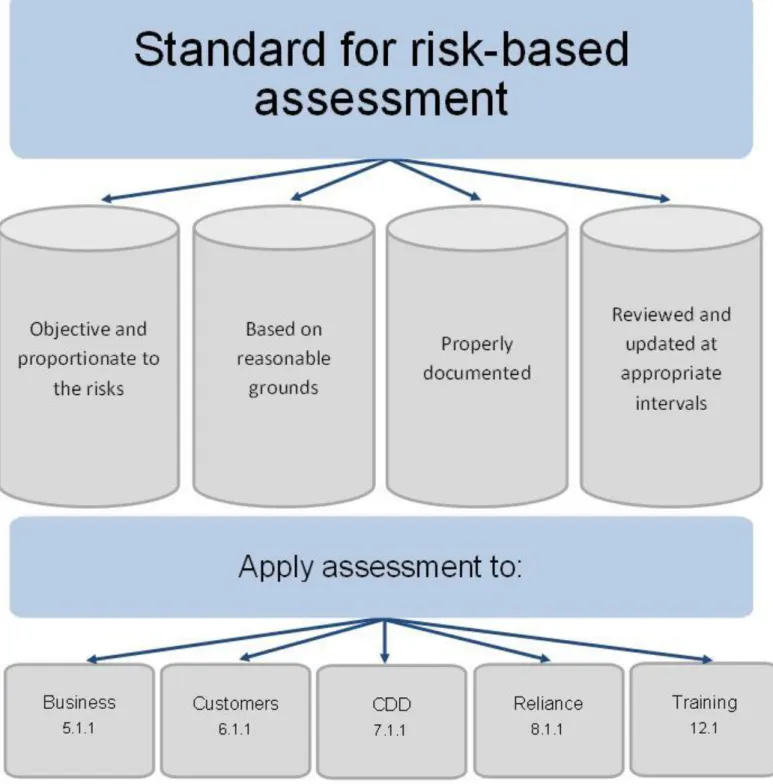
4.1.1 A Relevant Person must:(a) assess and address its AML risks under this module by adopting an approach which is proportionate to the risks to which the person is exposed as a result of the nature of its business, customers, products, services and any other matters which are relevant in the context of money laundering; and
(b) ensure that, when undertaking any risk-based assessment for the purposes of complying with a requirement of this module, such assessment is:
(i) objective and proportionate to the risks; (ii) based on reasonable grounds;
(iii) properly documented; and
(iv) reviewed and updated at appropriate intervals. Guidance
1. Rule 4.1.1 requires a Relevant Person to adopt an approach to AML which is proportionate to
the risks. This is called the “risk-based approach” (“RBA”) and is illustrated in figure 1 above. The DFSA expects the RBA to be a key part of the Relevant Person’s money laundering compliance culture and to cascade down from the senior management to the rest of the organisation. Embedding the RBA within its business allows a Relevant Person to make decisions and allocate AML resources in the most efficient and effective way.
2. In implementing the RBA, a Relevant Person is expected to have in place processes to identify, assess, monitor, manage and mitigate money laundering risks. The general principle is that where there are higher risks of money laundering, a Relevant Person is required to take enhanced measures to manage and mitigate those risks, and that, correspondingly, when the risks are lower, simplified measures are permitted. Simplified measures are not permitted where there is a suspicion of money laundering.
3. The RBA discourages a “tick-box” approach to AML. Instead a Relevant Person is required to
assess relevant money laundering risks and adopt a proportionate response to such risks. The outcome of using the RBA is akin to using a sliding scale, where the type of CDD undertaken on each customer will ultimately depend on the outcome of the risk-based assessment made of such customer under this chapter.
4. The Rules regarding record-keeping for the purposes of this module are in section 14.4. These
5
BUSINESS RISK ASSESSMENT
Figure 2. Business risk-based assessment5.1
Assessing business AML risks
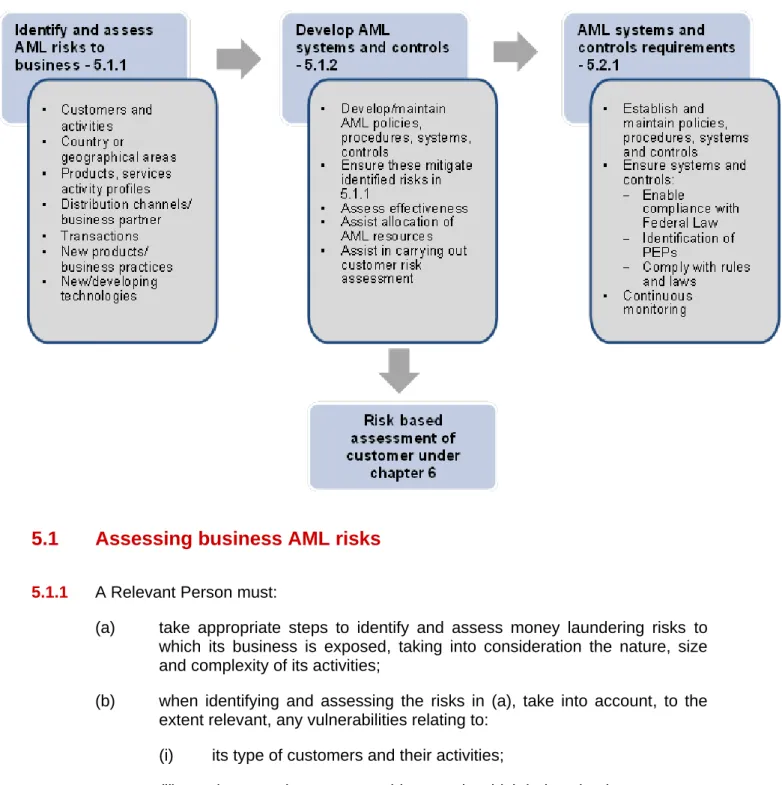
5.1.1 A Relevant Person must:
(a) take appropriate steps to identify and assess money laundering risks to which its business is exposed, taking into consideration the nature, size and complexity of its activities;
(b) when identifying and assessing the risks in (a), take into account, to the extent relevant, any vulnerabilities relating to:
(i) its type of customers and their activities;
(ii) the countries or geographic areas in which it does business; (iii) its products, services and activity profiles;
(iv) its distribution channels and business partners; (v) the complexity and volume of its transactions;
(vi) the development of new products and new business practices, including new delivery mechanisms, channels and partners; and (vii) the use of new or developing technologies for both new and
pre-existing products;
(c) take appropriate measures to ensure that any risk identified as part of the assessment in (a) is taken into account in its day to day operations, including in relation to:
(i) the development of new products; (ii) the taking on of new customers; and (iii) changes to its business profile.
5.1.2 A Relevant Person must use the information obtained in undertaking its business risk assessment to:
(a) develop and maintain its AML policies, procedures, systems and controls required by Rule 5.2.1;
(b) ensure that its AML policies, procedures, systems and controls adequately mitigate the risks identified as part of the assessment in Rule 5.1.1;
(c) assess the effectiveness of its AML policies, procedures, systems and controls as required by Rule 5.2.1(c);
(d) assist in allocation and prioritisation of AML resources; and
(e) assist in the carrying out of the customer risk assessment under chapter 6. Guidance
1. Unless a Relevant Person understands the money laundering risks to which it is exposed, it cannot take appropriate steps to prevent its business being used for the purposes of money laundering. Money laundering risks vary from business to business depending on the nature of the business, the type of customers a business has, and the nature of the products and services sold.
2. Using the RBA, a Relevant Person should assess its own vulnerabilities to money laundering
and to take all reasonable steps to eliminate or manage such risks. The results of this assessment will also feed into the Relevant Person’s risk assessment of its customers under chapter 6. For instance, if a Relevant Person reasonably concludes that a particular business line poses a negligible risk of money laundering, it may decide, using the RBA, that all its customers in that business line should be treated as posing a lower risk of money laundering, and it may apply Simplified Customer Due Diligence.
5.2
AML systems and controls
5.2.1 A Relevant Person must:
(a) establish and maintain effective policies, procedures, systems and controls to prevent opportunities for money laundering in relation to the Relevant Person and its activities;
(i) include the provision to the Relevant Person’s senior management of regular management information on the operation and effectiveness of its AML systems and controls necessary to identify, measure, manage and control the Relevant Person’s money laundering risks;
(ii) enable it to determine whether a customer or a beneficial owner is a Politically Exposed Person; and
(iii) enable the Relevant Person to comply with these Rules, Federal Law No.4 of 2002, Federal Law No.1 of 2004 and any other relevant Federal laws; and
(c) ensure that regular risk assessments are carried out on the adequacy of the Relevant Person’s AML systems and controls to ensure that they continue to enable it to identify, assess, monitor and manage money laundering risk adequately, and are comprehensive and proportionate to the nature, scale and complexity of its activities.
Guidance
In Rule 5.2.1(c) the regularity of risk assessments will depend on the nature, size and complexity of the Relevant Person’s business.
6
CUSTOMER RISK ASSESSMENT
Figure 3. Customer risk-based assessmentGuidance
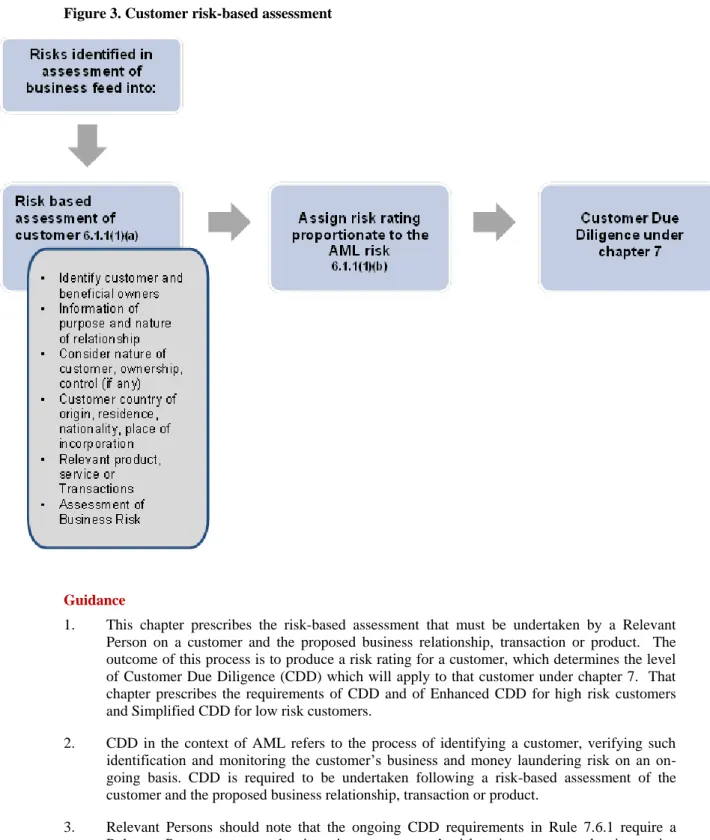
1. This chapter prescribes the risk-based assessment that must be undertaken by a Relevant Person on a customer and the proposed business relationship, transaction or product. The outcome of this process is to produce a risk rating for a customer, which determines the level of Customer Due Diligence (CDD) which will apply to that customer under chapter 7. That chapter prescribes the requirements of CDD and of Enhanced CDD for high risk customers and Simplified CDD for low risk customers.
2. CDD in the context of AML refers to the process of identifying a customer, verifying such identification and monitoring the customer’s business and money laundering risk on an on-going basis. CDD is required to be undertaken following a risk-based assessment of the customer and the proposed business relationship, transaction or product.
3. Relevant Persons should note that the ongoing CDD requirements in Rule 7.6.1 require a Relevant Person to ensure that it reviews a customer’s risk rating to ensure that it remains appropriate in light of the AML risks.
4. The DFSA is aware that in practice there will often be some degree of overlap between the customer risk assessment and CDD. For example, a Relevant Person may undertake some aspects of CDD, such as identifying a beneficial owner, when it performs a risk assessment of the customer. Conversely, a Relevant Person may also obtain relevant information as part of CDD which has an impact on its customer risk assessment. Examples of such relevant
information include information on the source of funds or wealth or information on the ownership and control structure of the customer. Where information obtained as part of CDD of a customer affects the risk rating of a customer, the change in risk rating should be reflected in the degree of CDD undertaken.
6.1
Assessing customer AML risks
6.1.1 (1) A Relevant Person must:
(a) undertake a risk-based assessment of every customer; and
(b) assign the customer a risk rating proportionate to the customer’s money laundering risks.
(2) The customer risk assessment in (1) must be completed prior to undertaking Customer Due Diligence for new customers, and whenever it is otherwise appropriate for existing customers.
(3) A Relevant Person may assign a low risk rating to a Prescribed Low Risk Customer without the need to undertake the risk-based assessment of the customer under (1)(a).
(4) Where a Relevant Person has assigned a customer a low risk rating under (2) and the customer ceases to meet the criteria to be a Prescribed Low Risk Customer the Relevant Person must undertake the risk-based assessment of the customer under (1)(a).
(5) When undertaking a risk-based assessment of a customer under (1)(a) a Relevant Person must:
(a) identify the customer and any beneficial owner;
(b) obtain information on the purpose and intended nature of the business relationship;
(c) take into consideration the nature of the customer, its ownership and control structure, and its beneficial ownership (if any);
(d) take into consideration the nature of the customer business relationship with the Relevant Person;
(e) take into consideration the customer’s country of origin, residence, nationality, place of incorporation or place of business;
(f) take into consideration the relevant product, service or transaction; and
(g) take into consideration the outcomes of business risk assessment under chapter 5.
6.1.2 A Relevant Person must not establish a business relationship with the customer which is a legal person if the ownership or control arrangements of the customer prevent the Relevant Person from identifying one or more of the customer’s beneficial owners.
Guidance on the customer risk assessment
1. In assessing the nature of a customer, a Relevant Person should consider such factors as the legal structure of the customer, the customer’s business or occupation, the location of the customer’s business and the commercial rationale for the customer’s business model.
2. In assessing the customer business relationship, a Relevant Person should consider how the customer is introduced to the Relevant Person and how the customer is serviced by the Relevant Person, including for example, whether the Person will be a private banking client, will open a bank account or whether the business relationship will be purely advisory.
3. The risk assessment of a customer, which is illustrated in figure 3 above, requires a Relevant
Person to allocate an appropriate risk rating to every customer. The DFSA would expect risk ratings to be either descriptive, such as “low”, “medium” or “high”, or a sliding numeric scale such as 1 for the lowest risk to 10 for the highest. Depending on the outcome of a Relevant Person’s assessment of its customer’s money laundering risk, a Relevant Person should decide to what degree CDD will need to be performed.
4. Using the RBA, a Relevant Person could, when assessing two customers with near identical risk profiles, consider that one is high risk and the other low risk. This may occur, for example, where both customers may be from the same high risk country, but one customer may be a customer in relation to a low risk product, such as those in part (i) of the definition of a Prescribed Low Risk Customer, or may be a long-standing customer of a Group company who has been introduced to the Relevant Person.
5. In Rule 6.1.2, ownership arrangements which may prevent the Relevant Person from
identifying one or more beneficial owners include bearer shares and other negotiable instruments in which ownership is determined by possession.
Guidance on the term “customer”
6. The point at which a person becomes a customer will vary from business to business. However, the DFSA considers that it would usually occur at or prior to the business relationship being formalised, for example, by the signing of a client agreement or the acceptance of terms of business.
7. The DFSA does not consider that a person would be a customer of a Relevant Person merely
because such person receives marketing information from a Relevant Person or where a Relevant Person refers a person who is not a customer to a third party (including a Group member).
8. The DFSA considers that a counterparty would generally be a “customer” for the purposes of
this module and would therefore require a Relevant Person to undertake CDD on such a person. However, this would not include a counterparty in a transaction undertaken on a Regulated Exchange. Nor would it include suppliers of ordinary business services, for consumption by the Relevant Person such as cleaning, catering, stationery, IT or other similar services.
9. A Representative Office should not have any customers in relation to its DIFC operations.
Guidance on high risk customers
10. In complying with Rule 6.1.1, the DFSA considers that a Relevant Person should consider the
following factors, which may indicate that a customer poses a higher risk of money laundering:
a. the business relationship is conducted in unusual circumstances (e.g. significant unexplained geographic distance between the location of the Relevant Person and the customer);
c. companies that have nominee shareholders or directors or shares in bearer form;
d. businesses that are cash-intensive;
e. the ownership structure of the legal person appears unusual or excessively complex given the nature of the legal person’s business or activities;
f. countries identified by credible sources, such as mutual evaluation or detailed assessment reports or published follow-up reports, as not having adequate AML systems;
g. countries subject to sanctions, embargos or similar measures issued by, for example, the United Nations Security Council or identified by credible sources as having significant levels of corruption or other criminal activity;
h. countries or geographic areas identified by credible sources as providing funding or support for terrorist activities, or that have designated terrorist organisations operating within their country;
i. a person not meeting the definition of a PEP but whose high profile or influence poses
an elevated risk of corruption;
j. anonymous transactions (which may include cash);
k. private banking relationships;
l. non-face-to-face business relationships or transactions;
m. payment received from unknown or un-associated third parties;
n. discretionary trusts; and
7
CUSTOMER DUE DILIGENCE
Figure 4. CDD7.1
Requirement to undertake customer due diligence
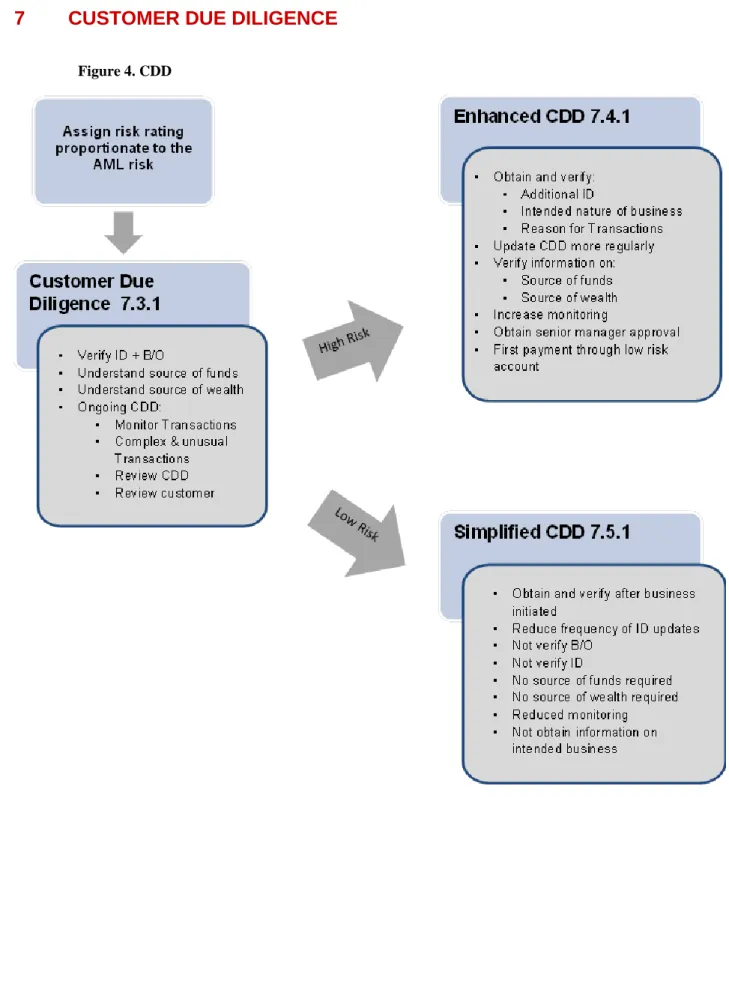
7.1.1 (1) A Relevant Person must:(a) undertake Customer Due Diligence under Rule 7.3.1 for each of its customers;and
(b) in addition to (a), undertake Enhanced Customer Due Diligence under Rule 7.4.1 in respect of any customer it has assigned as high risk. (2) A Relevant Person may undertake Simplified Customer Due Diligence in
accordance with Rule 7.5.1 by modifying Customer Due Diligence under Rule 7.3.1 for any customer it has assigned as low risk.
Guidance
A Relevant Person should undertake CDD in a manner proportionate to the customer’s money laundering risks identified under Rule 6.1.1(1). This means that all customers are subject to CDD under Rule 7.3.1. However, for high risk customers, additional Enhanced CDD measures should also be undertaken under Rule 7.4.1. For low risk customers, Rule 7.3.1 may be modified according to the risks in accordance with Rule 7.5.1.
7.2
Timing of customer due diligence
7.2.1 (1) A Relevant Person must:
(a) undertake the appropriate Customer Due Diligence under Rule 7.3.1 (a) to (c) when it is establishing a business relationship with a customer; and
(b) undertake the appropriate Customer Due Diligence under Rule 7.3.1(d) after establishing a business relationship with a customer. (2) A Relevant Person must also undertake appropriate Customer Due
Diligence if, at any time:
(a) in relation to an existing customer, it doubts the veracity or adequacy of documents, data or information obtained for the purposes of Customer Due Diligence;
(b) it suspects money laundering in relation to a person; or
(c) there is a change in risk-rating of the customer, or it is otherwise warranted by a change in circumstances of the customer.
(3) A Relevant Person may establish a business relationship with a customer before completing the verification required by Rule 7.3.1 if the following conditions are met:
(a) deferral of the verification of the customer or beneficial owner is necessary in order not to interrupt the normal conduct of a business relationship;
(b) there is little risk of money laundering occurring and any such risks identified can be effectively managed by the Relevant Person;
(c) in relation to a bank account opening, there are adequate safeguards in place to ensure that the account is not closed and transactions are not carried out by or on behalf of the account holder (including any payment from the account to the account holder) before verification has been completed; and
(d) the relevant verification is completed as soon as reasonably practicable and in any event no later than 30 days after the establishment of a business relationship.
Guidance
1. For the purposes of Rule 7.2.1(2)(a), examples of situations which might lead a Relevant Person to have doubts about the veracity or adequacy of documents, data or information previously obtained could be where there is a suspicion of money laundering in relation to that customer, where there is a material change in the way that the customer’s account is operated, which is not consistent with the customer’s business profile, or where it appears to the Relevant Person that a person other than the customer is the real customer.
2. In Rule 7.2.1(3)(a), situations that the Relevant Person may take into account include, for example, accepting subscription monies during a short offer period or executing a time critical transaction, which if not executed immediately, would or may cause a customer to incur a financial loss due to price movement or loss of opportunity or when a customer seeks immediate insurance cover.
3. When complying with Rule 7.2.1, a Relevant Person should also, where relevant, consider Rule 7.7.1 regarding failure to conduct or complete CDD and chapter 13 regarding SARs and tipping off.
7.3
Customer due
diligence requirements
7.3.1 (1) In undertaking Customer Due Diligence required by Rule 7.1.1(1)(a) a Relevant Person must:
(a) verify the identity of the customer and any beneficial owner on the basis of original documents, data or information issued by or obtained from a reliable and independent source;
(b) understand the customer’s source of funds; (c) understand the customer’s source of wealth; and
(d) undertake on-going due diligence of the customer business relationship under Rule 7.6.1.
(2) In complying with (1)(a) for life insurance or other similar policies, a Relevant Person must:
(a) verify the identity of any named beneficiaries of the insurance policy; and
(b) verify the identity of the persons in any class of beneficiary, or where these are not identifiable, ensure that it obtains sufficient information to be able to verify the identity of such persons at the time of payout of the insurance policy.
(3) Where a customer, or a beneficial owner of the customer, is a Politically Exposed Person, a Relevant Person must ensure that, in addition to (1) it also:
(a) increases the degree and nature of monitoring of the business relationship, in order to determine whether the customer’s transactions or activities appear unusual or suspicious; and
(b) obtains the approval of senior management to commence a business relationship with the customer,
unless the customer is a Prescribed Low Risk Customer. Guidance on CDD
1. A Relevant Person should, in complying with Rule 7.3.1(1)(a), and adopting the RBA, obtain,
verify and record, for every customer who is a natural person, the following identification information:
a. full name (including any alias);
b. date of birth;
c. nationality;
d. legal domicile; and
e. current residential address (not a P.O. box).
2. Items (a) to (c) above should be obtained by sighting a current valid passport or, where a customer does not own a passport, an official identification document which includes a photograph. The concept of domicile generally refers to the place which a person regards as his permanent home and with which he has the closest ties or which is his place of origin.
3. A Relevant Person should, in complying with Rule 7.3.1(1)(a), and adopting the RBA, obtain,
verify and record, for every customer which is a legal person, the following identification information:
a. full business name and any trading name;
b. registered or business address;
c. date of incorporation or registration;
d. place of incorporation or registration;
e. a valid commercial or professional licence;
f. the identity of the directors, partners, trustees or equivalent persons with executive authority of the legal person; and
g. for a trust, a certified copy of the trust deed to ascertain the nature and purpose of the trust and documentary evidence of the appointment of the current trustees.
4. In complying with Rule 7.3.1(1)(a), it may not always be possible to obtain original documents. Where identification documents cannot be obtained in original form, for example, because a Relevant Person has no physical contact with the customer, the Relevant Person should obtain a copy certified as a true copy by a person of good standing such as a registered lawyer or notary, a chartered accountant, a police officer, an Employee of the person’s embassy or consulate, or other similar person. The DFSA considers that downloading information from an official source (such as a regulator’s or other official government website) is sufficient to make the relevant document “original”.
5. For higher risk situations the DFSA would expect identification information to be independently verified, using both public and non-public sources. For lower risk situations, not all of the relevant identification information would need to be verified.
6. In complying with Rule 7.3.1(1) (b) and (c), a Relevant Person is required to “understand” a
customer’s source of funds and wealth. This would mean obtaining information from the customer or from a publicly-available source on the source of funds and wealth. For a public company, this might be achieved by looking at their published accounts. For a natural or legal person, this might involve including a question on source of funds and wealth in an application form or client questionnaire. Understanding a customer’s source of funds and wealth is also important for the purposes of undertaking ongoing due diligence under Rule 7.3.1(1)(d). 7. An insurance policy which is similar to a life policy would include life-related protection, or a
pension, or investment product which pays out to the policy holder or beneficiary upon a particular event occurring or upon redemption.
Guidance on verification of beneficial owner
8. In determining whether an individual meets the definition of a beneficial owner or controller,
regard should be had to all the circumstances of the case, in particular the size of an individual’s legal or beneficial ownership in a transaction. The question of what is a “small” ownership interest for the purposes of the definition of a beneficial owner will depend on the individual circumstances of the customer. The DFSA considers that the question of whether an ownership interest is small should be considered in the context of the Relevant Person’s knowledge of the customer and the customer risk assessment and the risk of money laundering.
9. When verifying beneficial owners under Rule 7.3.1(1)(a), a Relevant Person is expected to adopt a substantive (as opposed to form over substance) approach to CDD for legal persons. Adopting a substantive approach means focusing on the money laundering risks of the customer and the product/service and avoiding an approach which focusses purely on the legal form of an arrangement or sets fixed percentages at which beneficial owners are identified (or not). It should take all reasonable steps to establish and understand a corporate customer’s legal ownership and control and to identify the beneficial owner. The DFSA does not set explicit ownership or control thresholds in defining the beneficial owner because the DFSA considers that the applicable threshold to adopt will ultimately depend on the risks associated with the customer, and so the DFSA expects a Relevant Person to adopt the RBA and justify on reasonable grounds an approach which is proportionate to the risks identified. A Relevant Person should not set fixed thresholds for identifying the beneficial owner without objective and documented justification as required by Rule 4.1.1. An overly formal approach to defining the beneficial owner may result in a criminal “gaming” the system by always keeping his financial interest below the relevant threshold.
10. The DFSA considers that in some circumstances no threshold should be used when identifying
beneficial owners because it may be important to identify all underlying beneficial owners in order to ensure that they are not associated or connected in some way. This may be appropriate where there are a small number of investors in an account or fund, each with a significant financial holding and the specific risks are higher. However, where the customer-specific risks are lower, a threshold can be appropriate. For example, for a low-risk corporate customer which, combined with a lower-risk product or service, a percentage threshold may be appropriate for identifying “control” of the legal person for the purposes of the definition of a beneficial owner.
11. For a retail investment fund which is widely-held and where the investors invest via pension
contributions, the DFSA would not expect the manager of the fund to look through to any underlying investors where there are none with any material control or ownership levels in the fund. However, for a closely-held fund with a small number of investors, each with a large shareholding or other interest, the DFSA would expect a Relevant Person to identify and verify each of the beneficial owners, depending on the risks identified as part of its risk-based assessment of the customer. For a corporate health policy with defined benefits, the DFSA would not expect a Relevant Person to identify the beneficial owners.
12. In any situation where a Relevant Person does not look through to a beneficial owner because it sets a percentage threshold which prevents this, the DFSA expects that, should a request for information regarding a beneficial owner be made by a competent authority, including the DFSA, such Relevant Person should be able to have access to information about the identities of any beneficial owners which it has not identified in order to respond promptly to the request for information.
13. Where a Relevant Person carries out identification and verification in respect of actual and potential beneficial owners of a trust, this should include the trustee, settlor, the protector, the enforcer, beneficiaries, other persons with power to appoint or remove a trustee and any person entitled to receive a distribution, whether or not such person is a named beneficiary. Guidance on politically exposed persons
14. Individuals who have, or have had, a high political profile, or hold, or have held, public office, can pose a higher money laundering risk to a Relevant Person as their position may make them vulnerable to corruption. This risk also extends to members of their families and to known close associates. Politically Exposed Person (“PEP”) status itself does not, of course, incriminate individuals or entities. It does, however, put the customer into a higher risk category.
15. Generally, a foreign PEP presents a higher risk of money laundering because there is a greater
risk that such person, if he was committing money laundering, would attempt to place his money offshore where the customer is less likely to be recognised as a PEP and where it would be more difficult for law enforcement agencies in his home jurisdiction to confiscate or freeze his criminal property.
16. Corruption-related money laundering risk increases when a Relevant Person deals with a PEP.
Corruption may involve serious crimes and has become the subject of increasing global concern. Corruption offences are predicate crimes under the Federal Law No. 4 of 2002. A Relevant Person should note that customer relationships with family members or close associates of PEPs involve similar risks to those associated with PEPs themselves.
17. The DFSA considers that after leaving office a PEP may remain a higher risk for money laundering if such person continues to exert political influence or otherwise pose a risk of corruption.
7.4
Enhanced customer due diligence
7.4.1 Where a Relevant Person is required to undertake Enhanced Customer Due Diligence under Rule 7.1.1(1)(b) it must, to the extent applicable to the customer: (a) obtain and verify additional:
(i) identification information on the customer and any beneficial owner; (ii) information on the intended nature of the business relationship; and (iii) information on the reasons for a transaction;
(b) update more regularly the Customer Due Diligence information which it holds on the customer and any beneficial owners;
(c) verify information on:
(i) the customer’s source of funds; (ii) the customer’s source of wealth;
(d) increase the degree and nature of monitoring of the business relationship, in order to determine whether the customer’s transactions or activities appear unusual or suspicious; and
(e) obtain the approval of senior management to commence a business relationship with a customer; and
(f) where applicable, require that any first payment made by a customer in order to open an account with a Relevant Person must be carried out through a bank account in the customer’s name with a Prescribed Low Risk Customer of type (a), (c) or (d).
Guidance
1. In Rule 7.4.1 Enhanced CDD measures are only mandatory to the extent that they are applicable to the relevant customer or the circumstances of the business relationship and to the extent that the risks would reasonably require it. Therefore, the extent of additional measures to conduct is a matter for the Relevant Person to determine on a case by case basis.
2. In Rule 7.4.1 (e), senior management approval may be given by an individual member of the
Relevant Person’s senior management or by a committee of senior managers appointed to consider high risk customers. It may also be outsourced within the Group.
3. For high risk customers, a Relevant Person should, in order to mitigate the perceived and actual risks, exercise a greater degree of diligence throughout the customer relationship and should endeavour to understand the nature of the customer’s business and consider whether it is consistent and reasonable.
4. A Relevant Person should be satisfied that a customer’s use of complex legal structures and/or
the use of trust and private investment vehicles, has a genuine and legitimate purpose.
5. For enhanced CDD, where there is a beneficial owner, verification of the customer’s source of
funds and wealth may require enquiring into the beneficial owner’s source of funds and wealth because the source of the funds would normally be the beneficial owner and not the customer. 6. The DFSA considers that verification of source of funds includes obtaining independent
corroborating evidence such as proof of dividend payments connected to a shareholding, bank statements, salary/bonus certificates, loan documentation and proof of a transaction which gave rise to the payment into the account. A customer should be able to demonstrate and document how the relevant funds are connected to a particular event which gave rise to the payment into the account or to the source of the funds for a transaction.
7. The DFSA considers that verification of source of wealth includes obtaining independent corroborating evidence such as share certificates, publicly-available registers of ownership, bank or brokerage account statements, probate documents, audited accounts and financial statements, news items from a reputable source and other similar evidence.
8. A Relevant Person may commission a third party vendor report to obtain further information
on a customer or transaction or to investigate a customer or beneficial owner in very high risk cases. A third party vendor report may be particularly useful where there is little or no publicly-available information on a person or on a legal arrangement or where a Relevant Person has difficulty in obtaining and verifying information.
7.5
Simplified customer due diligence
7.5.1 (1) Where a Relevant Person is permitted to undertake Simplified Customer Due Diligence under Rule 7.1.1(2), modification of Rule 7.3.1 may include:
(a) verifying the identity of the customer and any beneficial owners after the establishment of the business relationship under Rule 7.2.1(3); (b) deciding to reduce the frequency of, or as appropriate not undertake,
customer identification updates;
(c) deciding, not to verify a beneficial owner;
(d) deciding not to verify an identification document other than by requesting a copy;
(e) not enquiring as to a customer’s source of funds or source of wealth; (f) reducing the degree of on-going monitoring of transactions, based on
a reasonable monetary threshold or on the nature of the transaction; or
(g) not collecting specific information or carrying out specific measures to understand the purpose and intended nature of the business relationship, but infering such purpose and nature from the type of transactions or business relationship established.
(2) The modification in (1) must be proportionate to the customer’s money laundering risks.
Guidance
1. Rule 7.5.1(1) provides examples of Simplified CDD measures. Other measures may also be used by a Relevant Person to modify CDD in accordance with the customer risks.
2. A Relevant Person should not use a “one size fits all” approach for all its low risk customers.
Notwithstanding that the risks may be low for all such customers, the degree of CDD undertaken needs to be proportionate to the specific risks identified on a case by case basis. For example, for customers where the money laundering risks are very low, a Relevant Person may decide to simply identify the customer and verify such information only to the extent that this is commercially necessary. On the other hand, a low risk customer which is undertaking a complex transaction might require more comprehensive Simplified CDD.
3. An example of circumstances where a Relevant Person might reasonably reduce the frequency
of or, as appropriate, eliminate customer identification updates would be where the money laundering risks are low and the service provided does not offer a realistic opportunity for money laundering.
4. An example of where a Relevant Person might reasonably reduce the degree of on-going monitoring and scrutinising of transactions, based on a reasonable monetary threshold or on the nature of the transaction, would be where the transaction is a recurring, fixed contribution to a savings scheme, investment portfolio or fund or where the monetary value of the transaction is not material for money laundering purposes given the nature of the customer and the transaction type.
7.6
Ongoing customer due diligence
7.6.1 When undertaking ongoing Customer Due Diligence under Rule 7.3.1(1)(d), a Relevant Person must, using the risk-based approach:
(a) monitor transactions undertaken during the course of its customer relationship to ensure that the transactions are consistent with the Relevant Person’s knowledge of the customer, his business and risk rating;