Published Online 2013 November 1. Research Article
Commensal E. coli as an Important Reservoir of Resistance Encoding
Genetic Elements
Azam Mahmoudi-Aznaveh
1, Bita Bakhshi
1, *, Shahin Najar-Peerayeh
1, Anoshirvan Kazemnejad
1
, Zahra Rafieepour
2, Mohammad Rahbar
3, Shahla Abbaspour
41 Department of Bacteriology, Faculty of Medical Sciences, Tarbiat Modares University, Tehran, IR Iran 2 Food Microbiology Research Center, Tehran University of Medical Sciences, Tehran, IR Iran 3 Antimicrobial Resistance Research center, Tehran University of Medical Sciences, Tehran, IR Iran 4 Bahrami Hospital, Tehran, IR Iran
* Corresponding author: Bita Bakhshi, Department of Bacteriology, Faculty of Medical Sciences, Tarbiat Modares University. Tehran, IR Iran. Tel: +982182884558, Fax: +982182884555, E-mail: [email protected]
Received: July 10, 2013; Revised: July 23, 2013; Accepted: August 23, 2013
Background: Diarrheagenic E. coli is the most important cause of diarrhea in children and is a public health concern in developing
countries. A major public problem is acquisition and transmission of antimicrobial resistance via mobile genetic elements including plasmids, conjugative transposons, and integrons which may occur through horizontal gene transfer.
Objectives: The aim of this study was to investigate the distribution of class 1 and 2 integrons among commensal and enteropathogenic
E. coli isolates and assess the role of commensal E. coli population as a reservoir in the acquisition and transmission of antimicrobial resistance.
Materials and Methods: Swabs were collected directly from stool samples of the children with diarrhea admitted to three hospitals in
Tehran, Iran during July 2012 through October 2012. Antimicrobial susceptibility testing and PCR analysis were performed for analysis of the resistance pattern and integron content of isolates.
Results: A total of 20 enteropathogenic E.coli (identified as eae+stx1-stx2-) and 20 commensal E.coli were selected for analysis. The resistance
pattern in commensal and pathogenic E.coli was very similar. In both groups a high rate of resistance was seen to tetracycline, streptomycin, cotrimoxazole, nalidixic acid, and minocycline. Of 20 EPEC strains, 3 strains (15 %) and 1 strain (5%) had positive results for int and hep genes, respectively. Among 20 commensal, 65% (13 strains) and 10% (2 strains) had positive results for int and hep genes, respectively.
Conclusions: The higher rate of class 1 integron occurrence among commensal population proposes the commensal intestinal organisms
as a potential reservoir of mobile resistance gene elements which could transfer the resistance gene cassettes to other pathogenic and/or nonpathogenic organisms in the intestinal lumen at different occasions.
Keywords: Enteropathogenic; E.coli; Commensal; Integron; Resistance
Implication for health policy/practice/research/medical education:
The higher rate of class 1 integron occurrence among commensal population proposes the commensal intestinal organisms as a potential reservoir of mobile resistance gene elements which could transfer the resistance gene cassettes to other pathogenic and/or nonpathogenic organisms in the intesti-nal lumen at different occasions.
Copyright © 2013, Alborz University of Medical Sciences. This is an Open Access article distributed under the terms of the Creative Commons Attribution License, which permits unrestricted use, distribution, and reproduction in any medium, provided the original work is properly cited.
1. Background
Infectious diarrheal diseases are the second most cause of mortality and morbidity among infectious diseases among children less than 5 years old, with annually mor-tality rate of 3 million (1). The predominant organism in the normal flora of intestine, Escherichia coli, remains harmless in the intestinal lumen but in case of immune suppression or other situations may cause infection (2). Diarrheagenic E.coli is the most important cause of diar-rhea in children and is a public health concern in devel-oping countries. E.coli pathotypes should be differenti-ated from commensal E.coli in intestinal flora (3). A major public health problem is acquisition and transmission of antimicrobial resistance via mobile genetic elements including plasmids, conjugative transposons, and
inte-grons which may occur through horizontal gene trans-fer (4-6). Integrons are genetic elements containing site specific for recombination, capture and mobilization of gene cassettes (7). Gene cassettes which are small non-replicating mobile DNA elements share similar structure in spite of various ranges of genes. Gene cassettes differ to a great extent in length from 262 to 1549 bp due to dif-ferences in sizes of genes they transport. Mobilized in-tegrons contribute considerably to spread of antibiotic resistance genes (8). They are common genetic elements among both nosocomial and community of gram nega-tive isolates (9-11). Integrons play a chief role in the arrest and expression of exogenous genetic material. So far, nine classes of integrons have been described and based on the integrase gene sequences, three classes of inte-grons were categorized which are responsible for
multi-drug resistance. Classes 1 and 2 are most frequently asso-ciated with resistance in clinical infection (12-14). A high prevalence of class 1 and class 2 integrons in Gram-neg-ative clinical isolates have been reported from different countries. According to these data integrons are compar-atively prevalent, especially in Enterobacteriaceae and play role to the spread of antimicrobial drug resistance in healthcare settings (15). It has presumptive but defec-tive integrase gene intI2 since the nucleotide sequence is abrupt by an internal stop codon (TTA) at amino acid position 179. The intI2 gene is placed 5´ to the first gene cassette and its gene product was found to share 46% ho-mology with intI1 (16).
2. Objectives
The aim of this study was to investigate the distribution of classes 1 and 2 integrons among commensal and en-teropathogenic E. coli isolates and assess the role of com-mensal population as a reservoir in the acquisition and transmission of antimicrobial resistance.
3. Materials and Method
3.1. Specimens and Culture Process
Swabs were collected directly from stool samples of the children with diarrhea admitted to three hospitals in Tehran, Iran during July 2012 through October 2012. Patients were under five years of age which did not receive any an-tibiotics. Samples were suspended into Cary-Blair transport media and transported to laboratory on ice where one loop from each sample was streaked directly on MacConkey agar within 4 hours after collection. Plates were incubated at 37 °C for 18–24 h, and up to 5 colonies with typical appearance of E. coli were selected and subjected to biochemical tests including Oxidase test, Indole, Methyl red, Voges- Proskauer
test, Nitrate reduction, Urease production, Simon citrate agar, and various sugar fermentation.
3.2. Antimicrobial Susceptibility Testing
Antimicrobial susceptibility of EPEC isolates was deter-mined using the disk diffusion protocols on Mueller–Hin-ton agar, as described by the CLSI guidelines. Each isolate was tested for susceptibility to 8 antimicrobial agents: Augmentin (25 mg), tetracycline (30 mg), streptomycin (10 mg), ciprofloxacin (5 mg), gentamicin (10 mg), cotri-moxazole (25mg), nalidixic acid (30 mg), and minocy-cline (30 mg) (Difco Laboratories, Detroit, USA).
3.3. Molecular Diagnostic Methods for EPEC
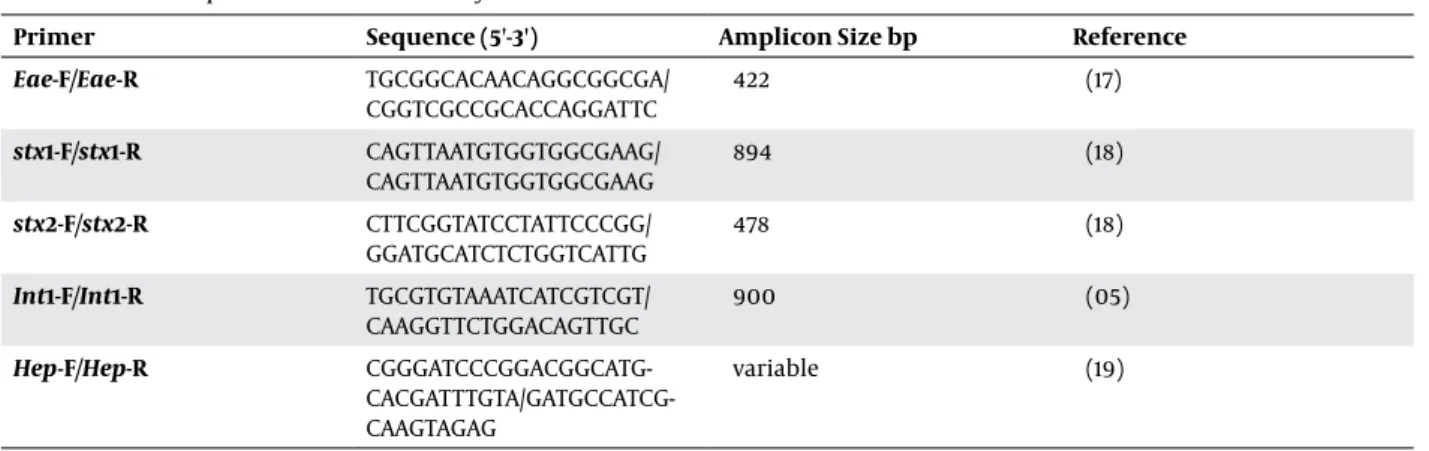
DNA from purified and confirmed E.coli isolates was subjected to PCR analysis (Table 1). EPEC strains were rec-ognized by the presence of eaeA gene and the absence of Shiga toxin genes (stx1, 2). PCR was performed in a reac-tion mixture with a total volume of 25 µL, containing 15.9 µL of sterile water, 2.5 µL of 10× Taq polymerase buffer, 0.3 µL of dNTPs (10 mmol/L), 1 U of Taq DNA polymerase, and 25 pmol of each primer. Amplification was performed as follows: initial denaturation step at 94 °C for 5 min, fol-lowed by 30 cycles including denaturation (94 °C for 1 min), annealing (58 °C for 1 min, separately adjusted for each set of primer pairs), and extension (72 °C for 1 min), followed by a final extension step at 72 °C for 5 min.
3.4. Detection of Class 1 and 2 Integron Conserved
Regions by PCR
Presence of classes 1 and 2 integrons among the EPEC isolates was investigated using int1-F and int1 -R prim-ers for class 1 and hep -F, and hep -R for class 2 integron. The primers were specifically chosen to amplify the con-served region of each class of integron (Table 1).
Table 1. Primers Sequences Used in This Study
Primer Sequence (5'-3') Amplicon Size bp Reference
Eae-F/Eae-R TGCGGCACAACAGGCGGCGA/
CGGTCGCCGCACCAGGATTC 422 (17)
stx1-F/stx1-R CAGTTAATGTGGTGGCGAAG/
CAGTTAATGTGGTGGCGAAG 894 (18)
stx2-F/stx2-R CTTCGGTATCCTATTCCCGG/
GGATGCATCTCTGGTCATTG 478 (18)
Int1-F/Int1-R TGCGTGTAAATCATCGTCGT/
CAAGGTTCTGGACAGTTGC 900 (05)
Hep-F/Hep-R CGGGATCCCGGACGGCATG- CACGATTTGTA/GATGCCATCG-CAAGTAGAG
variable (19)
4. Results
A total of 20 enteropathogenic E.coli (identified as
eae+stx1-stx2-) and 20 commensal E.coli collected during
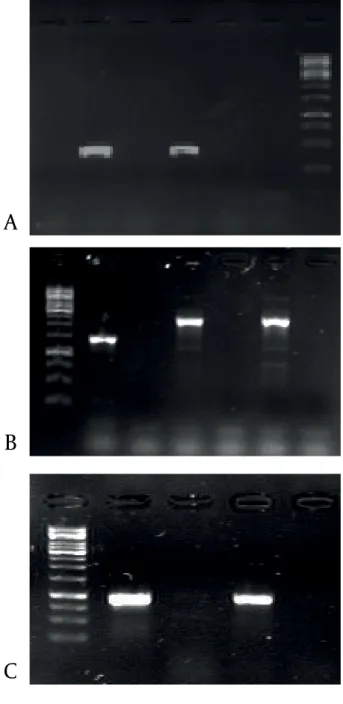
July 2012 and October 2012 were selected for analysis. An amplification band of 422bp, 894bp and 478bp was obtained for eae, stx1 and stx2, respectively. The result of PCR
analyses for each pair of primer sets is shown in Figure 1.
A
B
C
Figure 1. A) PCR amplification of eae gene. Lanes 1-4: presumptive EPEC isolated from patients, lane 5: Positive control, Lane 6: negative control. B) PCR amplification of class 1 integron integrase gene (int). Lane 1: Positive control, lane 2: negative control, lanes 3 and 4: isolates under study. C) PCR amplification of class 2 integron gene (hep). Lane 1: Positive control, lane 2: negative control, lanes 3-6: isolates under study.
4.1. Antibiotics Resistance Pattern
The antibiotic resistance pattern of isolates is shown in the Table 2. The resistance pattern in commensal and pathogenic E.coli was very similar. In both groups a high rate of resistance was seen to tetracycline, streptomycin,
cotrimoxazole, nalidixic acid, and minocycline. The most dominant resistance was seen to cotrimoxazole among commensal isolates (75%, 15 isolates), while the dominant resistance among EPEC isolates was seen to tetracycline (65%, 13 isolates).
Table 2. Antibiotics Resistance Profiles Antimicrobial
Agents Resistance (%) in Commensal E. coli Resistance (%) in Pathogenic E. coli
Augmentin 25 20
Tetracycline 65 65
Streptomycin 40 45
Ciprofloxacine 10 20
Gentamicin 15 5
Cotrimoxazole 75 60
Nalidixic acid 50 60
Minocycline 60 40
4.2. Distribution of Classes 1 and 2 Integrons and
Sizing of Class 1 Integron
Of 20 EPEC strains, 3 strains (15 %) and 1 strain (5%) had positive results for int and hep genes, respectively. An am-plification band of 900 bp was obtained for all int+ iso-lates; while, a fragment of 2300bp was obtained for hep gene among EPEC. Among 20 commensal, 65% (13 strains) and 10% (2 strains) had positive results for int and hep genes, respectively. Two fragments of 1500bp and 2300bp were obtained for hep gene among commensals.
5. Discussion
EPEC is one of the major agents of acute diarrhea among children in Iran (17). Furthermore, the emer-gence and spread of antimicrobial resistant E. coli and other pathogenic bacteria have become as serious public health threats. Water contaminated with effluents from livestock farms, aquaculture, hospitals, municipal waste-water treatment, or pharmaceutical manufacturing can be enriched for enteric bacteria resistance to one or more antibiotics. The distribution of class 1 was 15% and 65% among our EPEC and commensal population, respec-tively; Furthermore, the distribution of class 2 integron were 5% and 10% among the two groups, respectively. The higher rate of class 1 integron occurrence among com-mensal population proposes the comcom-mensal intestinal organisms as a potential reservoir of mobile resistance gene elements which could transfer the resistance gene cassettes to other pathogenic and/or nonpathogenic or-ganisms in the intestinal lumen at different occasions.
Both EPEC and commensal samples showed antibiotic resistance against 8 antibiotics tested which provides an evidence for exchange of resistance genetic elements among nonpathogenic commensal E.coli and EPEC
through horizontal mechanisms via transposons or plas-mids.
The prevalence of class 1 integrons in E. coli was 49% in selected nonoutbreak isolates from hospitalized pa-tients from 2002 to 2004 in Mexico City (20). A Study performed on the prevalence and diversity of integrons and associated resistance genes in fecal E. coli isolates of healthy humans in Spain, found that integrases were associated with class 1 and/or class 2 integrons confer-ring resistance to a wide spectrum of antibiotics in 29% of the E. coli isolates (14). This leads to a worrisome speculation that individuals in the community could be a reservoir of integron-containing E. coli isolates and improper sanitation could easily cause the rapid dis-semination of these resistant strains. Highly resistant E.
coli strains are not only found in humans with disease
but have also been reported in the feces of healthy hu-mans. All these reports draw our attention to the pres-ence of antibiotic resistance in E. coli from a wide range of sources due to integrons. Most of the strains under study were resistant to all tested antimicrobial agents except gentamicin. The result of this study is consistent with the previous results from Iran and other countries (21). One probable explanation for the high prevalence of resistance to antibiotics tested is using most of these antibiotics in conventional dairies which facilitates the natural selection and spread of resistance strains con-taining integrons (8).
In a study by Koczura et al. (21), four virulence encod-ing genes were associated with the presence of class 1 integrons; whereas, none of the genes investigated oc-curred in the intI1-negative isolates. This suggests that at least in some cases, those virulence genes were localized within the same plasmids as the integrons which may reflect pathogenic potential of integron-bearing strains (21). This emphasizes on the need to monitor the distri-bution and content of different classes of integrons not only for their resistance but also for virulence potential.
As our results indicated, integrons were present in 20% of EPEC and 70% of commensal E.coli. The occurrence of integron-negative antibiotic resistant strains empha-sizes on multidisciplinary mechanisms of resistance among E.coli isolates of both pathogenic and commen-sal origins.
Acknowledgements
We thank the research council of Tarbiat Modares Uni-versity for supporting the project.
Authors’ Contribution
The entire manuscript was prepared by the author.
Financial Disclosure
There is no financial disclosure.
Funding/Support
The study is self-funded.References
1. Phongpaichit S, Wuttananupan K, Samasanti W. Class 1 in-tegrons and multidrug resistance among Escherichia coli isolates from human stools. Southeast Asian J Trop Med Public
Health. 2008;39(2):279-87.
2. Nataro JP, Kaper JB. Diarrheagenic Escherichia coli. Clin
Micro-biol Rev. 1998;11(1):142-201.
3. kabir MR. Usefulness of a multiplex pcr for detection of diar-rheagenic E.coli in a diagnostic microbiology laboratory set-ting. Bangladesh J Med Microbiol. 2007;1(2):38-42.
4. Terajima J, Tamura K, Hirose K, Izumiya H, Miyahara M, Konuma H, et al. A multi-prefectural outbreak of Shigella sonnei infec-tions associated with eating oysters in Japan. Microbiol
Immu-nol. 2004;48(1):49-52.
5. Adabi M, Bakhshi B, Goudarzi H, Zahraei SM, Pourshafie MR. Distribution of class I integron and sulfamethoxazole trim-ethoprim constin in Vibrio cholerae isolated from patients in Iran. Microb Drug Resist. 2009;15(3):179-84.
6. Hall RM, Collis CM. Mobile gene cassettes and integrons: cap-ture and spread of genes by site-specific recombination. Mol
Microbiol. 1995;15(4):593-600.
7. Hall RM, Stokes HW. Integrons: novel DNA elements which cap-ture genes by site-specific recombination. Genetica. 1993;90(2-3):115-32.
8. Dini P, Amarloie OA, Moghadam MF, Moosakhani F, Mottaghian P, Barin A. The Comparison of antagonistic effects of normal vaginal lactobacilli and some commonly used antibiotics on isolated bacteria of uterine infections in dairy cows. Int J Anim
Vet Adv. 2012;4(6):358-62.
9. Schmitz FJ, Martinez-Freijo P, Theis S, Fluit AC, Verhoef J, Heinz HP, et al. Class I integrons: prevalence and impact on antibi-otic susceptibility in 278 consecutive unrelated Gram-negative blood isolates. Clin Microbiol Infect. 1999;5(8):496-498.
10. Leverstein-van HMA, M. Blok HE , T. Donders AR , Paauw A, Fluit AC, Verhoef J. Multidrug resistance among Enterobacte-riaceae is strongly associated with the presence of integrons and is independent of species or isolate origin. J Infect Dis. 2003;187(2):251-9.
11. Zhao S, White DG, Ge B, Ayers S, Friedman S, English L, et al. Identification and characterization of integron-mediated anti-biotic resistance among Shiga toxin-producing Escherichia coli isolates. Appl Environ Microbiol. 2001;67(4):1558-64.
12. Albert MJ, Rotimi VO, Dhar R, Silpikurian S, Pacsa AS, Molla AM, et al. Diarrhoeagenic Escherichia coli are not a significant cause of diarrhoea in hospitalised children in Kuwait. BMC
Mi-crobiol. 2009;9:62.
13. Cambray G, Guerout AM, Mazel D. Integrons. Annu Rev Genet. 2010;44:141-66.
14. Barbour E, Azhar E, Salabi AAE, Hani MA, et al. Transposable el-ements in Escherichia coli antimicrobial resistance. Adv Biosci
Biotechnol. 2013;4:415-23.
15. Ahangarzadeh Rezaee M, Langarizadeh N, Aghazadeh M. First re-port of class 1 and class 2 integrons in multidrug-resistant Kleb-siella pneumoniae isolates from northwest Iran. Jpn J Infect Dis. 2012;65(3):256-9.
16. Hansson K, Sundstrom L, Pelletier A, Roy PH. IntI2 integron inte-grase in Tn7. J Bacteriol. 2002;184(6):1712-21.
17. Najibi S, Bakhshi B, Fallahzad S, Pourshafie MR, Katouli M, Sattari M, et al. Distribution of class 1 integrons among enteropathogen-ic Escherenteropathogen-ichia coli. Can J Menteropathogen-icrobiol. 2012;58(5):637-43.
18. Jafari F, Garcia-Gil LJ, Salmanzadeh-Ahrabi S, Shokrzadeh L, Aslani MM, Pourhoseingholi MA, et al. Diagnosis and prevalence of enteropathogenic bacteria in children less than 5 years of age with acute diarrhea in Tehran children's hospitals. J Infect. 2009;58(1):21-7.
19. White PA, McIver CJ, Rawlinson WD. Integrons and gene cas-settes in the enterobacteriaceae. Antimicrob Agents Chemother. 2001;45(9):2658-61.
20. Diaz-Mejia JJ, Amabile-Cuevas CF, Rosas I, Souza V. An analysis of the evolutionary relationships of integron integrases, with em-phasis on the prevalence of class 1 integrons in Escherichia coli
isolates from clinical and environmental origins. Microbiology. 2008;154(Pt 1):94-102.
21. Koczura R, Mokracka J, Barczak A, Krysiak N, Kaznowski A. Associ-ation between the presence of class 1 integrons, virulence genes, and phylogenetic groups of Escherichia coli isolates from river water. Microb Ecol. 2013;65(1):84-90.