Lowy Institute Paper 12
heating up the planet
CLIMATE CHANGE AND SECURITY
Alan Dupont
Lowy Institute Paper 12
heating up the planet
CLIMATE CHANGE AND SECURITY
Alan Dupont
First published for
Lowy Institute for International Policy 2006
PO Box 102 Double Bay New South Wales 2028 Australia www.longmedia.com.au
[email protected] Tel. (+61 2) 9362 8441
Copyright © Lowy Institute for International Policy 2006
All rights reserved. Without limiting the rights under copyright reserved above, no part of this publication may be reproduced, stored in or introduced into a retrieval system, or transmitted in any form or by any means (including but not limited to electronic, mechanical, photocopying, or recording), without the prior written permission of the copyright owner.
Cover and text design by Shane Grantham Printed and bound in Australia
Typeset in Esprit Book 10 National Library of Australia Cataloguing-in-Publication data
Dupont, Alan, 1950- .
Heating up the planet : climate change and security. 1st ed.
Bibliography. ISBN 1 921004 22 3.
1. Climatic changes - Government policy - Australia. 2. Environmental policy - Australia. 3. National security - Australia. 4. Environmental degradation
- Political aspects. I. Lowy Institute for International Policy. II. Title. (Series : Lowy Institute papers ; 12).
363.707
Dr. Alan Dupont is Senior Fellow for International Security at the Lowy Institute for International Policy. He was formerly the Director of the Asia Pacifi c Security Program at the Australian National University’s Strategic and Defence Studies Centre and is a former army offi cer, strategic analyst, free-lance journalist, diplomat and academic. Alan is also a well known commentator, author and international security analyst who has published widely on non-military security challenges to Australia and the region. He has a masters degree and doctorate in international relations from the Australian National University. Dr. Graeme Pearman is honorary Senior Research Fellow at Monash University. He trained as a biologist and was Chief of the CSIRO Division of Atmospheric Research from 1992–2002. He is an internationally recognised climate scientist with more than 150 academic publications to his credit and is a Fellow of the Australian Academy of Science, the Royal Society of Victoria and the Australian Academy of Technological Sciences and Engineering. Graeme was awarded a United Nation’s Environment Program Global 500 Award in 1989, an Australian Medal of the Order of Australia in 1999 and a Federation Medal in 2003.
Executive summary
In this Lowy Paper we argue that there is no longer much doubt that the world is facing a prolonged period of planetary warming, largely fuelled by modern lifestyles, which is unprecedented in human history in terms of its magnitude and probable environmental consequences. With a few notable exceptions, even sceptics now seem prepared to accept the validity of the basic science underpinning climate change forecasts.
Crucially, however, there is no consensus about appropriate strategies for dealing with the consequences of climate change, primarily because there is no agreement about its seriousness for international security. The reality is that climate change of the order and time frames predicted by climate scientists poses fundamental questions of human security, survival and the stability of nation states which necessitate judgments about political and strategic risk as well as economic cost.
The central problem is the rate at which temperatures are increasing rather than the absolute size of differential warming. Spread over several centuries, or a millennium, temperature rises of several degrees could probably be managed without political instability or major threats to commerce, agriculture and infrastructure. Compressed within the space of a single century, global warming will present far more daunting challenges of human and biological adaptation, especially for natural ecosystems which typically evolve over hundreds of thousands and millions of years.
H E AT I N G U P T H E P L A N E T E X E C U T I V E S U M M A RY
Our principal conclusion is that the wider security implications of climate change have been largely ignored and seriously underestimated in public policy, academia and the media. Climate change will complicate and threaten Australia’s security environment in several ways. First, weather extremes and greater fl uctuations in rainfall and temperatures have the capacity to refashion the region’s productive landscape and exacerbate food, water and energy scarcities in a relatively short time span. Sea-level rise is of particular concern because of the density of coastal populations and the potential for the large-scale displacement of people in Asia.
Secondly, climate change will contribute to destabilising, unregulated population movements in Asia and the Pacifi c. Most of these fl ows are likely to be internal, but the ripple effects will be felt beyond the borders of the states most affected, requiring cooperative regional solutions. Thirdly, more extreme weather patterns will result in greater death and destruction from natural disasters, adding to the burden on poorer countries and stretching the resources and coping ability of even the most developed nations. Fourthly, extreme weather events and climate-related disasters will not only trigger short-term disease spikes but also have more enduring health security consequences, since some infectious diseases will become more widespread as the planet heats up.
Fifthly, even if not catastrophic in themselves, the cumulative impact of rising temperatures, sea levels and more mega droughts on agriculture, fresh water and energy could threaten the security of states in Australia’s neighbourhood by reducing their carrying capacity below a minimum threshold, thereby undermining the legitimacy and response capabilities of their governments and jeopardising the security of their citizens. Where climate change coincides with other transnational challenges to security, such as terrorism or pandemic diseases, or adds to pre-existing ethnic and social tensions, then the impact will be magnifi ed. However, state collapse and destabilising internal confl icts is a more likely outcome than interstate war. For a handful of small, low-lying Pacifi c nations, climate change is the ultimate security threat, since rising sea-levels will eventually make their countries uninhabitable.
Far from exaggerating the impact of climate change it is possible that scientists may have underestimated the threat. If this were to be
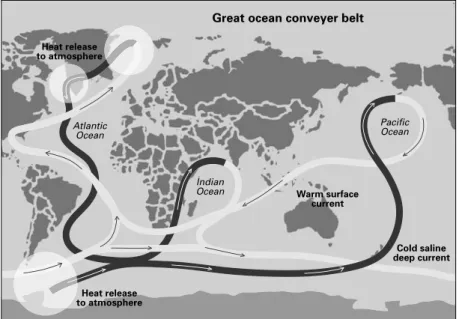
the case, the most likely catalysts are a collapse of the Thermohaline Circulation, which could have a detrimental effect on the growth of carbon dioxide in the atmosphere and life in the ocean, and the rapid recession of land-based glaciers and polar ice, which could dramatically increase sea-levels. Abrupt climate change could push the planet’s fragile and already stretched ecosystem past an environmental tipping point from which there will be no winners.
In the concluding chapter we make six recommendations for identifying and ameliorating the security consequences of climate change.
Recommendation 1
The Federal Government should encourage a more strategic approach to climate change and establish an interdepartmental task force to examine the policy connections between climate change and national security, with particular reference to the nation’s food, water, energy, health and environmental vulnerabilities, disaster planning and unregulated population movements.
Protecting and stabilising our climate is a legitimate objective of national security policy, since human survival is dependent on the health of the biosphere and the coupled ocean-atmosphere system. The public and policy discourse on climate change in Australia has been dominated by arguments about the reliability of the scientifi c data and the seriousness of climate change. But there has been a notable absence of any real attempt to situate the climate change debate within a broader policy framework or to assess strategic risk, in which the probability of an adverse climate event is measured against the magnitude of its impact. It is essential that we do so and that government takes the lead in encouraging a more holistic approach to climate change, which includes a comprehensive assessment of its implications for national and international security.
The Federal Government should establish an interdepartmental task force to examine, in detail, the policy connections between climate change and national security, with particular reference to the nation’s food, water, energy, health and environmental vulnerabilities, disaster
H E AT I N G U P T H E P L A N E T E X E C U T I V E S U M M A RY
planning and unregulated population movements. These studies could be extended geographically, to include the wider region, and functionally to include inputs from relevant non-government expert groups in the fi elds of climate science, agriculture, energy, health, immigration, defence, foreign policy and emergency management.
Recommendation 2
It is time for the Australian Intelligence Community to focus on climate-change risk and to mainstream the study of this emerging challenge to security.
The Government ought to pay greater attention to the national security implications of climate change. This will require attitudinal change and a willingness to incorporate the strategic, foreign policy and resource implications of climate-induced extreme weather events, sea-level rise and environmental refugees into national security planning.
It is time for the Australian Intelligence Community to focus on climate-change risk and to mainstream the study of this emerging challenge to security. The Offi ce of National Assessments could initiate this process by coordinating an agency-wide, all-source assessment of the climate-change risk to Australia drawing upon the full intellectual resources of the nation. In the longer term, the intelligence community needs to strengthen its analytical capabilities in this fi eld by recruiting more people with backgrounds in science, agronomy, environmental studies and infectious diseases, along with strategists capable of applying multi-disciplinary approaches to the study of climate change.
Recommendation 3
Good policy assumes the ability to conceptualise the problem of climate change in its entirety rather than in a compartmentalised way. Governments — federal state and local — need to think about better ways of growing the intellectual resources to develop this capacity.
One problem is that our education system is not producing suffi cient numbers of students and graduates with the requisite skills to effectively analyse the causes and consequences of climate change. The problem is both conceptual and structural. Conceptually, strategic and international security studies in Australia is still overwhelmingly concerned with military confl ict and this bias is refl ected in our universities and teaching institutions.
Structurally, the study of climate change is very stove-piped. Climate scientists see the issue primarily through the lens of physical science, economists focus on cost-benefi t calculations, environmentalists and business sceptics argue about desirable levels of greenhouse-gas emissions and appropriate remedies, while strategists have largely ignored the subject altogether. But good policy assumes the ability to see the problem in its entirety rather than in a compartmentalised way. Governments in this country — federal, state and local — need to think about better ways of growing the intellectual resources to develop this capacity.
They could start by providing incentives for universities and research institutes to ramp up the study of climate change in all its manifestations and to contribute solutions to an issue that will have increased policy salience in the decades ahead. Internationally, there are emerging institutional structures designed to promote ‘sustainability science’, where the study of economics, engineering and the social and physical sciences is integrated to achieve a better understanding of real world problems. The Australian Academy of Science has outlined a ‘blueprint’ for how such science might be undertaken and this interdisciplinary approach would be ideally suited to the study of climate change.
Recommendation 4
Australia should take the lead in working with like minded Asia–
Pacifi c governments to examine the implications of climate change for regional security and stability.
In assessing the threat to national security from climate change it is abundantly clear that Australia cannot quarantine itself from
H E AT I N G U P T H E P L A N E T E X E C U T I V E S U M M A RY
the international impact because climate change, by defi nition, is a global problem. Glacial melt in the polar ice cap will raise the seas around Australia as much as Europe and North America, and fossil fuel emissions in China and India will affect our climate as well as theirs.
It follows, therefore, that climate change responses require a high degree of international cooperation if they are to have any prospect of being effective. Both the Kyoto Protocol and Asia–Pacifi c Partnership on Clean Development and Climate explicitly recognise this reality. What is lacking, however, is agreement on how to identify, ameliorate and manage the security consequences. Australia should take a leadership role here, working with like minded Asia–Pacifi c governments to examine the implications of climate change for regional security and stability. This could be done bilaterally, as well as multilaterally, and follow the same basic pattern as our cooperation with the region on counter-terrorism and HIV/AIDS.
Examples of what might be discussed are: refi ning natural disaster and response mechanisms; identifying which areas are most likely to be affected by sea-level rise and developing programs to relocate people from threatened areas; improving climate forecasting; fostering more effi cient water and energy use; assessing the impact on fi sh stocks and agriculture; studying the implications of rising temperatures on the spread of infectious diseases and of sea-level rise on maritime disputes. Recommendation 5
Policy makers must factor climate wild cards into their security calculations and alternative futures planning and ‘think the unthinkable’.
Particular attention should be given to the climate wild cards discussed in this Lowy Paper. Even if the probability of their occurrence is low, their potential impact could be very high indeed, and for this reason policy makers ought to factor them into their security calculations and alternative futures planning.
Priority should be given to the consequences of a collapse, or slowing, of the Thermohaline Circulation and worst case scenarios of glacial and ice-cap melt. There has been insuffi cient study of the effect of changes to the Circulation on the southern hemisphere or of rising temperatures on the Antarctic continent. These are critical issues for Australia and they warrant the establishment of a task force to explore the science as well as the potential security fallout. Like Peter Schwartz and Doug Randall, the government needs to encourage our intelligence agencies, universities and research institutes to ‘think the unthinkable’ as part of a broad strategy to prepare the country for a very different climate future.
Recommendation 6
The most effective way of ameliorating the security risk of prospective climate change is to reduce the level of greenhouse gases that are responsible for heating up the planet.
Although this Lowy Paper has deliberately not canvassed the wider economic, social and environmental aspects of climate change, it is clear that the most effective way of ameliorating the security risk is to reduce the level of greenhouse gases that are responsible for heating up the planet.
However, it is diffi cult to see how greenhouse-gas emissions can be substantially reduced this century, the precursor to regaining climate equilibrium in the next, without a fundamental transformation of our approach to energy use. This will require technological improvements encompassing cleaner coal and fuel effi cient hybrid cars, as well as the increased use of gas, nuclear power and renewable sources of energy. A continuation of our present reliance on fossil fuels will inevitably warm the atmosphere of the planet to levels that will place unprecedented stress on the earth’s ecological fabric and challenge the adaptive capacities of future generations.
Chapter 3: Natural disasters, energy security and 41 environmental refugees
Natural disasters Sea-level rise Energy security
Environmental and climate refugees
Chapter 4: Wild cards and abrupt climate change 61 Aerosol masking
Carbon sink or carbon source? Glacial and permafrost instability
Collapse of the Thermohaline Circulation Thinking the unthinkable
Is this plausible?
Conclusion and policy recommendations 79 Bibliography 91
Notes 111
Contents
Executive summary vii
Boxes, fi gures, tables and maps xvi
Acknowledgments xvii
List of acronyms xviii
Introduction 1
Chapter 1: Is climate change real? 7
What shapes our climate? Human infl uences
The Intergovernmental Panel on Climate Change (IPCC) The climate projections for Australia and the region Assessing what is an acceptable risk
The sceptics – do they have a case? Climate change is real
Chapter 2: Food, water and disease 27
Food security Water security Infectious diseases
List of boxes, fi gures, tables and maps Boxes
1.1 Calculating greenhouse gas emissions 18
2.1 Asian food vulnerabilities 29
2.2 Climate change and agricultural productivity 32
3.1 Adapting to climate change 47
3.2 James Lovelock: environmental apostate 54 4.1 Signifi cance of the Thermohaline Circulation 73 Figures
1.1 Changes in atmospheric carbon dioxide and methane 11 over the past two millennia
1.2 The international system for climate change action 13 1.3 Average temperature at the Earth’s surface 14 3.1 Great weather related disasters 1950-1999 42 3.2 Natural disasters in Oceania 1970-1999 43 3.3 Schematic representation of the relationship between 52
climate change, energy security and foreign policy
4.1 Managing climate-change risk 62
4.2 Diagrammatic representation of the 70 Thermohaline Circulation
Tables
1.1 Climate change certainty levels 23
2.1 Climate change and water scarcity 34
2.2 Effect of climate factors on vector and rodent-borne 38 disease transmission.
3.1 Potential land loss and population exposure to sea-level 50 rise in selected Asian countries
4.1 Climate change wild cards 64
Maps
3.1 Areas at risk from sea-level rise in Asia 49
4.1 Asian brown cloud 65
Acknowledgments
This collaboration has been long in the making and has benefi ted greatly from interviews with prominent scholars in the fi eld of climate science as well as constructive and insightful comments from a number of colleagues. We are particularly grateful to Professors Michael Oppenheimer from Princeton University and Stephen Schneider from the University of California (Los Angeles) for making themselves available to discuss the issues covered in this Lowy Paper during the course of a fi eld trip in November 2005. Professor Peter Curson, from Macquarie University, Dr. Barry Pittock, formerly of the CSIRO and Dr. Kevin Walsh from Melbourne University, cast a collective critical eye over an earlier iteration and made many helpful suggestions for improvements. Joanne Bottcher, at the Lowy Institute, provided a seemingly inexhaustible list of reference material and sage advice on formatting and style. Finally, our thanks go to Jonathan Lusthaus, our tireless but much over-worked research assistant. Without him this Lowy Paper may not have seen the light of day. Any errors of fact or interpretation are, of course, the responsibility of the authors.
Introduction
There are many historical examples of climate shifts or extremes of weather triggering confl ict and even contributing to the rise and fall of civilisations and nations. Growing aridity and frigid temperatures from a prolonged cold snap caused Huns and German tribes to surge across the Volga and Rhine into milder Gaul during the fourth century, eventually leading to the sack of Rome by Visigoths, while Muslim expansion into the Mediterranean and southern Europe in the eighth century was to some extent driven by drought in the Middle East. The Viking community in Greenland died out in the fi fteenth century partly because of a sudden cooling of temperatures across northern Europe known as the ‘Little Ice Age’.1
However, for the most part these climatic changes were relatively short-lived and far less signifi cant than those in prospect. In a world already populated by 6.5 billion people and destined to reach 9 billion by 2050, deviations from global or regional weather norms, particularly if they occur within the span of a single human generation, could have profound consequences for international security if food production is disrupted, fresh water becomes scarce, diseases spread and natural disasters increase. Climate shifts, manifested in rising sea-levels and more intense droughts and storms, could stimulate large scale movements of people within, and across, international borders.2
Individually or collectively, such developments could destabilise nations internally, aggravate tensions between states and endanger human List of acronyms
ATHC Atlantic Thermohaline Circulation
CSIRO Commonwealth Scientifi c and Industrial Research Organisation
ERS Economic Research Service (US Department
of Agriculture)
IPCC Intergovernmental Panel on Climate Change ppmv parts per million by volume
H E AT I N G U P T H E P L A N E T INTRODUCTION
security.3 International society could also be affected because of the
often subtle and poorly understood dependence of natural ecosystems on the weather and climate.
Sceptics dismiss any direct connection between climate change and security, maintaining that climatic factors will only marginally infl uence tomorrow’s security environment, if at all. They point to signifi cant natural fl uctuations in climate patterns and short-term cyclical phenomena like El Niño and the recently identifi ed Pacifi c Decadal Oscillation, the causes of which are not fully understood.4
Even if global warming does take place, they argue, many of its effects may be localised, benign or favourable. While reductions in rainfall may lead to desertifi cation or water shortages in some regions, others will benefi t from increased rainfall and higher crop yields.5 China,
for example, could initially benefi t as a result of greater productivity in its cooler north and arid interior through a combination of warmer temperatures and higher rainfall. Russia might also gain, as previously dry areas become moister and therefore more productive.6 Even where
the fabric of the state is torn by environmentally induced confl icts, in all likelihood they will be localised and have negligible effects on world order — ‘visions of starving millions from the “South” invading the “North” in search of food are far fetched…’.7
On the other hand, mainstream climate scientists and some international security specialists contend that the magnitude of expected climate change will be substantial and certainly beyond our societal and eco-system experience, posing genuine and multiple risks to global security. Governments are now beginning to heed their warnings. Australia’s Environment Minister, Ian Campbell, sees climate change as a ‘very serious threat’ and British Prime Minister, Tony Blair, has declared that ‘there will be no genuine security if the planet is ravaged by climate change’.8 Blair’s chief climatologist, Sir John Houghton, has
gone even further, asserting that climate change is ‘a weapon of mass destruction’and at least as dangerous as international terrorism.9
Are Campbell, Blair and Houghton right? And, if so, what is the evidence for considering climate change a fi rst order security issue? In seeking answers to these questions it is important to understand how
thinking about security has been transformed by the dramatic reduction in interstate confl icts that have occurred since the end of the Cold War. Historically, national security was considered to be synonymous with defence of the realm against military dangers from other states or polities. Consequently, military strategists and national security specialists were disinclined to consider the implications of non-military threats to security, such as climate change.
But attitudes are changing as evidence grows that many security threats are not immutably linked to the exercise of state power or military force. As has been argued elsewhere, a new class of non-military threats has emerged over the past few decades which have direct implications for international security.10 They include the
activities of non-state actors, such as terrorists and organised criminal groups, as well as unregulated population movements, infectious diseases and the rapid depletion of the Earth’s natural resources. Environmental dangers, such as climate change, form part of this new security paradigm. They stem not from competition between states or shifts in the balance of power, but from human-induced disturbances to the fragile balance of nature, the consequences of which may be just as injurious to the integrity and functioning of the state and its people as those resulting from military confl ict. They may also be more diffi cult to reverse or repair, as global warming and the destruction of the ozone layer illustrate. Seen in this light, our climate is a critical part of the Earth’s natural support system which sustains all life. Protecting and stabilising our climate is, therefore, a legitimate long-term objective of security policy since human survival is dependent on the health of the biosphere and the coupled ocean–atmosphere.
Until recently, most of the controversy surrounding the climate change debate has centred on the reliability of the scientifi c forecasts and the adequacy of the international response, especially in reducing greenhouse-gas emissions. In this Lowy Paper we argue that there is no longer much doubt international society is facing a prolonged period of planetary warming, largely fuelled by modern lifestyles, which is unprecedented in human history in terms of its magnitude
H E AT I N G U P T H E P L A N E T INTRODUCTION
integrated and informed appreciation of the enormous challenge posed by a rapidly warming planet.
Secondly, although climate change is clearly a global phenomenon, the geographical focus of this paper is Asia and the Pacifi c. Australia is better equipped than most nations to meet the challenge of climate change because of our wealth, knowledge edge, low population densities and abundant natural resources. But this should not be a cause for complacency. Most of our neighbours are not as well endowed. With few exceptions, they are still developing states, with far less capacity to mitigate or adapt to climate change. As the pace of Australia’s integration with the region accelerates, the deleterious effects of climate change in Asia and the micro-states of the Southwest Pacifi c will be of direct consequence for our own security interests.
Thirdly, climate change cannot be assessed without an understanding of the links between a warming planet, eco-system transformation and human survival. We seek to illuminate this complex and poorly understood interrelationship through this cross-disciplinary collaboration, drawing on the authors’ expertise in climate science and international security.
Fourthly, judgments are required about the seriousness of climate change for Australia and the region relative to the other dangers we confront. Policy makers, in particular, must be able to prioritise climate change within their taxonomy of threats to national and international security. Is signifi cant climate change more likely than a terrorist attack by a non-state actor, a military strike by a state adversary or a disease pandemic? Or is climate change better understood as a low probability but high impact event?
Finally, this paper makes no claim to be a comprehensive treatment of the subject which is beyond the scope of a single monograph or the competence of the authors. A more extensive analysis would require input from agricultural science, economics, political science, geography and medicine to name just a few of the relevant disciplines. Nor will the reader fi nd much here about the Kyoto Protocol, greenhouse-gas emission targets, climate policy or technological solutions. Not because they are unimportant, but because these issues have been canvassed and probable environmental consequences. With a few notable
exceptions, even sceptics now seem prepared to accept the validity of the basic science underpinning climate change forecasts.
Crucially, however, there is no consensus about appropriate strategies for dealing with the consequences of climate change, primarily because there is no agreement about its seriousness for international security. Some economists argue that it makes no sense to make expensive adjustments to industrial or agricultural practices and to attempt substantial reductions in greenhouse gas emissions unless it can be demonstrated that they would be effi cacious or that the cost is justifi ed by the consequences of not taking remedial action. In strict economic terms they are right, but the problem is that climate change is not amenable to a simple cost-benefi t analysis because it transcends economic calculations.
The reality is that climate change of the order and time frames predicted by climate scientists poses more fundamental questions of human security, survival and the stability of nation states which necessitate judgments about political and strategic risk as well as economic cost. The central problem is the rate at which temperatures are increasing rather than the absolute size of differential warming. Spread over several centuries, or a millennium, temperature rises of several degrees could probably be managed without political instability or major threats to commerce, agriculture and infrastructure. Compressed within the space of a single century, global warming will present far more daunting challenges of human and biological adaptation, especially for natural ecosystems, which typically evolve over hundreds of thousands and millions of years.
The purpose of this Lowy Paper is four-fold. First, we aim to broaden and deepen understanding of the political, economic and strategic impact of climate change by viewing the issue through the lens of security. Most of the literature and public discourse on climate change is dominated by arguments about the utility of setting targets for greenhouse-gas emissions and the costs to industry and the economy. While this debate is important, we argue that the wider security implications have been neglected to the detriment of a more
H E AT I N G U P T H E P L A N E T
Chapter 1
Is climate change real?
Human induced climate change is one of the major challenges confronting the world this century.
Prime Minister John Howard, the National Press Club, 15 June 2004.
Despite nearly two decades of public debate there is still residual scepticism about the seriousness of climate change and the degree to which humans are responsible. In this Chapter we explain how the natural and human drivers of the Earth’s climate interact and why the vast majority of the world’s scientists believe that signifi cant and potentially destabilising climate change this century is inevitable, notwithstanding the contrary views of sceptics. How do scientists measure changes in the composition of the atmosphere, temperature and ocean currents, the key components of our climate, and how reliable and accurate are the data sets which inform the super-computers that help scientists to predict our climate?
extensively elsewhere. We hope, nonetheless, that those interested in the subject will fi nd some enlightenment in these pages.
The structure of this monograph is as follows. Chapter one explains how the natural and human drivers of the earth’s climate interact and why the vast majority of the world’s scientists believe that signifi cant and potentially destabilising climate change this century is inevitable, notwithstanding the contrary views of sceptics. As the Earth heats up and sea levels rise, there will be demonstrable and largely negative consequences for food production, fresh water availability and the spread of infectious diseases. Chapter two surveys the implications of climate change for food, water and disease transmission, especially in Asia and the Pacifi c, while Chapter three explores the links between climate change, natural disasters, energy security and environmental refugees, including how each is likely to play out regionally, as well as internationally. Chapter four looks at the possibility that the magnitude of future climate change and the speed with which it could occur has been underestimated, rather than exaggerated, and asks whether we have adequately factored in a number of ‘wild cards’ in the climate change pack.
H E AT I N G U P T H E P L A N E T IS CLIMATE CHANGE REAL?
called ‘greenhouse gases’ — mainly carbon dioxide, methane, nitrous oxide and chlorofl uorocarbons (once used as propellants in aerosols and refrigerants) also play a role by preventing the unimpeded escape of heat from the earth to space. Without these gases the Earth’s surface would be 30–33oC colder. This is the radiative budget of the earth.
The energy that is absorbed is not evenly distributed across our planet’s surface because of the spherical shape of the Earth and its daily rotation and seasonal progression around the sun, resulting in differential heating of both the atmosphere and the oceans that drives the circulations we call winds and currents. This is the dynamic component of the climate system. Energy absorbed at the earth’s surface is responsible for the evaporation of water, which is then carried upwards into the atmosphere, where it forms clouds and rain, the core of the hydrological cycle. These subcomponents of the climate systems are complex and highly interactive which is why detailed predictions of climate change are diffi cult and contentious. It is simply not possible to conduct empirical studies on a global scale to determine what will happen when the mix of greenhouse gases is varied or the overall level increases.
Nevertheless, scientists have made great progress in measuring the physical characteristics of the climate and its variations, allowing the building of sophisticated computer models that integrate this knowledge into a single description of the climate system. These models have advanced signifi cantly in the past decade due to an improved understanding of our climate and better use of observations of the real system to validate the performance of the models. New developments in computer technology allow models to represent more frequently and accurately the complexity of the atmosphere and oceans across the globe. As a result, climatologists now have far greater confi dence in their ability to predict the magnitude and nature of future climate change for a given change in atmospheric greenhouse gases.
Fortunately, our climate is modifi ed and tempered by the protective layer of the Earth’s atmosphere, although it is occasionally disrupted by asteroids and meteors, a number of which have struck the Earth with massive force and catastrophic consequences for all life forms.16
Sixty-What shapes our climate?
In assessing the signifi cance of climate change for international security it is important to recognise that our climate is in a constant state of fl ux and today bears little resemblance to the climate of our prehistoric ancestors. An extra-terrestrial observer in 20,000 B.C. would have looked down on a very different planet, where sea levels were 80 metres lower than present, average mean temperatures fi ve degrees colder, 50% of the Earth’s surface was covered in ice, and ecosystems and animal species were markedly different in distribution and composition.11
Even as recently as 10,000–15,000 years ago, much of the planet lay in the grip of a severe ice age, with the northern ice cap extending almost as far south as present day Portugal, while a large part of Tasmania was covered in ice.
None of these temperature and climatic fl uctuations have anything to do with human activity but are primarily the consequence of the Earth’s celestial heart beat — the variations in its orbit around the sun and the obliquity and ‘wobble’ of its axis.12 The effects are typically measured in
hundreds of thousands or millions of years, although some fl uctuations occur over much shorter time scales because of decadal variations in solar radiation, periods of greater or lesser volcanic activity and the internal features of the coupled ocean–atmosphere–biosphere system producing, for example, the El Niño and La Niña effects.13 Changes to
the biology of the planet can also infl uence climate by causing feedback loops, enhancing the magnitude of climatic fl uctuations during colder phases.14 The earth is currently in a warmer interglacial phase, which
climatologists expect to last for at least another 10,000 years, human infl uences excluded, before the redevelopment of another Ice Age resulting in re-glaciation, especially in the northern hemisphere, and a return to a harsher, colder climate.15
Our underlying climate is determined by the balance between solar energy that arrives at the outer limits of the atmosphere and the proportion that is refl ected or re-radiated back to space by clouds, aerosol particles and the Earth’s surface, with the amount of snow and ice being particularly important because of their refl ective qualities. So
H E AT I N G U P T H E P L A N E T IS CLIMATE CHANGE REAL?
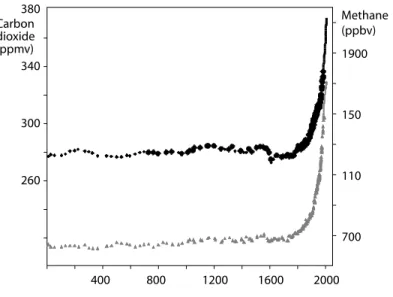
Figure 1.1: Changes in atmospheric carbon dioxide and methane over the past two millennia
Source: Etheridge et al. (1996) and Etheridge and MacFarling (personal communication).
Note: This graph shows the rapid rise of carbon dioxide and methane during the period of industrialisation from data collected by direct measurement at the Cape Grim Observatory, Tasmania. The data points are measurements of air trapped in Antarctic ice. Such information is now available for much of the last million years.
Increased levels of greenhouse gases reduce the heat lost to space, trapping it within the lower atmosphere and causing mean global temperatures to rise over time. Climatologists expect that over the next hundred years the concentration of carbon dioxide accumulating in the atmosphere will eventually more than double, suffi cient to increase global temperatures by several degrees and fundamentally alter global weather patterns.
fi ve million years ago an asteroid, estimated to be about ten kilometres in diameter, slammed into North America at high velocity, leaving a fi ve kilometre deep crater and dispersing vast amounts of dust and particles into the atmosphere. The impact was so severe that the world was plunged into darkness, bringing about a precipitous end to the age of the dinosaurs.17 Such is the reality of naturally occurring climate
change — long periods of relative stability, as measured in human years, punctuated by occasional catastrophic events, signifi cant decadal fl uctuations and more severe, longer term cyclical shifts that pose major challenges of adaptation and survival for all species on the planet. Human infl uences
Of far more immediate concern, however, is the now irrefutable evidence that human activities are heating up the planet at a rapid rate. This anthropogenic warming could have profound implications for our security and way of life. The reason is that air pollution from industrial emissions, automobile exhausts, the burning of carbon-based fuels, changes in land use, agriculture and the large-scale destruction of forest cover has resulted in a build-up of greenhouse gases in the Earth’s atmosphere.
These gases have grown signifi cantly in concentration since the Industrial Revolution (Figure 1.1), primarily due to human activities. The devastating Indonesian fi res of 1997–98 caused by land clearing for palm oil plantations, for example, are estimated to have released at least a billion tonnes of carbon as carbon dioxide into the atmosphere, more than the total annual emissions from Western Europe’s cars and power stations.18 But these high impact events are actually less detrimental to
our atmosphere than the steady, incremental increase in greenhouse-gas emissions caused by our dependence on fossil fuels. Analysis of direct atmospheric measurements and air trapped in ice-core samples from Antarctica clearly shows that the three key greenhouse gases of carbon dioxide, methane and nitrous oxide are at higher levels than at any time in the last 650,000 years.19 By 2030, concentrations of carbon dioxide are
likely to be 60% higher than the pre-industrial levels of 200 years ago.
#ARBON DIOXIDE PPMV
-ETHANE PPBV
H E AT I N G U P T H E P L A N E T IS CLIMATE CHANGE REAL?
The Intergovernmental Panel on Climate Change (IPCC) A handful of scientists were aware of the connection between the accumulation of carbon dioxide and other greenhouse gases in the atmosphere and the stability of the earth’s climate as early as the middle of the nineteenth century. However, the wider community of climatologists did not evince a great deal of interest or awareness of the connection until the 1970s, when solid evidence began to emerge of a build up of carbon dioxide. In response, the World Meteorological Organisation convened the fi rst World Climate Conference in 1979, which concluded that continued expansion of man’s activities on earth may cause signifi cant extended regional and even global changes of climate.20
A subsequent 1986 meeting of leading scientists in Villach, Austria went further, forecasting that by the end of the century the general warming of the planet would exceed the natural fl uctuations of the planetary mean temperature.21 However, this prediction was based
on theoretical expectations of planetary warming. There was still no convincing ‘hard’ evidence to support the contention that warming was greater than would be expected from natural variation. But the indicators were suffi ciently worrying for the World Meteorological Organisation to establish an Intergovernmental Panel on Climate Change (IPCC) with the United Nations Environment Programme as a partner, tasked to:
• Identify knowledge gaps and uncertainties about climate change and its impacts as well as information needs for policy development;
• Review national and international policy on climate change;
• Conduct scientifi c assessments (based on peer reviewed and published literature) of all aspects of the climate-change issue and disseminate the results widely.22
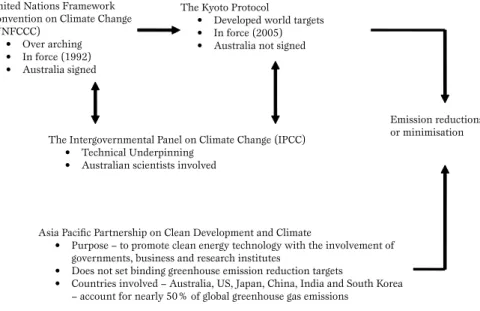
The IPCC is now a key part of the international regime for assessing the impact of climate change and developing effective responses, based
on the United Nations Framework Convention on Climate Change and associated Kyoto Protocol. The latter is essentially an agreement on the measures needed to reduce greenhouse gases (Figure 1.2).23 A
third element is the Asia Pacifi c Partnership on Clean Development and Climate. This was established in 2005 and aims to achieve emission reductions voluntarily through the development of clean energy technology and involves governments in partnership with business and research institutes. Its six members — Australia, US, Japan, China, India and South Korea — account for nearly 50% of greenhouse-gas emissions globally.24
Figure 1.2: The international system for climate change action
The IPCC is today universally regarded as the most authoritative source of information on climate change. So far it has produced three major assessments — in 1990, 1995 and 2001 — and a fourth is due in 2007. The 1995 Second Assessment was politically infl uential as it United Nations Framework
Convention on Climate Change (UNFCCC)
• Over arching • In force (1992) • Australia signed
The Kyoto Protocol
• Developed world targets • In force (2005) • Australia not signed
Emission reductions or minimisation The Intergovernmental Panel on Climate Change (IPCC)
• Technical Underpinning • Australian scientists involved
Asia Pacifi c Partnership on Clean Development and Climate
• Purpose – to promote clean energy technology with the involvement of governments, business and research institutes
• Does not set binding greenhouse emission reduction targets
• Countries involved – Australia, US, Japan, China, India and South Korea – account for nearly 50% of global greenhouse gas emissions
H E AT I N G U P T H E P L A N E T IS CLIMATE CHANGE REAL?
The IPCC made two other important fi ndings. It identifi ed a number of potentially serious climatic changes, including the probably heightened incidence and severity of extreme weather patterns (such as droughts, high temperatures and fl oods) that are expected to have a negative impact on agriculture and primary production. While acknowledging the diffi culty of making accurate forecasts of local variations in weather cycles, the report concluded that the ‘emerging pattern’ clearly shows the weather is responding to higher concentrations of greenhouse gases.26
In 2001, the IPCC published a Third Assessment Report which reinforces and strengthens the fi ndings of its predecessor and provides further evidence that signifi cant warming and sea-level rise are likely. Precise levels of future greenhouse-gas concentrations are diffi cult to predict due to uncertainty about key variables such as technological and economic advances, developments in fuel effi ciency and the degree of government intervention. Thus, rather than making one defi nitive assessment, the IPCC developed a number of plausible emission scenarios and extrapolated from them to sketch out likely climatic changes.27 It
is important to note that these scenarios are not predictions, but rather a scoping of what might plausibly occur under a range of different assumptions about the global use of energy.
The Third Assessment Report estimates that temperatures will increase by between 1.4ºC–5.8ºC this century (compared with the 1ºC– 3.5ºC predicted in 1995) with lower emissions of sulphur dioxide leading to fewer sulphate particles in the atmosphere and thus less offsetting of the warming effect of greenhouse gases. Crucially, even if atmospheric concentrations of these gases are stabilised, temperatures will continue their upward trend over the next several decades. As the heating slowly penetrates to the depths of the world’s oceans sea levels will also rise, probably for several centuries. Other key judgments are that:
• Model simulations of the climate system give increased confi dence in climate projections;
• Observed warming over the last 50 years is likely to have been due mainly to the increase in greenhouse–gas concentrations; received widespread international media coverage and shaped the tenor
and parameters of today’s climate change debate. Its key conclusions were that:
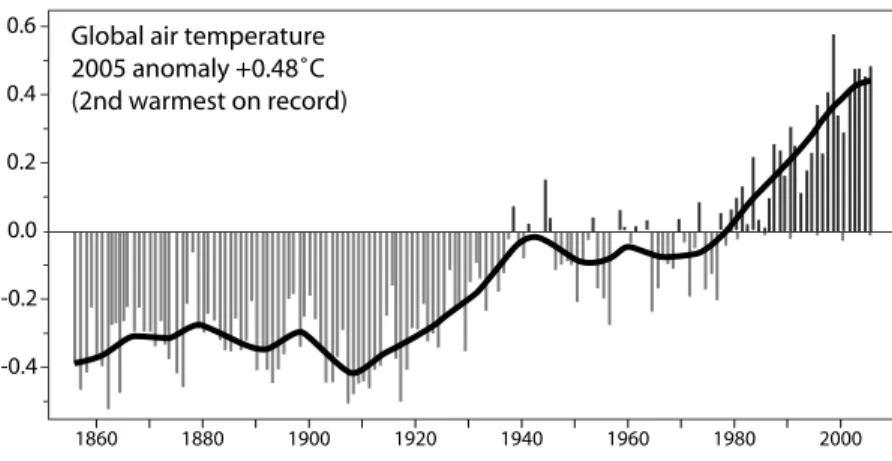
• Mean global temperatures rose between 0.3ºC and 0.6ºC in the 20th
century, most of it occurring over the last 40 years (Figure 1.3);
• The early 1990s were the warmest years recorded since 1860, the fi rst year that accurate temperature records were kept;
• Temperatures were predicted to increase by 1ºC to 3.5ºC by the end of this century (the variation is accounted for by different emission scenarios and model uncertainties);
• The average rate of warming was greater than any seen in the last 10,000 years;
• Temperatures will continue to rise beyond 2100, even if concentrations of greenhouse-gases are stabilised;
• Sea levels have risen between 10 and 25 centimetres in the twentieth century and will rise between 15 and 95 centimetres by 2100.25
Figure 1.3: Average temperature at the Earth’s surface
Source: http://www.cru.uea.ac.uk/cru/info/warming
'LOBALAIRTEMPERATURE ANOMALY# NDWARMESTONRECORD
H E AT I N G U P T H E P L A N E T IS CLIMATE CHANGE REAL?
• up to 15% less rainfall year-round in the south-east and in spring in Queensland;
• up to 20% less rainfall year-round in the south-west; • up to 15% more summer rainfall on the east coast; • up to 15% more autumn rainfall inland;
• heavier rainfall where average rainfall increases, or decreases slightly;
• stronger tropical cyclones, but uncertain changes in frequency and location.30
Assessing what is an acceptable risk
Until now, the IPCC has not provided defi nitive statements on what level of global mean temperature change might be regarded as an acceptable risk, or, in the words of the Framework Convention on Climate Change, what might be regarded as ‘dangerous anthropogenic interference with the climate system.’31 Determining what is ‘dangerous’ climate change,
or change that represents an acceptable risk, is problematic for two reasons. First, our understanding of how climate change will impact at the local or regional level is still uncertain. Secondly, perceptions of what constitutes an acceptable risk depend on location, coping capacity and who is making the assessment. Residents of Pacifi c island nations, or of Bangladesh, may see things quite differently from people living in inland Australia or the continental United States because of the far greater impact of sea-level rise on coastal and island communities, as well as the limited capacity of less developed countries to respond.32
Nonetheless, there is an emerging consensus that if global mean temperature rises can be contained to around 2.0oC an increase of this
order can be managed without undue risk to international security.33
But confi dence in this judgment dips sharply once the rise exceeds 2.0oC. Unfortunately, it seems very likely that this de facto temperature
ceiling will be breached. In April, 2006, Sir David King, the UK Chief Scientist, warned that temperatures will probably rise by at least 3.0oC,
which will cause severe droughts, put 400 million people at risk from hunger and jeopardise water supplies for up to 3 billion people.34 The
• Human infl uence will be responsible for further changes in atmospheric composition (in particular carbon dioxide) throughout the 21st century;
• Sea-level rises of 9–88 cm by 2100 are almost certain.28
The climate projections for Australia and the region We still don’t know enough about the regional and national consequences of climate change because accurate predictions become more diffi cult at the sub-system level since there are many more factors to consider. Nevertheless, the IPCC has identifi ed fi ve likely climate outcomes for Asia and the Pacifi c:
• more intense summer monsoons, increasing the degree and frequency of destructive fl oods and soil erosion;
• sea-level rises which will submerge low-lying coastal plains and river deltas, placing at risk already endangered coastal ecosystems;
• changes in precipitation, which could alter river fl ows and affect hydro-electric power;
• decreasing fresh water availability resulting from higher rates of evaporation and salinisation;
• greater uncertainty associated with water management and supply.29
The Commonwealth Scientifi c and Industrial Research Organisation (CSIRO) has used a number of different models to project the likely consequences for Australia, drawing on the organisation’s own research and that of the IPCC. By 2030, relative to 1990 conditions, the CSIRO anticipates:
• a warming of 0.4–2.0oC, the temperature effects being least near
the coast and greatest inland;
• a 10–50% increase in days over 35oC;
H E AT I N G U P T H E P L A N E T IS CLIMATE CHANGE REAL?
the gases is emitted. The latter depends on a wide range of interconnected technological and socio-political factors. If all anticipated growth in energy demand over this century were to be met using today’s fossil fuel technology, emissions would increase by almost 100% from present levels. It is reasonable to assume, however, that technological advances will allow greater fuel effi ciency and reduced emissions. It may even prove possible to capture the carbon dioxide from power plants and store it under the ground so that it will not be released into the atmosphere. How quickly these technologies come into play depends on how urgent the task of emission reductions is seen by governments, social adaptation, economic costs and the use of alternative fuels like nuclear, wind, solar, geothermal and biomass power, which contribute smaller amounts of greenhouse gases to the atmosphere when power plants are being built.
The Intergovernmental Panel on Climate Change (IPCC) has calculated future emissions by developing several possible global energy scenarios which factor in different levels of demand, technological uptake and emission control. These scenarios were developed to establish what might happen without any policy of intervention. Because of the degree of inertia in the current energy system, the IPCC has a high level of confi dence in its assessment that the concentration of carbon dioxide in the atmosphere by 2030 will be 60% higher than pre-industrial times. Beyond 2030, accurate forecasts become more diffi cult, refl ecting uncertainty about human responses.37
The sceptics — do they have a case?
So how much credence should be given to these fi ndings and what are the arguments of the sceptics? A few dissident climatologists and fi gure of 2.0oC is signifi cant politically because it underpins the large
number of national emission targets being set around the world by individual states. If the international community accepts that 3.0oC is
probable then more stringent emission reductions than those mandated by the Kyoto Protocol will be necessary to stabilise our climate.
Box 1.1: Calculating greenhouse gas emissions The amount of carbon dioxide in the atmosphere has climbed more than 30% since the Industrial Revolution and is increasing by an average 0.4% per year, or 2 parts per million by volume (ppmv). It is now (2006) 379 ppmv. We know this is the result of human activity because the changing isotopic composition of the atmospheric carbon dioxide betrays its fossil origin. Once the concentration of atmospheric carbon dioxide exceeds about 400 ppmv, as seems likely within the next decade, it will be diffi cult to keep temperature rises below 2.0oC above pre-industrial levels, after
which climate change becomes progressively more destructive environmentally, and the likelihood of disastrous impacts on agriculture, water, forests and sea-levels rise exponentially.35 On current estimates,
the 2.0oC threshold could be breached as early as 2026.36
Agricultural practices and manufacturing have also forced up methane and nitrous oxide, while tropospheric ozone, another greenhouse gas, has risen by 40% since the beginning of the industrial revolution.
Future concentrations of greenhouse gases, particularly carbon dioxide, will be partly determined by how much the global carbon budget is affected by climate change itself; that is, what proportion of the gases emitted are retained in the atmosphere, and what absolute amount of
H E AT I N G U P T H E P L A N E T IS CLIMATE CHANGE REAL?
of a particular recording station, to even out temperature anomalies. Studies designed to measure temperature increases typically compare measurements taken in urban areas with those in rural locations, or include remote sites over the ocean or in pristine mountains where the heat island effect is zero.42
Moreover, observations from meteorological stations and satellites have been supplemented and compared with those obtained from deep-ocean measurements and analysis of the isotopic composition of ice, tree ring growth and borehole temperatures. The integration of all these measurements is providing a much clearer and richer picture of the history of our climate, enabling scientists to predict future temperature and sea-level rises with greater confi dence than ever before.
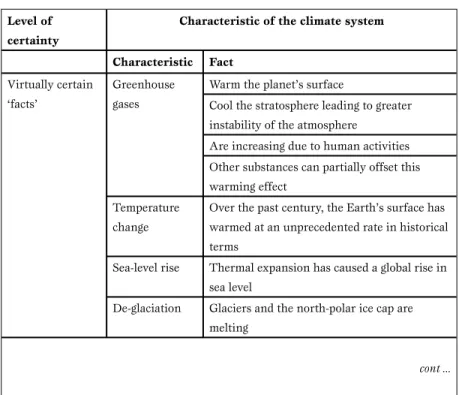
Unfortunately, the technical and somewhat arcane nature of the scientifi c arguments makes it diffi cult for non-specialists to come to grips with the complexities of the climate change debate, which has become highly politicised as the economic, environmental and political stakes have risen. It is important to recognise, however, that expert opinion overwhelmingly supports the view that global warming of the order projected by the IPCC is likely (Table 1.1). The IPCC Assessment Reports represent the collective judgment of 2500 of the most prominent scientists working on climate change and its conclusions are subject to extensive peer review in what is probably the most rigorous scientifi c collaboration in history.43
Other independent reports by leading climatologists have endorsed the basic fi ndings of the IPCC and the evidence for global warming has become more compelling since the 1995 and 2001 Assessment Reports. 1998 is the warmest year ever recorded but the next fi ve hottest years in descending order were 2005, 2002, 2003, 2004 and 2001.44 An
independent panel of experts convened by the US National Academy of Science reported that temperatures have already risen by 0.3ºC between 1979 and 2000.45 This is the highest rate of warming since the
beginning of instrumental temperature measurement.46
There is broad scientifi c consensus that glaciers around the world and the polar ice caps are melting at accelerating rates and meteorologists contest the IPCC assessments on two main grounds.38
Some question the reliability and consistency of the temperature and atmospheric data gathered for use in understanding the climate system and validating climate change models, particularly satellite observations. While accepting that concentrations of greenhouse gases have increased and the surface of the planet is warming, they argue that these rises are not demonstrably penetrating the upper atmosphere. If substantial climate change is occurring, warming should be evident throughout the 12 kilometre-deep troposphere. Sceptics also claim that the amplifying effect on global warming predicted by the IPCC may be minimal because water vapour feedback may not reach the upper atmosphere and greenhouse gas-enhancing water vapour in the atmosphere could actually decrease because of the physics of cloud formation.39
It is true that early satellite data on temperature was not consistent with the observations of surface warming, raising legitimate questions about its reliability and hence the models they informed. However, a subsequent review by the IPCC showed that ‘temperature trends from weather balloons since 1958 for the lowest 8 km of the atmosphere and at the surface are in good agreement with a warming of about 0.1oC per decade.’40 Indeed, after errors in the processing of the
satellite data were corrected, both satellite and balloon observations have since provided clear supporting evidence of surface observations showing an increase in surface temperature extending right through to the troposphere.41
A second argument advanced by sceptics is that observations showing temperature change are based on meteorological records taken by weather services around the world and that the sites for these thermometers have been infl uenced by the so-called ‘heat island’ effect where the growth of urban development, particularly large, high rise buildings tends to artifi cially raise temperatures and block natural atmospheric mixing. But climate scientists are well aware of this anomaly and have developed methods for fi ltering out the distorting effects of urban sites. Most observations are carefully screened for siting inconsistencies, or the actual site is changed over the lifetime
H E AT I N G U P T H E P L A N E T IS CLIMATE CHANGE REAL?
• Markedly more extensive and reliable evidence of climate-system changes and of the impact on human and natural ecosystems; • Progress in defi ning what are acceptable risks in terms of future
global average temperature increase, or what is ‘dangerous’ anthropogenic change to the climate.
Table 1.1: Climate change certainty levels
Level of certainty
Characteristic of the climate system
Characteristic Fact
Virtually certain ‘facts’
Greenhouse gases
Warm the planet’s surface
Cool the stratosphere leading to greater instability of the atmosphere
Are increasing due to human activities Other substances can partially offset this warming effect
Temperature change
Over the past century, the Earth’s surface has warmed at an unprecedented rate in historical terms
Sea-level rise Thermal expansion has caused a global rise in sea level
De-glaciation Glaciers and the north-polar ice cap are melting
cont ...
seas are continuing to warm and expand.47 The US National Snow
and Ice Data Centre has concluded that human induced warming is at least partially responsible for the shrinking of the Arctic ice cap which will disappear entirely by 2060 at present rates of melt.48
One potentially serious consequence of the loss of the permafrost of the northern hemisphere tundra region is the possible release of otherwise trapped carbon back into the atmosphere as methane or carbon dioxide, adding to the stock of greenhouse gases. While the melting of sea ice does not contribute to sea level change, the melting of glaciers can. We now know from a variety of independent studies that sea levels have risen by around 10 cm globally over the past 55 years, essentially because of the thermal expansion of water and the melting of terrestrial snow and ice.49 We also know that this rate of
sea-level rise is accelerating.50
Although the IPCC Fourth Assessment Report will not be released until 2007, its fi ndings are expected to confi rm these trends, provide greater clarity in previous areas of uncertainty and endorse the central conclusions of the Third Assessment Report. Among its probable fi ndings:
• Greenhouse gases will continue to rise as a consequence of human activity based on new knowledge of the global cycling of these gases between the atmosphere, ocean and plants, knowledge that has been enhanced through evidence extending back one million years, in the case of ice core samples and palaentological evidence. Data from satellite and direct observations will be more comprehensive, accurate and reliable and in closer agreement with other indications of climate change, leading to improved forecasting;
• Clearer evidence of change to the global cryosphere (the Earth’s ice and snow cover) including evidence of human impact on glacial instability, sea-ice retreat and permafrost melt;
• Greater agreement between different climate models which are now more capable of representing the impact of greenhouse-gas changes on climate;
H E AT I N G U P T H E P L A N E T IS CLIMATE CHANGE REAL?
Climate change is real
As with all scientifi c enquiry, sceptics have played an important role in questioning both the underlying assumptions and the veracity of the data of what is still a relatively new and inexact science. The ongoing dialectic has resulted in better science and therefore greater certainty about the scope, magnitude and implications of climate change. But in our judgment, charges that the extent of climate change is being exaggerated by the IPCC, or that the data is insuffi ciently precise to support the IPCC’s principal conclusions, are not sustained. Of course, the IPCC Assessment Reports are not omniscient but then their authors do not make this claim. Along with other authoritative scientifi c assessments, they should be seen as periodic snapshots of the state of our current knowledge which facilitate risk assessment and improve our capacity to manage climate perturbations.
Nonetheless, evidence that human activities are signifi cantly warming up the planet is now irrefutable, even if there are still uncertainties about the precise rate of global warming and sea-level rise. A telling survey of the scientifi c literature on climate change, for example, found that of 928 peer reviewed articles published between 1993 and 2003, not one disagreed with the scientifi c consensus that human induced global warming is real.52 Moreover, it should be remembered that
climate scientists have drawn on the knowledge and expertise of a wide range of related disciplines in making their forecasts, especially geology, palaeontology and archaeology. It has been the integration of knowledge from all these fi elds that has provided the foundation of modern climate science and the crucial, observable evidence used for the testing of climate modelling capabilities.
Ironically, while a great deal of the data is no longer in dispute, most people do not have a realistic sense of the magnitude of likely future climate change because scientists have largely failed to communicate the signifi cance of their fi ndings in a way that policy makers, the media and the general public can easily understand. Focusing on mean temperature increases and sea-level rise does not give a true sense of their import. A change of one degree this century would be highly
Level of certainty
Characteristic of the climate system
Characteristic Fact
Very probable (9 out of 10 chance)
Greenhouse gases
There will be a doubling of carbon dioxide concentrations over pre-industrial levels this century
Global warming will continue and exceed 2oC this century
Temperature change
By 2100 global mean surface temperature changes are expected to be 1.4–5.8oC higher than today
Sea-level rise By 2100 seas will rise by between 25 and 75 cm, mainly because of thermal expansion Precipitation The rate of evaporation increases with
warming leading to an increase in global mean precipitation of about 1.5–2.5% per 1oC Higher latitudes of the northern hemisphere are expected to experience temperature and precipitation increases well in excess of the global average
Probable (greater than 2 out of 3 chance)
Soil moisture Eventual marked decrease over mid-latitude continents
Sea-ice cover Little change in the circum-polar Antarctic ocean
Ocean salinity Reduced at higher latitudes due to higher precipitation and glacial melt inhibiting tendency of the water to sink thereby slowing ocean currents
Storm intensity Increased tropical storm intensity
Research needs Response of clouds, water vapour, ice, ocean currents and specifi c regions to warming remain formidable research challenges Source: Adapted from Mahlman, J.D., Uncertainties in projections of human-caused
H E AT I N G U P T H E P L A N E T
Chapter 2
Food, water and disease
Climate change will, in many parts of the world, adversely affect socio-economic sectors, including water resources, agriculture,
forestry, fi sheries and human settlements, ecological systems (particularly forests and coral reefs), and human health (particularly diseases spread by insects), with developing countries
being the most vulnerable. Robert T. Watson, Chair, IPCC.54
As the earth heats up and sea levels rise, there will be demonstrable and largely negative consequences for food production, fresh water availability and the spread of infectious diseases. While these impacts will not be uniformly felt around the globe, they are likely to be widespread.55
Food is highly sensitive to the weather, water is already in short supply and meteorological infl uences affect the transmission dynamics of many diseases.56 Successfully meeting these challenges will depend on the
resilience, adaptability and resources of the populations most affected. While the developed world may be able to navigate these newly exposed shoals with tolerable stress, nations less well endowed will struggle, signifi cant, although it doesn’t seem much because we routinely
experience much greater temperature variations (night-to-day, day-to-day and month-to-month) in our lives. It has to be remembered, however, that average global temperatures normally vary by no more than a few tenths of a degree from year-to-year and decade-to-decade. More than 2oC could push the world into uncharted waters, given that
the Earth was only 5oC cooler than today during the last Ice Age.
Figures for average sea-level rise also understate the problem. A rise of 10 or 20 cm seems relatively inconsequential when measured against the large waves commonly seen on any popular surf beach. However, in conjunction with major storm surges associated with mega-hurricanes like Katrina which devastated the US coastal city of New Orleans in 2005, such rises will almost certainly result in episodes of more extreme fl ooding of coastal and low lying areas, rendering much of this terrain uninhabitable without massive engineering solutions that are simply unaffordable for most countries.53