INNOVATION IN
HEALTH INFORMATICS
Research article
Cite this article: Kralj D, Kern J, Tonković S, Končar M. Development of the quality assessment model of EHR software in family medicine practices: research based on user satisfaction. J Innov Health Inform.2015;22(3):340-358.
http://dx.doi.org/10.14236/jhi.v22i3.158
Copyright © 2015 The Author(s). Published by BCS, The Chartered Institute for IT under Creative Commons license http://creativecommons.org/ licenses/by/4.0/
Author address for correspondence:
Damir Kralj
Perivoj Vrbanic Josipa 3, HR-47000 Karlovac, Croatia E-mail: damir.kralj@ ka.t-com.hr.
Accepted July 2015
Development of the quality assessment
model of EHR software in family medicine
practices: research based on user
satisfaction
Damir Kralj
Ministry of Interior – PA Karlovac, Trg hrvatskih redarstvenika 6, HR-47000 Karlovac, Croatia
Josipa Kern
University of Zagreb, School of Medicine, Rockefellerova 4, HR-10000 Zagreb, Croatia
Stanko Tonković
University of Zagreb, Faculty of Electrical Engineering and Computing, Unska 3, HR-10000 Zagreb, Croatia
Miroslav Končar
ORACLE Croatia, Budmanijeva 1, HR-10000 Zagreb, Croatia
ABSTRACT
Background Family medicine practices (FMPs) make the basis for the Croatian health care system. Use of electronic health record (EHR) software is mandatory and it plays an important role in running these practices, but important functional features still remain uneven and largely left to the will of the software developers.
Objective The objective of this study was to develop a novel and comprehensive model for functional evaluation of the EHR software in FMPs, based on current world standards, models and projects, as well as on actual user satisfaction and requirements.
Methods Based on previous theoretical and experimental research in this area, we made the initial framework model consisting of six basic categories as a base for online survey questionnaire. Family doctors assessed perceived software quality by using a five-point Likert-type scale. Using exploratory factor analysis and appro-priate statistical methods over the collected data, the final optimal structure of the novel model was formed. Special attention was focused on the validity and quality of the novel model.
Results The online survey collected a total of 384 cases. The obtained results indicate both the quality of the assessed software and the quality in use of the novel model. The intense ergonomic orientation of the novel measurement model was particularly emphasised.
Conclusions The resulting novel model is multiple validated, comprehensive and universal. It could be used to assess the user-perceived quality of almost all forms of the ambulatory EHR software and therefore useful to all stakeholders in this area of the health care informatisation.
INTRODUCTION
Family medicine practices (FMPs) make the basis for the health care systems in numerous countries, including the Croatian health care system as well. Although in the literature in the field of health informatics we may usually find terms general practice and general practitioner, here we deliberately introduce terms FMP and family doctor (FD). Family medicine (FM) is the official name of this basic seg-ment of the Croatian primary health care (PHC). FDs focus on meeting the needs of the entire family, they are uniquely trained to care for the whole person throughout his or her life, from birth to old age and often receive training outside of general medicine in the areas of pediatrics, obstetrics and gynecology and geriatrics.1 They solve most of the
popula-tion’s health problems and collect an important amount of health data with the smallest facility cost. Electronic health record (EHR) software plays an important role in running these practices in the context of modern medicine. Croatian Health Insurance Fund (CHIF) forms the current certifi-cation criteria for the selection of the software support to Croatian FMPs since it is an executive and regulatory body of the Ministry of Health.2 Unfortunately, these certification
criteria are still based solely on the necessary legislative or communication criteria and capabilities,3,4 while other
important functional features of this type of software sup-port remain uneven and largely left to the will of the soft-ware developers. According to the current criteria, the CHIF chose eight versions of EHR software that are presently used in Croatian FMPs. Today, worldwide we can find a few measurement models for assessing the quality of the EHR systems. Particularly prominent are American certification programs5,6 and European framework model for
certifica-tion and quality assessment of the EHR systems.7 However,
due to the fact that this area is extremely fast changing, a need for creating a novel model for evaluation of the quality of EHR software used in FMPs has arisen. It would include modern world achievements as well as the uniqueness of the Croatian health care system and FDs’ requirements. We assumed that during the past five years of mandatory use of EHR software, Croatian FDs have mastered the use of infor-mation technology in daily operations, have become aware of the necessity of having an advanced and functional soft-ware support used in everyday work, and can recognise the needs that are not being met at the present stage of the development of this type of software. We also assumed that by applying the appropriate assessment model, their quali-tatively expressed satisfaction with the use of selected EHR software can be transformed into a quantitative assessment of the user-perceived quality of the software functionalities. Thus, the ultimate goal of this study is to design a novel model for fast and easy evaluation and comparison of qual-ity of the EHR software versions. Based on the qualqual-ity rates gathered this way, the existing and future customers could more easily choose a better software solution, and health authorities can obtain feedback on the quality of the actual
certification criteria, and manufacturers can get information about the directions for the improvement of their products.
METHODS
In order to achieve the set objective, we created a methodology which among others includes theoretical study, designing, implementing and multiple evaluation of a novel measurement model.
Theoretical study
Within theoretical study, we analysed and contrasted the cur-rent world models for certification and quality assessment of EHR systems5–7 as well as world-renowned projects,8–15
standards,16–18 and initiatives.19,20 Special attention was paid
to the European research papers and studies in the field of information technology (IT) adoption,21 quality evaluation22–27
and usability28–30 of the ambulatory EHR systems. Trying to
assess the situation and the specifics of Croatian health sys-tem, we analysed the significant results of research on the health information system in the Republic of Croatia.3,4,31–37
We also tried to keep to basic guidelines for good evaluation practice in health informatics38 and statement on reporting of
evaluation studies in the health informatics.39
Initial framework model
services’ contains 10 statements covering: various forms of services for improving the patient’s life quality according to personal profile of the treatment (diet, exercise, medication plans and health summaries), automatic forming of call lists for check-ups for targeted risk groups and advanced EHR data analysis for the purpose of medical–scientific research. The complete content and organisation of the IFM is shown in Appendix A.
Content validity
A verification of the content validity40–42 of the IFM was
carried out in three steps. In the first step, we compared the basic quality indicators of our IFM with the contents of the recognised international certification and quality label-ing models.5–7 In the second step, the IFM was given for the
assessment procedure to the professional association of FDs ‘Croatian Association of Family Medicine’ [hrv. Koordinacija Hrvatske Obiteljske Medicine, (KoHOM)]. In the third step, we conducted a process of content validation by three groups of independent prominent professionals. Twenty-eight of fifty addressed professionals accepted the call, 10 of which were health care professionals, 10 were IT professionals in health informatics and eight were administrative professionals in health care. Average ratings obtained for all categories from all three groups were between 4 and 5 assessed on an equi-distant scale from 1 to 5. According to the overall results of the content validity verification, we concluded that our IFM is valid and ready for further procedures. The sources of references for the process of content validation are listed in square brackets after each statement in Appendix A.
Experimental research
Following the IFM, we have designed the measurement tool (questionnaire), consisting of two main parts. The first part has 14 questions and includes general information about the FMP, FD and currently used software version. The complete content is presented in Appendix B. This part is important for a description of measured population. The second part contains a total of 127 questions on EHR software inbuilt functionalities deployed within six major categories, i.e. six units of the IFM shown in Appendix A. Each statement from the IFM was shaped as a question about the level of user satisfaction with the applied software functionality. The sur-vey was carried out during the period from October 2012 to January 2013. The questionnaire was designed in elec-tronic format using the ‘SurveyMonkey’43 online service and
offered to the population of 2335 Croatian FDs through offi-cial mailing lists and websites of FDs’ professional asso-ciations. The collection of cases was solely based on the discretion of a doctor to accept and fill in the questionnaire. Each case entered this way is considered as independent of the others. The applicants were asked to assess the quality of application of certain software functionality by using five-point Likert-type scale40–42 with degrees: 1 – not
applied or is unusable, 2 – poorly applied, 3 – moderately applied, 4 – successfully applied and 5 – very successfully applied. In fact, one can say that it is a hybrid scale between
applications yes/no and satisfaction. We chose it in line with the key principles of research, which are:
• If some of the functionality exists, and the doctor cannot recognise it or it is not documented in user guide, it is considered that it has never been applied. • The answer ‘do not know’ deliberately is not offered
in order to encourage doctors to better explore their EHR software versions to be more familiar with them. • Spacings between adjacent points of the scale are
considered to be equal.
At the beginning of the questionnaire, the candidates were acquainted with the method and principles of testing. The average estimated time needed to complete the question-naire was 45 min.
Face validity test
For the purposes of the so-called ‘face validity’ testing,40–42 at
the end of the questionnaire, we added two more questions for the assessment of the quality and intelligibility of the question-naire, as well as a free text field for doctors’ comments. For the assessment, an equidistant five-point scale is also applied.
Statistical methods and procedures
In order to determine the correct statistical methods and tests that could be applied in further analysis depending on the actual circumstances, we used appropriate methods and procedures of descriptive statistics for testing the collected data distribution properties. For the purpose of extracting the key subcategories in the main categories of the final form of the novel measurement model, we have implemented proce-dures of exploratory factor analysis (EFA) or principal com-ponent analysis (PCA) over the sets of observed variables, i.e. quality indicators that describe the main categories.44 In
parallel with these procedures, we also tested the construct validity and the value in use. In order to confirm value in use and compare quality ratings among all software versions, it was necessary to calculate the scale scores of the indi-vidual ranking subcategories in a simple and usable way. For that purpose, we doubted among: different applications of weighted sums,42,45 using of U-statistics46 and the simple
application of the mean values of normalised scale scores. We dropped U-statistics because the calculation is very com-plicated, and, after all, our model is not applied in the field of clinical testing. According to Nunnally,42 weighting schemes
are very complicated and usually produce a measurement that is highly correlated with the unweighted measurement, and there is no statistical advantage to the weighting. So, we decided to analyse the properties of the measured sample (normality and dependencies of the distribution) at the level of each individual Likert item as an ordinal scale (in accor-dance with Steven’s teaching47) and, in the spirit of the
mod-ern psychometrics,40–42 to use equally weighted scale scores
X =actual scale score – min. scale score
max. scale score – min. scale score (1)
The ‘SPSS Statistics 17.0’ software was used for all statistical calculations.48,49 Implied confidence interval in all statistical
procedures is 95%, and hence the significance level is 0.05.
RESULTS
Primary result analysis
The survey collected 399 cases and 384 (16.4% of 2335 FDs) remained after the cleaning process. The cleaning was car-ried out by complete removal of 15 (3.8 % of 399 cases) incomplete or incorrect records. The sample included the applicants from all 20 counties of the Republic of Croatia and the City of Zagreb and consisted of 315 (82%) females and 69 (18%) males. By applying the chi-square test, we found statistically significant differences between the observed and expected distributions by age, gender and specialist degree in FM. For distribution by age groups χ2 (4, n = 384) = 13.431, p = 0.009 and for distribution by gender χ2 (1, n = 384) = 5.484, p =0.019, while for distribution according to specialist degree in FM χ2 (1, n = 384) = 28.568, p < 0.001.50 The sample
included members of all eight officially approved software versions, where one collected only one case and was there-fore dismissed as statistically irrelevant. The distribution of sample cases for seven further analysed software versions was 133, 124, 63, 33, 17, 8 and 5, respectively. Kolmogorov– Smirnov and Shapiro–Wilk tests50 indicated significant
statistical deviation from the normal distribution at the level of p < 0.001 (α = 0.05) among all measured categories. After these tests, we carried out the tests on the diversity of collected results with respect to two key independent vari-ables: the gender of a doctor and EHR software version. The non-normal distribution and unbalanced sample point to the use of non-parametric statistical methods and addi-tional caution in applying further statistical procedures. So, we used the Kruskal–Wallis test50 to test the differences
between these groups. Based on the results of these tests, we concluded that there are no statistically significant differ-ences in the distribution of the collected results with regard to gender (0.97 ≥ p > 0.05, α = 0.05), while at the same time, there are significant differences in the distribution of the collected results with regard to the used software version (p < 0.001 and α = 0.05). This means that there are no addi-tional complications during further analysis and reporting due to different gender sensibilities and that is possible to make a comparison of perceived software quality among present software versions.
Face validity
Obtained average ratings were 3.95 for quality and 3.89 for intelligibility of the IFM and questionnaire, assessed on an equidistant scale from 1 to 5. Doctors were generally commented on the shortcomings of EHR software they use,
11% of doctors have complained of the length of the questionnaire and 14% praised the concept of the ques-tionnaire, while 19% expressed problems in knowing the software they use.
Design of the novel model structure
In order to design subcategories of the novel measurement model, we carried out certain procedures of PCA or EFA. To check the suitability of a particular sample, we conducted the Kaiser–Meyer–Olkin (KMO) test of sampling adequacy and Bartlett’s test of sphericity.44,48,49 The values of the KMO
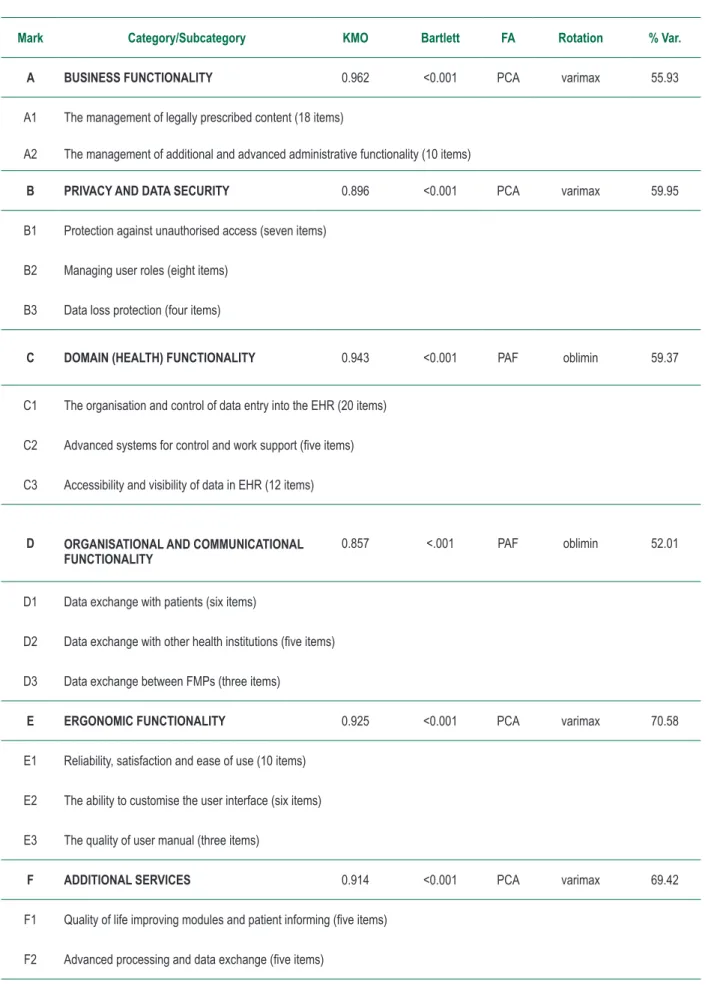
test were very high in all cases, ranging from 0.857 to 0.962, while the values of Bartlett’s test were in all cases statisti-cally significant at p < 0.001. So, the sample was valid in all cases and the results of sample factor analysis may be useful.43,44 To single out the optimal number of factors in
every category, a triple criterion was applied: Kaiser’s crite-ria, Cattel’s diagrams and parallel analysis of the actual dis-tribution of values with a set of normally distributed random numbers obtained by applying the so-called ‘Monte Carlo’ simulation was used.51 Tabular presentation of the novel
model structure is shown in Table 1. Table 1 also shows the key values of test parameters of the FA. Observed variables which describe their related latent variables (subcategories), i.e. statements shown in Appendix A, have appropriate marks of subcategories in round brackets in the first column. The structural diagram of the novel model is shown in Figure 1.
Construct validity
In order to assess the construct validity, we considered the extent the variables inside particular category, i.e. construct have the same object of measurement or so-called conver-gent validity, as well as the ratio between this values and the degree of association of these variables with neigh-boring constructs (which are considered independent) or so-called discriminative validity or discriminativity.41,52 The
convergent validity was confirmed by successfully imple-mented procedure of FA and calculation of the Cronbach
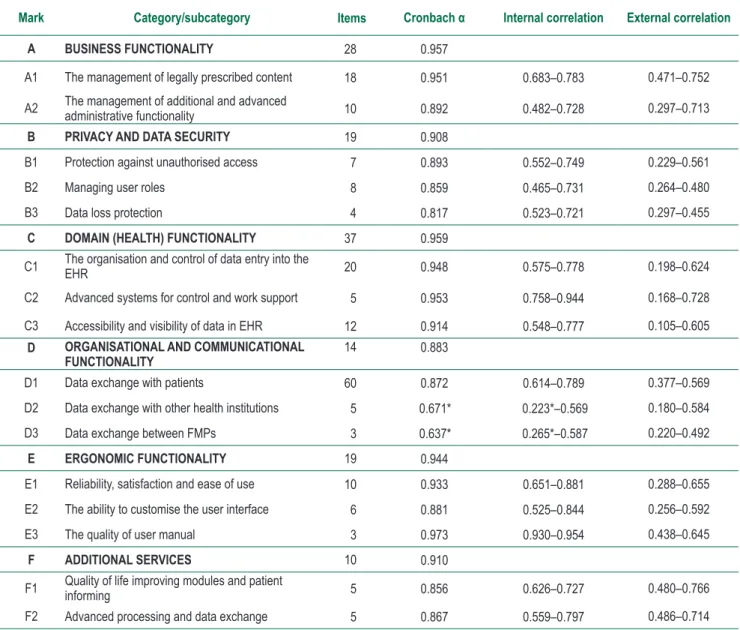
α reliability coefficient for each of models category and subcategory scale. As shown in Table 2, the calculations of Cronbach α coefficient53 are mostly significantly higher
than 7 for all subcategories, except in the case of a subcat-egories D2 and D3, where we can say that it is satisfactory for the field of application.42 It is desirable that values of
internal correlation factors are as higher as possible (>0.3) and values of external correlation factors as less as pos-sible (<0.3).
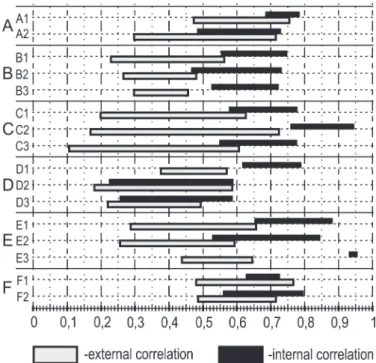
Graphical presentation of the ratio between the ranges of internal and external correlation of certain subcategory is shown in Figure 2. Significantly smaller discriminativity
Table 1. The structure of the novel model with values of test parameters of the FA
Mark Category/Subcategory KMO Bartlett FA Rotation % Var.
A BUSINESS FUNCTIONALITY 0.962 <0.001 PCA varimax 55.93
A1 The management of legally prescribed content (18 items)
A2 The management of additional and advanced administrative functionality (10 items)
B PRIVACY AND DATA SECURITY 0.896 <0.001 PCA varimax 59.95
B1 Protection against unauthorised access (seven items)
B2 Managing user roles (eight items)
B3 Data loss protection (four items)
C DOMAIN (HEALTH) FUNCTIONALITY 0.943 <0.001 PAF oblimin 59.37
C1 The organisation and control of data entry into the EHR (20 items)
C2 Advanced systems for control and work support (five items)
C3 Accessibility and visibility of data in EHR (12 items)
D ORGANISATIONAL AND COMMUNICATIONAL
FUNCTIONALITY 0.857 <.001 PAF oblimin 52.01
D1 Data exchange with patients (six items)
D2 Data exchange with other health institutions (five items)
D3 Data exchange between FMPs (three items)
E ERGONOMIC FUNCTIONALITY 0.925 <0.001 PCA varimax 70.58
E1 Reliability, satisfaction and ease of use (10 items) E2 The ability to customise the user interface (six items) E3 The quality of user manual (three items)
F ADDITIONAL SERVICES 0.914 <0.001 PCA varimax 69.42
Figure 1. Structural diagram of the novel model
Table 2. Values and ranges of item–item and item–scale correlation coefficients
Mark Category/subcategory Items Cronbach α Internal correlation External correlation
A BUSINESS FUNCTIONALITY 28 0.957
A1 The management of legally prescribed content 18 0.951 0.683–0.783 0.471–0.752 A2 The management of additional and advanced administrative functionality 10 0.892 0.482–0.728 0.297–0.713
B PRIVACY AND DATA SECURITY 19 0.908
B1 Protection against unauthorised access 7 0.893 0.552–0.749 0.229–0.561
B2 Managing user roles 8 0.859 0.465–0.731 0.264–0.480
B3 Data loss protection 4 0.817 0.523–0.721 0.297–0.455
C DOMAIN (HEALTH) FUNCTIONALITY 37 0.959
C1 The organisation and control of data entry into the EHR 20 0.948 0.575–0.778 0.198–0.624
C2 Advanced systems for control and work support 5 0.953 0.758–0.944 0.168–0.728
C3 Accessibility and visibility of data in EHR 12 0.914 0.548–0.777 0.105–0.605
D ORGANISATIONAL AND COMMUNICATIONAL
FUNCTIONALITY 14 0.883
D1 Data exchange with patients 60 0.872 0.614–0.789 0.377–0.569
D2 Data exchange with other health institutions 5 0.671* 0.223*–0.569 0.180–0.584
D3 Data exchange between FMPs 3 0.637* 0.265*–0.587 0.220–0.492
E ERGONOMIC FUNCTIONALITY 19 0.944
E1 Reliability, satisfaction and ease of use 10 0.933 0.651–0.881 0.288–0.655 E2 The ability to customise the user interface 6 0.881 0.525–0.844 0.256–0.592 E3 The quality of user manual 3 0.973 0.930–0.954 0.438–0.645
F ADDITIONAL SERVICES 10 0.910
compare the user-perceived quality ratings among different EHR software versions available on the market.
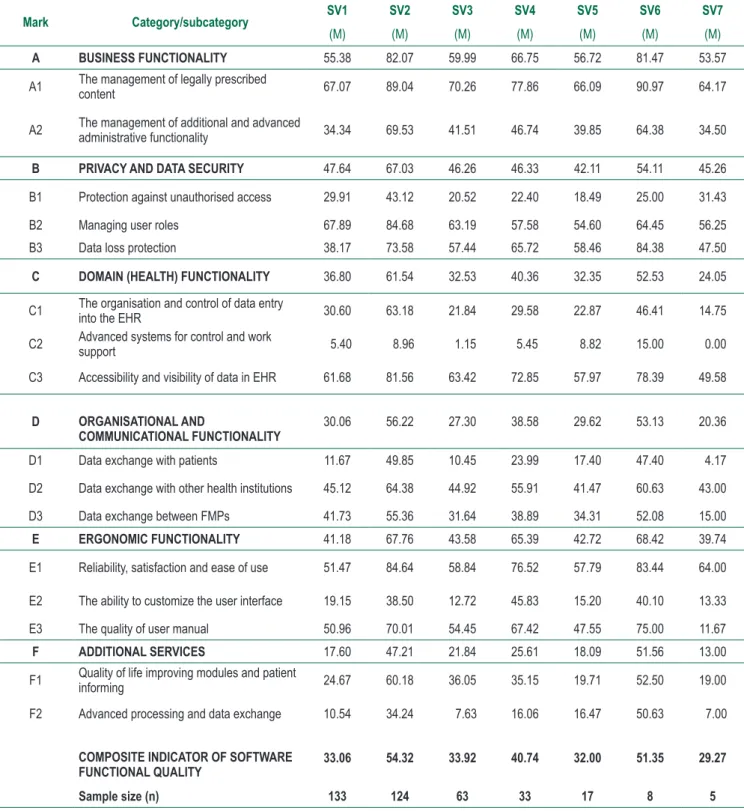
As can be seen from the results in Table 3, there are a lot of room for functional improvement of the EHR software for FMPs available in Croatian market. Generally speaking, we can say that the highest rated functionalities are those that have long been present in the local market, while the new and advanced functionalities, yet to be introduced and encouraged. Comparing with the results of some of our previ-ous research,34 Croatian FDs are still not enough motivated
and the local health authorities are still not enough interested in this kind of study.
Implications of the findings
Considering the assessment categories and application of the standardised measurement scale, the novel evaluation model could be used to assess the user-perceived functional quality of almost all forms of EHR software in ambulatory set-tings within the PHC as well as in various specialist clinics within the polyclinic or health care consulting. Its value in use has been demonstrated through a simple and understandable presentation of measured results. Based on the quantitative and qualitative results of this study, manufacturers of EHR software, competent health authorities and other stakehold-ers, in the coming period, could draw the conclusions that could help them to solve identified problems and improving the functionalities of the targeted EHR software. Inclusion of ergonomic categories moves the focus of the functional qual-ity assessment of EHR software from a strictly institutional assessment of elementary functions, common in preced-ing periods, towards new concepts, based on usability and its key element – user satisfaction. The importance of such an approach is also confirmed by the recent actions of the
Value in use
Table 3 shows the user-perceived quality ratings of categories and subcategories in normalised mean values ranging from 0 to 100 for seven out of eight approved software versions (SV1– SV7) in total. The overall score named as ‘Composite indicator of software functional quality’ is highest for software version SV2
and amounts 54.32±1.10, while the lowest of 29.27±3.02 was given to SV7. The highest rated subcategory was ‘A1-The man-agement of legally prescribed content’ for software version SV2
(89.04±1.04) and the lowest rated subcategory for all software versions was ‘C2-Advanced systems for control and work sup-port’. Software version SV2 has significantly higher ratings than other versions within mostly all categories and subcategories. By far, the lowest total ratings for all versions goes to the subcat-egory ‘C2-Advanced systems for control and work support’ and ranges from 0.00 (obviously this functionality does not exist or it is not perceived by users at all) for SV7 (n=5), over 8.96 ±1.90 for SV2 (n=115), up to 15.00±6.27 for SV6 (n=8). The results in Table 3 are here presented mainly to demonstrate value in use of the novel model. Serious analysis and interpretation of the results requires much more space and should be the subject of a separate paper. The quality ratings presented with normalised mean values, their standard errors of mean, and standard devi-ation are shown in APA style table in Appendix C.
DISCUSSION
Principal findings
We found that in accordance with the set objective, it is pos-sible to realise a novel model for the assessment of the inbuilt functionalities of the EHR software in FMPs, which is based on user satisfaction. Moreover, it is possible to assess and
US non-profit agencies HIMSS and the recent expansion of the CCHIT certification programs to the area of usability test-ing as a key factor of the effectiveness of health care delivery and patient safety in the treatment.54
Comparisons with the literature
The situation observed in this study is partially supported by the results of our research conducted during the past five years.4,34,35 There are also several European studies that deal
with the issue of functional quality and advanced functionalities of this type of EHR software. The most similar to our research are OECD’s cross European e-Health benchmarking among general practitioners15 and Italian nationwide study about the
state and possibilities of improvement of the EHR software in general practice.27 These studies reach similar
conclu-sions relating to the application of advanced functionalities within their scope of observation. However, in both the cases, observed situations are expressed as overall ratings of perceived functional quality, and the categorisation of indica-tors is not clear enough to be used by stakeholders present in the e-Health market. We believe that our model provides a better categorisation of quality indicators, i.e. it better follows the workflow in FMPs and provides a concrete comparison between different software versions. In this way, stakeholders can clearly perceive which products raise and which reduce the functional quality of this segment of e-Health. The concurrent
Table 3. The results obtained by using the novel model
Mark Category/subcategory SV1 SV2 SV3 SV4 SV5 SV6 SV7
(M) (M) (M) (M) (M) (M) (M)
A BUSINESS FUNCTIONALITY 55.38 82.07 59.99 66.75 56.72 81.47 53.57
A1 The management of legally prescribed content 67.07 89.04 70.26 77.86 66.09 90.97 64.17
A2 The management of additional and advanced administrative functionality 34.34 69.53 41.51 46.74 39.85 64.38 34.50
B PRIVACY AND DATA SECURITY 47.64 67.03 46.26 46.33 42.11 54.11 45.26
B1 Protection against unauthorised access 29.91 43.12 20.52 22.40 18.49 25.00 31.43
B2 Managing user roles 67.89 84.68 63.19 57.58 54.60 64.45 56.25
B3 Data loss protection 38.17 73.58 57.44 65.72 58.46 84.38 47.50
C DOMAIN (HEALTH) FUNCTIONALITY 36.80 61.54 32.53 40.36 32.35 52.53 24.05
C1 The organisation and control of data entry into the EHR 30.60 63.18 21.84 29.58 22.87 46.41 14.75
C2 Advanced systems for control and work support 5.40 8.96 1.15 5.45 8.82 15.00 0.00
C3 Accessibility and visibility of data in EHR 61.68 81.56 63.42 72.85 57.97 78.39 49.58
D ORGANISATIONAL AND
COMMUNICATIONAL FUNCTIONALITY 30.06 56.22 27.30 38.58 29.62 53.13 20.36
D1 Data exchange with patients 11.67 49.85 10.45 23.99 17.40 47.40 4.17
D2 Data exchange with other health institutions 45.12 64.38 44.92 55.91 41.47 60.63 43.00
D3 Data exchange between FMPs 41.73 55.36 31.64 38.89 34.31 52.08 15.00
E ERGONOMIC FUNCTIONALITY 41.18 67.76 43.58 65.39 42.72 68.42 39.74
E1 Reliability, satisfaction and ease of use 51.47 84.64 58.84 76.52 57.79 83.44 64.00 E2 The ability to customize the user interface 19.15 38.50 12.72 45.83 15.20 40.10 13.33 E3 The quality of user manual 50.96 70.01 54.45 67.42 47.55 75.00 11.67
F ADDITIONAL SERVICES 17.60 47.21 21.84 25.61 18.09 51.56 13.00
F1 Quality of life improving modules and patient informing 24.67 60.18 36.05 35.15 19.71 52.50 19.00 F2 Advanced processing and data exchange 10.54 34.24 7.63 16.06 16.47 50.63 7.00
COMPOSITE INDICATOR OF SOFTWARE
FUNCTIONAL QUALITY 33.06 54.32 33.92 40.74 32.00 51.35 29.27
6. HealthIT.gov. Meaningful Use. Available from: http://www. healthit.gov/policy-researchers-implementers/meaningful-use. Accessed on 4 March 2014.
7. EuroRec. European Institute for Health Records. Available from: http://www.eurorec.org. Accessed on 6 April 2014.
8. Framework for Rural and Remote Readiness in Telehealth, Written by the Alliance of Building Capacity, CANARIE Final Report. 2002. Available from: http://hdl.handle.net/1880/43064. Accessed on 12 October 2013.
9. World Health Organization. Strategy 2004–2007: eHealth for Health Care Delivery. Available from: http://www.who.int/eht/en/ eHealth_HCD.pdf. Accessed on 6 November 2013.
10. Khoja S, Scott RE, Mohsin M, Ishaq AFM and Casebeer A. Developing a conceptual-framework for e-Health readiness assessment tools for developing countries. In: Svensson PG (Ed). ICT Developments: e-Health in Developing Countries US study about optimizing EHR usage in PHC30 approaches
the problem of the EHR software functionality in the context of harmonisation of the standardisation of the EHR processes with the PHC teams’ demand for EHR customisation. It is a situation that also requires a close cooperation between key stakeholders and requires an assessment of user satisfaction with inbuilt standard functionalities of EHR software.
Limitations of the method
One of the first potential limitations of the here presented research is the limitation on the area of Croatian FM. However, the number of localisation parameters is relatively small, so this evaluation model is generally applicable beyond the Croatian borders. The localisation is mainly expressed in administrative and domain functionalities that are directly regulated by various rules and regulations stipulated by Croatian health authorities. Other categories and the meth-odology itself are generally applicable.
Another potential limitation is related to the problem of sampling.50 Collected sample is stratified into seven
unbal-anced strata representing users of the seven EHR software versions. In principle, we are not interested so much in the actual distribution of the EHR software versions, but we are interested in comparison of their perceived quality. In this regard, it would be better to randomly collect equal number of cases in each stratum and evaluate software versions on a more equal basis.
Length of the questionnaire can also be a limiting factor, because, first of all, it looks repulsive to potential applicants and they may refuse to even begin to fill out a questionnaire. Estimated time to complete the questionnaire in practice may be considerably longer if doctors are not enough familiar with their EHR software.
Call for further research
Further research is of key importance for improving this kind of software support. In the next period, we will certainly try to test our model in other types of practices in PHC as well as
in the case of various specialist practices within the polyclinic or health care consulting. We hope that based on collected results, these tests will contribute to: improvement and pos-sible corrections of our model, better preparation of the mea-sured population, and better support from competent health authority. It is necessary in order to achieve more accurate and objective procedure of evaluation.
CONCLUSIONS
The quality assessment model of EHR software in FMPs presented in this study is multiple validated, comprehen-sive and universal. Considering clear and understandable measuring categories and the application of standardised measurement scale ranging from 0 to 100, it could be used for easy and fast evaluation and comparison of the user-perceived functional quality of almost all the forms of EHR software in different practices within the PHC as well as in the case of various specialist clinics within the polyclinic or health care consulting. True, we reported a certain number of limitations, but these limitations are difficult to avoid, and regularly, we can find them in almost all similar concurrent research projects. In the forthcoming period, it is essential to thoroughly present our study to all stakeholders. In the first step, this will contribute to the improvement of our model, while in further steps, it will contribute to the improvement of the quality of the considered EHR software.
Conflict of interest
The authors have no conflict of interest to disclose.
Acknowledgements
We are very grateful on the support provided by the professional association ‘Croatian Association of Family Medicine’ (KoHOM). They recognised the importance and value of this research and provide significant professional and technical support for its realisation.
REFERENCES
1. Rakel RE and Rakel DP. Textbook of Family Medicine, 8th edi-tion. Philadelphia: Elsevier Saunders, 2011.
2. Croatian Health Insurance Fund. CEZIH PZZ. Available from: http://www.cezih.hr. Accessed on 6 April 2014.
3. Končar M and Gvozdanović D. Primary health care information system – the cornerstone for the next generation health care sector in Republic of Croatia. International Journal of Medical Informatics 2006;75:306–14.
4. Kralj D. Quality assessment of e-Health solutions in primary health care – approach based on user experience. In: Ganesh RN (Ed). Applied Biological Engineering – Principles and Practice. Rijeka: InTech, 2012, 509–28.
(International Hospital Federation Reference Book). London: Pro-Brook, 2007–2008, 79–81.
11. Li JH. e-Health Readiness Framework from Electronics Health Records Perspective. M.S. Thesis. Sydney: University of New South Wales, 2008.
12. Dobrev A, Haesner M, Hüsing T, Korte WB and Meyer I.
Benchmarking ICT Use Among General Practitioners in Europe. Bonn/Brussels: Empirica, 2008.
13. Bjomberg A, Garrofe BC and Lindblad S. Euro Health Consumer Index 2009 – Report. Brussels: Health Consumer Powerhouse, 2009.
14. National Institute for Health and Clinical Excellence. Quality and Outcome Framework. Available from: http://www.nice.org. uk/aboutnice/qof/qof.jsp. Accessed on 6 November 2013.
15. OECD. SMART 2011/0033 – Benchmarking Information and Communication Technologies in Health Systems: Benchmarking Deployment of eHealth Among General Practitioners II – Background Document. Available from http://www.himsa-info.eu/00him/wp-content/uploads/downloads/2013/04/ C1_General-Practitioners-survey_Background-document.pdf. Accessed on 12 April 2013.
16. HL7 International. Introduction to HL7 Standards. Available from: http://www.hl7.org/implement/standards. Accessed on 26 March 2014.
17. National Institute of Standards and Technology. NISTIR 7741: NIST Guide to the Processes Approach for Improving the Usability of Electronic Health Records. 2010.
18. National Institute of Standards and Technology. NISTIR 7804: Technical Evaluation, Testing and Validation of the Usability of Electronic Health Records. 2012.
19. Integrating the Healthcare Enterprise. Changing the Way Healthcare Connects. Available from: http://www.ihe.net. Accessed on 26 March 2014.
20. Agency for Healthcare Research and Quality. Medical Liability Reform & Patient Safety. Available from: http://www.ahrq.gov/ qual/liability/. Accessed on 8 December 2013.
21. Ammenwerth E, Iller C and Mahler C. IT-adoption and the inter-action of task, technology and individuals: a fit framework and a case study. BMC Medical Informatics and Decision Making
2006;6(3). PubMed PMID: 16401336; PubMed Central PMCID: PMC1352353.
22. de Keizer N and Ammenwerth E. The Effects and Quality of IT Evaluation Studies: Trends in 1982–2002, In: AMIA Annual Symposium Proceedings 2005, pp. 186–90. Review. PubMed PMID: 16779027; PubMed Central PMCID: PMC1560570.
23. Hoerbst A and Ammenwerth E. Quality and certification of electronic health records: an overview of current approaches from the US and Europe. Applied Clinical Informatics
2010;1(2):149–64.
24. Riedmann D, Jung M, Hackl WO and Ammenwerth E. How to improve the delivery of medication alerts within computerised phy-sician order entry systems: an international Delphi study. Journal of the American Medical Informatics Association 2011;18(6):760– 6. http://dx.doi.org/10.1136/amiajnl-2010-000006. Epub 2011 Jun 22. PubMed PMID: 21697293; PubMed Central PMCID: PMC3197982.
25. Darmon D, Sauvant R, Staccini P and Letrilliart L. Which func-tionalities are available in the electronic health record systems used by French general practitioners? An assessment study of 15 systems. International Journal of Medical Informatics
2014;83:484–94.
26. McAlearney AS, Hefner JL, Sieck C, Rizer M and Huerta TR. Evidence-based management of ambulatory electronic health record system implementation: an assessment of concep-tual support and qualitative evidence. International Journal of Medical Informatics 2014;83:37–46.
27. Cabitza F, Del Zotti F and Misericordia P. Electronic Records for General Practice – Where we are, Where we Should Head
to Improve Them. In: Healthinf 2014. Proceedings of the 7th International Conference on Health Informatics (France, 3–6 March), 2014: INSTICC Press.
28. Jung M, Riedmann D, Hackl WO, Hoerbst A, Jaspers MW, Ferret L et al. Physicians’ perceptions on the usefulness of contextual information for prioritizing and presenting alerts in computerised physician order entry systems. BMC Medical Informatics and Decision Making 2012;12(111). http://dx.doi. org/10.1186/1472-6947-12-111. PubMed PMID: 23031275; PubMed Central PMCID: PMC3522054.
29. Hyppönen H, Reponen J, Lääveri T and Kaipio J. User experi-ences with different regional health information exchange sys-tems in Finland. International Journal of Medical Informatics
2014;83:1–18.
30. Pandhi N, Yang W-L, Karp Z, Young A, Beasley JW, Kraft S et al. Approaches and challenges to optimising primary care teams’ electronic health record usage. Informatics in Primary Care 2014;21(3):142–51.
31. Kalpić D, Mornar V, Kovač M, Fertalj K and Kos M. An Insight into Efforts to Establish Computerisation and E-Services for Public Health in Croatia. In: Gavish B (Ed). Proceedings of the 2005 Networking and Electronic Commerce Research Conference. Dallas: Gavish, Bezalel;2005.
32. Kern J and Polašek O. Evaluation of the GP Information System – Pilot Study. In: Proceedings of the European Federation of Medical Informatics. Special Topic Conference. Athens, Greece:IOS Press;2005, pp. 113–5.
33. Kern J and Polašek O. Information and communication technology in family practice in Croatia. European Journal for Biomedical Informatics. 2007;1:7–14.
34. Kralj D, Končar M and Tonković S. Use of Guidelines and Decision Support Systems Within EHR Applications in Family Practice – Croatian Experience. In: Pallikarakis B (Ed).
Proceedings of the 12th Mediterranean Conference on Medical and Biological Engineering and Computing: MEDICON 2010 (Chalkidiki, Greece 27–30 May). Heidelberg, Germany: Springer; 2010, pp. 928–31.
35. Kralj D, Končar M and Tonković S. A methodology to assess experiences in implementing e-Health solutions in Croatian family medicine. Studies in Health Technology and Informatics
2011;165:129–34.
36. Andrijašević L, Angebrandt P and Kern J. Users’ satisfac-tion with the primary health care informasatisfac-tion system in Croatia: a cross-sectional study. Croatian Medical Journal
2012;53(1):60–5.
37. Kralj D, Končar M and Tonković S. Quality Assessment Model of Software for Managing Family Medicine Practice – Methodology and Basic Results. In: Barrionuevo SG (Ed). Proceedings of the BHI 2014: 2nd IEEE EMBS International Conference on Biomedical and Health Informatics: BHI 2014; (Valencia, Spain, Jun 1–4). IEEE; 2014, pp. 334–7.
38. Nykanen P, Brender J, Talmon J, de Keizer N, Rigby M, Beuscart-Zephir MC et al. Guideline for Good Evaluation Practice in Health Informatics (GEP-HI). International Journal of Medical Informatics 2011;80:815–27.
39. Talmon J, Ammenwerth E, Brender J, de Keizer N, Nykanen P and Rigby M. STARE-HI – Statement on Reporting of Evaluation Studies in Health Informatics. International Journal of Medical Informatics 2009;78:1–9.
40. Anastasi A. Psychological Testing – 6th edition. New York: Macmillan Publishing Company, 1988.
41. Urbina S. Essentials of Psychological Testing. Hoboken, New Jersey: John Wiley & Sons Inc, 2004.
42. Nunnally JC and Bernstein IH. Psychometric Theory – 3rd edi-tion. New York: McGraw-Hill Inc, 1994.
edition. Boston: Pearson Education, 2007.
45. Sauro J and Lewis JR. Quantifying the User Experience. Waltham, MA: Elsevier Morgan Kaufmann, 2012.
46. Wittkowski KM, Lee E, Nussbaum R, Charnian FN and Krueger JG. Combining several ordinal measures in clinical studies.
Statistics in Medicine 2004;23:1579–92.
47. Stevens SS. On the theory of scales of measurement. Science. 1946;103(2684):677–80.
48. Pallant J. SPSS Survival Manual. New York: McGraw-Hill Inc, 2007.
49. Garth A. Analysing data using SPSS. Shefield Hallam University, 2008.
Pearson Prentice Hall, 2010.
51. Watkins MW. Determining parallel analysis criteria. Journal of Modern Applied Statistical Methods 2006;5(2):344–6.
52. Cook DA and Beckman TJ. Current concepts in validity and reliability for psychometric instruments: theory and application.
American Journal of Medicine 2006;119(2):e7–16.
53. Cronbach LJ. Coefficient alpha and the internal structure of tests. Psychometrika. 1951;16(3):297–334.
54. Certification Commission for Healthcare Information Technology. CCHIT 2011 Usability Testing Guide for Ambulatory EHR’s. Available from: http://www.cchit.org/ambulatory-ehr. Accessed on 5 January 2014.
APPENDICES
APPENDIX A
IFM – Combined view
The following table contains the statements of initial framework model, which are in the same time questions asked in the sec-ond part of the survey questionnaire. Abbreviations of references for content validation are listed in square brackets at the end of each statement. Column ‘Cat.(Subcat.)’ contains marks of main categories and statements, and marks of subcategories of final model to which particular statement belongs are given in round brackets.
CAT./item/(Subcat.) QUALITY ASSESSMENT MODEL OF EHR SOFTWARE IN FMP
A BUSINESS FUNCTIONALITY
a1 (A1) The program enables input and storage of personal patient data (name, first name, father’s name, sex, date of birth, social security number, personal identification number). [QSL2: GS001519.4 // LOCAL]
a2 (A1) The program enables input and storage of all relevant socio-demographic data of patients. [QREC: GS002341.02, GS002343.01; GS002346.01; GS002348.01; GS002349.01; GS002350.01; GS002351.01; GS002352.01; GS002353.01 // LOCAL]
a3 (A2) The program enables distinguishing of patients with the same surname, name, sex and date of birth. [QSL2: GS002312.1]
a4 (A1) The program enables fast access to data records for the realisation of contact with the patient (phone, e-mail). [QREC: GS002342.01 // LOCAL]
a5 (A1) The program enables input and storage of appointments of the patients to examination in the practice. [QSL2: GS001523.3; GS002265.1 // LOCAL]
a6 (A1) The program enables enrolling of patients through the so-called. waiting room’. [QREC: GS001876.02; GS001846.03 // LOCAL]
a7 (A1) The program enables checking of the patient’s health insurance status by connecting to a central health information system or insurance carrier information system. [QREC: GS001922.01; GS002114.02 // CCHIT: AM 33.01 // LOCAL]
a8 (A2) The program enables recording (logging) of attempts and results of verifying the status of the insured. [QREC: GS001940.03 // KOHOM]
a9 (A2) The program enables searching and grouping of patients according to the status of the insured. [QREC: GS002155.01; GS002322.01 // LOCAL]
a10 (A2) The program contains a built-in socio-demographic nomenclatures of the places, districts, streets, occupations, etc. [QREC: GS002680.02; GS002682.02; GS002684.03; GS002685.03; GS002686.03; GS002687.02 // LOCAL]
a11 (A2) The supplier of the program regularly performs updating of the socio-demographic nomenclatures. [QREC: GS002680.02; GS002682.02; GS002684.03; GS002685.03; GS002686.03; GS002687.02 // LOCAL]
a12 (A1) The program contains a built-in nomenclatures of health resources (health care professionals, institutions and independent practices). [QREC: GS001927.01 // LOCAL]
a13 (A1) Supplier of the program regularly performs update of the nomenclatures of the health resources. [QREC: GS001927.01 // LOCAL]
a14 (A1) The program contains a built-in legally prescribed nomenclature of drugs, medical aids and procedures. [QREC: GS002401.01 // LOCAL]
a15 (A1) Supplier of the program regularly performs update of the nomenclatures of drugs, medical aids and procedures. [QREC: GS002401.01 // LOCAL]
a16 (A2) The program enables the extension of the existing list of drugs and efficiently search the extended list. [QREC: GS002439.04 // LOCAL]
a17 (A1) The program monitors the business and administrative work quality indicators as the number of prescriptions, issued orders and the rate of sick leave. [LOCAL]
a18 (A2) The program has a built-in visual (graphical) display of the status of prescriptions, issued orders and the rates of sick leave. [LOCAL]
a19 (A1) The program enables creation of electronic prescriptions and referrals, and in the case of communication problems, formatting and printing of paper prescriptions and referrals. [QREC: GS001664.01; GS001684.02; GS002295.05 // LOCAL] a20 (A1) The program contains templates for designing and printing of the legally required medical certificates. [QREC: GS001907.01
// LOCAL]
a21 (A1) The program contains templates for designing and printing of forms for legally required reporting in the cases of: malignant diseases, infectious diseases and psychoactive drugs addicts (Pompidou form). [QREC: GS002701.01 // LOCAL]
a22 (A1) The program contains the templates for designing and printing forms for legally required reporting of the case of: work-related injuries, accidents and incidents of violence. [QREC: GS002701.01 // LOCAL]
a23 (A1) The program enables the implementation of all necessary steps in the application process of a work injury and a further billing of provided services. [LOCAL]
a24 (A1) The program enables creation of the periodic reports in electronic and paper form. [QSL2: GS002287.2 // LOCAL]
a25 (A1) The program enables tracking of the date of mandatory sick leave control, i.e. approval of the sick leave. [LOCAL]
a26 (A2) The program enables entering and track of information on issued decisions on disability of the patients. [LOCAL]
a27 (A2) The program enables the control of the right to issue the travel order, depending on the actual distance between the place of residence of the patient and the health care institution to which reference is made. [LOCAL]
a28 (A2) In the case of, opening of the sick leave due to patient care for a child or spouse, or the escorting of the person being treated by another doctor, the program enables the automatic collection of data about nurtured, or escorted person from a central information system. [QREC: GS002114.02; GS002157.01 // LOCAL]
B PRIVACY AND DATA SECURITY
b1 (B2) Entrance to the program is protected by username and password. [QSL1: GS002268.1 (QSL1&2) // QREC: GS002282.01]
b2 (B2) Each user is uniquely and permanently recognised in the program. [QSL1: GS002268.1 (QSL1&2) // QREC: GS002282.01]
b3 (B2) The protection system distinguishes users by role, for example: doctor–administrator (team leader), a doctor–user (e.g. replacement doctor), nurse, replacement nurse, etc. [QSL2: GS001539.2 // QREC: GS001512.01 // CCHIT: SC 01.03; SC 01.04]
b4 (B2) The doctor–administrator can revoke (deny access) existing and add new users and define their roles. [QSL2: GS001539.2 // QREC: GS001512.01 // CCHIT: SC 01.03; SC 01.04]
b5 (B2) For each role (user), it is possible to set the level of authority to access certain parts of electronic health records. [QSL2: GS001539.2 // QREC: GS001512.01 // CCHIT: SC 01.03; SC 01.04]
b6 (B2) The protection system enables each user to change password. [QREC: GS002175.02; GS002185.01; GS002201.01; GS002215.01; GS002216.01; GS002655.02; GS005451.02 // CCHIT: SC 03.02; SC 03.05; SC 03.06]
b7 (B1) The protection system, after a certain period (e.g. 30 days), alerts the user and determines password change. [QREC: GS002175.02; GS002185.01; GS002201.01; GS002215.01; GS002216.01; GS002655.02; GS005451.02 // CCHIT: SC 03.02; SC 03.05; SC 03.06]
b8 (B1) The protection system, while changing the password, tests the quality and ‘impenetrability’ of the new password suggesting improvements (e.g. more letters and/or numbers). [QREC: GS002175.02; GS002185.01; GS002201.01; GS002215.01; GS002216.01; GS002655.02; GS005451.02 // CCHIT: SC 03.02; SC 03.05; SC 03.06]
b9 (B1) The doctor–administrator can reset the password to other users, which they must change on the first following logon (e.g. nurse, replacement nurse or replacement doctor forgot their password or their account have to be reactivated). [QREC: GS002175.02; GS002185.01; GS002201.01; GS002215.01; GS002216.01; GS002655.02; GS005451.02 // CCHIT: SC 03.02; SC 03.05; SC 03.06]
b10 (B1) The protection system enables the user to set an arbitrary period of inactivity after which the access to the user interface of the program is locked and the user have to login again. [QREC: GS002175.02; GS002185.01; GS002201.01; GS002215.01; GS002216.01; GS002655.02; GS005451.02 // CCHIT: SC 03.02; SC 03.05; SC 03.06]
b11 (B2) The protection system, also, enables the doctors to login using the smart cards. [QREC: GS002175.02; GS002185.01; GS002201.01; GS002215.01; GS002216.01; GS002655.02; GS005451.02 // CCHIT: SC 03.02; SC 03.05; SC 03.06]
b12 (B2) The program vendor may, if necessary, remotely set a new one-time password which the user must change on first following logon (e.g. doctor–administrator forgots his password or is not present to reset the password of any other user). [QREC: GS002175.02; GS002185.01; GS002201.01; GS002215.01; GS002216.01; GS002655.02; GS005451.02 // CCHIT: SC 03.02; SC 03.05; SC 03.06]
b13 (B1) For each entered or changed information in the program exists an easy way to determine who of the users and when made this change. [QSL1: GS001538.1; GS001594.2 (QSL1&2) // QSL2: GS001537.3; GS001538.2]
b14 (B1) At the request of the patient, doctor–administrator can block other users to access certain parts of the health record (hide them). [QSL1: GS001945.1; GS002269.1; GS002415.1]
b15 (B1) The program has an embedded system for chronological tracking of permits, prohibitions and approvals issued by the patient to the doctor with regard to the handling of his/her data in the electronic health record. [QREC: GS001761.01; GS001757.01 // CCHIT: AM15.05]
b16 (B3) The program has a built-in system for automatic data backup. [QREC: GS002236.03 // CCHIT: SC08.01]
b17 (B3) In the case of sudden system crashes during the data entry or free text entries, the data entered to the moment of the fall will be retained and may be supplemented and completed after rebooting. [CCHIT: PC04.08]
b18 (B3) If the program does not have an inbuilt automatic backup system, when exiting the program, the user is warned of the obligation of subsequent data backups. [QREC: GS002236.03 // CCHIT: SC08.01]
b19 (B3) In the case of data loss due to unwanted events, from the previously stored data it is possible to fully reconstruct the state of the health records recorded just before the last data backup. [QREC: GS002239.02 // CCHIT: SC 08.02]
C DOMAIN (HEALTH) FUNCTIONALITY
c1 (C3) After entering the patient’s health record, you can see the data from the last contact, and at least a few (or a dozen) links to records of previous contacts (visits) are offered in chronological order. [QSL1: GS001598.1; GS001901.1 // QSL2: GS001610.3; GS001611.1; GS001903.01 // LOCAL]
c2 (C3) Within the health record of the individual patient, the program also enables parallel access to the data (data preview) from two or more of the previous contacts (visits). [LOCAL]
c3 (C3) All patient’s information can be accessed directly from his/her medical records. [QSL1: GS002281.1 // LOCAL]
c4 (C1) The program enables you to simultaneously open and view two or more medical records of different patients, and an easy transition (navigation) between them (e.g. ‘one-click’). [KOHOM // LOCAL]
c5 (C1) The program enables recording of the triage records enrolled by nurse with the ability that a doctor, when opening the treated patient health records and see them, may confirm and enroll directly in medical history. [KOHOM]
c6 (C1) The program supports so-called ‘family health record’ allowing quick entry into the medical records of associated family members. [QREC: GS002875.01; GS002878.01; GS002879.01 // KOHOM]
c7 (C1) Within the ‘family health records’ (if implemented) it is possible to write notes and comments, that are visible and changeable in/from the personal health records of each associated member of the family. [KOHOM]
c8 (C3) The program has built-in, and uses as a main, international classification of diseases ICD-10. [QSL2: GS001544.4; GS002437.6 // LOCAL]
c9 (C1) The program has built-in, and uses as an alternative, international classification of diagnoses and procedures in primary care ICPC-2. [QSL2: GS001544.4; GS002437.6 // LOCAL]
c10 (C3) The program enables recording and monitoring of proven allergic reactions for each individual patient. [QSL2: GS001590.2 // QREC: GS001586.01; GS001587.02]
c11 (C3) The program enables recording and monitoring of chronic diseases for each patient. [QREC: GS001535.02]
c12 (C1) Warnings on allergic reactions and chronic diseases are clearly visible within the entire health record of each patient. [QSL2: GS001590.2 // QREC: GS001535.02; GS001586.01; GS001587.02]
c13 (C1) The program has a built-in database of officially accepted indexed lists of diagnostic and pharmacological guidelines to help doctors in their work. [QREC: GS001777.02; GS001653.02 // LOCAL]
c14 (C1) The program provides Internet access to the officially accepted diagnostic and pharmacological guidelines to help doctors in their work. [QREC: GS002324.01; GS001778.03; GS001654.03 // LOCAL]
c15 (C1) The program supports the concept of ‘partial contact’, i.e. can connect all documentation and related services for the defined approach, monitoring and troubleshooting of each health problem extracted from the entire episode of care within one contact with the patient (i.e. if within one visit a patient presents more problems, each of them can be processed independently and be monitored until complete solving). [QREC: GS002648.01]
c16 (C3) The program enables you to enter the patient’s subjective statements of the health problem by free text. [QSL2: GS002269.1]
c17 (C1) The program enables atomised and structured input of the vital parameters of the patient (e.g. RR, heart rate, body weight, height, BMI, waist circumference, PEFR, PT, INR, temperature, HgbA1c etc.), i.e. each entry of the data into its ‘box’. [QSL2: GS001512.1; GS002175.2 // QREC: GS001971.02]
c18 (C1) The program enables automatic enrollment of normal medical findings or part of the findings at enrollment of medical history, physical status, etc. [KOHOM]
c19 (C1) The program enables input and graphical representation of the chronological changes of the vital parameters such as height, weight, blood pressure, blood sugar, BMI. [QREC: GS001740.02 // MU: §170.302(f)]
c20 (C1) The program has a consistent way of presentation of the clinical alerts e.g. the color red to indicate abnormal and/or high results of laboratory tests. [QSL2: GS003787.1]
c21 (C1) The program enables recording of values and graphical representation of the growth curve (percentile) for children from 2 to 20 years of age, including monitoring of changes in BMI. [QREC: GS001633.01; GS001740.02 // MU: §170.302(f)]
c22 (C1) The program contains templates for entering data required to assess the Barthel index for the purpose of categorizing the condition of patients with mobility disabilities. [QREC: GS002701.01 // LOCAL]
c23 (C1) The program contains templates for data entry for the MMT (mini-mental test) for patients with signs of dementia. [QREC: GS002701.01 // LOCAL]
c24 (C1) The program has incorporated an advanced system that depending on the selected diagnosis automatically suggests doctors to fill the forms for legally required reporting (malignant diseases, infectious diseases, drug addiction, violent incidents). [QREC: GS002702.02 // LOCAL]
c25 (C1) The program has a built-in advanced control and helping system to help doctors in the diagnostic process by considering collected and recorded objective indicators of the patient’s health status. [QREC: GS001832.02; GS001833.03; GS001830.01]
c26 (C2) The program has a built-in advanced prescribing control system, which warns of possible drug interactions and allergies enrolled in the patient’s health record. [QSL2: GS002582.2 // QREC: GS001789.01]
c27 (C2) The program has a built-in advanced prescribing control system, which warns of possible interactions between multiple active prescribed medications enrolled in the patient’s health record. [QREC: GS001787.01; GS001788.01]
c28 (C2) The program has a built-in advanced prescribing control system, which warns of possible contraindications for the prescribed medication due to the active patient’s diagnosis. [QREC: GS001808.01; GS003335.01]
c29 (C2) The program has a built-in advanced prescribing control system, which warns of inadequate daily dose for a particular patient with respect to age, weight and gender. [QREC: GS001677.03]
c30 (C3) The program has built-in an advanced system for monitoring the dynamics of the consumption of drugs for the individual patient, which warns doctors to remaining dose of previously prescribed medication. [QREC: GS001567.03 // LOCAL]
c31 (C3) The program enables doctors to check whether the patient has taken the prescribed medication at a pharmacy. [QREC: GS002113.04, GS002115.03 // LOCAL]
c32 (C3) The program enables you to reissue the previous prescription without re-entering of data (repeat therapy for chronic diseases). [QREC: GS001683.01]
c33 (C2) When you referring a patient to the laboratory tests, the program warns to the potential impact of active prescribed medications to the results of laboratory tests. [QREC: GS001795.02; GS001794.02]
c34 (C1) When you referring a patient to the laboratory tests, the required tests are automatically controlled depending on the active diagnosis of the patient (e.g. in which case you can ask for CRP, in which for SE) . // [LOCAL]
c35 (C3) The program enables you to control prescribing by types, conditions and terms of use of the orthopedic devices, depending on the diagnosis in accordance with the current Regulations on orthopedic and other aids (internship of the insured, permitted annual quantity, issued quantity). [QREC: GS002418.02; GS002419.01 // LOCAL]
c36 (C3) The program enables keeping book of vaccination. [QREC: GS001815.01]
c37 (C1) The program has the ability to monitor the patient’s negative reactions to a particular vaccine. [QREC: GS001819.01; GS001820.02]
D ORGANISATIONAL AND COMMUNICATIONAL FUNCTIONALITY
d1 (D1) The program enables input (manual) and chronological graphic display of submitted on the paper delivered home daily measurements of the patient’s vital parameters (blood pressure, blood sugar, etc.). [QREC: GS001604.03]
d2 (D1) The program enables acceptance and chronological graphical representation in electronic format (e.g. Excel tables, etc.) submitted home daily measurements of the patient’s vital parameters (blood pressure, blood sugar, etc.). [QREC: GS001604.03; GS001937.05; GS001649.07]
d3 (D2) The program enables an electronic referring (or ordering) patients on laboratory tests in a reference laboratory within the primary care. [QREC: GS002090.04; GS001713.03; GS001722.03 // MU: §170.304(a)]
d4 (D2) The program enables acceptance and direct entry into the health record of test results submitted in a structured electronic format (via a central system or external media). [QREC: GS002085.03; GS001604.03; GS001937.05 // LOCAL // MU: §170.302(h)]
d5 (D2) The program enables an electronic referring (ordering) patients to specialist examinations in hospitals and clinics. [QREC: GS001712.04; GS001722.03 // MU: §170.304(a)]
d6 (D1) The program enables acceptance and direct entry into the health record in electronic form submitted results and findings of specialist examinations in hospitals and clinics (via a central system or external media). [QREC: GS001715.01; GS001604.03; GS001937.05; GS002136.03 // MU: §170.304(a)]
d7 (D2) The program enables an electronic referring (ordering) patients to hospitalisation in hospitals and clinics. [LOCAL // MU: §170.304(a)]
d8 (D1) The program enables acceptance and direct entry into the health record in electronic form submitted discharge letters from hospital treatment in hospitals and clinics (via a central system or external media). [QREC: GS001604.03; GS001937.05; GS002136.03; GS002132.04]
d9 (D1) The program enables you to scan findings, discharge letters and other documents, and insert them into the patient’s health record in the form of digital images. [QREC: GS001640.02]
d10 (D1) The program enables storage of medical images and their review by direct access from the patient’s health records. [QREC:GS001643.02; GS002093.02]
d11 (D3) In the case of a transfer of the patient to another doctor, the program, enables you to print out the entire contents of the patient’s electronic health record. [QREC: GS001910.02 // LOCAL]
d12 (D3) In the case of a transfer of the patient to another doctor, the program enables you to export the entire contents of the patient’s electronic health records in order to deliver to the newly elected doctor in electronic format (e.g. CSV, XLS and other formats). [QREC: GS001649.07; GS001937.05 // LOCAL]
d13 (D3) In the case of the arrival of a new patient, the program enables you to import the entire contents of the patient’s electronic health record, which was exported in electronic form by patient’s former doctor from his/her program. [QREC: GS001649.07; GS001937.05 // LOCAL]
d14 (D2) The program enables automatic entry of data about a particular vaccination in the central immunisation registry. [QREC: GS002122.01]
E ERGONOMIC FUNCTIONALITY
e1 (E2) The program enables user to choose the color of certain parts of the display, such as the background color of each window, font and background color on the menus, color and size of warning labels, etc. [QREC: GS003757.02; GS003758.01; GS003760.01 // ISO 9241 // NISTIR 7804]
e2 (E2) The program enables user choose audio warnings that accompany the emergence of visual warnings. [ISO 9241 // NISTIR 7804]
e3 (E1) The user interface of the program is very clear and understandable, and the selection of certain options intuitive and easy. [ISO 9241 // NISTIR 7804]
e4 (E1) Operating the program is very simple and very easy to learn. [ISO 9241 // NISTIR 7804]
e5 (E1) Manufacturer of the program enables the use of the accelerators, i.e. keyboard shortcuts (such as <Ctrl+A>, <Alt+C>, function keys, etc.) for faster and easier navigation through the user interface and functionalities. [ISO 9241 // NISTIR 7804] e6 (E1) Any mistakes made during data entry is easy and simple to correct. [ISO 9241 // NISTIR 7804]
e7 (E2) The program enables user to create and display his/her own reminders and guidelines for assistance with referring the patient to a laboratory tests and specialist examinations. [QREC: GS003306.04; GS001958.01 // CCHIT: AM 12.04; AM 10.06 // LOCAL]
e8 (E2) The program enables user to create and display his/her own reminders and guidelines for assistance in prescribing drugs. [QREC: GS003306.04; GS001958.01 // CCHIT: AM 12.04; AM 10.06 // LOCAL]
e9 (E2) The program enables user to create and display his/her own reminders and guidelines for assistance in the treatment and taking specific actions dependent on the condition of each individual patient. [QREC: GS003306.04; GS001958.01 // CCHIT: AM 12.04; AM 10.06 // LOCAL]
e10 (E2) The program has built-in a well elaborated and always available contextual help system that can be invoked, for example, by pressing the F1 key, pressing right mouse button, etc. (help depends on the situation and action being taken in the program). [QREC: GS002774.02; GS003613.01]
e11 (E3) Manufacturer of the program has provided and delivered a detailed user’s manual in printed and/or electronic form. [QREC: GS002775.01]
e12 (E3) The user guide contains detailed and understandable descriptions of all built-in system functionalities (related to the proper operation and use of software). [QREC: GS002247.01; GS002246.02]
e13 (E3) The user guide contains detailed and understandable descriptions of all built-in domain functionalities (medical and administrative). [QREC: GS002247.01; GS002246.02]
e14 (E1) The manufacturer (vendor) of the program has provided users the service of telephone support (helpdesk) which is always available during business hours. [LOCAL]
e15 (E1) The manufacturer (vendor) of the program has provided users the ability to remotely access their computers in order to eliminate possible problems and/or disadvantages. [QREC: GS002763.01 // LOCAL]
e16 (E1) Every time you start the program, checks for a new version, and, if necessary, program upgrades and updates are being performed. [QREC: GS002760.01 // LOCAL]
e17 (E1) The concept and organisation of the program greatly facilitates, accelerates and enhances work in your FD office. [ISO 9241 // NISTIR 7804]
e18 (E1) The concept and organisation of the program give the impression of reliability in operation. [ISO 9241 // NISTIR 7804] e19 (E1) The concept and organisation of the program give the impression of high overall satisfaction with the use of the program. [ISO
9241 // NISTIR 7804]
F ADDITIONAL SERVICES
f1 (F1) The program enables you to create, view and print reports for each patient that minimally contains a list of active problems, a list of prescribed drugs, and possible adverse effects and allergic reactions to drugs. [QREC: GS001909.02 // LOCAL] f2 (F1) The program enables you to create and print a complete plan (schedule) of medications for each individual patient. [QREC:
GS004556.05; GS004563.02 // LOCAL]
f3 (F1) The program enables printing tips, instructions, dietary recommendations, and similar materials to improve the quality of life according to health status and problems of each individual patient. [CCHIT: FN 14.01 // LOCAL]
f4 (F2) The program enables the creation of a list and sending of a call for the mandatory vaccination of a patient from the list like e.g. in the case of vaccination of preschool children, vaccination against tetanus, etc. [QREC: GS001821.01; GS001822.02 // LOCAL]
f5 (F1) The program enables the creation of reminders on expiry of patient’s sick leave. [QREC: GS001847.02 // LOCAL]
f6 (F1) The program enables you to create reminders and lists to call patients on preventive medical check-ups for infants, preschoolers, and for patients after 50 years of age. [QREC: GS001847.02 // MU: §170.304(d) // LOCAL]
f7 (F2) The program enables the creation of reminders and lists for control laboratory tests of the patients e.g. in cases of increased blood fat, blood sugar, HbA1c control, control of thyroid hormones, etc. [QSL2: GS002625.1 // QREC: GS001849.02 // MU: §170.304(d) // LOCAL]
f8 (F2) Depending on the doctor’s decision and the patient’s consent, the program enables sending of reminders and calls to the individual patient (or group of patients) via e-mail. [QREC: GS001850.02 // LOCAL]
f9 (F2) Depending on the doctor’s and the patient’s consent, the program enables sending of the laboratory test results to the patient via e-mail. [LOCAL]
f10 (F2) The program enables doctors to form arbitrary queries for search and analysis of patient data contained in the corresponding database (electronic medical records), and also storage and export of this way isolated and de-personalised data in one of the standardised electronic formats (xls, doc, txt, csv etc.). [QSL2: GS002307.2 // QREC: GS001936.04; GS003738.01 // KOHOM]
EXPLANATION OF REFERENCE MARKS:
[QSL1] – Item refers to EuroRec Quality Seal Level 1. [QSL2] – Item refers to EuroRec Quality Seal Level 2. [QREC] – Item refers to EuroRec Repository.
[CCHIT] – Item refers to CCHIT Certified 2011 Program. [MU] – Item refers to HHS Meaningful Use of EHR.
[ISO, NIST] – Reference to the standards that define the criteria for ‘usability’ testing.
[LOCAL] – Criteria (or complement of the existing criteria) recorded during previous research.