Journal of Algebra Combinatorics Discrete Structures and Applications
Recent progress on weight distributions of cyclic codes
over finite fields
∗
Research Article
Hai Q. Dinh
1∗∗, Chengju Li
2§, Qin Yue
2∗ ∗ ∗1. Departments of Mathematical Sciences, Kent State University, Warren, OH 44484, USA
2. Department of Mathematics, Nanjing University of Aeronautics and Astronautics, Nanjing, 211100, P.R. China
Abstract: Cyclic codes are an interesting type of linear codes and have wide applications in communication and storage systems due to their efficient encoding and decoding algorithms. In coding theory it is often desirable to know the weight distribution of a cyclic code to estimate the error correcting capability and error probability. In this paper, we present the recent progress on the weight distributions of cyclic codes over finite fields, which had been determined by exponential sums. The cyclic codes with few weights which are very useful are discussed and their existence conditions are listed. Furthermore, we discuss the more general case of constacyclic codes and give some equivalences to characterize their weight distributions.
2010 MSC:94B15, 11T71, 11T24
Keywords: Linear codes, Weight distribution, Cyclic codes, Finite fields, Gauss periods, Gauss sums, Exponential sums, Quadratic forms
1.
Introduction
The classes of cyclic codes play a very significant role in the theory of error-correcting codes. Cyclic codes can be efficiently encoded using shift registers, and they have rich algebraic structures for efficient error detection and correction, which explains their preferred role in engineering. Information Theory and Coding Theory have been widely considered to be born in 1948, when Claude Shannon’s1landmark paper [75] on the mathematical theory of communication, showed that good codes exist2. Cyclic codes were
∗
The second and third authors are supported by NNSF of China (No. 11171150)
∗∗
E-mail: [email protected]
§
E-mail: [email protected]
∗ ∗ ∗
E-mail: [email protected]
1
introduced as early as 1957, nine years after that, in a series of papers by Prange [67]-[71]. Since then, cyclic codes have been the most studied of all codes. Many well known codes, such as BCH, Kerdock, Golay, Reed-Muller, Preparata, Justesen, and binary Hamming codes, are either cyclic codes or can be constructed from cyclic codes.
In this paper, we survey some results on the weight distributions of cyclic codes over finite fields that have been recently determined by exponential sums. For a prime p, let Fq be a finite field of
characteristic p with q elements, i.e., q = ps, for some positive integer s. An [n, k, d] linear code C is a k-dimensional subspace of Fnq with minimum distance d. Hereafter, we always assume that the code
lengthnand the field characteristicpare coprime3. The codeC is called cyclic if(c
0, c1, . . . , cn−1)∈ C
implies(cn−1, c0, c1, . . . , cn−2)∈ C. By identifying the vector(c0, c1, . . . , cn−1)∈Fnq with
c0+c1x+c2x2+· · ·+cn−1xn−1∈Fq[x]/(xn−1),
any codeCof lengthnoverFqcorresponds to a subset ofFq[x]/(xn−1). ThenCis a cyclic code if and only
if the corresponding subset is an ideal ofFq[x]/(xn−1). Note that every ideal ofFq[x]/(xn−1)is principal.
Hence there is a monic polynomialg(x)with least degree such thatC=hg(x)iandg(x)|(xn−1). Then
g(x) is called the generator polynomial andh(x) = (xn−1)/g(x)is called the check polynomial of the
cyclic code C. Suppose that h(x)hast irreducible factors over Fq, we callC the dual of the cyclic code
witht zeros.
LetAi be the number of codewords with Hamming weightiin the codeC of length n. The weight
enumerator of Cis defined by
1 +A1x+A2x2+· · ·+Anxn.
The sequence (1, A1, A2, . . . , An)is called the weight distribution of the code C. In coding theory it is
often desirable to know the weight distributions of the codes because they can be used to estimate the error correcting capability and the error probability of error detection and correction with respect to some decoding algorithms. This is quite useful in practice. Unfortunately, it is a very hard problem in general and remains open for most cyclic codes.
Letr=qmfor a positive integermandαa generator of
F∗r. Leth(x) =h1(x)h2(x)· · ·ht(x), where
hj(x) (1≤j≤t)are distinct monic irreducible polynomials overFq. Letgj=α−sj be a root ofhj(x)and
as the founder of both digital computer and digital circuit design theory, when, in 1937, as a 21-year-old master’s student at MIT, he wrote a thesis establishing that electrical application of Boolean algebra could construct and resolve any logical, numerical relationship. It has been claimed that this has been the most important master’s thesis of all time. Shannon contributed to the field of cryptanalysis during World War II and afterwards, including basic work on code breaking.
2
Shannon’s theorem ensures that our hopes of getting the correct messages to the users will be fulfilled a certain percentage of the time. Based on the characteristics of the communication channel, it is possible to build the right encoders and decoders so that this percentage, although not 100%, can be made as high as we desire. However, the proof of Shannon’s theorem is probabilistic and only guarantees the exixtence of such good codes. No specific codes were constructed in the proof that provides the desired accuracy for a given channel. The main goal of Coding Theory is to establish good codes that fulfill the assertions of Shannon’s theorem. During the last 50 years, while many good codes have been constructed, but only from 1993, with the introduction of turbo codes [7], the rediscoveries of LDPC codes, and the study of related codes and associated iterative decoding algorithms, researchers started to see codes that approach the expectation of Shannon’s theorem in practice.
3 The case when the code lengthnis divisible by the characteristicpof the field yields the so-called repeated-root
nj the order ofgj for0≤sj≤r−2 (1≤j ≤t). Letmj be the least positive integer such thatqmj ≡1
(mod nj). In fact, we havedeg(hj(x)) =mj forj = 1,2, . . . , t. Denoteδ= gcd(r−1, s1, s2, . . . , st)and
n=r−1
δ . A cyclic codeCcan be defined by
C={c(a1, a2, . . . , at) :aj ∈Fqmj}, (1)
where
c(a1, a2, . . . , at) = ( t
X
j=1
Trqmj/q(aj), t
X
j=1
Trqmj/q(ajgj), . . . , t
X
j=1
Trqmj/q(ajgjn−1)) (2)
and Trqmj/qdenotes the trace function fromFqmj toFq. It follows from Delsarte’s Theorem [22] that the
code C is an[n, k]cyclic code overFq with the check polynomialh(x), wherek=m1+m2+· · ·+mt.
In the rest of this paper, we usegi to denote the corresponding cyclic code. If we only giveg1 and
g2, we mean that the dual of cyclic code has two zeros and the product of the minimal polynomials of
g1 andg2 overFq is the check polynomial of such cyclic code. It is similar for cyclic codes whose duals
have more zeros. In most cases, we also only list the cyclic codes whose weight distributions are known because they may have many nonzero weights. The reader can get the details on weight distributions in the corresponding references which are given.
For anya1, a2, . . . , at∈Fr, the Hamming weight ofc(a1, a2, . . . , at)is equal to
WH(c(a1, a2, . . . , at)) =n−Z(r, t),
where
Z(r, t) =|{0≤i≤n−1 :
t
X
j=1
Trqmj/q(ajgji) = 0}|.
Let φ be the canonical additive character of Fq. Then ψj =φ◦Trqmj/q is the canonical additive
character of Fr. By the orthogonal property of additive characters we have
Z(r, t) =
n−1
X
i=0
1
q X
y∈Fq
φ(y
t
X
j=1
Trqmj/q(ajgij))
= 1
q
t
X
j=1 n−1
X
i=0
X
y∈Fq
ψj(yajgji). (3)
Hence determining the weight distribution of cyclic code is equivalent to determining the multiset
{Z(r, t) :aj ∈Fqmj forj= 1,2, . . . t}.
In general, it is very difficult and remains open for most cases. However, the weight distributions of cyclic codes had been determined in a few cases by using mathematical tools, such as Gauss periods, Gauss sums, quadratic forms, and the numbers of the solutions of equations over finite fields.
In view of the trace representation (2) ofC, it is natural to study the weight distributions of irreducible cyclic codes (i.e.,t= 1) and the duals of cyclic codes with two or three zeros (i.e.,t= 2or3). There are few results [53,90] on weight distributions of cyclic codes with arbitrary zeros. Moreover, Ding and Yang [27] used Gauss periods to give an excellent survey on weight distributions of irreducible cyclic codes. In this paper, we mainly investigate the weight distributions of reducible cyclic codes which had been determined by exponential sums. The cyclic codes with few weights which are very useful are discussed and their existence conditions are listed.
of cyclic codes whose duals have arbitrary zeros. In Section 4, we investigate the cyclic codes with Niho exponents. In Section 5, the cyclic codes with few weights are discussed and their existence conditions are listed. Section 6 discusses the more general case of constacyclic codes, we present some methods to study the equivalence classes of constacyclic codes. All constacyclic codes that are in the same equivalence class of cyclic codes share the same weight distributions and all results from previous sections hold for such constacyclic codes.
It is impractical to mention all recent work on weight distributions of cyclic codes in this paper. We focus on the weight distributions determined by exponential sums and some results may be omitted. An apparent omission is the weight distributions determined by combinatorial methods. However, we hope that this paper will show that weight distributions of cyclic codes which are determined by exponential sums in general.
2.
Weights of the duals of cyclic codes with two or three zeros
We begin with the weight distributions of cyclic codes whose duals have two or three zeros because Ding and Yang had given an elegant survey on irreducible cyclic codes. For details we refer the readers to [27] and the references therein. Below we consider the cyclic codes whose duals have two zeros. The weight distributions of such codes are settled for a few special cases and is quite complex in general [17].
Let g1, g2, andg3 be three zeros of h1(x), h2(x), andh3(x), respectively, and C the cyclic code as
(1) with the check polynomialh(x) =h1(x)h2(x)h3(x). Now we assume thatm1 =m2=m3=m if we
do not give a special statement andαis a primitive element ofFqm. The weights ofC were first studied
in [14,18, 81] by using exponential sums and combinatorial methods. Yuan et al. [91] used exponential sums to present the weight distributions of cyclic codes from perfect nonlinear functions. We refer the reader to [15] for a survey of highly nonlinear functions. Feng and Luo [34] presented a unified way to determine the weight distributions of cylic codes defined by perfect nonlinear functions.
Theorem 2.1. The weight distributions of the following cyclic codes defined by perfect nonlinear functions are known:
1. g1=α−1, g2=α−(p
l+1)
, whereq=p,l≥0is an integer, and m/gcd(m, l)is odd [35,91];
2. g1=α−1, g2=α−
3l+1
2 , whereq= 3,l is odd, andgcd(m, l) = 1[35].
Remark 2.2. Let the assumptions and the notations be as above theorem. Then f(x) =xpl+1 is called Dembowski-Ostrom function [23] andf(x) =x3
l+1
2 is called Coulter-Matthews function [21].
2.1.
Quadratic forms and weight distributions
Quadratic form is an effective tool to determine the weight distributions of cyclic codes. Below we recall some results on quadratic forms. We refer the readers to [54] for more details on quadratic forms. LetH be anm×msymmetric matrix overFp. By identifyingFpm withFmp , a functionQ(x)from Fpm
to Fp is called a quadratic form overFp if
Q(x) =XHX⊥, whereX = (x1, x2, . . . , xm)∈Fmp.
Suppose that r = rank(H). Then there exists M ∈ GLm(Fp) such that H0 = M HM⊥ is a diagonal
matrix and H0 = diag(a1, . . . , ar,0, . . . ,0), where ai ∈ Fp for 1 ≤ i ≤r. Let ∆ = a1· · ·ar (∆ = 1 if
Proposition 2.3. [35, 54] Suppose that p is an odd prime. Let (∆p) denote the Legendre symbol and
ζp=e
2π√−1
p be a complexp-th root of unity. Then we have
X
X∈Fmp
ζpXHX⊥ = (
(∆p)pm−r
2, if p≡1 (mod 4);
(∆p)(√−1)rpm−r
2, if p≡3 (mod 4).
By employing the above proposition, Feng and Luo [35, 55] presented the weight distributions of several classes of cyclic codes. Since then a series of jobs were motivated by their original idea.
Theorem 2.4. Let l be a positive integer. Then the weight distributions of cyclic codes overFp (podd prime) had been determined by using quadratic forms in the following cases:
1. g1=α−2, g2=α−(p
l+1)
, wherem≥3 andgcd(m, l) = 1 [35];
2. g1=α−2, g2=α−(p
l+1)
, andg3=α−1, wherem≥3 andgcd(m, l) = 1 [35];
3. g1=α−2, g2=α−(p
l+1)
, wherem≥2 and1≤l≤m−1 [55];
4. g1=α−2, g2=α−(p
l+1)
, andg3=α−1, wherem≥2 and1≤l≤m−1 [55];
5. g1=α−1, g2=α−
pl+1
2 , where l/gcd(m, l)is odd [58];
6. g1=α−1, g1=α−(p
l+1)
, andg3=α−(p
3l+1)
, wherem/gcd(m, l)is odd [92];
7. g1=−α−1, g2=α−
pl+1
2 , wherem/gcd(m, l)≥3 is odd [96];
8. g1=α−1, g2=α−
p2l+1
2 , andg3=α−
p4l+1
2 , wherem≥5 is odd and gcd(m, l) = 1[98];
9. g1=α−(p
l+1)
, g2=α−(p
3l+1)
, wherem/gcd(m, l)is even [95];
10. g1=α−1, g1=α−(p
l+1)
, andg3=α−(p
3l+1)
, wherem/gcd(m, l)is even [95];
11. g1=α−2, g2=α−(p
2l+1)
, andg3=α−(p
4l+1)
, wherem/gcd(m, l)is odd [94];
12. g1=α−1, g2=−α−1, andg3=α−
pl+1
2 , where m≥3is odd and gcd(m, l)=1 [57];
13. g1=α−2, g2=α−4, andg3=α−10, wherep= 3 [56].
There is a parallel result on the exponential sums over quadratic forms for even p. Luo et al. [59] investigated these exponential sums and gave the weight distributions of cyclic codes associated with generalized Kasami sequences.
Theorem 2.5. [59] For even m, letl be an integer with 1 ≤l ≤m−1 and l 6= m
2. Then the weight distributions of binary cyclic codes C are known in the following cases:
1. g1=α−(2
m
2+1) andg
2=α−(2
l+1)
;
2. g1=α−(2
m
2+1), g
2=α−(2
l+1)
, andg3=α−1.
Remark 2.6. In the above theorem, m1=m2, m2=mandm3=m.
2.2.
Gauss periods and weight distributions
There is another useful tool which is called Gauss periods to determine the weight distributions of cyclic codes. Now we recall the definition of Gauss period.
Let r−1 = nN and α be a fixed primitive element of Fr, where r = qm = psm. We define
Ci(N,r)=αihαNifori= 0,1, . . . , N −1, wherehαNidenotes the subgroup of
F∗r generated byαN. The
Gauss periods of orderN are given by
η(N,r)i = X
x∈Ci(N,r)
ψ(x),
whereψis the canonical additive character ofFrandη (N,r)
i =η
(N,r)
i (modN)ifi≥N. In general, the explicit
evaluation of Gauss periods is a very difficult problem. However, they can be computed in a few cases: N = 2,3,4, semi-primitive case, and index 2 case [27, 64]. By using these known Gauss periods, the weight distributions of some classes of cyclic codes were determined.
For future use, here we also introduce Gauss sums which are closely related to Gauss periods. Let
λ:F∗r→C∗
be a multiplicative character of F∗r. Now we define the Gauss sum overFr by
G(λ) = X
x∈F∗r
λ(x)ψ(x).
It is easy to see that G(λ0) =−1, whereλ0 is the trivial multiplicative character, i.e.,λ0(x) = 1 for all
x∈F∗r. Gauss sums can be viewed as the Fourier coefficients in the Fourier expansion of the restriction
ofψ toF∗r in terms of the multiplicative characters ofFr, i.e.,
ψ(x) = 1
r−1 X
λ∈bF∗r
G(λ)λ(x), forx∈F∗r. (4)
By (4), we can obtain
η(N,r)i = 1
N
N−1
X
j=0
ζN−ijG(λj) = 1
N(−1 +
N−1
X
j=1
ζN−ijG(λj)),
whereλis a primitive multiplicative character of orderN overF∗r. Generally, the explicit determination of Gauss sums is a difficult problem. However, they can be explicitly evaluated in the following cases [6,89]: quadratic Gauss sums, semi-primitive Gauss sums, and index 2 Gauss sums.
Ding [24] used Gauss periods to determine the weight distributions of irreducible cyclic codes. More-over, a survey on the weight distributions of irreducible cyclic codes determined by Gauss periods was given by Ding and Yang [27]. Below we consider the weight distributions of reducible cyclic codes.
Letm1 =m2 =m, r=qm, andαa generator ofF∗r. Lethbe a positive factor ofq−1 ande >1
an integer such that e|gcd(q−1, hm). Define
g=αq−h1, n=h(r−1)
q−1 , β=α
r−1
e , N = gcd(r−1
q−1,
e(q−1)
h ).
We easily see that the order ofg is nand(βg)n= 1. It had been proved that the minimal polynomials
ofg−1 and(βg)−1 over
Fq are distinct except whenq= 3, h= 1, e=m= 2[87]. Hence their product is
a factor of xn−1.
Letg1=g−1 andg2 = (βg)−1. In general, we have m1 =m2 =m. Thus the corresponding cyclic
called the dual of primitive cyclic code with two zeros had been studied in [9, 13, 14, 18, 62, 63, 74]. In this subsection, we only consider cyclic codes whose weight distributions are determined by Gauss periods, so we do not describe the results on primitive cyclic codes here. In fact, to determine the weight distributions of cyclic codes, more mathematical tools are employed, such as Gauss sums, Jacobi sums, and elliptic curves.
Theorem 2.7. Let g1 = g−1 and g2 = (βg)−1. Then the weight distribution of cyclic code C were determined by Gauss periods in the following cases:
1. e >1andN = 1 [60];
2. e= 2andN = 2 [60];
3. e= 2andN = 3 [26];
4. e= 2andpj+ 1≡0 (modN)for some positive integer j [26];
5. e= 3andN = 2 [82];
6. e= 2, N ≡ 3 (mod 4)is a prime, N−1
2 | sm, andp is of index 2 modulo N which means [Z
∗
N :
hpi] = 2and−16∈ hpi, wherehpiis a subgroup generated bypinZ∗N [37];
7. e= 4andN = 2 [86];
8. e= 3andN = 3 [87];
9. e= 2andpj+ 1≡0 (modN)for some positive integer j [88].
In [79], Vega presented an extended version for the class of cyclic codes studied by Ma et al. [60] and gave their weight distributions. Moreover, a general description for such reducible cyclic codes which generalizes the codeC withe= 2was given by Vega and Morales [80]. The weight distributions of these general cyclic codes were determined explicitly and the main tool is also Gauss periods.
Theorem 2.8. [80] Suppose that q is odd and sm is even. Let d, a1, a2, and δ be four integers such that 2d | sm, a1 −a2 = ±r−21, and δ = gcd(qr−−11, a1). Let λ1, λ2 be two divisors of q−1 such that
gcd(q−1,ai
δ) = q−1
λi for i = 1,2. Fix δ
0 = gcd(2,∆
δ) and λ = max{λ1, λ2}. Let g1 = α
−a1 and
g2=α−a2. Ifδδ
0|(pd+ 1) and2δ < r−1 pd
1
, then
1. the corresponding cyclic codeC is an[n,2m] code with n=λ∆δ and its weight distribution can be computed explicitly;
2. C is a projective linear code which means the minimum weight of its dual code is at least three if and only ifδ0= 1 andλ= 2.
In this subsection, we have investigated the weight distributions of cyclic codes in the case m1 =
m2 = m. Now we concentrate on the case m1 6= m2. In [46, 47], the authors used Gauss periods to
express the weight distributions of such cyclic codes. Moreover, a more general result on cyclic codes whose duals have two zeros was given in [48]. Based on the expression via Gauss periods, the weight distributions of several classes of cyclic codes were explicitly presented.
Let αbe a fixed primitive element ofFr and F∗qmi =hαii, whereαi =α
r−1
qmi−1 fori= 1,2. Denote qmi−1 =n
iNi,gi=α−iNi,d= gcd(n1, n2), andn=n1dn2.
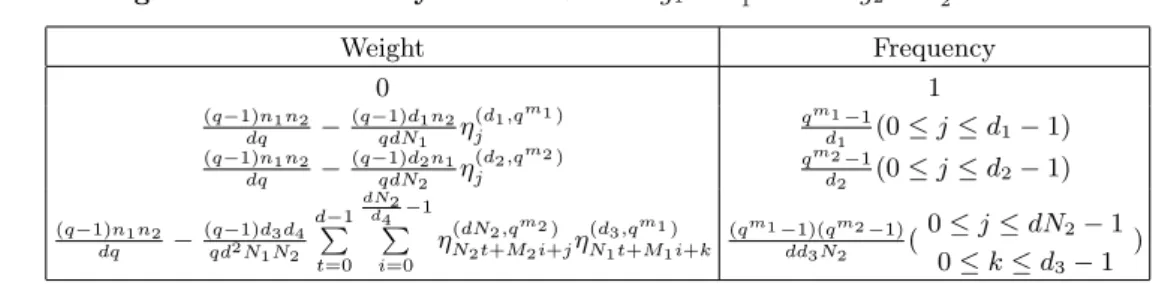
Theorem 2.9. [48] Ifgcd(n1, n2) =d,n1N1=qm1−1,n2N2=qm2−1,M1= q
m1−1 q−1 , M2=
qm2−1 q−1 , d1=
gcd(M1, N1), d2 = gcd(M2, N2), d3 = gcd(M1ddN4 2, dN1), and d4 = gcd(M2, dN2), then the weight
Table 1. Weight distribution of cyclic code C with g1=α
−N1
1 and g2=α
−N2
2 .
Weight Frequency
0 1
(q−1)n1n2
dq −
(q−1)d1n2
qdN1 η
(d1,qm1) j
qm1−1
d1 (0≤j≤d1−1)
(q−1)n1n2
dq −
(q−1)d2n1
qdN2 η
(d2,qm2)
j
qm2−1
d2 (0≤j≤d2−1)
(q−1)n1n2
dq −
(q−1)d3d4
qd2N 1N2
d−1
P
t=0
dN2 d4 −1
P
i=0
η(dN2,qm2)
N2t+M2i+jη
(d3,qm1)
N1t+M1i+k
(qm1−1)(qm2−1) dd3N2 (
0≤j≤dN2−1 0≤k≤d3−1
)
Table 2. Weight distribution ofC from two distinct finite fields.
Weight Frequency
0 1
qm1−1(qm2−1) qm1−1
qm2−1(qm1−1) qm2−1
(qm1−1)(qm2−1)
q −
δ q
δ−1
P
v=0
η(vδ,q+km1)η(vδ,q+jm2) (qm1−1)(δ2qm2−1)(0≤k, j≤δ−1)
As an application of Theorem2.9, the weight distribution of cyclic code from two distinct finite fields (i.e.,N1=N2= 1) was presented.
Theorem 2.10. [48] Letm1, m2 be two positive divisors ofmwith gcd(m1, m2) = 1,n1=qm1−1, and
n2=qm2−1. Ifgcd(q−1, m1−m2) =δ, thenC is a[(q
m1−1)(qm2−1)
q−1 , m1+m2]cyclic code and its weight distribution is given by Table 2.
Ifgcd(m1, m2) = 1, then the weight distributions of the cyclic codesC can be explicitly determined
when the Gauss periods of orderδare known.
Corollary 2.11. [48] Letr=qm,m
1, m2 be two divisors ofmwithgcd(m1, m2) = 1.
1. If gcd(q−1, m1−m2) = 1, then the corresponding cyclic code C is a [(q
m1−1)(qm2−1)
q−1 , m1+m2] three-weight cyclic code and its weight distribution can be explicitly determined.
2. If gcd(q−1, m1−m2) = 2, then the corresponding cyclic code C is a [
(qm1−1)(qm2−1)
q−1 , m1+m2] four-weight cyclic code and its weight distribution can be explicitly determined.
In particular, if (q−1) | m1 or (q−1) |m2, then we have δ = 1 bygcd(m1, m2) = 1. Thus C is
a three-weight cyclic code. Moreover, if q = 2, then the corresponding code C is a three-weight binary cyclic code which is more interesting in communication and storage systems.
IfN1=N2= 2, then we have the following theorem.
Theorem 2.12. [48] Let r =qm with q odd, m
1, m2 be two divisors of m with gcd(m1, m2) = 1 and
(q−1) | m1 or (q−1) | m2, n1 = q
m1−1
2 , and n2 = qm2−1
2 . Then the corresponding code C is a
[(qm1−2(q1)(q−1)m2−1), m1+m2]cyclic code with five nonzero weights and its weight distribution can be explicitly determined.
More classes of cyclic codes can be presented by Theorem 2.9 and it is unnecessary to state them here. We refer the readers to [46–48] for more results.
two zeros [9]. It is a good research problem to present the weight distributions of cyclic codes by using zeta functions, quadratic forms, Gauss periods, or other mathematical tools.
3.
Weight distributions of cyclic codes with arbitrary zeros
In this section, we survey the weight distributions of cyclic codes with arbitrary zeros. It is in general very difficult to computeZ(r, t)if the dual of cyclic code has more zeros. Hence there are few results on such cyclic codes.
3.1.
Hermitian forms graphs and weight distributions
Let G be a finite Abelian group and D a subset of G. The Cayley graph Cay(G, D) on G with connection setD is the directed graph with vertex setGand edge set{(g, h) :g, h∈G, gh−1∈D}.
LetA= (agh)with entries in{0,1} be a square matrix such thatagh= 1 ifgh−1∈D andagh= 0
otherwise. We call A the adjacency matrix of Cay(G, D). It is known that each character χ of G corresponds to an eigenvector of A with eigenvalue χ(D) = P
d∈D
χ(d) . Furthermore, the spectrum of
Cay(G, D)is the multiset{χ(D) :χ∈Gb}, whereGb is the character group ofG.
In this subsection, we always suppose thatm= 2lfor some integerl ands= 1, i.e.,q=p. A matrix H overFp2 is called Hermitian ifH =H∗, where H∗ is the conjugate transpose ofH. LetHdenote the Abelian group formed by alll×lHermitian matrices overFp2 under the matrix addition. The Hermitian forms graph is the Cayley graph Cay(H,D), where D={H ∈ H: rank(H) = 1}. LetW =Fl
p2. Then the Hermitian forms graph onW is the Cayley graph Cay(H,D). The eigenvalues of the Hermitian forms graph were first computed by Stanton [76] and a more accessible formula was given in [10] by using the Gaussian binomial coefficients. For details and more information on the spectrum of Hermitian forms graph, we refer the readers to [10].
Li et al. [53] proposed an elegant method to study this problem by building a connection between the corresponding exponential sums and the spectra of Hermitian forms graphs.
For oddl, we denotet=l−21. Suppose thatαis a primitive element of Fr. Letgj =α−(p
2i−1+1) for
j = 1,3, . . . , tandgt+1=α−(p
l+1)
. Then we havem1=m2=· · ·=mt=mandmt+1=m2 and .
Theorem 3.1. [53] The corresponding codeC is a [r−1,m42] cyclic code and its weight distribution can be exactly determined.
Very recently, Zhou et al. [99] generalized this class ofp-ary cyclic codes proposed in [53] and the weight distributions of the generalized cyclic codes were settled for both evenl and oddlalong with the idea of Li, Hu, Feng, and Ge.
Theorem 3.2. [99] Lett=bm
2c. Then the weight distributions of the following cyclic codes over Fq (q is a prime power here) are known:
1. gj=α−(p
2j−1+1)
(j= 1,2, . . . , t),gt+1=α−(p
l+1)
for odd m;
2. gj=α−(p
2j−1+1)
(j= 1,2, . . . , t),gt+1=α−(p
l+1)
, andgt+2=α−1 for odd m;
3. gj=α−(p
2j−1+1)
(j= 1,2, . . . , t) for even m;
4. gj=α−(p
2j−1+1)
3.2.
Yang-Xiong-Ding-Luo cyclic codes
By Yang-Xiong-Ding-Luo cyclic codes we mean a class of cyclic codes with arbitrary number of zeros proposed in [90]. Now we describe this class of cyclic codes.
Main Assumptions: Letr=qm=psm be a prime power for two integers s, mand lete≥t≥2.
Assume that
1. a6≡0 (modr−1)ande|(r−1);
2. aj≡a+r−e1∆j (mod r−1),1≤j≤t, where∆u6= ∆v for anyu6=v andgcd(∆2−∆1, . . . ,∆t−
∆1, e) = 1;
3. gj =α−aj for1≤j≤t, their minimal polynomials overFq are pairwise distinct, andm1=m2=
· · ·=mt=m.
Denote
δ= gcd(r−1, a1, a2, . . . , at), n=
r−1
δ ,
and
N= gcd(r−1
q−1, ae).
We easily see that
eδ|N(q−1).
It follows from Delsarte’s Theorem [22] that the corresponding codeCis an[n, tm]cyclic code overFq.
It was proved that Condition (3) can be met by the following simple criterion.
Criterion: [90] Suppose that for any proper factor` ofm(i.e. `|mand` < m) we have
r−1
q`−1 -N.
Then Condition (3) in the Main Assumptions holds. In particular, ifN ≤√r, then Condition (3) in the Main Assumptions is met.
If t= 2, leta1 = q−h1 and a2 = q−h1 + r−1
e for positive integers e, hsuch that e|handh|(q−1),
the code C had been studied in [26, 37, 60, 82, 86–88]. Hence this class of cyclic codes with arbitrary zeros can be viewed as the generalization of cyclic codes whose duals have two zeros. The proper choices of these ai’s is key to compute the weight distribution of the codeC. It may be very difficult to find the
weight distribution if the integersai are not chosen in the right way.
If t = e ≥ 2, the set {∆j : 1 ≤ j ≤ e} is a complete residue system modulo e, so we may take
∆1= 0,∆2= 1, . . . ,∆e=e−1.
Theorem 3.3. [90] Under the Main Assumptions, whenN = 1andt=e≥2, the corresponding codeC
is at-weight cyclic code overFq and its weight distribution can be explicitly presented.
The Gauss periods are known for N = 2,3,4, semi-primitive case, and index 2 case. Hence the weight distributions of more cyclic codes can be determined.
Theorem 3.4. [90] Suppose that the Gaussian periods ηj(N,r) of order N have µ distinct values
{η1, η2, . . . , ηµ}, and for eachi(1≤i≤µ), there are exactly τi distinct js such thatη (N,r)
j =ηi. (Note that τ1+τ2+· · ·+τµ =N.) Then, the corresponding code C is an [n, em] cyclic code over Fq with at most µ+ee
3.3.
Cyclic codes from
Fl
conjugates
LetFq be a finite field withq=ltandγa primitive element ofFq, wherelis a prime power andtis
a positive integer. Let g be an element in the algebraic closure ofFq andmg(x)its minimal polynomial
overFq. Suppose thatdeg(mg(x)) =mandFqm =Fq(g). Theng=α−N andN |(qm−1), whereαis a
primitive element of Fqm.
LetC be a cyclic code overFq with check polynomial
h(x) =mg(x)mgl(x)· · ·mglt−1(x),
wheremglu(x)is the minimal polynomial ofgl u
overFq foru= 0,1, . . . , t−1. It follows from Delsarte’s
Theorem [22] that the code C is an [n, tm] cyclic code overFq, wheren= q
m−1
N . It is well known that
g(x) = (xn −1)/h(x) ∈ Fq[x] and every codeword of C is c(x) = a(x)g(x), where a(x) ∈ Fq[x] and
deg(a(x))≤ tm−1. Note that the roots of h(x) are all the conjugates ofg with respect to Fl. Then
h(x)∈Fl[x]is the minimal polynomial ofgoverFlandg(x)∈Fl[x]. Fora(x)∈Fq[x],deg(a(x))≤tm−1,
byFq =Fl⊕γFl⊕ · · · ⊕γt−1Fl we have
a(x) =s0(x) +γs1(x) +· · ·+γt−1st−1(x),
where su(x)∈Fl[x]anddeg(su(x))≤tm−1 foru= 0,1, . . . , t−1. Then we get
c(x) =a(x)g(x) =s0(x)g(x) +γs1(x)g(x) +· · ·+γt−1st−1(x)g(x).
It is easy to see that each su(x)g(x) is a codeword of the irreducible cyclic code over Fl whose check
polynomial is h(x) for u= 0,1, . . . , t−1. Let T :=Trqm/l denote the trace function from Fqm to Fl.
Then by the trace representation of the irreducible cyclic code, the cyclic code Ccan be expressed by
C={c(a0, a1, . . . , at−1) :a0, a1, . . . , at−1∈Fqm},
where
c(a0, a1, . . . , at−1) = ( t−1
X
u=0
γuT(au), t−1
X
u=0
γuT(auαN), . . . , t−1
X
u=0
γuT(au(αN)n−1)). (5)
When gcd(qml−−11, N) = 1, the zeros of the check polynomial of the cyclic code C are α−N lu for
u= 0,1, . . . , t−1. In [90], Yang et al. also dealt with such problem and the zeros of the check polynomials
of Yang-Xiong-Ding-Luo cyclic codes areα−(a+qmt−1u)foru= 0,1, . . . , t−1, wheret|(qm−1)anda6≡0
(mod qm−1). Hence this class of cyclic codes with arbitrary number of zeros are different from
Yang-Xiong-Ding-Luo cyclic codes.
Theorem 3.5. [49] Let the notations be as above. Ifgcd(qml−−11, N) = 1, then the corresponding code C
is at-weight cyclic code and its weight distribution can be explicitly determined.
4.
Weight distributions of cyclic codes with Niho exponents
In this section, we always assume thatq=p, i.e.,s= 1. Now we consider the weight distributions of cyclic codes over Fp with Niho exponents which are due to [65].
A positive integer dis of Niho exponent if d≡pi (mod pl−1), where m= 2l for some integer l.
Without loss of generality, we can assume thatd≡1 (modpl−1). For two Niho exponentsd=s(pl−1)+1
and d0=s0(pl−1) + 1, we call them equivalent ifd0 ≡pid (modpm−1)for some integer i. Moreover, d ≡pld (modpm−1) if and only if s+s0 ≡1 (modpl+ 1). Hence, s can be restricted in the range
Let g1 = α−d1 and g2 = α−d2 for two Niho exponents d1, d2. Suppose that g1 and g2 are not
conjugates over Fp. To determine the weight distribution of the corresponding cyclic codeC, by (3) we
have to deal with the exponential sums
T(a, b) = X
x∈Fr
ψ1(a1xd1)ψ2(a2xd2) =ζ
Trpm1/p(a1xd1)+Trpm2/p(a2xd2)
p
for a1, a2 ∈ Fr. If one of d1, d2 is equal to 1 and p = 2, this class of cyclic codes with few nonzero
weights were studied [18]. Li, Feng, and Ge [52] gave some sufficient conditions for these codes to have few nonzero weights for bothp= 2and oddp.
Some preliminaries are necessary for determining the exponential sumsT(a, b). LetFpm be a finite
field withm= 2l andr=pm. DenoteS={x∈
Fr:xx¯ = 1}, wherex¯=xp
l
. ThenS is a cyclic group of order pl+ 1andS =hηiwithη=αpl−1.
Lemma 4.1. [52,65] For two Niho exponentsd1=s1(pl−1) + 1 andd2=s2(pl−1) + 1, we have
T(a, b) = (N(a, b−1))pl,
where N(a, b)is the number of z∈S satisfying
azs1+ ¯az1−s1+bzs2+ ¯bz1−s2= 0.
From the properties of trace function, we easily obtain the following moment identities which is very important to determine the value distribution of T(a, b).
Lemma 4.2. 1. P
a,b∈Fr
T(a, b) =p2m.
2. P
a,b∈Fr
T(a, b)2=p2mN
2(d1, d2), whereN2(d1, d2)is the number of solutions of the equations
(
xd1+yd1= 0
xd2+yd2= 0 , x, y∈Fr.
3. P
a,b∈Fr
T(a, b)3=p2mN
3(d1, d2), whereN3(d1, d2)is the number of solutions of the equations
(
xd1+yd1+zd1 = 0
xd2+yd2+zd2 = 0 , x, y, z∈Fr.
From the above two lemmas we see that determining the weight distributions of cyclic codes with Niho exponents is equivalent to count the number of solutions of the equation and the system of equations over finite fields. Hence, if cyclic codes with Niho exponents have many nonzero weights, it is very difficult to determine their weight distributions. Recently, Li, Feng, and Ge [52] presented the weight distributions of three classes of cyclic codes with Niho exponents.
Theorem 4.3. [52] LetC be a cyclic code defined by g1=α−d1 and g2=α−d2 for two Niho exponents
d1, d2. Then the weight distribution of the p-ary cyclic code C with the following Niho exponents are known:
1. p= 2,d1= 2l+ 1, andd2=s2(2l−1) + 1, wheres26≡ 12 (mod 2l+ 1);
2. p= 2,l≥2,d1=s1(2l−1)+1, andd2=s2(2l−1)+1, wheres1= 2k−1t−t−21 ands2= 2k−1t+t+12 for integersk(1≤k≤l) andt(tis odd and1≤t≤2l+1) satisfying2k−1t,2k+1t6≡0 (mod 2l+1) andm≡ −1 (modk)or gcd(k,2m) = 1;
5.
Cyclic codes with few weights
Cyclic codes with few weights are of much interest in coding theory due to their applications in cryptography and combinatorics. In this section, we begin with some definitions.
A linear code is called to be projective if the minimum weight of its dual code is at least three. Moreover, a linear code is aN-weight code if the number of non-zero weights of this code isN.
A cyclic code of length noverFq is irreducible if its check polynomial is irreducible (its polynomial
representation is a minimal ideal). It is said to be non-degenerate if its check polynomial is a primitive divisor ofxn−1overFq (that is, the order of this polynomial isn).
5.1.
One-weight cyclic codes
LetFr be a finite field withr=qm elements. When the length of a cyclic codeC isr−1 and the
check polynomial is the minimal polynomial overFq of a primitive root ofFr(in fact,Cis an irreducible
cyclic code), then the code C is called a simplex code or a subfield code. It is easily proved thatC is a 1-weight code with (q−1)qm−1 as its unique non-zero weight.
In [84], Wolfmann first gave some descriptions of one-weight cyclic codes via Pless identities [66]. Furthermore, Vega and Wolfmann [81] presented a better and more simple characterization of one-weight irreducible cyclic codes.
Theorem 5.1. [81] Let C be an [n, k] irreducible cyclic code over Fq with n =λrq−−11, where λ divides
q−1. Letρbe the order of the check polynomial ofC, that is, the common order of its roots. The following assertions are equivalent:
1. C is a one-weight cyclic code;
2. C contains a codeword of weightλqm−1;
3. gcd(ρ,qρ −1) =qqm−−11.
5.2.
Two-weight cyclic codes
Two-weight linear codes are closely related to strongly regular graphs, partial difference sets, and finite projective spaces. There is a survey [12] to investigate their relationships.
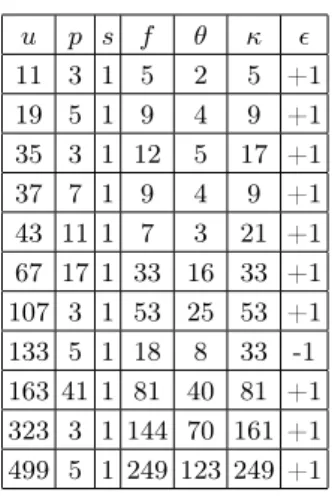
For two-weight irreducible cyclic codes, Schmidt and White [73] in 2002 gave a classification by Gauss sums. They presented some necessary and sufficient numerical conditions on the parameters of an irreducible cyclic code to have at most two nonzero weights. It is conjectured that an irreducible cyclic code is a two-weight code if and only if it is a semi-primitive code or one of the eleven sporadic examples. Moreover, they gave a partial proof of this conjecture via generalized Riemann hypothesis.
Let q = p be a prime, and let u, m be positive integers such that u divides ppm−−11. Let C be an irreducible cyclic code over Fp defined byg1 =α−u. For a positive integerx, let Sp(x)denote the sum
of thep-digits ofx, that is, if
x=l0+l1p+· · ·+lvpv,
where 0≤li ≤p−1 andlv6= 0, then
Sp(x) =l0+l1+· · ·+lv.
Denote f =: ordu(p)(i.e., the least positive integer such that pf ≡1 (modu)) and
θ=θ(u, p) =: 1
p−1min{Sp(
j(pf−1)
Table 3. Eleven sporadic examples withu≤100000 u p s f θ κ
11 3 1 5 2 5 +1
19 5 1 9 4 9 +1
35 3 1 12 5 17 +1
37 7 1 9 4 9 +1
43 11 1 7 3 21 +1 67 17 1 33 16 33 +1 107 3 1 53 25 53 +1 133 5 1 18 8 33 -1 163 41 1 81 40 81 +1 323 3 1 144 70 161 +1 499 5 1 249 123 249 +1
Then we have the following theorem.
Theorem 5.2. [73] Let the notations be as above. Ifm=f l for some integer l, thenC is a two-weight code if and only if there exists a positive integer κsatisfying
κ|(u−1),
κplθ≡ (mod u),
κ(u−κ) = (u−1)pl(f−2θ),
where =±1. Moreover, the two nonzero weights are
w1= (p−1)plθ−1(pl(f−θ)−κ)/u,
w2=w1+(p−1)plθ−1.
Conjecture 5.3. [73] An irreducible cyclic code is a two-weight code if and only if it is a semi-primitive code or one of the eleven sporadic examples in Table3.
In [85], Wolfmann gave a characterization of projective two-weight linear codes. Furthermore, a family of projective 2-weight irreducible cyclic codes were presented.
Theorem 5.4. [85] LetCbe a non-degenerate irreducible cyclic code of lengthnoverFq withgcd(n, q) =
1. LetFqm be the splitting field ofxn−1 overFq and letnN =qm−1. If :
1. gcd(n, q−1) = 1,
2. m= 2f l such that (q−1)(qf+ 1)≡0 (modN),
3. N 6=q−1 andd6= (q−1)(qf l+ 1),
then C is a projective two-weight code.
Conjecture 5.5. [85] Any projective two-weight non-degenerate irreducible cyclic code is a code satisfying conditions (1)-(3) of Theorem 5.4except for eleven special cases deduced from Table3.
Wolfmann [84] also characterized projective two-weight cyclic codes and proved that if a linear code
C is a two-weight projective cyclic code of dimensionmoverFq, then either:
(1)C is irreducible, or
(2) if q 6= 2, C is the direct sum of two one-weight irreducible cyclic codes of length n = λqqm−−11, where λdivides q−1 andλ6= 1 and direct sum means direct sum as vector spaces.
It is clear that the codeC is reducible in case (2) of Wolfmann’s characterization [84]. Two-weight reducible cyclic codes had also been presented in [39] and [81]. Motivated by these results, in 2008, Vega [78] presented a family of two-weight reducible cyclic codes which were constructed as the direct sum of two one-weight cyclic codes and obtained their weight distributions. Moreover, this new family gives a unified explanation for all these two-weight cyclic codes that were presented in [39] and [81]. To get Vega’s result, Gauss sum introduced in Section 2 is a necessary tool.
Theorem 5.6. [78] Letp, q, andmbe defined as before. Denote∆ = qqm−−11. Leta1, a2 andvbe integers such that a1qi 6≡ a2 (mod qm−1), for all i ≥ 0, v = gcd(a1−a2, q−1), and a2 ∈ Z∗∆. For some integer ` satisfying `|gcd(a1, a2, q−1), we setλ=
(q−1)`
gcd(a1,a2,q−1), n=λ∆,µ=
q−1
∆ , and ξ= q−1
v . Let
h1(x), h2(x) ∈ Fq[x] be the minimal polynomials of α−a1 and α−a2, respectively. Suppose that at least one of the following two conditions holds:
1. p= 2, k= 2, v= 1, anda1 is a unit in the ringZ∆, or
2. for some integerj , with1≤pj< qm , we have
(1 +ae2(a1−a2))pj ≡1 (mod ∆v),
where ae2 is the inverse ofa2 in Z∆. Then the following four assertions are true:
(a) h1(x)and h2(x) are the check polynomials for two different one-weight cyclic codes of length n and dimension m.
(b) µ|v andλ > vµ.
(c) If C is the cyclic code with check polynomial h1(x)h2(x), then C is an[n,2m] two-weight cyclic code with weight enumerator polynomial
A(x) = 1 + µ
vn(q−1)z
(λ−v µ)q
m−1
+ (q2m−1−µ
vn(q−1)z
λqm−1.
(d)C is a projective code if and only ifµ=v.
5.3.
Three-weight cyclic codes
Cyclic codes with three nonzero weights have been applied in association schemes [11] and secret sharing schemes [97]. Hence constructing three-weight cyclic codes is a good research problem. Recently, perfect nonlinear (or planar) and almost perfect nonlinear functions are employed to find three weight cyclic codes.
In [91], Yuan, Ding, and Carlet used planar functions to get two classes of three-weight cyclic codes. Feng and Luo [34] presented a unified way to investigate the weight distributions of cyclic codes from planar functions.
Table 4. Weight distribution of cyclic code from planar functions.
Weight Frequency
0 1
(q−1)qm−1−qm−21 (q−1)(q
m−1)(qm−1+qm2−1)
2
(q−1)qm−1 (qm−1)(qm−1+ 1) (q−1)qm−1+qm−21 (q−1)(q
m−1)(qm−1−qm−21)
2
Table 5. Weight distribution of cyclic code in [34].
Weight Frequency
0 1
(q−1)qm−1−q−1 2 q
m−1
2 (qm−1)(qm−1+q
m−1 2 )
(q−1)qm−1 (qm−1)(qm−2qm−1+ 1) (q−1)qm−1+q−21qm−21 (qm−1)(qm−1−q
m−1 2 )
1. g1=α−1 andg2=α−(q
l+1)
[91];
2. g1=α−1 andg2=α−
ql+1
2 , whereq= 3,gcd(m, l) = 1, andhis odd [34,91].
Moreover, its weight distribution is presented in Table 4.
Luo and Feng [58] extended the second construction in Theorem5.7.
Theorem 5.8. [58] Let m≥3 be odd and let q be an odd prime. Then the code C over Fq defined by
g1=α−1 andg2=α−v is a three-weight [qm−1,2m]cyclic code with the weight distribution in Table 5
if v=ql2+1, wherel is a positive integer satisfyinggcd(2m, l) = 1.
We remark that Table4and Table5are same whenp= 3. Additionally, Ding, Gao, and Zhou [25,96] presented several classes of three-weight cyclic codes overF3 from almost perfect nonlinear functions.
Theorem 5.9. Letq= 3andC be the ternary cyclic code defined byg1=α−1andg2=α−v. ThenC is a [qm−1,2m]three-weight cyclic code with weight distribution depicted in Table 4or 5in the following cases:
1. mis odd and v=3m+14−1 [25]; 2. mis odd and v= 3m2+1 −1 [97];
3. m≡3 (mod 4)andv= 3m+12 −1 2 [97];
4. m≡1 (mod 4)andv= 3
m+1 2 −1
2 +
3m−1 2 [97];
5. m≡3 (mod 4)andv= 3m+18−1 [97];
6. m≡1 (mod 4)andv= 3m+18−1 +3m2−1 [97]; 7. m≡3 (mod 4)andv= (3m4+1 −1)(3
m+1
2 + 1)[97];
8. m≡7 (mod 8)andv= (3m8+1 −1)(3
m+1 4 + 1)(3
m+1
Table 6. Weight distribution of three classes of cyclic code in [25].
Weight Frequency
0 1
(q−1)(qm−1−qm2−1) 1 2(q
m−1)(qm−1+qm2−1) (q−1)qm−1 (qm−1)(qm−qm−1+ 1) (q−1)(qm−1+qm2−1) 1
2(q m−
1)(qm−1−qm2−1)
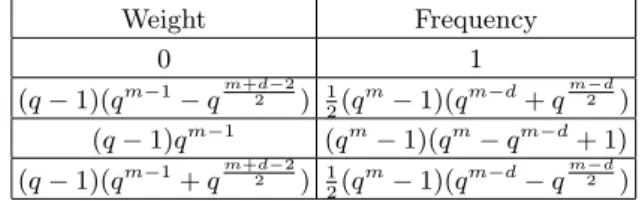
Table 7. Case: v≡1 +q−21 (modq−1).
Weight Frequency
0 1
(q−1)qm−1−q−1 2 q
m+d−2
2 (qm−1)(qm−d+q
m−d
2 )
(q−1)qm−1 (qm−1)(qm−2qm−d+ 1)
(q−1)qm−1+q−21qm+2d−2 (qm−1)(qm−d−q
m−d
2 )
Remark 5.10. Forq= 3,xv is an almost perfect nonlinear function overFqm for the followingv:
1. v= 3m2+1 −1;
2. v=3m2+1−1
2 ifm≡3 (mod 4);
3. v=3
m+1 2 −1
2 +
3m−1
2 ifm≡1 (mod 4);
4. v=3m+1−1
8 if m≡3 (mod 4);
5. v=3m+18−1+3m2−1 if m≡1 (mod 4).
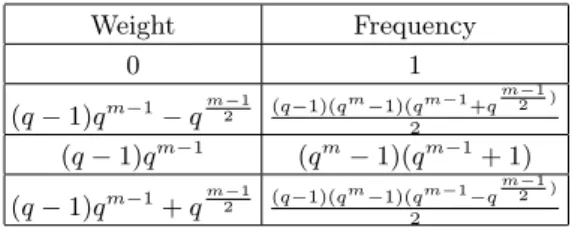
There are another three classes of three-weight cyclic codes whose weight distributions are given in Table6 and are different from the one in Table4or 5.
Theorem 5.11. [25] Let q = 3 and C be the ternary cyclic code defined by g1 =α−1 and g2 = α−v. ThenC is a[qm−1,2m] three-weight cyclic code with weight distribution depicted in Table6if
1. v=3m3h+1+1−1+
3m−1 2 , where
m+1
h is even; or
2. v= (3m8+1−1)(3
m+1 4 + 1)(3
m+1
2 + 1) +3
m−1
2 , wherem≡7 (mod 8); or
3. v= (3m4+1−1)(3
m+1
2 + 1) + 3
m−1
2 , wherem≡3 (mod 4).
In 2014, Li et al. [50] gave a more general description of three-weight cyclic codes defined byg1=α−1
andg2=α−v.
Theorem 5.12. [50] Letm≥3 be odd. Letqbe any odd prime. Ifvis an integer satisfying(ql+ 1)v≡2 (mod qm−1)for some positive integerv withgcd(m, l) =d, thenC is a[qm−1,2m]cyclic code with the weight distribution in Table 7ifv≡1 + q−21 (mod q−1) and Table8whenv≡1 (modq−1).
Table 8. Case: v≡1 (modq−1).
Weight Frequency
0 1
(q−1)(qm−1−qm+2d−2) 1 2(q
m−1)(qm−d+qm−2d)
(q−1)qm−1 (qm−1)(qm−qm−d+ 1)
(q−1)(qm−1+qm+2d−2) 1 2(q
m−1)(qm−d−qm−2d)
Theorem 5.13. Letqbe a prime andC a cyclic code overFq defined byg1=α−v1 andg2=α−v2. Then
C is a [qm−1,2m] three-weight cyclic codes in the following cases:
1. v1= 2andv2=pl+ 1, wherem≥3 is odd and gcd(m, l) = 1 [35];
2. v1=q
m+1
2 andv2= ql+1
2 , wheregcd(m, l) = 1 [96].
6.
Generalization to constacyclic codes
The concept of cyclic codes was extended naturally to negacyclic codes,4 and then to constacyclic codes. Given a nonzero element λof Fq, a linear codeC of length nover Fq is called λ-constacyclic if
(λcn−1, c0,· · · , cn−2) ∈ C for every (c0, c1,· · · , cn−1) ∈ C. Just like cyclic codes, λ-constacyclic codes
of length n over Fq are classified as the ideals hg(X)i of the quotient ring Fq[X]/hXn−λi, where the
generator polynomial g(X) is the unique monic polynimial of minimum degree in the code, which is a divisor ofXn−λ. Whenλ=1,λ-constacyclic codes are just cyclic codes and whenλ=−1,λ-constacyclic codes are negacyclic codes. In general, the dual of aλ-constacyclic code of lengthnis aλ−1-constacyclic
code of length n.
There are cases when one code can be mapped onto another by means of a map which preserves the Hamming distances. Two codesC1, C2are considered to be of the same quality if there exists a mapping
ϕ : Fn
q −→ Fnq with ϕ(C1) = C2 which preserves the Hamming distance, i.e. dH ϕ(a), ϕ(a0) =
dH(a,a0),for any a,a0 ∈Fnq.Mappings with the latter property are called isometries, and such codes are
naturally called equivalent. There are various ways in which such an equivalence relation can be defined. For example, ifC1, C2are linear codes, then we can naturally assume furthermore that the isometryϕis
a linear map (e.g., [8]).
Since each λ-constacyclic code is an ideal of Fq[X]/hXn−λi, it is natural to assume that
isome-tries between constacyclic codes preserve the algebraic structures and Hamming distances. It turns out that if we can classify all the equivalence classes of constacyclic codes, we then only have to study the represtentative of those equivalence classes. In particular, if we can determine all constacyclic codes that are equivalent to cyclic codes, then all our results about Hamming weight and weight distributions of cyclic codes in previous sections hold true for those constacyclic codes. We devote this section to consider two type of equivalences, and for each type, we give the necessary and sufficient conditions for λ- and µ-constacyclic codes to be equivalent.
4
As mentioned before, cyclic codes were introduced in 1957. Just about 11 years after that, negacyclic codes over finite fields Fpwere initiated by Berlekamp in 1968 [3,4], where he showed that these codes are more useful
for correcting errors measured relative to the Lee metric. Berlekamp also designed a decoding algorithm that can correct errors with Lee weight at most p−1
2 . A couple of years after that, in 1971, Kelsch and Green [45] were
sucessful to provide non-binary negacyclic codes exceeding Berlekamp’s p−21 bound. They constructed 2-error-correcting negacyclic codes of length 3m−1
2 with redundancy2m overF3, and all negacyclic codes of length pm−1
2
First of all, some special results have been obtained in the literature.
Lemma 6.1. [42, Lemma 3.1] or [1, Corollary 2.1] Let nbe a positive integer, and λ∈F∗q. If µnλ= 1 for someµ∈F∗q, then
Fq[X]/hXn−λi −→ Fq[X]/hXn−1i, X7→ µX
is an Fq-algebra isomorphism which is Hamming distance preserving.
In particular, in casenis odd, forλ=−1, it is obvious that µ=−1satisfies the hypothesis of the above lemma. That means that negacyclic codes of odd length are scalar equivalent to cyclic codes of the same length, which is a well known result that was proven to be true for the more general case when the alphabet is a finite commutative ring.
Noting this fact, Dinh [29] established a one-to-one correspondence between negacyclic and cyclic codes, carrying results on negacyclic codes to cyclic codes accordingly.
Proposition 6.2. [29, Proposition 6.1] Let p be an odd prime and q a power of p. Then the map
ξ : Fq[X]
hXps+1i 7→
Fq[X]
hXps−1i, given by f(X) 7→ f(−X), is an Fq-algebra isomorphism. In particular, for
A⊆ Fq[X]
hXps+1i,B⊆
Fq[X]
hXps−1i such thatξ(A) =B, thenAis an ideal of
Fq[X]
hXps+1i if and only ifB is an ideal
of Fq[X]
hXps−1i. Equivalently,A is a negacyclic code of length p
s over
Fq if and only ifB is a cyclic code of lengthps overFq.
Later on, Dinh in [30] showed that all constacyclic codes of lengthps overFq are scalar equivalent
to negacyclic codes.
Proposition 6.3. [30, Proposition 3.1] Letpbe an odd prime andqa power ofp. Letλ∈F∗
q. Then there
exists a unique elementλ0inF∗q such thatλ ps
0 =−λ−1. LetΦbe the mapΦ : F
q[X]
hXps+1i 7→
Fq[X]
hXps−λi, given
by Φ(f(X)) =f(λ0X). ThenΦis an Fq-algebra isomorphism, and it is Hamming distance preserving.
For the more general alphabets of finite rings, [83] showed that cyclic and negacyclic codes overZ4
have the same structure for odd code lengths. Dinh and López-Permouth in [28] generalized that to obtain that this fact holds true for cyclic and negacyclic codes of odd lengths over any finite chain ring. Batoulet al. in [2, Proposition 3.4] extended this result to a more general setting.
Generalizing the ideas above, Chen et al. in [19] introduced a concept called “isometry” for the nonzero elements of Fq to classify constacyclic codes overFq such that the constacyclic codes belonging
to the same isometry class have the same distance structures and the same algebraic structures.
Definition 6.4. [19, Definition 3.1] Letλ, µ∈F∗q. We say that an Fq-algebra isomorphism
ϕ: Fq[X]/hXn−µi −→ Fq[X]/hXn−λi
is an isometryif it preserves the Hamming distances on the algebras, i.e.
dH ϕ(a), ϕ(a0)
=dH(a,a0), ∀ a,a0∈Fq[X]/hXn−µi.
And, if there is an isometry betweenFq[X]/hXn−λiandFq[X]/hXn−µi, then we say thatλisn-isometric toµ inFq, writtenλ∼=nµ.
Clearly, then-isometry “∼=n” is an equivalence relation onF∗q, henceF∗q is partitioned inton-isometry
classes. Ifλ∼=n µ, then theλ-constacyclic codes of lengthnare in one to one correspondence with the
µ-constacyclic codes of lengthnsuch that the corresponding constacyclic codes have the same dimension and the same distance distribution, specifically, have the same minimum distance; at that case for convenience, theλ-constacyclic codes of lengthnare said to beisometricto theµ-constacyclic codes of lengthn. So, it is enough to study then-isometry classes of constacyclic codes.
Theorem 6.5. [19, Theorem 3.2] For any λ, µ ∈ F∗q, the following three statements are equivalent to each other:
(i) λ∼=n µ.
(ii) hλ, ξni=hµ, ξni, wherehλ, ξnidenotes the subgroup of
F∗q generated by λandξn.
(iii) There is a positive integerk < nwithgcd(k, n) = 1and an elementa∈F∗q such thatanλ=µk and the following map
ϕa: Fq[X]/hXn−µki −→ Fq[X]/hXn−λi, (6)
which maps any elementf(X) +hXn−µkiof F
q[X]/hXn−µkito the elementf(aX) +hXn−λi ofFq[X]/hXn−λi, is an isometry.
In particular, the number of n-isometry classes of F∗q is equal to the number of positive divisors of
gcd(n, q−1).
Taking µ = 1, we see that λ ∼=n 1 implies that there is an isometry ϕa : Fq[X]/hXn −1i →
Fq[X]/hXn−λisuch that ϕ(X) =aX. Thus for the constacyclic codesn-isometric to cyclic codes, the
following consequence is closely related to [42, Lemma 3.1] or [1, Corollary 2.1].
Corollary 6.6. [19, Corollary 3.4] Let n be a positive integer, and λ ∈ F∗q. The λ-constacyclic codes of length n are isometric to the cyclic codes of length n if and only if anλ= 1 for an elementa ∈
F∗q; further, in that case the map
ϕa: Fq[X]/hXn−1i −→ Fq[X]/hXn−λi, (7)
which mapsf(X)tof(aX), is an isometry, and
Xn−λ=λ·Mr1(aX)
psM r2(aX)
ps· · ·M rρ(aX)
ps (8)
is an irreducible factorization of Xn−λ inFq[X], wheren=n0ps withs≥0 andp6 |n0, Mri(X) is the
irreducible factor ofXn0−1 overFq corresponding to theq-cyclotomic coset containingri. In particular, any λ-constacyclic codeC has a generator polynomial as follows:
ρ
Y
i=1
Mηri(aX)ei, 0≤ei≤ps, for any i= 1,· · ·, ρ. (9)
As an immediate application of Corollary6.6, the next result can be regarded as a generalization of Proposition 6.3.
Corollary 6.7. (cf. [19, Corollary 3.5]) Ifnis a positive integer coprime toq−1, then there is only one
n-isometry class in F∗q; in particular, for anyλ∈F∗q the λ-constacyclic codes of length nare isometric to the cyclic codes of length n, i.e. anλ= 1 for ana∈F∗q and all the (7), (8) and (9) hold.
Although λ ∼=n µ means there exists an isometry φ between the rings Fq[X]/hXn −λi and
Fq[X]/hXn−µi, it is not easy to connect the generator polynomial of the λ-constacyclic code C with
the generator polynomial ofφ(C), and as a result, it is not easy to describe the relationship between the duals C⊥ andφ(C)⊥.
To overcome this problem, Chen, Dinh and Liu in [20] considered a more specified relationship than the isometry “ ∼=n ”, that enabled us to obtain a much more explicit description of the generator
polynomials of all constacyclic codes. This detailed description also allows us to establish the generator polynomials of the dual codes. A new equivalence relationship “ ∼n ” is introduced on the nonzero
elements ofFq to classify constacyclic codes of lengthnoverFq. Some necessary and sufficient conditions
for any two nonzero elements of Fq to be equivalent to each other are established. It is shown that,
if λ ∼n µ then there exists a very explicit Fq-algebra isomorphism ϕ between Fq[X]/hXn −λi and
Fq[X]/hXn−µi. Furthermore, the generator polynomial of theλ-constacyclic codeC and the generator
Definition 6.8. [20, Definition 3.1] Letnbe a positive integer. For any elementsλ,µofF∗q we say that
λandµaren-equivalentinF∗q and denote byλ∼n µif the polynomialλXn−µhas a root inFq. In this case, we say λ-constacyclic codes aren-equivalent to µ-constacyclic codes.
It is routine to check that∼n is an equivalence relationship onF∗q. The next result shows thatλand
µaren-equivalent if and only if they are belonging to the same coset of hξniinhξi. In other words, the
cosets of hξniin hξigive all the n-equivalence classes, thus each n-equivalence class contains the same
number of elements.
Theorem 6.9. [20, Theorem 3.2] For any λ, µ∈F∗q, the following four statements are equivalent:
(i) There exists ana∈F∗
q such that
ψ: Fq[X]/hXn−µi → Fq[X]/hXn−λi
f(X)7→f(aX),
is anFq-algebra isomorphism.
(ii) λandµare n-equivalent inF∗q.
(iii) λ−1µ∈ hξni.
(iv) (λ−1µ)d= 1,whered= q−1 gcd(n,q−1).
In particular, the number of then-equivalence classes inF∗q isgcd(n, q−1).
Comparing with the equivalence relation“∼=n”mentioned previously, one can easily find thatλ∼n µ
implies λ ∼=n µ. However, the converse of this statement is not true in general. In fact, Theorem6.5
implies that if λ∼=n µthen there exists a positive integerk coprime tonsuch thatλ∼nµk. Therefore,
every isometry class is equal to some unions of n-equivalence classes. We give the following illustrative example.
Example 6.10. Takeq= 24 andn= 6 in Theorem6.9. Clearly,gcd(6,24−1) = 3and
F∗24 =hξi
[
ξhξi[ξ2hξi.
This implies that ξ and ξ2 are not 6-equivalent. However, it is readily seen that there are just two
6-isometry classes andξ∼=n ξ2.
7.
Concluding remarks
In this paper, we investigated the weight distributions of cyclic codes determined by exponential sums. It is clear that Gauss periods, Gauss sums, and quadratic forms are important tools. The weight distributions of cyclic codes have been studied for many years and are known in some cases. However, it remains open for most cyclic codes. Thus there are many challenging problems to be solved.
References
[1] N. Aydin, I. Siap, D. K. Ray-Chaudhuri, The structure of 1-generator quasi-twisted codes and new linear codes, Designs Codes Cryptogr. 24, 313-326, 2001.
[2] A. Batoul, K. Guenda, T. A. Gulliver, On self-dual cyclic codes over finite chain rings, Designs Codes Cryptogr. 70, 347-358, 2014.
[3] E. R. Berlekamp, Negacyclic Codes for the Lee Metric, Proceedings of the Conference on Combi-natorial Mathematics and Its Applications, Chapel Hill, N.C., University of North Carolina Press, 298-316, 1968.
[4] E. R. Berlekamp,Algebraic Coding Theory, revised 1984 edition, Aegean Park Press, 1984.
[5] S. D. Berman,Semisimple cyclic and Abelian codes. II, Kibernetika (Kiev) 3 (1967), 21-30 (Russian). English translation: Cybernetics 3, 17-23,1967.
[6] B. C. Berndt, R. J. Evans, K. S. Williams,Gauss and Jacobi Sums, Wiley-Interscience Publication, 1998.
[7] C. Berrou, A. Glavieux, and P. Thitimajshima, Near Shannon limit error-correcting coding and decoding: Turbo-codes, 1993.
[8] A. Betten, M. Braun, H. Fripertinger, A. Kerber, A. A. Kohnert, A. Wassermann,Error Correcting Linear Codes: Classification by Isometry and Applications, Springer, Berlin, 2006.
[9] N. Boston and G. McGuire,The weight distribution of cyclic codes with two zeros and zeta functions, J. Symbolic Comput., 45(7), 723-733, 2010.
[10] A. E. Brouwer, A. M. Cohen, and A. Neumaier,Distance-Regular Graphs, Berlin, Germany: Springer-Verlag, 18, 1989, Ergebnisse der Mathematik und ihrer Grenzgebiete (3) [Results in Mathematics and Related Areas (3)].
[11] A. R. Calderbank and J. M. Goethals,Three-weight codes and association schemes, Philips J. Res., 39, 143-152, 1984.
[12] R. Calderbank and W. M. Kantor, The geometry of two-weight codes, Bull. London Math. Soc., 18, 97-122, 1986.
[13] A. Canteaut, P. Charpin, and H. Dobbertin, Weight divisibility of cyclic codes, highly nonlinear functions onF2m and crosscorrelation of maximum-length sequences, SIAM J. Discrete Math., 13(1),
105-138, 2000.
[14] C. Carlet, P. Charpin, and V. Zinoviev,Codes, bent functions and permutations suitable for DES-like cryptosystems, Des. Codes Cryptogr. 15(2), 125-156, 1998.
[15] C. Carlet and C. Ding, Highly nonlinear mappings, J. Complexity, 20(2), 205-244, 2004.
[16] G. Castagnoli, J. L. Massey, P. A. Schoeller and N. von Seemann, On repeated-root cyclic codes, IEEE Trans. Inform. Theory 37, 337-342, 1991.
[17] P. Charpin,Open problems on cyclic codes, in Handbook of Coding Theory, Part 1: Algebraic Coding, V. S. Pless, W. C. Huffman, and R. A. Brualdi, Eds. Amsterdam, The Netherlands: Elsevier, ch. 11, 1998.
[18] P. Charpin, Cyclic codes with few weights and Niho exponents, J. Combin. Theory Ser. A, 108, 247-259, 2004.
[19] B. Chen, Y. Fan, L. Lin, H. Liu, Constacyclic codes over finite fields, Finite Fields Appl. 18, 1217-1231, 2012.
[20] B. Chen, H. Q. Dinh, H. Liu,Repeated-root constacyclic codes of length`ps and their duals, Discrete Appl. Math. 177, 60-70, 2014.
[21] R. S. Coulter and R. W. Matthews, Planar functions and planes of Lenz- Barlotti class II, Des., Codes, Cryptogr., 10, 167-184, 1997.
[22] P. Delsarte,On subfield subcodes of modified Reed-Solomon codes, IEEE Trans. Inform. Theory, 21(5), 575-576, 1975.
[23] P. Dembowski and T. G. Ostrom, Planes of ordern with collineation groups of ordern2 , Math. Z., 193, 239-258, 1968.
955-960, 2009.
[25] C. Ding, Y. Gao, and Z. Zhou, Five families of three-weight ternary cyclic codes and their duals, IEEE Trans. Inform. Theory, 59(12), 7940-7946, Dec. 2013.
[26] C. Ding, Y. Liu, C. Ma, and L. Zeng, The weight distributions of the duals of cyclic codes with two zeros, IEEE Trans. Inform. Theory, 57(12), 8000-8006, 2011.
[27] C. Ding and J. Yang, Hamming weights in irreducible cyclic codes, Discrete Math., 313(4), 434-446, Feb. 2013.
[28] H. Q. Dinh, S. R. López-Permouth,Cyclic and negacyclic codes over finite chain rings, IEEE Trans. Inform. Theory, 50, 1728-1744, 2004.
[29] H. Q. Dinh, On the linear ordering of some classes of negacyclic and cyclic codes and their distance distributions, Finite Fields Appl. 14 , 22-40, 2008.
[30] H. Q. Dinh,Constacylic codes of lengthpsover
Fpm+uFpm, Journal of Algebra, 324, 940-950, 2010.
[31] H. Q. Dinh,Repeated-root constacyclic codes of length2ps, Finite Fields Appl. 18, 133-143, 2012.
[32] H. Q. Dinh,Structure of repeated-root constacyclic codes of length3psand their duals, Discrete Math.
313, 983-991, 2013.
[33] G. Falkner, B. Kowol, W. Heise, E. Zehendner, On the existence of cyclic optimal codes, Atti Sem. Mat. Fis. Univ. Modena 28, 326-341, 1979.
[34] K. Feng and J. Luo, Value distributions of exponential sums from perfect nonlinear functions and their applications, IEEE Trans. Inform. Theory, 53(9), 3035-3041, Sep. 2007.
[35] K. Feng and J. Luo, Weight distribution of some reducible cyclic codes, Finite Fields Appl., 14, 390-409, 2008.
[36] T. Feng, On cyclic codes of length 22r−1 with two zeros whose dual codes have three weights, Des.
Codes Cryptogr., 62, 253-258, 2012.
[37] T. Feng and K. Momihara, Evaluation of the weight distribution of a class of cyclic codes based on index 2 Gauss sums, IEEE Trans. Inform. Theory, 59(9), 5980-5984, Sep. 2013.
[38] T. Helleseth,Some results about the cross-correlation function between two maximal linear sequences, Discrete Math., 16(3), 209-232, 1976.
[39] T. Helleseth, Some two-weight codes with composite parity-check polynomials, IEEE Trans. Inform. Theory, 22, 631-632, 1976.
[40] T. Helleseth, A note on the cross-correlation function between two binary maximal length linear sequences, Discrete Math., 23(3), 301-307, 1978.
[41] T. Helleseth, J. Lahtonen, and P. Rosendahl, On Niho type cross-correlation functions of m -sequences, Finite Fields Appl., 13, 305-317, 2007.
[42] G. Hughes,Constacyclic codes, cocycles and au+v|u−vconstruction, IEEE Trans. Inform. Theory 46, 674-680, 2000.
[43] I. James, Claude Elwood Shannon, 30 April 1916 - 24 February 2001, Biographical Memoirs of Fellows of the Royal Society, 55, 257-265, 2009.
[44] T. Kasami,The weight enumerators for several classes of subcodes of the 2nd order binary reed-muller codes, Inf. Control, 18(4), 369-394, 1971.
[45] R. G. Kelsch, D. H. Green, Nonbinary negacyclic code which exceeds Berlekamp’s(p−1)/2 bound, Elec. Letters 7, 664-665, 1971.
[46] C. Li and Q. Yue,Weight distribution of two classes of cyclic codes with respect to two distinct order elements, IEEE Trans. Inform. Theory, 60(1), 296-303, Jan. 2014.
[47] C. Li, Q. Yue, and F. Li, Weight distributions of cyclic codes with respect to pairwise coprime order elements, Finite Fields Appl., 28, 94-114, 2014.
[48] C. Li, Q. Yue, and F. Li,Hamming weights of the duals of cyclic codes with two zeros, IEEE Trans. Inform. Theory, 60(7), 3895-3902, Jul. 2014.
[49] C. Li and Q. Yue, Weight distributions of a class of cyclic codes fromFl-conjugates, submitted.
[50] C. Li, N. Li, T. Helleseth, and C. Ding, The weight distributions of several classes of cyclic codes from APN monomials, IEEE Trans. on Inform. Theory, 60(8), 4710-4721, Aug. 2014.
[51] N. Li, T. Helleseth, A. Kholosha, and X. Tang, On the Walsh transform of a class of functions from Niho exponents, IEEE Trans. Inform. Theory, 59(7), 4662-4667, Jul. 2013.
[52] S. Li, T. Feng, and G. Ge, On the weight distribution of cyclic codes with Niho exponents, IEEE Trans. Inform. Theory, 60(7), 3903-3912, Jul. 2014.
![Table 6. Weight distribution of three classes of cyclic code in [ 25 ]. Weight Frequency 0 1 (q − 1)(q m−1 − q m−12 ) 1 2 (q m − 1)(q m−1 + q m−12 ) (q − 1)q m−1 (q m − 1)(q m − q m−1 + 1) (q − 1)(q m−1 + q m−12 ) 1 2 (q m − 1)(q m−1 − q m−12 )](https://thumb-us.123doks.com/thumbv2/123dok_us/7937574.2110040/17.892.112.609.177.478/table-weight-distribution-classes-cyclic-code-weight-frequency.webp)