TECHNICAL UNIVERSITY OF CLUJ-NAPOCA
ACTA TECHNICA NAPOCENSIS
Series: Applied Mathematics, Mechanics, and Engineering Vol. 62, Issue I, March, 2019
EXPERIMENTAL STUDY ON DECREASING THE DAMAGE TO THE
OLIVE TREE DURING MECHANIZED HARVESTING
Theoharis BABANATSAS, Roxana Mihaela BABANATIS-MERCE, Dan Ovidiu GLAVAN, Andrei KOMJATY
Abstract: In this paper, we carried out an experimental study on determining the elements that damage the
trunk of the olive tree during mechanized harvesting of olives. For this purpose, we used an experimental stand, which can change the shaking force as well as the amplitude depending on the diameter of the trunk. Thus, we were able to optimize the force, which lead to a reduction of the damage caused to the trunk, in the contact area with the shaking equipment.
Key words: olives harvesting, value analysis, optimization, power, amplitude.
1. INTRODUCTION
In modern agriculture, as shown in another study, we have to take into consideration all the parameters influencing a product. From planting to harvesting and storage [1]. The majority of harvested olives are intended for two uses, namely for consumption and for oil. In both cases, halfway storage is very important for the final quality of the product. Depending on the destination, the best harvesting method is selected [2].
Currently, the most efficient harvesting methods are those conducted by shaking [3]. Unfortunately, when using mechanized shaking, the olive tree is damaged. When using mechanized trunk shaking methods, the contact area is where the most damage occurs [4].
Therefore, in order to avoid the damage, our proposal is to optimize the shaking force and the amplitude, depending on the diameter of the trunk.
The force and amplitude optimization process, both from a mathematical and from an information technology standpoint, will be presented in a subsequent paper.
Force and amplitude optimization should respond to the following [1], [4]:
• increase productivity; • increase quality;
• financial efficiency; • health;
• market demands. 2. METHODOLOGY
In order to carry out this research study, we traveled to Greece, to an olive orchard, in the Halkidiki area, Poligiros village, in the autumn of 2018, from October 20th to 28th (Figure 1).
Fig. 1: Olive orchard in Halkidiki, Poligiros, Greece
In order to carry out the experimental part, we divided the olive orchard in two areas of approximately the same size (Figure 2), with a total of 105 olive trees in area A, and 97 olive trees in area B.
Fig. 2: Olive tree orchard divided in two area
First, we measured the diameter of all olive tree trunks in the two areas, at 50 cm from the
ground (contact area between shaking
equipment and tree) [4], as in Figure 3. We used a slide caliper rule, as in Figure 4, and the resulting values were consolidated in a data base (Table 1 and 2). To simplify, we ordered the olive tree diameter measurements in increasing order.
Fig. 3: Trunk measurement
Fig. 4: Slide caliper rule used in trunk measurement
In area A, we used the Pellenc shaking equipment, which is a mechanized harvesting piece of equipment by means of shaking, with an
85 hp shaking force (60.000 N m/s), a 5-150 mm amplitude, and a frequency up to 45Hz, for a period of 30 sec/olive tree, as these parameters are necessary in order to separate the olives from the trees [5], [6], [7].
We used this equipment with gripper system [8], [9] on all 105 trees in area A without adjusting values (as it is used now), Figure 5.
Fig. 5: Regular shaking equipment
After each shaking, we weighed the fallen olives, and checked if there was visible damage to the tree trunk [10], [11]. All values were consolidated in the data base (Table 1).
Table 1 Consolidated values from area A after shaking
operations
O
li
v
e
tr
ee
D
ia
m
et
er
o
f
tr
u
n
k
a
t
5
0
cm
f
ro
m
g
ro
u
n
d
F
o
rc
e
(N
m
/s
)
A
m
p
li
tu
d
e
(m
m
)
F
al
le
n
o
li
v
es
(K
g
)
D
am
ag
ed
tr
u
n
k
1 170,23 60.000 15 22.69 39% 2 172,89 60.000 15 19.50 69% 3 175,41 60.000 15 25.46 47% ... ... ... ... ... ... 55 213,05 60.000 15 20.94 79% 56 213,38 60.000 15 23.14 82% 57 213,70 60.000 15 24.44 35% ... ... ... ... ... ... 103 249,65 60.000 15 26.93 94% 104 251,98 60.000 15 17.94 97% 105 256,30 60.000 15 22.30 36%
In step two, we used an electrical device for adjusting amplitude and frequency, like the muscular answer of the human body in a vibrational environment [12] (Figure 6), and an eccentric electric motor [13] which is able to generate up to 85 hp of force (the equivalent of 63.384,49 N m/s) and a frequency of up to 60 Hz (Figure 7),.
A = 105 trees Mechanical – trunk shaking
Fig. 6: Amplitude and frequency adjuster
Fig. 7: Eccentric engine
We assembled these devices onto the shaking equipment (Figure 8), so that we could modify the values of the amplitude [13] and shaking force depending on tree trunk diameter.
Fig. 8: Electric motor fastening system
Fig. 9: Shaking olives off trees, by adjusting force and amplitude
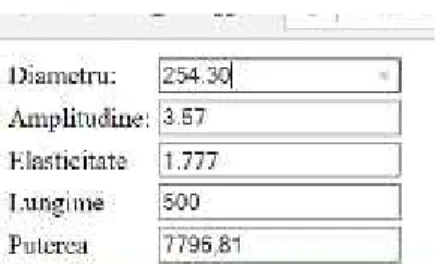
Modifying these values was based on a software, see Figure 9 (this study will be presented in a subsequent paper).
Fig. 9: Entering diameter values into the software
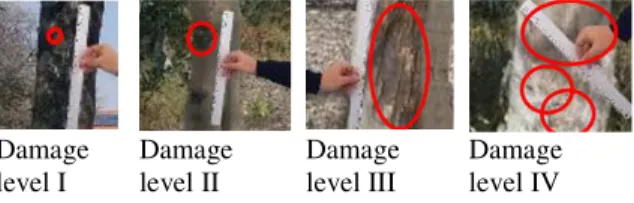
Similar to step one, we weighed the olives after each shaking operation, and checked for visible damage (Table 2, Figure 10), and all values were consolidated in the data base (Table 3).
Table 2 Tree trunk damage key
Visible damage on tree trunk
Degree of damage (intensity)
I II III IV
0-25% 25-50% 50-75% 75-100% Inexistent
of minor marks
Visible marks of small dimens ion (max 10 cm)
Very large marks (max 40 cm)
Damage level I Damage level II Damage level III Damage level IV
Fig. 10: Trunk damage levels
Table 3 Consolidation of values from area B after shaking
operations O li v e tr ee D ia m et er o f tr u n k at 5 0 cm fr o m g ro u n d F o rc e (N m /s ) A m p li tu d e (m m ) F al le n o li v es (K g ) D am ag ed tr u n k
1 172,21 2.048,57 4,47 24.57 0% 2 173,11 2.084,51 4,44 27.27 7% 3 174,23 2.120,86 4,42 20.18 29% ... ... ... ... ... ... 48 220,16 5.066,22 4,13 26.40 44% 49 220,20 5.078,31 4,13 27.19 22% 50 220,31 5.098,47 4,13 25.58 0% ... ... ... ... ... ... 95 250,65 7.434,23 3,63 26.59 18% 96 252,98 7.614,08 3,59 23.33 45% 97 254,30 7.796,81 3,57 17.92 38%
3. RESULTS AND DISCUSSIONS
We noted that amplitude varied, namely the larger the tree diameter, the lower the amplitude, and vice versa – with a smaller diameter, amplitude was higher (Figure 11).
Fig. 11: Variation of amplitude depending on diameter
We also noted a variation of shaking force, namely the larger the diameter, the higher the
necessary force is, while with a smaller diameter, less force is necessary (Figure 12).
Fig. 12: Variation of force depending on diameter
In order to determine the efficiency of separating olives from the tree, we compared the two systems, specifically the regular system (option A, no robotic elements) versus the robotic system (option B, with integrated robotic elements).
In option A we found the tree bark was damaged. This damage is based mainly on the force and amplitude that were too high for the diameter of the tree, as shown in Table 2. We did not note a direct connection between diameter and damage level to the tree bark.
In option B we found a much lower level of damage to the tree trunk compared to option B, as shown in Table 3. This decrease is based mainly on adjusting the force and amplitude to the diameter of the trunk. We did not find a direct connection between tree diameter and bark damage in this case either.
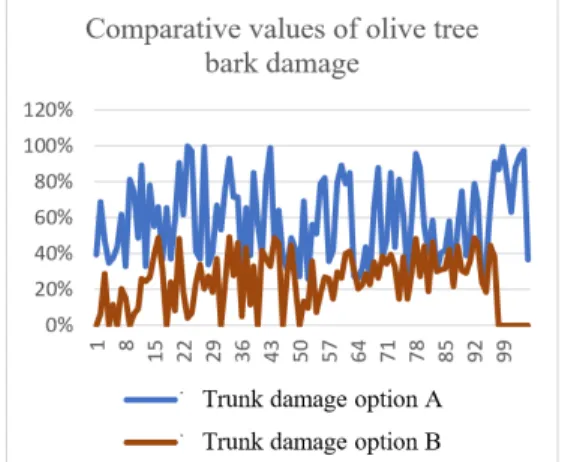
We consolidated all values, in order to determine exact causes of damage to the trees, as shown in Table 4 and Figure 13.
Table 4 Comparative values of olive tree bark damage
Damag e level
Option A Option B Total number of damage d trees Percentag e of damaged trees Total number of damage d trees Percentag e of damaged trees
I 0 0.00% 42 43.30%
II 40 37.14% 55 56.70%
0 .0 5 0 .0 8 5 0 .1 2 0 .1 5 5 0 .1 9 0 .2 2 5 0 .2 6 0 .2 9 5 0 .3 3 0 .3 6 5 0 .4 0 .4 3 5 0 .4 7 0 2 4 6 8 10 12 14 16
D- Diameter (m)
A -A m p li tu d e ( m m )
Variation of amplitude depending on diameter 0 .0 5 0 .0 8 8 0 .1 2 6 0 .1 6 4 0 .2 0 2 0 .2 4 0 .2 7 8 0 .3 1 6 0 .3 5 4 0 .3 9 2 0 .4 3 0 .4 6 8 0.00 10,000.00 20,000.00 30,000.00 40,000.00 50,000.00 60,000.00 70,000.00 Diameter (m) P o w e r ( N m / s )
III 33 31.43% 0 0.00%
IV 32 30.48% 0 0.00%
4. CONCLUSIONS
In option A, of the total 105 olive trees, none were included in the first damage group (no visible damage, minor damage), 40 trees were included in group II (visible small damage), 33 were included in group III, and 32 in group IV (large damage to the tree bark).
However, with option B (including the robotic elements), values were significantly improved, with none of the olive trees being damaged at level III or IV.
Fig. 13: Trunk damage during olive harvesting
With both options, the total number of harvested olives was similar, without being influenced by amplitude and shaking force adjustments (Figure 14).
Fig. 15: Olive separation from tree with both options
Thus, we determined a connection between the trunk diameter, the required shaking force, and damage to the tree trunk in the contact area. 6. REFERENCES
[1]. Babanatis Merce, R.M., Babanatsas, T.,
Maris, S., Tucu, D., Ghergan, O. C.. Study of an automatic olives sorting system. Actual tasks on agricultural engineering, proceedings. Book Series: Actual Tasks on Agricultural Engineering, vol 46, Zagreb, 485-490, 2018.
[2]. Agronews. Online Greek Agricultural
Magazine. Retrieved on December 27, 2018 at https://www.agronews.gr/el/171971/to-viologiko-ehei-mellon/
[3]. Ghaffariyan, M., Brown, M.. Selecting the
efficient harvesting method using multiple criteria analysis: A case study in south-west Western Australia. Journal of Forest Science. 59, 2013.
[4]. Babanatsas, T., Glavan, D.O., Babanatis
Merce, R.M., Maris, S.. Modelling in 3D the olive trees cultures in order to establish the forces (interval) needed for automatic harvesting. IOP Conference Series:
Materials Science and Engineering,
International Conference on Applied
Sciences, vol 294, Hunedoara, Romania, 2018.
[5]. Mnerie, D., Tucu, D., Anghel, G. V. ,
Slavici, T.. Study about integration capacity of systems for agro-food production. Actual
tasks on agricultural engineering,
proceedings. Book Series: Actual Tasks on Agricultural Engineering, vol. 36, Zagreb, 617-622, 2008.
[6]. Bechar, A., Vigneault, C. Agricultural
robots for field operations: Concept and component. Biosystem Engineering Vol. 149. 94-111, 2016.
[7]. Ward, G. New mechanical and robotic
harvesting tehnologie increase fruit production efficency. Horticulural Australia Ltd. Australia 2003
[8]. Tucu, D., Golimba, A.-G., Mnerie, D..
engineering, proceedings. Book Series: Actual Tasks on Agricultural Engineering, vol 38, Zagreb, 447-454, 2010.
[9]. Covaciu, F.. Actuation and control of a
serial robotic arm with four degrees of freedom,Acta Technica Napocensis, Series: Applied Mathematics, Mechanics and Engineering, Vol. 61, Issue III, September 2018, pp. 347-356.
[10]. Stefanidis, G. P., Tsibliaris, D. Study of
olive detache system. University of Patras. Patra, Greece, 2015
[11]. Castro-García, S., Blanco-Roldán, G. L.,
Gil-Ribes, J.. Table olive orchards for trunk shaker harvesting. Biosyst. Eng. Vol. 129, 388–395, 2015.
[12]. Fodor, R., S., Arghir, M.. The muscular
answer of the human body in a vibrational
environment, Acta Technica Napocensis, Series: Applied Mathematics, Mechanics and Engineering, Vol. 57, Issue I, March 2017, pp. 77-82.
[13]. Teutan, E., Rafa, V.. Analysis and fuzzy
simulation of a pump with eccentric for natural gases odorized, Acta Technica Napocensis, Series: Applied Mathematics, Mechanics and Engineering, Vol. 61, Issue I, March 2018, pp. 55-60.
[14]. Munteanu, L., Brişan, C., Chiroiu, V.,
Ioan, R.. Strain amplitude dependent
internal friction and the young’s modulus defect in damaged solids, Acta Technica Napocensis, Series: Applied Mathematics, Mechanics and Engineering, Vol. 60, Issue IV, November 2017, pp. 485-490.
STUDIU EXPERIMENTAL PRIVIND REDUCEREA DETERIORĂRI MASLINUL LA
RECOLTAREA MECANIZATĂ
Rezumat:În această lucrare am realizat un studiu experimental asupra determinării elementelor care deteriorează trunchiul măslinului la recoltarea mecanizată a măslinelor. Pentru acest studiu am folosit un stand experimental care poate modifica valoarea puterii de scuturare precum și valoarea amplitudinii în funcție de diametrul trunchiului. Astfel am reușit să optimizăm puterea ceea ce a dus la reducere a deteriorării trunchiului, în zona de contact cu dispozitivul de scuturare.
Theoharis BABANATSAS, As. drd. Eng., “Aurel Vlaicu” University Arad, Faculty of Engineering, Department of Automation, Industrial engineering, Textile production and Transport, E-mail:
[email protected], Phone: 0257-283010.
Roxana Mihaela BABANATIS-MERCE, As. drd. Eng., “Aurel Vlaicu” University Arad, Faculty of Engineering, Department of Automation, Industrial engineering, Textile production and Transport, E-mail: [email protected], Phone: 0257-283010.
Dan Ovidiu GLAVAN, Cof. dr. Eng., “Aurel Vlaicu” University Arad, Faculty of Engineering, Department of Automation, Industrial engineering, Textile production and Transport, E-mail: [email protected], Phone: 0257-283010.

![Fig. 2: Olive tree orchard divided in two area First, we measured the diameter of all olive tree trunks in the two areas, at 50 cm from the ground (contact area between shaking equipment and tree) [4], as in Figure 3](https://thumb-us.123doks.com/thumbv2/123dok_us/7995712.2120256/2.918.99.423.228.428/orchard-divided-measured-diameter-contact-shaking-equipment-figure.webp)