Dr Pratima Thakur et al JMSCR Volume 07 Issue 08 August 2019 Page 574
To Study the effect of altitude, route of administration and age on pain
response to vaccination at birth
Authors
Dr Pratima Thakur
1*, Dr Pancham Kumar
2, Dr Rakesh Sharma
2, Dr Banita Negi
31
Department of Paediatrics SLBSGMCH Nerchowk
2
Department of Paediatrics Indira Gandhi Medical College, Shimla,
3
Deprtment of Paediatrics RPGMC Tanda *Corresponding Author
Dr Pratima Thakur
Senior Resident, Department of paediatrics SLBSGMCH, Nerchowk, Mandi, HP., India Abstract
Background and Aims: Neonatal pain has been under diagnosed and undertreated since forever and
misconceptions regarding neonatal pain is the main reason behind it. Healthy neonates usually experience pain during the first week of life due to several medical procedures such as procedures such as blood sampling, immunization, vitamin K injection, or circumcision. Vaccination is one of the most painful procedures in infants and is the most common source of pain in childhood.
Methods: We observed 400 neonates receiving routine dose of BCG and Hepatitis B vaccine given at birth. Pain was assessed on NIPS scale 30 second after first injection and 30 seconds after second injection. The two injections were given 2 minutes apart.
Results: On comparing the combined score for Hepatitis B and BCG in neonates with age < 24 hours was
12.35±5.07 and in neonates of >24hours mean score after vaccination was 12.84±4.63. The p value was 0.189, which was not significant. The combined mean nips score after Hepatitis B plus BCG injection in neontes residing at altitudes of <999m, 1000-1999m, >2000m was 12.35±4.78, 12.58±4.74, 12.61±5.18 respectively, with a p value of 0.968.Pain during the intramuscular route of injection was significantly higher than intradermal with a mean NIPS score of 8.47±3.09 vs 3.8±2.45 (table 4) and P value of <0.0001, indicating that intramuscular route of vaccination is more painful than intradermal route.
Conclusion: there was no significant effect age in hours and altitude on pain perceived due to vaccination given at
birth in the neontes. Pain perceived was more on intermuscular route of vaccination than on intradermal route.
Keywords: Vaccination, Neonatal Infant Pain Scale Score, Neonate, Pain, BCG Vaccine, Hepatitis B Vaccine,
altitude, age, route of administration.
Introduction
Healthy neonates usually experience pain during the first week of life due to several medical procedures such as procedures such as blood sampling, immunization, vitamin K injection, or circumcision. Vaccination is one of the most painful procedures in infants and is the most common source of pain in childhood(1).
Dr Pratima Thakur et al JMSCR Volume 07 Issue 08 August 2019 Page 575 immediate effects include syncope,(4) fear,
irritability, sleep disorder, and a reduction in nutrition. Its short-term effects include a delay in wound healing, a change in immunity system function, endocrine and biochemical changes, increased cortisol and catecholamine release, increased glucagon, growth hormone, rennin, aldosterone, and antidiuretic hormones, and decreased insulin secretion. They also include physiological changes such as apnea, bradycardia, skin color changes, sweating palms, tachycardia, hypertension, increased respiration rate and muscular tonicity, increased intracranial pressure and oxygen intake, and behavioural changes including fretting, crying, etc.(5,6) Long-term effects of vaccination are delayed development and having different responses to similar painful experiences, long-term effects on neurotransmitters and endocrinal systems, as well as long-term complications on brain development and fear of future injections(7,8).
The purpose of this study is to help to understand the factors that affect the response to pain in neontes. Thus, better understanding of the factors effecting acute response to pain will help in devising methods to reduce pain in neontes. Less painful methods for vaccination will reduce the stress among the children and their parents. Intense anxiety experienced by parents and their children regarding vaccination may result in non-adherence to the recommended vaccination schedule. Thus, devising a less painful and less stressful route and method for vaccine administration may help in improving the compliance to vaccination(9).
Aims and Objective
To study the effect of altitude, age in hours and mode of administration of vaccine on acute pain response to vaccination given at birth
Material and Methods
The study was conducted at Kamla Nehru State Hospital for Mother and child, a unit of Department of Paediatrics at Indira Gandhi
medical College, Shimla. It was a hospital based observational cross-section study.
Inclusion Criteria
1. All full-term healthy neonates receiving BCG and Hepatitis B vaccination at birth.
2. Parents consenting to include their newborns in the study.
Exclusion Criteria
1. Sick newborns and newborn on any supportive care
2. Preterm and IUGR newborn
Dr Pratima Thakur et al JMSCR Volume 07 Issue 08 August 2019 Page 576 (SPSS) version 21.0. Statistical analysis of the
data was done to find the difference in pain intensity on NIPS scale. Categorical variables were presented in number and percentage (%) and continuous variables were presented as mean ± SD and median. Normality of data was tested by Kolmogorov-Smirnov test. If the normality was rejected then non parametric test was used. Qualitative variables were correlated using Chi-Square test /Fisher’s exact test. A p value of <0.05 was considered statistically significant.
Results
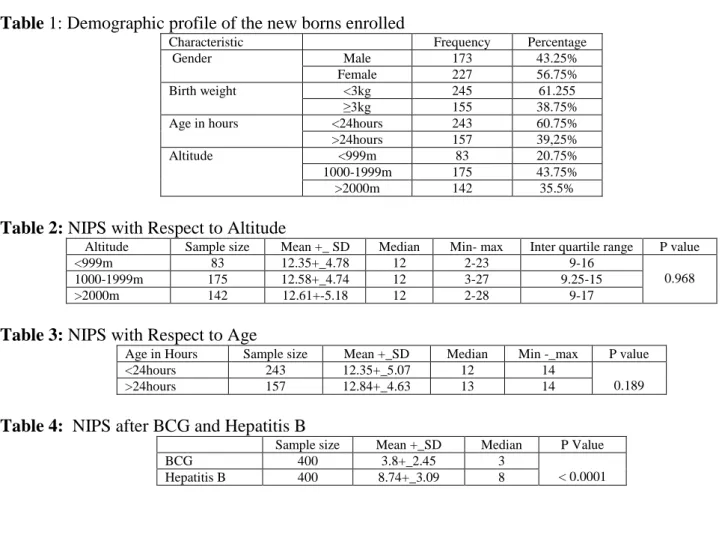
In our study total of 400 healthy term neontes fulfilling the inclusion criteria were enrolled, who received the routine dose of BCG and Hepatitis B vaccine at birth. Of all the neontes taken for the study, 243 neontes were vaccinated at age less than 24 hours and 157 neontes were vaccinated at age more than 24 hours. On comparing the combined score for Hepatitis B and BCG in neonates with age < 24 hours was 12.35±5.07 and
in neonates of >24hours mean score after vaccination was 12.84±4.63. The p value was 0.189 (Table 2). The p value obtained is not significant. Thus, age in hours at the time of vaccination does not affect the pain experienced by the neonates.
Altitude: there were 83 neontes belonging to altitude <999m, 175 belonging to altitude 1000-1999m and 145 belonging to altitude of more than 2000m. The combined mean nips score after Hepatitis B plus BCG injection in neontes residing at altitudes of <999m, 1000-1999m, >2000m was 12.35±4.78, 12.58±4.74, 12.61±5.18 respectively, with a p value of 0.968 (Table 3). The p value is not significant. Thus, the altitudes to which the neonates belonged did not have an effect on the pain perceived by them.
Route of vaccination: Pain during the intramuscul-ar route of injection was significantly higher than intradermal with a mean NIPS score of 8.47±3.09 vs 3.8±2.45 (table 4) and P value of <0.0001.
Table 1: Demographic profile of the new borns enrolled
Characteristic Frequency Percentage
Gender Male 173 43.25%
Female 227 56.75%
Birth weight <3kg 245 61.255
≥3kg 155 38.75%
Age in hours <24hours 243 60.75%
>24hours 157 39,25%
Altitude <999m 83 20.75%
1000-1999m 175 43.75%
>2000m 142 35.5%
Table 2: NIPS with Respect to Altitude
Altitude Sample size Mean +_ SD Median Min- max Inter quartile range P value
<999m 83 12.35+_4.78 12 2-23 9-16
0.968
1000-1999m 175 12.58+_4.74 12 3-27 9.25-15
>2000m 142 12.61+-5.18 12 2-28 9-17
Table 3: NIPS with Respect to Age
Age in Hours Sample size Mean +_SD Median Min -_max P value
<24hours 243 12.35+_5.07 12 14
0.189
>24hours 157 12.84+_4.63 13 14
Table 4: NIPS after BCG and Hepatitis B
Sample size Mean +_SD Median P Value
BCG 400 3.8+_2.45 3
< 0.0001
Dr Pratima Thakur et al JMSCR Volume 07 Issue 08 August 2019 Page 577 Discussion
This study conducted at Kamla Nehru State Hospital of Mother And Child, Branch of Indra Gandhi Medical College, Shimla describes the effect of age in hours, altitude and mode of administration of vaccine on acute pain response vaccination given at birth. When the pain response to vaccination was compared in the neontes hailing from different altitudes, the NIPS score was 12.35±4.78, 12.58±4.74, 12.61±5.18 in neontes belonging to altitudes <999m, 1000-1999m and >2000m respectively. The p value was 0.968, which was not significant. The NIPS score for the infants at the end of vaccination procedure with age <24hours at the time of vaccination was 12.35±5.07, whereas the NIPS score for those with age >24hours the time of vaccination was 12.84±4.62, with p value of 0.189, which was not significant. Thus, pain due to vaccination was not affected by the age in hours of life at which the neonates received the vaccination. Our findings were in collaboration with Pragya Pathak and Raman Kalia et al.,(12) who studied the “Effect of Needle Gauge on Perception of Pain Intensity Among Infants Receiving D.P.T and concluded that there is no significant difference in behavioural response to pain among infants up to 24 weeks age.
All the infants are given BCG vaccine and Hepatitis B vaccine according to immunisation program. Of the two vaccines, BCG is given by intradermal route and Hepatitis B is given by intramuscular route. Also, the NIPS score after receiving BCG was 3.38±2.01 and after Hepatitis B vaccine 7.16±2.23, with a p value of <0.0001 which is statistically significant. Thus, the pain experienced by the neontes was less on BCG vaccine compared to Hepatitis B vaccine. Since BCG is given by intradermal route and Hepatitis B is given by intramuscular route, it may be concluded that intradermal route is less painful than intramuscular route of vaccination. The difference to the pain perceived by the neonates in two groups may be due to the fact that the route of administration of the two vaccines is different.
The difference may also be attributed to the fact that composition of the two vaccines is different and the needle used for the two vaccines is of different calibre. Our findings were in concordance with Minoo Sharma et al(13) who suggested that pain was more in intramuscular route as compared to intradermal route in neontes. Also, our findings are in agreement with evacignacco et al(14), who did multi centric study from four European neonatal intensive care units, intensity of pain for 27 common neonatal procedures was calculated using visual analogue scale and found that range of pain intensity was more for intramuscular as compared to heel prick. Thus, intramuscular route of injection is more painful procedure than heel prick method. Although, the pain assessment scale used by them is different so the results of their study may not be comparable to ours.
Conclusion
There was no effect of age in hours, altitude on pain perceived due to vaccination in the neontes. Hepatitis was found more painful then BCG indicating that intermuscular route of vaccination is more painful then intradermal route.
Limitations:
In our study only intramuscular and intradermal routes of vaccination were studied. Other routes like subcutaneous and intravenous and intradermal routes could not be studied. So, there is a need to do further extensive studies in this field for better understanding.
Source of support: nil
References
Dr Pratima Thakur et al JMSCR Volume 07 Issue 08 August 2019 Page 578 2. World health organisation. World health
assembly endorses new plan to increase global access to vaccine [press release]. Geneva: world health organisation; [May25, 2014]. Available from; hptt://ww.who.int/immunisation/newsroo m/press/who_endorses_gvap/en.Accessed July14, 2014.
3. World Health Organization. World health assembly endorses new plan to increase global access to vaccines [press release]. Geneva: World Health Organization; [May 25, 2012].
4. Cohen LL, Maclaren JE, Demore M, Fortson B, Friedman A, Lim CS, et al. A randomized controlled trial of vapocoolant for pediatric immunization distress relief. Clin J Pain. 2009;25:490–4
5. Clifford Gevirtz MD, MPH, Anne Haddad. Topics in Pain Management Current Concepts and Treatment Strategies. Pain Management. 2008;23:1–12.
6. Bilgen H, Ozek E, Cebeci D, Ors R. Comparison of sucrose, expressed breast milk, and breastfeeding on the neonatal response to heal prick. J Pain. 2001;2:301– 5.
7. Ramponi D. Reducing pain in pediatric procedures in the emergency department. J Emerg Dep. 2009;35:379–82.
8. Harrison D. Oral sucrose for pain management in the paediatric emergency department; A review. Australas Emerg Nurs J. 2008;11:72–9.
9. Jay S Invasive medical procedures: psychological intervention and assessment. Routh Ded. Handbook of paediatric psychology New York, NY Guilford Press1998;410- 425.
10.Indian Academy of Paediatrics Committee on Immunization (IAPCOI). Consensus recommendations on immunization, 2008. Indian Pediatr.2008 Aug; 45(8) :635–48.
11.Centres for disease control and prevention; Pink book; vaccine administration 2015;6;79 – 106.
12.Pathak P, Kalia R, Bharti B.Effect of needle gauge on perception of pain intensity among infants receiving D.P.T.vaccination. Nursing and Midwifery Research Journal 2007; 3(4):172-78. 13.Sharma M, Bhardwaj P, Singh B,
Ahluwalia K. Assessment of pain intensity and its persistence following common needle prick procedures in newborns. Int J Clin Exp Physiol2014;1:226-8
14.Cignacco E, Hamers JP, Stoffel L, van Lingen RA, Schütz N, Müller R, et al.