IC, 2019 – 15(2): 99-113 – Online ISSN: 1697-9818 – Print ISSN: 2014-3214 https://doi.org/10.3926/ic.1361
Analysis of some economic-financial ratios to analyse the
financial crisis in five-star hotels in Barcelona and Madrid
Laia Pié , Isaac Bonillo , Judit Barcelo , Laura Fabregat-Aibar Universitat Rovira i Virgili (Spain)
[email protected], [email protected], [email protected], [email protected]
Received September, 2018 Accepted April, 2019
Abstract
Purpose: Analyse some of the financial ratios to see the impact of the economic crisis on 5-star hotels in Spain.
Design/methodology: The information needed to write this article was taken from the Iberian Balance Sheet Analysis System (SABI), the Hotel Occupancy Survey published periodically by the National Statistics Institute, the IDESCAT and the official websites of the hotels analysed.
Findings: The results obtained show how the financial crisis did not have a direct impact on luxury hotels, but on the contrary, they continue to increase their success thanks to the best continuous strategies. One test is the luxury hotels that were created in Barcelona and Madrid between 2008 and 2011. The work shows that it does not take into account for a hotel chain to have more than one luxury hotel in the same city, since one both of them may end up showing financial losses. It is also found that it is important to determine the number of rooms that the hotel must have in order to avoid construction costs and to have the maximum efficiency.
Research limitations/implications: The study has the problem of not updating the SABI database. In some cases, the information has not been updated since 1990.
Practical implications: The result that luxury hotels can cover the fixed assets coefficient with their equity. At the same time, it supports the importance of making a better forecast of the number of rooms in order to help them have a better financing.
Social implications: It supports the importance of a single luxury hotel in the same hotel chain in the same city and of making good strategic planning in order to improve the results of financial ratios.
Originality/value: The article helps explain how the tourist model in Spain has changed since the beginning of the financial crisis.
Keywords: Economic-financial analysis, Ratios, Luxury tourism
Jel Codes: G01, G30, G32, M10, Z30, Z32
To cite this article:
1. Introduction
One of the main countries in the world with a great potential for tourism is Spain, as much for the high number of visitors it receives as for the income this activity generates. The Tourist Studies Institute (IET) reported that Spain was the destination for 56.7 million international tourists in 2017, a 12.4% increase with respect to the previous year. Furthermore, tourist spending was 82 million euros, an 8.9% interannual increase.
In 2017, tourism accounted for approximately 16% of the GDP in Spain and generated a gross income of 171,500 million euros according to data from the CaixaBank Research report. Despite the Brexit, from the United Kingdom, almost 18 million tourists arrived, increasing by 7.7% compared to 2016, according to Frontur data. This is in no way a new concept, given that tourism has been tightly linked with the economic development of the country since the 1960s.
Nowadays, the autonomous communities that receive most of this tourism are first the Catalonia (18,233,294), followed in order by Balearic Islands (13,691,618), Canary Islands (12,957,334), Andalusia (11,024,038), the Community of Valencia (8,517,973) and the Community of Madrid (6,218,732). The tourists that spend most, however, originate from the United Kingdom, Germany and France, although in recent years the spending of tourists from Russia, northern European countries and Latin America has been as high. Despite the Brexit, from the United Kingdom, almost 18 million tourists arrived, increasing by 7.7% compared to 2016, according to Frontur data. Tourism has increased its average daily expenditure by 4.4% compared to 2016, which translates into a daily average cost of 137 euros per tourist.
For many years, the tourist model in Spain was principally based on international tourism whose requirements were mainly sun and sea. Nowadays, however, be it due to the financial crisis or simply because this model has become increasingly changeable, there is a demand for tourism where not only can one sunbathe, but one can also enjoy the local culture and gastronomy offered by the autonomous community being visited.
The year 2017 has served the country to consolidate itself as a second world power in reference to tourist destinations, only surpassed by France (82.6 million tourists and 67.2 million inhabitants). Great world powers such as the United States (75.6 million tourists and 323 million inhabitants) have been overtaken by the Spanish tourist offer. This increase in tourism in Spain has been partly due to the geopolitical instability of countries such as Egypt, Tunisia and Turkey.
Furthermore, if we analyse tourism we can see that in Spain luxury tourism sales for 2017 closed at 4,500 million euros, 25% up on 2016, according to data from the World Tourism Organization, a mighty figure that contrasts heavily with the general decrease in consumption at 2012 in response to the financial crisis. This increase, however, has been mainly due to the rise in this type of tourism, especially in the cities of Barcelona and Madrid. This type of tourist has enormous purchasing power and continues to travel for pleasure despite the crisis, disbursing a huge amount of money.
The principal characteristic of this tourist flow is that they are a loyal and consistent type of client who wants to be offered high quality and exclusive services. The profile of the luxury tourist is a trained professional who speaks foreign languages and is highly knowledgeable about the place they are visiting. They want a personalised, planned stay with a great offer of exclusive and unique services, what we could call a custom-made trip. The last thing a client of this type takes into consideration when planning a trip is the amount of money it will cost him to experience unique moments that are not within everyone reach. There are two kinds of clients within this category of tourist: those who are looking for new experiences on their trip and those who are repeating a trip that surpassed their expectations. For Spain, this expansion of the luxury tourism offer has brought about the appearance of new experiences and products that are specific to this field. When we talk about unique experiences we can highlight luxury hotels, private tours, private jets, exclusive transport services and personal shoppers, excursions to wineries and a 24-hour personal service, among others.
section 4 we describe the methodology we have used and we carry out the empirical application. Last, we draw our conclusions.
2. Review of the literature and empirical evidence
2.1. Hotel law
The different types of tourist accommodation include hotels, tourist lodgings, campsites, apartments, holiday cities, youth hostels, residences, and so on. However, despite there being different types of tourist establishments, the basic element of the overall offer are hotels, because the hotel sector ‘includes all the establishments that habitually and professionally work to provide people with accommodation in return for payment, with or without supplementary services’. (Mestres, 1999).
The autonomous communities are currently exclusively responsible for regulating matters related to tourism in their territories. Until 5th February 2010 the Royal Decree 1634/1983 of 15 June, which established the classification regulations for hotel establishments on a national level, was in force, even though several autonomous communities already had their own regulations. Thus, we refer to Law 13/2002 of 21 June on tourism in Catalonia to know what hotel establishment is understood to mean and what the minimum requirements for 5-star hotels in Barcelona are.
In article 40 of Law 13/2002 of 21 June on tourism in Catalonia hotels are defined as ‘establishments that provide tourists with temporary accommodation services in accommodation units, either as a single establishment or as a business unit with the corresponding tourist services’, which always includes daily cleaning. These tourist dwellings are categorised by article 33 of Decree 183/2010 of 23 November on tourist accommodation establishments in the first group of hotel establishments, along with hotel-apartments and health spas. Hotels are understood to be ‘hotel establishments that provide accommodation services in accommodation units and which are open 24 hours a day, irrespective of whether supplementary services are available or not’. (Article 41.4 of Law 13/2002 of 21 June on tourism in Catalonia, modified by Law 9/2011 of 29) December on promoting economic activity. These establishments can be classified into seven categories: one star, two stars, three stars, four stars, four stars superior, five stars and grand luxury. (Article 34.2 of Decree 183/2010 of 23 November on tourist accommodation establishments.)
Hotel establishments in the Community of Madrid, on the other hand, are regulated by Decree 159/2003 of 10 July through the Hotel Establishment Ordinance of the Community of Madrid. This decree defines hotels as ‘commercial establishments open to the public which offer tourist accommodation with or without dining facilities and other supplementary services and occupy an entire building or an independent part of one, with their spaces forming an homogenous whole, with entrances, lifts and stairs that are for exclusive use and comply with the minimum technical requirements established by this decree. Thus, establishments comprised of two or more buildings integrated in suitably independent facilities can be called hotels’. (Article 3 of Decree 183/2010 of 23 November on tourist accommodation establishments.)
2.2. Review of the literature
If we analyse the literature, we can see that in this case only exist little contributions who analyse with ratios the economic-financial situation in five stars hotels. For instance, Tsai, Pan and Lee (2011) there is little literature dealing with the luxury hotel sector from a perspective of the financial management. We only find the study of Min, Minb, Jong Joocand and Kiml (2009), which is applied in Korea and the principal aim is to evaluate the financial efficiency of the hotels in front of their competitors, this is a way to identify possible sources of inefficiency and to provide useful information to continuous improvement, and consequently, to avoid the business failure.
the three different periods of an economy, specifically, 1990-92, 1996-98 and 2002-04. Therefore, this study aims to understand how affect the economic/financial changes of the hotel industry.
There are, however, some papers that analyse the hotel sector, such as Sánchez, Campa, Travé and Comas (2007), who proposed a method of analysis of the economic and financial performance of hotel companies in Catalonia. They also determined the economic and financial statements and other management indicators of Catalan hotel companies and establishments, in accordance with established types, focusing the study on Catalonia. Campa (2005) also applied the uniform system known as System of Accounts for the Lodging Industry to different hotel companies. Our object of study, however, is quite different from those mentioned here.
This article has a dual objective. First, know the financial statements of five-star hotels in Barcelona and Madrid by analysing some economic-financial ratios and second to analyse the economic impact of the last few years on five-star hotels that belong to the same hotel chain, be they in the same city or in each of the two cities analysed. We also focus on hotels in the two cities that do not belong to the same hotel chain but have approximately the same number of rooms. The period analysed is 2008-2011, selected because the aim was to analyse how this type of tourism evolved at the peak of the financial crisis.
3. Hotel establishments
There are three groups of establishments in the Community of Madrid and hotels are categorised in the first. They can be one star, two stars, three stars, four stars, five stars or grand luxury, depending on the characteristics of the hotel.
An analysis of Figure 1 shows that the four-star category of hotels had the most irregular occupancy rates over the four years, even though their results were favourable. Regarding the rest of the hotel categories, it must be pointed out that in general terms three and five-star hotels increased the number of tourists they accommodated. On the other hand, numbers decreased for one and two-star hotels. In short, we can say that between 2008 – the year the financial crisis began – and 2011 tourism in Spain increased for the three highest hotel categories. We could put forward different hypotheses to explain this, such as that tourism in Spain is cheaper than in the rest of Europe or that four-star hotels offer similar services to five-star hotels at cheaper rates.
3.1. Five-star hotels
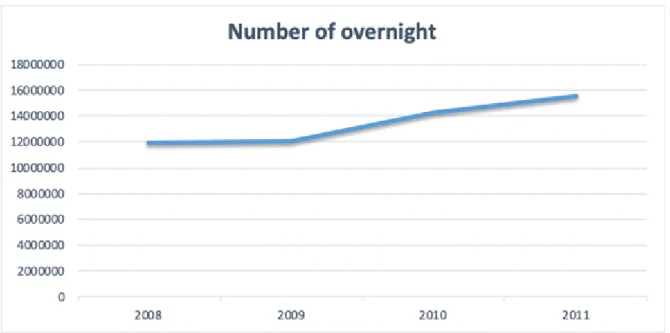
Five-star hotels have lately modified their services to cater for the needs of their guests, raising the quality of these services and innovating with exclusive and unique ones. This has meant that the number of overnight stays has increased in the hotels with these characteristics, as shown in Figure 2.
Figure 2. Number of overnight stays in five-star hotels. (Compiled by authors from INE databases)
The graph above shows how the number of overnight stays in five-star hotels evolved over the period 2008-2011. As can be seen, the evolution was regular with 11,955,425 overnight stays in 2008 and 12,073,726, 14,243,609 and 15,552,178 overnight stays in the years 2009, 2010 and 2011 respectively. It is interesting to see how five-star hotels managed the crisis, increasing their overnight stays compared with previous years, given that these are establishments that are not within everybody’s reach and the number of guests is more specific (Cristina Martín, executive director of the Spanish Association of Luxury, assured that the sector would continue to grow in 2012 despite the crisis).
This growth in overnight stays is due to five-star hotels having adapted to meet the new needs of the market. Luxury tourism is a sector that has recently been growing companies offer different promotional packages to attract guests or to create company loyalty. The chain hotel NH, which inaugurated two luxury hotels in Barcelona in 2011, is an example of this adaptation to new market requirements. It is also interesting to note that since seeing these financial results some lower category hotels have decided to progressively increase their category as a marketing strategy (Hosteltur.com. Hotels: Hotel reforms: Marconfort Beach Club Hotel in Torremolinos (Malaga) has been upgraded from three to four stars. 16th February 2012 [Free entry] http://www.hosteltur.com/165450_marconfort-beach-club-hotel-aumenta-categoria.html).
Regarding the cities in question, Barcelona has 25 luxury hotels that offer their clients a great number of services and unique, varied experiences to satisfy their every desire. The alternatives offered by the city of Barcelona have a common denominator: to ensure that quality prevails over quantity.
The profile of the guests that make use of luxury tourism in Barcelona are generally those that have previously visited the city and wish to discover its most luxurious, privileged spots. The experiences and services the city offers can be provided by expert guides or well-known architects willing to give guided tours of the city to discover the best gastronomy and wine, attend exclusive events, rent luxury vehicles and even be assisted personally in the most exclusive clothes shops.
Madrid has attracted increasing numbers of luxury tourists is the number of shops that offer their clients an exclusive, personalised service.
It is important to note the increase of the hotel price index. The biggest increase was in the 2-star hotels with 3.9%, followed by 3-star hotels with 3.8%, those with 1-star with 3.7%, those of 4 stars with 3.5% and yet, the 5-star hotels have only increased by 1.1%. This means an average income of € 175.5 for 5-5-star hotels, € 89 for 4-star hotels and € 63.9 for 3-4-star hotels. The Autonomous Communities that have increased their prices the most were Madrid (5%), Canarias (3.3%), Catalonia (3%) and Andalucía (0.8%). Tourist destinations such as the Balearic Islands have worked with lower increments in order to see their tourist demand augmented.
Catalonia is the region of Spain that has received the most tourists, reaching 18,223,294 tourists thanks to all the cultural heritage that can be seen in its tourism offer. In second place the regions most visited by tourism have been the Balearic Islands and the Canary Islands for their sunny weather throughout the year. We are struck by the fact that Andalucía has such a low tourism reception due to its territorial extension and its great availability of beach areas. The low numbers of tourists that show the northern regions of Spain, show us that the national tourist demand prefers sunny and warm areas where coastal tourism abounds instead of mountain tourism that is accompanied by areas of less warm temperatures.
3.2. Evolution of the concept of tourism in Spain
Tourism is being considerably influenced by the technological advances of recent years. With the emergence of new technologies, new companies born in the digital sphere have appeared, which have radically transformed part of the sector's value chain. This impact is especially high in the initial phase of the purchase cycle. In addition, in the medium term, advances in the "Internet of things", mobile robotics and artificial intelligence have the potential to further revolutionize the sector. Digitization has also given greater visibility and accessibility to the economy of collaborative consumption or sharing, an aspect that is having a special impact on the tourism sector, enriching the range of goods and services available in the market.
The sector has clear opportunities for long-term growth that it can take advantage of. It is, by its nature, a sector of the future, since the proportion of spending that households spend on tourism usually grows with their level of income. The emerging countries, therefore, will most likely constitute a growing source of tourist flows, as we begin to see with China. On the other hand, the aging of the European population and of other advanced economies drives a very attractive demand, since they tend to be people with relatively high incomes and who travel outside periods of maximum tourist influx. The challenges, however, are not few: the sector must adapt to a changing demand in the future, must achieve coordination with other sectors of economic activity and, to prioritize investment in infrastructure, legislation must be adapted so that they can develop, in an orderly fashion, the new business models that were born or can be born with the new technologies.
3.3. Evolution of five-star hotels in Barcelona and Madrid
The number of five-star hotels in both the cities analysed (Barcelona and Madrid) increased between 2008 and 2010, as shown in Figure 3. The year when the quantitative difference was greatest was 2008 and Barcelona had less hotels of the category analysed than Madrid. In 2009 the number of hotels in Barcelona rose to 22, closing the gap on Madrid, which had 23.
Figure 3. Hotels available in the cities of Barcelona and Madrid. (INE database and websites of the cities of Barcelona and Madrid)
4. Research design
4.1. Methodology and description of the sample
The information needed to write this article was taken from the Iberian Balance Sheet Analysis System (SABI), the Hotel Occupancy Survey published periodically by the National Statistics Institute, the IDESCAT and the official websites of the hotels analysed.
The SABI is a database containing the financial information of over 1,200,000 Spanish and more than 350,000 Portuguese companies. However, it is important to point out that one of the most serious limitations of this database is that the information on some of the companies of not up-to-date enough and at best corresponds to the year 2005.
The Hotel Occupancy Survey is one of the main statistical sources to measure tourist activity (Previous to 1998, the Hotel Occupancy Survey was called the Survey of Travellers’ Movements in Hotel Establishments.). It analyses data about the travellers, the number of overnight stays and average stays distributed according to the permanent residence or autonomous community of the travellers, in addition to the category of hotel in which they stayed. The number of establishments available, the limited places and other information is also analysed. The main aim of the survey is to know the behaviour of a series of variables that allows us to describe the fundamental characteristics of the hotel sector: travellers, number of overnight stays and bed occupancy rates. Every month the IDESCAT adds the results for Catalonia - which are separated by hotel category and destination brand- to the INE data. (For the first time, in January 2011 disaggregated information was disseminated in the main countries and autonomous communities of origin and included data since January 2007. The data published from January 2006 onwards cannot be directly compared with the data published up to December 2005. Therefore, some link coefficients have been used to calculate the interannual variation rates as they allow data for the different years to be compared).
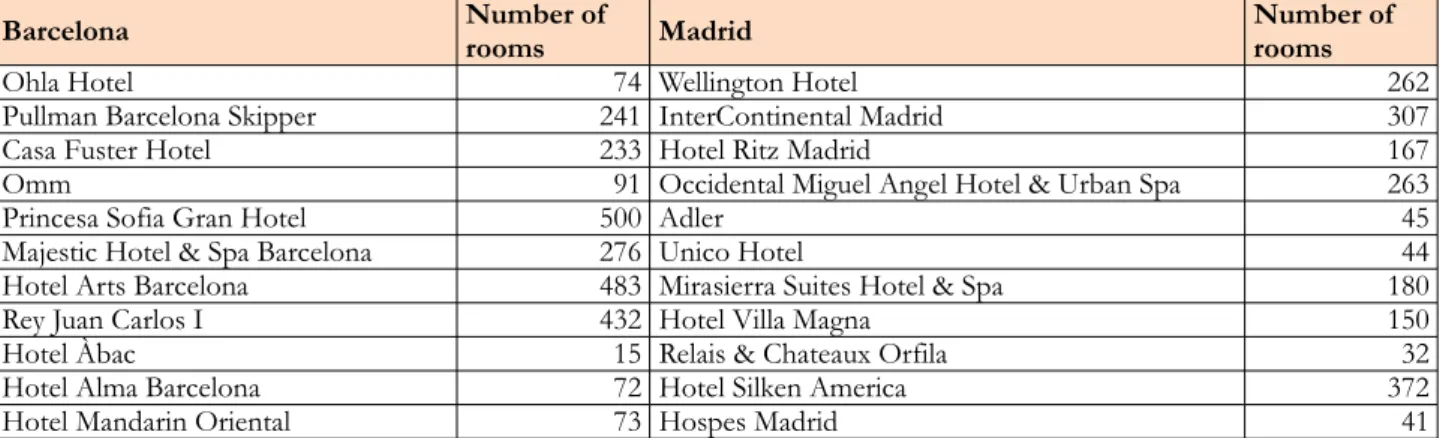
Barcelona Number of rooms Madrid Number of rooms
Ohla Hotel 74 Wellington Hotel 262
Pullman Barcelona Skipper 241 InterContinental Madrid 307
Casa Fuster Hotel 233 Hotel Ritz Madrid 167
Omm 91 Occidental Miguel Angel Hotel & Urban Spa 263
Princesa Sofia Gran Hotel 500 Adler 45
Majestic Hotel & Spa Barcelona 276 Unico Hotel 44 Hotel Arts Barcelona 483 Mirasierra Suites Hotel & Spa 180
Rey Juan Carlos I 432 Hotel Villa Magna 150
Hotel Àbac 15 Relais & Chateaux Orfila 32
Hotel Alma Barcelona 72 Hotel Silken America 372
Hotel Mandarin Oriental 73 Hospes Madrid 41
Table 1. Hotels in Barcelona and Madrid that are not related to hotel chains
Hotel chain Barcelona Number of rooms Madrid Number of rooms
Eurostars Eurostars Grand Marina 273 Eurostars Madrid Tower 474 Eurostars BCN Design 65
Melià ME by Melia Barcelona 259 Melià Madrid Princesa 274 Melià Barcelona 333 Gran Melià Fènix 214
Meliá Castilla 915
Hilton Hotel Hilton Diagonal Mar
Barcelona 433 Hilton Madrid Airport 284
Hotel Barcelona Hilton 289
Derbyhotelscollection Hotel Bagués 31 Urban 102
Hotel Claris 120 Villa Real Hotel 115
Husa Hotels Miramar 75
Hotel Palace 12
Gran Hotel La Florida 70
Hesperia Hesperia Tower Hotel 280 Hesperia Madrid 139 NH Palacio De Tepa 85 Starwood W Barcelona 473 The Westin Palace, Madrid 467
Le Meridien 233
AC AC Santo Mauro, Autograph
Collection 50
AC Palacio Del Retiro, Autograph
Collection 50
Table 2. Hotels in the same hotel chain in Barcelona and Madrid
The following aspects were taken into consideration when selecting the hotels to be analysed. First, that the information provided by the annual accounts did not refer to the group of companies the establishment belonged to and second, that the relevant information was available up to at least the year 2010.
To observe different situations of the statements of five-star hotels during the period 2008-2010 we decided to examine four different hypotheses. First, we analysed the some economic-financial ratios of the five-star hotels in the same hotel chain in Barcelona. Second, we studied the some economic-financial ratios of the five-star hotels in the same hotel chain in Madrid. We also analysed the some economic-financial ratios of five-star hotels in the same hotel chain in Barcelona and Madrid. Finally, we evaluated the some economic-financial ratios of the five-star hotels with approximately the same number of rooms in the two cities.
There was more than one hotel chain with two hotels in Madrid, but the chain selected for analysis was Derbyhotelscollection because it provided us with the most up-to-date information. For the same reason, this chain was also used to analyse the hotels located in the two cities in question.
The main reason why we believed it was interesting to study two hotels with approximately the same number of rooms was because they have a similar structure and so we could see if the number of rooms was an important factor that could affect the results. The hotels selected for this analysis from the tables above were Hotel Hilton Barcelona and Wellington Hotel in Madrid with 289 and 262 rooms respectively.
The analysis of the financial statements using the ratios selected allowed us to see how the situation of the hotels evolved during the periods in question and to determine whether it is viable for hotel chains to have two hotels in the same city or if it is better to have them in each of the two cities. We also studied whether the financial situations of five-star hotels with approximately the same number of rooms were similar. Ratio is understood to be the quotient between two selected values, such that they have a meaning to study the situation (Amat & Campa, 2011). In other words, it is the result of dividing two financial statements to be able to understand the financial situation of companies, which in this case are five-star hotels. Depending on the information sought, different types of ratios can be used. In this study we only use those that are obtained by dividing part or all of the assets that make up the balance sheet and which provide us with the most information about the economic-financial situation of the company.
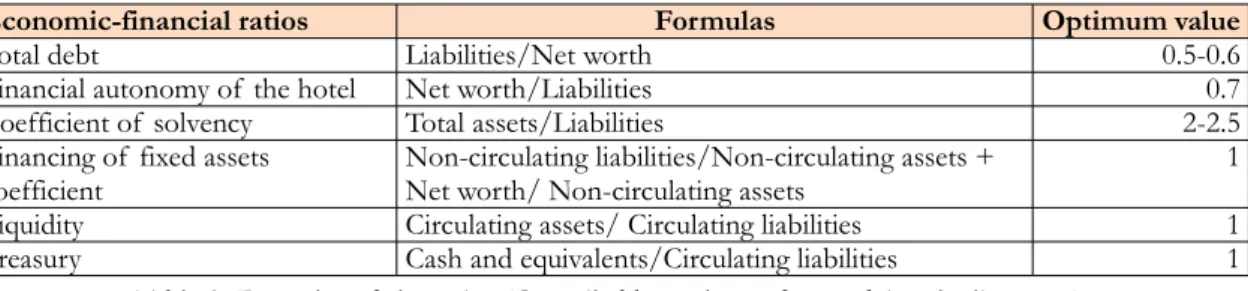
To be able to draw conclusions within a context and to see the evolution over the course of a year, we calculated the ratios for the years 2008, 2009 and 2010. Table 3 shows the ratios we have used to analyse the financial situation of the hotels.
Economic-financial ratios Formulas Optimum value
Total debt Liabilities/Net worth 0.5-0.6
Financial autonomy of the hotel Net worth/Liabilities 0.7 Coefficient of solvency Total assets/Liabilities 2-2.5 Financing of fixed assets
coefficient Non-circulating liabilities/Non-circulating assets + Net worth/ Non-circulating assets 1 Liquidity Circulating assets/ Circulating liabilities 1 Treasury Cash and equivalents/Circulating liabilities 1
Table 3. Formulas of the ratios (Compiled by authors after studying the literature)
The first block refers to the hotel’s debt. The financial autonomy of the company and the debt ratio provide us with information about the company’s level of risk regarding meeting its obligations, the intensity of its debt and its financial autonomy.
A high debt ratio is bad for the company as it means that accessing external financial sources to cover its debts will be difficult. On the other hand, if the result is low it means that the company has no risk in covering its debts. Furthermore, the higher the financial autonomy ratio result, the more advantageous it is for the company as it means that it has enough autonomy to cover its obligations.
The solvency coefficient specifically tells us whether the company’s total assets are enough to cover its liabilities. If the result for this coefficient is less than 1 we can say that the company is in technical failure because its total assets are not enough to cover its debts. If the result, however, is between 2 and 2.5, the company is financially solvent.
The second block refers to the analysis of the financing of the fixed assets, which gives us information about the relationship between the company’s equity and its fixed assets. A result higher than 1 tells us that there are permanent resources in the company to make new investments and to grow competitively, while a result lower than 1 indicates the opposite.
4.2. Empirical analysis
4.2.1. Five-star hotels in the same hotel chain in Barcelona
The following table shows the results of the different ratios for the Hotel Hilton Barcelona Diagonal and the Hotel Hilton Barcelona, which both belong to the Hilton hotel chain.
The first thing we notice upon analysing the results is that the debt ratio of the Hotel Hilton Barcelona Diagonal went from 10.51 to -2.11. This downturn is surprising because over the years in question its liabilities increased. Looking at the balance sheet, we can deduce that this situation is explained by the decrease in equity. In other words, the company met its debts with its net worth.
Economic-financial ratios Hotel Hilton BarcelonaDiagonal Hotel Hilton Barcelona
Years 2010 2009 2008 2010 2009 2008
Total debt
Liabilities/Net worth -2.11 -3.31 10.51 0.39 0.37 0.75
Financial autonomy of the hotel
Net worth/Liabilities -0.47 -0.30 0.09 2.59 2.7 0.75
Solvency coefficient
Total assets/Liabilities 0.53 0.70 1.09 3.6 3.7 2.32
Financing of fixed assets coefficient
Non-circulating liabilities/circulating assets + Net worth/ Non-circulating assets
-1.5 2.18 0.46 1.39 1.31 1.06
Liquidity
Circulating assets/ Circulating liabilities 0.43 0.59 0.71 2.56 2.31 1.15
Treasury
Cash and equivalents/Circulating liabilities
0.42 0.57 Not
available 2.54 2.3 1.15
Table 4. Results of the some economic-financial ratios
On the other hand, from 2008 onwards The Hotel Hilton Barcelona showed it was a good debt for the company, as it was always below the optimum value. The result of this ratio is explained by the company’s progressively decreasing circulating liabilities.
Regarding financial autonomy, the Hotel Hilton Barcelona had enormous autonomy that increased over the years in question, while from 2008 onwards the financial autonomy of the Hotel Hilton Barcelona Diagonal decreased to the point where in 2010 it was below the optimum value, indicating that with its profits the company’s net worth would not be enough to meet its obligations.
Regarding the solvency coefficient, the Hotel Hilton Barcelona was in a favourable situation, obtaining a result that was above the optimum value. On the other hand, the Hotel Hilton Barcelona Diagonal was below the unit, so its assets could not cover its liabilities. We can see, however, that the financing of the fixed assets increased for the two hotels, apart from in 2010 when there was a marked decrease for the Hotel Hilton Barcelona Diagonal. This downturn indicates that the establishment could not cover its fixed assets with the net worth of the hotel. Last, we see two different situations for the ratios of liquidity and treasury. While the Hotel Hilton Barcelona Diagonal remained below the optimum value without being able to meet its short-term debts, the Hotel Hilton Barcelona could meet its debts because the result of their ratios was above the optimum value. To conclude this analysis, it must be highlighted that even though the two hotels belong to the same hotel chain the results are opposing.
was improving. In summary, we can say that it is not viable for the Hilton Company to have two hotels in the same city, as there is no positive equilibrium in their economic-financial statements.
4.2.2. Five-star hotels in the same hotel chain in Madrid
Table 5 shows the results of the ratios used to analyse the financial statements of the Hotel Urban and the Hotel Villa Real in Madrid, which belong to the Derbyhotelscollection hotel chain.
Economic-financial ratios Hotel Urban Hotel Villa Real
Years 2010 2009 2008 2010 2009 2008
Total debt
Liabilities/Net worth 11.41 26.84 22.526 0.19 0.23 0.16
Financial autonomy of the hotel
Net worth/Liabilities 0.08 0.04 -0.002 5.13 4.33 6.44
Solvency coefficient
Total assets/Liabilities 1.09 1.04 1 6.13 5.33 7.91
Financing of fixed assets coefficient
Non-circulating liabilities/circulating assets + Net worth/ Non-circulating assets
0.28 0.53 0 1.38 1.42 1.41
Liquidity
Circulating assets/ Circulating liabilities 0.82 0.85 0.81 3.95 5.08 5.13
Treasury
Cash and equivalents/Circulating liabilities
0.81 0.84 0.81 3.88 5 5.04
Table 5. Results of the some economic-financial ratios
A first glance at the results of this table tells us that the two hotels in question have totally heterogenous economic-financial statements. If we focus our attention in the situation of the Hotel Villa Real, we could see a debt and a financial positive autonomy. First, we must say that the hotel was below the optimum value and so it had very good financial autonomy, which meant it could meet its debts because its net worth was much higher than its liabilities.
The solvency coefficients of these hotels were also opposing. The economic solvency of the Villa Real was above the optimum value, so the company was in a stable and favourable situation. The solvency coefficient of the Hotel Urban, on the other hand, progressively increased over the period to reach 1.09 in 2010. Despite not being a negative result, it was a situation that needed to be kept a close eye on.
Regarding the results of the ratios of financing of fixed assets, liquidity and treasury we can see a similarly opposing situation. The Hotel Urban was below the optimum value; even in 2008 it had no financing of fixed assets. The Hotel Villa Real, on the other hand, had good results that were above the optimum value and so it could meet its debt with its net worth and its circulating assets.
Therefore, these two hotels from the same hotel chain had totally opposing financial statements. The Hotel Villa Real had a favourable balance situation, but the Hotel Urban was almost under the optimal values. These bad results could be attributed to the renovations the hotel underwent and so the situation needs to be reanalysed some years from now to see if it has improved, because as the results show the establishment was managing to reduce its financial debt.
4.2.3. Five-star hotels from the same hotel chain in Barcelona and Madrid
The following table shows the results obtained when we calculated the corresponding ratios to know the financial statements of the Hotel Bagues in Barcelona and the Hotel Villa Real in Madrid.
Economic-financial ratios Hotel Villa Real(Madrid) Hotel Bagues(Barcelona)
Years 2010 2009 2010 2009
Total debt
Liabilities/Net worth 0.19 0.23 0.48 0.56
Financial autonomy of the hotel
Net worth/Liabilities 5.13 4.33 2.08 1.80
Solvency coefficient
Total assets/Liabilities 6.13 5.33 3.08 2.80
Financing of fixed assets coefficient
Non-circulating liabilities/Non-circulating assets + Net worth/ Non-circulating assets
1.38 1.42 1.61 1.64
Liquidity
Circulating assets/ Circulating liabilities 3.95 5.08 5.36 6.42
Treasury
Cash and equivalents/Circulating liabilities 3.88 5 2.59 3.17
Table 6. Results for the some economic-financial ratios
Before commenting on the ratios individually, we can state that the results obtained show that the hotels analysed were in a favourable situation. If we focus on each ratio, regarding debt the two establishments had positive results, which even decreased with respect to the previous year. Thus, both hotels had financial autonomy, which was above the optimal value. It must be pointed out that the hotel in Madrid had much better results than the hotel in Barcelona because its net worth was much higher.
The solvency coefficients of the two establishments demonstrate that they had more assets than liabilities and so they could access external financial sources because they had enough assets to meet their obligations. The financing of fixed assets coefficients also show that the hotels were in a good position because both had enough permanent resources to invest in company growth. The two ratios that provide us with information on the liquidity of the company show that even though the hotels were down slightly on the previous year, they remained above the optimal values. Thus, they could meet their short-term debts with their circulating assets. Consequently, the results of the ratios of the two hotels that belong to the same chain but are in the two different cities analysed show that they both had optimal financial statements. All their results were favourable for the company. We can therefore conclude that for the Derbyhotelscollection chain having these establishments in the different cities analysed is profitable.
4.2.4. Five-star hotels with a similar number of rooms in Barcelona and Madrid
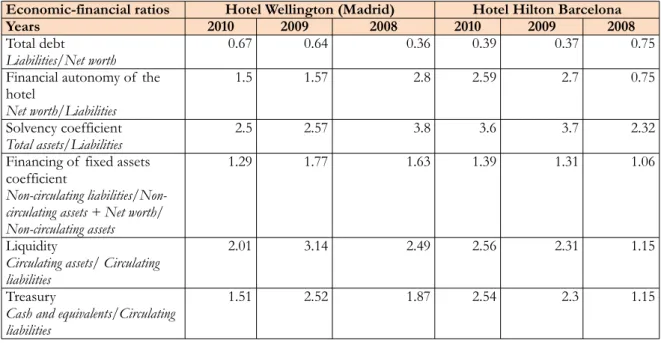
The following table shows the results obtained when calculating the corresponding ratios to know the financial statements of the Hotel Wellington in Madrid and the Hotel Hilton in Barcelona. A first glance tells us that the hotels had similar results, which makes us think that the number of rooms puts five-star hotels in similar financial situations.
If we analyse the ratios individually, we find that the debt ratio was positive for the two establishments because it was within the parameters of the optimal value. It must be said, however, that even though they were in positive situations, the Hotel Wellington increased its debt during the period analysed, while the Hotel Hilton’s debt reduced.
Economic-financial ratios Hotel Wellington (Madrid) Hotel Hilton Barcelona
Years 2010 2009 2008 2010 2009 2008
Total debt
Liabilities/Net worth 0.67 0.64 0.36 0.39 0.37 0.75
Financial autonomy of the hotel
Net worth/Liabilities
1.5 1.57 2.8 2.59 2.7 0.75
Solvency coefficient
Total assets/Liabilities 2.5 2.57 3.8 3.6 3.7 2.32
Financing of fixed assets coefficient
Non-circulating liabilities/Non-circulating assets + Net worth/ Non-circulating assets
1.29 1.77 1.63 1.39 1.31 1.06
Liquidity
Circulating assets/ Circulating liabilities
2.01 3.14 2.49 2.56 2.31 1.15
Treasury
Cash and equivalents/Circulating liabilities
1.51 2.52 1.87 2.54 2.3 1.15
Table 7. Results of the some economic-financial ratios
The financing of fixed assets coefficient of the two establishments was entirely covered by their equity. Thus, the two hotels could invest to make their business grow.
The liquidity and treasury ratios of the hotels, which tell us the extent to which the circulating assets can cover the circulating liabilities, show that both establishments had favourable results to cover their short-term debts. The analysis of the two hotels reveals that their financial statements were positive, even though the hotel in Madrid was trending downwards and the hotel in Barcelona was trending upwards compared to previous years. Finally, we can attribute these results to the fact that the number of rooms is a factor that influences the company’s financial situation and as such hotels that are starting out should make better forecasts of the number of rooms to be built in relation to the number of guests they are aiming to attract.
5. Discussion
Despite the consequences of the financial crisis, the luxury tourism flow in Spain is slightly up on previous years. These results can be attributed to the fact that luxury establishments have incorporated offering new products and services into their marketing strategies with the aim of attracting new clients and gaining the loyalty of existing ones. The main reason for this business change is the huge amount of money luxury tourism brings to this country. As we could read in the introduction, nowadays the situation of this sector is in constantly increasing due to these strategies.
Five-star hotels have weathered the crisis by adapting their offer to the requirements of the tourist market. A clear example is the increase in the number of establishments of this type in the two cities under study between 2008 and 2011. However, being a five-star hotel and adapting to the new requirements of the market is by no means a guarantee of success as it is also important for hotel chains to strategically distribute their establishments.
Taking the above consideration into account, it is worth pointing out that the analytical focus used in this paper has provided us with a set of results that help us to understand the economic-financial situations of these hotels. First, we can say that it is not profitable to have more than one five-star hotel from the same hotel chain in either Barcelona or Madrid. The results obtained show a clear heterogeneity towards these hotels. While one of the hotels stood out for its good results in the ratios used, with a favourable and sustainable financial statement, the other indicated quite the opposite, finding itself in critical circumstances in some cases.
company. We can attribute this situation to the fact that each hotel has a series of exclusive products and services designed to promote all the possibilities that each city offers to attract tourists’ attention.
Regarding the last hypothesis examined in this paper, we can say that the number of rooms an establishment has influences its financial statement. Therefore, it is important that before deciding on the number of rooms an establishment will have, an approximate forecast of the demand is made because an excess of rooms in these hotels represents significant construction and maintenance costs.
It must be pointed out that we came across certain limitations in the process of writing this article. The SABI database did not provide up-to-date information on all the companies. Some of them had not published their results since the 1990s and, in some cases, we found ourselves with capital assets that were not available.
Finally, this article can help to explain how the tourist model in Spain has changed since the onset of the financial crisis. It is therefore an important study as it helps us to define and put into practice the right resources policies to guarantee that the Spanish tourism sector develops much more efficiently.
Declaration of Conflicting Interests
The authors declared no potential conflicts of interest with respect to the research, authorship, and/or publication of this article.
Funding
The authors received no financial support for the research, authorship, and/or publication of this article.
References
Amat, O., & Campa, F. (2011). Contabilidad, control de gestión y finanzas de hoteles. Barcelona: Profit, ISBN: 978-84-92956-63-0.
Campa, F. (2005). La Contabilidad de gestión en la Industria Hotelera: Estudio Sobre su implantación en las cadenas hoteleras en España. Doctoral Thesis, Rovira i Virgili University. Department of Business Management, Reus.
Devesa, M., & Esteban, L. (2011). Spanish hotel industry: Indebtedness determinants. Applied Economics, 43(28), 4227-4238. https://doi.org/10.1080/00036846.2010.491446
Hotel occupation survey (INE). Available in: http://www.ine.es
Hosteltur.com. Hotels: Reformes hoteleres: Marconfort Beach Club Hotel, situat a Torremolinos (Màlaga) ha augmentat de categoria passant de 3 a 4 estrelles. Available in: http://www.hosteltur.com/165450_marconfort-beach-club-hotel-aumenta-categoria.html (Last access date: February 16th, 2012)
IDESCAT. Available in: http://www.IDESCAT.es
IET. Available in: http://estadisticas.tourspain.es/en-EN/Paginas/default.aspx
Jang, S., Tang, C-H., & Chen, M. (2008). Financing behaviors of hotel companies. International Journal of Hospitality Management, 27(3), 478-487. https://doi.org/10.1016/j.ijhm.2007.08.010
Mestres Soler, J.R. (1999). Técnicas de Gestión y Dirección Hotelera (2nd ed) (pp. 1). Barcelona: Ediciones Gestión
2000.
Min, H., Minb, H., Jong Joocand, S., & Kiml, J. (2009). Evaluating the financial performances of Korean luxury hotels using data envelopment analysis. The Service Industries Journal, 29(6), 835-845.
https://doi.org/10.1080/02642060902749393
Pacheco, L., & Tavares, F. (2017). Capital structure determinants of hospitality sector SMEs. Tourism Economics, 23(1), 113-132. https://doi.org/10.5367/te.2015.0501
SABI. Available in: http://sabi.bvdep.com/version2012322
Serrasqueiro, Z., & Nunes, P. (2014). Financing behavior of Portuguese SMEs in hotel industry. International Journal of Hospitality Management, 43, 98-107. https://doi.org/10.1016/j.ijhm.2014.09.001
Tsai, H., Pan, S., & Lee, J. (2011). Recent research in hospitality financial management. International Journal of Contemporary Hospitality Management, 23(7), 941-971. https://doi.org/10.1108/09596111111167542
World Tourism Organization. Available in: http://www2.unwto.org/es
Intangible Capital, 2019 (www.intangiblecapital.org)