TECHNICAL UNIVERSITY OF CLUJ-NAPOCA
ACTA TECHNICA NAPOCENSIS
Series: Applied Mathematics, Mechanics, and Engineering Vol. 63, Issue II, June, 2020
CONTRIBUTIONS REGARDING THE MODELING, DESIGN AND COST
OF A VIBRATION DAMPING DEVICE IN THE HAND-ARM SYSTEM
Aurora Felicia CRISTEA, Marga GHIŞA (FĂGĂDAR)
Abstract: The paper aims to present a way of approaching the design of a vibration attenuation device, vibrations transmitted from an excitation source, usually the machine-tool to the hand-arm system. This study includes a simplify mechanical model, but also an estimation calculation of such an attenuator, in case of commercialization of it.
Key words: Attenuator design, vibration. 1. INTRODUCTION
From the specialized literature [3], [4] it is known that the mechanical vibrations transmitted to the human body, in the present work hand-arm system, produce in time, professional affections.
The present paper aims to theoretically and by design a device for the hand-arm system that will minimize the effect of vibrations transmitted from excitation sources. Thus, the paper will be divided on three study topics, one regarding the realization and simulation of a theoretical model of the arm-arm system with / without attenuator, another topic will include the design with SolidEdge of a vibration attenuator, which is intended to be mounted in parallel with the forearm and the estimated cost of such a device, in case of its commercialization. It is also known that, the human hand-arm system is a system with a high degree of complexity, non-homogeneous, continuous, with viscous-elastic properties in muscles, bones and skin. The dynamic characteristics from the perspective of the analysis of the biomechanical model require the identification of the mechanical, visco - elastic and inertia properties of the model, under typical operating conditions. In the movement of the human arm there are many factors that refer to its behavior, these factors are classified as follows: The instantaneous position of a vibrating system, at any moment of movement, can bedetermined by a multitude of dynamic independent or coordinated parameters called and degrees of dynamic freedom.
In the following, some simplifications will be addressed, in order to make a study of the hand-arm model.
2. MODELLING
The mathematical model leads to the dynamic equilibrium equations of the vibrating model. In order to simplify the real dynamic model hand-arm, this being a model with distributed masses, it will be transformed into a system with concentrated masses where m1 represents the mass of the hand, m2 is the mass of the forearm, and m3 the mass of the arm, each mass is considered concentrated in the center of mass of the analyzed element. The wrist joint is neglected because the hand is positioned on the excitation source (machine - tool), during which a certain operation (e.g. turning) is performed, the human operator having the elbow bent at 90°, and the rotation shoulder is considered in this study by 0°. The forces of weight of the anatomical elements are neglected: hand (m1), forearm (m2) and arm (m3), which act in the center of the masses, the explanation is that they are balanced by the static arrow in the arc.
. (1)
Matrices have dimensions (4x4), and the excitation matrix {F} is dimension (4x1). {W} represents the vector matrix of the generalized coordinates of the motion, having the dimension (4x1) and for which the transposed matrix is
, , , .
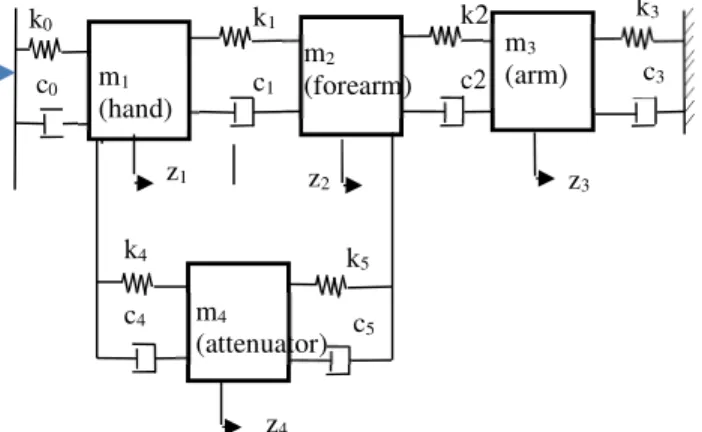
It is considered a linear mechanical model with four degrees of freedom, representing the hand-arm system and having no cylindrical joint at the wrist, elbow and shoulder. The four degrees of freedom are given by z1 moving mass m1 (hand), z2 moving mass m2 (forearm), z3 moving mass m3 (arm) and z4 moving mass m4 (vibration attenuator). The Ozh direction of vibration transmission is taken according to the anatomical coordinate system given by the specialized literature and by ISO 5349/2003 [4]. The system is driven by a disruptive forced signal of harmonic form given by z and it is taken from the machine - tool.
The visco-elastic characteristics are taken from the literature [1]. The dampers in the attenuating device component are considered to move in the direction of Ozh chosen, and for the sake of simplification of the calculations, concentrated mass systems have been taken in the center of mass and the damping and elasticity constants c4 = c5 = c and k4 = k5 = k. The system of equations that characterize the mechanical model presented in figure 1 is given by the relation:
! "# ! $ #%& ! $
0
(2)
0
2 2 0
The unknowns of the system given by the relation (2) are the accelerations which will then be integrated twice times (Runge Kutta method of order 4) resulting finally, velocities and displacements specific to each mass of the assembly in figure 1.
2.1 Integration of the system of differential equations corresponding to the linear hand-arm system with the vibration attenuator mounted on the forearm
For the system of equations given by 2 after an integration and then a double integration, the velocities and displacements corresponding to the generalized coordinates of the movement z1 (for the hand), z2 (for the forearm), z3 (for the arm) and z4 (for the vibration attenuator) are obtained. and for a machine speed of 1000 RPM.
Fig. 2 Solutions for integrating of the differential system of equations to the hand-arm system with the vibration
attenuator fitted to it, for the frequency f = 16.66 Hz (n = 1000 RPM).
0 0.2 0.4 0.6 0.8 1 1.2 1.4 1.6 1.8 2
-0.015 -0.01 -0.005 0 0.005 0.01 0.015
0.02 viteza z1deplasarea z1
viteza z2 deplasarea z2 viteza z3 deplasarea z3 viteza z4 deplasarea z4
Fig. 1 Linear mechanical system of the hand-arm assembly with four degrees of freedom and with the
vibration attenuator mounted on the forearm (between the imaginary wrist and elbow).
k1 c1 k0
c0
k2 c2
k4 c4
k5
c5
z1 z2 z3
z4
k3
c3 m3
(arm) m2
(forearm) m1
(hand)
m4 (attenuator)
V
el
o
v
it
y
[
m
/s
,
D
is
p
la
ce
m
en
t
[m
]
Time [s]
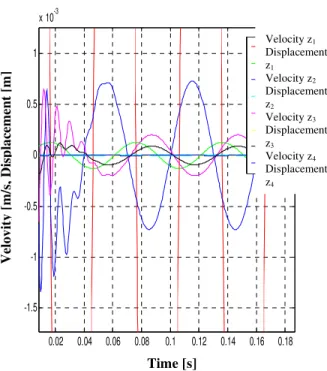
Fig. 3 Solutions for integrating of the differential system of equations to the system hand-arm having the vibration
attenuator fitted to it, for all the studied frequencies, increased by 200%.
From the point of view, regarding the study of the movement, we are only interested in the displacements and it is observed that for the studied rotation of the machine - tool these have small values for all the generalized coordinates taken in the study (Fig. 2 and Fig. 3), the largest corresponding to the mass m4 namely z4
(mechanical vibration attenuator) in the 0.5 x 10 -3 scale. It is observed that, the smallest
displacements were obtained for z2 and z3, respectively forearm and arm, which theoretically justifies the use of a vibration attenuator mounted on the forearm.
3. DESIGN OF THE VIBRATION ATTENUASTOR FOR THE CHOICE OF MATERIALS, INTERIOR AND EXTERNAL DIMENSIONS
For the design of a vibration attenuating device, it started from the fact that, it fulfills the role of reducing the transmitted vibrations as best as possible, it can be mounted on the forearm, like the mathematical model, not to exceed the mass of 0.5 Kg and not have an acceptable marketing cost. The designed vibration attenuation device, which includes the vibration attenuator (s), will consist of:
- (1) rubber sleeve (mounted on the hand), - (2) screw (the one on the sleeve),
- (3) plate - OL 50 (which is connected to the sleeve),
- (4) OL 50 pins (2 pcs., they connect the sleeve plate),
- (5) ACE shock absorber (marketed) following the constructive characteristics to be fulfilled in the design of the attenuating device,
- (6) OL 50 extension (symbolized graphically by a transparent tube),
- (7) OL 50 handle (the one that holds the hand).
Fig. 4 Vibration attenuator views regarding their construction (ACE company).
The following will presents how the vibration attenuation device was designed in SolidEdge and how it will be mounted on the hand. Two situations were analyzed: when a single ACE vibration dumping (Fig.5) and two ACE dumping mounted in series and in parallel were installed (Fig. 6, 7) in the attenuation.
Fig. 5 Vibration attenuation device having only one vibration attenuator fitted.
a.
0.02 0.04 0.06 0.08 0.1 0.12 0.14 0.16 0.18
-1.5 -1 -0.5 0 0.5 1
x 10-3
viteza z1 deplasarea z1 viteza z2 deplasarea z2 viteza z3 deplasarea z3 viteza z4 deplasarea z4
V
el
o
v
it
y
[
m
/s
,
D
is
p
la
ce
m
en
t
[m
]
Time [s]
Velocity z1
Displacement z1
Velocity z2
Displacement z2
Velocity z3
Displacement z3
Velocity z4
b. Fig. 6
a. Vibration attenuation device with vibration dumping (2 pieces) mounted in parallel. b. Vibration attenuation device with vibration
dumping (2 pieces) mounted in series.
3. ESTIMATED MARKETING COST
3.1. Estimation of the production price
The literature [5] shows that a market instrument and an essential indicator of the economic-social reality the market price represents "an amount of currency that the buyer is willing and can offer to the producer in exchange for the good he can offer." In any economic system, regarding the price there are points of view with apparently diametrically opposed interests, namely: of the producer and of the consumer. Thus, as a producer, a price is requested, if is possible as high as realisable, as it could bring a higher profit, but it must be accepted by the consumer and as a result cannot exceed his possibilities. As a consumer, the price is the amount you are willing to offer for a good or service, depending on the value you give to the offer.
The objectives of pricing: prices must cover all costs, prices will not exceed those demanded by close competitors, prices will be set in such a way as to discourage the entry of new companies into the market and prices must ensure a return on investment, not less than x percent.
3.1.1 Factors that influence the size and dynamics of the price
Although, since the end of the last century, unique negotiable prices are set for sale for all
buyers, the price remains one of the important variables, which any manufacturer uses in the marketing activity.
Price fulfills its role as a marketing tool only under conditions in which, in orientation of its level, harmoniously combines the conditions of production with those of the market. Therefore, in determining the price that will be asked by the buyer, the manufacturer must take into account the influence of a number of factors, both internal and external.
3.1.2 Internal factors determining the price
These are the factors that the company can handle in its interest, although the margins are limited due to the nature of the activity carried out and the markets on which the product will appear, essential for the company being the way it defines its business, determining what it produces and what market it sells.
The price index expresses the evolution of prices and is calculated by comparing the price levels in two distinct periods. The following calculation relationship is currently used:
Ip = p1/p0 (3) in which:
IP represents the price index.
p1 represents the price in the current period. p0 represents the price in the basic period. From the point of view of the concrete method of calculation, we distinguish:
· Fixed base indices
· Indexes with the chain base.
A wide range of international price indices is frequently used worldwide, which is differentiated according to:
· The type of prices on the basis of which they were determined.
· The number of products included in the same group.
· The period for which they were calculated, etc. Estimated prices for materials 2019-2020.
Table 1 Nr. Components Estimate Price 1 Steel E 295 - thickness of 10
mm, 1 m2 (1 m2 = 4 pieces plates, respectively 2 pieces no. 1 and 2, pieces no. 3, according to the project)
400 RON (100 RON / 1pc .)
2 ACE vibration attenuators 420 RON / piece (variant 1 of assembly) 3 Transparent plastic tube 8 RON / piece
4 Screws and rivets (4 pcs + 4 pcs.)
24 RON (3 RON / pcs) 5 Natural or synthetic rubber 5
euro / m2, 10 mm thick film (4 collars = 60 x 4 = 240 mm), results in 10,000 mm2 x 5/240 mm
0.32 Ron (~ 0.08 RON / piece x 4)
6 extension Steel E 295,
d = 15, l = 1 ml 1 ml = 12 RON
3.2Real determination of the total price, estimated by product (vibration attenuation device for the hand-arm system)
Table 2 Nr. Components Estimate Price 1 plate steel E 295 -1 pcs. 100 RON 2 plate steel E 295 - 1 pcs. 100 RON 3 ACE vibration attenuator 1
pcs. = 420 RON (variant 1 of assembly) or ACE vibration attenuator 2 pcs.
840 RON
(variant 2 of assembly)
4 clear plastic tube 1 pcs. 8 RON
5 natural rubber foil type, 240 mm
0.08 RON
6 screws and screws 2 x 2 pcs. 12 RON
7 steel E 295 extension cord 1 pcs.
0.008 RON
8 Construction and assembly work
100
RON/product
Table 3 Total price
- Price - variant 1 - (mitigation device which includes an ACE vibration attenuator)
740,088 RON / pcs.
- Price - variant 2 - (mitigation device that includes two ACE vibration attenuators)
1160,088 RON / pcs.
3.2.1 Disadvantages of the estimated real price
The product made (vibration attenuation device) is quite expensive in terms of materials, the solution to lower the price could be the actual production of vibration dampers, because these components are most valued in the attenuator device created with a high weight 52 % (variant 1 of assembly (with one attenuator) and 30% variant 2 of assembly (with two attenuators)).
3.2.2 The advantages of the product realized
The only protective measures for the transmission of mechanical vibrations in the vibrational work environment in humans are gloves, this device at least theoretically has shown that the installation on the hand-arm system produces a reduction of the vibrations transmitted along the arm by up to 70%. This minimization has a beneficial effect on the health status of people exposed to high vibrations in the workplace (e.g. miners, foresters, road workers, etc.).
In addition, this device does not diminish the dexterity of handling devices used in the workplace, especially the fingers.
4. CONCLUSIONS
5. BIBLIOGRAFIE
[1] Cherian, T., Rakheja, S., Bhat, R., B., An analytical investigation of an energy flow divider to attenuate hand- transmitted
vibration, Concordia University, Canada,
1995, pag. 455-467.
[2] Aurora Felicia Cristea, Influencing of the
vibrations effects to the hand-arm system,
ACTA Technica Napocensis, Series: Applied Mathematics, Mechanics and Engineering, 2019, vol I, nr. 62, pag. 121-126.
[3] K. Krajnak, Health effects associated with occupational exposure to hand-arm or whole
body vibration, J Toxicol Environ Health B
Crit Rev. Author manuscript; available in PMC.
[4] Mechanical vibration - Measurement and evaluation of human exposure to hand-transmitted vibration - Part 2: Practical
guidance for measurement at the workplace,
https://www.iso.org/standard/27511.html.
[5]https://www.academia.edu/19670644/Preturi
_si_tarife_curs.
Contribuṭii privind modelarea, proiectarea şi costul unui dispozitiv de amortizare a vibratiilor la sistemul mână-braṭ
Rezumat: Lucrarea doreṣte să prezinte un mod de abordare a proiectării unui dispozitiv de atenuare a vibraţiilor, vibraţii ce se transmit de la o sursă de excitaţie, de obicei maşină-unealtă, la sistemul mână-braţ. Acest studiu include şi un model mecanic simplificat, dar şi un calcul estimativ de realizare a unui astfel de atenuator, în cazul comercializării acestuia.
CRISTEA Aurora Felicia, Assistant professor PhD. Eng., Technical University of Cluj-Napoca, Mechanical Engineering Systems Department, e-mail: [email protected];