JOURNAL OF SPORT SCIENCES
RJSS
Change Management of Sports Clubs of City of
Tabriz
Kazem Zare1, 2, Hamid Janani 1, 2*
1Department of Physical Education, East Azarbaijan Science and Research Branch,
Islamic Azad University, Tabriz, Iran
2Department of Physical Education, Tabriz Branch, Islamic Azad University, Tabriz,
Iran
*Corresponding Author Email: [email protected]
ABSTRACT This research was conducted with the aim of surveying the correlation between QWL and change management of sports clubs of city of Tabriz. The research method was descriptive-correlative. 150 managers of sports clubs were chosen through simple random sampling. The research tools were Shojaei quality of work life questionnaire (2009) and Maleki change management questionnaire (2010). Spearman correlation coefficient was used for data analysis. Results showed that there was a positive and significant correlation between QWL and change management (Readiness for change, planning for change, implementing change and change stability) of managers of sports clubs of city of Tabriz. Also there was a positive and significant correlation between components of salary and bonuses, democracy in organization, job design and work environment and change management (readiness for change, planning for change, implementing change and change stability) of managers of sports clubs of Tabriz; but there was no significant correlation between participation in decision making and continuous learning opportunities and change management (readiness for change, planning for change, implementing change and change stability) of managers of sports clubs of Tabriz. It is suggested to increase and improve the indicators of QWL to increase the level of indicators of change management.
KEYWORDSQWL, Change Management, Managers of Sports Clubs.
INTRODUCTION
Nowadays a significant part of our life is spent in organizations or in relation to organizations. We work in one organization and use the services and products of another organization. Each organization has multiple responsibilities and realizes a general or special goal for the society and its people (Alaghehband, 2007). Reaching a high quality work life requires organized efforts from an organization and letting employees have more opportunities to affect their work and cooperate in the overall effectiveness of the organization. Nowadays in the contemporary management, QWL has turned into the main social issue all around the world. Supporters of QWL theory try to find new systems for helping employees balance between work life and personal life (Donyavi, 2009). Broadly, organizations are the main pillar of the current society and management is the most important factor in their survival, growth and development or failure; and undoubtedly, it is the managers’ responsibility to direct the movement from the current situation to a desirable situation regarding the organizational goals. On the other hand, massive changes at global level have caused several problems and changes for the organizations for reaching their goals. These changes result in new changes, especially regarding the management theories; and it could be stated that hundreds of management theories have been provided in 20th century. The important issue is that in all these
theories the emphasis is on the important role of management and efficient manpower of the organization in
Vol 3 (2): 45-50
http://www.rjssjournal.com ISSN: 2148-0834
reaching the organizational goals; and this perspective regarding the role of management in organizations has led to several researches and surveys related to organizational management and leadership; because it is in optimal management that employees feel that they are more accepted in the organizations and they are involved in its tasks and through this they feel self-respect, job satisfaction, and the employees’ cooperation improves (Hersey & Blanchard, 2008). For providing such ground managers must have mental relaxation in the competition field in order to efficiently cope with these changes. In such organizations it is possible to reach these goals through improving the QWL of managers, since individuals’ mental needs in the organization are met by the use of QWL techniques (Payne, 2000). QWL is a comprehensive program for increasing the employees’ satisfaction, training them in the environment and helping them in management and changes. Dissatisfaction with quality of work life is a fundamental problem which affects all employees regardless of their position and status. Nowadays for keeping their competitive status, all organizations need rapid change. Rapid changes require organizations to have adaptive managers and employees, who work efficiently, continuously improve systems and processes and are customer-oriented (Vaill, 1996) and who can coordinate themselves with the changes of internal and external environment in order to survive; and in this regard the change management skill of managers is highly important. If there were no changes managers would have a much simpler task and planning would have been easy. Also regarding the advancements in the current era in terms of technology and different sciences, managers of sports organizations should also adapt themselves with these changes otherwise, this part of sports that have a more service-providing and educational role will face several problems. This inattention severely decreases the effectiveness and efficiency of organization and ultimately has negative results for the sports club and sports in the society. Due to the lack of knowledge of organizational managers about the QWL this issue has lost its actual size and proportion in the organizations. Improving the QWL of employees’ needs constant care of organizational managers to develop a support system for the human resources; based on this, optimal use of human resources depends on developing human resource strategies and taking measures to protect the body and soul of employees and to protect their human dignity. Proceedings such as welfare and medical facilities, job security, job design, job importance, job growth and development, training and improvement could be considered as QWL (Norouzi, 2013). Thus regarding the above mentioned statements and importance of QWL and change management in organizations the current research tries to answer this question that whether there is a significant correlation between QWL of managers of sports clubs of Tabriz and their change management or not.
MATERIALS AND METHODS
The research method was descriptive-correlative. The population included all managers of sports clubs of city of Tabriz and the number was 260 individuals; and based on Morgan table 150 individuals were randomly chosen and participated in this research. The predictor variable was quality of work life and the criterion variable was change management. At the research implementation stage, after making the coordination with the related sports clubs the questionnaires were handed out to participants. After providing introductory explanations about the measuring tools and aim of conducting the test, the answering method was fully explained to participants. Regarding the ethical considerations, after obtaining their testimonials, and providing enough information, they were assured that the received information would be only used in this research and they would be protected from all sorts of abuse. From 150 distributed questionnaires, 127 questionnaires were surveyed in analyses. The following questionnaires were used for measuring research variables.
Managers’ quality of work life questionnaire (Shojaei, 2009): This questionnaire includes 33 questions and it is answered based on a 5-point Likert scale and it can measure 5 dimensions of salary and bonuses, continuous learning opportunities, democracy in the organization, participation in decision making, job
management was 0.917; which indicates the desirable reliability for the measuring tools. Spearman correlation coefficient was used for data analysis. Significance level in all analyses was p≤0.05.
RESULTS
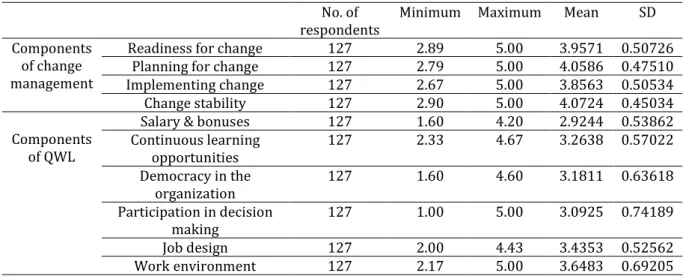
Table 1 shows mean and standard deviation of research components.
Table 1. Descriptive statistics of components of QWL and change management. No. of
respondents
Minimum Maximum Mean SD Components
of change management
Readiness for change 127 2.89 5.00 3.9571 0.50726
Planning for change 127 2.79 5.00 4.0586 0.47510
Implementing change 127 2.67 5.00 3.8563 0.50534
Change stability 127 2.90 5.00 4.0724 0.45034
Components of QWL
Salary & bonuses 127 1.60 4.20 2.9244 0.53862
Continuous learning opportunities
127 2.33 4.67 3.2638 0.57022
Democracy in the organization
127 1.60 4.60 3.1811 0.63618
Participation in decision making
127 1.00 5.00 3.0925 0.74189
Job design 127 2.00 4.43 3.4353 0.52562
Work environment 127 2.17 5.00 3.6483 0.69205
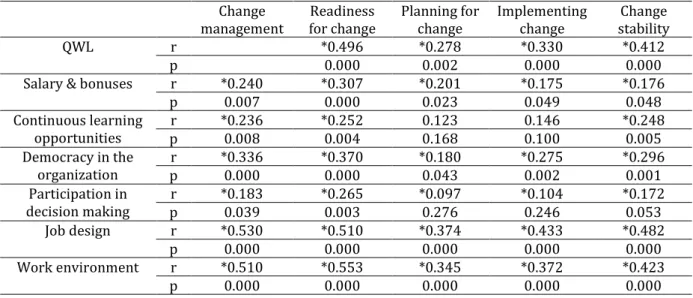
Kolmogorov-Smirnoff test results showed that data distribution of components of quality of work life and change management was abnormal (p≤0.05). Spearman correlation test was used for surveying the correlation between QWL and change management (readiness for change, planning for change, implementing change and change stability). Results showed that there was a positive and significant correlation between QWL and change management (readiness for change, planning for change, implementing change and change stability) of managers of sports clubs of city of Tabriz (Table2). Also the correlation between dimensions of QWL and management was surveyed. Results showed that there was a positive and significant correlation between salary and bonuses and components of change management (readiness for change, planning for change, implementing change and change stability) of managers of sports clubs of Tabriz. Other analyses showed a positive and significant correlation between continuous learning opportunities and change management in two dimensions of readiness for change and change stability of managers of sports clubs of Tabriz; but there was no significant correlation between continuous learning opportunities and two dimensions of planning for change and implementing change of managers of sports clubs of Tabriz. Also there was a positive and significant correlation between democracy in the organization and change management and its components (readiness for change, planning for change, implementing change and change stability) in managers of sports clubs of Tabriz. There was a positive and significant correlation between participation in decision making and change management and component of readiness for change of managers of sports clubs of Tabriz; but there was no significant correlation between participation in decision making and three dimensions of planning for change, implementing change and change stability of managers of sports clubs of Tabriz. There was a positive and significant correlation between job design and change management and its components (readiness for change, planning for change, implementing change and change stability) in managers of sports clubs of Tabriz. Other analyses showed a positive and significant correlation between work environment and change management and its components (readiness for change, planning for change, implementing change and change stability) in managers of sports clubs of Tabriz (Table2).
Table 2. Spearman correlation coefficient results of QWL and dimensions of change management. Change
management
Readiness for change
Planning for change
Implementing change
Change stability
QWL r *0.496 *0.278 *0.330 *0.412
p 0.000 0.002 0.000 0.000
Salary & bonuses r *0.240 *0.307 *0.201 *0.175 *0.176
p 0.007 0.000 0.023 0.049 0.048
Continuous learning opportunities
r *0.236 *0.252 0.123 0.146 *0.248
p 0.008 0.004 0.168 0.100 0.005
Democracy in the organization
r *0.336 *0.370 *0.180 *0.275 *0.296
p 0.000 0.000 0.043 0.002 0.001
Participation in decision making
r *0.183 *0.265 *0.097 *0.104 *0.172
p 0.039 0.003 0.276 0.246 0.053
Job design r *0.530 *0.510 *0.374 *0.433 *0.482
p 0.000 0.000 0.000 0.000 0.000
Work environment r *0.510 *0.553 *0.345 *0.372 *0.423
p 0.000 0.000 0.000 0.000 0.000
*At level P<0.05 difference is significant.
DISCUSSION AND CONCLUSION
The aim of conducting the current research was surveying the correlation between QWL of managers of sports clubs of Tabriz and their change management. Results showed that there was a positive and significant correlation between QWL and change management (readiness for change, planning for change, implementing change and change stability). The current research results are consistent with research results of Ahadi (2011). Since the aim of organizational change is adaptability to environment and better performance, a set of actual work conditions in an organization such as salary and bonuses, participation in decision making, job diversity and enrichment are considered as the QWL program and ultimately in the process of making and developing change management paying attention to the above mentioned dimensions could result in the best possible management method. Thus there may be a direct correlation between QWL and change management. Also, there was a positive and significant correlation between salary and bonuses and change management and its components (readiness for change, planning for change, implementing change and change stability).
The current research results are consistent with research results of Ahadi (2011) and it confirms that adequate salary and bonuses is an important factor for increased performance. Fair salary and bonuses depends on appropriate and correct system of payment, fair payments, security and stability of payment, reward based on performance, on-time payment without delay, paying appropriate rewards and etc. Organization could design and implement a fair and reasonable salary system through analyzing jobs and using appropriate resources. Direct and indirect payments meet different needs of individuals; thus they are important; and there may be a direct correlation between salary and bonuses and change management. There was a positive and significant correlation between continuous learning opportunities and change management and its components (readiness for change, planning for change, implementing change and change stability); whereas, there was no significant correlation between continuous learning opportunities and components of planning for change and implementing change. This lack of correlation could be due to the lack of implementing training programs along with conducted changes in an organization in one of the stages of change. In case of providing the ground for fostering talents and improving the individuals’ abilities in the environment, individuals will easily and fearlessly accept the changes. Providing the appropriate ground for improving individuals’ abilities, promotion opportunities,
toward changes (Robbins, 2002). Thus there may be a direct correlation between continuous learning opportunities and change management. There was a positive and significant correlation between democracy in the organization and change management and its components (readiness for change, planning for change, implementing change and change stability). It could be said that distributing democracy in the organization is one of the aims of QWL. Democracy in the organization is inevitable and traditional concepts existing in models such as bureaucratic model are inappropriate for today’s organizations. Providing the ground for freedom of speech without being afraid of the reaction of higher authority in an organization is called democracy. Providing opportunities such as independence and autonomy at work, benefiting from different skills and access to data related to work are some of the measures took in the organization to satisfy and ensure the employees. Thus there may be a direct correlation between democracy in the organization and change management and its components. Other results indicated a significant correlation between participation in decision making and change management and its component of readiness for change; but there was no significant correlation between participation in decision making and components of planning for change, implementing change and change stability. Group factors such as group cohesion, social standards and participation in decision making are some of the factors resisting against change (Robbins, 2002).
Individuals who are affected by changes are different from each other in terms of attitude and needs; thus effective change programs must be flexible enough to create a collaborative environment for all employees at the organization. The more individuals participate in decision makings the more awareness about the goals of change program and the easier the acceptance and implementation of change programs. Creating an atmosphere of cooperation, and trust in organizational relationships could be an important step for reaching the goals of organizational change. Managers must use the participation of employees in the process of resistance recognition in different forms and challenge change strategies and use them to gain employees’ participation in change. In this case it could be expected from this approach to provide a model being used for positive and active resistance accompanies by benefits (Rezaeian and Baba Ahari, 2004). The ability to create trust and impose power from an appropriate source for creating an environment in which the individuals feel the change is necessary and committing them to change is one of the important features of managers and leaders. Trust could be gained through participation in different fields and discussing them and this also prevents from the negative aspects of power (Zand, 2003). Thus there may be a direct correlation between participation in decision making and change management. Also there was a positive and significant correlation between job design and change management and its components (readiness for change, planning for change, implementing change and change stability). Individuals in an organization are the base and foundation of all organizational changes such as change in the structure, group process, reward systems and job design and the nature of human being shows resistance toward any changes even desirable changes. Efficient change brings about improving new tendencies and behaviors or new strategies and improving new tendencies and behaviors challenges leaving current tendencies and behaviors. In other words, for replacing the current behavior with a new one there is a need for breaking the resistant layers of individuals and attracting their participation for efficient implementation of change. In other words, for making a behavioral change the resistance toward previous behavior must be eliminated and the tendency to accept the new behavior must be created (Rezaeian and Baba Ahari, 2004).
Organization must take measures for updating the technical and professional information of its employees and increasing the job content. Also for realizing the principals of succession in the organization it must use job rotation techniques. Thus there may be a direct correlation between job design and change management and its components. Also there was a positive and significant correlation between work environment and change management and its components (readiness for change, planning for change, implementing change and change stability). The current research results are consistent with research results of Shahbazi (2009). Naturally, organizations face different phenomena each day and as a result they must be flexible and change the work environment according to those phenomena. By making a balance it means coordinating work life and other aspects of life of employees and managers. Thus there may be a direct correlation between work environment and change management and its components. Generally it is suggested to increase and improve the indicators of QWL in order to increase the indicators of change management.
REFERENCES
Ahadi S, 2012. Surveying the correlation between change management and QWL among general managers and administrative employees of Urmia University 2011-2012. Mater thesis.
Alaghehband A, 2007. Educational management authorities. Tehran: Ravan publications. 5(1): 2-7. Donyavi Z, 2009. Correlation between QWL and organizational effectiveness of teachers. Master thesis of
Islamic Azad University of Sari.
Farnia MA, Shojaei KH, 2009. Surveying the correlation between QWL of principals and their efficiency at schools of Sardash County in academic year 2008-2009. Journal of educational sciences. 2: 5 Hersey P, Blanchard KH, 2008. Organizational behavior management. Translated by Kabiri GH, Tehran:
Institute of Jahad Daneshgahi publication.
Koushki MS, Akbari S, Ali Arab M, Ahmadi Angali K, 2013. QWL and its correlation with efficiency of nurses in hospitals of Shahid Beheshti University of Medical Sciences. Journal of faculty of health and research institute of health. 10(4): 81-90.
Norouzi M, 2013. Surveying nature, approaches and strategies of improving QWL in organization. Administrative culture and behavior. 5:17.
Payne RL, 2000. Eupschian Management and Millennium. Journal of Managerial Psychology. 15(3): 219-226.
Rezaeian A, Baba Ahari M, 2004. Designing a model for organizational behavior change by the use of processing tools of theoretical thought of constraints. Journal of humanities teacher. 2(8): 81-110. Robbins S, 2002. Organizational behavior concepts. Translated by Parsaeian and Arabi. 5th ed. Tehran:
office of cultural researches publication.
Vaill PB, 1996. By learning as a way of being: Strategies for survival in a world of permanent white water. San Francisco: Jossey -Bass publisher.
Shahbazi B, Vaezi M, Sanayeporr H, 2009. Showing the relation between job life and function of education managers of Esfahan. Governmental management journal. 1(3): 69-84.