International Journal of Applied Linguistics & English Literature ISSN 2200-3592 (Print), ISSN 2200-3452 (Online) Vol. 2 No. 1; January 2013
Copyright © Australian International Academic Centre, Australia
Does Writing Self-efficacy Correlate with and Predict Writing
Performance?
Rapassak Hetthong (Corresponding Author)
Department of Languages and Linguistics, Faculty of Liberal Arts Prince of Songkla University Hatyai Campus, Songkhla, Thailand
E-mail: [email protected]
Adisa Teo
Department of Languages and Linguistics, Faculty of Liberal Arts Prince of Songkla University Hatyai Campus, Songkhla, Thailand
E-mail: [email protected]
Received: 19-08- 2012 Accepted: 01-10- 2012 Published: 01-01- 2013 doi:10.7575/ijalel.v.2n.1p.157 URL: http://dx.doi.org/10.7575/ijalel.v.2n.1p.157
The research work was financed by Graduate School, Prince of Songkla University Hat Yai Campus, Thailand. Abstract
Self-efficacy has been broadly studied in recent decades and it has been attested an essential contributor to success in English language learning. However, to date, there have been few studies looking into self-efficacy in EFL writing, and into the students’ self-efficacy at a micro-skill level. This paper aims to investigate whether there is a relationship between writing self-efficacy and writing performance and to explore whether students’ overall writing self-efficacy predicts their overall writing performance. By means of a questionnaire for writing self-efficacy and a paragraph writing test, paragraph writing scores of 51 third-year English majors were collected. Then the data were computed using Pearson Correlation Coefficient and the Simple Linear Regression. The results reveal that there is a significant positive relationship between writing self-efficacy and writing performance both at the paragraph level and at the sub-skill level. Furthermore, the overall writing self-efficacy predicts the overall writing performance. In the last part, the importance of self-efficacy is discussed and implications for EFL/ESL education are offered.
Keywords: aspects of writing, English as a foreign language, paragraph writing, writing self-efficacy 1. Introduction
According to social cognitive theory, self-efficacy has been proved to be the most consistent and reliable predictor of students’ task performance (Bandura, 1997). Self-efficacy is an individual’s confidence in his/her ability to successfully perform a particular task. Self-efficacy is derived from four sources: mastery experience, vicarious experience, social persuasion and emotional state. In academic context, self-efficacy helps a student to determine how much effort, persistence and resilience to be put on a task. For example, in writing classes, highly self-efficacious students view difficulties as tasks to be mastered form a stronger sense of commitment to their interests in the writing tasks; and recover quickly from difficulties and disappointments. Conversely, inefficacious students avoid challenging tasks; believe that difficult tasks and situations are beyond their capabilities; fall back on previous personal failures and negative outcomes; and quickly lose confidence in their personal abilities (Schunk, 1996). As self-efficacy beliefs directly influence subsequent behaviors, they have been attested to be a better predictor of performance than factors such as actual ability or previous accomplishments (Bandura, 1994).
1.1 Background of the Study
It has been more than three decades since Albert Bandura (1977) introduced self-efficacy theory and the construct has gained attention in various fields of knowledge. From the review of correlational studies of learners/students’ self-efficacy in L2/FL settings within the last 10 years, the evidences have supported the claim that language achievement or performance can be explained by self-efficacy beliefs (Chen, 2007; Chen & Lin, 2009; Erkan & Saban, 2011; Gahungu, 2007; Ghonsooly & Elahi, 2010; Mahyuddin et al., 2006; Naseri & Zaferanieh, 2012; Rahemi, 2007; Rahimi & Abedini, 2009; Shah et al., 2011; Shang, 2010; Termit & Saravana, 2012; Tilfarlioglu, & Cinkaram, 2009; Woodrow, 2011; Zare & Mobarakeh, 2011). This claim was in concert with the meta-analysis conducted by Multon, Brown, & Lent (1991), which revealed that self-efficacy determines 14% of the variance of students’ academic performance.
As Latif (2007) states, skilled writers who have positive beliefs about their writing ability tend to possess sound knowledge of vocabulary and grammar. They expect to do well when they are assigned writing tasks. In contrast, poor writers are likely faced with difficulties in producing effective and coherent writings, as they worry about their lack of language-related writing skills and they are afraid of negative evaluations from teachers and peers. These negative self-beliefs keep them from starting to write in English. Students’ negative writing affects are the problems faced by both native and non-native teachers. Similarly, Erkan and Saban (2011) also noticed that many of the students who took an English written exam finished their exam paper quickly without trying to write a good paper
In the past decade, most of the self-efficacy research studies were undertaken in Iran (Abedinia et al., 2011; Ghonsooly & Elahi, 2010; Heidari et al., 2012; Naseri & Zaferanieh, 2012; Rahemi, 2007; Rahimi & Abedini, 2009; Zare & Mobarakeh, 2011), Malaysia (Mahyuddin et al., 2006; Sani & Zain,2011; Shah et al., 2011; Termit & Saravana, 2012; Wong, 2005), Taiwan (Chen, 2007; Chen & Lin, 2009; Shang, 2010; Su & Duo, 2012) and Turkey (Çubukçu, 2008; Erkan & Saban, 2011; Tilfarlioglu & Ciftci, 2011; Tilfarlioglu & Cinkaram, 2009) in order to provide a new insight into self-efficacy to EFL teachers and scholars. All the studies mentioned above centered on whether self-efficacy correlates with anxiety, strategy use, or language performance. The review of these studies shows that there are strong connections between these three constructs. Proponents of self-efficacy theory suggest that if language tasks and activities are perceived as interesting and achievable, learners tend to engage themselves more in the learning process and the tasks. In the field of L2/FL writing, self-efficacy has been found to positively correlate with writing performance (Amogne, 2008; Chen & Lin, 2009; Erkan & Saban, 2011; Shah et al., 2011; Woodrow 2011). Pajares (1996) states that a person's performance is better predicted by his/her judgment about personal ability than his/her actual ability or previous successes. This assumption was supported by the study of Chen (2007) who found that self-efficacy predicts students’ language performance. The current study therefore postulated whether an investigation with Thai EFL students would yield the same result or not. However, one point to note as Bandura (1997) cautioned is that, self-efficacy and performance should be measured at a compatible layer. Following Bandura’s (1997) suggestion, the current study investigated writing self-efficacy in relation to writing performance both at sub-skill and paragraph levels.
1.2 Research Questions
1. At sub-skill and paragraph levels, does the students’ writing self-efficacy correlate with their writing performance?
2. Does the students’ overall writing self-efficacy predict their overall writing performance? 1.3 Significance of the Study
Primarily, self-efficacy is a prominent motivational construct that needs more studies to shape up insights among researchers and educators. To the best of the researchers’ knowledge, the present study was the unique one of self-efficacy studies, as it looked into the importance of self-self-efficacy at a sub-skill level. The present study serves as an additional investigation with new findings; it contributes to the theoretical framework of self-efficacy and supplements an alternative to the education of English or L2 writing.
2. Literature Review 2.1 Self-efficacy
Self-efficacy beliefs have both positive and negative impacts on learners’ perceptions towards their ability in learning a particular task/skill. Schunk (1996) states that learners with higher levels of self-efficacy are more likely to set high achievable goals and persevere to fulfill those goals. Inefficacious students tend to set low goals and tend to quit if the task becomes difficult. Self-efficacy beliefs affect how students put effort in the task/skill they attempt. Self-efficacy mediates the students’ judgment whether to try more or avoid doing the task. Self-efficacy allows students to formulate a sense of competence when they are faced with difficult tasks (Pajares, 1996) and leads students to further engage themselves in that learning task. On the other hand, in case of inefficacious students, tasks are believed to be harder than they actually are. This eventually causes a decrease in effort and persistence.
Bandura (1977) theorizes that self-efficacy is generated within a learner’s thought, as he/she interprets the information which is derived from four sources. The first and the most powerful source which influences self-efficacy is mastery experience. In the context of L2/FL learning, it refers to learners’ previous successes in a certain area of abilities/skills. That is, learners’ grades or scores in previous language courses can heighten or lower their confidence in doing a related language task. The second source, vicarious experience, is when learners observe language performance of others and compare it to their own. According to self-efficacy theory (Bandura, 1977), the most dominant form of vacarious experience is when learners see peers or others who are regarded as equally competent as the observers perform a task. Learners will generate the beliefs that “if he/she can do, so can I”. The third source, social persuasion, helps learners to form personal efficacy when the comments or feedback they receive is interpreted in a positive way. Learners who positively perceive feedbacks tend not to fear mistakes; in addition, they tend to regulate themselves in terms of strategies until they find the strategies which work for them. The fourth source of self-efficacy is emotional state. It refers to anxiety or fear that students encounter when they need to perform certain tasks that they perceive to be out of control. Examples of situations that worry learners can range from being singled out to answer the question in class to taking a written exam within time limit.
2.2 Writing Self-efficacy
past two decades. Writing self-efficacy is self-efficacy in the domain of English writing. As a significant positive relationship between students’ self-efficacy beliefs and their writing performance was found in many studies in ESL/EFL contexts (Amogne, 2008; Chen & Lin, 2009; Erkan & Saban , 2011, Shah et al., 2011; Woodrow 2011), it can be implied that self-efficacy plays a crucial role in learners’ writing. Writing self-efficacy mediates the way a writer thinks, feels and acts (Schwarzer & Fuchs, 1995). Confidence in English writing manipulates learners’ perceptions towards writing in general; it mediates possibility whether they will master or avoid writing tasks. If learners believe they can do a writing task, whether they are excellent or poor writers, it is likely that they will try harder to cope with challenges that may rise during the time they practice or perform the task. In the face of frustrations and difficulties, self-efficacy promotes learners’ self-commitment to a pursuit of strategies until they achieve the task. Thus, it is fair to state that writing performance can be explained by writing self-efficacy.
2.3 Assessing Writing Self-efficacy
There are two suggested practices in the assessment of self-efficacy in relation to learning task performance. First of all, Bandura (1997) has cautioned researchers who attempt to predict academic outcomes from students' self-efficacy beliefs that self-efficacy beliefs should be measured in the way that the aspects of students’ self-efficacy being measured should be exactly represented in the scoring scheme for assessing the performance/task. A researcher who wishes to assess the essay-writing self-efficacy has to consider the task demands of writing an essay which can range from writing a simple sentence with accurate punctuation and grammatical structure to organizing sentences into a paragraph. A writing self-efficacy questionnaire does not lend itself to predict students’ writing performance, if the scoring criteria of the writing test are not reflected in the items of the questionnaire for writing self-efficacy. Secondly, Pajares (2003) also asserts that the items in the writing self-efficacy questionnaire should be worded in terms of “I can”, rather than “I will”. 2.4 Review of Related Studies
L2 education scholars have found a number of evidences which support the proposition that writing self-efficacy plays a crucial role on writing performance. Woodrow (2011) attempted to highlight the significance of writing self-efficacy in a large sample size with 738 Chinese university students from four universities in a major city in China. The result of Woodrow’s study indicates significant relationship between writing self-efficacy and writing performance. In the study, the subjects were given 8-point Likert scale questionnaires to measure self-efficacy and anxiety in writing. Then, the writing task immediately followed. As the study was designed to investigate whether anxiety and self-efficacy were related to writing performance, it took a structural model equation to generate the whole picture of relationship and predicting ability of the two constructs over writing performance. The results of the model indicated that there is a strong negative relationship between writing anxiety and writing performance (-.71); in addition, it was revealed that writing self-efficacy is moderately related to writing performance (.43). The relationship between writing anxiety and writing performance was mediated by self-efficacy. The findings conform to those of Chen & Lin (2009). This study also indicates that there is an association between self-efficacy beliefs, anxiety and language performance/achievement. However, the writing anxiety does not directly predict writing performance as the writing self-efficacy does.
Given a research work with a similar type of results, Shah et al. (2011) explored whether the 120 Malaysian Form-3 and Form-5 students’ general self-efficacy and self-efficacy in writing correlated with their writing performance. In his study, students' writing test score from a national standardized essay writing test was found to have a moderate positive correlation (r = 0.563) with general self-efficacy, and high positive correlation (r = 0.641) with writing self-efficacy. Though holistic scoring method was the means of scoring the students’ writing test, an evidence of correlation at the sub-skill level were found. Self-efficacy in organization and mechanics were correlated with writing performance. The criteria group of "Mechanics" in his study contained quite a range of sub-skills including using correct tenses, writing a coherent paragraph, punctuating correctly, spelling correctly, using an adequate range of vocabulary for the task, using correct transitions and coordinators to link ideas, as well as the ability to incorporate idioms and proverbs. The "Organization" area covered some aspects such as organization of ideas, the presence of topic sentences, supporting details, and concluding the essay in a good paragraph.
Nevertheless, there were other two research projects which yielded different results. One was Al-Mekhlafi (2011)’s investigation into the relationship between Arab EFL trainee-teachers’ writing self-efficacy and their writing achievement. The study yielded no significant relationship between the two variables; its result contradicted to the finding of the aforementioned study that Woodrow (2011) conducted. His study took a 38-item questionnaire which is used to explore sources of writing self-efficacy. Moreover, the writing achievement was measured in a form of total score the students obtained from the writing course which consists of 20 % from portfolio, 20 % from mid semester test, 10 % from participation, and 50 % from the final examination. This affected the concept of self-efficacy which should be regarded as task-specific, since the variable of writing achievement was portioned into several components.
performance than other confounding factors being measured in his study. Taking the findings of this study into account, it cannot be definitely concluded that self-efficacy correlate with, or predict language performance.
Based on the four studies mentioned above, it can be pointed out that instrumentations of self-efficacy beliefs and instrumentations of language performance/achievement might have an effect on the findings. Bandura (1997) and Pajares (1996) strongly cautioned that the measures of two constructs being compared to investigate their correlation must correspond to each other and must be at the same level in terms of specificity. The construct of self-efficacy should not be generalized as self-concept, self-esteem, or even as sources of self-efficacy.
In a study supporting Bandura (1997)’s claim about predicting ability of self-efficacy over language performance, Chen (2007) investigated the impact of four independent variables, namely English listening self-efficacy, English listening anxiety, perceived value of English language, and perceived value of English culture on English listening final performance of the 277 Taiwanese non-English major students. Listening self-efficacy was found to be of highest correlation with listening performance (r=.74). This implies that participants who had high level of listening self-efficacy performed in the listening tasks better than those who had low level of self-self-efficacy. Chen (2007), in line with Bandura (1986) and Pajares (1996), suggested that a measure of self-efficacy that closely corresponded with a measure of task performance would maximize the potential of self-efficacy to predict performance. Additionally, a regression analysis was performed to see how well the four variables contributed to the level of English listening final performance. It was found that, among the four independent variables, English listening self-efficacy was the strongest predictor (β= .638) of listening performance when the other three independent variables were controlled.
3. Method
3.1 Subjects and Design
The subjects of this study were 51 third-year students who majored in English in Department of Languages and Linguistics at Prince of Songkla University, Hat Yai Campus. To measure self-efficacy in paragraph writing as a predetermined task, the subjects must represent the population of EFL students who had sufficient background knowledge to provide information about paragraph writing that they studied in their second year. A purposive sampling method was then taken. This research study took a cross-sectional design; a paragraph writing test and a questionnaire for writing self-efficacy were the instruments.
3.2 Instrumentations
3.2.1 Paragraph Writing Test and the Scoring Criteria
Subjects were asked to write a single argumentative paragraph of 150 words in the paragraph writing test. The subjects needed to write one main idea with supporting details to answer whether the Internet is useful or harmful. This test took the features of the “Test of English for Educational Purposes” (TEEP) which provides the subjects with an instruction, a writing prompt, and suggestions for using time. (See the Paragraph Writing Test in Appendix A). To grade the paragraph, this study used the analytic scoring criteria adopted from “TEEP attribute writing scale” by Cyril Weir (1990). This scale is used to assess the essay in the “Test of English for Educational Purposes (TEEP)”. The scoring criteria included seven aspects: 1) relevance and adequacy of content, 2) compositional organization, 3) cohesion, 4) adequacy of vocabulary for purpose, 5) grammar, 6) punctuation, and 7) spelling. The score for each criterion ranges from 0 to 3. The perfect score of the paragraph is 27. (see the TEEP Attribute Writing Scale in Appendix B) In the piloting stage, the 33 paragraph writing test papers were scored by three raters using the TEEP Attribute Writing Scale (Weir, 1990). The paragraph writing test and the scoring criteria has been checked for its interrater reliability. The Chronbach Alpha Coefficient was computed and found to be 0.927.
3.2.2 Questionnaire for Writing Self-efficacy
This questionnaire consists of 12 items in Thai. They are in consistence with the seven writing aspects constituting the scoring criteria of the paragraph writing test (See the Questionnaire for Writing Self-efficacy in Appendix 1). Each writing aspect is covered by two questionnaire items except the aspects of punctuation and spelling which are covered by only one questionnaire item. The questionnaire for writing-efficacy was developed based on self-efficacy theory. It takes response formats ranging from 0 to 100, as it is proved by a study regarding response format by Pajares et al. (2001) to be of reliability when assessing self-efficacy beliefs. The subjects wrote any number from 0 to 100 to rate their judgment about their ability to write a paragraph. After a pilot study, the internal consistency of the scale was computed and the Cronbach alpha was found to be 0.9106.
3.3 Procedure
The instruments were piloted with 33 third-year English majors from a university in South of Thailand. As this group of subjects had as similar exposure of paragraph writing as the subjects in the main data collection, convenience sampling technique was then taken. For the administration in the pilot study, the subjects were given the questionnaires and then the writing test. The whole process took approximately 1 hour and 45 minutes.
and found to be 0.927. It indicates that the paragraph writing test and the scoring criteria was reliable with high level of interrater reliability.
After the pilot study, the main study was conducted with 51 third-year English majors in Department of Languages and Linguistics at Prince of Songkla University, Hat Yai Campus, Thailand. It followed the same sequence of administration as in the pilot study.
3.4 Data Analysis
All data were encoded into SPSS 11.5. The first research question can be answered by calculating the correlation between the mean score of subjects’ writing self-efficacy and the mean score of their paragraph writing test, aspect by aspect, to determine whether there is any relationship between them. For the second research question, the Simple Linear Regression analysis was performed to see whether the students’ overall writing self-efficacy predicts their overall writing performance.
4. Findings
This part reports the results of the analysis. The correlations between the students’ writing self-efficacy and their writing performance and the results of Linear Regression analysis are presented as follows:
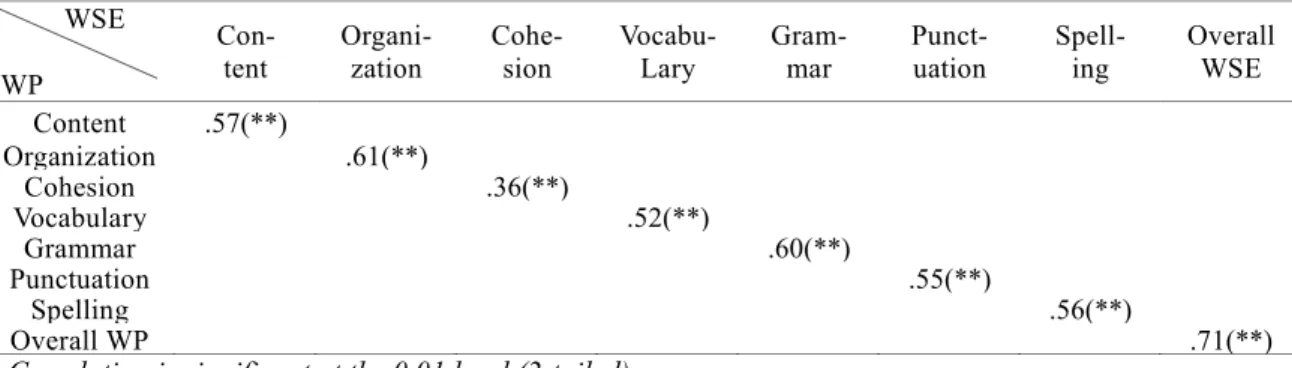
4.1 Correlations between the Students’ Writing Self-efficacy and their Writing Performance Table 1. Correlations
WSE
WP
Con-
tent Organi- zation Cohe- sion Vocabu- Lary Gram- mar Punct- uation Spell- ing Overall WSE
Content .57(**)
Organization .61(**)
Cohesion .36(**)
Vocabulary .52(**)
Grammar .60(**)
Punctuation .55(**)
Spelling .56(**)
Overall WP .71(**)
** Correlation is significant at the 0.01 level (2-tailed). WP: Writing performance, WSE: Writing Self-efficacy
Table 1 demonstrates the different levels of correlations between the students’ judgment about their ability in seven sub-skills and their writing score received from the paragraph writing test for that sub-skill criterion. The correlations range from 0.36 to 0.61: cohesion (r=0.36), vocabulary (r=0.52), punctuation (r=0.55), spelling (r=0.56), content (r=0.57), grammar (r=0.60), organization (r=0.61) respectively. This signifies that the aspect which students judged themselves about their ability most accurately was organization; on the contrary, cohesion was the aspect that the students judged themselves about their ability least accurately.
4.2 Predicting Ability of Overall Writing Self-efficacy over Overall Writing Performance
Table 2. Model Summary
Model R R Square Adjusted R
Square Std. Error of the Estimate
1 .712(a) .508 .498 1.946
a Predictors: (Constant), Writing Self-efficacy
A Simple Linear Regression analysis was performed to see how well the student's overall writing self-efficacy predicted their overall writing performance. The students’ scores on the questionnaire for writing self-efficacy functioned as the independent variable, and the scores on the paragraph writing test functioned as the predictor. As shown in Table 2, it can be implied that the correlation (R = .712) between the overall writing self-efficacy and the overall writing performance significantly and strongly exists. As this is an overall result of the strength of relationship, a more specific analysis must follow.
Table 3. ANOVA(b)
Model Squares Sum of Df Mean Square F Sig.
1 Regression 191.314 1 191.314 50.509 .000(a)
Residual 185.597 49 3.788
Total 376.912 50
By considering Table 3. ANOVA(b), the p-value (sig.) less than 0.001 indicates that the finding is statistically significant. This signifies that the predictor predicts the dependent variable. (F=50.509, df=50 and p<0.001). It could be said that the predictive power of the students’ overall writing self-efficacy over their overall writing performance was significant.
Table 4. Coefficients (a)
Model Unstandardized Coefficients Standardized Coefficients T Sig.
β Std. Error Beta
1 (constant) 5.325 1.158 4.599 .000
Writing Self-efficacy .020 .003 .712 7.107 .000
The data in Table 4 provide us with a better picture of how well the independent variable (overall writing self-efficacy) could predict the dependent variable (overall writing performance). The value of Beta (β) in Standardized Coefficients = 0.712 (N = 51) indicates that an increase of one standard deviation in the predictor (overall writing self-efficacy) will result in a change of 0.712 standard deviations in the writing performance. The p-value (Sig.), which is less than 0.001, confirms that the students’ overall writing self-efficacy predicts their overall writing performance.
5. Discussions and Conclusions
The current study was aimed to investigate whether there are correlations between students’ writing self-efficacy and their writing performance, both at sub-skill and paragraph levels, and whether the students’ overall writing self-efficacy predicts their overall writing performance. When the correlation at the level of paragraph writing was examined, there was a high positive relationship between the students’ overall writing self-efficacy and their overall writing performance (r=0.71). In other words, although there was a variation of sub-skill correlations, the correlation of the overall paragraph writing was highly positive. The findings were consistent with those of Shah et al. (2011) who found that Malaysian students’ writing ability in the aspect of mechanics such as punctuation and spelling are moderately correlated with their writing self-efficacy. However, there was an evident controversial result. The cohesion aspect in this study was found to yield low positive correlation, while this aspect in Shah’s study yielded a moderate positive correlation. The results that correlations at sub-skill level between writing self-efficacy and writing performance are consistent with self-efficacy theory (Bandura, 1997), that is, students’ accuracies in judging themselves about their ability to deal with sub-skill tasks generally vary. Schunk (1996) explained that learner have different judgments about their personal ability and generate their self-efficacy by associating the tasks with previous successes. Zimmerman et al (1992) state that students who are familiar with the task, tend to regulate themselves in terms of strategy use to acquired skills for the task and accomplish it. Drawing on the results of the Linear Regression analysis, it can be implied that writing self-efficacy significantly correlate with writing performance. Overall, the result of regression analysis supports the assumption that writing self-efficacy has a predictive power over writing performance. The result was consistent with those of Chen (2007). From the overall empirical evidences, the theory of self-efficacy has been confirmed and success or performance in L2 learning can be explained by self-efficacy.
6. Implications and Suggestions
From pedagogical perspective, teachers of L2/EFL are suggested to create a motivating language classroom. First of all, instead of giving a test, teachers can conduct a questionnaire of self-efficacy for diagnostic purpose before starting a class. Teachers should realize that the issue of aspects of writing is individual and specific. Teachers should personalize students’ learning by having them practice certain skills. In practice, once the self-rating results reveal certain aspects students lack, teachers should attend to them by intervening with appropriate techniques. Secondly, teachers should not rely too much on traditional ways of teaching writing which focuses on teaching grammatical rules and showing errors in the early drafts to students in class. Cheng and Dörnyei (2008) suggest “teachers’ motivational strategies” that can promote students’ confidence and have been proved universal in both western and oriental cultures such as “1) make clear to students that communicating meaning effectively is more important than being grammatically correct, 2) design tasks that are within the students’ ability, 3) teach students learning techniques, 4) provide students with positive feedback, and 5) encourage students to try harder” (p. 157).
For research implications, interested researchers in the field may want to
1. explore an impact of task familiarity on learners’ self-efficacy and their language performance by using tasks of different levels of familiarity.
2. explore the relationship of self-efficacy with other variables such as cognitive style, locus of control, goal orientation etc.
3. experiment whether certain EFL activities that promote metacognitive knowledge contribute to the enhancement of self-efficacy and learning improvement (Pajares, 1996; Shannon, 2008).
References
Abedinia A., Rahimib A., & Zare-eec A. (2011). Relationship between Iranian EFL learners' beliefs about language learning, their language learning strategy use and their language proficiency. Procedia - Social and Behavioral Sciences, 28 (2011), 1029-1033
Al-Mekhlafi, M. A. (2011). The Relationship between witing self-efficacy beliefs and final examination scores in a writing course among a group of Arab EFL Trainee-teachers. International Journal for Research in Education (IJRE), 29, 16-33. Retrieved from www.fedu.uaeu.ac.ae/journal/docs/pdf/pdf29/2_E.pdf
Amogne, D. (2008). An investigation of the correlation among efficacy sources, students’ self-efficacy and performance in reading and writing skills: Bahir Dar University in Focus. (Unpublished master’s thesis), Addis Ababa University, Addis Ababa, Ethiopia
Anyadubalu, C. C. (2010). Self-efficacy, anxiety, and performance in the English language among middle-school students in English language program in Satri Si Suriyothai School, Bangkok. International Journal of Human and Social Sciences, 5(3), 193-198. Retrieved from http://www.waset.org/journals/ijhss/v5/v5-3-29.pdf
Bandura, A. (1977). Social Learning Theory. New York: General Learning Press.
Bandura, A. (1986). Social foundations of thought and action: A social cognitive theory. Englewood Cliffs, NJ: Prentice Hall.
Bandura, A. (1994). Self-efficacy. In V. S. Ramachaudran (Ed.), Encyclopedia of human behavior (Vol. 4, pp. 71-81). New York: Academic Press. (Reprinted in H. Friedman [Ed.], Encyclopedia of mental health. San Diego: Academic Press, 1998), 153-174.
Bandura, A. (1997). Self-efficacy: The exercise of control. New York: W.H. Freeman.
Cubukcu, F. (2008). A study on the correlation between self-efficacy and foreign language learning anxiety. Journal of Theory and Practice in Education. 4(1), 148-158
Chen, H. (2007). The relationship between EFL learners’ self-efficacy beliefs and performance. (Unpublished doctoral dissertation), Department of Education, Florida State University, United States
Chen, M. C., & Lin H. (2009). Self-efficacy, foreign language anxiety as predictors of academic performance among professional program students in a general English proficiency writing test. Perceptual and Motor Skills, 2009(109), 420-430.
Cheng, H-F., & Dörnyei, Z. (2007). The use of motivational strategies in language instruction: The case of EFL teaching in Taiwan. Innovation in Language Learning and Teaching, 1(1), 153-174.
Erkan, D. Y., & Saban, A. (2011). Writing performance relative to writing apprehension, self-efficacy in writing, and attitudes towards writing: A correlational study in Turkish tertiary-level EFL. The Asian EFL Journal Quarterly, 13(1), 164-192.
Gahungu, N. O. (2007). The relationships among strategy use, self-efficacy, and language ability in foreign language learners. (Unpublished doctoral dissertation). Northern Arizona University, United States
Ghonsooly, B. & Elahi, M. (2010). Learners' self-efficacy in reading and its relation to foreign language reading anxiety and reading achievement. Journal of English Language Teaching and Learning, 217, 45-67
Heidari, F., Izadi, M. & Ahmadian, M. V. (2012). The relationship between Iranian EFL learners’ self-efficacy beliefs and use of vocabulary learning strategies, English Language Teaching, 5(2)
doi:10.5539/elt.v5n2p174
Huwari, I. F., & Noor Hashima, Abd. Aziz. (2011). Writing apprehension in English among Jordanian postgraduate students at Universiti Utara Malaysia (UUM). Academic Research International, 1(2), 190-198. Retrieved from http://www.savap.org.pk/journals/ARInt./Vol.1(2)/2011(1.2-16).pdf
Latif, M. A. (2007). The factors accounting for the Egyptian EFL university students’ negative writing affect. Essex Graduate Student Papers in Language & Linguistics, 9, 57-82.
Mahyuddin R., Elias H., Cheong L. S., Muhamad M. F., & Noordin N. Abdullah M. C. ( 2006). The relationship between students' self-efficacy and their English language achievement. Malaysian Journal of Educators and Education, 21, 61-71.
Naseri, M., & Zaferanieh, E. (2012). The relationship between reading self-efficacy beliefs, reading strategy use and reading comprehension level of Iranian EFL learners. World Journal of Education, 2(2), 64-75
Multon, K. D., Brown, S. D., & Lent, R. W. (1991) Relation of self-efficacy beliefs to academic outcomes: A meta-analytic investigation. Journal of Counseling Psychology, 38, 30-38.
Rahemi, J. (2007). Self-efficacy and Iranian senior high school students majoring in Humanities. Novitas-ROYAL, 1(2), 98-111 Retrieved from http://www.novitasroyal.org/Rahemi.pdf (September 21, 2012)
Rahimi, A., & Abedini, A. (2009). The interface between EFL learners' self-efficacy concerning listening comprehension and listening proficiency. Novitas-ROYAL, 3(1),14-28
Shah P. M., Mahmud W. H., Din R., Yusof A., & Pardi K. M. (2011). Self-Efficacy in the writing of Malaysian ESL learners. World Applied Sciences Journal (Innovation and Pedagogy for Lifelong Learning), 15, 08-11
Retrieved from http://www.idosi.org/wasj/wasj15(IPLL)11/2.pdf
Shannon, S. V. (2008). Using metacognitive strategies and learning styles to create self-directed Learners. Institute for Learning Styles Journal, 1(Fall), 14-28
Sani, A. M. & Zain, Z. (2011). Relating adolescents’ second language reading attitudes, self efficacy for reading, and reading ability in a non-supportive ESL setting. Reading Matrix, 11(3), 243-254
Retrieved from http://www.readingmatrix.com/articles/september_2011/sani_zain.pdf
Schunk, D. H. (1996, April). Self efficacy for learning and performance. Paper presented at the annual meeting of the American Educational Research Association, New York
Shah P. M., Mahmud W. H., Din R., Yusof A., & Pardi K. M. (2011). Self-Efficacy in the writing of Malaysian ESL learners. World Applied Sciences Journal (Innovation and Pedagogy for Lifelong Learning), 15, 8-11 Retrieved from http://www.idosi.org/wasj/wasj15(IPLL)11/2.pdf
Shang, H. F. (2010). Reading strategy use, self-efficacy and EFL reading comprehension. The Asian EFL Journal Quarterly, 12(2), 18-42
Schwarzer, R. & Fuchs, R. (1995). Self efficacy and health haviours. In Conner, M. & Norman, P. (Eds). Predicting Health Behaviour. Open University Press
Su, M. H., & Duo, P. C. (2012). EFL learners’ language learning strategy use and perceived self-efficacy. European Journal of Social Sciences, 27(3), 335-345
Retrieved from http://www.europeanjournalofsocialsciences.com/ISSUES/EJSS_27_3_04.pdf
Termit, K. R. S., & Saravana, K. R. (2012). The relationship of writing apprehension level and self-efficacy beliefs on writing proficiency level among pre-university students. English Language Teaching, 5(7), 42-52
doi:10.5539/elt.v5n7p42
Tilfarlioğlu, F. T., & Ciftci, F. S. (2011). Supporting self-efficacy and learner autonomy in relation to academic success in EFL classrooms (A Case Study). Theory and Practice in Language Studies, 1(10), 1284-1294. Retrieved from http://dx.doi.org/10.4304/tpls.1.10.1284-1294
Tilfarlioglu, F. Y., & Cinkaram, E. (2009). Self-efficacy in EFL: Differences among proficiency groups and relationship with success. Novitas-ROYAL, 3(2), 129-142
Weir, C. J. (1990). Communicative Language Testing. Englewood Cliffs, NJ: Prentice Hall Regents.
Wong, M. S-L. (2005). Language learning strategies and language self-efficacy: Investigating the relationship in Malaysia. RELC Journal, 36 (3), 245-269
Woodrow, L. (2011). College English writing affect: Self-efficacy and anxiety. System, 39, 510-522.
Zare, M., & Mobarakeh, S. D. (2011). The relationship between self-efficacy and use of reading strategies: The case of Iranian senior high school students. Studies in Literature and Language, 3(3), 98-105
Retrieved from http://cscanada.net/index.php/sll/article/view/j.sll.1923156320110303.148
Appendix A: Paragraph Writing Test
Paragraph Writing Test
Name ___________________ ______________________ Participant Code: ____
This is a test of your ability to write a paragraph in English. You have 1 hour to write a paragraph of 150 words for a university lecturer on the following topic.
“Some people say that the Internet has a positive impact on students' life; others tend to argue that it is harmful. Which idea do you agree with?” Please support your idea.
Your writing will be assessed by the following criteria:
Scoring Criteria Details
1.Content of your answer
The content must be relevant to the topic and it should have adequate supporting details.
2.Organization of your ideas
Your main idea must be well-developed and flow in a logical sequence.
3.Cohesion You must use appropriate sentence connectors and transitions to make a strong paragraph.
4.Vocabulary Vocabulary must be appropriate for the purpose of the paragraph. 5.Grammar Writing is excellent and fluent, with none or very few grammar errors. 6.Punctuation Your punctuations must be accurate.
7.Spelling Your spellings must be accurate.
Suggestions for using your time
1- Think Think of possible ideas about the topic. Select only the best idea for your paragraph
and reasons to support the main idea. 10 minutes
2- Plan Write the main idea and supporting details in a logical sequence. 5 minutes
3- Write Write the paragraph. 40 minutes
4- Edit Read through your paragraph, check for errors, and check that the meaning is clear
for your reader. 5 minutes
Total 60 minutes
IMPORTANT REMINDERS:
1. An off-topic paragraph will receive a score of zero. 2. Any notes in this booklet will not be marked. 3. Your paragraph must be double-spaced.
*** When you are told to do so, you can start writing your paragraph. Note:
Appendix B: TEEP Attribute Writing Scale A. Relevance and adequacy of content
0. The answer bears almost no relation to the task set. Totally inadequate answer.
1. Answer of limited relevance to the task set. Possibly major gaps in the treatment of topic and/or pointless repetition. 2. For the most part answers the tasks set, though there may be some gaps or redundant information.
3. Relevant and adequate answer to the task set. B. Compositional organization
0. No apparent organization of content.
1. Very little organization of content. Underlying Structure not sufficiently controlled. 2. Some organizational skills in evidence, but not adequately controlled.
3. Overall shape and internal pattern clear. Organizational skills adequately controlled. C. Cohesion
0. Cohesion almost totally absent. Writing so fragmentary that comprehension of the intended communication is virtually impossible.
1. Unsatisfactory cohesion may cause difficulty in comprehension of most of the intended communication.
2. For the most part satisfactory cohesion although occasional deficiencies may mean that certain parts of the communication are not always effective.
D. Adequacy of vocabulary for purpose
0. Vocabulary inadequate even for the most basic parts of the intended communication.
1. Frequent inadequacies in vocabulary for the task. Perhaps frequent lexical inappropriacies and/or repetition. 2. Some inadequacies in vocabulary for the task. Perhaps some lexical inappropriacies and/or circumlocution. 3. Almost no inadequacies in vocabulary for the task. Only rare inappropriacies and/ or circumlocution. E. Grammar
0. Almost all grammatical patterns inaccurate. 1. Frequent grammatical inaccuracies. 2. Some grammatical inaccuracies. 3. Almost no grammatical inaccuracies. F. Mechanical accuracy I (punctuation) 0. Ignorance of conventions of punctuation. 1. Low standard of accuracy in punctuation. 2. Some inaccuracies in punctuation. 3. Almost no inaccuracies in punctuation. G. Mechanical accuracy II (spelling) 0. Almost all spelling inaccurate. 1. Low standard of accuracy in spelling. 2. Some inaccuracies in spelling. 3. Almost no inaccuracies in spelling.
Appendix C: Questionnaire for Writing Self-efficacy (Thai version)
แบบว ัดความเชื อในความสามารถแห่งตนในเรื องการเขียนภาษาอ ังกฤษ
หมายเลขผู ้ตอบแบบสอบถาม: ____
คําชี แจงข ้อความต่อไปนี เป็นเรื องความเชื อในความสามารถแห่งตนในเรื องการเขียนภาษาอังกฤษให ้นักเรียนเขียนตัวเลขจากเลข 0 ถึง 100 ที นักเรียนเชื อว่าบ่งบอกระดับความสามารถของตนเองในประเด็นนั นๆ
0 10 20 30 40 50 60 70 80 90 100
เชื อว่าทําไม่ได ้แน่นอน เชื อว่าทําได ้ในระดับ
ปานกลาง
เชื อว่าทํา ได ้ดีแน่นอน ตัวอย่าง
A. ฉันสามารถเขียนงานในระดับอนุเฉท (paragraph) โดยไม่ต ้องมีคําชี แจงหรือความช่วยเหลือใดๆ 65
1. ฉันสามารถคิดประเด็นต่างๆที เกี ยวข ้องกับหัวข ้อที ต ้องเขียนได ้อย่างรวดเร็ว
2. ฉันสามารถหาตัวอย่างที สนับสนุนความคิดหลัก (main idea) โดยไม่ออกนอกหัวเรื องที เขียน
3. ฉันสามารถจัดลําดับความคิดได ้อย่างเป็นเหตุเป็นผล
4. ฉันสามารถเขียนโครงสร ้างของอนุเฉท (paragraph) เพื อขยายความคิดหลัก (main idea) ได ้
5. ฉันสามารถเขียนประโยคที ยาวและซับซ ้อนโดยใช ้คําเชื อมประเภท sentence connectors เช่น and, because, but, although เป็นต ้นได ้อย่างถูกต ้องและมีประสิทธิภาพ
6. ฉันสามารถเชื อมโยงประเด็นต่างๆโดยใช ้คําเชื อมประเภท transitions เช่น firstly, furthermore, in addition, therefore, in other words เป็นต ้นได ้อย่างถูกต ้องและมีประสิทธิภาพ
7. ฉันสามารถใช ้คําศัพท์ที เหมาะสมกับงานเขียนประเภทต่างๆเช่นการเล่าเรื อง (narrations) การบรรยาย (descriptions) การอภิปราย (argumentations) ได ้อย่างมีประสิทธิภาพ
9.ฉันสามารถตรวจแก ้ข ้อผิดในงานเขียนของฉันในเรื องความสอดคล ้องของประธานและกริยา (subject-verb agreements) รูปพหูพจน์ (plurals) กริยาที เหมาะสมกับกาล (verb tenses)
และเรื องอื นๆได ้
10. ฉันสามารถเขียนประโยคที ไม่มีข ้อผิดพลาดทางไวยากรณ์
11. ฉันสามารถใช ้เครื องหมายวรรคตอน (punctuations) ในการเขียนระดับอนุเฉท (paragraph) ได ้อย่างถูกต ้อง
12. ฉันสามารถสะกดคําศัพท์ภาษาอังกฤษทุกคําได ้อย่างถูกต ้อง
Appendix D: English Translations for the Items in “Questionnaire for Writing Self-efficacy” Item 1: I can quickly think of ideas that are relevant to the assigned topic.
Item 2: I can easily find examples to support the main idea without getting off topic. Item 3: I can organize ideas in a logical sequence.
Item 4: I can structure a paragraph to support the main idea.
Item 5: I can make long and complex sentences by using correct sentence connectors. Item 6: I can effectively connect ideas with appropriate transitions.
Item 7: I can use appropriate vocabulary for the purpose of writing, e.g., narrations, descriptions, argumentations, etc. Item 8; I can use synonyms rather than repeating the same words over and again.
Item 9: I can edit my writings for mistakes regarding subject-verb agreements, plurals, verb tenses, etc. Item 10: I can write sentences without grammatical errors.
Item 11: I can correctly punctuate a paragraph.