
Understanding and evaluating blind deconvolution algorithms
Anat Levin
1,2, Yair Weiss
1,3, Fredo Durand
1, William T. Freeman
1,4 1MIT CSAIL,
2Weizmann Institute of Science,
3Hebrew University,
4Adobe
Abstract
Blind deconvolution is the recovery of a sharp version of a blurred image when the blur kernel is unknown. Recent algorithms have afforded dramatic progress, yet many as-pects of the problem remain challenging and hard to under-stand. The goal of this paper is to analyze and evaluate re-cent blind deconvolution algorithms both theoretically and experimentally. We explain the previously reported failure of the naive MAP approach by demonstrating that it mostly favors no-blur explanations. On the other hand we show that since the kernel size is often smaller than the image size a MAP estimation of the kernel alone can be well con-strained and accurately recover the true blur.
The plethora of recent deconvolution techniques makes an experimental evaluation on ground-truth data important. We have collected blur data with ground truth and com-pared recent algorithms under equal settings. Additionally, our data demonstrates that the shift-invariant blur assump-tion made by most algorithms is often violated.
1. Introduction
Blind deconvolution is the problem of recovering a sharp version of an input blurry image when the blur kernel is unknown [10]. Mathematically, we wish to decompose a blurred imageyas
y=k⊗x (1)
wherexis a visually plausible sharp image, andkis a non negative blur kernel, whose support is small compared to the image size. This problem is severely ill-posed and there is an infinite set of pairs(x, k)explaining any observedy. For example, One undesirable solution that perfectly satis-fies eq. 1 is the no-blur explanation:kis the delta (identity) kernel andx=y. The ill-posed nature of the problem im-plies that additional assumptions onxorkmust be intro-duced.
Blind deconvolution is the subject of numerous papers in the signal and image processing literature, to name a few consider [1, 8, 22, 15, 17] and the survey in [10]. Despite the exhaustive research, results on real world images are rarely produced. Recent algorithms have proposed to address the ill-posedness of blind deconvolution by characterizingx us-ing natural image statistics [16, 4, 14, 6, 7, 3, 20]. While this principle has lead to tremendous progress, the results are still far from perfect. Blind deconvolution algorithms exhibit some common building principles, and vary in oth-ers. The goal of this paper is to analyze the problem and
shed new light on recent algorithms. What are the key chal-lenges and what are the important components that make blind deconvolution possible? Additionally, which aspects of the problem should attract further research efforts?
One of the puzzling aspects of blind deconvolution is the failure of the MAP approach. Recent papers empha-size the usage of a sparse derivative prior to favor sharp im-ages. However, a direct application of this principle has not yielded the expected results and all algorithms have required additional components, such as marginalization across all possible images [16, 4, 14], spatially-varying terms [7, 19], or solvers that vary their optimization energy over time [19]. In this paper we analyze the source of the MAP failure. We show that counter-intuitively, the most favorable solution under a sparse prior is usually a blurry image and not a sharp one. Thus, the global optimum of the MAP approach is the no-blur explanation. We discuss so-lutions to the problem and analyze the answers provided by existing algorithms. We show that one key property mak-ing blind deconvolution possible is the strong asymmetry between the dimensionalities ofxandk. While the number of unknowns inxincreases with image size, the dimension-ality ofkremains small. Therefore, while a simultaneous MAP estimation of bothxandkfails, a MAP estimation of
kalone (marginalizing overx), is well constrained and re-covers an accurate kernel. We suggest that while the sparse prior is helpful, the key component making blind deconvo-lution possible is not the choice of prior, but the thought-ful choice of estimator. Furthermore, we show that with a proper estimation rule, blind deconvolution can be per-formed even with a weak Gaussian prior.
Finally, we collect motion-blurred data with ground truth. This data allows us to quantitatively compare re-cent blind deconvolution algorithms. Our evaluation sug-gest that the variational Bayes approach of [4] outperforms all existing alternatives. This data also shows that the shift invariance convolution model involved in most existing al-gorithms is often violated and that realistic camera shake includes in-plane rotations.
2. MAP
x,kestimation and its limitations
In this paperydenotes an observed blurry image, which is a convolution of an unknown sharp imagexwith an un-known blur kernelk, plus noisen(this paper assumes i.i.d. Gaussian noise):
y=k⊗x+n. (2)
Using capital letters for the Fourier transform of a signal: Yω=KωXω+Nω. (3)
The goal of blind deconvolution is to infer bothkandx
given a single inputy. Additionally,kis non negative, and its support is often small compared to the image size.
The simplest approach is a maximum-a-posteriori (MAPx,k1) estimation, seeking a pair(ˆx,kˆ)maximizing:
p(x, k|y)∝p(y|x, k)p(x)p(k). (4)
For simplicity of the exposition, we assume a uniform prior onk. The likelihood termp(y|x, k)is the data fitting term logp(y|x, k) = −λkk⊗x−yk2
. The priorp(x)favors natural images, usually based on the observation that their gradient distribution is sparse. A common measure is
logp(x) =−X
i
|gx,i(x)|α+|gy,i(x)|α+C (5)
wheregx,i(x)andgy,i(x)denote the horizontal and vertical
derivatives at pixeli(we use the simple[−1 1]filter) and
Cis a constant normalization term. Exponent valuesα <1 lead to sparse priors and natural images usually correspond toαin the range of[0.5,0.8][21]. Other choices include a Laplacian priorα= 1, and a Gaussian priorα= 2. While natural image gradients are very non-Gaussian, we examine this model because it enables an analytical treatment.
The MAPx,kapproach seeks(ˆx,kˆ)minimizing
(ˆx,k) = arg minˆ x,k λkk⊗x−yk 2 +X i |gx,i(x)|α+|gy,i(x)|α. (6)
Eq. (6) reveals an immediate limitation:
Claim 1 Letxbe an arbitrarily large image sampled from
the priorp(x), andy =k⊗x. The pair(x, k)optimizing the MAPx,kscore satisfies|x| →0and|k| → ∞.
Proof: For every pair (x, k)we use a scalars to define a new pair x′ = s·x, k′ = 1/s·kwith equal data fitting
kk⊗x−yk2
=kk′⊗x′−yk2
. While the data fitting term is constant, the prior term improves ass→0.
This observation is not surprising. The most likely image under the prior in Eq. (5) is a flat image with no gradients. One attempt to fix the problem is to assume the mean inten-sity of the blurred and sharp images should be equal, and constrain the sum ofk:Piki= 1. This eliminates the zero
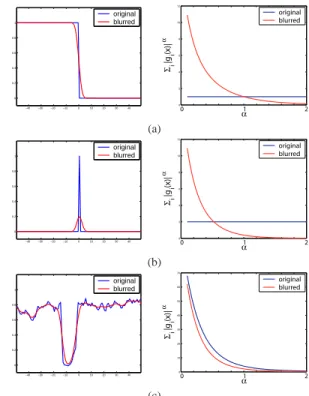
solution, but usually the no-blur solution is still favored. To understand this, consider the 1D signalsxin Fig. 1 that were convolved with a (truncated) Gaussian kernelk∗
of standard deviation4pixels. We compare two interpreta-tions: 1) the true kernel: y =k∗⊗x. 2) the delta kernel (no blur)y=k0
⊗y. We evaluate the−logp(x, k|y)score (Eq. (6)), while varying theαparameter in the prior.
For step edges (Fig. 1(a)) MAPx,kusually succeeds. The
edge is sharper than its blurred version and while the Gaus-sian prior favors the blurry explanation, appropriate sparse priors (α <1) favor the correct sharp explanation.
1We keep estimation variables in subscript to distinguish between a
MAP estimation of bothxandk, to a MAP estimation ofkalone.
−40 −30 −20 −10 0 10 20 30 40 0 0.2 0.4 0.6 0.8 1 original blurred 0 1 2 0 2 4 6 8 10 12 α Σi |g i (x)| α original blurred (a) −40 −30 −20 −10 0 10 20 30 40 0 0.2 0.4 0.6 0.8 1 original blurred 0 1 2 0 2 4 6 8 10 12 α Σi |g i (x)| α original blurred (b) −40 −30 −20 −10 0 10 20 30 40 0 0.2 0.4 0.6 0.8 1 original blurred 0 1 2 0 10 20 30 40 50 60 70 α Σi |g i (x)| α original blurred (c)
Figure 1. The MAPx,k score evaluated on toy 1D signals. Left:
sharp and blurred signals. Right: sum of gradients−logp(x) =
P
i|gi(x)| α
as a function ofα.
15×15windows 25×25windows 45×45windows
3% 1% 0%
Figure 2. MAPx,kfailure on real image windows. Windows in
which the sharp explanation is favored are marked in red. The percent of windows in which the sharp version is favored decreases with window size.
In contrast, Fig. 1(b) presents a narrow peak. Blurring reduces the peak height, and as a result, the Laplacian prior
α= 1favors the blurryx(kis delta) because the absolute sum of gradients is lower. Examining Fig. 1(b-right) sug-gests that the blurred explanation is winning for smallerα
values as well. The sharp explanation is favored only for low alpha values, approaching a binary penalty. However, the sparse models describing natural images are not binary, they are usually in the rangeα∈[0.5,0.8] [21].
The last signal considered in Fig. 1(c) is a row cropped from a natural image, illustrating that natural images con-tain a lot of medium contrast texture and noise, correspond-ing to the narrow peak structure. This dominates the statis-tics more than step edges. As a result, blurring a natural image reduces the overall contrast and, as in Fig. 1(b), even sparse priors favor the blurryxexplanation.
−1 −0.8 −0.6 −0.4 −0.2 0 0.2 0.4 0.6 0.8 1 0 1 2 3 4 5 6 7 8x 10⁻⁴ x p(x) ℓ=0 ℓ=3 ℓ=9 1 2 3 4 5 6 7 8 9 10 6 6.5 7 7.5 8 8.5 9 9.5 10 ℓ(blur width) E[−log p(x)] α=0.2 α=0.5 α=1
(a)plforα= 0.5 (b)Epl[−logp0(xl)]
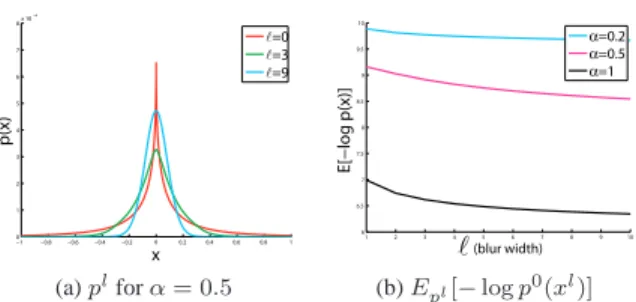
Figure 3. (a) Comparison of gradient histograms for blurred and unblurred images sampled from p0
(x). Blur reduces the aver-age gradient magnitude. (b) Expected negative likelihood reduces (probability increases) with blur.
To confirm the above observation, we blurred the image in Fig. 2 with a Gaussian kernel of standard deviation3 pix-els. We compared the sum of the gradients in the blurred and sharp images using α = 0.5. For15×15windows the blurred image is favored over97%of the windows, and this phenomenon increases with window size. For45×45 windows, the blurred version is favored at all windows. An-other observation is that if the sharp explanation does win, it happens next to significant edges.
To understand this, note that blur has two opposite ef-fects on the image likelihood: 1) it makes the signal deriva-tives less sparse, and that reduces the likelihood. 2) It re-duces the derivatives variance and that increases its likeli-hood. For very specific images, like ideal step edges, the first effect dominants and blur reduces the likelihood. How-ever, for most natural images the second effect is stronger and blur increases the likelihood. To illustrate this, letx0
be a sequence sampled i.i.d. fromp0
(x0
i)∝e−γ|x
0
i|α,xℓa
sequence obtained by convolvingx0
with a widthℓbox fil-ter (normalizing the kernel sum to1), andpℓits probability
distribution. The expected negative log likelihood (effect-ing the MAPx,k) ofxℓ under the sharp distributionp0 is:
Epℓ[−logp0(xℓ)] =−
R
pℓ(x) logp0
(x)dx. Fig. 3(a) plots
pℓforα = 0.5, and Fig. 3(b) the expected likelihood as a
function ofℓ. The variance is reduced by convolution, and hence the negative log-likelihood reduces as well.
Revisiting the literature on the subject, Fergus et al. [4] report that their initial attempts to approach blind deconvo-lution with MAPx,kfailed, resulting in either the original
blurred explanation or a binary two-tone image, depending on parameter tunings.
Algorithms like [7, 6] explicitly detect edges in the im-age (either manually or automatically), and seek a kernel which transfers these edges into binary ones. This is mo-tivated by the example in Fig. 2, suggesting that MAPx,k
could do the right thing around step edges. Another algo-rithm which makes usage of this property is [19]. It opti-mizes a semi-MAPx,kscore, but explicitly detects smooth
image regions and reweights their contribution. Thus, the MAPx,kscore is dominated by edges. We discuss this
algo-rithm in detail in [13]. Earlier blind deconvolution papers
which exploit a MAPx,kapproach avoid the delta solution
using other assumptions which are less applicable for real world images. For example, [1] assumesxcontains an ob-ject on a flat background with a known compact support.
All these examples highlight the fact that the prior alone does not favor the desired result. The source of the problem is that for all αvalues, the most likely event of the prior in Eq. (5) is the fully flat image. This phenomenon is ro-bust to the exact choice of prior, and replacing the model in Eq. (5) with higher order derivatives or with more so-phisticated natural image priors [18, 23] does not change the result. We also note that the problem is present even if the derivatives signal is sampled exactly fromp(x)and the prior is perfectly correct in the generative sense.
In the next section we suggest that, to overcome the MAPx,klimitation, one should reconsider the choice of
es-timator. We revisit a second group of blind deconvolution algorithms derived from this idea.
3. MAP
kestimation
The limitations of MAP estimation in the case of few measurements have been pointed out many times in esti-mation theory and statistical signal processing [9, 2]. In-deed, in the MAPx,kproblem we can never collect enough
measurements because the number of unknowns grows with the image size. In contrast, estimation theory tells us [9] that, given enough measurements, MAP estimators do ap-proach the true solution. Therefore, the key to success is to exploit a special property of blind deconvolution: the strong asymmetry between the dimensionalities of the two unknowns. While the dimensionality of xincreases with the image size, the support of the kernel is fixed and small relative to the image size. The imageydoes provide a large number of measurements for estimating k. As we prove below, for an increasing image size, a MAPk estimation of
kalone (marginalizing overx) can recover the true kernel with an increasing accuracy. This result stands in contrast to Claim 1 which stated that a MAPx,kestimator continues
to fail even as the number of measurements goes to infin-ity. This leads to an alternative blind deconvolution strat-egy: use a MAPkestimator to recover the kernel and, given
the kernel, solve forxusing a non blind deconvolution al-gorithm.
Before providing a formal proof, we attempt to gain an intuition about the difference between MAPk and MAPx,k
scores. A MAPk estimator selects ˆk = arg maxkp(k|y),
wherep(k|y) = p(y|k)p(k)/p(y), andp(y|k)is obtained by marginalizing overx, and evaluating the full volume of possiblexinterpretations:
p(y|k) =
Z
p(x, y|k)dx. (7)
To see the role of marginalization, consider the scalar blind deconvolution problem illustrated in [2]. Suppose a scalar
yis observed, and should be decomposed asy=k·x+n. Assume a zero mean Gaussian prior on the noise and signal,
k x max p(x,k) 0 0.5 1 1.5 2 2.5 3 0 0.002 0.004 0.006 0.008 0.01 0.012 0.014 0.016 0.018 0.02 k p(k) 0 0.5 1 1.5 2 2.5 3 0 0.02 0.04 0.06 0.08 0.1 0.12 0.14 0.16 0.18 0.2 k p(k) N=1 N=5 N=25 N=100 (a)p(x, k|y) (b)p(k|y1) (c)p(k|y1, ..yN)
Figure 4. A toy blind deconvolution problem with one scalary= kx+n(replotted from [2]). (a) The joint distributionp(x, k|y). A maximum is obtained forx→0, k→ ∞. (b) The marginalized scorep(k|y)produce an optimum closer to the truek∗. (c) The uncertainty ofp(k|y)reduces given multiple observationsyj =
kxj+nj. x∼N(0, σ2 ), n∼N(0, η2 ). Then P(x, k|y)∝e− 1 2η2|kx−y| 2 −x2 2σ2 . (8)
Fig. 4(a) illustrate the 2D distribution P(x, k|y). Unsur-prisingly, it is maximized byx→0, k→ ∞. On the other hand,p(y|k)is the integral over allxexplanations:
P(y|k)∝ Z e− 1 2η2|kx−y| 2 −2xσ22 dx. (9)
This integral is not maximized byk → ∞. In fact, if we consider the first term onlyR e−
1 2η2|kx−y|
2
dx, it clearly fa-vors k → 0 values because they allow a larger volume of possible x values. To see that, note that for every k
and everyǫ > 0 the size of the set ofxvalues satisfying
|kx−y| < ǫis2ǫ/k, maximized ask → 0. Combining
the two terms in (9) leads to an example in the middle of the range, and we show in Sec. 3.1.1 thatx ≈ σ, which make sense becausexnow behaves like a typical sample from the prior. This is the principle of genericity described in Bayesian terms by [2]. Fig. 4(b) plotsP(y|k), which is essentially summing the columns of Fig. 4(a).
Now consider blur in real images: for the delta kernel there is only a single solutionx=ysatisfyingk⊗x=y. However, while the delta spectrum is high everywhere, the true kernel is usually a low pass, and has low spectrum val-ues. Referring to the notation of Eq. (3), if Kω = 0, an
infinite subspace of possible explanations is available as
Xω can be arbitrary (and with noise, any low |Kω|
val-ues increase the uncertainty, even if they are not exactly0). Hence, the true kernel gets an advantage in thep(y|k)score. We prove that for sufficiently large images, p(k|y) is guaranteed to favor the true kernel.
Claim 2 Letxbe an arbitrarily large image, sampled from
the priorp(x), andy =k⊗x+n. Thenp(k|y)is maxi-mized by the true kernelk∗. Moreover, ifarg max
kp(y|k)
is unique,p(k|y)approaches a delta function2. 2Note that Claim 2 does not guarantee that the MAP
kis unique. For
example, if the kernel support is not constrained enough, multiple spatial shifts of the kernel provide equally good solutions. The problem can be easily avoided by a weak prior onk(e.g. favoring centered kernels).
Proof: We divide the image into small disjoint windows
{y1
, ..., yn}and treat them as i.i.d. samplesyj ∼p(y|k∗).
We then select kM L = arg max
kQjp(yj|k). Applying
the standard consistency theorem for maximum likelihood estimators [9] we know that given enough samples, the ML approaches the true parameters. That is, whenn→ ∞
p(kM L({y1
, ..., yn}) =k∗)→1. (10)
Due to the local form of the prior p(x) (Eq. (5)), tak-ing sufficiently far away disjoint windows will ensure that
p(y|k)≈Qjp(yj|k). Thus,p(y|k)is maximized bykM L.
Also, if we select a m times larger image y′, p(y′|k) =
p(y|k)m. Thus, ifp(y|k)<max
kp(y|k)thenp(y|k)→0.
Finally, ifp(k∗)>0, thenkM AP, kM Lare equal on large
images since arg maxkp(y|k) = arg maxkp(y|k)p(k),
and thus,kM AP →k∗. Similarly, ifmax
kp(y|k)is unique,
p(k|y)approaches a delta function.
Fig. 4(c) plotsp(y|k)for a scalar blind deconvolution task withNobservationsyj=kxj+nj, illustrating that as
N increases, the uncertainty around the solution decreases (compare with Fig. 4(b)).
In [13] we also justify the MAPkapproach from the loss
function perspective.
3.1. Examples of MAP
kestimation
Claim 2 reduces to a robust blind deconvolution strategy: use MAPkestimator to recoverkM AP = arg maxkp(k|y),
and then use kM AP to solve forxusing some non blind
deconvolution algorithm. To illustrate the MAPkapproach,
we start with the simple case of a Gaussian prior onp(x), as it permits a derivation in closed form.
3.1.1 The Gaussian prior
The prior onX in Eq. (5) is a convolution and thus diago-nal in the frequency domain. IfGx, Gydenote the Fourier
transform of the derivativesgx, gy, then:
X ∼N(0, diag(σ2 ω)) σ 2 ω=β(kGx,ωk 2 +kGy,ωk 2 )−1 . (11)
Note that since a derivative filter is zero at low frequencies and high at higher frequencies, this is similar to the classical 1/f2
power spectrum law for images. Denoting noise vari-ance byη, we can expressp(X, Y;K) =p(Y|X;K)p(X) as: p(X, Y;K)∝e− 1 2η2kKωXω−Yωk2−2σ12 ω kXωk2 . (12)
(see [13] for details). Conditioned onk, the mean and mode of a Gaussian are equal:
XωM AP = „ |Kω| 2 + η 2 σ2 ω «−1 KωTYω. (13)
Eq. (13) is the classic Wiener filter [5]. One can also in-tegrateX and expressp(Y|K)analytically. This is also a diagonal zero mean Gaussian with
Y ∼N(0, diag(φ2 ω)), φ 2 ω=σ 2 ω|Kω| 2 +η2. (14)
Eq. (14) is maximized whenφ2
ω =|Yω|2, and for blind
deconvolution, this implies:
|Kˆω| 2 = max „ 0,|Yω| 2 −η2 σ2 ω « . (15)
The image estimated usingKˆ satisfies|Xω|2≈σ2ω.
There-fore MAPk does not result in a trivialX = 0solution as
MAPx,kwould, but in a solution whose variance matches
the prior varianceσ2
, that is, a solution which looks like a typical sample from the priorp(X).
Another way to interpret the MAPk, is to note that
logp(Y|K) = logp(XM AP, Y;K)−1
2 X ω log „| Kω|2 η2 + 1 σ2 ω « +C (16)
Referring to Eq. (12), the second term is just the log deter-minant of the covariance ofp(X|Y;K). This second term is optimized whenKω= 0, i.e. by kernels with more blur.
That is, logp(Y|K) is equal to the MAPx,k score of the
mode plus a term favoring kernels with blur.
The discussion above suggests that the Gaussian MAPk
provides a reasonable solution to blind deconvolution. In the experiment section we evaluate this algorithm and show that, while weaker than the sparse prior, it can provide ac-ceptable solutions. This stands in contrast to the complete failure of a MAPx,kapproach, even with the seemingly
bet-ter sparse prior. This demonstrates that a careful choice of estimator is actually more critical than the choice of prior.
Note that Eq. (15) is accurate if every frequency is esti-mated independently. In practice, the solution can be further constrained, because the limited spatial support ofkimplies that the frequency coefficients{Kω}are linearly dependent.
Another important issue is that Eq. (15) provides informa-tion on the kernel power spectrum alone but leaves uncer-tainty about the phase. Many variants of Gaussian blind de-convolution algorithms are available in the image process-ing literature (e.g. [8, 15]) but in most cases only symmet-ric kernels are considered since their phase is known to be zero. However, realistic camera shake kernels are usually not symmetric. In [13] we describe a Gaussian blind decon-voltion algorithm which attempts to recover non symmetric kernels as well.
3.1.2 Approximation strategies with a sparse prior
The challenge with the MAPkapproach is that for a general
sparse prior,p(k|y)(Eq. (7)) cannot be computed in closed form. Several previous blind deconvolution algorithms can be viewed as approximation strategies for MAPk, although
the authors might not have motivated them in this way. A simple approximation is proposed by Levin [14], for the 1D blur case. It assumes that the observed deriva-tives of y are independent (this is usually weaker than assuming independent derivatives of x): logp(y|k) =
P
ilogp(gx,i(y)|k). Since p(gx,i(y)|k) is a 1D
distribu-tions, it can be expressed as a 1D table, or a histogramhk.
The independence assumption implies that instead of sum-ming over image pixels, one can expressp(y|k)by sum-ming over histogram bins:
logp(y|k) =X
i
logp(gx,i(y)|k) =
X
j
hjlog(hkj) (17)
wherehdenotes the gradients histogram in the observed im-age andjis a bin index. In a second step, note that maximiz-ing Eq. (17) is equivalent to minimizmaximiz-ing the histogram dis-tance between the observed and expected histogramsh,hk.
This is because the Kullback Leibler divergence is equal to the negative log likelihood, plus a constant that does not de-pend onk(the negative entropy):
DKL(h, hk) = X j hjlog(hj)− X j hjlog(hkj). (18)
Since the KL divergence is non-negative, the likelihood is maximized when the histogramsh, hkare equal. This very
simple approach is already able to avoid the delta solution but as we demonstrate in Sec. 4.1 it is not accurately identi-fying the exact filter width.
A stronger approximation is the variational Bayes mean-field approach taken by Fergus et al. [4]. The idea is to build an approximating distribution with a simpler paramet-ric form: p(x, k|y)≈q(x, k) =Y i q(gi,x(x))q(gi,y(x)) Y j q(kj). (19)
Since qis expressed in the gradient domain this does not recoverxdirectly. Thus, they also pick the MAPk kernel
fromqand then solve forxusing non blind deconvolution. A third way to approximate the MAPk is the Laplace
approximation [2], which is a generalization of Eq. (16): logp(y|k)≈logp(xM AP, y;k)−1
2log|A|+C (20) A= ∂
2
∂xi∂xj
logp(x, y;k)|x=xM AP. (21)
The Laplace approximation states that p(y|k) can be ex-pressed by the probability of the modexM AP plus the log
determinant of the variance around the mode. As discussed above, higher variance is usually achieved when k con-tains more zero frequencies, i.e. more blur. Therefore, the Laplace approximation suggests thatp(y|k)is the MAPx,k
score plus a term pulling toward kernels with more blur. Un-fortunately, in the non Gaussian case the covariance matrix isn’t diagonal and exact inversion is less trivial. Some ear-lier blind deconvolution approaches [22, 17] can be viewed as simplified forms of a blur favoring term. For example, they bias towered blurry kernels by adding a term penaliz-ing the high frequencies ofk or with an explicit prior on the kernel. Another approach was exploit by Bronstein et al. [3]. They note that in the absence of noise and with in-vertible kernelsp(k|y)can be exactly evaluated for sparse priors as well. This reduces to optimizing the sparsity of the image plus the log determinant of the kernel spectrum.
1 2 3 4 5 6 7 −35 −34 −33 −32 −31 −30 −29 −28 kernel width −log likelihood 1 2 3 4 5 6 7 2 2.5 3 3.5 4 4.5 5 5.5 6 kernel width −log likelihood 1 2 3 4 5 6 7 6 8 10 12 14 16 18 20 kernel width −log likelihood 1 2 3 4 5 6 7 18 20 22 24 26 28 30 32 34 kernel width −log likelihood
Exact Zero sheet MAPx,k MAPx,k+edge reweight
1 2 3 4 5 6 7 −34 −33 −32 −31 −30 −29 −28 −27 −26 −25 −24 kernel width −log likelihood 1 2 3 4 5 6 7 0.023 0.0235 0.024 0.0245 0.025 0.0255 0.026 0.0265 0.027 kernel width −log likelihood 1 2 3 4 5 6 7 82 82.5 83 83.5 84 84.5 85 85.5 86 86.5 87 kernel width −log likelihood 1 2 3 4 5 6 7 −3.5 −3 −2.5 −2 kernel width −log likelihood
Gaussian prior independent approx variational approx Bronstein et. al. Figure 5.logp(y|k)scores using various approximation strategies on 1D image signals. Successful algorithms locate the minimum score at the true kernel width, denoted by the dashed line.
4. Evaluating blind deconvolution algorithms
In this section we qualitatively compare blind deconvo-lution strategies on the same data. We start with a synthetic 1D example and in the second part turn to real 2D motion.4.1. 1D evaluation
As a first test, we use a set of1000signals of size10×1 cropped from a natural image. These small 1D signals al-low us to evaluate the marginalization integral in Eq. (7) exactly even for a sparse prior. The signals were convolved with a 5-tap box filter (cyclic convolution was used) and an i.i.d. Gaussian noise with standard deviation0.01was added. We explicitly search over the explanations of all box filters of sizeℓ = 1, ..,7 taps (all filters normalized to 1). The explicit search allows comparison of the score of dif-ferent blind deconvolution strategies without folding in op-timization errors. (In practice opop-timization errors do have a large effect on the successes of blind deconvolution algo-rithms.)
The exact −logp(y|k) score is minimized by the true box widthℓ= 5.
We tested the zero sheet separation (e.g. [11]), an earlier image processing approach with no probabilistic formula-tion. This algorithm measures the Fourier magnitude ofyat the zero frequencies of each box filterk. If the image was indeed convolved with that filter, low Fourier content is ex-pected. However, this approach considers the zero frequen-cies alone ignoring all other information, and is known to be noise sensitive. It is also limited to kernel families from a simple parametric form and with a clear zeros structure.
Supporting the example in Sec. 2, a pure MAPx,k
ap-proach (p(y|k) ≈ p(xM AP, y|k)) favors no-blur (ℓ = 1).
Reweighting the derivative penalty around edges can im-prove the situation, but the delta solution still provides a noticeable local optimum.
The correct minimum is favored with a variational Bayes approximation [4] and with the semi Laplace approxima-tion of [3]. The independence approximaapproxima-tion [14] is able to overcome the delta solution, but does not localize the solu-tion very accurately (minimum atℓ= 4instead ofℓ = 5.) Finally, the correct solution is identified even with the poor image prior provided by a Gaussian model, demonstrating
2 3 4 5 6 7 8 0 0.1 0.2 0.3 0.4 0.5 0.6 0.7 0.8 0.9 1 kernel width likelihood N=20 N=5 N=2
Figure 6. The uncertainty in kernel estimation decreses with more samples. For as little at N = 20columns it is already tightly peaked at the true answer.
(a) (b)
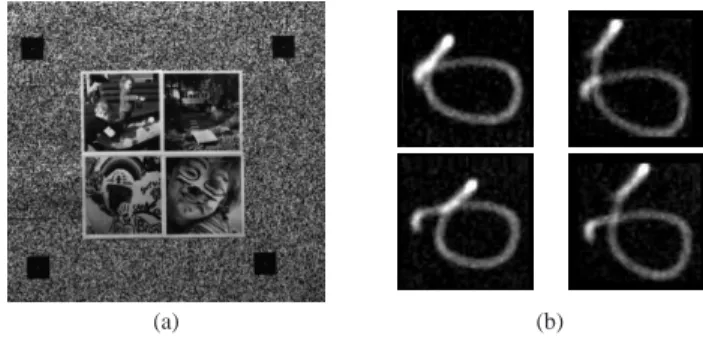
Figure 7. Ground truth data acquisition. (a) Calibration image. (b) Smear of points at 4 corners, demonstrating that the spatially uniform blur model is violated.
that the choice of estimator (MAPx,kv.s. MAPk), is more
critical than the actual prior (Gaussian v.s. sparse).
Since claim 2 guaranties success only for large images, we attempt to evaluate how large an image should be in practice. Fig. 6 plots the uncertainty in p(k|y)for multi-ple random sammulti-ples ofN 10×1columns. The probability is tightly peaked at the right answer for as little asN = 20 columns. The search space in Fig. 6 is limited to the single parameter family of box filters. In real motion deblurring one searches over a larger family of kernels and a larger uncertainty is expected.
4.2. 2D evaluation
To compare blind deconvolution algorithms we have col-lected blurred data with ground truth. We capture a sharp version a planar scene (Fig. 7(a)) by mounting the camera on a tripod, as well as a few blurred shots. Using the sharp reference we solve for a non-negative kernelkminimizing
kk⊗x−yk2
. The scene in Fig. 7(a) includes high frequency noise patterns which helps stabilizing the constraints onk. The central area of the frame includes four real images used as input to the various blind deconvolution algorithms.
We first observed that assuming a uniform blur over the image is not realistic even for planar scenes. For exam-ple Fig. 7(b) shows traces of points at4corners of an im-age captured by a hand-held camera, with a clear variation between the corners. This suggests that an in-plane rota-tion (rotarota-tion around the z-axis) is a significant component of human hand shake. Yet, since a uniform assumption is made by most algorithms, we need to evaluate them on data
Figure 8. Ground truth data:4images and8blur kernels, resulting in32test images 1.5 2 2.5 3 3.5 above 4 0 20 40 60 80 100 Fergus Shan Shan, sps deconv MAPxk Gaussian prior Error ratios Percentage
Figure 9. Evaluation results: Cumulative histogram of the decon-volution error ratio across test examples.
which obeys their assumption. To capture images with spa-tially invariant blur we placed the camera on a tripod, lock-ing theZ-axis rotation handle of the tripod but loosening theXandY handles. We calibrated the blur of8such im-ages and cropped4 255×255windows from each, leading to32test images displayed in Fig. 8 and available online3. 3www.wisdom.weizmann.ac.il/˜levina/papers/LevinEtalCVPR09Data.zip
We used an 85mm lens and a0.3 seconds exposure. The kernels’ support varied from10to25pixels.
We can measure the SSD error between a deconvolved output and the ground truth. However, wider kernels result in larger deconvolution error even with the true kernel. To normalize this effect, we measure the ratio between decon-volution error with the estimated kernel and decondecon-volution with the truth kernel. In Fig. 9 we plot the cumulative his-togram of error ratios (e.g. binr= 3counts the percentage of test examples achieving error ratio below3). Empirically, we noticed that error ratios above 2 are already visually im-plausible. One test image is presented in Fig. 10, all others included in [13].
We have evaluated the algorithms of Fergus et al. [4] and Shan et al. [19] (each using the authors’ implementation), as well as MAPk estimation using a Gaussian prior [13],
and a simplified MAPx,kapproach constrainingPki = 1
(we used coordinate descent, iterating between holdingx
constant and solving fork, and then holdingkconstant and solving forx). The algorithms of [14, 7, 3] were not tested because the first was designed for 1D motion only, and the others focus on smaller blur kernels.
We made our best attempt to adjust the parameters of Shan et al. [19], but run all test images with equal parame-ters. Fergus et al. [4] used Richardson-Lucy non blind de-convolution in their code. Since this algorithm is a source for ringing artifacts, we improved the results using the ker-nel estimated by the authors’ code with the (non blind) sparse deconvolution of [12]. Similarly, we used sparse de-convolution with the kernel estimated by Shan et al.
The bars in Fig. 9 and the visual results in [13] suggest that Fergus et al.’s algorithm [4] significantly outperforms all other alternatives. Many of the artifacts in the results of [4] can be attributed to the Richardson-Lucy artifacts, or to non uniform blur in their test images. Our comparison also suggests that applying sparse deconvolution using the kernels outputted by Shan et al. [19] improves their results. As expected, the naive MAPx,kapproach outputs small
ker-nels approaching the delta solution.
5. Discussion
This paper analyzes the major building blocks of recent blind deconvolution algorithms. We illustrate the limita-tion of the simple MAPx,k approach, favoring the no-blur
(delta kernel) explanation. One class of solutions involves explicit edge detection. A more principled strategy exploits the dimensionality asymmetry, and estimates MAPkwhile
marginalizing overx. While the computational aspects in-volved with this marginalization are more challenging, ex-isting approximations are powerful.
We have collected motion blur data with ground truth and quantitatively compared existing algorithms. Our com-parison suggests that the variational Bayes approxima-tion [4] significantly outperforms all existing alternatives.
The conclusions from our analysis are useful for direct-ing future blind deconvolution research. In particular, we
Input Ground truth
Fergus et. al. Shan et. al. error ratio=1.7 error ratio=15.2
Naive MAPx,k Gaussian prior
error ratio=15.2 error ratio=18.6
Figure 10. Visual deconvolution results by various deconvolution algorithms. See [13] for more examples.
note that modern natural image priors [18, 23] do not over-come the MAPx,klimitation (and in our tests did not change
the observation in Sec. 2). While it is possible that blind deconvolution can benefit from future research on natural image statistics, this paper suggests that better estimators for existing priors may have more impact on future blind deconvolution algorithms. Additionally, we observed that the popular spatially uniform blur assumption is usually un-realistic. Thus, it seems that blur models which can relax this assumption [20] have a high potential to improve blind deconvolution results.
Acknowledgments: We thank the Israel Science
Foun-dation, the Royal Dutch/Shell Group, NGA NEGI-1582-04-0004, MURI Grant N00014-06-1-0734, NSF CAREER award 0447561. Fredo Durand acknowledges a Microsoft Research New Faculty Fellowship and a Sloan Fellowship.
References
[1] G. R. Ayers and J. C. Dainty. Interative blind deconvolution method and its applications. Opt. Lett., 1988.
[2] D. Brainard and W. Freeman. Bayesian color constancy.
JOSA, 1997.
[3] M. M. Bronstein, A. M. Bronstein, M. Zibulevsky, and Y. Y. Zeevi. Blind deconvolution of images using optimal sparse representations. Image Processing, IEEE Transactions on, 14(6):726–736, 2005.
[4] R. Fergus, B. Singh, A. Hertzmann, S.T. Roweis, and W.T. Freeman. Removing camera shake from a single photograph.
SIGGRAPH, 2006.
[5] R. C. Gonzalez and R. E. Woods. Digital Image Processing. Prentice Hall, January 2002.
[6] Jiaya Jia. Single image motion deblurring using trans-parency. In CVPR, 2007.
[7] N. Joshi, R. Szeliski, and D. Kriegman. Psf estimation using sharp edge prediction. In CVPR, 2008.
[8] A. K. Katsaggelos and K. T. Lay. Maximum likelihood blur identification and image restoration using the em algorithm.
IEEE Trans. Signal Processing, 1991.
[9] S. M. Kay. Fundamentals of Statistical Signal Processing:
Estimation Theory. Prentice Hall, 1997.
[10] D. Kundur and D. Hatzinakos. Blind image deconvolution.
IEEE Signal Processing Magazine, 1996.
[11] R. G. Lane and R. H. T. Bates. Automatic multidimensional deconvolution. J. Opt. Soc. Am. A, 4(1):180–188, 1987. [12] A. Levin, R. Fergus, F. Durand, and W. Freeman. Image
and depth from a conventional camera with a coded aperture.
SIGGRAPH, 2007.
[13] A. Levin, Y. Weiss, F. Durand, and W.T. Freeman. Un-derstanding and evaluating blind deconvolution algorithms. Technical report, MIT-CSAIL-TR-2009-014, 2009. [14] Anat Levin. Blind motion deblurring using image
statis-tics. In Advances in Neural Information Processing Systems
(NIPS), 2006.
[15] A. C. Likas and N. P. Galatsanos. A variational approach for bayesian blind image deconvolution. IEEE Trans. on Signal
Processing, 2004.
[16] J. W. Miskin and D. J. C. MacKay. Ensemble learning for blind image separation and deconvolution. In Advances in
Independent Component Analysis. Springer, 2000.
[17] R. Molina, A. K. Katsaggelos, J. Abad, and J. Mateos. A bayesian approach to blind deconvolution based on dirichlet distributions. In ICASSP, 1997.
[18] S. Roth and M.J. Black. Fields of experts: A framework for learning image priors. In CVPR, 2005.
[19] Q. Shan, J. Jia, and A. Agarwala. High-quality motion de-blurring from a single image. SIGGRAPH, 2008.
[20] Q. Shan, W. Xiong, and J. Jia. Rotational motion deblurring of a rigid object from a single image. In ICCV, 2007. [21] E P Simoncelli. Bayesian denoising of visual images in the
wavelet domain. In Bayesian Inference in Wavelet Based
Models. Springer-Verlag, New York, 1999.
[22] E. Thi´ebaut and J.-M. Conan. Strict a priori constraints for maximum-likelihood blind deconvolution. J. Opt. Soc. Am.
A, 12(3):485–492, 1995.
[23] Y. Weiss and W. T. Freeman. What makes a good model of natural images? In CVPR, 2007.

![Figure 10. Visual deconvolution results by various deconvolution algorithms. See [13] for more examples.](https://thumb-us.123doks.com/thumbv2/123dok_us/9228149.2407741/8.918.84.424.35.627/figure-visual-deconvolution-results-various-deconvolution-algorithms-examples.webp)
